by editor | Dec 29, 2025 | Critical Thinking, Environmental Literacy, Experiential Learning, Gardening, Farming, Food, & Permaculture, Indigenous Peoples & Traditional Ecological Knowledge
Dr. David Zandvliet, Ph.D.,
Simon Fraser University
Professor and UNESCO Chair
Chantal Martin
Director, Education & Research
Vancouver Botanical Gardens Association
Poh Tan PhD (UBC, Exp. Medicine), PhD (SFU, Education)
Scientist, Researcher, Educator, Author, Entrepreneur
Research Associate, Institute for Environmental Learning
Founder and CEO, STEMedge Academy
Shaila Shams
Doctoral Student, Faculty of Education
Simon Fraser University
Akiko Inui-Ohta
Doctoral Student, Faculty of Education
Simon Fraser University
Photos by Tina Chin
(except where noted)
Prologue
I was filled with excitement upon first hearing that the Vancouver Botanical Gardens Association would be working with the Institute for Environmental Learning to form a new fellowship opportunity at VanDusen Botanical Gardens and Bloedel Conservatory. It also came with many questions focused on how participatory action research would work between a team of passionate environmental educators and academic fellows, each with their own goals and desired outcomes. Five years later, as Director of Education and Research, I have firsthand observed the evolution of a wonderful partnership between academia and community through the fellowship program, and the far-reaching impacts I could have never predicted.
Introduction
Th e context for this research program is the Vancouver Botanical Gardens Association (or VBGA) a non-profit organization that promotes biodiversity and connections to plants through education in botanical gardens among its many other conservation related functions. With the establishment of the VBGA fellowship program, VanDusen Botanical Gardens and the Bloedel Conservatory (located in Vancouver, Canada) have become important sites for research on the potential for botanical gardens as diverse and inclusive learning environments. For the past few years, a number of graduate fellowships have been enacted by the Institute for Environmental Learning (or IEL) undertaking a program of participatory action research in these urban botanical gardens. In our research, we use a lens of biocultural diversity to frame our work. Put simply, this idea suggests that the diversity of life is made up of the diversity of plants, animals, habitats and ecosystems, but also of the diversity of human cultures and languages
As joint operating partners of VanDusen Botanical Garden and Bloedel Conservatory alongside the Vancouver Board of Parks and Recreation, the VBGA is a charitable not-for-profit responsible for; education and research, a botanical library, volunteer programs, and fundraising all which supports Garden and Conservatory programs, services, and conservation. The VBGA has a mission to engage people of all ages and walks of life in the importance of biodiversity to our lives, and to foster a lifelong love of plants and gardens by virtue of their participation in our programs and services. Our educational offerings include adult, youth, and family programing, community outreach, and teacher professional development. The VBGA education team is intentional and thoughtful to ensure that our programs are accessible, high quality and have short-term and long-term impacts that fulfill the VBGA’s mission. This is where the research fellows conducting participatory action research (PAR) have helped us flourish.

VBGA Preschool Wonder Walk.
The idea of creating a research program centered on environmental learning activities in (and around) botanical gardens, is a relatively recent phenomenon. This research responds to an educational condition that many botanists refer to as ‘plant blindness’ though recently some scholars have rejected this term as negative preferring the term ‘plant awareness disparity’ for this phenomenon. However termed, plant blindness refers to the largely overlooked idea that plants are essential for human survival. As an example of this line of research in botanical gardens, we examine Sellman and Bogner’s research which evaluated an education program in a European garden, studying the impact of learning on high school students’ (cognitive) achievement. This study demonstrated the potential of urban gardens as an effective learning environment in that it was shown to complement formal school-based learning settings: adding richness to classroom activities both before and after the garden experiences. However, studies like these typically evaluate only a short visitation to one garden and do not describe in detail the context or types of pedagogies utilized . Further, they do not consider implications for longer term, immersive programming in botanical gardens, or the potential for catering to the educational needs of teacher-educators or other types of adult learners.
We sought out answers to our burning questions, the types of questions and answers which fuel our fire as informal environmental educators in a botanical garden. The types of questions that research fellows have the expertise / knowledge to find answers to … the questions that can be answered collaboratively by academics and community organizations exploring STEM education together in a garden.
- How do life experiences / worldviews inform the practice of educators working at a botanical garden?
- How do we cultivate a culture of care for nature / community belonging when delivering our programs?
- How (can we inspire a) long-lasting connection to plants through various pedagogies (or strategies)?
Michael Bonnett’s philosophical stance asserts that responsibility for learners’ incomplete understanding of environmental issues stems from a “technologizing of education” that emphasizes abstract ideas over social processes.
He advocates for a change in teaching and learning environments, where the subject matter is shifted away from standardized material to broader curricula based on creativity, intuition, and values. Others argue further that, what is needed is a focus on interpersonal and community factors that reflect value, fairness, respect, and collaboration . This indicates the importance of continuing to study and do research on community programming in botanical gardens – whether this is offered at the individual or community level.
Similar to the informal context of botanical gardens, zoos and aquaria too have begun shifting their educational focus to some of the unique attributes of their informal learning environments: taking a new role in promoting wildlife conservation and conservation learning among visitors as informal environmental education. Research in these types of settings providing insights into the potential impact of such encounters on visitors’ conservation attitudes and behaviour.
 Still, research of this type describing the potential use of botanical gardens for either formal or informal environmental education practices remains relatively undescribed and under-theorized.
In the face of climate crisis and loss of biodiversity, connecting people to plants through education is crucial. I am known to share that I believe you can teach any concept in nature including science, technology, engineering and math. Formal educators often respond with a challenge, “prove you can teach about fractions, or aerodynamics, or architecture with plants” they say. “How about counting the number of pomegranate seeds per fleshy fruit quadrant, or how about testing out the floating power of various maple seeds, or how about learning about biomimicry such as lotus effect treatment for metal to prevent corrosion?” I might reply.
Following my time working with the VBGA research fellows, my answer would now also include “How about teaching environmental STEM concepts through ethnobotany, storytelling, and incorporating biocultural diversity.” PAR has provided academic resources to our organization that contribute to achieving a sustainable future, including new and innovative ways of thinking and sharing STEM concepts. PAR empowers organizations such as botanical gardens, community members, and researchers to act as co-researchers, while contributing lived experience and knowledge to the research process.
Participatory Action Research
In our research, it is recognized that environmental learning processes should be described as both an art and a science. In this, environmental learning programs consider multiple models for teaching and learning, as well as teachers’ own pedagogical content knowledge that forms a unique blend of disciplinary knowledge combined with knowledge about specific learning contexts. For the VBGA fellowship program, the model we selected for our educational inquiry is community-based research that has been termed participatory action research or PAR.
Over the past thirty years or so, researchers have developed at least five different approaches to participatory action research (or PAR) including the following: (1) action research in organizations, (2) participatory research in community development, (3) action research in schools, (4) farmer participatory research, and (5) participatory evaluation.

Storytelling with Kung Jaadee.

Medicine Wheel Ceremony with Phil L’hirondelle.
From traditional Vietnamese storytelling, Hawaiian epistemology, bio-cultural diversity, youth perspectives, using non-anthropocentric approaches and language, and more, Participatory Action Research (PAR) was the creative glue that bonded our diverse perspectives together (in the research). During times of adversity such as the pandemic, PAR allowed the VBGA to continue to engage our community in innovative ways.
Through PAR we have robust community informed evaluations, which allow us to better meet the communities needs and provide high quality effective programming. Through PAR, we work on communicating STEM concepts in approach and language that explores harmonious co-existence of humans and non-humans. In the end, this fellowship has not only provided results, but also built our resiliency and capacity in providing programs for an ever-expanding community.
Conceptually, PAR originates from critical and neo-Marxist perspectives that have been raised in the social sciences over many years. This model stands in stark contrast to traditional approaches in educational research which sometimes is seen as maintaining hierarchical roles for researchers/subjects and teachers/students. PAR questions the unequal power relationships inherent in these traditional models and offers an approach to research that recognizes the inequalities in modern society.
Autoethnography as Method
As has likely become apparent in the presentation of this text, research conducted by the VBGA research fellows is shared in this work using a unique narrative structure and methodology known as autoethnography. In this research method, relevant personal life experiences of participants inform the design of the research program and the activities of the researcher (both as educators and academics). Now as in the past, these processes are continuing to unfold in the VBGA fellowship program and are deeply intertwined. In relating the practice of autoethnography, the research team uses methods in which: “researchers constitute their own object of research so that the knowing subject and the research object become one”. This inquiry also relates to the ‘lived experience’ of the research team as people and as academics, alongside other relationships. Each of these are described here as they relate to the research program and its relationship to other learning outcomes associated with VBGA programs.
Auto-ethnography has similarly been used to examine concepts of pedagogy, and place with environmental educators. Using similar methods, this research highlights research fellows’ experiences within and alongside educators working alongside the VBGA programs. In this, a reflexive process provides an entry point into how ‘place’ might be treated pedagogically in the programs. Narrative discourse is also used to share findings related to the on-going developments with the VBGA and its programming.
Notably, the use of autoethnography and narrative for research in education is increasing, although some researchers believe that its potential for theory and practice has not been fully explored. In this case, the research team used auto-ethnography to relate personal accounts of their experiences to generate key findings about the research program itself. For example, in one method, these data emerge from the interpretation of narrative texts using a technique known as structured vignette analysis.
Autoethnography can also be described as an approach to writing and research that describes and analyzes personal experience to clearly understand cultural experience. This approach challenges traditional forms of research and positions the research as a political and socially conscious act. As attempted here, researchers often use principles of autobiography and ethnography to do and write an autoethnography. Thus, as a method, autoethnography should be considered both a process and product.
A Collaborative Research Narrative
Importantly, auto-ethnography allows researchers to write in a personalized style, drawing on their experience to extend understanding about the social phenomenon under study. As a method, it is grounded in postmodern philosophy and is linked to growing debate about reflexivity and voice in research. The intent of this auto-ethnography is to acknowledge the link between the personal and cultural and make room for nontraditional inquiry and expression around the research program conducted with the VBGA.
Importantly, autoethnography (as a writing style) also borrows from autobiography in making its texts aesthetic by using techniques of ‘showing’, intended to bring readers ‘into the scene’ —particularly into thoughts, emotions, and actions of the author or researcher. In contrast, ‘telling’ is a strategy from ethnography that provides some distance from the events described, allowing for further analysis and/or interpretation. For the purposes of this research, the research fellows use both techniques to elucidate their meanings.
Collaborative autoethnography (or CAE) is a newer (and more social) version of auto-ethnography and is a technique we attempt to illustrate in this paper. CAE is unique in that it involves ‘researchers pooling their stories to find commonalities and differences and then negotiating meaning among these stories to discover deeper understanding of the stories in relation to the socio-cultural context under study in this case, the research and development is undertaken by our VBGA research fellows.

Student studying plants.
Some Projects Emerge
The VBGA runs a number of programs, for example it organizes guided tours and field trips for elementary and high school education, but also prepares and shares teaching kits, especially for elementary teachers, to be used at local schools. The purpose of the nature kits is to introduce students to (nearby) nature and the variety of local plants and species. The project that one of the research fellows (Shaila) undertook was aimed at developing a more holistic perspective with the kits by including Indigenous expressivism described by Deluze and Guttarian posthumanism, and ecofeminism as her guiding philosophies. The goal being to prepare the teaching kits to help young learners develop and nurture a non-anthropocentric philosophy with their learning. This lens enabled the program to adopt a decolonizing perspective toward education and nurture a holistic worldview through the use of non-anthropocentric language.
Congruent with our biocultural lens we understand that language, can shape our beliefs, views, perspectives, and practices. A traditional anthropocentric worldview can be seen as promoting a hierarchical relationship between humans and non-humans that we wanted to disrupt and challenge. For this project, the team developed four nature kits- spring, summer, fall and winter for elementary school students across BC for their science class. We designed activities and inquiry questions for the teachers. All the activities are in alignment with the respective grades’ course curriculum and goal. We further adopted an inquiry lens and incorporated questions and activities using language in a way that promotes Indigenous and holistic understanding of the natural world among the students.
Shaila’s story: Sense of place, belonging and finding connections with nature and relations through introspection and reflection
My journey with the VBGA and the Institute for Environmental Learning is fairly a new one. It started with an initial conversation with the lead researcher (David) and VBGA director (Chantal), and another research fellow (Poh) about building relationships between academic research and community. Their approach to share and mobilize environmental education with the community and not confining research only within academia resonated strongly with me. I was very fortunate to have received the opportunity to join the team as a research fellow and explore ways to forge my connection with the environment and education.
My work as the VBGA research fellow was inspired by a range of spiritualities, philosophies, values, beliefs, and practices from the Indigenous nations of Turtle Island, and from the east and the west about life and education. The key point being conceptualizing education holistically and as a life phenomenon, and not to segregate and confine education within the four walls of classrooms. With that understanding of education and my training in language studies, I aimed to explore how traditional teaching and learning materials promote human centred world views and knowledge, see humans as superior to nature, and how such concepts are embedded in human languages that subconsciously continue to promote anthropocentricism intertwined with the promotion of capitalism in a neoliberal economy. From an ecological perspective, deep environmental awareness and harmonious co-existence with nature is important for sustainable living. The awareness needs to be developed from an early age so that the next generation sees the connection between human and nature and learns to appreciate the value of co-existence for a sustainable future. Thus, the aim of my project was to develop teaching and learning materials for the VBGA that will facilitate young learners develop deep appreciation for the natural world, identify and understand the connections humans share with nature, develop respect for Indigenous holistic perspectives toward life, and lastly, disrupt the human centredness in the current knowledge production system. The goal of the project is well-aligned with British Columbia’s K-12 curriculum that emphasizes understanding Indigenous ways of making sense of the world and knowledge production.
My coming to the understanding of life, our relationship with nature, and holistic education is an ongoing journey that can be traced back to my early life experiences. I grew up in Dhaka, the capital city of Bangladesh at a time when globalization and capitalism had not hit it hard, and it was still a small city with ample greenery and close-knit neighbourhoods where everyone knew each other. I also had the opportunity to travel all over Bangladesh with my family and make frequent visits to my father’s village home where my extended family lives still today. I witnessed the relationship of people with their surrounding nature from an early age; but truth be told, I did not consider it something special back then. Or, it could be said that that was the way of life for people around me and it seemed so natural and normal. I realized the urge and the need to be mindful of our relationship with the environment and nature years later when I felt an alienation which existed in the urban society of Dhaka that grew to be a city of millions by then obliterating the age-old neighbourhoods, community living, and any greenery that was left from the natural environment.
Fast forward two decades, I came to British Columbia, Canada as an international student to pursue my graduate studies. This was the first time I realized the sense of place, physical nature, and what they mean to us. It is true that I did not know any humans here, but it was painful to realize that I was not familiar even with the trees and plants and the physical environment around me. I came to the realization that to grow connection with a place, we need not just human connection but more than that. It was at this point, with all my ideas about education, environment, growing roots in and connecting with a place mish mashed, I had this conversation about the participatory emerging research project with the VBGA and Institute for Environmental Learning at SFU and became a proud and grateful team member.
There were a few defining moments in my journey (to becoming) a VBGA research fellow. Some of them include our conversations about education, research, environment, some of them include my experiencing the garden and the richness it offers, and some of it includes my observation of VBGA’s education programs, all the while my experiences from Bangladesh were in the background. Being a doctoral student in education specializing in language studies, I was faced with the question about my contribution to the team. Upon having extensive discussions with the research team and VBGA’s education team, I thought we could develop educational resources for elementary students adopting a non-anthropocentric perspective and language.
Akiko’s story: A Journey of Growth through the Fellowship Experience
My first encounter with the fellowship was an interview with the lead investigator (David), and the Director of the VBGA (Chantal). During the interview, I was asked about my perspectives on biocultural diversity in Japan, knowing I had grown up there. His question transported me back over twenty years, to a life I had almost forgotten. One vivid memory surfaced: a conversation with my grandfather, a gardener by trade and a man of few words. He once shared a profound lesson with me: Japanese gardeners never shape trees merely to please the owners. Instead, they prioritize the health and natural beauty of each tree. This approach contrasts sharply with some Western gardening styles, where trees are often trimmed into neat, geometric shapes or even animal forms. My grandfather spoke with pride about the gardener’s role in understanding and enhancing the inherent beauty of nature, a philosophy that mirrored the broader Japanese ethos of respecting and coexisting with nature.
Reflecting on this memory after the interview, I realized how deeply it had influenced my views on biocultural diversity. The interview prompted me to think critically about this concept as a research theme and how it related to my personal experiences. After consulting with the research and education team, I decided to focus my fellowship project on evaluating the VBGA’s field trip programs. My background in program evaluations for non-profit organizations and local school boards, particularly for programs supporting refugee and immigrant families in Canada, provided a solid foundation for this task. Familiar with community-based program evaluations, I quickly devised a plan for the steps and data collection needed. As I delved deeper into the evaluation process, engaging with students, teachers, parent chaperones, and various VBGA staff, I began to realize that this fellowship offered far more than I had anticipated. I discovered multiple connections with the garden, immersing myself fully in the experience and the people involved.
The fellowship provided me with opportunities to explore my relationship with nature, biocultural diversity, and environmental education through various roles. Firstly, as a fellow conducting a program evaluation, I enjoyed gathering diverse perspectives on the field trips. The VBGA education team was passionate about providing hands-on learning experiences that complemented classroom education. Teachers valued the field trips despite the logistical and financial challenges, while parents and guardians appreciated the unique opportunities these trips offered their children. The children’s candid feedback, highlighting their joy in observing turtles and learning about trees and insects, was especially heartening.
While I conducted the evaluation as a researcher, I couldn’t ignore how my personal experiences and perspectives helped me understand each participant’s viewpoint. The students’ excitement reminded me of my daughter’s curiosity, the parents’ gratitude echoed my appreciation for nature as a mother, and the teachers’ dedication mirrored the commitment of educators like myself. These connections enriched the evaluation process and made it more meaningful. Beyond the formal project, the fellowship invited me to various enriching experiences. I participated in the VBGA volunteer appreciation day and assisted with Pollinator Days, an event educating visitors about pollinators and their environments. These events showcased how VanDusen’s programs foster biocultural diversity and create opportunities for people to connect through nature.
One of the most personal moments came when I visited the Sakura Days Japan Fair at VanDusen with my daughter, who was in grade three at that time, and our family friends. Sharing the tradition of Hanami, admiring the Sakura blossoms, while explaining its cultural significance, made me realize how much I wanted my daughter to experience this part of her heritage. This was especially precious as we cannot see Sakura in Japan unless we visit during a specific time of the year. Similarly, exploring Bloedel with her and using a new education kit (developed by Poh) allowed us to bond over shared discoveries and stories from different cultures.
These experiences profoundly enriched my fellowship. When analyzing the program evaluation data, I approached it objectively. However, my recommendations were deeply informed by my multifaceted perspectives as a fellow, an educator, and a mother. This holistic view enabled me to understand the participants more deeply and envision how the program could be enhanced to provide meaningful learning experiences, tailored to meet the diverse needs of schools and students. In conclusion, this fellowship was a journey of professional growth and personal discovery. It allowed me to reconnect with my cultural roots, understand the importance of biocultural diversity, and appreciate the intricate ways in which we relate to nature. The insights gained from this experience continue to influence my work and my life, making this journey truly unforgettable.
Poh’s story: Reflections of Malaysia and Vietnam, Hibiscus and Lotus
As I reflect on my most recent research, it’s hard not to feel a sense of awe at the twists and turns in my project, the people I met and collaborated with, and connections with the community that emerged and formed through mutual and authentic commitment to understanding and stewarding our planet. My name is Poh and I am the longest serving of the three VBGA/IEL research fellows. As this story is written, I have been part of the VBGA and Bloedel community for three years. My project is specifically focused on bringing accessible and technology enabled virtual learning experiences to Bloedel Conservatory for educators in the formal / non-formal teaching space to learn about tropical plants and how they play a role in understanding temperate plants in our environment. In my previous fellowship project, I helped plan, create and develop Bloedel’s first virtual field trip experiences. These experiences were created to address accessibility challenges for classroom access to the conservatory and more so, to have access to culturally relevant plant science activities. These experiences had a positive response from teachers, and so in my current fellowship, I focused on an expanded Bloedel experience that included pre-, during, and post- learning prompts for the students.

Poh teaching hula at Bloedel Conservatory
I have many memorable moments during the fellowship that either sparked my curiosity, tested what I thought I knew about certain topics, and engagement with teachers and students from a blended learning approach. There were moments where I brought in my experience with other learning communities like Science World (a local science museum), Hawaiian hula dance family (a group I co-teach and dance with), or my Malaysian-Nyonya heritage to bring together science, culture, Indigenous worldviews, and arts. I had the opportunity to work with a design student who also had a passion for citizen science, and together we designed an activity booklet specifically for Grade 3-5 students to experience Bloedel Conservatory in a more engaged way. My student, Hoang and I worked every week over summer, meeting multiple times at the Conservatory to observe different plants, to listen to the birds’ chirp, to feel the warm and humid air, and to touch the smooth trunk of the banana plant. Hoang and I created Bloedel Conservatory’s first curricular aligned activity booklet with the intention of extending a student’s learning before, during, and after their visit to the Conservatory. These experiences were built in an online platform called ArcGIS StoryMaps, a tool that I stumbled upon during my research studies, that has become a digital storytelling tool used for the Bloedel experiences.
Among the many plants to choose from in the conservatory, the banana plant has been a key plant of focus in the last virtual experiences because of its significance in both Hoang and my own culture. The banana plant and the banana are not only eaten as a treat, but its leaves are used as wraps for cooking, it’s flowers in curries, and the fibre from its trunk is used as rope. After one of our visits at Bloedel, Hoang and I sat down in the shade under a tree just outside of the conservatory to talk about creating an activity booklet for students. As our conversation progressed, we began to talk about the banana plant and similarly our families use the different parts in our culture. I shared a scary story my grandmother told me about the banana plant and this story reminded Hoang of a Vietnamese story about how the shape of bananas came to be. We spent that afternoon talking about the many similarities and differences between the Vietnamese and Malaysia culture.
 Although our meetings were focused on the technical task of creating the virtual experience, we learned more about each other’s culture through stories told to us by our grandparents, parents, and community. We learned that even though our cultures are similar, there are significant differences because of historical impacts, environment, climate, and language. I learned that although Vietnam was geographically close to Malaysia, I knew very little about its history or its independence and rise from being a colonial state from France. I also learned that like Malaysia, Vietnam’s national flower is the lotus blossom because it symbolizes purity, elegance and strength. Malaysia’ national flower is the red hibiscus, called Bunga Raya in the local language (Bahasa Melayu), which symbolizes the courage and vitality of the people, and celebrated unity after gaining independence. Working with Hoang has been an eye-opening learning experience on how closely related and vastly different our cultures are. Our home countries are only separated by 680 kilometers of ocean between the two closets cities, but our culture, language, and practices evolved differently over time.
Analysis and Findings
As discussed earlier, collaborative autoethnography (or CAE) is a newer (and more social) version of autoethnography and is a technique we illustrate in this paper. CAE is unique in that it involves ‘researchers pooling their stories to find commonalities and differences and then negotiating meaning among these stories to discover deeper understanding of the stories in relation to the socio-cultural context under study. In this section, we as researchers (and fellows) analyse our experiences in a collaborative way drawing several themes from our work together. These emergent themes include evaluating and valuing experience, using scientific and cultural perspectives, and finally, seeing through a non-anthropocentric lens. Each of these are presented in narrative format (though shared in the passive voice) to emphasize that these findings were collaboratively derived. Each analysis originates from earlier narratives shared by VBGA research fellows.

Teaching plant dyes in VBGA Learning Garden.
‘Evaluating and Valuing’ the Fellowship Experience
Akiko, shares that while reflecting on her experience as a fellow, that facilitating participatory-action research on VBGA field trip programs marked an invaluable and pivotal juncture in her academic career. For her, the endeavour reinforced a commitment to collaborating with diverse local communities to enhance program evaluations aimed at improving lives through education. Typically, Akiko strives to maintain a neutral, third-party perspective in program evaluations to ensure unbiased analysis and equitable engagement with all stakeholders. However, in engaging with VBGA staff, volunteers, teachers, parents, children, and fellow researchers, she increasingly felt integrated into the community — developing a profound connection to diverse perspectives and a shared passion for making the field trip experience enriching and enjoyable for all participants.

Learning Garden Eco Dye Workshop. Photo by Chantal Martin.
Through interviews and conversations with community members, Akiko discerns that each individual harbours a unique relationship with nature, shaped by their distinct backgrounds and experiences. Her role evolved from that of an external evaluator to a community member, tasked with extracting their knowledge and experiences to provide insights on optimizing a community’s visits to the garden. Viewing the project through the lenses of her identities as a mother, immigrant, researcher, and educator, she resonates with the participants’ enthusiasm for nature education and their candid feedback on the field trip program. Unlike typical research endeavours focused solely on data collection, this participatory-action research aimed to enhance the field trip experience for the community. The participants’ willingness to share their observations and suggestions for program improvement is particularly enlightening.
During the fellowship, many parents, especially those with immigrant backgrounds, visited the garden for the first time with their children’s class, mirroring their children’s learning journey in a new country. After a visit to the garden, parents often engage in discussions about the field trip at home, which provides opportunities to share their childhood experiences with nature, akin to conversations Akiko has with her daughter after visits to the garden and the Bloedel Conservatory.
Throughout this process, she recognizes that her role within the community transcended mere research conduct; she is actively contributing to the participatory-action research’s objective of community improvement. This realization fosters a deeper level of engagement and self-reflection throughout the research process, as she attentively listens to participants’ contributions. It is inspiring to contemplate how we can extend our efforts to include those who have not yet visited the garden (due to various challenges) and to integrate their perspectives into future VBGA field trip programs.
Akiko summarizes that overall; her fellowship experience is profoundly fulfilling on both personal and professional levels. It facilitates a reconnection with nature amidst a busy life, prompting reflections on how to live harmoniously with the natural world. It also provides an opportunity to share the joy of being surrounded by nature with her daughter and to revisit childhood experiences with nature in Japan—experiences many children rarely have access to. Further, it enables her to connect with and learn from the participants in an evaluation study, while gaining insights into their collective wisdom and experiences through nature and environmental education. Ultimately, she learns that as a community, we provide the best for future generations by collectively preserving and enhancing our natural environment while supporting field trip programs that serve to facilitate children’s learning in nature.
Scientific and Cultural Perspectives on Plants
Poh shares that in the beginning of this fellowship, she tries starting her research from a structured and scientific methodical approach as she makes an attempt to place a linear understanding of her pedagogical approaches about plants and people. She quickly learns that to understand why and how people form connections to plants requires a more fluid and embodied understanding through story and art — allowing time for these connections to form. As her fellowship continues and throughout the other years she works alongside the education team and other research fellows, she learns the importance of allowing realizations, learnings, and connections to form requires moments of organic reflection — finding the “right” time and timeliness to cultivate meaningful connections between people and plants. In addition to allowing time to flow through story and performance (e.g. her performances of Hawaiian hula dance), it is also important for Poh, as a researcher, that she be aware of and act upon the biases that she holds for certain plants and her special relationship with these plants because of her background as a scientist and her Nyonya heritage. Much like the hibiscus and the banana plant that are key features in her project, she feels and experiences time differently – a non-linear and spiral patterned experience as co-learners and co-participants in these moments of critical meaning.
 Poh’s analysis begins with the hibiscus flower which cycles through a circadian-rhythmic process called nyctinasty where this flower opens and closes in response to light and synchronization with its pollinators. It’s beautiful bloom only lasts between 24 – 36 hours before the flower wilts and falls to the ground. She is reminded of this as she shares stories about the hibiscus — and depending on the time of the year, students visiting the Conservatory and experiencing a virtual field trip may not see the hibiscus in bloom. She posits that we could offer a picture of a hibiscus or even attempt to preserve a hibiscus flower for students to see in the flower’s absence, but this would not be the same. As an educator, she asks herself, what is her intention for students when learning about the hibiscus? Was it to see its beautiful colours? Was it to feel its delicate petals and witness its cycles? Yes and no. Although she designs the learning experience with an intention for students to come to the conservatory to learn about the biology of the flower and plant, it is even more important for them to learn about its meaning to different cultures, its role as symbol of strength and courage, and a reminder of the planet’s beauty and its resilience as humans moved this plant species to diverse locations on the planet. At the same time, Poh is reminded that as a Nyonya from Malaysian heritage, the red hibiscus was chosen to be her country’s national flower. Bunga Raya (or Celebratory Flower) signifying the unity and courage of the Malaysian people: its five red petals embodying the spirit, resilience, and bravery of the nation. Through this experience Poh develops a much deeper appreciation and connection to the flower after immigrating and living in Canada for more than 30 years – a connection she notes was starting to fade due to geographical and cultural distance.
Finally, she shares that her time spent at the Conservatory, engaging with diverse narratives and participating in participatory action research, facilitates an organic emergence of patterns and insights, rather than her initial attempts to produce predetermined or expected outcomes. Her relationship and realizations within the education team, with other fellows in the program, and with the plants and animals in the Conservatory, leads her to an enriched understanding of time and patience. These also underscore the importance of capturing pivotal moments of connection far beyond the gardens – into her life as a mother, scientist, educator, and researcher.
Seeing Through a Non-Anthropogenic Lens
Shaila’s deep appreciation for Indigenous expressivism and the use of a non-anthropocentric lens are also key to this analysis. She realizes that these themes are rooted in her childhood memories observing people with a deep connection to nature — to the extent that their food habits were guided by the seasons. Yes, to some extent this is because only seasonal food was available back then — as the agro-economy was local. Still, because people practised this knowledge/wisdom about a connection that our bodies and minds have with the different seasons, that certain foods grow in season, and the reasons to include these habits can enhance our overall well-being. For example, Shaila sees the tradition of picking and cooking certain types of leafy greens together as ‘welcoming in’ a season. These food items were not cultivated but instead grew on their own –here and there – something that we have come to label as weeds (in the Western sense) thanks to modern and urban forms of education. She shares that it was traditionally a women’s duty to collect those leafy greens and though this may seem like a folk ritual — there is a deep meaning and purpose in the harvest. The growth of those leafy greens in a specific season indicates a healthy balance in the ecosystem of a particular place including the idea that a human cultivation system is in balance and does not destroy the natural growth of other species.
 Shaila shares that it is women who ensured that this balance was intact – and so a women’s participation and care for the ecology exists where a patriarchal capitalist world denies it. She posits that there is a close and complex relationship between nature and the people who care for it. The relationship that people share with nature and the wisdom they gain from their relationship with the environment is documented and reflected in the knowledge of Ayurveda that focuses on the body, mind, and environment relationship. In her childhood, Shaila saw orchards and forests situated in the villages that were considered community property on which everybody had the right to harvest. Thus, our relationship with nature and our dependence on the environment, impacts people’s concept of property, rights, and ownership. These may seem disconnected observations, but all of these highlight the point that our relationship with nature is one of intricate co-existence and of knowledge production and a complex sharing that anthropocentrism denies.
Shaila sees such cultural practices fading away in Canada (and in her home country) and feels the hollowness created among humans when they become alienated from nature. She further reflects that upon her arrival to Canada, as much as she longed for human connection, she suffered also due to her unfamiliarity with local nature. She did not know which species to plant in which season, when they would bloom, or how she would take care of them. While there is an abundance of nature in BC, she feels fortunate to wake up in the morning and be amazed at the sight of BC’s mountains, and she laments that there was no connection for her in her early years in Canada. Her life experiences learning here in BC are gradually ‘taking root’ and she is learning more about nature and the local environment every day. She now knows the name of ‘that flower’ blooming in spring whose fragrance she used to inhale at night but never knew how to identify, she also learns how to walk on the unceded territories of Canada’s Indigenous nations, and how a summer night in this part of the world feels.
Summarizing all of this, Shaila’s time as a research fellow with the VBGA is a time of exploration, reflection, and understanding. She has encouragement from members of the research team to weave her thoughts and philosophies and to apply these in the creation of educational resources that help children have a more holistic view of nature and to understand that we humans are part of nature, not separate from it. It gives her the opportunity to explore new ideas and connect them with her cultural background and understanding of humans, society, and nature. Finally, she learns about and explores the participatory research method that encourages an organic development of research; a process that deeply resonates with us all as it forces us to rethink our role as researchers and our relationship with our immediate surroundings. Overall, the fellowship opportunity allows Shaila and other researchers a unique chance to experience an urban garden and explore its potential for education in a holistic sense that leads to a shared journey of personal growth and relationship building.
Campers washing harvested beets.
Summary and Conclusions
Analysis of our experiences with the VBGA fellowship program help make a case for the enactment of a more inclusive, ‘ecological’ framework for research in environmental programming. Put simply, this idea highlights an ‘embeddedness’ of humans in natural systems: an idea held by Indigenous cultures worldwide since time immemorial. Ecological frameworks view humans as one part of the natural world and human societies and cultures as essentially an outgrowth of interactions between our species and particular places. Such an approach to learning in the VBGA gardens has allowed educators to consider multiple perspectives on an issue under study. This line of inquiry also allowed our research fellows to more deeply consider the concept of ‘biocultural diversity’ which is central to our work.
Biocultural diversity, as defined by Luisa Maffi, is ‘the diversity of life in all its manifestations: biological, cultural, and linguistic’ which she shares are interrelated within a complex socioecological adaptive system. Maffi relates that this diversity is made up not only of the diversity of plants and animal species, but also of the diversity of human cultures and languages. This point must be highlighted in our work as our narratives have demonstrated that the cultural backgrounds of each of our research fellows were deeply influential in their research as we worked together to enact participatory methods in our action research conducted in these urban gardens.

VGBA Education team at Grouse Mountain.
Providing quality environmental education in our communities is something the dedicated team of educators at the VBGA holds near and dear to our hearts, after all it is this passion that brings us all together. That passion, however, is formed through our unique life experiences and worldviews. Letting researchers into our world was exciting and new, and with that also came worry. This stemmed from the fear that our team’s unique blend of educator perspectives may be judged, undervalued, or not be truly seen for our successes. We could not have foreseen that not only have our programs improved because of this PAR-based partnership, but we are encouraged in our passion, supported in our uniqueness, and challenged in our complacency. We are better informed by community, we value the evolution of language as a tool for belonging, and we look towards opportunities for growth as individuals, as an organization, and for community. The VBGA and the researchers that work here once seemed to be two separate pieces working alongside each other. Together, we came to see that the researchers, the VBGA, and community members all make up a thriving ecosystem reflective of our own biocultural diversity — collaboratively achieved while working together in these urban botanical gardens.
In all of this, we now regard biocultural diversity as a provocation for narrative forms of research such as this. In our work, we view the concept of bio-cultural diversity as dynamic in nature –taking as a start the local values and practices of different cultural groups (or individuals) as its starting point for doing participatory research. For educators, the idea is to work to preserve or restore important practices and values and to modify, adapt and support diversity in ways that resonate with diverse urban communities as they experience this learning in urban botanical gardens. In our research, bio-cultural diversity is conceived as a reflexive and sensitizing concept used to assess the different values and knowledge of all people – as a reflection on how we may live sustainably now, and in the future.
Endnotes
Maria Albuquerque, Jacqueline Kwok, Chantal Martin, Hailey Moran, Gladys Runtukahu, Poh Tan, and David Zandvliet, “Biocultural Diversity in Botanical Gardens: A Journey Through Stories,” Langscapes Magazine (2022, April) https://terralingua.org/stories/reverence-for-nature-a-biocultural-journey-in-botanical-gardens/
Luisa Maffi, ‘Biocultural Diversity and Sustainability,’ in Sage Handbook on Environment and Society, eds. Pretty, J. Ball, A.S., Benton, T., Guivant, J.S., Lee, D.R., Orr, D., Pfeffer, M.J. and Ward, H. (London: Sage, 2007), 267–77.
James Wandersee and Elizabeth Schussler, National survey on the public perception of plants. (Portland, OR: Paper presented at the Annual Meeting of the Botanical Society of America, 2000, Aug.)
Kathryn Parsley, “Plant awareness disparity: A case for renaming plant blindness,” Plants, People Planet 2(6), (2020), 598-601, https://doi.org/10.1002/ppp3.10153
Daniela Sellman and Franz Bogner, “Climate change education: quantitatively assessing the impact of a botanical garden as an informal learning environment,” Environmental Education Research, 19-4, (2013), 415–429, DOI:10.1080/13504622.2012.700696
Michael Bonnett, “Lost in space? Education and the concept of nature,” Studies in Philosophy and Education, 23, (2004), p125.
Gregory Smith and David Sobel, Place- and Community-based Education in Schools. (New York: Routledge, 2010).
Robert Stevenson, “A Critical Pedagogy of Place and the Critical Place(s) of Pedagogy.” Environmental Education Research, 14-3, (2008), 353–360.
Brian Watchow, B. and Michael Brown, “A Pedagogy of Place: Outdoor Education for a Changing World,” (Melbourne: Monash University Publishing, 2011).
Roy Ballantyne, Jan Packer, Karen Hughes and Lynn Dierking, “Conservation learning in wildlife tourism settings: Lessons from research in zoos and aquariums,” Environmental Education Research, 13(3), (2007), 367–383, DOI: 10.1080/13504620701430604
Daniele Sellman and Franz Bogner, “Climate change education: quantitatively assessing the impact of a botanical garden as an informal learning environment,” Environmental Education Research.
John Gaventa and Andrea Cornwall, Power and knowledge: The Sage handbook of action research: Participative action research, (London: Sage, 2008).
Wolff-Michael Roth, Auto/biography and auto/ethnography: Praxis of research method, 109 (Rotterdam: Brill/Sense Publishers, 2005).
Max van Manen, Researching lived experience: Human science for an action sensitive pedagogy. (N.Y: State University of New York Press, 1990).
Robbie Nicol, “Returning to the richness of experience: is autoethnography a useful approach for outdoor educators in promoting pro-environmental behaviour?,” Journal of Adventure Education & Outdoor Learning, 13:1, (2013), 3-17, DOI:10.1080/14729679.2012.679798
Jayne Pitard, “Using Vignettes Within Autoethnography to Explore Layers of Cross-Cultural Awareness as a Teacher,” Forum: Qualitative Social Research, 17, (2016), Art. 11.
Carolyn Ellis and Arthur P. Bochner, “Autoethnography: An Overview,” Forum: Qualitative Social Research 12, (2011), Art. 10.
Sarah Wall, “An autoethnography on learning about ethnography,” International Journal of Qualitative Methods, 5(2), (2006), https://journals.library.ualberta.ca/ijqm/index.php/IJQM/article/view/4396
Carolyn Ellis and Arthur P. Bochner, “Autoethnography: An Overview,” Forum: Qualitative Social Research.
Heewon Chang, Faith Ngunjiri, and Kathy-Ann C. Hernandez, Collaborative Autoethnography.
Simone Bignall, Steve Hemming, and Daryl Rigney, “Three Ecosophies for the Anthropocene: Environmental Governance, Continental Posthumanism and Indigenous Expressivism,” Deleuze Studies, Vol. 10, No. 4 (2016), 456-477, https://www.jstor.org/stable/45331750
Maria Mies and Vandana Shiva, Ecofeminism, (London: Zed Books, 2014).
Heewon Chang, Faith Ngunjiri, and Kathy-Ann C. Hernandez, Collaborative Autoethnography.
Farhad Mazhar, Daniel Buckles, P.V. Satheesh, and Farida Akhter, Food Sovereignty and Uncultivated Biodiversity in South Asia : Essays on the Poverty of Food Policy and the Wealth of the Social Landscape. (International Development Research Centre, 2007)
David Zandvliet, Shannon Leddy, Cate Inver, Victor Elderton, Brittney Townrow, Lori York, “Approaches to Bio-Cultural Diversity in British Columbia,” Sustainability, 15-8 (2023). https://doi.org/10.3390/su15086422
Gregory Cajete, Indigenous Community: Rekindling the Teachings of the Seventh Fire, (Living Justice Press, 2020).
Luisa Maffi, ‘Biocultural Diversity and Sustainability,’ in Sage Handbook on Environment and Society.
by editor | Jan 15, 2019 | IslandWood, Marine/Aquatic Education

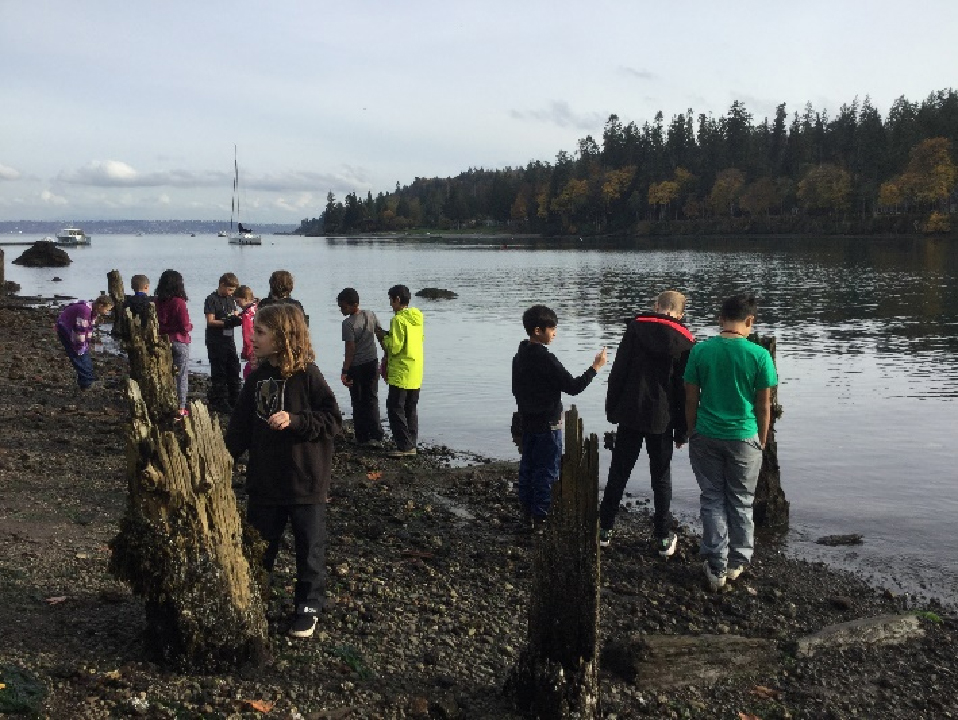
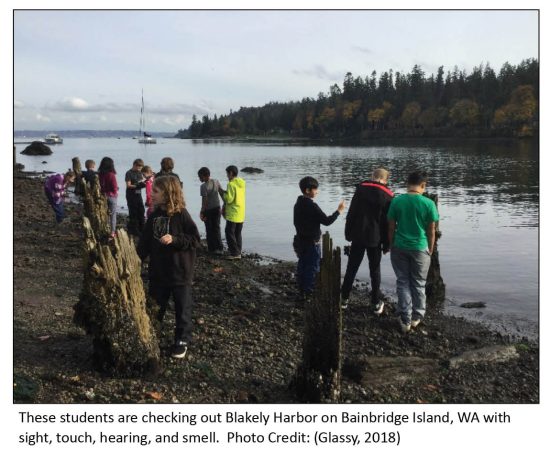
These students are checking out Blakely Harbor on Bainbridge Island, WA with sight, touch, hearing, and smell. Photo credit: Glassy, 2018
Adventure Hike to a Harbor:
Creating a space for all to engage with marine science
By Julia Glassy
I am currently a graduate student of University of Washington over on Bainbridge Island, WA at IslandWood, a non-profit outdoor education center. I am passionate about adventuring outdoors and marine science education. Interacting with the marine ecosystem allows people of all ages to explore a new ecosystem and grow an appreciation for all that ecosystem provides to the plants and animals who live there and for us, as humans.
What exactly is an adventure hike?
To some it may be walking somewhere with style or awe inspiring activities on the way to a location. While for others it may be getting in a car and driving to a location to check it out and explore. Lastly, an adventure hike could be riding a bus to go out and explore an outdoor space. To me, it is all of the above!
What might one do on adventure hike?
This all depends on the mode of transportation to a waterfront or shoreline and the age of the members going. Games you can play include wind storm (everyone needs to find a tree to hold onto or someone else if they are connected to a tree). Also flash flood (where everyone has to be on higher ground then the caller of the flood). Another game is “I-Spy” where you say “I spy with my little eye something that is blank” and you can fill in the blank. Talking as a group work too!
If in a car, then look out the window and take in the nature outside. Play a couple rounds of “I Spy” with all members in the car.
If on a bus, do what Ms. Frizzle does and make the adventure unique and exciting. Ms. Frizzle is a fictional charismatic 4th grade science teacher who takes her students on unique out-of-this-world field trips via her magic school bus.
Public transportation is an eco-friendly option to get to places that are a little farther away where walking is not an option. Also buses bring people together from all backgrounds, ages, cultures, and economic statuses. Taking a bus might not always be the most direct option, but it sure is the most fun as seen by Ms. Frizzle. It is okay to let the inner child out during these adventure hikes and explore in a new way. Aim for getting to the point of being comfortable with saying “We are on another one of Ms. Frizzle’s crazy class trips!” (Cole, 1995, p. 18). Take ownership over the adventure and be like Ms. Frizzle or like her students.
If visiting a shoreline is not feasible
Visiting your local aquarium:
They will have marine organisms that you can check out up close or hands-on. This hands-on experience is important for children of all ages in order to learn and understand similarities and differences among a variety of ecosystems.
Even if you do not have access locally to a marine or fresh water ecosystem that is okay! Books and films are good resources for learning more about an unfamiliar ecosystem. Reference books and documentaries can be purchased online or in store, but many of them can be checked out at your local library.
Getting more out of a visit to the shoreline
Get familiar with shore and ocean creatures and be a part of an investigation with children or adults you take to the harbor as an adventure hike or school field trip. Investigations do not follow the strict procedure of experiments, but instead are informal ways of wondering and discovering something. An investigation can be done in multiple ways, by taking in observations through sight, hearing, touch, or smell, and making guesses, and asking questions. Taking in observations through the different senses allows someone to become familiar with and gain a sense of place. With this new information, you can gain an appreciation for the place or item that was investigated.
Some books to refer to while familiarizing oneself with shore or ocean habitat depending on age are:
Toddlers:
On the Beach (Smith and Howell, 2003)
Young Readers and Explorers:
In One Tidepool: Crabs, Snails, and Salty Tails (Fredericks, 2002)
Magic School Bus On the Ocean Floor (Cole, 1995)
Ocean (MacQuitty, 2000)
Seashore (Parker, 2000)
Shoreline (Taylor, 1993)
All Ages-Reference:
Beachcombers Guide to Seashore Life in the Pacific Northwest (Sept, 1999)
Activities to do at a Harbor, Shoreline, or Beach
Free Exploration:
Free explorations are where someone takes a few minutes or longer of unstructured time to wander or explore a new space or ecosystem. This unstructured time can reduce all aged students’ distraction level and setup for other activities by allowing students to self-direct their investigations and learning. This is important because it allows students, children, and adults to build confidence, independence, and a greater understanding about the world around them.

Students at IslandWood’s School Overnight Program searching for crabs at Blakely Harbor on Bainbridge Island WA. Photo credit: Glassy, 2018
Crab-itat:
Crab-itats are a fun, hands-on way to explore and learn the important components that crabs need to survive and thrive. One way to make a crab-itat is to use natural materials from the beach you are on to make a habitat for the crabs found there (IslandWood Education Wiki, 2018). The logistics of this project are up to the person making the habitat, and the habitat could take many forms, and be made with several different natural items. Young students and adults can try to add abiotic (non-living) and biotic (living) items to their habitat and then think and describe their reasoning behind the items they chose.
This process of thinking and then explaining the habitat they created allows for the connection to the survival needs of crabs. You can then relate this learning to any animal or plant in other ecosystems. Another important take away from this activity is for someone to gain a sense of place and appreciation for the beach environment. With this new appreciation the person will feel more inclined to take small steps or community action to help take care of the ecosystem so others can enjoy it too!
Investigation:
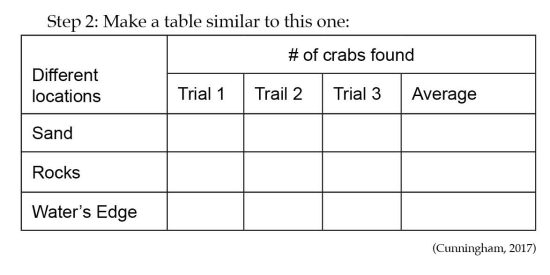
Step 1: Pick three different locations on the shoreline (ex: sand, rocks, and water’s edge).
Step 2: Make a table similar to this one:
|
Different
locations |
# of crabs found |
| Trial 1 |
Trail 2 |
Trial 3 |
Average |
| Sand |
|
|
|
|
| Rocks |
|
|
|
|
| Water’s Edge |
|
|
|
|
(Cunningham, 2017)
Step 3: Count the number of crabs at each location. The number of trials is up to you.
Step 4: Calculate average of each location, if you have more than one trial. The average will give an area that crabs are more likely to be, providing evidence for a potential claim. Through this investigation, you can gain knowledge of the preferred habitat of the crabs in your area, make observations, form claims with evidence, and be like a scientist. Investigations are important because you can make them relatable or personal to you and then gain skills that you can use at school, work, or other aspects of your life. You can also look for and investigate sea stars, sea anemones, or snails depending on your personal interests and the beach location near you.
Finding something new to learn more about:
This is similar to free exploration, but instead each person or pair can find something they are interested in and use different tools to explore and learn about it. This includes using a Lummi Loupe (a domed magnifier), small containers, magnifying glasses, and/or reference books. For example, a group of fifth graders I was teaching were excited to go to Blakely Harbor on Bainbridge Island so I brought some small clear containers and some Lummi Loupes to the harbor. Some students were excited about barnacles so we picked up a rock with living, but closed up barnacles on it and put it in one of the containers with saltwater. While still at the beach we observed the barnacles in the container. Also the students used the Lummi Loupes to look at the barnacles up close. We then returned the rock to where we found it and put the saltwater back in Puget Sound. Using the different tools to learn something about the organisms through the use of the four senses (sight, smell, hear, and touch) and then referring to a guide to find out the name of the plant or animal allows for more comprehensive learning and understanding.
Common Animals and Plants Found At the Shoreline
Crabs: Shield-Backed Kelp Crab, Purple Shore Crab, many types of Hermit Crabs (Sept, 1999)
Sea Star: Leather Star, Pacific Blood Star, Purple Star, and many others (Sept, 1999)
Sea Anemones: Giant Green Anemone, Plumose Sea Anemone (Sept, 1999)
Barnacles: Thatched Barnacle, Acorn Barnacle, Goose Barnacle (Sept 1999)
Limpets: Rough Keyhole Limpet, Ribbed Limpet, and more (Sept, 1999)
Chitons: Gumboot Chiton, Woody Chiton, Cooper’s Chiton, and more (Sept, 1999)
Plants On or Near the Shore: Common Sea Lettuce, Bull Kelp, Iridescent Seaweed (Sept, 1999), and Pickleweed
Guidelines for Exploring At the Beach
- Gently roll a rock over to see what is underneath and then return to original state. The rock should be no bigger than the size of your head.
- Be cautious of picking up animals higher than your knee (that is a long way to fall)
- Have a blast exploring the beach and enjoy discovering and learning about something new
 Julia Glassy is a current graduate student of University of Washington over on Bainbridge Island, WA at IslandWood. In addition to taking classes, she teaches 3rd through 6th graders who come over to IslandWood from their schools in the greater Seattle and Bainbridge Island area for four days as a part of the School Overnight Program.
References:
Cole, J. (1995). The Magic School Bus On the Ocean Floor. Littleton, MA: Sundance.
Cunningham, Jenny. (Ed.). (2017). IslandWood Field Journal. Bainbridge Island, WA: IslandWood.
Ecosystem in a Box. (n.d.). Retrieved December 6, 2018, from https://wiki.islandwood.org/index.php?title=Ecosytem_in_a_Box
Glassy, Julia. (Photograph). (2018). Blakely Harbor, Bainbridge Island. Bainbridge Island, WA: IslandWood.
Fredericks, A. D. (2002). In One Tidepool: Crabs, Snails, and Salty Tails. Nevada City, CA: Dawn Publications.
MacQuitty, M., Dr. (2000). Ocean. New York: Dorling Kindersley.
Parker, S. (2000). Seashore. New York: Dorling Kindersley.
Sept, J. D. (1999). The Beachcombers Guide to Seashore Life in the Pacific Northwest. Madeira Park, BC: Harbour Pub.
Smith, A., & Howell, L. (2003). On the Beach. Tulsa, OK: EDC Publishing.
Taylor, B. (1993). Shoreline. London: Dorling Kindersley.
by editor | Dec 17, 2018 | IslandWood, Marine/Aquatic Education, Place-based Education
Adventure Hike to a Harbor:
Creating a space for all to engage with marine science
By Julia Glassy
I am currently a graduate student of University of Washington over on Bainbridge Island, WA at IslandWood, a non-profit outdoor education center. I am passionate about adventuring outdoors and marine science education. Interacting with the marine ecosystem allows people of all ages to explore a new ecosystem and grow an appreciation for all that ecosystem provides to the plants and animals who live there and for us, as humans.
What exactly is an adventure hike?
To some it may be walking somewhere with style or awe inspiring activities on the way to a location. While for others it may be getting in a car and driving to a location to check it out and explore. Lastly, an adventure hike could be riding a bus to go out and explore an outdoor space. To me, it is all of the above!
What might one do on an adventure hike?
This all depends on the mode of transportation to a waterfront or shoreline and the age of the members going. Games you can play include wind storm (everyone needs to find a tree to hold onto or someone else if they are connected to a tree). Also flash flood (where everyone has to be on higher ground then the caller of the flood). Another game is “I-Spy” where you say “I spy with my little eye something that is blank” and you can fill in the blank. Talking as a group work too!
If in a car, then look out the window and take in the nature outside. Play a couple rounds of “I Spy” with all members in the car
If on a bus, do what Ms. Frizzle does and make the adventure unique and exciting. Ms. Frizzle is a fictional charismatic 4th grade science teacher who takes her students on unique out-of-this-world field trips via her magic school bus
Public transportation is an eco-friendly option to get to places that are a little farther away where walking is not an option. Also buses bring people together from all backgrounds, ages, cultures, and economic statuses. Taking a bus might not always be the most direct option, but it sure is the most fun as seen by Ms. Frizzle. It is okay to let the inner child out during these adventure hikes and explore in a new way. Aim for getting to the point of being comfortable with saying “We are on another one of Ms. Frizzle’s crazy class trips!” (Cole, 1995, p. 18). Take ownership over the adventure and be like Ms. Frizzle or like her students.
If visiting a shoreline is not feasible
Visiting your local aquarium:
They will have marine organisms that you can check out up close or hands-on. This hands-on experience is important for children of all ages in order to learn and understand similarities and differences among a variety of ecosystems.
Even if you do not have access locally to a marine or fresh water ecosystem that is okay! Books and films are good resources for learning more about an unfamiliar ecosystem. Reference books and documentaries can be purchased online or in store, but many of them can be checked out at your local library.
 Getting more out of a visit to the shoreline
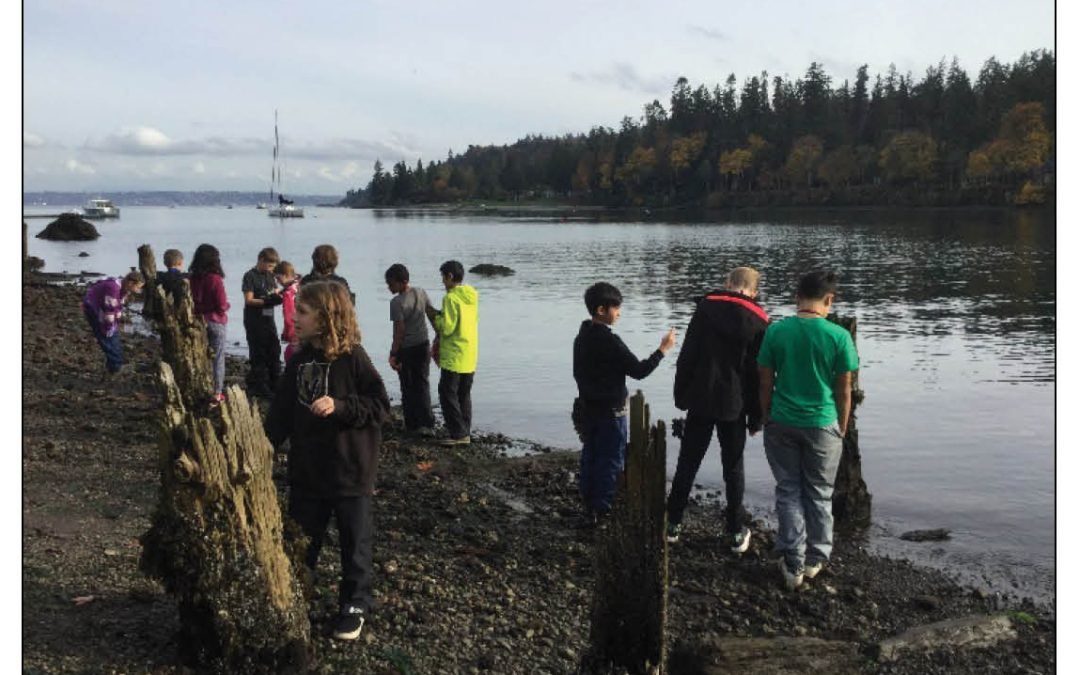
Get familiar with shore and ocean creatures and be a part of an investigation with children or adults you take to the harbor as an adventure hike or school field trip. Investigations do not follow the strict procedure of experiments, but instead are informal ways of wondering and discovering something. An investigation can be done in multiple ways, by taking in observations through sight, hearing, touch, or smell, and making guesses, and asking questions. Taking in observations through the different senses allows someone to become familiar with and gain a sense of place. With this new information, you can gain an appreciation for the place or item that was investigated.
Some books to refer to while familiarizing oneself with shore or ocean habitat depending on age are:
Toddlers:
On the Beach (Smith and Howell, 2003)
Young Readers and Explorers:
In One Tidepool: Crabs, Snails, and Salty Tails (Fredericks, 2002)
Magic School Bus On the Ocean Floor (Cole, 1995)
Ocean (MacQuitty, 2000)
Seashore (Parker, 2000)
Shoreline (Taylor, 1993)
All Ages-Reference:
Beachcombers Guide to Seashore Life in the Pacific Northwest (Sept, 1999)
Activities to do at a Harbor, Shoreline, or Beach
Free Exploration
Free explorations are where someone takes a few minutes or longer of unstructured time to wander or explore a new space or ecosystem. This unstructured time can reduce all aged students’ distraction level and setup for other activities by allowing students to self-direct their investigations and learning. This is important because it allows students, children, and adults to build confidence, independence, and a greater understanding about the world around them.
Crabitat
Crab-itats are a fun, hands-on way to explore and learn the important components that crabs need to survive and thrive. One way to make a crab-itat is to use natural materials from the beach you are on to make a habitat for the crabs found there (IslandWood Education Wiki, 2018). The logistics of this project are up to the person making the habitat, and the habitat could take many forms, and be made with several different natural items. Young students and adults can try to add abiotic (non-living) and biotic (living) items to their habitat and then think and describe their reasoning behind the items they chose.
This process of thinking and then explaining the habitat they created allows for the connection to the survival needs of crabs. You can then relate this learning to any animal or plant in other ecosystems. Another important take away from this activity is for someone to gain a sense of place and appreciation for the beach environment. With this new appreciation the person will feel more inclined to take small steps or community action to help take care of the ecosystem so others can enjoy it too!
Investigation
 Step 1: Pick three different locations on the shoreline (ex: sand, rocks, and water’s edge).
Step 2: Make a table similar to this one
(Cunningham, 2017)
Step 3: Count the number of crabs at each location. The number of trials is up to you.
Step 4: Calculate average of each location, if you have more than one trial. The average will give an area that crabs are more likely to be, providing evidence for a potential claim. Through this investigation, you can gain knowledge of the preferred habitat of the crabs in your area, make observations, form claims with evidence, and be like a scientist. Investigations are important because you can make them relatable or personal to you and then gain skills that you can use at school, work, or other aspects of your life. You can also look for and investigate sea stars, sea anemones, or snails depending on your personal interests and the beach location near you.
Finding something new to learn more about
This is similar to free exploration, but instead each person or pair can find something they are interested in and use different tools to explore and learn about it. This includes using a Lummi Loupe (a domed magnifier), small containers, magnifying glasses, and/or reference books. For example, a group of fifth graders I was teaching were excited to go to Blakely Harbor on Bainbridge Island so I brought some small clear containers and some Lummi Loupes to the harbor. Some students were excited about barnacles so we picked up a rock with living, but closed up barnacles on it and put it in one of the containers with saltwater. While still at the beach we observed the barnacles in the container. Also the students used the Lummi Loupes to look at the barnacles up close. We then returned the rock to where we found it and put the saltwater back in Puget Sound. Using the different tools to learn something about the organisms through the use of the four senses (sight, smell, hear, and touch) and then referring to a guide to find out the name of the plant or animal allows for more comprehensive learning and understanding.
Common Animals and Plants Found At the Shoreline
Crabs: Shield-Backed Kelp Crab, Purple Shore Crab, many types of Hermit Crabs (Sept, 1999)
Sea Star: Leather Star, Pacific Blood Star, Purple Star, and many others (Sept, 1999)
Sea Anemones: Giant Green Anemone, Plumose Sea Anemone (Sept, 1999)
Barnacles: Thatched Barnacle, Acorn Barnacle, Goose Barnacle (Sept 1999)
Limpets: Rough Keyhole Limpet, Ribbed Limpet, and more (Sept, 1999)
Chitons: Gumboot Chiton, Woody Chiton, Cooper’s Chiton, and more (Sept, 1999)
Plants On or Near the Shore: Common Sea Lettuce, Bull Kelp, Iridescent Seaweed (Sept, 1999), and Pickleweed
Guidelines for Exploring at the Beach
- Gently roll a rock over to see what is underneath and then return to original state. The rock should be no bigger than the size of your head.
- Be cautious of picking up animals higher than your knee (that is a long way to fall)
- Have a blast exploring the beach and enjoy discovering and learning about something new
 Julia Glassy is a current graduate student of University of Washington over on Bainbridge Island, WA at IslandWood. In addition to taking classes, she teaches 3rd through 6th graders who come over to IslandWood from their schools in the greater Seattle and Bainbridge Island area for four days as a part of the School Overnight Program.
References
Cole, J. (1995). The Magic School Bus On the Ocean Floor. Littleton, MA: Sundance.
Cunningham, Jenny. (Ed.). (2017). IslandWood Field Journal. Bainbridge Island, WA: IslandWood.
Ecosystem in a Box. (n.d.). Retrieved December 6, 2018, from https://wiki.islandwood.org/index.php?title=Ecosytem_in_a_Box
Glassy, Julia. (Photograph). (2018). Blakely Harbor, Bainbridge Island. Bainbridge Island, WA: IslandWood.
Fredericks, A. D. (2002). In One Tidepool: Crabs, Snails, and Salty Tails. Nevada City, CA: Dawn Publications.
MacQuitty, M., Dr. (2000). Ocean. New York: Dorling Kindersley.
Parker, S. (2000). Seashore. New York: Dorling Kindersley.
Sept, J. D. (1999). The Beachcombers Guide to Seashore Life in the Pacific Northwest. Madeira Park, BC: Harbour Pub.
Smith, A., & Howell, L. (2003). On the Beach. Tulsa, OK: EDC Publishing.
Taylor, B. (1993). Shoreline. London: Dorling Kindersley.

by editor | Jan 19, 2016 | Environmental Literacy, Learning Theory
by David A. Greenwood, Lakehead University, Canada
As part of the 2009 North American Association of Environmental Education Research Symposium, this article addresses the cultural and theoretical frameworks that we bring to environmental education, the web of ideas and experiences that define the scope and purpose of the work in its geopolitical context. Originally delivered as a keynote address at the symposium, the paper highlights two necessarily related conversations within environmental education: the first concerns the problem of empire, including its roots in imperialism and colonialism, as well contemporary problems of globalization; the second concerns the problem of nature, including the need to develop intimate connections with the non-human on a planet that everywhere bares the mark of human alteration. Nature and empire are two poles on a continuum that shape the cultural and ecological contexts of life and learning. The author argues for the need to hold empire and nature not in opposition, but in paradox. Holding the tension of paradox complicates simplistic binaries, and can contribute to a stance that appreciates the relationships between seeming polarities in the intersectional work of social and ecological change.
For starters, I want to welcome all travelers to the Columbia River watershed. Here we are. I live some 300 miles east on the Idaho border, and the Palouse River that flows full of agricultural silt and erosion through my rural town mixes here with Portland’s urban confluences on its way to the Pacific Ocean. The mouth of the Columbia is an impressive roar of waves, marine life and history, commerce, and even today, shipwreck. Historian Richard White (1995) called the great Columbia River “the organic machine”: upriver the once wild Columbia and its many tributaries are now a mechanized and politicized system of dammed, slack-water reservoirs. The organic machine, indeed.
The tension of paradox surrounds us, and it surrounds the field of environmental education: local-global; urban-rural; environment-culture; masculine- feminine; native-settler; public-private; land-property; commons-enclosure; human-more-than-human; inhabitant-refugee; social justice-ecojustice; schooling- learning; domination-resistance; me-you; us-them; nature-empire.
My thesis is a simple claim around a single paradox: environmental education of any stripe can deepen its theory and practice by purposefully embracing the tensions between nature and empire. Nature and empire are two poles on a continuum that shape the cultural and ecological contexts of life and learning.
In the tradition of 19th century natural history, imagine an object lesson. I hold in my hands two related objects: the flight feather of a barn owl, and a wallet full of plastic and paper money. Inquiry: How do these objects and what they represent implicate me and shape our work? Nature and empire, the flight feather of an owl and the wallet of a white man, generate a paradox, a paradox that we need to hold, and balance.
 We need to embrace paradox because we nature-lovers and no-child-left-insiders must also face up to the eco- and genocidal politics of empire, politics we’re all complicit with everyday in our cosmopolitan superprivilege. We need to embrace paradox because as heady academics and well-meaning activists, we can easily forget the gift of our own embodied and earthy existence. This feather is perfect. No matter how scientifically rigorous, politically informed, or culturally responsive, environmental education is barren if it does not include re-enchantment with the wide world of creation, encounters with the others, and gratitude for the gift of life.
Nature, empire, and paradox.
Nature. Remember, when you walked miles into the mountains until the rant of your mind receded. The sounds around you returned. Birds, insects, movement in the cover. The air, warm and cool of sun and shade. You started to blend, quiet self diminished and enlarged by a place full of others, and though walking through, you felt belonging. Until later you startled a cougar, you had thought this impossible, your shared shock while everything stopped, her ears twitching, brown eyes locked on your next move, your heart jumping on your chest, predator, prey, you watched each other’s bodies trembling. Remember, how against reason you wanted to run, how you caught your breath and she suddenly returned easily to the ninebark. The day shimmered, your relief, you had finally come back to your senses.
Encounter, enchantment, gratitude.
Empire. Like globalization, empire describes the political economy of the planet: the new imperialism, colonization, development, free trade. Empire—a system of domination and resistance, a bio-political power that is exercised, internalized, and shaped by networks of human cultures worldwide. A system of authority and control enacted by all of us, motivated by habit, addiction, desire, necessity, dreams of a better life, fantasies of endless economic growth—all increasing the throughput of natural and human capital. Empire creates and destroys under the flashing lights of a “postindustrial” age. Empire—your I-Phone, my laptop, the G-20—ecological and social impacts concealed, denied, ignored, and masked as ecological nostalgia or market opportunities. The subject of empire is the commodity; the object is the consumer. All of us are its soldiers.
Domination, critique, resistance
Context: It’s a beautiful world, life is short, and I want to live. I want to feel the wind rushing around me. I want to walk on the land I love, every day. I want to garden with my children and watch them taste the fruits. I want friends. I want to drink starlight in the mountains and howl at the moon. I want the experience of being alive, to feel my sensuous and spiritual relation to flesh, water, rock, fire, wind, species, shooting stars. I want to keep my privileges and increase them. I want to travel to Europe with my family. I want to see my daughters in London or Paris.
Context: Planet Earth 2009, population and industrial explosions, perpetual war, mass extinctions, billions of us striving for better and more, the unthinkable suffering of others. Such beauty and possibility for wonder, connection, pleasure—and—as Barry Lopez (2001) wrote in his great essay “The Naturalist”: “To read the newspapers today, to merely answer the phone, is to know the world is in flames” (¶ 24). Earth abides; meanwhile, no one knows the full extent of the mess we’re making of habitats, species, biosphere, ecosystems, neighborhoods, cultures, selves, others, relationships. No one knows the full extent of “this entire extractive culture [of empire] that has been deforesting, defishing, dewatering, desoiling, despoiling, destroying since its beginnings” (Jensen, 2009, ¶ 10). No one knows the full scale of the problem of empire, its spiral of unintended consequences, and the degree of our own complicity: the way we are part of the problem we fail to understand, the way we fail to understand our part in it. Some say we are on the brink of industrial apocalypse. Others remember: we’ve been here about 500 years.
Anyone paying any attention can see that the mounting data describe an awesome mess of impacts, but fitting the fragments together is complicated. How many parts per million CO2? How many African American men in prison?
Rare is the space in which related impacts are acknowledged along with their more complex cultural causes. But increasingly, impacts are experiential, and therefore transformative. During my first week of classes this fall, a graduate student showed us a collage of photographs she made from her travels with Philippine Exchange: a dichotomous landscape of incredible beauty, destruction from mining, factories like prisons, and desperate poverty: people barely surviving, naked children playing on mountains and rivers of waste. Slumdog without millionaire; millionaire far removed. “It humbled me,” she said, and our privileged space of learning grew quiet. Breathe it in now.
I believe that appropriate responses to the facts surrounding nature and empire—what we know and don’t know, what we feel and don’t feel—are anger, fear, grief, and humility. Avoiding such emotions can lead to projections that may contribute to problems we deny or arrogantly claim to understand. We might learn to be with, rather than run from, the natural sense of despair that the field of environmental education sometimes schools us to avoid. If we are the least connected to others, we are part of a great suffering. Inquiry: Can we hold the paradox between suffering and hope, the dichotomous landscape of wretchedness and magnificence? “The test of a first-rate intelligence,” F. Scott Fitzgerald (1936/2008) wrote, “is the ability to hold two opposing ideas in mind at the same time and still retain the ability to function. One should, for example, be able to see that things are hopeless yet be determined to make them otherwise” (¶ 2).
Paradox. Along with grief, anger, and a rational fear of catastrophe, there is also a sense of urgency and responsibility, an embodied and shared knowing that we must do what we can, and now. From “Hieroglyphic Stairway,” by Drew Dellinger (2006, p.47):
it’s 3:23 in the morning and I’m awake because my great great grandchildren won’t let me sleep
my great great grandchildren ask me in dreams
what did you do while the planet was plundered? what did you do when the earth was unraveling?
surely you did something when the seasons started failing?
as the mammals, reptiles, birds were all dying?
did you fill the streets with protest when democracy was stolen?
what did you do once you knew?
(See the poet perform the entire poem at http://www.youtube.com/ watch?v=XW63UUthwSg)
W. S. Merwin said of poetry, “Any work of art makes one very simple demand on anyone who genuinely wants to get in touch with it. And that is to stop. You’ve got to stop what you’re doing, what you’re thinking, and what you’re expecting and just be there . . . however long it takes” (Merwin in Moyers, 1995, p. 2). Like the other time I seek out on the land, poetry engenders another cultural way of knowing. It is a dissident minority tradition within my own colonized and colonizing culture. Stopping for poetry is an antidote to the morning news, to the incessant political posturing, to the super-sure academic argument, to the voice of reason that governs research methods and reports findings with caution and restraint. Poetry revives me, helps me to recover my wilder self, my possibilities, my empathy, in a domesticating competitive culture that makes me feel loss and lost. Poetry does not argue for the truth, it burns with it. “What did you do once you knew?” (Dellinger, 2006, p.47).
At 82, W. S. Merwin has won two Pulitzer prizes for poetry including this year’s prize; he is also an environmental and peace activist. What Merwin says of poetry is a fruitful beginning for any field of inquiry shaped in part by empire: we’ve got to stop what we’re doing, what we’re thinking, and what we’re expecting. Is it possible to let down our guard and just be here, together?
To deepen a felt experience of paradox between nature and empire, I want to read two poems by Mary Oliver, another great American poet of nature. The poems I’ll read are from her recent volume, Red Bird (2008); the titles are “The Teachers” and “Of the Empire.” These two poems reflect a tension in environ- mental education: between a focus on nature and human relationship with the more-than-human world, and a focus on empire and the political structures that shape people, place, and planet. My argument, again, is simple: environmental education research must hold together the tension between nature and empire or risk its own irrelevance while empire grows and nature recedes.
Mary Oliver is one of the best nature poets ever. She has taught millions to stop and wake up to their own terrestrial embodiment. In “The Summer Day” Oliver (1992) confesses:
I don’t know exactly what a prayer is. I do know how to pay attention, how to fall down into the grass, how to kneel down in the grass, how to be idle and blessed, how to stroll through the fields. (p.94)
Oliver ends this poem by asking of everyone alive, “What will you do with your one wild and precious life?” (p. 94). Her poem “The Teachers” (2008, p.27) is typical of her meditations on slowing and stopping to pay attention to the others and what our relationship to others might signify.
The Teachers
Owl in the black morning, mockingbird in the burning
slants of the sunny afternoon declare so simply
to the world everything I have tried but still
haven’t been able to put into words,
so I do not go far from that school
with its star-bright or blue ceiling,
and I listen to those teachers, and others too—
the wind in the trees and the water waves—
for they are what lead me from the dryness of self
where I labor with the mind-steps of language—
lonely, as we all are in the singular,
I listen hard to the exuberances
of the mockingbird and the owl, the waves and the wind.
And then, like peace after perfect speech, such stillness.
The teachers, the others, make me more human. The more-than-human world—as David Abram, Paul Shepard, Annie Dillard, Henry Thoreau, Rachel Carson, Jay Griffiths, Derrick Jensen, and all my friends remind me— the more-than-human-world is sacred, biological diversity makes human life possible, it makes my life, your life, potentially, beautiful. The logic of empire is destroying this world, leaving behind what David Quammen (1998) called “a planet of weeds.”
Who are the teachers, what are their names, and what, if we learn to listen, might we hear the land and the water telling us? Robert Michael Pyle (2008) wrote, “[Environmental] education, no matter how topographically or culturally informed, cannot fully or even substantially succeed without reinstating the pursuit of natural history as an everyday act” (p. 156). It’s only good manners, Pyle says, to get to know our neighbors. “What we know, we may choose to care for. What we fail to recognize, we certainly won’t” (Pyle, 2001, p. 18). Nature study, from this perspective, must also include the study of what we fail to recognize, the study of what dominates our attention and stunts our ability to perceive nature. It must, in other words, include the study of empire.
Environmental education requires an expansive conceptual and experiential framework connecting local and global realities; it requires ecological attention and political edge, to make it relevant to our place and time. It also requires what Phillip Payne and Brian Wattchow (2009) call “slow pedagogy,” deep experience that helps us open and become responsive to the voices of the teachers:
Owl in the black morning, mockingbird in the burning
slants of the sunny afternoon…
…I do not go far from that school…
(Oliver, 2008, p.27)
How far gone are we now, here, today, from the teachers? Returning to the teachers, slowing to open to the more-than-human others, to the experience of habitat and biological diversity, to the interactions between land and people— this is the heart and soul of environmental education. What impedes our ability to perceive these teachings?
Aldo Leopold (1949-1968) said it over a half century ago: “our educational and economic system is headed away from, rather than toward, an intense consciousness of land” (p. 223). Today, it is even possible to observe that some environmental education research is headed away from, rather than towards, intense consciousness of land, consciousness that can only develop through direct experience of sufficient frequency, duration, curiosity, and reverence, so that we may learn to listen and to love. The environmental education field has become culturally responsive, politically astute, and psychologically smart—mainly in response to empire. But we still need the teachers. What they teach us is irreplaceable, and endangered, unless we stop, look, and listen for a long time.
Before sharing Oliver’s (2008) poem, “Of the Empire,” I want to make a few paradoxical claims about the field of environmental education.
First, environmental education researchers and practitioners ought to guard against the lure of professionalization and the pressures of specialization that surround all fields of inquiry. There is a danger inherent in specialization that narrows our potential community and that distances us from the teachers. In many ways I believe, as Peter Martin wrote in 1996, that “having become institutionalized, environmental education is a lost cause and should be phased out as soon as possible” (p. 51). This obviously does not mean that I don’t support environmental education; rather, I observe that the development of environmental education as a profession can dull its political edge, and can school it far away from the teachers. What is more, as Foucault (1977) showed us, professions tend to normalize behaviour, marginalize outsiders, and disqualify dissent; they can make us docile and unresponsive to nature or empire.
In a provocative lecture titled “Professionals and Amateurs,” Edward Said (1994) noted:
 Specialization means losing sight of the raw effort of constructing either art or knowledge; as a result you cannot view knowledge and art as choices and decisions, commitments and alignments, but only in terms of impersonal theories or methodologies. . . . In the end as a fully specialized . . . intellectual you become tame and accepting of whatever the so-called leaders in the field will allow. Specialization also kills your sense of excitement and discovery, both of which are irreducibly present in the intellectual’s make-up. In the final analysis, giving up to specialization is, I have always felt, laziness, so you end up doing what others tell you, because that is your specialty after all. (p. 77)
Environmental education, because of its inherent interdisciplinarity and the enormous scope of the work, ought to resist specialization by definition. The real challenge is not to advance the field, but to participate in and help shape the larger movement for cultural and ecological renewal and transformation. As Paul Hawken (2007) tells it in his book Blessed Unrest, the larger movement is huge. It is made up of diverse networks of organizations and individuals working for peace, social justice, ecological sustainability, and Indigenous and civil rights. Each of these related ideals is threatened by the same empire. Political and conceptual power capable of resisting and shaping empire can be found in the intersectionality of the larger movement. This power is also found in the arts, the soul of all social movements.
Mary Oliver’s (2008) “Of the Empire”:
We will be known as the culture that feared death and adored power, that tried to vanquish insecurity for the few and cared little for the penury of the many. We will be known as a culture that taught and rewarded the amassing of things, that spoke little if at all about the quality of life for people (other people), for dogs, for rivers. All the world, in our eyes, they will say, was a commodity. And they will say that this structure was held together politically, which it was, and they will say also that our politics was no more than an apparatus to accommodate the feelings of the heart, and that the heart, in those days, was small, and hard, and full of meanness. (p.46)
Let’s face it: environmental education is a pedagogical David to the Goliath of empire with its schools, bombs, patriarchy, and shopping opportunities everywhere. The way the U.S. national budget is prioritized is symptomatic: trillions for horrific wars; nothing for the environment within the Department of Education. Even if the United State’s No Child Left Inside Act of 2009 eventually passes, and the environment is finally noted by the Department of Education 40 years after Earth Day, it and its budget will be subsumed under No Child Left Behind, which is the climax of neoliberal education reform aligned with the politics of empire. This is not conspiracy theory or even critical theory, but the explicit expression of educational purpose from policymakers and leaders from local, state, and federal levels. No Child Left Inside is a remarkable example of grass-roots political activism in support of environmental education. May we please open a window and listen to the teachers? But obviously, the thrust of formal education in the industrial/capitalist state is aligned with the politics of empire.
 Today in wartime, these politics constantly promote the expectation of “economic recovery,” and the recovery of “consumer confidence.” We might wonder what it means. Consumer confidence? Recovery back to what? The prevailing fiction of limitless growth, that logical impossibility that Edward Abby called “the ideology of the cancer cell”? Recovery back to what? An unjust colonial order? An economically exploitative and ecologically destructive culture of hyper-consumption, speculation, and debt? Today in wartime, few educators, environmental or otherwise, are questioning the profoundly pedagogical impact of empire: economic growth for the class economy, military adventurism for false security, and the erosion and commodification of the cultural and ecological commons. The most insidious effect of empire, however, may be that it functions to conceal from thought the very idea that any of this is problematic. These are the politics from which no child is left behind, and to which environmental education research must attend.
Memory and Reinhabitation
A writer and lover of beauty, my grandmother suffered from Alzheimer’s the last decade of her long life. She was the matriarch of a large family, a first generation immigrant who loved America, and the American flag, for the real opportunities it represented for freedom from poverty and oppression that my ancestors fled in Eastern Europe. I remember the last time I saw her before she was placed into full-time care. I took her for a short canoe ride on a lake in northern Wisconsin. She crawled into the bow seat; I paddled from the stern. I had never paddled so intentionally, every stroke deliberate and smooth. Once out on the water, she leaned over the gunwale and let her hand dip below the glassy surface. “Soft,” she said, “it’s so soft.”
The last time I saw her before the funeral was at the nursing home in Milwaukee. The attendant who wheeled her into the common room told her, “Your grandson is here to visit with you, Liz,” and then she parked the wheelchair next to me and left us alone. I was scared. Would she know me? Was it a good day or a bad day? So, I started talking about the weather, the season, what was going on. I said: “Nonny, guess what. I moved to the country.” Instantly, as if from far away, she came back: “Smart,” she said, “smart.”
Then she must have remembered I was a teacher. She loved education, read all the time, left school after eighth grade. “You’re teaching,” she said, half statement, half question. I answered, “Yes, I’m a professor now.” Unimpressed, she asked me what I was teaching, and glibly I told her, “Well, I’m trying to help tear down the system.” Her eyes got real squinty then, and they widened and cleared as she looked up at me with the firm authority of elderhood, “You mean build it up!” She was insistent, and that was the end of that.
Most days my grandmother didn’t know her own name, her children or grandchildren’s faces, the season, the current president (she often spoke of Lincoln), or how long ago her husband had passed (it had been 30 years). But at the mere mention of tearing something down, the response from my grandmother was immediate. “Sonny,” she said, “you need to build it up.”
Today I honor my grandmother’s wisdom. She came of age during the Depression. She stretched a meager budget for food for seven children. “Sonny,” she said, “you need to build it up.”
Building things up and tearing things down—this apparent dichotomy presents another opportunity to hold and balance paradox. I’ve described nature and empire as two poles of a paradox that reflect the expansive landscape of environmental education, the linked cultural and ecological contexts of our work. I want to offer another paradox that holds together the big aims of environmental education, and that also points to pathways for pedagogy and curriculum. The paradox is between decolonization and reinhabitation, between tearing things down, and building things up.
 I propose considering “decolonization” and “reinhabitation” as twin goals for education in a culture of empire. It should be said that these goals parallel other aims of educational research and practice; naming them is an effort to make inclusive space for those interested in environment and culture, nature, and empire. Like other synonymous terms, decolonization signals a strong critique of cultural practices and their underlying assumptions. The significance of decolonization as a theoretical category is that its usage specifically problematizes the colonization of people and land, both as historical practice and as the political progenitor of today’s empire. Of course critique alone is insufficient theory for environmental education research, and thus the pairing of decolonization with the vision of reinhabitation. It is the tension of paradox between decolonization and reinhabitation that gives both terms their conceptual range. Though for the sake of theory-building the two terms are called out as distinct, reinhabitation and decolonization are two dimensions of the same task. Renewal often requires that something is undone. In California, Van Jones expressed this clearly with his program, “Green Jobs, Not Jails.” Nature, empire, paradox.
Decolonization involves learning to recognize disruption and injury in person-place relationships, and learning to address their causes. Because colonization refers also to the colonization of the mind and body, it involves the practice of unlearning and undoing. Reinhabitation involves maintaining, restoring, and creating ways of living that are more in tune with the ecological limits of a place, practices that are less dependent on a globalized consumer culture that values profits and conveniences more than people and places. Reinhabitation means learning to live well socially and ecologically in a place, and learning to live in a way that does not harm other people and places (Gruenewald, 2003).1 These are big aims, but there is more. Reinhabitation also implies taking a new stance toward one’s own becoming. We reinhabit the self whenever we seek our own renewal, when we stop to listen to the teachers, or when we acknowledge the heartbeat of empire in our own bodies:
they will say also that our politics was no more than an apparatus to accommodate the feelings of the heart, and that the heart, in those days, was small, and hard, and full of meanness. (Oliver, 2008, p.46)
Because decolonization emphasizes human relationship to land, Indigenous perspectives on inhabitation are vital, as are the perspectives of other displaced and minoritized groups. Acknowledging Indigenous inhabitation is not only to recognize place-based relations to nature, but also to remember the long story of colonization, resistance, and the rights of sovereignty. Indigenous cultures are not the only cultures that have histories that need to be remembered; many minority traditions tell sacred stories of land, displacement, and struggle. Even mainstream white America incubates movements for resistance and change. The voices of poets, artists, activists, and others working for peace, social justice, Indigenous and civil rights, and for environmental justice and ecological sustainability—these voices are a worldwide movement standing up to empire. Whatever success this unnamed movement will have building things up and will depend not merely on critique and vision, not merely on developing communities of congruence and resistance. Perhaps building things up will depend mainly on changes in consciousness that open the heart, reinhabitations that slow us down so that we can recognize the intersectionality of our interests, how each of us is implicated in the other.
Listen to the teachers, confront empire. I want to build now toward naming a course of action for the field. While we might celebrate No Child Left Inside and the growth of green, decolonization means that we dig deeper: that we acknowledge genocide, racism, and patriarchy, past and present; that we acknowledge the class and caste systems that our contented consumption supports; and that we face up to our militarized culture of violence, repression, and war. Decolonization and reinhabitation mean untangling the roots of empire and building something up, a process that begins with ourselves, reaches outward, and never ends. Every act is important and not without consequence; collectively all of our actions create all of our contexts. Our numbers are many.
Our numbers, in fact, and our impacts, are extreme. Chris Jordan is a photographer who creates images that communicate the otherwise ineffable scale of our culture of mass consumption (see all the following images at http://www.chrisjordon.com). What is indistinguishable from a distance is revealed on closer scrutiny. “Gyre” (2009) depicts 2.4 million pieces of plastic, equal to the estimated number of pounds of plastic pollution that enter the world’s oceans every hour. All of the plastic in this image was collected from the Pacific Ocean. “Shark Teeth” (2009) depicts 270,000 fossilized shark teeth, equal to the estimated number of sharks of all species killed around the world every day for their fins. Jordan’s art also magnifies the social and psychological impacts of empire: “Ben Franklin” (2007) depicts 125,000 one-hundred dollar bills ($12.5 million), the amount our government spent every hour on the war in Iraq during 2007; “Constitution” (2008) depicts 83,000 Abu Ghraib prisoner photographs, equal to the number of people who have been arrested and held at US-run detention facilities with no trial or other due process of law, during the Bush Administration’s war on terror; “Barbie Dolls” (2008) depicts 32,000 Barbies, equal to the number of elective breast augmentation surgeries performed monthly in the US in 2006. The commodification of life under empire reeks of plastic, petroleum, patriarchy.
Paradoxically, the demand for Jordan’s work is high: people are drawn to the terrible truth of his poetry. Of all of Jordan’s (2009) work, his “E. Pluribus Unum,” or “the many become one,” best represents to me future directions for environmental educational research. From a distance, this image reminds me of the stories of the land told in tree rings. Complexity and beauty are revealed in proximity. This large scale mandala (the indoor wall hanging measures 45 by 45 feet) depicts the names of one million organizations around the world that are devoted to peace, environmental stewardship, social justice, and the continuation of diverse and indigenous cultures. The actual number of such organizations is unknown, but Paul Hawken’s (2007) “Blessed Unrest” project estimates the number at somewhere between one and two million, and growing. If the lines in this piece were straightened out, they would make an unbroken line of names, in a ten point font, twenty seven miles long.
 What I’m suggesting is that if part of the work of environmental education is to decolonize and reinhabit empire, then we must better recognize the intersectionality of our interests with the interests of others, even or especially those whose ecological consciousness may be diminished by the ravages of empire. Green jobs, not jails. Environmental educators who can hold the paradox between nature and empire can expand the landscape of the field while enhancing the reach and impact of environmental education. In all intersectional social movements there are opportunities to acknowledge and resist the power of empire, to remember and reinhabit colonized land and colonized places, to remember their stories, and to listen for the wisdom of the teachers. We need an intersectional approach because our work is already braided in its resistance to and reconfiguration of empire, and moreover, to discount the struggles of others is to cut ourselves off from the principle of interrelationship; and to discount the struggle of others is to enact the logic of empire.
The intersectional movement that environmental education needs has been gathering: social ecology, environmental justice, ecofeminsim, ecojustice, eco-pedagogy, ecopsychology, critical geography, Indigenous ways of knowing, place-based education, peace education, humane education, sustainability education, disability studies, transformative education, Transition Towns, Wendell Berry, Jane Goodall, the Earth Charter. The shared theme of intersectional movements is their responsiveness to both nature and empire. Their movement energy is the vanguard of educational theory and practice.
The politics of empire do not change unless they are resisted by growing social movements: locally, nationally, globally. Democrats in Washington are obviously not enough. President Obama is not enough. Even if he wanted a strong climate agreement, for example, or to remove the salmon killing dams on the Snake River, or to provide affordable universal health care, or to end war–he can’t get it done, because his work is governed by the logic of empire.
History shows us that through partnership, solidarity, and persistence, social groups grow wiser and stronger in their ability to transform this logic, and to reinhabit our colonized places and lives. In the age of empire, the field of environmental education can itself become a kind of E. Pluribus Unum that invites and creates intersectional theory and action.
But—as important as it is to politicize our work and to ally the field with kindred social movements, we must remember the teachers. We need to learn how to stop, slow, and invoke their sacred presences. We need to learn how to privilege the teachers—other species, their languages, “owl in the black morning”—as full partners in E. Pluribus Unum. Nature, habitat, ecosystem, species, climate—this is not a political group; it is the context that makes all politics possible. There is a power greater than political power, and a strength greater than intellectual muscle. We know it as the experience of being alive, and being connected to others. The challenge is to hold this power and develop this strength as we participate in the larger struggle for peace, social justice, Indigenous and civil rights, and ecological well being.
Because a culture of perpetual war undermines the growth of any environmental ethic, I want to close with a poem by Judyth Hill (2002, p.4) called “Wage Peace.”
“Wage Peace”
Wage peace with your breath. Breathe in firemen and rubble,
breathe out whole buildings and flocks of red wing blackbirds.
Breathe in terrorists and breathe out sleeping children and freshly mown fields.
Breathe in confusion and breathe out maple trees. Breathe in the fallen and breathe out lifelong friendships intact.
Wage peace with your listening: hearing sirens, pray loud. Remember your tools: flower seeds, clothespins, clean rivers.
Make soup. Play music, learn the words for “thank you” in three languages.
Learn to knit, and make a hat. Think of chaos as dancing raspberries,
imagine grief as the outbreath of beauty or the gesture of fish.
Swim for the other side. Wage peace.
Never has the world seemed so fresh and precious. Have a cup of tea and rejoice.
Act as if armistice has already arrived. Celebrate today.
Notes
Participation in the money economy makes it difficult to know how one’s consumption is impacting other people and places. The point is that to practice reinhabiting place, one must become more aware of how one’s actions have impacts “all over the place” now and in the future—and—one must begin to act ethically on that knowledge.
Acknowledgements
This paper was the concluding plenary address at the North American Association of Environmental Education (NAAEE) Annual Conference Research Symposium in Portland, Oregon, USA, October, 2009.
Excerpt from “hieroglyphic stairway” by Drew Dellinger. Copyright © 2006 by Drew Dellinger. Used by permission of the poet. www.drewdellinger.org
Excerpt from “The Summer Day” by Mary Oliver. Copyright © 1992 by Mary Oliver. Used by permission of the poet.
“The Teachers” and “Of the Empire” by Mary Oliver. Copyright © 2008 by Mary Oliver. Used by permission of the poet.
“Wage Peace” by Judyth Hill. Copyright © 2002 by Judyth Hill. Used by permission of the poet.
David A. Greenwood is Associate Professor and Canada Research Chair in Environmental Education in the Faculty of Education of Lakehead University in Thunder Bay, Canada. His teaching, research, and community work revolve around place-based, environmental and sustainability education. Widely published in these areas, David recently guest edited with Marcia McKenzie Volume 14 of the Canadian Journal of Environmental Education (2009), and is editor with Greg Smith of the book Place-Based Education in the Global Age (Routledge, 2008). Contact: greenwooddavida@gmail.com
References
Dellinger. D. (2006, Summer). hieroglyphic stairway. YES!, 38, 47.
Fitzgerald, F. S. (1936/2008). The crack up. Esquire. Retrieved from http://www.esquire.com/features/the-crack-up Foucault, M. (1977). Discipline and punish: The birth of the prison. New York: Vintage Books.
Gruenewald, D. (2003). The best of both worlds: A critical pedagogy of place. Educational Researcher, 32(4), 3-12.
Hawken, P. (2007). Blessed unrest. New York: Viking. Hill, J. (2002). Wage peace. In M. Adams (Ed.), Singing this great body back together:
In remembrance of September 11, 2002 (p. 4). Columbine Hills, CO: Baculite Publishing.
Jensen, D. (2009, May/June). The world at gunpoint. Orion. Retrieved from http://www.orionmagazine.org/index.php/articles/article/4697/
Leopold, A. (1949/1968). A Sand County almanac. Oxford, United Kingdom: Oxford University Press.
Lopez, B. (2001, Autumn). The naturalist. Orion. Retrieved from http://www.orionmagazine.org/index.php/articles/article/91/
Martin, P. (1996). A WWF view of education and the role of NGOs. In J. Huckle and S. Sterling,(Eds.), Education for sustainability (pp. 40-54). London: Earthscan.
Moyers, B. (1995). The language of life: A festival of poets. New York: Doubleday. Oliver, M. (1992). New and selected poems. Boston: Beacon Press.
Oliver, M. (2008). Red bird. Boston: Beacon Press.
Payne, P. & Wattchow, B. (2009). Phenomenological deconstruction, slow pedagogy, and the corporeal turn in wild environmental/outdoor education. Canadian Journal of Environmental Education, 14, 15-32.
Pyle, R. (2001). The rise and fall of natural history: How a science grew that eclipsed direct experience. Orion, 20(4), 16-23.
Pyle, R. M. (2008). No child left inside: Nature study as a radical act. In D. Gruenewald & G. Smith, (Eds.), Place-based education in the global age: Local diversity (pp.155-172). New York: Routledge.
Quammen, D. (1998). A planet of weeds. Harper’s Magazine, October, 57-69. Said, E. (1994). Representations of the intellectual. New York: Pantheon Books.
White, R. (1995). The organic machine: The remaking of the Columbia River. New York: Hill and Wang.

by editor | Oct 25, 2015 | Forest Education
Environmental Leadership: Making Connections
Two service-learning programs within the Environmental Leadership Program at the University of Oregon aim to deepen students’ knowledge of their bioregion through day-long, hands-on field trips.
By Kathryn A. Lynch, Environmental Leadership Program, University of Oregon
 hildren and young adults are often more tuned into the screens in front of them than the landscape surrounding them; when asked which direction is north their inclination is to check their smartphones. In response, the Environmental Leadership Program at the University of Oregon is developing environmental education projects seeking to reconnect children to nature.
The Environmental Leadership Program (ELP) is an interdisciplinary service-learning program housed in the University of Oregon’s Environmental Studies Program. Our mission is to provide undergraduates with an integrative capstone experience, our graduate students with project management experience, while engaging with the community to address real needs.
Since 2001, ELP has developed and implemented 81 projects addressing a wide array of topics. Currently, our projects fall within four primary tracks: environmental education, conservation science, sustainable practices, and community engagement.
The two main goals of our environmental education teams are to: 1) provide UO students the knowledge, skills and confidence to develop and implement place-based, experiential programs; and 2) develop age-appropriate, engaging curricula for local youth, grades K-8, that promotes the stewardship of our natural world.
During winter and spring of 2015, our two environmental education teams focused on the theme of “connections.” The new Restoring Connections team worked in partnership with Mt. Pisgah Arboretum and Adams Elementary to develop and implement a place-based curriculum which included an interactive classroom lesson and a field trip to Mt. Pisgah. The team provided over 200 K-2 students an opportunity to develop a deeper understanding of where they live and the importance of conservation and stewardship. The Canopy Connections team worked in partnership with the HJA Experimental Forest and the Pacific Tree Climbing Institute to develop and facilitate an interactive pre-trip lesson and field trip for over 200 middle-schoolers. Students studied forest succession, learned how to use a compass, wrote poetry in field notebooks, and climbed 90 feet into the canopy.
To prepare for their service projects,the undergraduates first enrolled in Environmental Education in Theory & Practice. In this class, they gained a working knowledge of best practices in EE through readings, guest lectures, field trips, and most importantly, their service-learning project in which they developed educational materials for their community partners. While the specifics of the curricula were left up to the teams to determine, all teams were required to: 1) incorporate an interdisciplinary approach, 2) include multicultural perspectives, 3) use experiential, inquiry-based methods, 4) promote civic engagement, and 5) articulate assessment strategies. Their materials were pilot-tested at the end of winter term, and the teams then worked with their community partners to implement their EE programs throughout spring term. Each UO student completed approximately 120 hours of service, which entailed facilitating classroom visits, field trips, and developing supplemental educational materials (e.g. websites, presentations). What follows are descriptions of these projects, written by the team members themselves.
 Case Study 1 –
Restoring Connections: Unplugging and Reconnecting
By Ashley Adelman, Roslyn Braun, Lucas Holladay, Kiki Kruse, Kerry Sheehan, Zoie Wesenberg, and Alicia Kristen (Project Manager).
 s a group of students made their way into the Douglas-fir forest from the oak savanna, a facilitator hushed the group with a “quiet coyote” hand signal. Immediately, everyone hunkered down, peering through the brush as the group tried to get a glimpse of the discovery. A student squealed in delight. The deer was still, its gaze locked onto ours. Having taught our students about the importance of deer ears for hearing predators, they noticed how the deer kept her ears pricked forward, waiting for our next move. The group slowly moved up the hill trying to get a better view. Experiences like this have the ability to enhance the senses like no video game or television show can. Learning about environmental issues at a young age can be overwhelming, but connecting to local nature, students can become more aware of and in tune with the natural world.
In spring 2015, the Environmental Leadership Program launched the Restoring Connections project at Adams Elementary School. Our team of six undergraduates, with the guidance of our graduate project manager, was responsible for the design, creation and implementation of this environmental education curriculum, focusing on Mt. Pisgah Arboretum’s natural ecosystems.
In this pilot year, we focused on kindergarten, first-, and second-grade students. Our goal was to address what Richard Louv calls ‘nature-deficit disorder’ through the creation and implementation of a place-based and experiential educational program. According to Louv, the cultural shift in which many youth now prefer to stay inside interfacing with screens, rather than going outside to play and explore, has resulted in devastating effects on their personal well-being – physically, mentally, and emotionally – in addition to having disastrous repercussions for the environment. How we set about addressing nature-deficit disorder was informed by Howard Gardner’s theory of multiple intelligences and David Sobel’s work, which outlines a framework for age-appropriate content. Working from this theoretical foundation, we knew we wanted to allow students to explore nature first-hand to help them develop a connection to where they lived, and nurture empathy for the plants and animals that share our bioregion. In addition, the structure of our program was influenced by the Tbilisi Declaration (1977), which states that environmental education should foster awareness, provide knowledge, develop skills, and shape attitudes in students so they can effectively participate in environmental decision making and stewardship. This idea of restoring children’s connection to nature, while they participated in restoring the land, was a central idea of the program.
The structure of our Restoring Connections program consisted of a 45-minute classroom visit on Tuesday, followed by an all-day field trip on Thursday. The classroom lessons focused on introducing key concepts, preparing the children for a successful field trip, and most importantly, instilling a sense of excitement and awe for the ‘magical forest’ they would be visiting. The field trip focused on awakening their senses, building connections and empathy, and finally, on giving students an opportunity to be involved in restoration activities.
During the field trip the kinders built elf and fairy homes out of natural materials in the wildflower garden, engaged their visual senses by finding a rainbow of colors, and engaged their auditory senses by using their ‘deer ears’ as they journeyed along the riverbank.
First-grade students explored the oak savanna, discovering how pollinators and native plants interact in this habitat. Students examined an Oregon white oak up close and played games that honed their observation and plant identification skills. The restoration work focused on creating habitat for native wildflowers by pulling invasive shining geranium, and planting native plants. Through this restoration work, students learned about native and non-native species and the importance of stewardship.
Second-grade students explored the Douglas-fir forest, studying concepts of camouflage and adaptation through role play and the study of animal behavior. Their restoration work was centered around building “habitat hotels” for decomposers found in the Douglas-fir forest.
The restoration work connects classroom learning to real-life experiences. By learning the differences between native and non-native plants, our first-grade students discovered the need to care for native species in Oregon. Gaining knowledge about the role of decomposers in the Douglas-fir forest allowed the second-grade students to understand ecosystem functions. These activities provided an example of the impact that they can have on the environment.
Throughout our ten weeks of teaching, over 200 students had the opportunity to visit and explore Mt. Pisgah. As part of our professional development, we were asked to evaluate what worked and what needed to be changed after each interaction, and then make those changes for the following week. Jenny Laxton, the education program coordinator at Mt. Pisgah, provided us with invaluable feedback to help us improve our program to best serve the needs of the Arboretum and Adams students and staff.
The opportunity to complete service work allowed the elementary students and our ELP team the opportunity to take the knowledge and skills we have gained in the classroom and use them in community action. We gained problem-solving and team management skills along with greater knowledge of best practices within environmental education. We were also encouraged to engage in critical self-reflection to improve our final outcomes.
The long term vision for this project is that starting next year, the Restoring Connectionsteam will work with a single cohort of children, from kinder through fifth-grade.This cohort of children will visit Mt. Pisgah Arboretum each season (fall, winter, spring) giving them multiple opportunities to visit, connect, and participate in restoration work. Each grade level will focus on exploring a different habitat located within the Arboretum, with activities geared toward hands on learning. By giving children an opportunity to be outside, learning in nature, we hope this project will deepen their sense of appreciation for the beauty of the natural world and reach those who may not thrive in a classroom setting. By returning each year, the children will gain an understanding of local natural history that cannot be gained through a single visit alone. By involving them in restoration efforts over time, the children will be able to witness the difference their actions have made on the landscape. Overall, Restoring Connections seeks to cultivate a lasting connection to the land, one that is based on reciprocity and respect.
To learn more about our project, please visit:https://blogs.uoregon.edu/restoring
 Case Study 2 –
Canopy Connections: Nurturing Naturalists
By Samantha Bates, Laura Buckmaster, Nicole Hendrix, Forrest Hirsh, Micaela Hyams, Elie Lewis, Amelia Remington, Nick Sloss, Tim Chen (Project Manager).
 ix middle-school students sit silently on a trail in an old-growth forest: one observes a newt run over her feet; another notices how moss and lichen create miniature forests; another writes poetry about the nearby sounds of Lookout Creek. Down the trail, students identify giant Douglas-firs, noting the distinct grooved bark in contrast to the smoother bark of the equally impressive western hemlocks. Using newly-honed plant identification skills, students compare two plots to form hypotheses about what stage of ecological succession they are observing. Further along, students put their compass skills to the test, going on a compass scavenger hunt of sorts, receiving a bearing and seeing if they can find the correct specific tree off the trail. Later, they will sit in a circle surrounded by enormous Douglas-fir, ancient Pacific yew, stringy western redcedar, and drooping western hemlock and draw a map of the forest with the creek as their backdrop. Meanwhile, their friends climb 90 feet into the canopy, finding treasures few ever ascend high enough to discover: dangling Lobaria lichen clinging to branches heavy with the plentiful “roses” of small, papery hemlock cones; licorice ferns growing out of decades-old moss carpets that blanket trees that students now observe from above.
Canopy Connections is in its seventh year. This year our team of eight undergraduates (and one graduate project manager), sought to distinguish ourselves by designing our curriculum around the theme “nurturing naturalists.” Drawing from Gardner’s multiple intelligences, our curriculum caters to multiple ways of knowing and different learning styles. All of our lessons focus on building sensory awareness.
The structure of our Canopy Connections program consisted of a 45-minute classroom pre-field trip visit, followed by an all-day field trip at H.J. Andrews Experimental Forest near Blue River, Oregon. The classroom lessons focused on introducing key concepts and preparing the middle-schoolers for a successful field trip. For the all-day field trip, each class was divided into four groups and rotated through four different stations.
Station 1: Climbing to the Canopy. At this station, students ascend 90 feet into the canopy of an old-growth Douglas-fir tree. Experienced tree climbers from the Pacific Tree Climbing Institute (PTCI) facilitate this activity. Students support one another in their learning about microclimates as they are connected to the ropes one by one and make their way up. While this activity is challenging for some children, the rush of adrenaline often provides them with a hyper sensitivity to their surroundings they might not have appreciated before. Many students leave this activity with a deeper respect for the sheer magnitude and magnificence of a 400-year old Douglas-fir tree.
Station 2: Nature’s Navigators. On the ground, students learned basic map reading and compass skills. Students worked in pairs, and with the help of facilitators, embarked on a compass expedition. Using their compass and species identification cards, they were tasked with locating and identifying four species of trees found in old-growth forests. They later observed the four tree species up close and collaborated to correctly identify them. Students used their new skills and knowledge to create a map of their immediate surroundings.
Station 3: The Life and Layers. At this station, students explored forest succession and disturbance. We introduced the four characteristics of an old-growth forest using the acronym OWLS–old, woody debris, layers, and snags. They then learned to identify several species seen on the forest floor. To paint a picture of how a forest becomes old-growth, we had students read a passage from Ancient Forests of the Pacific Northwest to each other and then look for these signs as they hiked. Through descriptions of nurse logs and pathogenic fungi, they gained an appreciation for the intricate relationships of the forest and began to consider the significance of observation for scientists and writers alike.
We encouraged students to touch the plants, compare, and describe them to each other in order to create detailed records in their field notebooks. Splitting into two groups, they examined plots located in stands of different aged forests, with the goal of using their new knowledge, observation, and recording skills to determine whether they were looking at the 40-year stand or an old-growth stand.
Station 4: Stop, Sit, Scribble. At this station, students practiced their writing skills, imitating the work done by the writers of the Long Term Ecological Reflections (LTER) project, which is designed to collect stories, poems, and essays for 200 years from 2003 to 2203. After listening to The Web, a poem written at HJA by Alison Hawthorne Deming, students followed the guiding principles of the LTER project and spread out on the forest floor to begin writing a stanza for a collaborative poem. They focused on incorporating sensory observation skills and using descriptive adjectives as do the writings collected for the LTER project.
 Although concepts of creative writing and poetry are taught in the lesson, students gain much more than an appreciation for adjectives. They learn collaboration and listening skills, while simultaneously absorbing clues from the natural world: the rush of the river, the smell of coolness in the air, the hundreds of plant species surrounding them. Sensory observation and creative writing connects with the theme of “nurturing naturalists” by bridging the gap between humanities and science.
Throughout Canopy Connection’s eight-week program, over 200 hundred students from four different middle schools participated in field trips. During nine days in the field, we totaled 54 hours of teaching with an 8:1 student-teacher ratio and led nine in-class pre-trip lessons. In addition, we worked in partnership with 23 high-school students from a local AP Environmental Literature class. These students helped us in the field, and we shared insights into going to college as well as being effective environmental stewards. Our team compiled our final curriculum and a final report, and developed a website to display our project. We presented our findings at the Undergraduate Research Symposium, a SMILE workshop at HJA, and an ELP final presentation. Our ultimate mission is positive environmental change stemming from an environmentally-literate younger generation. Many teachers and students have already reached out to express how much our field trip meant to them. To learn more about our project, please visit:
http://elp2015-canopyconnections.weebly.com/
Literature Cited
Deming, Alison Hawthorne. 2007. The Web. Orion Magazine, March/April. http://www.orionmagazine.org/index.php/articles/poem/248/
Gardner, Howard. 2011. Frames of Mind: The Theory of Multiple Intelligences. New York: Basic Books.
Louv, Richard. 2006. Last Child in the Woods. Saving our Children from Nature-Deficit Disorder. NC: Algonquin Books of Chapel Hill.
Norse, Elliott A. 1990. Ancient Forests of the Pacific Northwest. The Wilderness Society. Island Press: Washington D.C.
Sobel, David. 1996. Beyond Ecophobia: Reclaiming the Heart in Nature Education. Nature Literacy Series. Great Barrington, MA: The Orion Society.
Tbilisi Declaration. 1977. Summary of goals and guiding principles. http://www.gdrc.org/uem/ee/tbilisi.html

 e context for this research program is the Vancouver Botanical Gardens Association (or VBGA) a non-profit organization that promotes biodiversity and connections to plants through education in botanical gardens among its many other conservation related functions. With the establishment of the VBGA fellowship program, VanDusen Botanical Gardens and the Bloedel Conservatory (located in Vancouver, Canada) have become important sites for research on the potential for botanical gardens as diverse and inclusive learning environments. For the past few years, a number of graduate fellowships have been enacted by the Institute for Environmental Learning (or IEL) undertaking a program of participatory action research in these urban botanical gardens. In our research, we use a lens of biocultural diversity to frame our work. Put simply, this idea suggests that the diversity of life is made up of the diversity of plants, animals, habitats and ecosystems, but also of the diversity of human cultures and languages
 Still, research of this type describing the potential use of botanical gardens for either formal or informal environmental education practices remains relatively undescribed and under-theorized.


 Although our meetings were focused on the technical task of creating the virtual experience, we learned more about each other’s culture through stories told to us by our grandparents, parents, and community. We learned that even though our cultures are similar, there are significant differences because of historical impacts, environment, climate, and language. I learned that although Vietnam was geographically close to Malaysia, I knew very little about its history or its independence and rise from being a colonial state from France. I also learned that like Malaysia, Vietnam’s national flower is the lotus blossom because it symbolizes purity, elegance and strength. Malaysia’ national flower is the red hibiscus, called Bunga Raya in the local language (Bahasa Melayu), which symbolizes the courage and vitality of the people, and celebrated unity after gaining independence. Working with Hoang has been an eye-opening learning experience on how closely related and vastly different our cultures are. Our home countries are only separated by 680 kilometers of ocean between the two closets cities, but our culture, language, and practices evolved differently over time.
 Poh’s analysis begins with the hibiscus flower which cycles through a circadian-rhythmic process called nyctinasty where this flower opens and closes in response to light and synchronization with its pollinators. It’s beautiful bloom only lasts between 24 – 36 hours before the flower wilts and falls to the ground. She is reminded of this as she shares stories about the hibiscus — and depending on the time of the year, students visiting the Conservatory and experiencing a virtual field trip may not see the hibiscus in bloom. She posits that we could offer a picture of a hibiscus or even attempt to preserve a hibiscus flower for students to see in the flower’s absence, but this would not be the same. As an educator, she asks herself, what is her intention for students when learning about the hibiscus? Was it to see its beautiful colours? Was it to feel its delicate petals and witness its cycles? Yes and no. Although she designs the learning experience with an intention for students to come to the conservatory to learn about the biology of the flower and plant, it is even more important for them to learn about its meaning to different cultures, its role as symbol of strength and courage, and a reminder of the planet’s beauty and its resilience as humans moved this plant species to diverse locations on the planet. At the same time, Poh is reminded that as a Nyonya from Malaysian heritage, the red hibiscus was chosen to be her country’s national flower. Bunga Raya (or Celebratory Flower) signifying the unity and courage of the Malaysian people: its five red petals embodying the spirit, resilience, and bravery of the nation. Through this experience Poh develops a much deeper appreciation and connection to the flower after immigrating and living in Canada for more than 30 years – a connection she notes was starting to fade due to geographical and cultural distance.
 Shaila shares that it is women who ensured that this balance was intact – and so a women’s participation and care for the ecology exists where a patriarchal capitalist world denies it. She posits that there is a close and complex relationship between nature and the people who care for it. The relationship that people share with nature and the wisdom they gain from their relationship with the environment is documented and reflected in the knowledge of Ayurveda that focuses on the body, mind, and environment relationship. In her childhood, Shaila saw orchards and forests situated in the villages that were considered community property on which everybody had the right to harvest. Thus, our relationship with nature and our dependence on the environment, impacts people’s concept of property, rights, and ownership. These may seem disconnected observations, but all of these highlight the point that our relationship with nature is one of intricate co-existence and of knowledge production and a complex sharing that anthropocentrism denies.