
by editor | Dec 28, 2025 | Data Collection, Environmental Literacy
How do we train educators to successfully interface technologies with the outdoor experiences that they provide their students?
by R. Justin Hougham,
Marc Nutter,
Megan Gilbertson,
Quinn Bukouricz
University of Wisconsin – Extension
Originally published January 2020
 Technology in education (ed tech) is constantly changing and growing in impact in classrooms across the globe. While ed tech holds great promise for closing achievement gaps in sectors of the education community, it remains yet to be seen how this will truly live up to its potential (“Brain Gains”, 2017, July 22). Ed tech is anticipated to grow to a $120 billion market by 2019, which will largely be spent in software and web services. How might we hope to see this show up in out-of-classroom field experiences?
Unaddressed in these articles and what we explore here are the specific impacts that the conversation of technology in environmental education brings as well as a case study that shares strategies we have found to be effective when an education considers the merging of hardware (inquiry tools), technology application in professional development, and web-based collaboration tools. Important questions for environmental education ask include How does this scale for education for the environment? What considerations need to be taken to ensure that investment works? How would we know if it does? How do we train educators to successfully interface technologies with the outdoor experiences that they provide their students? In an article published here in Clearing in 2012, we explored the instructional framework for merging field based science education with mobile pedagogies in the framework entitled Adventure Learning @ (Hougham, Eitel, and Miller, 2012). In the years since, this model has informed a collection of hardware kits that supports the concepts in AL@ as well as an examination of the questions outline above, these hardware kits are called Digital Observation Technology Skills (DOTS) kits.
In the middle fork of the Salmon River in Idaho you’ll see Steelhead, rushing rapids and hot springs that all tell the story of the landscape. Similarly, along the Wisconsin River, you will see towns, forests and fields that have a link to the industries that have shaped the state over the last 150 years. If you’re in the right spot at the right time, you can find inquisitive young people and bright yellow cases filled with gadgets taking data points and crafting Scientific Stories about the watersheds in their state. Regardless of whether it is a wild river or a small tributary outside a schoolyard- scientific stories wait to be told in these places and technology that is appropriately considered helps unlock and share these experiences.

A naturalist assists youth with a water quality test while on a canoe trip. Photo credit: DOTS participant.
In a world where technology is almighty, wielding digital literacy is practically a requirement in our understanding of just about everything. The students of today are able to navigate through web pages and apps with ease, information at their fingertips like never before. Here, we can find ourselves removed from that information, disconnected from those data sources and collections, stifling our desire to wonder and inquire more. By investing in digital tools that can enhance inquiry of the natural world, educators can bridge this divide of both information and the ability to be a primary data collector. In equipping students with touchscreens and interfaces familiar to youth of today, they are able to partake in not only real world application of scientific observation, but also experimental design and efforts moving toward the future.
Young people in Wisconsin have been contributing to the development of this idea of digital data collection and inquiry, through DOTS. The DOTS program has been developing in Wisconsin since 2014, engaging both youth and adult demographics in digital literacies, and connecting the dots from data collection to inquiry and analysis. By involving youth in the visualization and comparison of their data collections, they are able to begin to accomplish higher order learning such as developing their own hypotheses and synthesize the meaning of their findings. DOTS has been developed for students in 4th through 8th grades but has been modified for audiences in 2nd through high school, including adult learners, continuing education, and professional development.
Case studies of this application vary widely in scale, location and content. Currently DOTS kits are used in Idaho and in Wisconsin by youth to examine water quality. A full-scale implementation is underway currently in Wisconsin to connect youth from many different watersheds. Held this past August, the Wisconsin Water Youth Stories Summit brought together students from across the state of Wisconsin who are interested in not only environment and ecosystems, but also water quality and sharing their “water stories”. Supported by an EPA grant, this Summit was a culminating experience for many of the youth, getting to collect and share their findings over their 3 day period at Upham Woods Outdoor Learning Center (Grant Number: EPA-00E02045). This two year grant has trained and equipped educators with DOTS tool with an emphasis on water quality monitoring. Throughout the year, youth from around Wisconsin collect data and share their findings with others in real time on the web. At the Water Stories Summit, each group brought their DOTS kit to explore the environment and compare collected data sets. This experience not only brought together young scientists with a vested interest in the future of water, but also allowed students to share stories of local water quality that affects their own communities around the state.

A student uses a water quality test to find the amount of phosphorus at a Wisconsin River location. Photo credit: DOTS participant.
Many shared stories about urban run-off pollution, such as lawn fertilizers and road salt, E. coli contamination, and they discussed the ways in which humans alter natural waterways. At the end of their experience one student said they learned that, “science is being precise and unbiased about nature and numbers.” Another student said of a different Upham experience, “We went to Blackhawk Island for our project. The tools helped us take photos of what was under the rock. The tools help to see what animals were living there. We came up with a lot of new questions after we did our research and we can’t wait to find out things like, if the temperature affects what animals we will find living under a rock, and what animals live at different depths.” Through these collaborations of student generated data, participants were able to make connections between each other and drive further inquiry questions such as how to improve water use and consumption, and how the water affects all other life.
While the kits themselves are certainly an enhancement to a variety of curriculum, the training that accompanies the deployment is just as important as the tools themselves. Educators that partner on DOTS projects are supported with (1) Equipment, (2) Training and (3) a Web platform for collaboration. It is the interrelationship between the inquiry tools, inquiry methods and inquiry artifacts that provide the support for transformative outdoor science experiences.
A DOTS kit consists of a select set of digital tools to equip youth and educators with everything they need to take a basic data set of an ecosystem and microclimate. Contained in a water-proof, heavy-duty case, the tools selected are chosen for their utility, cost effectiveness, and ease of use. Any suite of tools can be selected for an individual’s classroom purposes, this is first and foremost, a framework to scaffold inquiry and observational skills. DOTS users gain field experience with hand held weather stations, thermal imagers, digital field microscopes, GPS units, and cameras to contribute to local citizen science monitoring (Hougham and Kerlin, 2016). A DOTS program training is facilitated by program staff and has evolved over time to include these six goals. While these are used in DOTS, nearly any technology implementation would benefit from these goals being outlined.
- Establish functional and technical familiarity with DOTS Kit hardware
- Orientation to DOTS Kit web interface, data uploading, and site visualizations
- Examination of mobile, digital pedagogies in historical as well as applied contexts
- Advance instructional capacities in application of observation and inquiry facilitation applicable to experiences outside the classroom
- Production of digital artifacts that contribute to Scientific Storytelling
- Facilitation of initial curricular design considerations for integrating kits into existing programs
After the training, educators have access to a suite of tools that can be lent out for deeper science connections in outdoor spaces. Further, trained educators can use grab-and-go lessons from the project website to launch the concepts with their students and watch videos produced and hosted on the site that provide further instruction on applications of the tools.
Lastly, a web-based collaboration platform is hosted to support the development of additional inquiry. To continue this mission of enhancing student inquiry and promoting collaboration, data sets can be uploaded to an online public access platform. As users enter their data online, the map displays in real time the coordinates and information of each data point. Viewers can easily navigate a Google map with their and other’s data points for comparison and post-experience observation. This immediate viewership not only falls in line with today’s student’s understanding of a fast-paced, immediately available world, but also allows no stagnation in the learning process as inquiry can continue instantaneously. Through engagement by use of digital tools collecting data in the field, reflection on process and methods through data entry into the web-based model, and through analysis and refinement of hypothesis for further inquiry, students take ownership of their data and have a voice in sharing their discoveries with others. These inquiries have been qualified in the DOTS programming through use of a “scientific story”.
The scientific story helps to build connection between qualitative and quantitative data and their respective ways of understanding. As humans we have told stories for millennia to entertain, educate, and remember. Combining these elements of storytelling with the scientific method of developing hypotheses and data collection, a story is created to share. These stories are generally 3-5 sentences and include photos taken by camera and tools such as the handheld microscope and thermal imager. In taking a closer look with digital tools, a deeper appreciation is gained and honed in on through these scientific stories and it is through these words that we can harness stories in what they do best: share. They can be digitized and easily shared across social media platforms, creating interest in the environment and science in family and community members.
This story written while at Upham woods during the aforementioned Water Stories Summit, and describes the location and inquires the youth had.
We investigated two different locations as a part of the water study blitz at Upham Woods. The first location was the Fishing shore on the Wisconsin River, and the second location was a stagnant inlet only 100 feet away. We noticed several differences between the two locations. We wanted to know more about the animal life in both locations. What kind of animals live in these habitats that we couldn’t see during the blitz? What would we find if we studied the location where the Fishing Shore and Inlet connect?
This story highlights the questions students wanted to investigate further and spurred their desire to continue comparing locations in the context of animal life. Another story from the Water Stories Summit illustrates a group of high school students making connections between ideas and places.
When doing the data blitz at camp, we tested water for all kinds of factors (pH, Conductivity, Salinity and others). The cool thing we noticed was the differences in PH levels of the water that equaled a 9.49 level that makes water a base. This reminded us of what would happen if water had a unbalanced and non neutral PH level, that was out of control… One example of this is a sulphur pit, like in Yellowstone national park. The pH of this water is as low as 1.2, which is almost equivalent to battery acid.
By encouraging students to develop their own scientific story, they create a deeper connection with that place and nature in general. This connection evolves to a jumping off point for further inquiry and hypothesis development which can be fleshed out into full empirical science studies or harnessed into environmental service projects. Additionally, as data sets can be shared, these students in Wisconsin can use the data collected in Idaho to further their hypotheses and promote scientific collaboration.

A naturalist teaches an Escuela Verde student how to take a water quality reading. Photo credit: DOTS participant.
Throughout the use of this approach research suggests that digital tools should be adopted in environmental education whenever possible (Hougham et al., 2016). To assess participant perspectives, DOTS uses a modified Common Measures instrument (National 4-H Council, 2017) to examine student attitudes towards technology and towards nature. In a 2015 study conducted by the DOTS project research team (Hougham et al., 2016), students where engaged in two iterations of an environmental studies curriculum- one was with traditional analogue toolsets and one was with digital toolsets. In an analysis of pre/post-test evaluation responses (n= 135), students showed statistically significant and positive shifts in attitudes towards technology, the use of technology outdoors, and towards investigating nature. In a review of the data from DOTS users for both profession development and youth workshops (n=71), it was found that 97% of participants of all ages agreed or strongly agreed that they “better understand how science, technology, or engineering can solve problems after using the DOTS tools”, and 89% said they agreed or strongly agreed that they “liked learning about this subject”.
This survey data provides insight on scaffolding and curiosity building techniques. In this way, it was found that lessons on observation were most useful when they began with broad scale observations and students were invited to make more focused observations. This system allows for students to explore a part of the world that they find interesting, making them more invested in a narrative authentic to them. The practice of up close observation is nothing new in environmental education, notably Adventures with a Hand Lens was published in 1962, advancing outdoor science instruction to engage the learner in their own investigations of the world up close. Today, this observation scaffolds easily onto data collection, with students studying parts of the ecosystem that they find interesting with encouragement to find how these seemingly individual pieces coalesce into a larger system.
In moving environmental education into the digital age, educators should look to empower youth with the tools and responsibility to examine their surroundings, and in encouraging youth to take and use technology outside, educators can capitalize on students collecting their own data sets to develop deeper, more meaningful inquiry questions. And when they can begin developing their own questions that they want to answer rather than following a worksheet or handout, the exploration becomes that much more desirable and satiating. Those young people wielding handheld weather stations and thermal imagers on the Salmon River or on the Wisconsin may appear to be kids collecting some information for science project, but don’t be fooled, the next generation of scientists and scientific thinkers is out there, already developing their inquiries into the natural world.
References
- Brain Gains. (2017, July 22). The Economist. Retrieved from https://www.economist.com/news/leaders/21725313-how-science-learning-can-get-best-out-edtech-together-technology-and-teachers-can
- Headstrom, R.. (1962). Adventures with a Hand Lens.
- Hougham, R. J., Eitel, K. B., & Miller, B. G. (2013). AL@: Combining the strengths of adventure learning and place based education. 2012 CLEARING Compendium (pp 38-41).
- Hougham, J. and Kerlin, S. (2017). To Unplug or Plug In. Green Teacher. Available at: https://greenteacher.com/to-unplug-or-plug-in/.
- Hougham, R., Nutter, M., Nussbaum, A., Riedl, T. and Burgess, S. (2016). Engaging at-risk populations outdoors, digitally: researching youth attitudes, confidence, and interest in technology and the outdoors. Presented at the 44th Annual International Symposium on Experiential Education Research, Minneapolis, MN.
- National 4-H Council. (2017). Common Measures 2.0.
- Technology is transforming what happens when a child goes to school. (2017, July 22). The Economist. Retrieved from https://www.economist.com/news/briefing/21725285-reformers-are-using-new-software-personalise-learning-technology-transforming-what-happens
Dr. R. Justin Hougham is faculty at the University of Wisconsin- Extension where he supports the delivery of a wide range of science education topics to K-12 students, volunteers, youth development professionals, graduate students, and in-service teachers. Justin’s scholarship is in the areas of youth development, place-based pedagogies, STEM education, AL, and education for sustainability. See other content by this author.
Marc Nutter manages the facility of Upham Woods Outdoor Learning Center located in Wisconsin Dells, WI which serves over 11,000 youth and adults annually. With the research naturalist team at Upham Woods, Marc implements local, state, and federal grants around Wisconsin aimed to get youth connected to their local surroundings with the aid of technology that enhances observation.
Megan Gilbertson is currently a school psychology graduate student at Southern Illinois University – Edwardsville. While working at Upham Woods Outdoor Learning Center, she collaborated on grant funded projects to create and curate online data platforms for educational groups and facilitate programs for both youth and adults on the integration of technology with observation and inquiry in environmental education.
Quinn Bukouricz is a research naturalist involved with technology-integrated programming statewide, funded on grants and program revenues. He is also responsible the creation and care of programmatic equipment which includes the “Digital Observation Technology Skills” kits, and the implementation of grants.

by editor | Dec 6, 2025
Themes and Prompts for 2026 Honoring Our Rivers The following themes are suggestions. You don’t have to follow the theme to submit art or creative writing to Honoring Our Rivers. Feel free to let your imagination inspire you. We appreciate all submissions and...
by editor | Sep 20, 2025 | Environmental Literacy
Field-based Inquiry: Developing Comprehension and Memory
Preparing teachers to introduce their students to field-based research in local or regional environments means that these teachers have an inherent need to actually be able to do the kinds of work they plan for their students to engage. Something to think about.
by Jim Martin
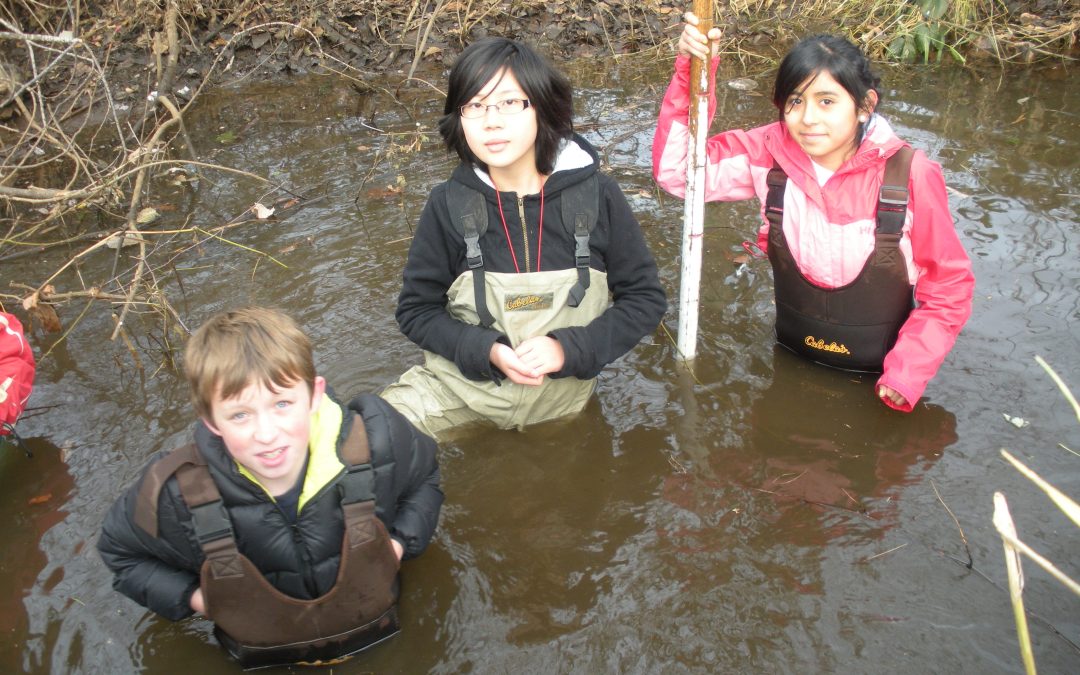
It’s a bright, sunshiny day on Oregon’s Salmon River, not far from where it passes by Welches, a small Oregon village. Just downstream, a school bus is disgorging a happy class, who are running down to the river’s edge. Arrived, the students traipse down the path to the river; happy, lugging gear; knapsacks hopping back and forth around their shoulders. Happy class; happy day! They are here to investigate the health of this stream in this particular place; and so, array themselves along the river’s bank; organize into five groups of four; find and arrange their gear, and start to work. Each group has chosen one of five aspects of the stream: Temperature and dissolved oxygen; turbidity; aquatic plant species; sediment grain size; and a transect from river’s edge 100 meters onto the shore to identify plant species. The odd thing about this is that this is their first field trip this year. And the teacher is standing, quiet, further up the stream bank, a slow smile on her face. What is she thinking? What does she know?
Have you ever wondered how natural areas develop and express a coherent view of a place which is as it should be?
Have you ever attempted to explore that thought; conducted an inquiry of your own into what is there, and how it works?
One more question: Have you ever stood looking over an urban or suburban area, and wondered if it actually works for your benefit?
 What is Field-Based Research?
Field-based research with students is a relatively recent phenomenon which immerses the brains and bodies of teachers and students in a milieu of conceptual interactions with concrete elements of a natural area which ultimately converge to produce people who comprehend, interact with, and appreciate, the species and ecosystems they visit, or live within. How does it do this?
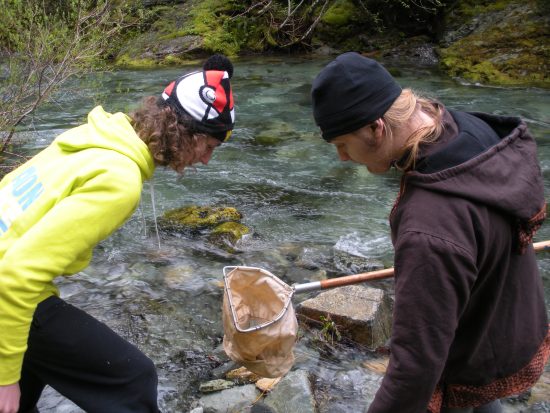
Good question. Try to envision how this would operate in a school classroom, without googling or searching for information to respond to that question. How many of us left our last school, college, or university, with not only a clear understanding of the species in the ecosystem we inhabit; but, the experience of sitting on a river bank, holding a temperature probe, ready to measure the temperature of the water next to the shore. Knowing why you’re doing this.
This might seem unattainable; but, a few hours in a natural area, with a well-prepared teacher, and some classroom prep in how to use most instruments; and, in the species who live there, can do it. And, using this active learning approach to education uses our brain in the way itevolved to do just that: Look about. See. Think!
This method of teaching new material involves active learning, in which students, after a brief introduction to the topic under study, engage in self-directed discussions, development of questions which need answers, active planning for activities directed by those questions, development of group roles and ways to work together effectively; and, finally, self and group assessment. When we take students, and teachers, into a natural area to engage in research into an ecosystem and its inhabitants, we open a door to this very human, and very effective way that our brain and body are organized to work together to discover, learn about, and comprehend, the components of this place: Who they are, what they do, and how they do this in cooperation with all the pieces of this particular place. Understandings that humans developed thousands of years ago; and which are slowly being re-learned by today’s humans.
Before the class’s field trip to the natural area, they spent three classes engaging as much of the field work as they could without being on that river bank in order to learn the observational skills they would need on site. On one of those days, they made their observations on a creek which flowed through the west edge of the school grounds. By their third day in the creek and lab, all of the students had introduced themselves to each of the sets of equipment, books, etc., and now will focus on one set, describe where they will be on that streambank, and how they would organize themselves and their gear to do a good job while they are on site. During all this work, as they observed in the creek and in the lab, practicing their skills, each student, and each group, discovered they were growing; working together, figuring things out, learning about their own capacities in this new world they had engaged.
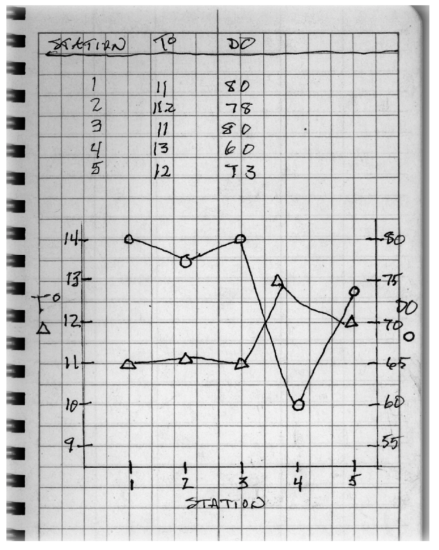 Then, the Temperature and Dissolved Oxygen group gathered together the five temperature and dissolved oxygen samples they had collected on the creek behind the school the day before, each from a different part of the creek. They brought each sample, one at a time, to their lab table, unscrewed the lid of each container, carefully let the probe into the container, and recorded the data presented: Temperature, or Dissolved Oxygen. They did this for each of their five samples, then used a graph to plot their data. The data, as plotted, is shown in the figure here. Their job at this point became how to explain the shape of their curve. They had made careful descriptions of the five stations when they made their water collections in the creek on their school grounds, and noted that there was a small fallen tree near Station 3, which disturbed plants, animals, and the bottom at that site. They decided that the slow rise at Station 4 simply indicated a recovery process might be in place; and, they would measure dissolved oxygen at Station 4 when they next visited the creek.
Currently, the U.S. is way behind in slowing climate change. Today’s students need all the assistance they can find in order to understand this fact, and its consequences for them in their lives.
Field-based science inquiry has proven itself over the past few decades to generate understandings which lead people to do their part in alleviating global warming’s effects. As noted in numerous articles found in CLEARING, and performed by teachers who have worked with organizations like the Diack Ecology Education Project1 to build their skills and understandings. We need to be prepared to increase the comprehension and dedication of a much larger segment of students in school today.
We, and our Primate ancestors, learned this way of looking at our world by interacting with it. As Archie Diack2, the founder of the Diack Ecology Education Program, said, more than once, “When we get our hands dirty, we begin to learn about the environment we live in.” When we hold a temperature probe in place in a stream, read the reported temperature, and set the probe down in order to pull out a pen to record it in a notebook, we are physically engaging thoughts and actions in the “Real World”—that physical place outside our body or classroom. Those actions produce a key to unlock the place in our brain which supports critical thinking, and long-term memory; the prefrontal cortex, or PFC. It all starts when we “place our hands on . . .” . That simple act sets our critical thinking processes in motion.
When we engage our mind in critical thinking, the PFC sets up a free place for this work and its storage, and a group of neural addresses which point to relevant information on this thing you want to know about. It does this, not to tell us what to think; but, to provide access to information, to suggest steps to take in order to accomplish your thinking, and memories from your current work that you’ll want later. In effect, the PFC helps you to set up what amounts to an office in your brain, and a strategic plan to learn this place you are working and thinking within. This same phenomenon can work in classrooms also, but is rarely employed.
Now, back to action! We left the teacher, a slow smile forming, and her students, organizing their work. Let’s get back to them. They are engaged in a sampling of a teacher-organized, student-centered, project to help students to comprehend the place of natural ecosystems in our worlds, and their place within them.
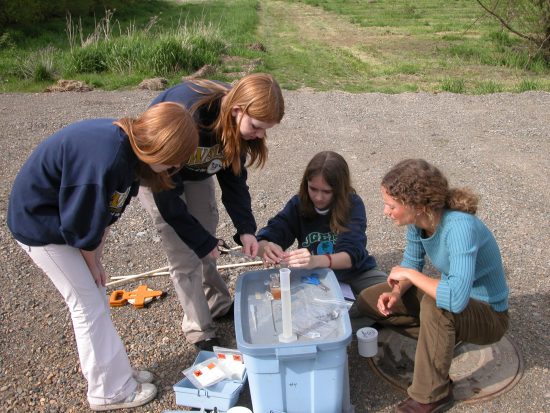 Back on the stream bank, the student groups have decided just where their particular station would work best; and, have begun to discuss how to set them up. As a class, they, not their teacher, are deciding just where each group’s station would work best. We’ll follow the Water Temperature and Dissolved Oxygen team, who are setting up a 30-meter reach along the river bank, adjacent to where a set of rocks in the stream near the shore, a growth of rushes and grasses in the water, and a strand of sand beyond the beach, will provide a variety of microhabitats which might affect the temperature and dissolved oxygen in the water in the stream along their reach. Before they started this field trip, in the classroom, they researched, thought, and finally decided to relate temperature and dissolved oxygen to the health of the stream itself, and for the organisms living there. So, this decision will focus the work that they do.
They decided to form two subgroups, one to do the temperature work, the other to do the dissolved oxygen work. The make up of each subgroup was decided by each student declaring what he or she preferred to do, then accommodating where possible. Then, they went to work. During the time they made and recorded their observations, they made minor decisions among each subgroup when a small tweak needed to be made in their work. And, so, they carefully measured and mapped their sampling stations in their notebooks, naming them by their polar coordinates. (Something they dreamed up!!) They also described their sites, and detailed the reasons for placing things where they are.
All this time, the teacher was moving up and down the class’ reach, responding to questions and encouraging their good work and thinking. When time was up, students gathered their materials, and moved back to the covered area on the shore, with the tables and benches they would need when they set things down; and, prepared a preliminary report on their work, findings, and interpretations. Each of the five groups decided on their part of the report. They agreed to calibrate the report when they were back in school.
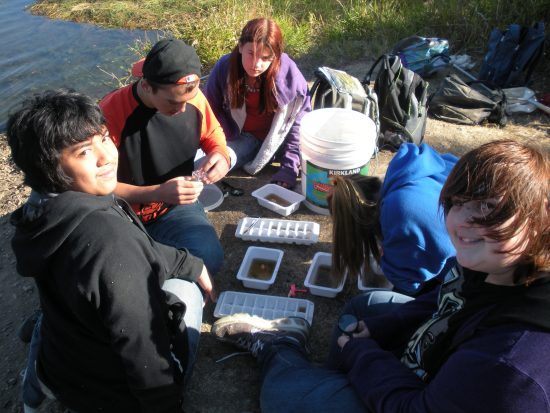 Each of the five classroom groups decided on their part of the report. They agreed to calibrate the report when they were back in school. Throughout their work, members of each group began to clarify relationships, the nature and specifics of the work, the meaning of what they were doing, and their own individual development into an effective member of their group. Students discovered that they are a powerful arrangement of people, ideas, and materials which can work together to accomplish worthwhile things. They learned that they could pull two or more pairs together as needed to build effective work groups. Plus, they learned that, when we begin to discover our own capacity while we are working, we discover that we are becoming people. This work, and events, may look or be different for each class, but together are usually equally effective.
The main reason these students were able to accomplish so much within a 4-hour field work period lies in the way their teacher organized her delivery. She has used active learning delivery techniques for three years now, and is very comfortable with them. One of the things she did was on Day One of the school year, arrange to have her students organize themselves into pairs. She did this by giving each student a Partner Calendar, a mostly blank sheet with spaces for writing “Time”, “Partner”, down the sheet until they had done ten spaces, with times beginning about 8:00 AM, until ending at 5:00 PM. Then, she asked the students to go around and introduce themselves to one another; and, while they were doing this, ask for, and fill out, a Calendar “Date”. As the class did this, she walked around and noticed who was totally involved in the activity, and who was either perplexed, or seemed bored. She talked to each of them individually, asking them how they thought this might work to organize effective work groups. This was one of the steps she used to build strong, effective groups. Students, many of whom had never met, began to know one another. This seemed to work each of the three years she had done it; and, that seemed to be true this day also.
When all the work of signing up seemed to be done, she asked the class to get together with their 2:00 Dates, and then brought these pairs out into the lab to take first steps for some work they would do. She asked each pair, a dyad, to get together with another pair to form a tetrad, a group of four. Each tetrad selected and went to a particular table. When they were at their tables, the teacher let the partners know that, in about three weeks, they would be going out to a river near the Columbia Gorge, between Washington and Oregon. Meanwhile, each week, they would spend one day in the lab, preparing to use the equipment they’d need to examine the river.
What did the teacher know? She knew from her teacher education preparation, and from two workshops she had attended three years before, that teacher lectures and assigned homework did not produce students who were involved and invested in their learnings. So, she attended a workshop focused on active learning, and a light flashed in her mind; she suddenly “got it!” Organize the teaching environment, now matter where it is, and organize what the students do so that it will raise questions in their minds. She knows now that they will heartily engage those questions; and, in doing so, will learn more than she could teach them using didactic methods. She had discovered learning as our brain is organized to do just that.
1 A program (https://www.diackecology.org/) which provides training for teachers, funds for equipment to use in natural areas, and basic funding for transportation to study sites.
2. Archie Diack, the founder of the Diack Ecology Education Program. The family of Arch W. Diack established the Diack Ecology Education Program to encourage teachers to involve students in student field-based research and ecology. The Diack program seeks to inspire a combination of experiential education and authentic science in order to spark interest in a scientific understanding of the complex ecosystems of the natural world.
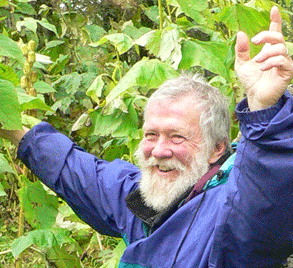 Jim Martin is a retired but still very active science educator who has written a remarkable series on finding science lessons in your community for CLEARING. You can find them at www.clearingmagazine.org.Student
by editor | Sep 2, 2025 | Environmental Literacy, Experiential Learning, Learning Theory, Questioning strategies, Teaching Science
Or, can we slow down enough to use inquiry to build effective conceptual learnings?
Education is not a Race to the Top. I have to state that up front. In a Race to the Top are we allowed the time it takes to contemplate what we are learning? Time to dig into the record to find the information which satisfies our needs to know? Time to make the conceptual connections between what we are currently learning, and what we have learned before? Time to become involved and invested in our educations? Time to become empowered as persons?
I do not believe that education is a race at all. Rather, it is a journey, a journey which wanders through who we are, who we were, and where we might go; all the while, developing the capacity to engage in autonomous learning, discovering how our brain and body work together to learn, becoming practiced in learning how to work with others to discover how we, our world, and our Universe work. Not a random journey, but one generated by interest and the need to discover and comprehend facts. Mental sprinting does not generate that world.
How can a wandering journey lead to empowered students?
Let me describe a simple activity to illustrate this. Simple, but demanding quality time; as with most of experience, things which are simple in concept are more often complex in execution. For a long time, my teaching has developed around the idea that our brain is organized to learn, and does so when we allow it. Allowing it means planting a thought in the student’s mind (read brain), then structuring the learning environment so the student, in pursuing this thought, raises a question and engages your curriculum in answering it. Means knowing that students’ brains will be effective in directing their learning.
As a matter of fact, everything students learn is the product of human brains that were thinking. Human (and all mammalian) brains are autonomous learners; especially when they need to know. Questions and thoughts, when they are pursued, generate needs to know. Together, these simple things and processes make brains learn. They learn how to learn. As the term goes along, students assume more and more of the load. The difficult part for us is learning to accept that this is true. Especially when our publishers present such compelling books, activities, and supplements in which students’ brains are directed to find particular answers to particular questions within them.
Here is my example of planting a question or thought in a student’s mind, then using it to deliver curriculum. In this example, students engage an activity in which they observe paramecium under the microscope. When they first observe them, they see majestic, sailing cells, moving through the medium like dancers in a ballroom; ships in a sea, traveling slowly, but always with some inherent purpose. While they travel, food vacuoles move slowly, contractile vacuole pulses, cilia beat, as this living ship navigates its waters. Most of the lab activities written to observe and know paramecia quash this exciting perception of these fascinating creatures. (Likewise for most other phenomena they address.)
During an activity where students rotate through a set of learning stations to introduce themselves to cells, they are asked to observe a sample from a bowl of cloudy water for paramecium. At the paramecium station, I ask my students to just look at them, and to know that they’re very old as a species. The next day, as we review their observations at the stations they visited, when they get to paramecium, I ask, “Did you notice anything interesting at the paramecium station?” Students relate some specifics they observed, with “dots” inside, moving things, as the most frequent observation of interest. I ask, “Do you think you can find out what they are doing?” They want to try, so we begin.
Each group chooses their most interesting observation to follow up on with an inquiry they design themselves. When they choose a thing like the moving “dots,” and ask about them, I suggest I might know a trick to make them easier to observe. Eventually, they will ask about the trick and I’ll mention that some scientists boil yeast in congo red, which changes color depending on the pH. They haven’t studied digestion yet, but will, so I add that food coming in has a low pH compared with digested food, and we’ll study that later in the year. They’re happy with that and ask if I have any congo red and yeast.
Another group decided to study the cilia that cover paramecia and appear to help them move. They were having trouble making their observations because the paramecia moved too fast. I said that some scientists used a solution that slowed the cells down, and they asked if I knew how to get some. I said that there might be some in the prep room, and that I’d look. My bottle of Protoslo was waiting there, and I gave it to them and showed them how to use it. Then off they went.
When the investigations have been completed, groups analyze and interpret their data, make inferences from the results, and report out to the class in a seminar. (When we started our investigation, I had informed the class that they should check what other groups were finding out because they were responsible for knowing all about paramecia. I reminded them of this when we started the seminar.) These are always lively, and groups always want to go into the lab to nail down one more thing when they are finished. Which we do.
How does all this help students get into the books to prepare for tests?
Then we do the inevitable seat work, but it is accomplished in a collegial atmosphere, and conducted along with the follow-up to the seminar they wanted to do. I tell them to list all of their discoveries; their group’s and the other groups’. I’ve observed that they know more, better, than I could ever teach them via direct teaching. Then, I test them. First with my test, which is mostly essay, and which they do their usual work on. The next day, they get the publisher’s test. Not long after the test begins, comments start coming in: “This is easy.” “This is boring.” “This barely covers the basics.” These students own their learnings. Their locus of control for their education resides within their person.
How do you view this way of teaching so you can try it? The whole thing is driven by a question the student raises. This act generates an incipient concept, a bootstrap I can use to make sure that facts are discovered to clarify the concept. These elusive facts which clarify students’ thoughts about the concepts and processes they are engaging are what I call, “needs to know.” What happens in your brain when you need to know something: a forgotten ingredient in a recipe, how much you spent on auto maintenance last year, where is Qatar? Your inner self is mobilized, and you find the facts. And they clarify. From time to time, they raise further questions. Likewise with students. Their “Need to Know” generates a search for relevant facts.
There is a difference between immersing students in the facts as they give form to the concept and medium, and committing facts to rote memory in the presence or absence of the medium. The difference between hypothetico-deductive and verification activities. The great majority of publishers’ activities are verification inquiries, with students simply verifying what they have been told they will find. Where is the brain’s role in this? Verification is clerk’s work; self-directed inquiry is brain’s work.
To do this kind of teaching, teachers must be comfortable with the concepts and processes embedded in their curricula, and with allowing their students to think. This is not easy at first. Teachers perceive that control has moved from themselves to the students; enough to make many have second thoughts. Clean structure in the learning environment and faith in the students’ integrity will make it work. And building their capacity for actively participating in effective work groups.
Asking and answering inquiry questions in an effective work group provides a nearly perfect environment for all students to learn any content for understanding. Note that I am not claiming the same for memorizing content particulars for tests. The main criterion of the teaching I support is that the student’s brain has to be an active participant in developing the concepts and engaging curricular particulars. It’s difficult to become comfortable with this way of teaching at first; at least, it was for me. I did, not sure how, make myself check where my students were relative to other students in their understandings. To see how they were doing, I followed up by talking with their teachers in the next grade when I could, to compare their outcomes on publishers’ tests compared with other classes. I focused on my bottom 25th percentile, who usually did well.
Memorizing material to pass tests does not personally empower most people. Learning for understanding does. These two approaches to learning aren’t necessarily incompatible. In the United States, we don’t seem to understand what the two approaches mean, and tend to emphasize the former over the latter. Learning for understanding is a student-centered process. It takes time to let our teacher-centered part of us relax and let the students follow their questions. And to elucidate the successive approximations of students who are involved and invested in their learnings; approximations which mark the road they are on: Students who own what they know and will know. ❏
Jim Martin is a retired but still very active science educator who writes a regular blog on science and learning for CLEARING. You can them at www.clearingmagazine.org.

by editor | Sep 1, 2025 | At-risk Youth, Critical Thinking, Data Collection, Technology
by Greta Righter
As an instructor at IslandWood, an environmental learning center on Bainbridge Island, WA, my week with students is fleeting. I have four days during IslandWood’s School Overnight Program (SOP) to explore and investigate the natural world with groups of 4-6th graders, and it never seems to be enough time. At IslandWood, students gather for four days of learning on 250 acres of a forest ecosystem, engaging in science, arts, and team-building activities and lessons. Just as they are beginning to distinguish a Western hemlock from a Douglas fir, and communicate well as a team, it’s time for them to pack up and head home. Most of the students are from the Seattle area, coming from various socioeconomic backgrounds, and may or may not have access to nearby green spaces in their home neighborhoods. As a newcomer to the field of experiential outdoor education, I still have a nagging voice that wonders if my students might walk away feeling like they can only engage with the natural world if they are in the forest. One aspect of teaching outdoor education that often feels most challenging is the transfer of learning: how can I best encourage students to carry their wonder and excitement of the natural world home with them, even if home is an urban setting? In this article I will describe an experiment with integrating technology into my field studies, and how it made that nagging voice in my head a little quieter.
Transfer of learning, or the ability to apply knowledge learned in one context to new contexts, can feel like the ‘achilles heel’ of outdoor education (Brown, 2010). Students are removed from indoor classrooms, plopped into the woods for a week to learn about nature, and then shuttled back to their desks a few days later. As one outdoor educator put it, “a major and persistent challenge for outdoor adventure education is the extent to which the learning experiences of students affect change beyond the immediate outdoor environment” (Brown, 2010, p.13). Programs like IslandWood’s SOP seek to create continuity in this experience through pre- and post-visit lessons to the classroom. Still, many outdoor education programs do not have any means of assessing transfer of learning. As I wave both hands goodbye to the buses pulling away each week, a little voice in the back of my head always wonders… “What will they remember? Did I make an impact?”
 Citizen Science & Phone Apps
Recently, I decided to focus my field instruction on the theme of citizen science. The National Geographic Society defines citizen science as “the practice of public participation and collaboration in scientific research to increase scientific knowledge” (National Geographic Society, 2012). With my student field group we broke down this term and defined citizen science as ‘regular people who make scientific observations’. I also provided some examples to my students of large citizen science projects that are going on around the world. In the interest of weaving citizen science work into my lessons, I experimented with the iNaturalist app in the field because it is user-friendly, it has a generalist focus on species identification and location, and it has the ability to connect users to other citizen scientists making similar discoveries. iNaturalist describes its function as ‘a place where you can record what you see in nature, meet other nature lovers, and learn about the natural world’ (iNaturalist.org, 2012). It seemed like the perfect tool to integrate into SOP, which focuses on making observations, and supporting claims with gathered evidence. The iNaturalist app provides a more interactive medium for recording and utilizing data, while also connecting those observations beyond the IslandWood setting.
The Struggle with ‘Screen time’
I felt some apprehension about introducing technology into outdoor education. As someone who experiences the outdoors as sanctuary, a place to escape the dings and rings of computers and phones, it made my heart hurt a little bit to bring a glowing screen into my field studies. I wondered, are technology and place-based learning inherently at odds with each other? Does gazing into a glowing screen detract from the experience of being immersed in the natural processes of the world? As a self-proclaimed luddite, one who fears and avoids the rapid progression of our tech-focused society, it felt like going against the grain to introduce technology into my field instruction. Worries about technology failures, lack of access to the internet, and encouraging more screen time amongst a generation of students who I honestly believe need less screen time riddled my mind. There are many who share this concern – a number of studies have linked the increase in mobile screen use among children to a variety of adverse outcomes including (but not limited to): decreased ability to recognize human emotions (Uhls, et.al., 2014), increase in childhood obesity rates (Chen, et.al., 2014), difficulty sleeping (Cajochen, 2011), and increased anxiety and depression (Twenge, et.al., 2017).
On the other hand, I believe that nothing is ever black and white. Technology does not have to be the enemy, and teachers and parents should not have to be suited up in a constant battle against it. Screens are here, and they are here to stay, and there are many good reasons for integrating technology into all areas of instruction. The need for future generations to be highly proficient in various forms of technology is of increasing importance (Haberman, 2010, p. 85). Also, technology offers a different medium of learning, and can broaden students’ connection with the world beyond their classroom. But that’s the classroom… how would it work to use an iPod out in the field?
How Did It Go?
The learning goals for our week of citizen science studies were for students to 1.) work together so that each student would input a new species identification into the iNaturalist app 2.) be able to describe what citizen science is, and 3.) give an example of how and where they would use this technology at home. In order to ensure successful integration of technology in the field, I made sure to establish some ‘tech norms’ before getting started:
Tech Norms:
Only the instructor (myself) will carry and use the iPod.
We will only utilize the phone for the iNaturalist app.
Everyone will contribute one species identification to the database.
We will work as a team to help each other identify and input new species.
 On our second full field day each student chose a specialist name tag – they chose between: Mycologist, Botanist, Zoologist, Entomologist, Ornithologist, & Marine Biologist. I explained that this was not the only thing they could explore – in fact, everyone’s goal for the day was to be a leader of investigating their specialization for the whole group. The mycologist could call others over when they found a mushroom they wanted help identifying. The ornithologist could ask others what colors they saw on that bird that just landed in a nearby tree. Our goal was to work together. Each student was equipped with a unique field guide, and other tools they might need to study the details of organisms, such as binoculars, magnifying glasses, and jars to collect specimens.
I immediately noticed that students were highly motivated to identify the plants and creatures they were discovering because of their interest in the iNaturalist app. Just as writing assignments geared towards a real audience can increase student motivation, so does recording observations and species identifications for a world-wide database (Norton-Meier, Hand, Hockenberry, & Wise, 2008). We talked about the fact that our identifications may not be accurate, but that was not the goal of the lesson. I reminded them that their goals are to practice using field guides, to work together to identify species, and to contribute their findings to the iNaturalist database for other citizen scientists, just like them, to review.
Our first species identification was at Blakely Harbor – a Purple Shore Crab (Hemigrapsus nudus). Students were eager to identify the gender of the crab, and wondered if there was a place to input that data into the app. I wasn’t sure so we searched together, and we found that there is a space to add general field notes so we put the gender there. After the Purple Shore Crab, we identified a Glaucous Winged Gull (Larus glaucescens) and an Acorn Barnacle (Balanus glandula). Back in the woods there were ambitious plans for moss and mushroom identification. I input all of the ID’s just as the students wanted me to, even if we weren’t 100% sure that they were correct. That’s part of the beauty of the iNaturalist app – it connects us to other people who are making the same discoveries, reviewing our pictures, and it allows them to reach out to us if they think we may have erred. Just as my students worked together to pour through the pages of their field guides, all scientists work together to make discoveries and make sense of the world around us.
Transfer of Learning through Technology
Apps like iNaturalist provide a familiar and intriguing medium for recording observations and create a means to transfer those observation skills from the outdoor education experience back to the student’s life at home. Each of my students left IslandWood with iNaturalist written down in their journals and a location they thought might use the app at home. This week I gave my students a tool – a real live tool. Not a theoretical idea or feeling, but something tangible that they can walk away with and use in their day-to-day lives at home or school. They can use this tool to continue practicing their observation skills, nurturing their own interest in the environment, and connecting with other citizen scientists. Through sharing this technology with my students, I realized that even though I chose to limit my own screen time, it is unrealistic for me to expect the same of upcoming generations. As long as the generations of a highly technological world are going to be using phones and tablets, then perhaps we, as educators, should be striving to create the best possible outcomes for this screen time.
References for this article can be found on the web version at http://www.clearingmagazine.org/archives/
Greta Righter is an instructor and graduate student at IslandWood on Bainbridge Island, WA. She is pursuing her M. Ed. in Curriculum & Instruction at the University of Washington.


