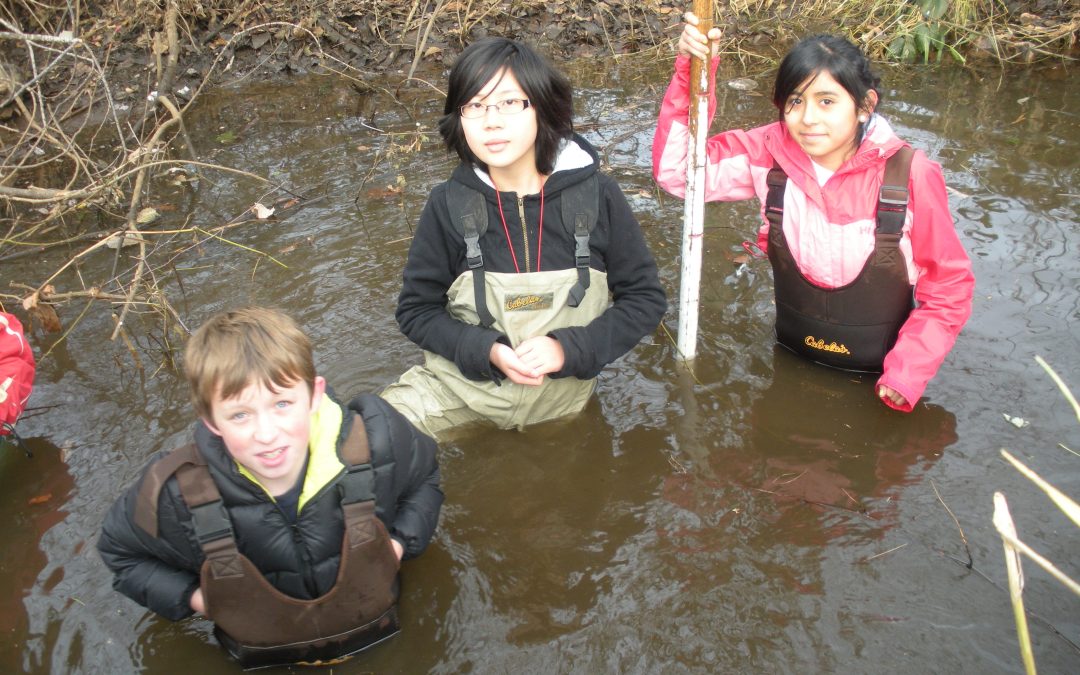
How do we train educators to successfully interface technologies with the outdoor experiences that they provide their students?
by R. Justin Hougham,
Marc Nutter,
Megan Gilbertson,
Quinn Bukouricz
University of Wisconsin – Extension
Originally published January 2020
Technology in education (ed tech) is constantly changing and growing in impact in classrooms across the globe. While ed tech holds great promise for closing achievement gaps in sectors of the education community, it remains yet to be seen how this will truly live up to its potential (“Brain Gains”, 2017, July 22). Ed tech is anticipated to grow to a $120 billion market by 2019, which will largely be spent in software and web services. How might we hope to see this show up in out-of-classroom field experiences?
Unaddressed in these articles and what we explore here are the specific impacts that the conversation of technology in environmental education brings as well as a case study that shares strategies we have found to be effective when an education considers the merging of hardware (inquiry tools), technology application in professional development, and web-based collaboration tools. Important questions for environmental education ask include How does this scale for education for the environment? What considerations need to be taken to ensure that investment works? How would we know if it does? How do we train educators to successfully interface technologies with the outdoor experiences that they provide their students? In an article published here in Clearing in 2012, we explored the instructional framework for merging field based science education with mobile pedagogies in the framework entitled Adventure Learning @ (Hougham, Eitel, and Miller, 2012). In the years since, this model has informed a collection of hardware kits that supports the concepts in AL@ as well as an examination of the questions outline above, these hardware kits are called Digital Observation Technology Skills (DOTS) kits.
In the middle fork of the Salmon River in Idaho you’ll see Steelhead, rushing rapids and hot springs that all tell the story of the landscape. Similarly, along the Wisconsin River, you will see towns, forests and fields that have a link to the industries that have shaped the state over the last 150 years. If you’re in the right spot at the right time, you can find inquisitive young people and bright yellow cases filled with gadgets taking data points and crafting Scientific Stories about the watersheds in their state. Regardless of whether it is a wild river or a small tributary outside a schoolyard- scientific stories wait to be told in these places and technology that is appropriately considered helps unlock and share these experiences.
A naturalist assists youth with a water quality test while on a canoe trip. Photo credit: DOTS participant.
In a world where technology is almighty, wielding digital literacy is practically a requirement in our understanding of just about everything. The students of today are able to navigate through web pages and apps with ease, information at their fingertips like never before. Here, we can find ourselves removed from that information, disconnected from those data sources and collections, stifling our desire to wonder and inquire more. By investing in digital tools that can enhance inquiry of the natural world, educators can bridge this divide of both information and the ability to be a primary data collector. In equipping students with touchscreens and interfaces familiar to youth of today, they are able to partake in not only real world application of scientific observation, but also experimental design and efforts moving toward the future.
Young people in Wisconsin have been contributing to the development of this idea of digital data collection and inquiry, through DOTS. The DOTS program has been developing in Wisconsin since 2014, engaging both youth and adult demographics in digital literacies, and connecting the dots from data collection to inquiry and analysis. By involving youth in the visualization and comparison of their data collections, they are able to begin to accomplish higher order learning such as developing their own hypotheses and synthesize the meaning of their findings. DOTS has been developed for students in 4th through 8th grades but has been modified for audiences in 2nd through high school, including adult learners, continuing education, and professional development.
Case studies of this application vary widely in scale, location and content. Currently DOTS kits are used in Idaho and in Wisconsin by youth to examine water quality. A full-scale implementation is underway currently in Wisconsin to connect youth from many different watersheds. Held this past August, the Wisconsin Water Youth Stories Summit brought together students from across the state of Wisconsin who are interested in not only environment and ecosystems, but also water quality and sharing their “water stories”. Supported by an EPA grant, this Summit was a culminating experience for many of the youth, getting to collect and share their findings over their 3 day period at Upham Woods Outdoor Learning Center (Grant Number: EPA-00E02045). This two year grant has trained and equipped educators with DOTS tool with an emphasis on water quality monitoring. Throughout the year, youth from around Wisconsin collect data and share their findings with others in real time on the web. At the Water Stories Summit, each group brought their DOTS kit to explore the environment and compare collected data sets. This experience not only brought together young scientists with a vested interest in the future of water, but also allowed students to share stories of local water quality that affects their own communities around the state.
A student uses a water quality test to find the amount of phosphorus at a Wisconsin River location. Photo credit: DOTS participant.
Many shared stories about urban run-off pollution, such as lawn fertilizers and road salt, E. coli contamination, and they discussed the ways in which humans alter natural waterways. At the end of their experience one student said they learned that, “science is being precise and unbiased about nature and numbers.” Another student said of a different Upham experience, “We went to Blackhawk Island for our project. The tools helped us take photos of what was under the rock. The tools help to see what animals were living there. We came up with a lot of new questions after we did our research and we can’t wait to find out things like, if the temperature affects what animals we will find living under a rock, and what animals live at different depths.” Through these collaborations of student generated data, participants were able to make connections between each other and drive further inquiry questions such as how to improve water use and consumption, and how the water affects all other life.
While the kits themselves are certainly an enhancement to a variety of curriculum, the training that accompanies the deployment is just as important as the tools themselves. Educators that partner on DOTS projects are supported with (1) Equipment, (2) Training and (3) a Web platform for collaboration. It is the interrelationship between the inquiry tools, inquiry methods and inquiry artifacts that provide the support for transformative outdoor science experiences.
A DOTS kit consists of a select set of digital tools to equip youth and educators with everything they need to take a basic data set of an ecosystem and microclimate. Contained in a water-proof, heavy-duty case, the tools selected are chosen for their utility, cost effectiveness, and ease of use. Any suite of tools can be selected for an individual’s classroom purposes, this is first and foremost, a framework to scaffold inquiry and observational skills. DOTS users gain field experience with hand held weather stations, thermal imagers, digital field microscopes, GPS units, and cameras to contribute to local citizen science monitoring (Hougham and Kerlin, 2016). A DOTS program training is facilitated by program staff and has evolved over time to include these six goals. While these are used in DOTS, nearly any technology implementation would benefit from these goals being outlined.
Establish functional and technical familiarity with DOTS Kit hardware
Orientation to DOTS Kit web interface, data uploading, and site visualizations
Examination of mobile, digital pedagogies in historical as well as applied contexts
Advance instructional capacities in application of observation and inquiry facilitation applicable to experiences outside the classroom
Production of digital artifacts that contribute to Scientific Storytelling
Facilitation of initial curricular design considerations for integrating kits into existing programs
After the training, educators have access to a suite of tools that can be lent out for deeper science connections in outdoor spaces. Further, trained educators can use grab-and-go lessons from the project website to launch the concepts with their students and watch videos produced and hosted on the site that provide further instruction on applications of the tools.
Lastly, a web-based collaboration platform is hosted to support the development of additional inquiry. To continue this mission of enhancing student inquiry and promoting collaboration, data sets can be uploaded to an online public access platform. As users enter their data online, the map displays in real time the coordinates and information of each data point. Viewers can easily navigate a Google map with their and other’s data points for comparison and post-experience observation. This immediate viewership not only falls in line with today’s student’s understanding of a fast-paced, immediately available world, but also allows no stagnation in the learning process as inquiry can continue instantaneously. Through engagement by use of digital tools collecting data in the field, reflection on process and methods through data entry into the web-based model, and through analysis and refinement of hypothesis for further inquiry, students take ownership of their data and have a voice in sharing their discoveries with others. These inquiries have been qualified in the DOTS programming through use of a “scientific story”.
The scientific story helps to build connection between qualitative and quantitative data and their respective ways of understanding. As humans we have told stories for millennia to entertain, educate, and remember. Combining these elements of storytelling with the scientific method of developing hypotheses and data collection, a story is created to share. These stories are generally 3-5 sentences and include photos taken by camera and tools such as the handheld microscope and thermal imager. In taking a closer look with digital tools, a deeper appreciation is gained and honed in on through these scientific stories and it is through these words that we can harness stories in what they do best: share. They can be digitized and easily shared across social media platforms, creating interest in the environment and science in family and community members.
This story written while at Upham woods during the aforementioned Water Stories Summit, and describes the location and inquires the youth had.
We investigated two different locations as a part of the water study blitz at Upham Woods. The first location was the Fishing shore on the Wisconsin River, and the second location was a stagnant inlet only 100 feet away. We noticed several differences between the two locations. We wanted to know more about the animal life in both locations. What kind of animals live in these habitats that we couldn’t see during the blitz? What would we find if we studied the location where the Fishing Shore and Inlet connect?
This story highlights the questions students wanted to investigate further and spurred their desire to continue comparing locations in the context of animal life. Another story from the Water Stories Summit illustrates a group of high school students making connections between ideas and places.
When doing the data blitz at camp, we tested water for all kinds of factors (pH, Conductivity, Salinity and others). The cool thing we noticed was the differences in PH levels of the water that equaled a 9.49 level that makes water a base. This reminded us of what would happen if water had a unbalanced and non neutral PH level, that was out of control… One example of this is a sulphur pit, like in Yellowstone national park. The pH of this water is as low as 1.2, which is almost equivalent to battery acid.
By encouraging students to develop their own scientific story, they create a deeper connection with that place and nature in general. This connection evolves to a jumping off point for further inquiry and hypothesis development which can be fleshed out into full empirical science studies or harnessed into environmental service projects. Additionally, as data sets can be shared, these students in Wisconsin can use the data collected in Idaho to further their hypotheses and promote scientific collaboration.
A naturalist teaches an Escuela Verde student how to take a water quality reading. Photo credit: DOTS participant.
Throughout the use of this approach research suggests that digital tools should be adopted in environmental education whenever possible (Hougham et al., 2016). To assess participant perspectives, DOTS uses a modified Common Measures instrument (National 4-H Council, 2017) to examine student attitudes towards technology and towards nature. In a 2015 study conducted by the DOTS project research team (Hougham et al., 2016), students where engaged in two iterations of an environmental studies curriculum- one was with traditional analogue toolsets and one was with digital toolsets. In an analysis of pre/post-test evaluation responses (n= 135), students showed statistically significant and positive shifts in attitudes towards technology, the use of technology outdoors, and towards investigating nature. In a review of the data from DOTS users for both profession development and youth workshops (n=71), it was found that 97% of participants of all ages agreed or strongly agreed that they “better understand how science, technology, or engineering can solve problems after using the DOTS tools”, and 89% said they agreed or strongly agreed that they “liked learning about this subject”.
This survey data provides insight on scaffolding and curiosity building techniques. In this way, it was found that lessons on observation were most useful when they began with broad scale observations and students were invited to make more focused observations. This system allows for students to explore a part of the world that they find interesting, making them more invested in a narrative authentic to them. The practice of up close observation is nothing new in environmental education, notably Adventures with a Hand Lens was published in 1962, advancing outdoor science instruction to engage the learner in their own investigations of the world up close. Today, this observation scaffolds easily onto data collection, with students studying parts of the ecosystem that they find interesting with encouragement to find how these seemingly individual pieces coalesce into a larger system.
In moving environmental education into the digital age, educators should look to empower youth with the tools and responsibility to examine their surroundings, and in encouraging youth to take and use technology outside, educators can capitalize on students collecting their own data sets to develop deeper, more meaningful inquiry questions. And when they can begin developing their own questions that they want to answer rather than following a worksheet or handout, the exploration becomes that much more desirable and satiating. Those young people wielding handheld weather stations and thermal imagers on the Salmon River or on the Wisconsin may appear to be kids collecting some information for science project, but don’t be fooled, the next generation of scientists and scientific thinkers is out there, already developing their inquiries into the natural world.
References
Brain Gains. (2017, July 22). The Economist. Retrieved from https://www.economist.com/news/leaders/21725313-how-science-learning-can-get-best-out-edtech-together-technology-and-teachers-can
Headstrom, R.. (1962). Adventures with a Hand Lens.
Hougham, R. J., Eitel, K. B., & Miller, B. G. (2013). AL@: Combining the strengths of adventure learning and place based education. 2012 CLEARING Compendium (pp 38-41).
Hougham, J. and Kerlin, S. (2017). To Unplug or Plug In. Green Teacher. Available at: https://greenteacher.com/to-unplug-or-plug-in/.
Hougham, R., Nutter, M., Nussbaum, A., Riedl, T. and Burgess, S. (2016). Engaging at-risk populations outdoors, digitally: researching youth attitudes, confidence, and interest in technology and the outdoors. Presented at the 44th Annual International Symposium on Experiential Education Research, Minneapolis, MN.
National 4-H Council. (2017). Common Measures 2.0.
Technology is transforming what happens when a child goes to school. (2017, July 22). The Economist. Retrieved from https://www.economist.com/news/briefing/21725285-reformers-are-using-new-software-personalise-learning-technology-transforming-what-happens
Dr. R. Justin Hougham is faculty at the University of Wisconsin- Extension where he supports the delivery of a wide range of science education topics to K-12 students, volunteers, youth development professionals, graduate students, and in-service teachers. Justin’s scholarship is in the areas of youth development, place-based pedagogies, STEM education, AL, and education for sustainability. See other content by this author.
Marc Nutter manages the facility of Upham Woods Outdoor Learning Center located in Wisconsin Dells, WI which serves over 11,000 youth and adults annually. With the research naturalist team at Upham Woods, Marc implements local, state, and federal grants around Wisconsin aimed to get youth connected to their local surroundings with the aid of technology that enhances observation.
Megan Gilbertson is currently a school psychology graduate student at Southern Illinois University – Edwardsville. While working at Upham Woods Outdoor Learning Center, she collaborated on grant funded projects to create and curate online data platforms for educational groups and facilitate programs for both youth and adults on the integration of technology with observation and inquiry in environmental education.
Quinn Bukouricz is a research naturalist involved with technology-integrated programming statewide, funded on grants and program revenues. He is also responsible the creation and care of programmatic equipment which includes the “Digital Observation Technology Skills” kits, and the implementation of grants.
It’s hard to imagine a more attention-getting activity for students of all ages than the Soil Your Undies Challenge. The name alone evokes questions, and the process is a memorable way for students to understand the multiple factors impacting soil health, as 21 K-12 educators learned at an Engaging Communities in Agriculture Education workshop in September.
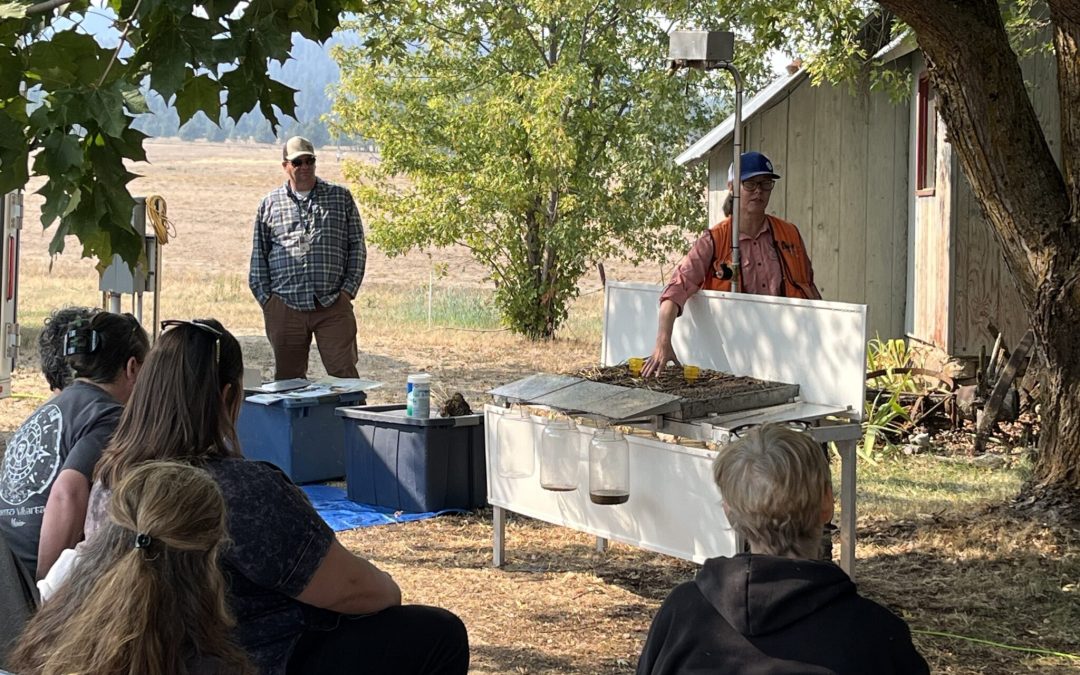
A team from Natural Resources Conservation Service (NRCS) demonstrated the activity, which involves burying new, cotton-based underwear at different sites with varying ecosystem soil conditions. When the underwear is dug up after 60 days, increased microbial activity, an indicator of healthy soil, can be observed. Underwear buried in healthy soil had hardly a shred of material left other than the synthetic elastic waistband.
“This was a fantastic opportunity to see different ways to incorporate agriculture education into different classroom settings,” one educator shared. “[The workshop] provided great networking and resource opportunities.”
The one-day, in-person workshop provided training and resources for educators to integrate agriculture education and career-connected learning into their practice, connect with local community partners and learn about opportunities for students to participate in field-based agricultural learning experiences.
“This was a fantastic opportunity to see different ways to incorporate agriculture education into different classroom settings. “[The workshop] provided great networking and resource opportunities.”
— Workshop Participant
Teachers from twelve school districts were represented between Ferry, Stevens, Pend Oreille, and Spokane Counties. The spread across the grade levels was evenly distributed. Pacific Education Institute’s (PEI) Amy Dawley and Michelle Townshend teamed up with staff from Pend Oreille Conservation District, Stevens Conservation District, and NRCS to co-facilitate the workshop. The workshop was funded by a NRCS grant.
Other highlights included another NRCS demonstration, this time of how no-till, low-till and tilled soil interact with water through a slake test. “The Soil Health Trailer was a big hit,” says Dawley. “It provided a clear visual observation of how intact microbial and fungal soil components, plus living plant roots, create stable soil that does not easily break apart and erode within water. They also demonstrated wind erosion across the surface of a miniature farm setting using a modified leaf blower with variable mph speeds. Again, the importance of wind breaks and established vegetation in preventing soil loss to wind was clearly observable.”
Indigenous Eats from Spokane delivered a catered hot lunch for everyone. “The food was delicious and generous, and it was so appreciated given that the workshop site was quite remote,” says Dawley.
Participants learned about the many factors impacting soil health along with strategies for integrating agriculture and career connected learning into curriculum.
After lunch, the group split into grade-band groups. Grades K-5 educators created soil shakes to determine the soil texture (ratio of sand: silt: clay) and also took home a mini-composting unit. “There is nothing like following a hands-on recipe to put components of a healthy compost system to memory!” Dawley notes.
Grades 6-12 educators went on an Ecosystem Hunt to discover how living (biotic) and non-living (abiotic) components, along with processes (indicating interaction between the components), define the way we depend on ecosystems for our food. They accompanied Stevens County and Pend Oreille Conservation District staff in the afternoon to explore how and why soil samples are collected for lab analysis in agriculture. In addition, they observed water infiltrating soil using infiltration rings as a correlative investigation of soil conditions at Vetter Farm.
Teachers left the event feeling empowered to integrate the resources and activities into their curriculum. “I am confident to take the kids out, but I feel like finishing curriculum always ‘gets in the way’,” one shared. “Now I can make more time for these important field experiences as part of their learning.”
A linguistic “ecosystem”: Word study methods for outdoor education
by Sam Rubin samrubin19@gmail.com
Once the students had settled on the benches of the Pond Shelter on IslandWood’s campus, I unfolded my large butcher paper with the word “macroinvertebrate” written in large letters.
“What does that say, macrinovirbatalalalate?”
“Microscope?”
“Macaroni and cheese!”
A chorus of giggles emerged as students wondered if we were going to study macaroni and cheese. I gave them space to explore this idea, excited about their joy as we began to engage in word study.
~~~
In my experience teaching in elementary school settings, a significant barrier in science sensemaking and understanding is the perception and reality of complicated scientific language. A student might see the word “macroinvertebrate” and receive an explanation of what it means, but the length and perceived complexity of the word blocks recall and connection to other words. Thus, a student might not see themselves as a scientist because they feel they lack the understanding and language to form that identity. While scientific words are lengthy and morphologically intricate, this structure makes them ripe for linguistic study.
I have always loved words, a love that was solidified as I began my studies of linguistics in college. After graduation, I found a job teaching kindergarten at an elementary school in the San Francisco Bay Area. To my pleasant surprise, the literacy curriculum at this school was grounded in linguistics, with kindergarteners learning words such as “grapheme” and “phoneme,” and engaging in a daily, interdisciplinary practice of morphological and etymological inquiry. This instructional method is deemed “Structured Word Investigation,” or SWI, based in research on effective morphological instruction (Bowers and Kirby, 2010). When I began my graduate studies teaching intersectional environmental education at IslandWood, I noticed myself engaging in SWI practices for sensemaking in this new context. I wondered if the same word study practices I employed in the classroom could be applied to outdoor, field-based science education.
SWI blurs the boundaries between science and literacy in novel ways. The scientific approach of noticing, wondering, and analyzing word data in literacy instruction challenges the notion of science as a discrete and exclusive endeavor, while using literacy practices in science construct deeper understanding. Additionally, the study of words creates space for multilingual learners to share their expertise. Perhaps a Spanish-speaking student knows a Spanish word with a Latin base that illuminates the meaning of a challenging morpheme, or two Lushootseed words for different more-than-humans illustrate a connection that clarifies a Western science conception.
In this article, I will share two SWI word studies I reasoned through with a wonderful group of students. Since every word study is different, I choose to share these as two vignettes rather than a context-lacking list of tips. I do hope that outdoor educators can use this article as both motivation and a toolbox, so techniques and curricular questions are inevitably included in these vignettes. At the end of this article are various resources to help you get started!
Day 1: “ecosystem”
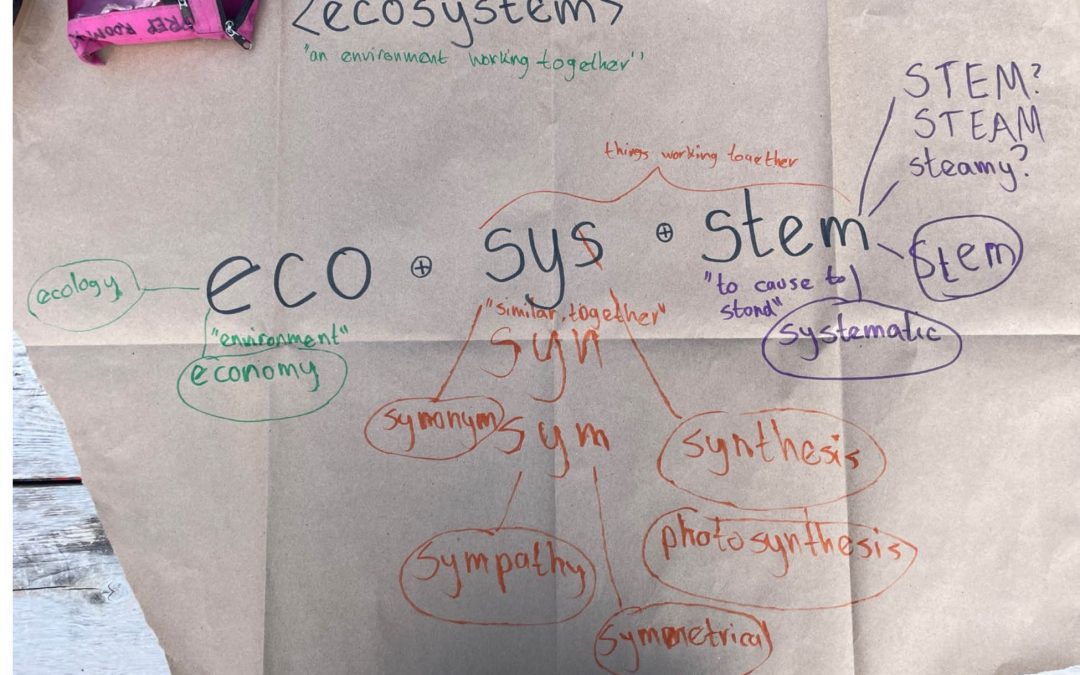
When I meet a new group of students, I often ask them,“What is an ecosystem?” I usually do this by taking students to some of the different ecosystems IslandWood has on its campus, examining biotic and abiotic factors, and perhaps asking students to find similarities between themselves and the ecosystems they explored, to build a stronger connection to land. In planning for my week of word study, I looked up the etymology of <ecosystem> on etymonline.com (a SWI teacher’s favorite resource), finding that the base <stem> in <ecosystem> comes from the Greek word histanai, meaning “cause to stand.” From previous word studies, I know that the prefix <sy-> is an reduced form of the prefix <syn-> (sometimes appearing as <syl-> and <sym->), meaning “with, together.” To scaffold this word study for my students, I wrote the word sum “eco + sy + stem” on a large piece of butcher paper, folded it, and placed it in my backpack.
At the end our first field day, after some free explore time in a forest ecosystem, the time felt right for a word investigation. Sitting on the ground, logs, and stumps, students examined the butcher paper and awaited instruction.
My first question, as in any good scientific investigation, was, “What do you notice?”
Students shared that they knew about the prefix “eco-“, defining it as “environment.” Another student said a <system> is when “things work together.” A visibly excited student exclaimed, “So an <ecosystem> is when the environment works together!”
I was already thrilled about the direction of this word study, and wanted to go further. I asked students what they wondered about the word, and a student asked if it was connected to “STEM.” We talked about what the acronym stood for, and even though it wasn’t necessarily connected in meaning to the base “stem”, I still wrote it down, because it was a part of student sensemaking. Another student wondered if it was connected to the stem of a flower. I asked students what a flower stem does.
“Brings water and nutrients to the flower!”
“Protects the flower!”
“Makes it stand up!”
I couldn’t have said it better myself! The group decided that the definition of the base <stem> was “stand up,” and I wrote it down.
At this point, we had two out of three morphemes figured out, and it was time to tackle the pesky “sy-” prefix. After some think time, a particularly scientific student yelled out “photosynthesis!” Not usually the first word I see in this word study, I was more than happy to write it down and indicate further connections to science. Another student added “synthesis” to our list. The chaperone, a math teacher, asked students what it means when a shape can be split into two mirror-image parts, and like a lightbulb turning on, half the students cried “symmetrical!” Thinking about other words they learned in school, one student shared the word “synonym” and another “sympathy”. We had a good list of words going, so we moved on to thinking about commonalities between words.
“All these words mean something about being similar, or together!”
“Oh! So an ecosystem is when the environment stands up together!”
“Yeah, but maybe ‘stands up’ in this word means something like supporting or working together.”
I took this opportunity to ask my favorite question: “So, how are we an ecosystem?”
Quiet. Then, a brave voice.
“Well, we all work together, and support each other to help each other stand.”
“Yeah! And we all stand up for each other!”
What began as a vague, science-y nature word suddenly became a meaningful, connected, and motivating idea. Through every student observation, question, and synthesis, we were building a deeper understanding of both language and science, grounded in our outdoor context.
Figure 1: Recorded evidence of our investigation. I crossed out the accidental extra “s”, and made a show of adjusting my understanding after a mistake! Photo by Sam Rubin.
Day 2: “macroinvertebrate”
Once the students had settled on the benches the Pond Shelter on IslandWood’s campus, I unfolded my large butcher paper, with the word <macroinvertebrate> written in large letters. We were about to investigate various freshwater macroinvertebrates to assess the pollution level of the pond.
“What does that say, macrinovirbatalalalate?”
“Microscope?”
“Macaroni and cheese!”
A chorus of giggles emerged as students wondered if we were going to study macaroni and cheese. Sensing the challenge in a large group discussion, while also hoping for students to apply some of their knowledge from our “ecosystem” investigation, I prompted them to work with a small group and write down some ideas in their journals. I asked them to write down what they noticed, what they wondered, and perhaps hypothesize a word sum (since I hadn’t split the word into morphemes this time).
After some writing and pair-share, a student pointed out that they recognized the prefix “macro-” as the opposite of “micro->, like in “microscope”, and another student clarified that “macro-” means “big.” Another student noticed <invert>, having seen the word “inverted” before. Another student noticed the prefix “in-“, and thus we are left with the base “vert”. All these ideas (along with “macaroni and cheese”) were written on the butcher paper, so students (and I!) could track the discussion.
At this point, we are left with the base “vert”. While not a word itself, like the base “stem” in “ecosystem”, “vert” might appear in many words an elementary school student might see. We call this a bound base, since it must be bound to a prefix, suffix, or other base to make a recognizable English word.
I had done some research about “vert” using Neil Ramsden’s Word Searcher, a helpful tool for finding words with similar structures to a base of interest. It is important to remember, though, that a word may share the same structure as the base, but have a different meaning, such as “overtake”, a compound word combing “over” and “take”. It is vital to always check for both when planning a word study.
In uncovering the meaning of “vert”, I prompted the students with some ideas. Perhaps in math they learned about “vertical” axes or a shape’s “vertex”, in social studies read about religious “converts”, or in SEL class thought about whether they were more “extroverted” or “introverted”. As they uncovered these words, a student had an idea that these words had to do with “angles” or “turning.” Their idea aligned with the Latin root vertere meaning “to turn.” Suddenly, the word “vertebrate” that one student has also pointed out made more sense, as the place where someone’s body “turns.”
Now, as the group looked at the word <macroinvertebrate> they notice denotations of “large,” “not,” and “turn” within the word, along with a connection to backbones, and the larger, unfamiliar word becomes a conglomerate of small, familiar morphemes. One student hypothesized that the definition of a macroinvertebrate could be “a large creature that can’t move in a certain way because it doesn’t have a backbone,” followed by many nods of assent from their peers.
Figure 2: Recorded evidence of our “macroinvertebrate” investigation. Photo by Sam Rubin.
When we were exploring the macroinvertebrates at the pond after our word study, I experienced a much richer pool of observations around the ways these creatures were moving and turning, what protections they had, and their relative size. Our word study both gave students tools to be more active readers while also engaging their scientific minds.
—
“What were those little bugs we saw at the pond called again?” A student wondered as we were walking to their lodge, preparing for departure.
“OH! Umm, I think it started with an ‘m’, like m…a…c…r…o…” her friend responded.
“MACROINVERTEBRATES!” they yelled in unison.
I smiled, observing this too-good-to-be-true assessment of their new linguistic knowledge. Not only did they recall the name and meaning of this large word, but also were able to begin to spell it out! I knew that engaging in frequent word study in the classroom was an effective literacy tool, and now could see evidence of just two days of scientific, contextual word investigation.
I challenge educators, especially outdoor educations to really spend time with the word-related questions students ask. The only tools you really need to facilitate these are curiosity and a proclivity towards saying “yes, and…” (traits of any effective outdoor educator). It is okay to get things wrong–I often will return to a previous day’s word study clarifying a mistake I later realized I had made, which only contributes to the student’s learning and development of trusting relationships. If you have a word in mind, do some research on Etymonline, but don’t expect all the answers there! The most exciting learning occurs from engaging in scientific word study with students themselves.
Resources
com: A master of SWI and word study, Rebecca Loveless shares more background and implementation of SWI curriculum.
Words in the Wild: A literacy- and exploration-based outdoor education center that provides ideas of scientific, contextual word study.
Etymonline: An “online etymological dictionary” helpful for word study research.
Bowers, P. N., & Kirby, J. R. (2010). Effects of morphological instruction on vocabulary acquisition. Reading and Writing, 23(5), 515–537. https://doi.org/10.1007/s11145-009-9172-z
Credits
Sam Rubin is a field instructor and graduate student at IslandWood’s Graduate Program in Education for Environment and Community in partnership with the University of Washington.
Integrating Place-based Environmental Education, Literacy, and the Performing Arts
by Regine Randall, Rebecca Edmondson, and MaryAnne Young
“Teacher, teacher, teacher, teacher, teacher!”
Such a cry is likely to get any educator’s attention—and quickly. Yet, this repetitive call is not coming from a child but, rather, an ovenbird whose common breeding territory includes Acadia National Park in Maine. In a unique collaboration supported by a regional instructional grant, teachers Rebecca Edmondson and MaryAnne Young at Conners Emerson School in Bar Harbor, Maine—the primary gateway for Acadia—developed a musical to integrate multiple elements of the state’s Kindergarten–Grade 5 curriculum while also helping children to take notice of the very special place where they live.
Creating the musical Plant Kindness and Gather Love gave the students at Conners Emerson, as well as the communities on Mount Desert Island, an opportunity to celebrate the 2016 centennial of Acadia National Park and the bicentennial of Maine in 2020. Plant Kindness and Gather Love, however, was much more than that: it served as a much-needed model for creative teaching where learning objectives incorporate important foundational skills with efforts going well beyond screens or a brick and mortar building to raise children’s awareness of the world around them.
The seed of an idea takes root
Acadia National Park draws several million visitors from across the world every year. Yet, Edmondson and Young wondered how well students at Conners Emerson really knew what was in their own backyard? Having collaborated frequently and over time to blend language arts with music, Edmondson and Young observed that this integrated approach had a consistently positive impact on student learning and engagement. Young had a regular practice of sharing books with children in which the lyrics of a song were, in fact, the entire narrative of the story. With books in hand, the students then sought out Edmondson’s help in learning the songs. Singing the text breathed new life into traditional read-alouds. With this in mind, Edmondson realized that she and Young could adapt the same approach beyond a single book or skill (e.g. alphabet learning) to create an original story about Acadia. As noted earlier, the project coincided with celebrations of the centennial of Acadia and the bicentennial of Maine but also tapped into traditional academic subjects and literacy standards. Raising awareness of the park’s natural diversity through the musical was simply one more opportunity for Edmondson and Young to amplify what could be discovered within Acadia but also a chance to join with park associates in highlighting stewardship through family-friendly conservation practices.
Centuries ago, philosophers Johann Heinrich Pestalozzi and Friedrich Froebel argued that the best education occurred when children learned with the head, heart, and hands through play (McKenna, 2010; Tracey & Morrow 2012). Plant Kindness & Gather Love became a manifestation, quite literally, of Unfoldment Theory where teachers provided the necessary support for the children’s play (Prochner, 2021). Moreover, Edmondson and Young believed that such a musical would help children as young as kindergarten begin to see themselves as stewards of the earth because coming to love a place foments a desire to know and protect it (North American Association for Environmental Education [NAAEE], 2016). Despite the Herculean effort required to launch any school production, the excitement and pleasure embedded in this creative endeavor optimized learning for students and teachers alike while also forging a stronger and more memorable connection to the natural world. What makes the work unique is that their younger students did not need to wait until middle or high school to “envision knowledge” because this collaboration gave them the opportunity to be actors in sharing what they learned with a community that may or may not have known the same content (Langer, 2011).
From root to branch
Plant Kindness and Gather Love developed into a forty-minute musical with ten original songs written, arranged, and choreographed by Young and Edmondson with parts for fifteen characters. In the planning stage, Young and Edmondson brainstormed ideas for the musical with the Acadia National Park (ANP) Education Coordinator, Katie Petri, as well as other ANP associates. The Park Service went on to provide material support for the production in the form of Junior Ranger hats. The goal of the musical was to expand the venues through which children learned environmental content specific to Acadia and Mt. Desert Island. Instructional activities that supported the production of the musical ranged from students sketching and labeling wildflowers (where they also learned about the Fibonacci sequence) to discussing and illustrating the dramatic seasonal changes in Acadia to determining the components of stewardship and encouraging that we all act upon them. Such endeavors help introduce children, especially those in kindergarten and the primary grades, to all the park has to offer since more formal outdoor education programs (e.g., Young Birder, Schoodic Adventure) often begin a bit later, typically around age ten or fourth grade.
Interest in the musical spread throughout the school and the larger community. Locally, the art teacher helped with scenery and displays, a local greenhouse donated flowering plants and foliage, and parents constructed costumes. To help other teachers throughout the state and New England consider similar projects, Petrie organized a teacher workshop at the Schoodic Institute at Acadia National Park based on Plant Kindness and Gather Love as a follow up to performances in Bar Harbor, Maine. Additional workshops on the musical were offered at the Maine Music Educators Association Conference and the Maine Environmental Education Association Conference. Most notably, a copy of Plant Kindness and Gather Love went to Washington DC to be placed on Senator Susan Collins’ reception room table along with other children’s books by Maine authors.
Making music
The songs within the musical Plant Kindness and Gather Love moved from broad concepts to specific ideas. In “Nature Lover,” the introduction began with a simple request: step outside. Jason Mraz had expressed this same sentiment years earlier in a clever rearrangement of his smash pop hit, “I’m Yours” where, during his performance of “Outdoors” on Sesame Street, he sings about the good feeling we get when we’re no longer “trapped between the walls and underneath the ceiling” (Sesame Street, 2009). Edmondson and Young took a similar approach by using song to inspire students to explore, but Acadia was the place to where children were taking a “close look or commanding view.” Only through experiencing the sights, feelings, sounds, and wanderings in a place like Acadia can they promote the desire, as Jason Mraz also reminded us, that “all of nature deserves to be loved, loved, loved, loved, loved” In the musical, a “nature lover” may be one who goes on to identify birds in Acadia by their unique calls or one who takes the initiative necessary to lead for an environmentally literate citizenry as made manifest by Maine’s motto of “Dirigo” (“I lead” or “I direct”).
Plant Kindness and Gather Love integrated content to develop higher-order thinking skills in identification, comparison/contrast, mapping, synthesis, and representation. Typically, the focus on higher-order thinking characterizes learning objectives in grades six to twelve when basic academic skills are assumed to be more fully developed (Zwiers, 2004). Yet, as Johns and Lenski (2014) note, learning anything requires that we can recognize something for what it is and also know what it is not. Edmondson and Young capitalized on this principle in their musical. For instance, the tempo of the song “Beacon Bills” is allegro (brisk) and includes the calls of no less than ten birds found in the park. Children become acclimated to a “prima donna” cardinal calling “purty, purty, purty” whereas a chestnut-sided warbler is “pleased, pleased, pleased to meet cha.” What is significant here is that students come to know things not through sight or seatwork alone. They can also learn by seeing what gets left behind: tracks, nests, scents, even scat! Not actually seeing but still knowing is the essence of inferential reasoning.
Another song in Plant Kindness and Gather Love has children singing of the wildflowers in Acadia. This scene incorporates movement because the children who play daisies, violets, bachelor buttons, British soldiers, foxgloves, and Johnny jump-ups are “dancing in the breeze” along the sea. Movement can solidify content in long-term memory, and we see this technique in teaching letters through air writing as well as during exercised where children tap out sounds or clap to count syllables (Madan & Singhal, 2012). That said, imagining that the wind off the Gulf of Maine made you sway in the same way as Queen Anne’s lace can fuse children’s personal expression with their connection to nature.
Children performing as flowers may be charming as well as kinesthetic, but it did not veil the very pointed message contained in the refrain. As the “flowers” came together in a true “kindergarten,” they sang out “Don’t pick me” over and over. Children’s growing sense of the natural world develops alongside their growing sense of themselves, as well as others, in the world. By leaving flowers to bloom and go to seed, we are making a promise to those who will come upon them in the next season that they play a vital role in the park ecosystem in addition to being a pleasure we share (Harlan & Rivkin, 2008). Of course, not all plants are equal, and such a song helps elementary science teachers also discuss the concepts of invasive species such as purple loosestrife in the park.
More on reading and writing Acadia
Too often and in many schools, reading and writing activities in the primary grades are taught as discrete skills that divorce them from other content (Gabriel, 2013). With science of reading initiatives, this practice may become even more entrenched with the focus on content area reading and writing not gaining momentum until upper elementary or middle school when curriculum more often reflects scheduling constraints, staffing, or building organization rather than a pedagogical decision (Fullan et al., 2018). Yet, the musical and what children learned about Acadia easily lead to a variety of literacy activities that keep nature and content learning at the fore. For example, children who are developing phonological awareness, an important precursor to skilled reading, can participate in activities where they see pictures of different birds (such as owl, seagull, chickadee), name the bird, and then stomp out the number of syllables they hear in the name. In a word identification lesson focusing on the onset (letter or letters making the initial consonant sound, blend, or digraph) and rime (the vowel that follows and remaining letters) of one syllable words, choosing a word from one of the songs (e.g., “pick” from the refrain “Don’t Pick Me!” in “Wildflowers of Acadia”) so that children can change the first letter(s) to form other words strongly supports decoding and spelling development (tick, quick, stick, chick, etc.). Since students are likely to have been introduced to this vocabulary, the words are easier to decode for two reasons: 1) they are within the same phonetic word family, and 2) they have become part of students’ receptive and expressive language used when learning about Acadia.
Such an activity moves from word and spelling patterns to an opportunity to record salient observations based on what happens in the park. For instance, “Tuck your pants into your socks to avoid tick bites.” Another might be “With a quick dive, a loon snatches a fish.” Or, “Adding a branch here and a little stick there, beavers keep their dam in good shape.” Finally, “Trails to Jordan, Valley Cove, and Precipice cliffs often close in the spring because peregrine falcons nest there and raise their chicks.” In another spin on word learning, the use of rhyming words such as tea, ski, and tree all contain different graphemes (ea, i, and ee) that are among the letter combinations that “spell” the long /e/ sound. Not only do such activities help children learn phonics concepts and other basic skills, but they are also introducing content specific vocabulary (loon, dam), homonyms (their, there), and usage based on context (nest as a verb). Bridging the observation skills that help children notice the macro and micro details within the natural world strengthens their ability to notice patterns and differences across multiple areas.
Speaking from my own perspective as a teacher educator, I welcome instruction that moves away from over-dependence on workbooks and commercial programs. Teachers who understand the scope and sequence of language development are poised to use any text any day to capitalize on how words work (sounds, spelling, syllables) and the ways we use words to create meaning and show what we know. Writing prompts that simply ask children to record what they see (the waves rolling in at Sand Beach), feel (wind at the top of Cadillac Mountain), or hear (the collision of water and air at Thunder Hole) are always authentic in the sense that responses can change day by day, hour by hour, or minute by minute. In terms of checking understanding of key facts or concepts, students can also complete sentence stems such as:
Hiking in the woods means….(e.g. you might get bug bites).
Being a park ranger means…(e.g. you have to be good with the public).
Loving nature means…(e.g. you are happiest outside).
Going to Acadia means…(e.g. you are on an island, or you could be on the Schoodic peninsula, or you are in a National Park).
Open-ended sentence stems allow children to generate many different responses with varying level of detail. Such responses can also suggest what we need to study further or better understand. It is a low-risk activity that introduces children to multiple perspectives while also enabling the teacher to identify misconceptions or misinformation (Randall & Marangell, 2018). Further, the sentence stems serve as a launch for extended writing on a self-selected topic of interest to the student. Ultimately, though, Plant Kindness and Gather Love went beyond interdisciplinary cross-pollination: it helped teachers understand how nature and place can re-energize lessons to improve targeted skills, expand our ideas of text to include multimodal materials beyond print (artifacts, audio, digital collections, etc.), and facilitate content learning. Historically, we know what engages learners and creates success; the joy and pleasure that went into imagining, producing, and performing Plant Kindness and Gather Love are the same emotions that motivate any learner to gain important skills, understand content more deeply, achieve more, and seek out new experiences wherever they are (Dewey, 1938; Duke et al., 2021; Gardner, 1999; Rosenblatt, 1938).
Show and share how to care
The musical concluded with an ode to the beauty of the park, which is undeniable and fine as far that goes, but also, more pointedly, with a call to be active in its preservation. The different songs, choreography, and even the costuming in the musical all contributed to creating the sense of wonder that comes from living in proximity to the natural world (Wilson, 1994). The score and lyrics for “Nature Lover” in Plant Kindness and Gather Love sets the stage by encouraging discovery, and the North American Association for Environmental Education (2016) described children as naturally inquisitive because “everything” is worth exploring “with all of the senses” (p. 2). So, exploring is for everyone but, perhaps, it is children’s particular ability to notice “a fish, a beaver, or an otter…a little bird…a white-tailed deer” that can reignite our own interest in using natural places as tableaux for learning.
You, too, may live in an area that has of extraordinary natural beauty and diversity, is near a wonderful park, or, equally important, want to make wherever it is you do live more special in the eyes of children. For instance, Last Stop Market Street by Matt de la Pena and Christian Robinson is a children’s picture book of city life where Nana helps her grandson smell the rain, watch it pool on flower petals, and be a better witness to what’s beautiful in people, places, and things. With this in mind, the success of Plant Kindness and Gather Love may be just the right incentive for you and your colleagues to tell the “lively stories” – in any form, not just musicals – of the places and the inhabitants in your community (van Dooren, 2014).
References
Dewey, John. (1938). Experience and education. Macmillan.
Duke, N. K., Ward, A. E., & Pearson, P. D. (2021). The science of reading comprehension instruction. The Reading Teacher, 74(6), 663-672.
Fullan, M., Quinn, J., & McEachen, J. (2018). Deep learning: Engage the world, change the world. Corwin.
Gabriel, R. (2013). Reading’s non-negotiables: Element of effective reading instruction. Rowman & Littlefied Education.
Gardner, H. (1999). Intelligence reframed: Multiple intelligences for the twenty-first century. Basic Books.
Harlan, J. D., & Rivkin, M. S. (2008). Science experiences for the early childhood years: An integrated affective approach (9th ed.). Pearson.
Johns, J., & Lenski, S. (2014). Improving reading: Strategies, resources, and Common Core connections. Kendall-Hunt.
Langer, J. A. (2011). Envisioning knowledge: Building literacy in the academic disciplines. Teachers College.
Madan, C. R., & Singhal, A.. (2012). Using actions to enhance memory: Effects of enactment, gestures, and exercise on human memory. Frontiers in Psychology, 3(507): 1-4. http://dx.doi.org/10.3389/fpsyg.2012.00507
McKenna, M. K. (2010). Pestalozzi revisited: Hope and caution for modern education. Journal of Philosophy and History of Education, 60, 121-25.
Tracey, D. H., & Morrow, L. M. (2012). Lenses on reading: An introduction to theories and models (2nd ed.). Guilford.
van Dooren, T. (2014). Flight ways. Columbia University Press.
Wilson, R. (1994). Environmental education at the early childhood level. North American Association for Environmental Education.
Zwiers, J. (2004). Developing academic thinking skills in grades 6–12: A handbook of multiple intelligence activities. International Reading Association.
Authors
Régine Randall, PhD, is a professor in Curriculum and Learning at Southern Connecticut State University (SCSU) in New Haven, Connecticut where she teaches both graduate and undergraduate courses in education. Her teaching and research interests allow for regional collaboration with K-12 educators on literacy instruction and assessment, student engagement, and best practices in environmental and agricultural education. With roots in Maine, Régine is an avid hiker and biker throughout New England and the Adirondack Mountains of upstate New York.
Rebecca Edmondson is a composer, conductor, clinician who has taught in both public and private schools in Maine and Pennsylvania for the past forty years. Her school music program was one of 12 in the country designated as a Model Music Education Program, and her writing has appeared in the American String Teacher. In addition to winning composition competitions, Rebecca was named the 2022 Maine’s Hancock County Teacher of the Year. She continues to nurture the love of learning through music and developing children’s books. All this has prepared her to become Liam and Finn’s Grammy.
MaryAnne Young is a lifetime resident of coastal Maine. She comes from a large family tree of educators and authors. After more than 38 years as an educator MaryAnne retired from Conners Emerson School. She engages with young learners as a substitute teacher and continues to write poetry and story songs. MaryAnne is inspired by the woods, waters and wildlife that surround the place she calls home. Her most joyful lifetime achievement is being a proud Mimi to Cameron and Maya…the new generation of Nature Lovers!A
Field-based Inquiry: Developing Comprehension and Memory
Preparing teachers to introduce their students to field-based research in local or regional environments means that these teachers have an inherent need to actually be able to do the kinds of work they plan for their students to engage. Something to think about.
by Jim Martin
It’s a bright, sunshiny day on Oregon’s Salmon River, not far from where it passes by Welches, a small Oregon village. Just downstream, a school bus is disgorging a happy class, who are running down to the river’s edge. Arrived, the students traipse down the path to the river; happy, lugging gear; knapsacks hopping back and forth around their shoulders. Happy class; happy day! They are here to investigate the health of this stream in this particular place; and so, array themselves along the river’s bank; organize into five groups of four; find and arrange their gear, and start to work. Each group has chosen one of five aspects of the stream: Temperature and dissolved oxygen; turbidity; aquatic plant species; sediment grain size; and a transect from river’s edge 100 meters onto the shore to identify plant species. The odd thing about this is that this is their first field trip this year. And the teacher is standing, quiet, further up the stream bank, a slow smile on her face. What is she thinking? What does she know?
Have you ever wondered how natural areas develop and express a coherent view of a place which is as it should be?
Have you ever attempted to explore that thought; conducted an inquiry of your own into what is there, and how it works?
One more question: Have you ever stood looking over an urban or suburban area, and wondered if it actually works for your benefit?
What is Field-Based Research?
Field-based research with students is a relatively recent phenomenon which immerses the brains and bodies of teachers and students in a milieu of conceptual interactions with concrete elements of a natural area which ultimately converge to produce people who comprehend, interact with, and appreciate, the species and ecosystems they visit, or live within. How does it do this?
Good question. Try to envision how this would operate in a school classroom, without googling or searching for information to respond to that question. How many of us left our last school, college, or university, with not only a clear understanding of the species in the ecosystem we inhabit; but, the experience of sitting on a river bank, holding a temperature probe, ready to measure the temperature of the water next to the shore. Knowing why you’re doing this.
This might seem unattainable; but, a few hours in a natural area, with a well-prepared teacher, and some classroom prep in how to use most instruments; and, in the species who live there, can do it. And, using this active learning approach to education uses our brain in the way itevolved to do just that: Look about. See. Think!
This method of teaching new material involves active learning, in which students, after a brief introduction to the topic under study, engage in self-directed discussions, development of questions which need answers, active planning for activities directed by those questions, development of group roles and ways to work together effectively; and, finally, self and group assessment. When we take students, and teachers, into a natural area to engage in research into an ecosystem and its inhabitants, we open a door to this very human, and very effective way that our brain and body are organized to work together to discover, learn about, and comprehend, the components of this place: Who they are, what they do, and how they do this in cooperation with all the pieces of this particular place. Understandings that humans developed thousands of years ago; and which are slowly being re-learned by today’s humans.
Before the class’s field trip to the natural area, they spent three classes engaging as much of the field work as they could without being on that river bank in order to learn the observational skills they would need on site. On one of those days, they made their observations on a creek which flowed through the west edge of the school grounds. By their third day in the creek and lab, all of the students had introduced themselves to each of the sets of equipment, books, etc., and now will focus on one set, describe where they will be on that streambank, and how they would organize themselves and their gear to do a good job while they are on site. During all this work, as they observed in the creek and in the lab, practicing their skills, each student, and each group, discovered they were growing; working together, figuring things out, learning about their own capacities in this new world they had engaged.
Then, the Temperature and Dissolved Oxygen group gathered together the five temperature and dissolved oxygen samples they had collected on the creek behind the school the day before, each from a different part of the creek. They brought each sample, one at a time, to their lab table, unscrewed the lid of each container, carefully let the probe into the container, and recorded the data presented: Temperature, or Dissolved Oxygen. They did this for each of their five samples, then used a graph to plot their data. The data, as plotted, is shown in the figure here. Their job at this point became how to explain the shape of their curve. They had made careful descriptions of the five stations when they made their water collections in the creek on their school grounds, and noted that there was a small fallen tree near Station 3, which disturbed plants, animals, and the bottom at that site. They decided that the slow rise at Station 4 simply indicated a recovery process might be in place; and, they would measure dissolved oxygen at Station 4 when they next visited the creek.
Currently, the U.S. is way behind in slowing climate change. Today’s students need all the assistance they can find in order to understand this fact, and its consequences for them in their lives.
Field-based science inquiry has proven itself over the past few decades to generate understandings which lead people to do their part in alleviating global warming’s effects. As noted in numerous articles found in CLEARING, and performed by teachers who have worked with organizations like the Diack Ecology Education Project1 to build their skills and understandings. We need to be prepared to increase the comprehension and dedication of a much larger segment of students in school today.
We, and our Primate ancestors, learned this way of looking at our world by interacting with it. As Archie Diack2, the founder of the Diack Ecology Education Program, said, more than once, “When we get our hands dirty, we begin to learn about the environment we live in.” When we hold a temperature probe in place in a stream, read the reported temperature, and set the probe down in order to pull out a pen to record it in a notebook, we are physically engaging thoughts and actions in the “Real World”—that physical place outside our body or classroom. Those actions produce a key to unlock the place in our brain which supports critical thinking, and long-term memory; the prefrontal cortex, or PFC. It all starts when we “place our hands on . . .” . That simple act sets our critical thinking processes in motion.
When we engage our mind in critical thinking, the PFC sets up a free place for this work and its storage, and a group of neural addresses which point to relevant information on this thing you want to know about. It does this, not to tell us what to think; but, to provide access to information, to suggest steps to take in order to accomplish your thinking, and memories from your current work that you’ll want later. In effect, the PFC helps you to set up what amounts to an office in your brain, and a strategic plan to learn this place you are working and thinking within. This same phenomenon can work in classrooms also, but is rarely employed.
Now, back to action! We left the teacher, a slow smile forming, and her students, organizing their work. Let’s get back to them. They are engaged in a sampling of a teacher-organized, student-centered, project to help students to comprehend the place of natural ecosystems in our worlds, and their place within them.
Back on the stream bank, the student groups have decided just where their particular station would work best; and, have begun to discuss how to set them up. As a class, they, not their teacher, are deciding just where each group’s station would work best. We’ll follow the Water Temperature and Dissolved Oxygen team, who are setting up a 30-meter reach along the river bank, adjacent to where a set of rocks in the stream near the shore, a growth of rushes and grasses in the water, and a strand of sand beyond the beach, will provide a variety of microhabitats which might affect the temperature and dissolved oxygen in the water in the stream along their reach. Before they started this field trip, in the classroom, they researched, thought, and finally decided to relate temperature and dissolved oxygen to the health of the stream itself, and for the organisms living there. So, this decision will focus the work that they do.
They decided to form two subgroups, one to do the temperature work, the other to do the dissolved oxygen work. The make up of each subgroup was decided by each student declaring what he or she preferred to do, then accommodating where possible. Then, they went to work. During the time they made and recorded their observations, they made minor decisions among each subgroup when a small tweak needed to be made in their work. And, so, they carefully measured and mapped their sampling stations in their notebooks, naming them by their polar coordinates. (Something they dreamed up!!) They also described their sites, and detailed the reasons for placing things where they are.
All this time, the teacher was moving up and down the class’ reach, responding to questions and encouraging their good work and thinking. When time was up, students gathered their materials, and moved back to the covered area on the shore, with the tables and benches they would need when they set things down; and, prepared a preliminary report on their work, findings, and interpretations. Each of the five groups decided on their part of the report. They agreed to calibrate the report when they were back in school.
Each of the five classroom groups decided on their part of the report. They agreed to calibrate the report when they were back in school. Throughout their work, members of each group began to clarify relationships, the nature and specifics of the work, the meaning of what they were doing, and their own individual development into an effective member of their group. Students discovered that they are a powerful arrangement of people, ideas, and materials which can work together to accomplish worthwhile things. They learned that they could pull two or more pairs together as needed to build effective work groups. Plus, they learned that, when we begin to discover our own capacity while we are working, we discover that we are becoming people. This work, and events, may look or be different for each class, but together are usually equally effective.
The main reason these students were able to accomplish so much within a 4-hour field work period lies in the way their teacher organized her delivery. She has used active learning delivery techniques for three years now, and is very comfortable with them. One of the things she did was on Day One of the school year, arrange to have her students organize themselves into pairs. She did this by giving each student a Partner Calendar, a mostly blank sheet with spaces for writing “Time”, “Partner”, down the sheet until they had done ten spaces, with times beginning about 8:00 AM, until ending at 5:00 PM. Then, she asked the students to go around and introduce themselves to one another; and, while they were doing this, ask for, and fill out, a Calendar “Date”. As the class did this, she walked around and noticed who was totally involved in the activity, and who was either perplexed, or seemed bored. She talked to each of them individually, asking them how they thought this might work to organize effective work groups. This was one of the steps she used to build strong, effective groups. Students, many of whom had never met, began to know one another. This seemed to work each of the three years she had done it; and, that seemed to be true this day also.
When all the work of signing up seemed to be done, she asked the class to get together with their 2:00 Dates, and then brought these pairs out into the lab to take first steps for some work they would do. She asked each pair, a dyad, to get together with another pair to form a tetrad, a group of four. Each tetrad selected and went to a particular table. When they were at their tables, the teacher let the partners know that, in about three weeks, they would be going out to a river near the Columbia Gorge, between Washington and Oregon. Meanwhile, each week, they would spend one day in the lab, preparing to use the equipment they’d need to examine the river.
What did the teacher know? She knew from her teacher education preparation, and from two workshops she had attended three years before, that teacher lectures and assigned homework did not produce students who were involved and invested in their learnings. So, she attended a workshop focused on active learning, and a light flashed in her mind; she suddenly “got it!” Organize the teaching environment, now matter where it is, and organize what the students do so that it will raise questions in their minds. She knows now that they will heartily engage those questions; and, in doing so, will learn more than she could teach them using didactic methods. She had discovered learning as our brain is organized to do just that.
1 A program (https://www.diackecology.org/) which provides training for teachers, funds for equipment to use in natural areas, and basic funding for transportation to study sites.
2. Archie Diack, the founder of the Diack Ecology Education Program. The family of Arch W. Diack established the Diack Ecology Education Program to encourage teachers to involve students in student field-based research and ecology. The Diack program seeks to inspire a combination of experiential education and authentic science in order to spark interest in a scientific understanding of the complex ecosystems of the natural world.
Jim Martin is a retired but still very active science educator who has written a remarkable series on finding science lessons in your community for CLEARING. You can find them at www.clearingmagazine.org.Student


 Technology in education (ed tech) is constantly changing and growing in impact in classrooms across the globe. While ed tech holds great promise for closing achievement gaps in sectors of the education community, it remains yet to be seen how this will truly live up to its potential (“Brain Gains”, 2017, July 22). Ed tech is anticipated to grow to a $120 billion market by 2019, which will largely be spent in software and web services. How might we hope to see this show up in out-of-classroom field experiences?





 Acadia National Park draws several million visitors from across the world every year. Yet, Edmondson and Young wondered how well students at Conners Emerson really knew what was in their own backyard? Having collaborated frequently and over time to blend language arts with music, Edmondson and Young observed that this integrated approach had a consistently positive impact on student learning and engagement. Young had a regular practice of sharing books with children in which the lyrics of a song were, in fact, the entire narrative of the story. With books in hand, the students then sought out Edmondson’s help in learning the songs. Singing the text breathed new life into traditional read-alouds. With this in mind, Edmondson realized that she and Young could adapt the same approach beyond a single book or skill (e.g. alphabet learning) to create an original story about Acadia. As noted earlier, the project coincided with celebrations of the centennial of Acadia and the bicentennial of Maine but also tapped into traditional academic subjects and literacy standards. Raising awareness of the park’s natural diversity through the musical was simply one more opportunity for Edmondson and Young to amplify what could be discovered within Acadia but also a chance to join with park associates in highlighting stewardship through family-friendly conservation practices.
 Plant Kindness and Gather Love developed into a forty-minute musical with ten original songs written, arranged, and choreographed by Young and Edmondson with parts for fifteen characters. In the planning stage, Young and Edmondson brainstormed ideas for the musical with the Acadia National Park (ANP) Education Coordinator, Katie Petri, as well as other ANP associates. The Park Service went on to provide material support for the production in the form of Junior Ranger hats. The goal of the musical was to expand the venues through which children learned environmental content specific to Acadia and Mt. Desert Island. Instructional activities that supported the production of the musical ranged from students sketching and labeling wildflowers (where they also learned about the Fibonacci sequence) to discussing and illustrating the dramatic seasonal changes in Acadia to determining the components of stewardship and encouraging that we all act upon them. Such endeavors help introduce children, especially those in kindergarten and the primary grades, to all the park has to offer since more formal outdoor education programs (e.g., Young Birder, Schoodic Adventure) often begin a bit later, typically around age ten or fourth grade.
 The songs within the musical Plant Kindness and Gather Love moved from broad concepts to specific ideas. In “Nature Lover,” the introduction began with a simple request: step outside. Jason Mraz had expressed this same sentiment years earlier in a clever rearrangement of his smash pop hit, “I’m Yours” where, during his performance of “Outdoors” on Sesame Street, he sings about the good feeling we get when we’re no longer “trapped between the walls and underneath the ceiling” (Sesame Street, 2009). Edmondson and Young took a similar approach by using song to inspire students to explore, but Acadia was the place to where children were taking a “close look or commanding view.” Only through experiencing the sights, feelings, sounds, and wanderings in a place like Acadia can they promote the desire, as Jason Mraz also reminded us, that “all of nature deserves to be loved, loved, loved, loved, loved” In the musical, a “nature lover” may be one who goes on to identify birds in Acadia by their unique calls or one who takes the initiative necessary to lead for an environmentally literate citizenry as made manifest by Maine’s motto of “Dirigo” (“I lead” or “I direct”).
 Plant Kindness and Gather Love integrated content to develop higher-order thinking skills in identification, comparison/contrast, mapping, synthesis, and representation. Typically, the focus on higher-order thinking characterizes learning objectives in grades six to twelve when basic academic skills are assumed to be more fully developed (Zwiers, 2004). Yet, as Johns and Lenski (2014) note, learning anything requires that we can recognize something for what it is and also know what it is not. Edmondson and Young capitalized on this principle in their musical. For instance, the tempo of the song “Beacon Bills” is allegro (brisk) and includes the calls of no less than ten birds found in the park. Children become acclimated to a “prima donna” cardinal calling “purty, purty, purty” whereas a chestnut-sided warbler is “pleased, pleased, pleased to meet cha.” What is significant here is that students come to know things not through sight or seatwork alone. They can also learn by seeing what gets left behind: tracks, nests, scents, even scat! Not actually seeing but still knowing is the essence of inferential reasoning.
 Children performing as flowers may be charming as well as kinesthetic, but it did not veil the very pointed message contained in the refrain. As the “flowers” came together in a true “kindergarten,” they sang out “Don’t pick me” over and over. Children’s growing sense of the natural world develops alongside their growing sense of themselves, as well as others, in the world. By leaving flowers to bloom and go to seed, we are making a promise to those who will come upon them in the next season that they play a vital role in the park ecosystem in addition to being a pleasure we share (Harlan & Rivkin, 2008). Of course, not all plants are equal, and such a song helps elementary science teachers also discuss the concepts of invasive species such as purple loosestrife in the park.
 Too often and in many schools, reading and writing activities in the primary grades are taught as discrete skills that divorce them from other content (Gabriel, 2013). With science of reading initiatives, this practice may become even more entrenched with the focus on content area reading and writing not gaining momentum until upper elementary or middle school when curriculum more often reflects scheduling constraints, staffing, or building organization rather than a pedagogical decision (Fullan et al., 2018). Yet, the musical and what children learned about Acadia easily lead to a variety of literacy activities that keep nature and content learning at the fore. For example, children who are developing phonological awareness, an important precursor to skilled reading, can participate in activities where they see pictures of different birds (such as owl, seagull, chickadee), name the bird, and then stomp out the number of syllables they hear in the name. In a word identification lesson focusing on the onset (letter or letters making the initial consonant sound, blend, or digraph) and rime (the vowel that follows and remaining letters) of one syllable words, choosing a word from one of the songs (e.g., “pick” from the refrain “Don’t Pick Me!” in “Wildflowers of Acadia”) so that children can change the first letter(s) to form other words strongly supports decoding and spelling development (tick, quick, stick, chick, etc.). Since students are likely to have been introduced to this vocabulary, the words are easier to decode for two reasons: 1) they are within the same phonetic word family, and 2) they have become part of students’ receptive and expressive language used when learning about Acadia.
 The musical concluded with an ode to the beauty of the park, which is undeniable and fine as far that goes, but also, more pointedly, with a call to be active in its preservation. The different songs, choreography, and even the costuming in the musical all contributed to creating the sense of wonder that comes from living in proximity to the natural world (Wilson, 1994). The score and lyrics for “Nature Lover” in Plant Kindness and Gather Love sets the stage by encouraging discovery, and the North American Association for Environmental Education (2016) described children as naturally inquisitive because “everything” is worth exploring “with all of the senses” (p. 2). So, exploring is for everyone but, perhaps, it is children’s particular ability to notice “a fish, a beaver, or an otter…a little bird…a white-tailed deer” that can reignite our own interest in using natural places as tableaux for learning.
 Régine Randall, PhD, is a professor in Curriculum and Learning at Southern Connecticut State University (SCSU) in New Haven, Connecticut where she teaches both graduate and undergraduate courses in education. Her teaching and research interests allow for regional collaboration with K-12 educators on literacy instruction and assessment, student engagement, and best practices in environmental and agricultural education. With roots in Maine, Régine is an avid hiker and biker throughout New England and the Adirondack Mountains of upstate New York.
 Rebecca Edmondson is a composer, conductor, clinician who has taught in both public and private schools in Maine and Pennsylvania for the past forty years. Her school music program was one of 12 in the country designated as a Model Music Education Program, and her writing has appeared in the American String Teacher. In addition to winning composition competitions, Rebecca was named the 2022 Maine’s Hancock County Teacher of the Year. She continues to nurture the love of learning through music and developing children’s books. All this has prepared her to become Liam and Finn’s Grammy.
 MaryAnne Young is a lifetime resident of coastal Maine. She comes from a large family tree of educators and authors. After more than 38 years as an educator MaryAnne retired from Conners Emerson School. She engages with young learners as a substitute teacher and continues to write poetry and story songs. MaryAnne is inspired by the woods, waters and wildlife that surround the place she calls home. Her most joyful lifetime achievement is being a proud Mimi to Cameron and Maya…the new generation of Nature Lovers!A