by editor | Sep 2, 2025 | Environmental Literacy, Experiential Learning, Learning Theory, Questioning strategies, Teaching Science
Or, can we slow down enough to use inquiry to build effective conceptual learnings?
Education is not a Race to the Top. I have to state that up front. In a Race to the Top are we allowed the time it takes to contemplate what we are learning? Time to dig into the record to find the information which satisfies our needs to know? Time to make the conceptual connections between what we are currently learning, and what we have learned before? Time to become involved and invested in our educations? Time to become empowered as persons?
I do not believe that education is a race at all. Rather, it is a journey, a journey which wanders through who we are, who we were, and where we might go; all the while, developing the capacity to engage in autonomous learning, discovering how our brain and body work together to learn, becoming practiced in learning how to work with others to discover how we, our world, and our Universe work. Not a random journey, but one generated by interest and the need to discover and comprehend facts. Mental sprinting does not generate that world.
How can a wandering journey lead to empowered students?
Let me describe a simple activity to illustrate this. Simple, but demanding quality time; as with most of experience, things which are simple in concept are more often complex in execution. For a long time, my teaching has developed around the idea that our brain is organized to learn, and does so when we allow it. Allowing it means planting a thought in the student’s mind (read brain), then structuring the learning environment so the student, in pursuing this thought, raises a question and engages your curriculum in answering it. Means knowing that students’ brains will be effective in directing their learning.
As a matter of fact, everything students learn is the product of human brains that were thinking. Human (and all mammalian) brains are autonomous learners; especially when they need to know. Questions and thoughts, when they are pursued, generate needs to know. Together, these simple things and processes make brains learn. They learn how to learn. As the term goes along, students assume more and more of the load. The difficult part for us is learning to accept that this is true. Especially when our publishers present such compelling books, activities, and supplements in which students’ brains are directed to find particular answers to particular questions within them.
Here is my example of planting a question or thought in a student’s mind, then using it to deliver curriculum. In this example, students engage an activity in which they observe paramecium under the microscope. When they first observe them, they see majestic, sailing cells, moving through the medium like dancers in a ballroom; ships in a sea, traveling slowly, but always with some inherent purpose. While they travel, food vacuoles move slowly, contractile vacuole pulses, cilia beat, as this living ship navigates its waters. Most of the lab activities written to observe and know paramecia quash this exciting perception of these fascinating creatures. (Likewise for most other phenomena they address.)
During an activity where students rotate through a set of learning stations to introduce themselves to cells, they are asked to observe a sample from a bowl of cloudy water for paramecium. At the paramecium station, I ask my students to just look at them, and to know that they’re very old as a species. The next day, as we review their observations at the stations they visited, when they get to paramecium, I ask, “Did you notice anything interesting at the paramecium station?” Students relate some specifics they observed, with “dots” inside, moving things, as the most frequent observation of interest. I ask, “Do you think you can find out what they are doing?” They want to try, so we begin.
Each group chooses their most interesting observation to follow up on with an inquiry they design themselves. When they choose a thing like the moving “dots,” and ask about them, I suggest I might know a trick to make them easier to observe. Eventually, they will ask about the trick and I’ll mention that some scientists boil yeast in congo red, which changes color depending on the pH. They haven’t studied digestion yet, but will, so I add that food coming in has a low pH compared with digested food, and we’ll study that later in the year. They’re happy with that and ask if I have any congo red and yeast.
Another group decided to study the cilia that cover paramecia and appear to help them move. They were having trouble making their observations because the paramecia moved too fast. I said that some scientists used a solution that slowed the cells down, and they asked if I knew how to get some. I said that there might be some in the prep room, and that I’d look. My bottle of Protoslo was waiting there, and I gave it to them and showed them how to use it. Then off they went.
When the investigations have been completed, groups analyze and interpret their data, make inferences from the results, and report out to the class in a seminar. (When we started our investigation, I had informed the class that they should check what other groups were finding out because they were responsible for knowing all about paramecia. I reminded them of this when we started the seminar.) These are always lively, and groups always want to go into the lab to nail down one more thing when they are finished. Which we do.
How does all this help students get into the books to prepare for tests?
Then we do the inevitable seat work, but it is accomplished in a collegial atmosphere, and conducted along with the follow-up to the seminar they wanted to do. I tell them to list all of their discoveries; their group’s and the other groups’. I’ve observed that they know more, better, than I could ever teach them via direct teaching. Then, I test them. First with my test, which is mostly essay, and which they do their usual work on. The next day, they get the publisher’s test. Not long after the test begins, comments start coming in: “This is easy.” “This is boring.” “This barely covers the basics.” These students own their learnings. Their locus of control for their education resides within their person.
How do you view this way of teaching so you can try it? The whole thing is driven by a question the student raises. This act generates an incipient concept, a bootstrap I can use to make sure that facts are discovered to clarify the concept. These elusive facts which clarify students’ thoughts about the concepts and processes they are engaging are what I call, “needs to know.” What happens in your brain when you need to know something: a forgotten ingredient in a recipe, how much you spent on auto maintenance last year, where is Qatar? Your inner self is mobilized, and you find the facts. And they clarify. From time to time, they raise further questions. Likewise with students. Their “Need to Know” generates a search for relevant facts.
There is a difference between immersing students in the facts as they give form to the concept and medium, and committing facts to rote memory in the presence or absence of the medium. The difference between hypothetico-deductive and verification activities. The great majority of publishers’ activities are verification inquiries, with students simply verifying what they have been told they will find. Where is the brain’s role in this? Verification is clerk’s work; self-directed inquiry is brain’s work.
To do this kind of teaching, teachers must be comfortable with the concepts and processes embedded in their curricula, and with allowing their students to think. This is not easy at first. Teachers perceive that control has moved from themselves to the students; enough to make many have second thoughts. Clean structure in the learning environment and faith in the students’ integrity will make it work. And building their capacity for actively participating in effective work groups.
Asking and answering inquiry questions in an effective work group provides a nearly perfect environment for all students to learn any content for understanding. Note that I am not claiming the same for memorizing content particulars for tests. The main criterion of the teaching I support is that the student’s brain has to be an active participant in developing the concepts and engaging curricular particulars. It’s difficult to become comfortable with this way of teaching at first; at least, it was for me. I did, not sure how, make myself check where my students were relative to other students in their understandings. To see how they were doing, I followed up by talking with their teachers in the next grade when I could, to compare their outcomes on publishers’ tests compared with other classes. I focused on my bottom 25th percentile, who usually did well.
Memorizing material to pass tests does not personally empower most people. Learning for understanding does. These two approaches to learning aren’t necessarily incompatible. In the United States, we don’t seem to understand what the two approaches mean, and tend to emphasize the former over the latter. Learning for understanding is a student-centered process. It takes time to let our teacher-centered part of us relax and let the students follow their questions. And to elucidate the successive approximations of students who are involved and invested in their learnings; approximations which mark the road they are on: Students who own what they know and will know. ❏
Jim Martin is a retired but still very active science educator who writes a regular blog on science and learning for CLEARING. You can them at www.clearingmagazine.org.
by editor | Mar 17, 2024 | At-risk Youth, Critical Thinking, Data Collection, Environmental Literacy, Equity and Inclusion, IslandWood, Learning Theory, Outdoor education and Outdoor School, Place-based Education, Questioning strategies, Schoolyard Classroom, Teaching Science
At-risk students are exposed to their local environment to gain an appreciation for their community, developing environmental awareness built on knowledge, attitudes, and behaviors applied through actions.
Lindsay Casper and Brant G. Miller
University of Idaho
Moscow, Idaho
Photos by Jessie Farr
 n the last day of class, I walked with my students along a local river trail shaded by cottonwood trees and surrounded by diverse plants and animals. The shaded areas provided spots for us to stop, where students assessed the condition of the local river system and the surrounding environment. The class had spent the previous week by the river’s mouth, and the students had grown a connection to the local environment and to each other. This was evident in their sense of ownership of the environment and their lasting relationships, which were expressed as the students discussed what they had learned during the class.
A month earlier, the class began differently. The students were focused on themselves and their own needs. They stood alone and unwilling to participate. Many expressed feelings of annoyance by being outside, forced to walk and unsure about what to expect in the class. My students were disengaged in their community, education, and the environment. Most had spent little time outside and lacked environmental knowledge and displayed an uncaring attitude toward their local community.
The class included a group of Youth-in-Custody (YIC) students, those who were in the custody of the State (the Division of Child and Family Services, DCFS; and the Division of Juvenile Justice, DJJS), as well as students who are “at-risk” for educational failure, meaning they have not succeeded in other school programs.
Most of my students came from challenging circumstances, with little support for formal educational opportunities, and live in urban areas below the poverty level. Students below the poverty level have fewer opportunities to access nature reserves safely (Larson et al., 2010), and children who live in neighborhoods where they do not feel safe are less likely to readily apply environmental knowledge and awareness to their community (Fisman, 2005).
Despite these setbacks, I wanted to expose my students to their local environment and help them gain an appreciation for their community. I wanted to increase their environmental awareness, built on knowledge, attitudes, and behaviors applied through actions.
The summer education program approached the environmental curriculum via an action-oriented strategy, which takes learning to a level where the class and the outside world integrate with actual practices and address environmental problems (Mongar et al., 2023). The students began to show an understanding of how knowledge can affect their environment and exhibited purpose behind their action. The steps in an action-oriented approach involves students identifying public policy problems, then selecting a problem for study, followed by researching the problem, and developing an explanation, and then finally communicating their findings to others (Fisman, 2005).
Students explored science content, studied sustainable issues, read relevant scientific literature, developed and carried out research, and analyzed data. This multi-step program enabled students to stay active and engaged in environmental science practices and processes, increased their environmental awareness, encouraged them to implement these practices in a real-world environment, and allowed them to immerse in the learning experience. The program developed a connection with environmental restoration, crossed cultural borders and demographic diversity, created a sense of ownership and attachment, and developed a sense of belonging.
Week 1: Invasive Species in Mount Timpanogos Wildlife Management Area
The first week, students monitored a local problem of invasive plants by conducting a field project on vegetation sampling at a wildlife management area. Students researched the area and the issues with the invasive species of cheatgrass. They examined the characteristics that make cheatgrass invasive and used skills to identify local native plants and introduced species in the wilderness. Students determined the problem and used a transect line and percent canopy cover to determine the area’s overall percent cover of cheatgrass. Students used the results of the survey to evaluate the cheatgrass invasion in the area. They compiled their research and presented the issue to local community members to educate and inform them about the possible environmental problems in the area.

Students working in the national forest studying the role of trees in carbon cycling.
Week 2: Carbon Cycling in Uinta-Wasatch-Cache National Forest
During week two, the program evaluated forest carbon cycling within a wilderness area, part of the Uinta-Wasatch-Cache National Forest. The students’ projects involved carbon cycling models and forest carbon sinks to build a comprehensive summary of all the structures and processes involved in trees to help reduce the impact of human activity on the climate. Students identified problems in their local forests by researching the role of forests in carbon sequestration and evaluating climate change. They then selected a problem for the class to study involving the effects of deforestation. Additional research included students discovering how trees sequester carbon and researching how much carbon trees and forests can hold over a given time. Students used their results and data collection to determine how effective trees are for carbon sequestration, compiled their research, and presented the issue to local community members to educate and inform them of the possible environmental problems in deforestation and the need for forested area protection.
Week 3: Jordan River Watershed Management
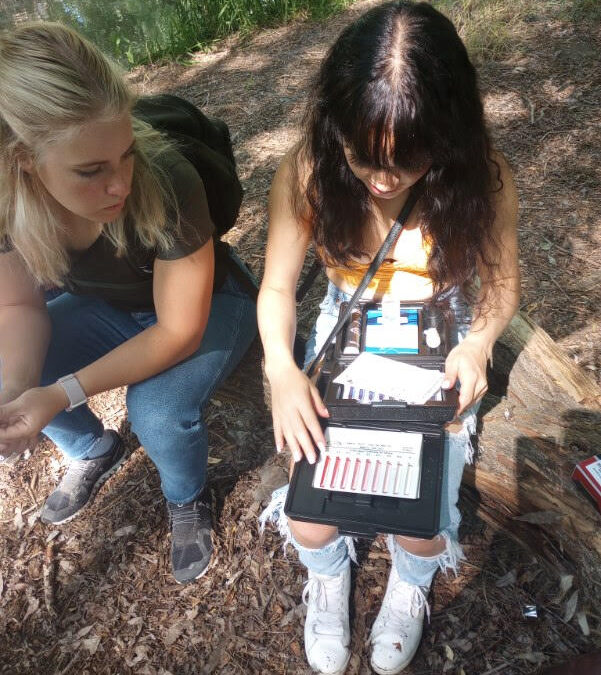
Week three focused on watershed management, during which students investigated a local river and evaluated its watershed and continued pollution. Students identified problems in their community by reading articles and examining data concerning a local river’s environmental issues, proposed solutions, as well as the progress that has been achieved. Students then made qualitative statements about the river’s current condition based on abiotic and biotic measurements. Students used the information gathered and discussed issues concerning the current quality of the river and discussed why water quality is essential. Students researched the issue by conducting river water quality experiments using flow rate measurements and collected macroinvertebrates. Based on their experimental results, students developed a portfolio with a problem explanation, alternative policies, and a public statement concerning the current Jordan River water quality. Students then presented their findings to community members to help inform and educate them about the river contamination and improvements.
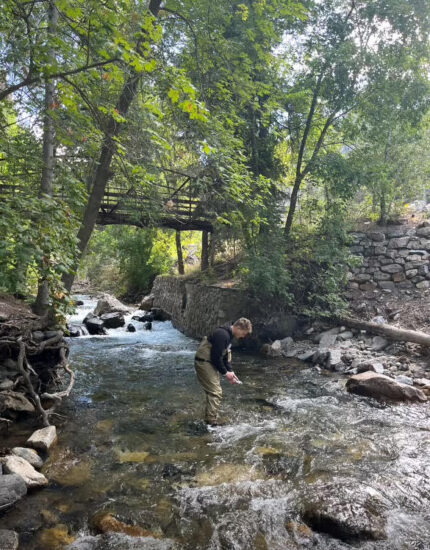
Student collecting water samples.
Week 4: Provo River Delta Restoration Project
During the last week, students examined a river delta restoration project for its effectiveness in restoring a wetland and recovering an endangered fish species. Students investigated the role and importance of river systems and wetland areas, monitored the status of the wetlands, and evaluated the current project’s future effectiveness. Students identified problems in their community by reading articles and examining historical data concerning the lakes environmental issues and made qualitative statements about the lake’s current condition. Students used the information gathered and discussed matters concerning the delta project to protect the local endangered species of June Sucker (Chasmistes liorus). In addition, students toured the construction site and participated in a stewardship activity planting new trees and helping to disperse cottonwood seeds around the area. Based on their stewardship project, a site tour, and experimental results, students developed a portfolio with a problem explanation, alternative policies, and a public statement concerning the current delta restoration project. Students presented their findings to others with the intent to inform and educate them about the project.

Student Impact
This program placed students as critical participants in sustainability and gave them ownership of their education, and knowledge of local environmental issues to give students a deeper appreciation and increased environmental awareness. This curriculum could be adapted for various populations although it is especially essential for those with disadvantaged backgrounds and those underrepresented in science. Creating an opportunity for my students to access nature and build environmental knowledge is important for them to build awareness and an increased ownership of their community. After completing the course, students wrote a reflection on their experience and a summary of what they learned concerning environmental awareness and feelings regarding their connection to nature.
“At first, I hated being outside, but it grew on me, and I had a lot of fun learning about the different invasive species and how they negatively affect the land.”
“I really enjoyed being outside for school. I liked the shaded and natural environments. It was enjoyable and easier to understand because I was learning about everything I could feel and touch.”
“I liked seeing the things we were learning about. It was easier to focus outside.”

Student working on writing assignments during the last day of class.
“I have had a lot of issues with school my whole life. I have never felt like what I was learning was useful. I felt like I was repeating work from former years over and over again and never getting anything out of it. After this experience, I began thinking that maybe the problem wasn’t what we were learning but where we were learning it. It was enjoyable being outside and seeing how what we were learning applied to the world around us. I got to see what we were being taught in action. We did tests with the world and not in a classroom. For the first time, I was really interested in what was being taught, and I realized that the problem wasn’t me.”
The importance of connecting at-risk youth to the outdoors is evident in their reflections. Their reflections indicate an appreciation for being outdoors, a more remarkable ability to focus their attention, and an advantage of learning in the world instead of the classroom. Students’ perception of environmental issues impacts their ability to make educated decisions. The increase in students place identity resulted in a deeper connection to the environment. Their knowledge, attitudes, and actions had changed.
Conclusion
On the last day of class, walking along the river trail with my students, I listened to their conversations, questioned their learning, and gathered their insights. I recognized how the connections made in class developed over time by building relationships, collaboration, trust, and teamwork. My students developed empathy for each other and their environment. As a class, we visited four distinct settings in our local area. My students could grasp the larger perspective by recognizing the cumulative effect of those areas as a whole. They identified the invasive species of cheatgrass studied in week one had made its way downriver and recognized the importance of carbon cycling studied during week two in the cottonwood trees flanking the banks of the river in addition to the value in wetlands studies in week three shown in the progress made on the restoration project. The sequence of each week was purposely built on the following week with a cumulative effort at the river delta restoration project, put in place to help solve many of the environmental issues identified in the previous week’s lessons. This program focuses on increasing student connection and ownership of the environment and identifying how isolated environmental concerns significantly impact the whole ecosystem. Additionally, I wanted my students to notice how environmental restoration and protection alleviate some of these issues. These connections came naturally to the students after the time spent outdoors and investigating environmental issues. Exposing them to new areas and increasing their knowledge and skills affects their awareness.
The environmental science program provided environmental concepts, fostering a deeper appreciation for nature and the outdoors. It engaged all senses, made learning more interactive and memorable, and encouraged more profound connections with the natural world, building ownership of the local area. This program initiated an attachment of students to the local area. It engaged students in environmental issues through science by participating in experiential outdoor education. It kept students engaged with relevant current topics, formed a connection to the natural world, and involved them in direct, focused experiences to increase knowledge, skills, and values.
 Lindsay Casper is a graduate student in Environmental Science at the University of Idaho, in Moscow Idaho and teaches Environmental Science to at-risk youth at Summit High School in Utah.
 Brant G. Miller, Ph.D., is an Associate Professor of Science Education at the University of Idaho. His research interests include Adventure Learning, culturally responsive approaches to STEM education, science teacher education, and technology integration within educational contexts.
by editor | Oct 17, 2023 | Critical Thinking, IslandWood, Learning Theory, Outdoor education and Outdoor School, Place-based Education, Questioning strategies
Key Considerations for Asking Questions as a
Field-Based Science Instruction
By Amos Pomp
Introduction
We do not ask [questions] in a vacuum; what we ask, how, and when are all related.
– Bang et al., 2018
How can field-based science instructors be intentional with the questions we ask students?
As a graduate student and field-based environmental science instructor for 4th-6th graders in Washington State, I ask students questions all the time. Asking questions is an integral part of learning and doing science and is one of the Next Generation Science Standards science and engineering practices. I believe that the questions I pose as an instructor have the power to either disengage or engage student groups in their learning processes. Thus, considering which questions I ask, and when, is a significant and nuanced part of my teaching practice.
Instructor-posed questions are an important, multifaceted part of effective pedagogy. Instructors should ask their students various types of questions and celebrate various types of answers. Instructors may ask questions to elicit students’ prior knowledge, check their understanding, help them figure out where there are gaps in their ideas, and help uncover ideas that would otherwise go unnoticed (Reiser et al., 2017). Instructors may also ask questions to “help students figure out and refine their own questions” (ibid.).
The way in which instructors ask questions and elicit answers is also important. If I only encourage spoken answers to my questions, I may send an implicit message that I only value verbal and vocal participation in my learning environments. If I only praise the ways in which one student’s artwork connects to my prompt, I’m implying that I prioritize some sensemaking over others’. If I only accept scientific names of plants as correct, I’m indicating what kinds of knowledge I deem acceptable.
Reflecting on this non-exhaustive list of reasons for asking questions, as well as the potential implications of how I solicit answers, has led me to be more intentional with the questions I do ask and how I ask them. I don’t just think about what I am asking my students; I also think about why I am asking it—for what purpose. I think about whom I am asking it to or for and what kind of responses I am expecting from my group. How can I engage them in their own sensemaking and synthesis, creative thinking, and science and engineering processes? To help plan for each new group of students I teach, I’ve developed a framework for how I consider the pedagogical purpose of my questions.
Reflecting on My Own Experience
At the beginning of the school year, my grad cohort and I had many discussions about what teaching and learning look like. From our conversations, we agreed on two key points. The first is that to us, successful field-based science instruction looks like guiding students in their own thinking, observing, and investigating. Rather than responding to students’ questions with an easy answer of my own, one of the routines I adapted early on was asking them, “What do you think?” Even when posed informally, asking students what they think and encouraging a genuine answer is a pedagogical move to redistribute power and agency by encouraging them to gather evidence and explain their own reasoning and learning.
 The second point we agreed on is that masterful instructors learn from and alongside their students in processes of collaborative sensemaking. At first, I found this process came naturally. Being new to field-based science education in the Pacific Northwest, it was easy for me to respond to a student’s pointing at something and asking what it was or what was happening without giving them an easy answer. “I’m not sure, have you seen something like it before?” I would say, or “tell me what you notice about it and what it’s doing. Can we come up with three possible answers to your question?” Asking these questions positioned my students as experts on their own experiences and encouraged us to work together to learn about our environment.
As the school year has progressed and I’ve became more knowledgeable about the ecosystem I’m teaching in, I’ve noticed two things happening. In moments where I am doing new activities or teaching lessons in new ways, my questions have remained open-ended and genuine, like the above examples.
In other cases, however, I have found myself struggling to maintain nuanced intentionality in my question asking. Sometimes I notice myself asking students answer-seeking, or “known-answer,” questions—questions to which I already know the answer I’m looking for—because I want the group to reach a specific understanding about a topic based on my own knowledge or some third-party definition (Bransford et al., 2000). Other times, I’ll ask the group a question about an activity we just did and receive mostly blank stares in response. In these instances, I am probably asking the wrong questions and discouraging the divergent thinking, diverse forms of engagement, and collaborative sensemaking and synthesis I’m looking for.
Upon reflection, I decided to create a tool to help me make sure I ask students pedagogical questions with the intention they deserve.
Instructor-Posed Questions: A Framework
When thinking about how to intentionally ask a question to a group of students, here are some key considerations I take into account.
Assessing the state of the group
Before asking my students a pedagogical question, I assess the state of the group. This assessment can happen during planning or in the moment. I think about where the students are or will be physically, as well as what is or will be going on, when I plan to ask the question. Perhaps they would still be riled up after an activity, or they might need a snack. Perhaps a group discussion would not add any value to what’s already happened or could possibly even detract from the experience. Perhaps the group needs to hear the question then move to another location before answering to have time to think and discuss casually on the way. If I want the group to engage in some sort of collaborative sense-making, I do my best to ensure that the group is in a place where most of the students will be able to engage in the process in some way.
Allowing for different forms of student engagement
When I plan to ask a group of students a question, I then think about how I want them to answer. I can ask them to answer in written/drawn form, whole-group share-out, in small groups or a partner, just in their own heads, or some other way. I make this decision based on patterns of what I’ve seen work best for similar groups in similar situations in the past.
Once I’ve decided how I want students to answer my question, I find it’s best to give instructions before asking the question. For example, I might say, “You’re going to answer this question in your journal, and you can write, draw, write a poem or song, or even create a dance or found-material sculpture.” Then I ask the question and repeat the ways that students can answer.
Clarifying the goal or purpose of my question
For this section I’ll use an example wherein my goal is for students to think and learn about the role of photosynthesis in a plant’s life and the role plants play in ecosystems.
With my goal in mind, I could ask, “What does photosynthesis mean?” However, I would likely hear one student’s regurgitating a definition from a textbook, which does not necessarily indicate true learning or understanding. Also, if I ask such didactic questions multiple times to the same group, I often end up calling on the same students repeatedly—missing out on quieter voices—because they are the ones comfortable with sharing in such a way.
I would also refrain from asking, “Who can tell me what photosynthesis means?” This wording implies that it’s time for someone to win favor by being the one who can. It’s a challenge to see who can show off their knowledge, and it doesn’t help a group of students explain how photosynthesis works or why it matters.
Additionally, I don’t want to ask my question if I’m looking for a specific answer. I have to be open to students’ explaining photosynthesis in new ways or talking about other ways that plants get energy and contribute to ecosystems.
Asking a question
Instead of the examples above, I could ask my students, “How do plants get energy?” or “How can we describe a plant’s relationship to the sun?” These explanatory questions engage students in more diverse scientific practices than just naming and defining a chemical reaction (Reiser et al., 2017). If I’m having trouble getting students to move toward photosynthesis, I could ask, “What do you think of when you hear the word photosynthesis?” which I still find to elicit more open-ended responses than the original example.
Something else to consider is that if, for example, I’m teaching a group of students who have never been to a harbor like the one I bring them to for a lesson, any questions I ask the group about what role plants might have in the harbor ecosystem will not carry as much meaning for them if they do not first have a shared, relational experience with plants at the harbor (Reiser et al., 2017). If I can first facilitate a time for them to explore and observe plants at the harbor, then asking them about their own thoughts and questions about plants at the harbor will have much more success. I can also ask questions in ways that allow students to bring in past experiences with other beaches or plants in other ecosystems.
I am also aware while teaching that common lines of questioning in schools are rooted in the discursive patterns of white, middle-class, European Americans. One way that I can expand my question-asking practice is encouraging learners to investigate the “likeness between things” to draw in students who engage in more metaphorical learning by exploring analogies with the question, “What is photosynthesis like?” (Bransford et al., 2000). Robin Wall Kimmerer agrees: “asking questions about relations illuminates answers that true-false questions may not” (Bang et al., 2018).
Finally, I could also ask questions that help students evaluate their own learning or the learning process, like “how did you contribute to the group in the photosynthesis investigation?” or “how did that activity go for you?” rather than ones that assess what they learned (Rogoff et al., 2018). I would ask these latter questions to prioritize my goal of exciting students about science learning over ensuring that they learn any specific “facts” or “knowledge.”
Deciding not to ask a question
Sometimes, I move through my framework and decide I don’t need to ask the group a question. Instead, I’ll tell the group some of my own thoughts on the matter, or I might just transition to something else entirely. An example of the latter is that if I’m more interested in having my students explore something other than how photosynthesis works, rather than asking them what they know about photosynthesis, I could simply say, “Photosynthesis, which, for those who might not remember, is how plants create their own energy from sunlight, carbon dioxide, and water.”
Conclusion
Asking questions in field-based science education is a nuanced practice. The way instructors ask questions reveals to students both explicitly and implicitly what forms of participation they value, whose knowledge they prioritize, and what kinds of learning they deem acceptable. With a bit of intentionality, however, instructor-posed questions are the key to engaging students in collaborative sensemaking and synthesis, divergent thinking, and science and engineering processes of their own.
References:
My mentors, Renée Comesotti and Dr. Priya Pugh
Bang, M., Marin, A., & Medin, D. (2018). If Indigenous peoples stand with the sciences, will scientists stand with us? Daedalus, 147(2), 148-159.
Bransford, J. D., Brown, A. L., & Cocking, R. R. (2000). How people learn (Vol. 11). Washington, DC: National academy press.
Reiser, B. J., Brody, L., Novak, M., Tipton, K., & Adams, L. (2017). Asking questions. Helping students make sense of the world using next generation science and engineering practices (pp. 87-108). NSTA Press, National Science Teachers Association.
Rogoff, B., Callanan, M., Gutiérrez, K. D., & Erickson, F. (2016). The organization of informal learning. Review of Research in Education, 40(1), 356-401.

by editor | Feb 23, 2021 | Critical Thinking, Equity and Inclusion, Questioning strategies
Aldo Leopold famously wrote,”One of the penalties of an ecological education is that one lives alone in a world of wounds.” As environmental educators, we must ask ourselves what we are giving our students that equips them to deal with this harsh reality.
by Nick Engelfried (2017)
It hurts to love nature in the twenty-first century. Climate change, species extinctions, toxic forms of resource extraction like fracking, all will inevitably be encountered by our students in headlines and the evening news. Again and again, they will be confronted with news of harm being done to the world they have grown to love. What tools can we give students to defend themselves against despair and cynicism?
The solution, I believe, is for students to see environmental issues not as a serious of hopeless problems, but as a set of challenges with solutions they can take action to implement. By “taking action,” I don’t mean changing light bulbs, turning off the faucet, or reducing one’s meat consumption.
Making environmentally friendly lifestyle choices may provide a temporary sense of relief for some students. However, those who think critically about it will quickly realize that much larger forces than their individual footprints are at play in creating the climate crisis.
If we want to help students thrive in Leopold’s “world of wounds,” we must guide them far beyond the realm of personal consumption choices. We must help them see opportunities for collective, not just individual action. This is especially important for students of high school age and up, who are both developmentally ready to think about social change and increasingly likely to be exposed to environmental news as their awareness of the world around them expands.
I recently had the opportunity to experiment with teaching students about collective action and climate change, while co-leading a group of high school juniors and seniors on a 12-day backpacking trip for the North Cascades Institute (NCI) Youth Leadership Adventures program. NCI is a nonprofit that has been helping people connect with nature in and around the majestic mountains of North Cascades National Park for over three decades. NCI’s Youth Leadership Adventures program gets high school students out into the backcountry to learn about natural history, sustainability, and leadership.
In the lessons my two co-instructors and I taught while leading our students through North Cascades National Park, we made a point of emphasizing climate change solutions that involve collective organizing. The successes and challenges we encountered may, I hope, be useful to educators in similar positions who wish to help their students become effective agents of environmental change.
On the third day of the trip, one of my co-instructor colleagues led a lesson which introduced concepts like how the greenhouse effect works. We felt it was important to give students this grounding in basic climate science as a way to set the stage for future lessons.
Two days later, we introduced students to some specific impacts of climate change on people around the world. Another of my fellow instructors led a “Climate Change Mixer” activity taken from Bill Bigelow and Tim Swinehart’s excellent book, A People’s Curriculum for the Earth. Students participated in a role play in which they took on the roles of real people whose lives are affected by climate change or energy extraction. Afterwards, several students expressed surprise at the severity of climate change impacts on people like members of the Gwich’in nation in the Arctic, whose way of life is threatened by melting ice and the die-off of caribou.
Having acquainted students with the science of climate change and some of its effects, we were ready to talk about action. The day after the mixer activity, I led a lesson on social change designed to get students thinking about how they could have a positive influence on climate issues. I opened the lesson by introducing a concept none of the students had heard of before: theory of change.
A person’s theory of change is their mental conceptualization of how change occurs in society. If you believe the solution to environmental problems is for each of us, one by one, to decide to change our lightbulbs and reduce our meat intake, that’s your theory of change. This is also the theory promoted by many mainstream environmental education materials, which emphasize individual lifestyle changes above all else.
Another, equally problematic theory of change most high schoolers have encountered is that major societal changes are mostly triggered by charismatic individuals and “super-people,” who inspire the masses with exceptional acts of daring or wisdom. The way history is taught at the elementary and high school levels tends to reinforce this theory. Traditional historical narratives focus on charismatic leaders—the George Washingtons, Abraham Lincolns, and Martin Luther Kings—to the virtual exclusion of thousands of other ordinary people who contributed to making change happen.
To get students thinking critically about developing their own theory of change, I had us analyze one of the most famous accounts of personal bravery from US history: the Rosa Parks story. I asked a student volunteer to recount the story the way they’d learned it in school. The traditional narrative goes something like this: Rosa Parks, a seamstress in Montgomery, Alabama, decided one day that she would not put up with racist segregation laws any longer. She refused to give up her seat on a bus to a white man, and this act of personal bravery inspired the city-wide Montgomery Bus Boycott. This in turn gave rise to the Civil Rights Movement.
I next introduced some additional facts usually left out of the Rosa Parks story (these particular bits of background information were drawn from Paul Schmitz’s article for Huffington Post, “How Change Happens: The Real Story of Mrs. Rosa Parks and the Montgomery Bus Boycott”). They include:
• Rosa Parks had a long history of challenging segregation. In 1943, she was elected Secretary of the local NAACP chapter.
• Prior to her arrest, Parks had received training in nonviolent civil disobedience practices at the Highlander Folk School.
• When Parks was arrested in 1955, Alabama NAACP President E. D. Nixon was already searching for a good plaintiff to challenge segregation laws.
• Organizing the Montgomery Bus Boycott was a major undertaking involving many people. Jo Ann Robinson, a local leader in the Women’s Political Council, spearheaded an effort to print and post 15,000 fliers supporting the boycott.
None of these details diminishes the significance of Rosa Parks or the heroic nature of her actions. However, the picture they paint is quite different from the traditional Rosa Parks story. Rather than an act of individual bravery spontaneously triggering change, this more accurate narrative becomes one about a community of people coming together to challenge an unjust system.
It was now time to get students thinking about social change in an age of climate crisis. To do this, I introduced a role play centered around a current issue in Washington State: the controversy over a proposed new oil export terminal on the Columbia River in Vancouver, WA.
I first gave students some context. Tesoro-Savage, an oil infrastructure company, is seeking permits from the State of Washington to build the country’s largest oil export facility at the Port of Vancouver. If built, the terminal would further the world’s reliance on fossil fuels, and would be serviced by four oil trains per day passing through many towns and cities in the Columbia River Gorge. A train derailment in any of these communities could cause a disaster involving a massive explosion and thousands of gallons of spilled oil.
Given that most students in our group came from Washington or northern Oregon, the Vancouver oil export debate is unfolding in their backyards. Despite this, not one student had heard about the issue before I introduced it to them. This says something about the state of environmental education in our schools.
Having given students basic facts about the oil export proposal, I next introduced a fictional scenario set in a hypothetical community called Columbia Village. I asked students to imagine that Washington Governor Jay Inslee had given the oil project its final permit (in fact, Governor Inslee is expected to make a decision later this year). Oil trains would soon begin rolling through Columbia Village, which is situated in the Gorge along the rail line. For the role play, students would take on the personas of people from a variety of backgrounds meeting at the Columbia Village Community Hall to discuss a response to this environmental and public safety threat.
Unlike the roles assigned to students in the Climate Change Mixer, those I created for this activity were not based on real people. However, as someone who has attended dozens of meetings where members of a community came together to challenge fossil fuel projects, I carefully modeled each role around a different point of view that one frequently encounters at such gatherings. Specific characters included a mother concerned about dangers to her children, an activist advocating mass civil disobedience, and a member of the Yakama Tribe concerned about the oil project’s impact on fishing rights.
At this point in the lesson we took a break for dinner, and to let students familiarize themselves with their roles. I explained that students’ job at the community meeting would be to advocate for their character’s point of view about an acceptable course of action. Students would be allowed to “change their minds,” but only if they felt this was realistic and that the concerns of their character had been adequately addressed.
My hope for this activity was students would realize that many characters in the role play represented very different theories of change—and that their job at the meeting must be to reconcile these diverse points of view into a plan that could realistically achieve the desired result. I myself participated in the role play when we reconvened, acting as the meeting facilitator whose only goal was to ensure a consensus was reached without advocating any particular point of view.
The role play that unfolded over the next forty minutes or so at least partly satisfied my hopes for the activity. Unsurprisingly, one of the most contentious issues was that of using civil disobedience to confront the oil trains. One character in the role play advocated people blockading the oil trains with their bodies—and several others responded negatively to this idea, arguing that it was too dangerous. It was not unlike actual debates over civil disobedience, which I have listened to at many real-life meetings.
As an alternative to civil disobedience, another student suggested organizing a massive but legal protest near the rail line. I was surprised that the students seemed to think getting a permit for such an event would be a much longer and more arduous process than would probably really be the case. More predictably, many students were a bit naïve about how many people they could get to show up at a protest, envisioning a crowd of 100,000. The Dalles, one of the larger towns in the Columbia Gorge, has a population of only some 14,000, and most Gorge communities are much smaller.
Another character in the role play suggested everyone work on reducing their individual carbon footprints so as to make oil infrastructure irrelevant. I had added this point of view hoping it would force students to grapple with whether individual lifestyle changes are really enough. As it turned out, many students seemed genuinely torn about this. Some were understandably drawn to the idea that individual changes might inspire larger community-wide actions. Others pointed out that even if an entire town’s population switched to energy efficient light bulbs, this wouldn’t have much impact on global economic forces that made the oil export project viable. While students never addressed the lifestyle issue in quite the direct way I hoped they might, I felt satisfied they were coming to realize that individual changes are necessary but not sufficient.
In the end the students, through their role play characters, arrived at a consensus for a compromise course of action: to move forward with a march and a petition-gathering effort, while also embarking on a public education campaign to encourage sustainable lifestyles, and preserving the option of civil disobedience for those who wished to engage in it. In real life, such a wide-ranging, ambitious plan of action would probably seem unrealistic for a new community group’s first meeting. However, I feel this is far less important than the fact that students were able to recognize the value of different theories of change as well as some of their defects, and to come up with a plan not unlike the strategies some real climate activist organizations have developed.
After the social change lesson, I realized in my eagerness to get students thinking about collective action, I had neglected to fully bring the lesson back to students’ own experience and concrete actions they themselves could take. Fortunately there was time to rectify this. Later in the trip, one of my colleagues led an activity in which students made a pledge to themselves to take a climate-related action of their own choosing within the next year. Some students’ pledges centered around lifestyle changes like using less plastic or water. But I was pleased to note others chose collective actions like getting involved in activist groups or starting a climate-focused club at their schools.
The climate change lessons my colleagues and I taught during this 12-day trip represented an experiment in getting students to think about how environmental change actually happens. There are things I plan to do differently next time I teach a similar curriculum. At the beginning of the social change lesson, I wish I had spent more time illustrating the theory of change concept with specific examples. In designing the oil trains role play, I also could have done more to flesh out the characters assigned to each student, which perhaps would have led to deeper conversations about diverse perspectives.
These lessons learned aside, I feel the curriculum my colleagues and I devised for this backpacking trip successfully helped students take the first tentative steps toward envisioning how they might play a role in confronting climate chaos—and not just by participating in Meatless Mondays. I hope they came away with at least a few tools for fighting back against the sense of hopelessness despair that can come from living in a “world of wounds.” ❏
Bibliography
Bigelow, Bill and Tim Swineheart. A People’s Curriculum for the Earth. Milwaukee, WI: Rethinking Schools, 2014. 410 pages. ISBN number: 978-0-942961-57-7. The “Climate Change Mixer” activity described on pages 92-101 is referenced for this article.
Leopold, Aldo. A Sand County Almanac, With Essays on Conservation From Round River. New York, NY: Random House Publishing Group, 1970. Originally published by Oxford University Press in 1949 and 1953. 295 pages. ISBN number: 0-345-34505-3. The quote used in this article, “One of the penalties of an ecological education is that one lives alone in a world of wounds,” appears on page 197.
Schmitz, Paul (December 1, 2014). “How Change Happens: The Real Story of Mrs. Rosa Parks and the Montgomery Bus Boycott.” Huffington Post. Retrieve August 7, 2017, from http://www.huffingtonpost.com/paul-schmitz/how-change-happens-the-re_b_6237544.html. This piece was used as the main source for background information about the Rosa Story.
Nick Engelfried is an environmental educator and activist, currently working on his M.Ed. in Environmental Education through Western Washington University. As part of his work for the degree program, he is participating in a year-long residency working with the North Cascades Institute.

by editor | Sep 17, 2015 | Questioning strategies
 What’s the Difference…
…between a single performer and an energetic band? Can students teach themselves?
by Jim Martin
CLEARING Master Teacher
 n an earlier set of blogs, we followed a middle school class whose science teacher had started them on a project to study a creek that flows at the edge of the school ground. The last time we saw them, groups were analyzing and interpreting the data and observations they collected on their first major field trip to the creek, and preparing a report to the class. The blog focused in on the group doing macros, macroinvertebrate insect larvae, worms, etc., who live on the streambed; aquatic invertebrates large enough to distinguish with the unaided (except for glasses) eye.
They eventually organized themselves into three groups, one to cover the process of collecting the macros, one to describe how they identified and counted them, and a third to find out how to use their macro findings to estimate the health of the creek. Sounds like they’re on a learning curve, moving from Acquisition to Proficiency. They would need some feedback, both from withn the group and from their teacher. She gave each group one more task, to find out what they could about effective student work groups.
The macro group prepared the presentation they would make to the class. Each of their groups prepared their part, then they gave their presentations within the group, and used this experience to tweak them into a final, effective presentation. Their presentation included the interpretation they made based on their collected data that the creek’s current health was Fair, tending toward Good.
They used the rest of their prep time to begin a search for information on effective student work groups. During their web search, they were surprised there was so little there about middle school work groups, since they are finding their work invigorating, and feel they are learning a lot. Some of the sites they visited were confusing, some targeted high schools, but most described college work groups. Among those things related to effective work groups they found and were interested in were those which described the work, maintenance, and blocking roles individuals play within work groups, and those which described how groups can make their work visible while they’re processing by using whiteboards, posters, etc. They saw how these aids would help clarify concepts as they were learning. They decided to report on these two findings, roles group members play and making the work visible so that it is easier to discuss and process.
Of the two group characteristics they decided to report on, the idea that individuals play roles in a group, and these roles affect the work of the group were the most interesting to them, and a bit of a revelation. They were especially intrigued by one of the Blocking roles, which interfere with a group’s capacity to complete its work. The one they found most interesting was the Avoidance Behaver role. Each of them had engaged this role when they were madly fighting for the D-net while first collecting macros. (By joisting to control the D-net and collecting tray, they were avoiding the work in the way in which they behaved. They had employed Avoidance Behaviors; each of them, as they joisted, was an Avoidance Behaver.) They still laughed at the fun they had been having, but also felt the odd juxtaposition of this role with the Work and Maintenance roles they also played to move the work along, clarify the processes they used and identifications they made, keeping communication lines open, and sending out consensus queries about what they thought they were finding out.
They were encouraged that most of the roles they assumed were positive ones which lead to a successful project. As they talked, they also came to consensus that this was a finding of their work as important as their findings indicating that the health of the stream was Fair, tending toward Good. A revelation for them, and would become one for their teacher.
This group has made good progress on their new learning curves, macroinvertebrates and group roles. One curve is facilitating their conceptual understanding of macros; the other curve is empowering them to understand the dynamics of an effective work group. They entered these learning curves because (1) their teacher set them up in the first place, and (2) the Acquisition phase included finding out about macros. And, perhaps inadvertently, their, and their teacher’s discovery of the importance of developing effective work groups. Because the students were first finding macros, then learning about them, they started their work seeking information and patterns which would help them know who was living on the bottom of the creek. They didn’t consciously couch their investigation in these terms, but this is what they were experiencing.
The experience of seeing if they could actually capture macros, and the fun involved in collecting and seeing them stimulated the limbic’s Seeking system in their brains, which added dopamine to the neural soup that facilitates human efforts to make work interesting. These feelings and felt interests, in turn, drove them to the books and the web to follow up on the needs to know generated by their inquiries. Under their own power. First, the excitement of learning how best to capture macros, then residual interest carried them to the manuals to begin to identify who was there. ‘Finding Out’ is a powerful student (and human) motivator, one we stamp out as students move through the grades we teach. Perhaps because many of us don’t understand the content we teach well enough to allow our students to have their own thoughts about it. (Parenthetical comment on the 50%)
We could learn to use this motivator to engage conceptual learnings in ways that involve and invest our students in their learnings, and empower them as persons. There is a big difference between memorizing for a test and trying to find out the same information. The difference between a single performer and an energetic band. One way that difference expresses itself is in our standing in global scales of learning, where we are consistently near the bottom, rarely in the upper half. Our current model of school is memorizing for tests. How well does that work? We need to rediscover this active, group-centered, collaborative way of being human, and exploit it in our classrooms and outdoor sites. Telling students what is before them doesn’t stimulate long-term conceptual memory; helping them find out does. I’d like to say, “Freeing them to find out,” but for many teachers those words, especially the first one, might be intimidating to hear.
Building effective work groups takes time and patience. Fortunately, it goes quicker if the process takes place while the groups are pursuing an inquiry. Engaging in this kind of work develops needs for just the sort of group processes which make inquiries successful. While she may not have consciously planned it, dividing the class into groups, each with its own part of the creek to study, set the stage with students who were ready to learn about effective work groups. They weren’t consciously aware that they were ready, but their needs to do the work did the job for them.
(I’m interested in Jaak Panksepp’s work at Washington State University on the brain’s limbic system’s Seeking System. It’s important to learning for understanding because this is one of the few instances in which engaging the relatively primitive Limbic System leads to effective activity in the cortex, where critical thinking happens. When educators speak of the brain and learning in the same sentence, eyes in just about any audience tend to either roll or glaze over. Even though the brain is our organ of learning, teachers and administrators tend to think of learning and publishers’ products as the only bundle that matters. No room for neuronal bundles. Connecting. In effective ways. Evolved bottom up, and may work best that way.)
First, by sending students to find out, the emotions of the Seeking system move them to the cortex and critical thinking. Then we organize the learners’ environment so the information they (their cortices) need to know is readily available. And we can watch as our students learn for understanding. My experience was this: First engage students in their inquiries, then see how much of the reading I would have assigned or lectured on that they get into on their own. My observations on learners over the years told me that any movement away from total inertia on the part of the student indicates a determined effort to learn even if it’s a small move, say 10% of the way to mastery. Perusing the research on the brain eventually clarified that particular parts of the brain, when they were working, elicited the learning behaviors I observed, and clarified students’ involvement and investment in the learning, and empowerment as persons, and prepared them to form effective work groups.
So, the teacher and her class were learning that one thing which will enhance student performance is to learn how to get group members to interact. You can facilitate this by ensuring that students’ work calls for the communication skills it takes to develop consensual decisions about complex topics. The teacher whose students we just followed did this by asking each group to research information about effective student work groups. They do the work, she gleans the information. Win-win. A further step would be deciding how to include minority opinions in final reports. Simple to do; you just announce that you allow it. In my experience, this helps students achieve ownership of their learnings. A surprise for me was that sometimes students presenting a minority report saw something other groups presented from a new perspective, that of observer, not of learner. Whether that altered their interpretation of findings wasn’t as important as the fact that they were developing the capacity to hear another view and think about it. And validate the right to hold it. And, holders of the majority opinion often did review their thoughts.
The macro group is moving through its own learning curve. Does their progress look like a learning curve? Where did they start? Where are they now? How does the learning curve differ for an individual student vs. an effective work group? I picture this difference as one between a single, good performer, and an energetic band; the interactions between group members, while they’re working, can make a routine school activity become an exciting experience, a performance to be remembered. If you’re a teacher, listen to that last word.
 This is a regular feature by CLEARING “master teacher” Jim Martin that explores how environmental educators can help classroom teachers get away from the pressure to teach to the standardized tests, and how teachers can gain the confidence to go into the world outside of their classrooms for a substantial piece of their curricula. See the other installments here, or search Categories for “Jim Martin.”

by editor | May 27, 2015 | Critical Thinking, Learning Theory, Place-based Education, Questioning strategies
Photo by Jim Martin
“Lessons for Teaching in the Environment and Community” is a regular series that explores how teachers can gain the confidence to go into the world outside of their classrooms for a substantial piece of their curricula.
Part 3: Emergent phenomena
by Jim Martin, CLEARING guest writer
If you go to a place in the world outside your classroom – your school yard, a trail nearby, a stream bank – and think about it, you’ll find it is a prism which, oriented effectively, holds the power to involve and invest your students in their educations, and empower them as persons. Simple miracle; takes work to discover.
You’ve found a place for your project, large or small, and thought of a partner or partners. Quite possibly, you might have noticed a piece of embedded curriculum. And maybe even thought of what students would do. These are the sort of things that emerge from the places in the real world when you go to them with your teacherly knowledge, skills, and understandings. The part of you that is Teacher is the prism from which the potential that resides in your community and environment emerge in observable form, paint their elements, disclose the human mind.
We named two projects last week. Let’s take a closer look at them and see what emerges.
A Small Project
Your class visits a nursing home every spring, and your students would like to grow flowering plants, pot them, and take them when they make their visit. You discuss this, and decide to plant seeds in the soil just under your classroom’s windows. When they’re growing well, students will transplant them to pots, which you have in your room.
What are the partnerships that will help you do this work? To do the project, you must get students out of the room and back, procure seeds and tools, touch bases with the custodian and principal, do the potting and manage kids on station. Plus, you have to deliver the fractions and biology lessons that you discovered in the schoolyard near your window. You have some resources, like the manager of a small local pharmacy, who has a limited budget for public services expenditures. Also, the nursing home and the school, which has gardening tools.
You need seeds, so ask the manager of the pharmacy outlet for a donation of one packet each of eight kinds of annual flowers. She agrees, and you get your seeds. So, children plant, seeds grow, students pot and then take their flowers to the nursing home. During the work, they learned about fractions and studied a biology unit on seeds. A resource you used is doing fractions and studying biology on site, so that you don’t do the project in addition to your already heavy teaching load.
Let’s call the people, institutions and organizations you worked with your “Partners,” and think of the project as one done with partnerships. Your Partnerships assist you with the logistical load involved in doing projects.
So, one tool you use is Partnerships, however small, to share the load. Sharing the load is an important part of doing projects. We live in communities, and ought to use them. It’s important to understand partnerships. Even though your partners are sponsoring part of the project, you are doing something for them and they are doing something for you. That’s why people engage in partnerships, because all parties bring something useful to the table.
A Larger Project
This project is a streambank restoration sponsored by a regional bird sanctuary and the local Friends of Trees organization. They provide tools, supplies, plants, and training for you and your students,. They also schedule three Americorps Volunteers for field trips and one classroom visit. You provide workers (your students), student-made site maps, site habitat assessments, and a summative Power Pointtm presentation.
The project entails a site visit to orient yourselves and begin site mapping, one to clear vegetation and continue mapping, another to survey, one to plant, and another to monitor the planting. In this sort of project, your partnerships are crucial to beginning and finishing the project. The bird sanctuary has some equipment and materials available to you for making the observations you’ll need to make the site map, and guidelines for performing the habitat assessments. They also have a person who will mentor you as you go through the stages of a streambank restoration project. This will give you the large picture within which your students’ work will fit. It also has, embedded within it, lots of useable curricula. Friends of Trees will help to plan and do vegetation clearing and using GIS techniques to map plants your students will put into the ground.
This means that you now must manage transportation, substitutes, and curriculum on your own. These present their own learning curves. The prism which organizes this confusing chatter of pieces, parts, jobs, and so forth, into recognizable and useful bands, bands which clarify community and environment based education into an inspiring and inviting rainbow is your capacity for doing self-directed science inquiry. In my experience, that seems to be the key empowering piece of the education puzzle. Most of us have never done a science inquiry from noticing something interesting, to asking a clear question about it, designing an investigation, collecting data, analyzing and interpreting it, communicating our findings, and identifying interesting follow-up questions. Somehow, engaging this from start to finish leaves teachers with a fresh perspective on what they are teaching, and how. And empowers them to thoroughly involve and invest their students in their educations and their lives. If you’ve ever seen the face and eyes of an empowered child, you’ll know what I mean.
Part of this change in perspective comes from releasing yourself from dependence upon directions in the publishers’ materials and teachers’ editions, and discovering that your students will find better, more effective ways to use them. Especially those in your bottom 25th percentile. (You can get an idea of what this might look like by going to Mike Weddle’s article here. He gives the most complete picture of what community and environment based education looks like that I’ve read. Written from the pen of a teacher. Jude Curtain, also on the website here, gives the best one-page description of science inquiry that I’ve read. They both know, and clearly express student-directed science inquiry.)
So, let’s walk through an inquiry, one blog at a time. The site can be your school, a natural area, a parking lot. They all work. Here’s what to do. If you can, spend some time in a place you’d like to do an inquiry. It doesn’t have to be one you’d take your students to. Browse around; find things that either interest you or raise questions in your mind. Just immerse yourself in the place. Here’s how one started for Dryas, my wife, and Carol Lindsay, our African Drum teacher, on a summer afternoon several years ago. We were by a side channel of a local stream, and they saw what they thought was a dragonfly with eight wings. They wondered what it really was, and set out to find out. This happens when you let something catch your eye. Go out this week and let it.
 This is the third installment of “Teaching in the Environment,” a new, regular feature by CLEARING “master teacher” Jim Martin that will explore how environmental educators can help classroom teachers get away from the pressure to teach to the standardized tests, and how teachers can gain the confidence to go into the world outside of their classrooms for a substantial piece of their curricula. See the other installments here.


