
by editor | Mar 20, 2019 | Indigenous Peoples & Traditional Ecological Knowledge
Educating as if Survival Matters
Nancy M Trautmann Michael P Gilmore
BioScience, Volume 68, Issue 5, 1 May 2018, Pages 324–326, https://doi.org/10.1093/biosci/biy026
Published:
22 March 2018
 ver the past 40 years, environmental educators throughout the world have been aiming to motivate and empower students to work toward a sustainable future, but we are far from having achieved this goal. Urgency is evident in the warning issued by more than 15,000 scientists from 184 countries: “to prevent widespread misery and catastrophic biodiversity loss, humanity must practice a more environmentally sustainable alternative to business as usual… Soon it will be too late to shift course away from our failing trajectory, and time is running out. We must recognize, in our day-to-day lives and in our governing institutions, that Earth with all its life is our only home” (Ripple et al. 2017).
In this tumultuous era of ecocatastrophes, we need every child to grow up caring deeply about how to live sustainably on our planet. We need some to become leaders and all to become environmentally minded citizens and informed voters. Going beyond buying greener products and aiming for energy efficiency, we must find ways to balance human well-being, economic prosperity, and environmental quality. These three overlapping goals form the “triple bottom line,” aiming to protect the natural environment while ensuring economic vitality and the health of human communities. This is the basis for sustainable development, defined by the United Nations as “development that meets the needs of the present without compromising the ability of future generations to meet their own needs” (WCED 1987). Strong economies of course are vital, but they cannot endure at the expense of vibrant human societies and a healthy environment.
Within the formal K–12 setting, a primary hurdle in teaching for sustainability is the need to meaningfully address environmental issues within the constraints of established courses and curricular mandates. In the United States, for example, the Next Generation Science Standards designate science learning outcomes for grades K–12 (NGSS 2013). These standards misrepresent sustainability challenges by portraying them as affecting all humans equally, overlooking the substantial environmental justice issues evident within the United States and throughout the world. Another oversight is that these standards portray environmental issues as solvable through the application of science and technology, neglecting the potential roles of other sources of knowledge (Feinstein and Kirchgasler 2015).
One might argue that K–12 students are too young to tackle looming environmental issues. However, they are proving up to the challenge, such as through project-based learning in which they explore issues and pose potential solutions. This may involve designing and conducting scientific investigations, with the possibility of participating in citizen science. Case-study research into teen involvement in community-based citizen science both in and out of school settings revealed that the participants developed various degrees of environmental science agency. Reaching beyond understanding of environmental science and inquiry practices, this term’s definition also includes confidence in one’s ability to take positive stewardship actions (Ballard et al. 2017). The study concluded that the development of environmental science agency depended on involving teens in projects that included these three factors: investigating complex social–ecological systems with human dimensions, ensuring rigorous data collection, and disseminating scientific findings to authentic external audiences. Educators interested in undertaking such endeavors can make use of free resources, including an ever-growing compendium of lesson plans for use with citizen-science projects (SciStarter 2018) and a downloadable curriculum that leads students through the processes of designing and conducting their own investigations, especially those inspired by outdoor observations and participation in citizen science (Fee 2015).
We need to provide opportunities for students to investigate environmental issues, collect and analyze data, and understand the role of science in making informed decisions. But sustainability challenges will not be resolved through scientific approaches alone. Students also need opportunities to connect deeply with people from drastically different cultures and think deeply about their own lifestyles, goals, and assumptions. As faculty members of the Educator Academy in the Amazon Rainforest, we have had the privilege of accompanying groups of US teachers through 10-day expeditions in the Peruvian Amazon. Last summer, we asked Sebastián Ríos Ochoa, leader of a small indigenous group living deep in the rainforest, for his view of sustainability. Sebastián responded that he and his community are one with the forest—it is their mother, providing life and wholeness. Reflecting on the changes occurring at an accelerating rate even in remote rainforest communities, Sebastián went on to state that his greatest wish is for his descendants to forever have the opportunity to continue living at one with their natural surroundings (Sebastián Ríos Ochoa, Maijuna Community Leader, Sucusari, Peru, personal communication, 18 July 2017). After decades of struggle during which their rainforest resources were devastated by outside loggers and hunters (Gilmore 2010), this indigenous group has regained control over their ancestral lands and the power to enact community-based conservation practices. Their efforts provide compelling examples of how people (no matter how few in number and how marginalized) can effect positive change.
In collaboration with leaders of Sebastián’s remote Peruvian community and a nongovernmental organization with a long history of working in the area, US educators are creating educational resources designed to instill this same sense of responsibility in children growing up without such direct connections to nature. Rather than developing a sense of entitlement to ecologically unsustainable ways of life, we need children to build close relationships with the natural world, empathy for people with different ways of life, and a sense of responsibility to build a better tomorrow. Although the Amazon rainforest is a common topic in K–12 and undergraduate curricula, typically it is addressed through textbook readings. Instead, we are working to engage students in grappling with complex real-world issues related to resource use, human rights, and conservation needs. This is accomplished through exploration of questions such as the following: (a) How do indigenous cultures view, interact with, and perceive their role in the natural world, and what can we learn from them? (b) How do our lives influence the sustainability of the rainforest and the livelihoods of the people who live there? (c) Why is the Amazon important to us, no matter where we live? (d) How does this relate to the triple-bottom-line goal of balancing social well-being, economic prosperity, and environmental protection?
Investigating the Amazon’s impacts on global weather patterns, water cycling, carbon sequestration, and biodiversity leads students to see that the triple bottom line transcends cultures and speaks to our global need for a sustainable future for humans and the environment throughout the world. Tracing the origin of popular products such as cocoa and palm oil, they investigate ways to participate in conservation initiatives aiming for ecological sustainability both at home and in the Amazon.
Another way to address global issues is to have students calculate the ecological footprint attributable to their lifestyles, leading into consideration of humankind vastly overshooting Earth’s ability to regenerate the resources and services on which our lives depend. In 2017, August 2 was determined to be the date on which humanity had overshot Earth’s regenerative capacity for the year because of unsustainable levels of fishing, deforestation, and carbon dioxide emissions (Earth Overshoot Day 2017). The fact that this occurs earlier each year is a stark reminder of our ever-diminishing ability to sustain current lifestyles. And as is continually illustrated in news of climate disasters, human societies with small ecological footprints can be tragically vulnerable to such calamities (e.g., Kristof 2018).
Engaged in such activities, students in affluent settings may end up deriving solutions that shake the very tenet of the neoliberal capitalistic societies in which they live. To what extent should students be encouraged to challenge the injustices and entitlements on which world economies currently are based, such as by seeking ways to transform the incentive structures under which business and government decisions currently are made? Should they be asked to envision ways of overturning the unsustainable ways in which modern societies deplete resources, emit carbon dioxide, and destroy the habitats needed to support diverse forms of life on Earth?
Anyone who gives serious consideration to the environmental degradation and social-injustice issues in today’s world faces the risk of sinking into depression at the thought of a hopeless future. What can we possibly accomplish that will not simply be too little, too late? Reflecting on this inherent tension, Jon Foley (2016) stated, “If you’re awake and alive in the twenty-first century, with even an ounce of empathy, your heart and mind are going to be torn asunder. I’m sorry about that, but it’s unavoidable — unless you simply shut down and turn your back on the world. For me, the only solution is found in the space between awe and anguish, and between joy and despair. There, in the tension between two worlds, lies the place we just might find ourselves and our life’s work.”
Education for sustainability must build on this creative tension, capturing students’ attention while inspiring them to become forces for positive change.
Acknowledgments
Collaboration with the Maijuna is made possible through work of the OnePlanet nonprofit organization (https://www.oneplanet-ngo.org) and Amazon Rainforest Workshops (http://amazonworkshops.com).
Funding statement
Nancy Trautmann was supported through a fellowship with the Rachel Carson Center for Environment and Society in Munich, Germany, to develop curricular resources that highlight the Maijuna to inspire U.S. youth to care about conservation issues at home and abroad.
References cited
Ballard HL, Dixon CGH, Harris EM. 2017.
Youth-focused citizen science: Examining the role of environmental science learning and agency for conservation. Biological Conservation 208: 65–75.
Earth Overshoot Day. 2017. Earth Overshoot Day 2017 fell on August 2. Earth Overshoot Day. (1 December 2017; www.overshootday.org)
FeeJM. 2015. BirdSleuth: Investigating Evidence. Cornell Lab of Ornithology . (15 January 2018; http://www.birdsleuth.org/investigation/)
FeinsteinNW, KirchgaslerKL. 2015.
Sustainability in science education? How the Next Generation Science Standards approach sustainability, and why it matters. Science Education 99: 121–144.
Foley J.2016. The space between two worlds. Macroscope . (28 October 2016; https://themacroscope.org/the-space-between-two-worlds-bc75ecc8af57)
Gilmore MP. 2010. The Maijuna: Past, present, and future . 226–233 in Gilmore MP, Vriesendorp C,Alverson WS, del CampoÁ, von MayR, WongCL, OchoaSR, eds. Perú: Maijuna. The Field Museum.
KristofN.2018. Swallowed by the sea. New York Times. (23 January 2018 ; www.nytimes.com/2018/01/19/opinion/sunday/climate-change-bangladesh.html)
[NGSS] Next Generation Science Standards. 2013. Next Generation Science Standards: For States, By States. NGSS. (10 October 2017; www.nextgenscience.org)
Ripple WJ et al. 2017. World scientists’ warning to humanity: A second notice. BioScience
67: 1026–1028.
SciStarter. 2018. SciStarter for Educators. SciStarter . (12 February 2018; https://scistarter.com/educators)
[WCED] World Commission on Environment and Development. 1987. Our Common Future . Oxford University Press.
© The Author(s) 2018. Published by Oxford University Press on behalf of the American Institute of Biological Sciences.
This is an Open Access article distributed under the terms of the Creative Commons Attribution Non-Commercial License (http://creativecommons.org/licenses/by-nc/4.0/), which permits non-commercial re-use, distribution, and reproduction in any medium, provided the original work is properly cited. For commercial re-use, please contact journals.permissions@oup.com

by editor | Nov 18, 2018 | Outstanding Programs in EE
 NatureBridge Takes the Classroom Outdoors: Inspires Teachers and Students Through Discovery
by Karen West
for NatureBridge
“The future will belong to the nature smart… the more high-tech we become, the more nature we need.”
– Richard Louv, author of “Last Child in the Woods, Saving Our Children from Nature-Deficit Disorder’’
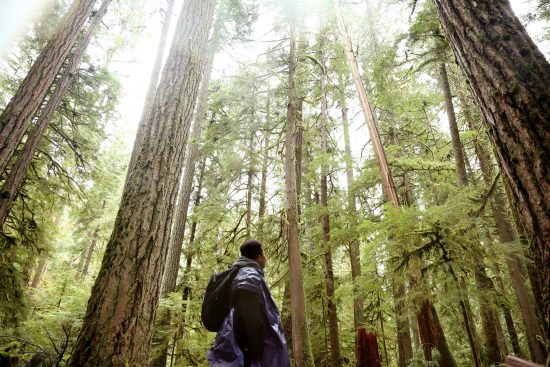
Jeff Glaser stood at the base of Madison Creek Falls in Olympic National Park, taking in the beauty of the water cascading 76 feet. As he hiked back toward the Elwha River, he recalled his nature-filled childhood, packed with camping, hiking and fishing trips throughout the Pacific Northwest.
He couldn’t help comparing the wilderness adventures of his youth to experiences of today’s generation, many of whom are growing up in an over-scheduled, technology bubble. “I love getting my students off their devices and into the natural environment where they can breathe, stretch and grow,’’ says Glaser, who teaches sixth grade math, science and religion at St. Louise School in Bellevue, Wa.
Glaser was one of more than a dozen teachers participating in a four-day professional development summer workshop at NatureBridge, an environmental education nonprofit with a campus in Olympic National Park on the shores of Lake Crescent. With environmental science at its core, the workshop was an example of how NatureBridge provides educators with training, resources and curriculum to help prepare their students to be the next-generation of environmental stewards.
The teachers from Washington, Oregon, California and New Jersey spent the week exploring marine and lowland forest ecosystems in Olympic National Park including the lower Elwha River watershed. NatureBridge educators, Olympic National Park assistant superintendent and rangers, and data driven scientists provided insight into how science, technology, engineering, and math skills inform decision making and management of this one million acre park.
In final projects, teachers in the workshop collaborated with their grade-level peers to submit classroom content for publication on the National Park Service’s K – 12 education site. Inspired by his visit to Rialto Beach, Glaser created a lesson plan focused on marine plastics – Where does the debris come from? What happens to it? And how much is generated?
“Many kids today don’t have these experiences – some don’t know their trees or their national parks,’’ says Glaser, whose parents integrated nature into his life-long learning. “It’s not just kids who are missing out on nature experiences. As teachers, we need to step it up and show our students these things.’’
The educational workshop is just one way NatureBridge collaborates with the national park to inspire teachers and students through critical-thinking skills, hands-on scientific research and inquiry-based learning.

OLYMPUS DIGITAL CAMERA
Letting Kids Get Their Hands Dirty
Founded in 1971 as Yosemite Institute, NatureBridge serves over 30,000 young people from more than 700 schools each year at its six national park campuses: the valleys of Yosemite, the watersheds of Washington’s Olympic National Park, the peaks of the Santa Monica Mountains, the marine sanctuary of the Channel Islands, the coastal hills of the Golden Gate National Recreation Area and the piedmont forest of Washington, D.C.’s Prince William Forest.
No matter what grade level or type of school, many of the teachers who go through a NatureBridge program all leave with the same discovery: Kids get excited about environmental science when they are immersed in a living, outdoor laboratory where they can become scientists in the field – and not worry about making mistakes.
“It’s all about discovery,’’ says NatureBridge educator Josh McLean, during a recent Elwha Exploration Day event. He says it’s more important for kids to think about and create questions than answering them correctly, adding that the most rewarding experiences often come when students are feeling out of their comfort zone.
“The struggles build our ability to persevere and find new knowledge,’’ McLean says, throwing in his favorite quote from poet William Blake who once said, “it’s the crooked paths that are the paths of genius.’’
NatureBridge offers three- to five-day residential programs primarily targeting students in grades 4–12. Olympic National Park is a place where kids and adults aren’t afraid to step in the mud. Students get to hold slimy salamanders, hike in an old growth forest or even touch snow for the first time. They walk across the bottom of what used to be a 60-foot deep lake conducting experiments like real-world scientists, touch springboard notches on tree stumps that were cut down 100 years ago and stand on a 210-foot slab of concrete that once was a dam.
“I can’t think of a better way to teach kids about nature,’’ says Stephen Streufert, vice president of education and Pacific Northwest director at NatureBridge. “By letting kids get their hands and feet dirty in outdoor classrooms, students acquire a deeper understanding of their environment and often begin a lifelong interest in science.’’

NatureBridge Changes Lives
Just ask high school senior Marisa Granados, NatureBridge’s 2018 Student of the Year. Before I had the opportunity to travel to Olympic National Park, I had begun to feel discouraged about the impact I really could make in the world.’’
Inspired by her first school trip to NatureBridge, Granados embarked on a 14-day NatureBridge Summer Backpacking program in 2017 that gave her renewed confidence in her ability to thrive and make a difference: “I was able to gain the confidence to speak up about what I wanted to do with my life. By gaining a stronger relationship with nature and discovering a deeper part of myself, I now see the influence of my actions and the amount of power that I have in creating change.’’
With the support of the U.S. Forest Service, she developed a handbook and curriculum for middle school students to learn and apply environmental stewardship effectively in her home state of New Mexico. She hopes to pursue a career in environmental engineering and outdoor education.
Granados is just one of thousands of students who has worked like a true scientist collecting and analyzing data in the Olympic National Park.
“There’s a mysticism around here that makes everything magical,’’ says Ingraham High School senior Jonathan Mignon on a recent scientific exploration in the Olympic National Park. “This is a place where you get sense of wild, untamed nature that speaks to me. It makes everything more tangible. You’re not only learning it but you’re feeling it.’’
When students hike in the Elwha River watershed, they don’t just hear that obstructions to river passage has changed, they see first-hand that salmon are now able to swim upriver and spawn in cobbled pools miles upriver from where the dams used to be. Students become part of the dam restoration story practicing scientific inquiry and critical thinking to understand complex issues associated with engineered environmental change.
“They think like scientists testing the quality of water, then transform into politicians, activists and concerned citizens engaging in debates about how the river and its salmon are managed,’’ says Streufert.
Students also get first-hand lessons in stewardship. “They learn that, for the Elwha dam removal to be successful, people had to listen, to engage with those they did not always agree with and to ultimately act, with multiple stakeholders and multiple outcomes in mind,’’ says Katie Draude, NatureBridge summer backpacking manager.

Bringing Back the Elwha
The Elwha Valley, where two dams were removed between 2011 and 2014, is a fertile learning environment for educators and students. The Elwha River Restoration Project – to date the largest dam removal in U.S. history – is one of the key areas of study for students visiting NatureBridge’s Olympic National Park campus. The $325 million National Park Service project entailed tearing down the 108-foot Elwha Dam and the nearby, 210-foot Glines Canyon Dam and restoring the river watershed.
Over the last several years, NatureBridge students have literally watched the river be reborn, recording its long and storied history.
The dams, the first of which was built in 1911, served their purpose of fueling regional growth by supplying much-needed electricity for the local timber and fishing industries. Though state laws required that construction of any kind allow for fish passage, both dams were built without it. But in 1992, after years of protest by many local tribes, lobbying and citizen outcry, Congress passed the Elwha River Ecosystem and Fisheries Restoration Act, which authorized dam removals. It took nearly two decades of bureaucratic wrangling before deconstruction began in 2011.
Meanwhile, the damage had already been done. The dams put a 100-year chokehold on migration of salmon just five miles upstream along the 46 mile river, disrupted the flow of sediment and wood downstream, and flooded the historic homelands and cultural sites of the Lower Elwha Klallam Tribe.
In its heyday, the Elwha River was home to one of the largest year-round salmon and steelhead runs of any river on the Olympic Peninsula and supported all five species of Pacific salmon. “People who were riding their horses up the trail just upstream from the river couldn’t cross,’’ Pat Crane, a longtime biologist for the Olympic National Park, told the professional development workshop teachers as they sat on what used to be the bottom of Lake Aldwell. “The horses refused to cross the creek because there were so many pink salmon in the creek.’’
That was in the late 1800s and 1900s, before there was electricity in Port Angeles and when steamboats were the region’s primary means of transportation – and before the dams were built. Back then, Crane estimates an average of 120,000 salmon came back to the river every year to spawn. “But by the time we go around to dam removal, we had between 100 and 200.’’
Today, the river, which flows from its headwaters in the Olympic Mountains to the Strait of Juan de Fuca, is the largest ecosystem restoration project in the National Park Service history – unleashing more than 70 miles of salmon habitat.
In September 2014, the first reported sighting of Chinook in the Elwha River above where the Glines Canyon Dam came down was confirmed, and they have slowly been returning ever since. In fact, as Crane was talking with the teachers during their workshop, he noticed a small stream near the river where dozens of baby salmon were gathering. “The fish are gambling they will be safe here,’’ Crane told the group. “They are safe for now but if the water dries up or a heron comes by, they could die.”
To kickstart the river’s recovery and help manage a century of accumulated sediment, Forest Service crews are planting 400,000 native plants and more than 5,000 pounds of native seed in the reservoir basins. But biologists say it could take a generation or more to heal.
What if We Taught Baseball the Way We Teach Science
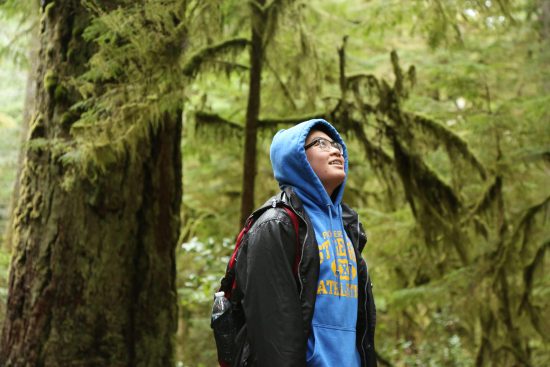
Research shows that environmental outdoor education sparks student interest, helps improve academic performance and builds confidence. A Stanford University study measuring the impacts of environmental education for K-12 students showed that environmental education helps students enhance critical thinking skills, develop personal growth and increase civic engagement.
An educator in the Stanford study commented: “In my 20 years of teaching before using the environment-based approach, I heard, ‘Why are we learning this? When are we going to finish?’ And now when we are out in the field and sorting macroinvertebrates, for example, I have to make them stop after four hours for lunch. And then they say, ‘We don’t want to!’”
A recent report from the Kaiser Family Foundation found that the average eight to 18-year-old American now spends more than 53 hours a week using “entertainment media”, up from 44 hours five years ago.
“When you think about the pressures of youth today and the kinds of things they are dealing with their families and teachers, their primary interface is screens,’’ Streufert recently told a group of educators, donors and community leaders.“We know that the average time of kids outside on any given day is about seven minutes – that includes structured play (soccer practice) and unstructured play (playing out in the woods).’’
To illustrate the importance of hands-on learning, NatureBridge educator McLean recalls the writings of UC Berkeley professor Alison Gopnik, who believes “children are designed to be messy and unpredictable, playful and imaginative.” In her book, The Gardner and the Carpenter, Gopnik asks, “imagine if we taught baseball the way we teach science.”
McLean says it would go something like this: “In kindergarten or first grade we might bring a baseball into the classroom. You could look at it but not touch it—it might be dangerous… And if you got to the sixth or seventh grade level, now you can roll the ball across the room or perhaps swing a bat as long as you are well away from everyone else. In high school, with close, coach supervision, maybe you have an interview with a famous baseball player or maybe re-enact a play from some famous game. And it’s not until undergraduate level in college that you play a game of baseball. If we taught baseball that way, we would expect to see the same level of success in Little League that we currently see in our science classrooms – it’s not high.’’
In her book, Gopnik answers her question by saying: “learning to play baseball doesn’t prepare you to be a baseball player—it makes you a baseball player.’’
The same is true in environmental education—if you want kids to learn, to be scientists, to be stewards, you must involve them in the process. Take them into the woods, show them the rivers, let them experience the outdoors. These are the moments that will transform them into scientists. These are the moments that will inspire them to care for the natural world—not one day, but now.
# # #

by editor | Aug 27, 2017 | Outstanding Programs in EE
A Biome Bonanza!
After taking a class for teachers about sustainability several years ago, my teaching partner and I were inspired to get kids out and about and connected to the natural world more. We looked at our science curriculum and with the help of Bob Carlson and his staff at our district’s CREST Center, we developed a couple of great overnight experiences for our students.
By Lisa Terrall, Bolton Elementary School
West Linn, Oregon
 iving in Oregon, we have easy access to many different biomes in which living things have adapted differently to their environments and lots of locations where evidence of volcanic activity is visible. In 4th grade, we did a lot of work around plant and animal adaptations, as well as geological changes to the Earth. We developed a 4 day “Biome Bonanza,” during which we spent a day at the coast, a day in an Oak Savannah and two days in the Columbia River Gorge.
Our day at the beach is a day trip. We stop at a spot in the coast range mountains where we can find sea floor fossils at a fairly high elevation. This allows kid to begin to see evidence of plate tectonics and how the crust that used to be the sea floor was lifted and is now part of a mountain. They love discovering and trying to identify the fossils they find and are amazed at how dynamic the Earth is.

 Our next stop is at the coast. We spend quite a bit of time exploring local tide pools and finding creatures that live there. Students get to see species they have researched up close and are able to begin to identify the structures and functions of their bodies and how they help with survival in that particular environment. Tide pools are great because they have multiple zones within them and the adaptations are different from zone to zone, as well as from tide pools to other surrounding environments like the ocean or the coastal forests. After our time in the tide pools we take a short forest hike, looking for how the environment is different, as well as how species have adapted for survival. We also get a good look at some of Oregon’s rocky cliffs and are able to see evidence of past basalt flows.
Our next day is spent in our town of West Linn, at a local Nature Conservancy preserve called Camassia. It is walking distance from our school and we are able to see more evidence of basalt flows, as the entire preserve is on top of columnar basalt with much of it exposed. The soil here is very thin and students are able to see how plants have adapted to this condition. They love being able to compare this to the coastal forest they were in just the day before. They are always amazed that the same basalt flow they are standing on stretches all the way to the coast and is contained in the cliffs they were able to see the prior day. It begins to give them a sense of connectivity and the magnitude of the volcanic events of the past. While we are there, we take the temperature of a pond and get a water sample to test for pH and turbidity when we return to school. Testing the water sample gives our students time to practice using the testing equipment and to recall 3rd grade learning around salmon and what they need (as far as water conditions) to survive.
 The next two days of our outdoor experience is spent on the road in the Columbia River Gorge. We take our 4th graders on an overnight trip to see more evidence of the basalt flows, learn about the Missoula Floods that shaped the gorge and our local valley, and to do more comparison of the plant and animal adaptations in yet a different environment. We spend time at a wildflower preserve, taking in the panoramic views of the gorge and identifying/sketching wildflowers. Students love identifying the flowers with a plant identification book and trying to figure out their adaptations. This area is quite windy and exposed to the weather being high up at the top of the gorge, so students get to see waxy leaf coatings, things growing low to the ground and even some hairy leaves. They compare that to the large, flat, shiny leaves they had seen in days prior in the coastal forest.
We also go to a local museum to hear and see a program about the Missoula Floods. This allows students to get more information from an expert about how the gorge they have just viewed came to be. We spend time at the museum exploring the Ice Age exhibit and taking a guided walk around the grounds to hear more about and see native flora and fauna.
That night we go to pizza and swim at a local pool before crashing on the floor of a grade school.
 The next day we spend time at Hood River Middle School hearing from Michael Becker and his science students about how they are continuing to strive to create a more sustainable space for learning. They have an amazing greenhouse that is ever evolving to include new and innovative things. The middle school students give our 4th graders a tour of the area, including a discussion about the geothermal energy system under the soccer field. This is a very inspiring part of the trip and spurs our students on to thinking about ways we can improve what we do at our own school.
When we leave the middle school, we head to a local falls area and go on a great hike. Students see and point out evidence of basalt flows, erosion, plant and animal adaptations and enjoy the outdoors. We also find a spot to pull out water testing equipment and run stations for students to test pH, temperature, and turbidity, as well as to collect and identify macroinvertebrate samples. This is always a highlight of the trip! At the end of our water stations, students make a determination about whether or not this stream is a healthy one for fish using their data as evidence.
Our trip is capped off by a visit to Bonneville Dam to see the fish ladders and learn how electricity of created from water flow.
 Overall, we have a great trip and students gain so much! They are able to see and touch things that they have studied in science class. They make connections, ask lots of great questions and enjoy the beauty of our natural spaces. We hear back from many students and parents that they re-visit many of the locations as a family at a later time and that the students are great tour guides with lots of information to share.
As curriculum and teaching assignments have changed, we have tweaked this trip for 5th grade. We are able to review past learning about salmon, plant and animal adaptations, and geology, as well as focus on new learning about energy. This year it is a two-night, three-day trip that will include many of the above activities, but will also include a day that has a visit to the Biglow Wind Farm in Wasco to see windmills in action, and a visit to White River Falls State Park to see a now defunct powerhouse at the base of a falls. We will also spend time at a local business in Hood River learning about their commitment to renewable energy and seeing their solar roof. Our students have been researching renewable energy in class and this will give them opportunities to enjoy the great outdoors while seeing things they have previously read about.
We feel these experiences are important for students now more than ever. In an increasingly digital world, it could be easy for students to be indoors more and pay less attention to the natural world around them. In addition to making the classroom learning feel more real, these trips get kids out, get them active, and help them connect to the wonder and beauty of our natural world.

by editor | Feb 22, 2017 | Learning Theory
The Importance of Deep Experiences in Nature
By Joseph Cornell
 rofound moments with nature foster a true and vital understanding of our place in the world. I remember an experience I had as a five-year-old boy that awakened in me a life-long fascination for marshes, birds, and for a life lived wild and free.
I was playing outside on a cold, foggy morning when I suddenly heard a startling chorus of “whouks” coming toward me through the air. I peered intently at the thick fog, hoping for at least a glimpse of the geese. Seconds passed; the tempo of their cries increased. They were going to fly directly overhead! I could hear their wings slapping just yards above me. All of a sudden, bursting through a gap in the fog, came a large flock of pearl-white snow geese. It seemed as if the sky had given birth to them. For five or six wonderful seconds their sleek and graceful forms were visible, then they merged once again into the fog. Seeing the snow geese thrilled me deeply, and ever since then I have wanted to immerse myself in nature.
Being Fully Present
When outdoors, many people are so engrossed in their own private concerns that they spend little time noticing their surroundings. I once demonstrated this to a group of 25 teachers in Canberra, Australia. I asked them to look at a beautiful tree as long as they were able to, and to raise their hands when their attention wandered from the tree and drifted to other thoughts. In only six seconds, every hand was raised. They were amazed to discover how restless their minds were.
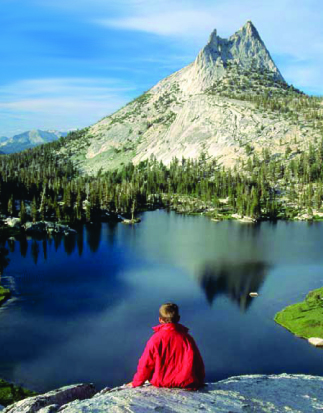
Exposure to nature isn’t always enough. A friend of mine discovered this when he took his eight-year-old son hiking in the Canadian Rockies. They hiked for several hours until they came to a spectacular overlook where they could see two glaciated valleys and several alpine lakes.
He said, “That view alone made our long trip from Iowa worthwhile.” He suggested to his son that they sit and enjoy the mountain scenery. But the boy, who’d been running exuberantly back and forth along the trail, sat for five seconds, then scrambled to his feet and started running up the trail again. My friend said he felt like screaming, “Stop! Look at this incredible view!”
How can we help others experience nature deeply when their minds and bodies are so restless? The secret I’ve discovered is to focus their attention with captivating nature activities that engage their senses.
For example, in the Camera Game, which is played with two people, the “photographer” taps the shoulder of the “camera” twice, and the camera-person opens his eyes on the scene before him. Because the camera-person looks for only three seconds, his mind doesn’t have time to daydream, so the impact of his “picture” is quite powerful. Players of the Camera Game have told me that they’ve retained a vivid memory of their pictures for five, even eight years afterwards. This activity helps people of all ages experience what it is like to truly see.
Other examples of simple, absorbing activities are mapping natural sounds, writing an acrostic poem about something captivating, drawing one’s “best nature view,” and interviewing nature, where you look
for a special rock, plant, or animal that has an interesting story to tell. Then you ask it questions like, “What events have you seen in your life? What is it like to live here? Is there something you would like to tell me?”
Superlative Moments
Abraham Maslow described peak experiences as especially joyous with “feelings of intense happiness and well-being” and which often involve “an awareness of transcendental unity.” Mountaineers commonly report having these kinds of experiences. John Muir, in the following passage, explains why:
In climbing where the danger is great, all attention has to be given the ground step by step, leaving nothing for beauty by the way. But this care, so keenly and nar- rowly concentrated, is not without advantages. One is thoroughly aroused. Compared with the alertness of the senses … on such occasions, one may be said to sleep all the rest of the year.
—John of the Mountains
The intense focus required by wilderness pursuits such as climbing heightens one’s awareness, which is why so many people avidly enjoy them.
 Leaders can encourage peak experiences on less wild walks by using experiential activities that focus people’s complete attention on nature. Concentration is concentration; people benefit from increased perception wherever they are. One educator who hikes the Appalachian or Pacific Crest Trail every summer practiced the Sharing Nature organization’s reflective “I Am the Mountain” exercise for just four minutes. Afterwards, he said enthusiastically, “I was able to experience a state of heightened awareness that usually takes me a month in the wilderness to feel.”
Meeting Nature Face to Face
Science can only describe a flowering cherry tree; it cannot help us experience the cherry tree in its totality. To develop love and concern for the earth, we need deep, absorbing nature experiences; otherwise, our relationship with nature will remain distant and abstract and never touch us deeply.
Rita Mendonca, Sharing Nature Brazil’s national coordinator, recently gave a training program in the Amazon for professional ecotourism guides, some of whom had worked in the area for 40 years. Their attitude at first was that she had little to teach them. But after participating in several experiential Sharing Nature® activities, a woman approached Rita and said with deep emotion, “You are helping me find the forest inside of me! We don’t know the forest in this way!”
Absorbing experiences bring us face-to-face with nature. The observer and the observed become united—and only then is true knowing and love awakened in the observer’s heart. John Muir said that the content of the human soul contains the whole world. The deeper purpose of experiential learning is to broaden our experience of life and include other realities as our own. When one is immersed in nature, Muir said, the “body vanishes and the freed soul goes abroad.” Only by expanding our sense of identity beyond our physical body and egoic self can we commune with distant horizons, brightly colored songbirds, and countless other delights.
When people are quiet and receptive, fully immersed in nature, insights on the real purpose of life reveal themselves. David Blanchette is a teacher at the Punahou School on Oahu Island, Hawaii, where every year he leads his 13-year-old students on an inspirational nature walk along a remote and wild coastline. Below are some of his students’ thoughts about life and nature after playing reflective, experiential Sharing Nature activities like “Expanding Circles,” “Trail of Beauty,” and the “John Muir Game”:
• It made me feel like I was actually a part of the sand and ocean.
• I was a calm ocean wave gently rolling towards the shore. I was the reef, feeling the cool water roll over me.
• I felt euphoria. I felt like I was one with everything around me.
• It felt powerful, yet peaceful. Every part of me is moving and flowing in harmony.
• Watching the turtle swim carefree reminded me that I have nothing to worry about.
• You really live when you take time to notice your surroundings.
• If you find beauty within the world you can find it within yourself.
Jessica, one of David’s students, wanted to express her appreciation for the ocean, so she gratefully wrote “thank you” in the sand—and let the ocean waves embrace her sentiment and take it into itself.
Fostering in others beautiful human qualities of humility, respect, love, and joyful harmony with one’s environment outside and inside of oneself—as expressed by the Hawaiian students—is what nature education is really about.
 Becoming Good Stewards
A teacher in the Southwest once asked the children in his class to draw a picture of themselves. He recalled, “The American children completely covered the paper with a drawing of their body, but my Navajo students drew themselves differently. They made their bodies much smaller and included the nearby mountains, canyon walls, and dry desert washes. To the Navajo, the environment is as much a part of who they are as are their own arms and legs.” The understanding that we are a part of something larger than ourselves is nature’s greatest gift. With it, our sense of identity expands and, by extension, so does our compassion for all things.
In order to create a society that truly reveres the natural world, we must offer its citizens life-changing experiences in nature. Saint Teresa of Avila said, “The soul in its ecstatic state grasps in an instant more truth than can be arrived at by months, or even years, of painstaking thought and study.” One moment of deeply entering into nature can inspire in us new attitudes and priorities in life that would take years to develop.
When people feel immersed and absorbed in the natural world, they are learning the highest that nature has to offer—because nature herself is their teacher.
Joseph Cornell is the author of the highly acclaimed Sharing Nature book series and is the founder and president of Sharing Nature Worldwide. You are welcome to reprint this article with prior permission from Sharing Nature Worldwide. You can find out more about Sharing Nature activities and resources at www.sharingnature. com or 530-478-7650. Contact Joseph Cornell at info@sharingnature.com.

by editor | Jan 26, 2017 | Arts and Humanities
 The Value of Creative Teaching
Place-based environmental education through the lens of art and creative writing
by Tess Malijenovsky
 lace-based environmental education is taking front seat inside and outside classrooms across the country in part to prepare future generations for the environmental challenges they’ll face ahead. That is, climate change, natural resource competition, ocean acidification, sea-level rise, and rampant species extinction. In the famous words of Albert Einstein, the significant problems we face today cannot be solved with the same thinking we used when we created them.
This is why we mustn’t undermine the value of creative thinking in outdoor environmental education. While our education system tends to emphasize critical thinking skills for good reason, sometimes the critic within must be silenced for the improvisation of ideas and solutions: In a study published by PLOS ONE journal, researchers Charles Limb and Allen Braud found that the parts of the prefrontal cortex associated with self-monitoring and conscious control were suppressed in jazz musicians playing improv. Despite differences in the analytical- and creative-thinking processes in the brain, however, both entail a sophisticated application of knowledge.
 Nature-themed art and writing exercises are ways for educators to elicit creative thinking in students when teaching environmental education. What’s more, nature illustration outdoors, for example, can break through learning barriers and focus the attention of students from diverse backgrounds and learning levels while delivering life science lessons, as witnessed by Straub Environmental Center’s executive director, Catherine Alexander.
Alexander recently spent a day at the Little North Fork of the Santiam River with 20 elementary-aged summer campers studying and drawing the plants, fungi, and animals surrounding their beautiful setting in an old-growth ecosystem. The students, representing a variety of learning styles and backgrounds, took their seats on mossy patches of sunlight, encapsulating science concepts in a portrayal of their immediate watershed environment.
Imagine a children drawing an osprey. As she focuses on her drawing, the child listens to her teacher talk about the length of the bird’s wingspan, the purpose of its long, sharp talons, what it eats, and where it lives. According to the brain lateralization theory that more divergent thinking occurs in the right side of the brain, listening while drawing helps distract and relax the student’s inner critic, expanding the reach and flow of new connections in her mind. Less intimidated or hypercritical in the art-making process, the child’s attention focuses on the charismatic creature she is drawing and learning about. The art lesson unravels into an engaged science lesson about the osprey’s ecological niche and life cycle.
“Art is more than a pastime,” says Alexander. “It can be an enabling portal for a number of academic subjects. The summer campers reminded me that art can have rhetorician value for students with learning disability or for whom English is not their first language. It can be a powerful equalizer and high-interest segue into all kinds of educational pursuits.”
 One free, online resource to help educators tie art and creating writing activities in life science lessons to Common Core and Next Generation Science Standards is the “Toolkit for Educators,” developed in partnership by Honoring Our Rivers: A Student Anthology, Portland Metro STEM Partnership, and Straub Environmental Center. The toolkit provides teacher-tested life science lessons plans that use Honoring Our Rivers (HOR) with the corresponding learning standards.
The HOR anthology, a program of Willamette Partnership, a Portland-based conservation nonprofit, encourages students to fall in love with rivers and express their connections to them creatively – through art, photography, poetry, stories, and foreign language – in hopes of naturally cultivating the next generation of watershed stewards for the Pacific Northwest species and communities who depend on these vital systems.
Educators who integrate river-watershed-themed art and writing activities into their lessons can not only stimulate the creative minds of their students in an engaging educational way but give them an opportunity to be published statewide by submitting their work to HOR. The program also hosts student art exhibitions and student reading events across Oregon.
Educators can also learn more about nature-themed art instruction at HOR’s upcoming workshops at the Coastal Learning Symposium this Oct. 14 at Newport’s Oregon Coast Aquarium.
Teachers have the power to encourage the creative capacities of our youth while addressing the increasing disconnect between children and the outdoors. HOR exists to help them accomplish this feat. For more information, visit www.honoringourrivers.org, or email info@honoringourrivers.org.
###
 Tess Malijenovsky is the coordinator of Honoring Our Rivers: A Student Anthology, a program of the Portland-based conservation nonprofit Willamette Partnership. Prior to moving out West, Tess was an environmental journalist and the assistant editor of Coastal Review Online in North Carolina. She studied Creative Writing and Spanish at the University of North Carolina Wilmington
