
by editor | Dec 28, 2025 | Data Collection, Environmental Literacy
How do we train educators to successfully interface technologies with the outdoor experiences that they provide their students?
by R. Justin Hougham,
Marc Nutter,
Megan Gilbertson,
Quinn Bukouricz
University of Wisconsin – Extension
Originally published January 2020
 Technology in education (ed tech) is constantly changing and growing in impact in classrooms across the globe. While ed tech holds great promise for closing achievement gaps in sectors of the education community, it remains yet to be seen how this will truly live up to its potential (“Brain Gains”, 2017, July 22). Ed tech is anticipated to grow to a $120 billion market by 2019, which will largely be spent in software and web services. How might we hope to see this show up in out-of-classroom field experiences?
Unaddressed in these articles and what we explore here are the specific impacts that the conversation of technology in environmental education brings as well as a case study that shares strategies we have found to be effective when an education considers the merging of hardware (inquiry tools), technology application in professional development, and web-based collaboration tools. Important questions for environmental education ask include How does this scale for education for the environment? What considerations need to be taken to ensure that investment works? How would we know if it does? How do we train educators to successfully interface technologies with the outdoor experiences that they provide their students? In an article published here in Clearing in 2012, we explored the instructional framework for merging field based science education with mobile pedagogies in the framework entitled Adventure Learning @ (Hougham, Eitel, and Miller, 2012). In the years since, this model has informed a collection of hardware kits that supports the concepts in AL@ as well as an examination of the questions outline above, these hardware kits are called Digital Observation Technology Skills (DOTS) kits.
In the middle fork of the Salmon River in Idaho you’ll see Steelhead, rushing rapids and hot springs that all tell the story of the landscape. Similarly, along the Wisconsin River, you will see towns, forests and fields that have a link to the industries that have shaped the state over the last 150 years. If you’re in the right spot at the right time, you can find inquisitive young people and bright yellow cases filled with gadgets taking data points and crafting Scientific Stories about the watersheds in their state. Regardless of whether it is a wild river or a small tributary outside a schoolyard- scientific stories wait to be told in these places and technology that is appropriately considered helps unlock and share these experiences.

A naturalist assists youth with a water quality test while on a canoe trip. Photo credit: DOTS participant.
In a world where technology is almighty, wielding digital literacy is practically a requirement in our understanding of just about everything. The students of today are able to navigate through web pages and apps with ease, information at their fingertips like never before. Here, we can find ourselves removed from that information, disconnected from those data sources and collections, stifling our desire to wonder and inquire more. By investing in digital tools that can enhance inquiry of the natural world, educators can bridge this divide of both information and the ability to be a primary data collector. In equipping students with touchscreens and interfaces familiar to youth of today, they are able to partake in not only real world application of scientific observation, but also experimental design and efforts moving toward the future.
Young people in Wisconsin have been contributing to the development of this idea of digital data collection and inquiry, through DOTS. The DOTS program has been developing in Wisconsin since 2014, engaging both youth and adult demographics in digital literacies, and connecting the dots from data collection to inquiry and analysis. By involving youth in the visualization and comparison of their data collections, they are able to begin to accomplish higher order learning such as developing their own hypotheses and synthesize the meaning of their findings. DOTS has been developed for students in 4th through 8th grades but has been modified for audiences in 2nd through high school, including adult learners, continuing education, and professional development.
Case studies of this application vary widely in scale, location and content. Currently DOTS kits are used in Idaho and in Wisconsin by youth to examine water quality. A full-scale implementation is underway currently in Wisconsin to connect youth from many different watersheds. Held this past August, the Wisconsin Water Youth Stories Summit brought together students from across the state of Wisconsin who are interested in not only environment and ecosystems, but also water quality and sharing their “water stories”. Supported by an EPA grant, this Summit was a culminating experience for many of the youth, getting to collect and share their findings over their 3 day period at Upham Woods Outdoor Learning Center (Grant Number: EPA-00E02045). This two year grant has trained and equipped educators with DOTS tool with an emphasis on water quality monitoring. Throughout the year, youth from around Wisconsin collect data and share their findings with others in real time on the web. At the Water Stories Summit, each group brought their DOTS kit to explore the environment and compare collected data sets. This experience not only brought together young scientists with a vested interest in the future of water, but also allowed students to share stories of local water quality that affects their own communities around the state.

A student uses a water quality test to find the amount of phosphorus at a Wisconsin River location. Photo credit: DOTS participant.
Many shared stories about urban run-off pollution, such as lawn fertilizers and road salt, E. coli contamination, and they discussed the ways in which humans alter natural waterways. At the end of their experience one student said they learned that, “science is being precise and unbiased about nature and numbers.” Another student said of a different Upham experience, “We went to Blackhawk Island for our project. The tools helped us take photos of what was under the rock. The tools help to see what animals were living there. We came up with a lot of new questions after we did our research and we can’t wait to find out things like, if the temperature affects what animals we will find living under a rock, and what animals live at different depths.” Through these collaborations of student generated data, participants were able to make connections between each other and drive further inquiry questions such as how to improve water use and consumption, and how the water affects all other life.
While the kits themselves are certainly an enhancement to a variety of curriculum, the training that accompanies the deployment is just as important as the tools themselves. Educators that partner on DOTS projects are supported with (1) Equipment, (2) Training and (3) a Web platform for collaboration. It is the interrelationship between the inquiry tools, inquiry methods and inquiry artifacts that provide the support for transformative outdoor science experiences.
A DOTS kit consists of a select set of digital tools to equip youth and educators with everything they need to take a basic data set of an ecosystem and microclimate. Contained in a water-proof, heavy-duty case, the tools selected are chosen for their utility, cost effectiveness, and ease of use. Any suite of tools can be selected for an individual’s classroom purposes, this is first and foremost, a framework to scaffold inquiry and observational skills. DOTS users gain field experience with hand held weather stations, thermal imagers, digital field microscopes, GPS units, and cameras to contribute to local citizen science monitoring (Hougham and Kerlin, 2016). A DOTS program training is facilitated by program staff and has evolved over time to include these six goals. While these are used in DOTS, nearly any technology implementation would benefit from these goals being outlined.
- Establish functional and technical familiarity with DOTS Kit hardware
- Orientation to DOTS Kit web interface, data uploading, and site visualizations
- Examination of mobile, digital pedagogies in historical as well as applied contexts
- Advance instructional capacities in application of observation and inquiry facilitation applicable to experiences outside the classroom
- Production of digital artifacts that contribute to Scientific Storytelling
- Facilitation of initial curricular design considerations for integrating kits into existing programs
After the training, educators have access to a suite of tools that can be lent out for deeper science connections in outdoor spaces. Further, trained educators can use grab-and-go lessons from the project website to launch the concepts with their students and watch videos produced and hosted on the site that provide further instruction on applications of the tools.
Lastly, a web-based collaboration platform is hosted to support the development of additional inquiry. To continue this mission of enhancing student inquiry and promoting collaboration, data sets can be uploaded to an online public access platform. As users enter their data online, the map displays in real time the coordinates and information of each data point. Viewers can easily navigate a Google map with their and other’s data points for comparison and post-experience observation. This immediate viewership not only falls in line with today’s student’s understanding of a fast-paced, immediately available world, but also allows no stagnation in the learning process as inquiry can continue instantaneously. Through engagement by use of digital tools collecting data in the field, reflection on process and methods through data entry into the web-based model, and through analysis and refinement of hypothesis for further inquiry, students take ownership of their data and have a voice in sharing their discoveries with others. These inquiries have been qualified in the DOTS programming through use of a “scientific story”.
The scientific story helps to build connection between qualitative and quantitative data and their respective ways of understanding. As humans we have told stories for millennia to entertain, educate, and remember. Combining these elements of storytelling with the scientific method of developing hypotheses and data collection, a story is created to share. These stories are generally 3-5 sentences and include photos taken by camera and tools such as the handheld microscope and thermal imager. In taking a closer look with digital tools, a deeper appreciation is gained and honed in on through these scientific stories and it is through these words that we can harness stories in what they do best: share. They can be digitized and easily shared across social media platforms, creating interest in the environment and science in family and community members.
This story written while at Upham woods during the aforementioned Water Stories Summit, and describes the location and inquires the youth had.
We investigated two different locations as a part of the water study blitz at Upham Woods. The first location was the Fishing shore on the Wisconsin River, and the second location was a stagnant inlet only 100 feet away. We noticed several differences between the two locations. We wanted to know more about the animal life in both locations. What kind of animals live in these habitats that we couldn’t see during the blitz? What would we find if we studied the location where the Fishing Shore and Inlet connect?
This story highlights the questions students wanted to investigate further and spurred their desire to continue comparing locations in the context of animal life. Another story from the Water Stories Summit illustrates a group of high school students making connections between ideas and places.
When doing the data blitz at camp, we tested water for all kinds of factors (pH, Conductivity, Salinity and others). The cool thing we noticed was the differences in PH levels of the water that equaled a 9.49 level that makes water a base. This reminded us of what would happen if water had a unbalanced and non neutral PH level, that was out of control… One example of this is a sulphur pit, like in Yellowstone national park. The pH of this water is as low as 1.2, which is almost equivalent to battery acid.
By encouraging students to develop their own scientific story, they create a deeper connection with that place and nature in general. This connection evolves to a jumping off point for further inquiry and hypothesis development which can be fleshed out into full empirical science studies or harnessed into environmental service projects. Additionally, as data sets can be shared, these students in Wisconsin can use the data collected in Idaho to further their hypotheses and promote scientific collaboration.

A naturalist teaches an Escuela Verde student how to take a water quality reading. Photo credit: DOTS participant.
Throughout the use of this approach research suggests that digital tools should be adopted in environmental education whenever possible (Hougham et al., 2016). To assess participant perspectives, DOTS uses a modified Common Measures instrument (National 4-H Council, 2017) to examine student attitudes towards technology and towards nature. In a 2015 study conducted by the DOTS project research team (Hougham et al., 2016), students where engaged in two iterations of an environmental studies curriculum- one was with traditional analogue toolsets and one was with digital toolsets. In an analysis of pre/post-test evaluation responses (n= 135), students showed statistically significant and positive shifts in attitudes towards technology, the use of technology outdoors, and towards investigating nature. In a review of the data from DOTS users for both profession development and youth workshops (n=71), it was found that 97% of participants of all ages agreed or strongly agreed that they “better understand how science, technology, or engineering can solve problems after using the DOTS tools”, and 89% said they agreed or strongly agreed that they “liked learning about this subject”.
This survey data provides insight on scaffolding and curiosity building techniques. In this way, it was found that lessons on observation were most useful when they began with broad scale observations and students were invited to make more focused observations. This system allows for students to explore a part of the world that they find interesting, making them more invested in a narrative authentic to them. The practice of up close observation is nothing new in environmental education, notably Adventures with a Hand Lens was published in 1962, advancing outdoor science instruction to engage the learner in their own investigations of the world up close. Today, this observation scaffolds easily onto data collection, with students studying parts of the ecosystem that they find interesting with encouragement to find how these seemingly individual pieces coalesce into a larger system.
In moving environmental education into the digital age, educators should look to empower youth with the tools and responsibility to examine their surroundings, and in encouraging youth to take and use technology outside, educators can capitalize on students collecting their own data sets to develop deeper, more meaningful inquiry questions. And when they can begin developing their own questions that they want to answer rather than following a worksheet or handout, the exploration becomes that much more desirable and satiating. Those young people wielding handheld weather stations and thermal imagers on the Salmon River or on the Wisconsin may appear to be kids collecting some information for science project, but don’t be fooled, the next generation of scientists and scientific thinkers is out there, already developing their inquiries into the natural world.
References
- Brain Gains. (2017, July 22). The Economist. Retrieved from https://www.economist.com/news/leaders/21725313-how-science-learning-can-get-best-out-edtech-together-technology-and-teachers-can
- Headstrom, R.. (1962). Adventures with a Hand Lens.
- Hougham, R. J., Eitel, K. B., & Miller, B. G. (2013). AL@: Combining the strengths of adventure learning and place based education. 2012 CLEARING Compendium (pp 38-41).
- Hougham, J. and Kerlin, S. (2017). To Unplug or Plug In. Green Teacher. Available at: https://greenteacher.com/to-unplug-or-plug-in/.
- Hougham, R., Nutter, M., Nussbaum, A., Riedl, T. and Burgess, S. (2016). Engaging at-risk populations outdoors, digitally: researching youth attitudes, confidence, and interest in technology and the outdoors. Presented at the 44th Annual International Symposium on Experiential Education Research, Minneapolis, MN.
- National 4-H Council. (2017). Common Measures 2.0.
- Technology is transforming what happens when a child goes to school. (2017, July 22). The Economist. Retrieved from https://www.economist.com/news/briefing/21725285-reformers-are-using-new-software-personalise-learning-technology-transforming-what-happens
Dr. R. Justin Hougham is faculty at the University of Wisconsin- Extension where he supports the delivery of a wide range of science education topics to K-12 students, volunteers, youth development professionals, graduate students, and in-service teachers. Justin’s scholarship is in the areas of youth development, place-based pedagogies, STEM education, AL, and education for sustainability. See other content by this author.
Marc Nutter manages the facility of Upham Woods Outdoor Learning Center located in Wisconsin Dells, WI which serves over 11,000 youth and adults annually. With the research naturalist team at Upham Woods, Marc implements local, state, and federal grants around Wisconsin aimed to get youth connected to their local surroundings with the aid of technology that enhances observation.
Megan Gilbertson is currently a school psychology graduate student at Southern Illinois University – Edwardsville. While working at Upham Woods Outdoor Learning Center, she collaborated on grant funded projects to create and curate online data platforms for educational groups and facilitate programs for both youth and adults on the integration of technology with observation and inquiry in environmental education.
Quinn Bukouricz is a research naturalist involved with technology-integrated programming statewide, funded on grants and program revenues. He is also responsible the creation and care of programmatic equipment which includes the “Digital Observation Technology Skills” kits, and the implementation of grants.

by editor | Sep 5, 2025 | Climate Change & Energy, Conservation & Sustainability, Critical Thinking, Data Collection, Environmental Literacy
Integrating Watershed Science in High School Classrooms
The Confluence Project Approach
High school students in northern Idaho learn about watersheds and the impacts of climate change through an intensive field science program that aligns with the Next Generation Science Standards.
by Audrey Squires, Jyoti Jennewein, Mary Engels,
Dr. Brant Miller and Dr. Karla Eitel
“It’s not just because I personally love snow and skiing and snowshoeing and all that. It’s not just because I love to teach science outdoors in the field. It’s not even just because I value connecting my students with real scientists every chance I get. It’s honestly not any one of these particular things alone that has made the Snow Science field trip the absolute favorite part of my Environmental Science curriculum over the last four years. Instead, it’s the simple notion that for this generation of teenagers in the Inland Northwest, the impacts of climate change on the hydrology of snow within our watershed might be the most valuable social, economic, and ecological topic to cover in the entire school year. Snow is the backbone of our way of life in North Idaho, and the sense of awareness and empowerment my students develop as a result of this Confluence Project three-lesson unit is absolutely critical for their growth and progress as young adults heading into the 21st century.”
– The Confluence Project Teacher,
Advanced Placement Environmental Science
Clean water matters, immensely, to all of us. We desperately need education that promotes deep understanding of how water is important to students. Fortunately, water as a theme is easily incorporated into numerous scientific disciplines. From the basics of the water cycle in foundational science courses to the complexities of cellular processes in advanced biology; and from energy forecasting with anticipated snow melt in economics to the nuances of water as a solute in chemistry, water is foundational to a variety of subjects and can be incorporated into the learning objectives with a little creativity and willingness to step outside the box.
Over the past three years in high schools across Northern Idaho we have been working to develop a water based curriculum that has the flexibility to be used in many types of classroom, and that provides students with firsthand experience with water and water related issues in their local watershed. The Confluence Project (TCP) connects high school students to their local watersheds through three field investigations that take place throughout an academic year. These field investigations are designed to integrate place-based educational experiences with science and engineering practices, and focus on three themes: (1) water quality, (2) water quantity, and (3) water use in local landscapes. During these field investigations, students actively collect water, snowpack, and soil data and learn to analyze and interpret these data to the ‘big picture’ of resource quality and availability in their communities.
 Before each field investigation, students are exposed to the pertinent disciplinary core ideas in class (National Research Council [NRC], 2011; NGSS Lead States, 2013), explore issues present at field sites, read relevant scientific articles, and learn field data collection techniques. Students then collect data in the field with support from resource professionals. After each field investigation, students analyze their data and use the results to discuss how to solve ecological issues they may have encountered. Adults guide students through this process at the beginning, with the goal that students will develop the necessary skillset to conduct independent, community-based, water-centric research projects by the end of the academic year (Figure 1). Students are ultimately challenged to creatively communicate their research projects, including both the scientific results and their proposed solutions to environmental issues encountered in their watershed, at a regional youth research conference (e.g. Youth Water Summit).
 Originally created to serve as a sustainable method to continue outreach efforts from a National Science Foundation Graduate STEM Fellows in K-12 Education (GK-12) grant (Rittenburg et al., 2015), the development of TCP coincided with the release of the Next Generation Science Standards (NGSS) (NGSS Lead States, 2013). With a strong emphasis on science and engineering practices, disciplinary core ideas, and coherent progressions (Reiser, 2013), the TCP model closely aligns with these new standards. Given that much of the curriculum developed for the older National Science Education Standards is content-focused (NRC, 1996), TCP fits the need to create curriculum that includes opportunities for students to explain how and why phenomena occur and to develop the critical thinking skills associated with scientific investigations.
Pedagogical Framework
Sobel (1996) wrote that “authentic environmental commitment emerges out of first hand experiences with real place on a small, manageable scale” (p. 39). In TCP, authentic learning often emerges as students engage in first-hand exploration. Using the local watershed as a lens for field investigations enables students to connect with their landscapes and develop new depths of understanding of the world around them. By connecting students’ lived experiences and local landscapes with scientific information we are able to generate a unique learning setting, which in turn sparks continued interest in exploring the familiar from a new perspective. As one student from the 2015-16 program wrote:
This localized learning approach is often referred to as place-based education (PBE), which engages students in learning that utilizes the context of the local environment (Sobel, 1996; Smith, 2002). PBE seeks to connect students to local knowledge, wisdom, and traditions while providing an authentic context to engage students in meaningful learning within their everyday lives.

TCP also uses a project-based learning (PBL) approach (Bell, 2010) to help students frame the field investigations and the subsequent analysis and interpretation of collected data as foundations for their own research projects. These practices emphasize student construction of meaningful and usable scientific concepts and, perhaps more importantly, relating these concepts to their own lived experience. For example, one student wrote the following reflection after a class water quantity field investigation:

These types of reflections demonstrate an internalization of curriculum unit topics, which in turn motivates students to continue learning.
Importantly, PBE and PBL are used as frameworks to align lessons with the NGSS. The pedagogical features of PBL match well with the eight science and engineering practices at the core of the NGSS framework, which include: (1) asking questions and defining problems; (2) developing and using models; (3) planning and carrying out investigations; (4) analyzing and interpreting data; (5) using mathematics and computational thinking; (6) constructing explanations and designing solutions; (7) engaging in argument from evidence; and (8) obtaining, evaluating and communicating information (Bybee, 2011). In TCP, these pedagogical approaches provide a meaningful context for students to engage in developing understandings of disciplinary core ideas, while the curriculum creates new, effective ways to enact the NGSS.
Empirical evaluation of student learning in the program (Squires et al., under review) indicates that after participation in TCP, students expressed greater concern for local ecological issues, recognized the efficacy of science as a tool to address environmental issues in their communities, and were more engaged in science when PBE and PBL pedagogies were used.
Project Implementation
“Yesterday my entomology class went to a local creek to study the bugs and life around it. It was really cool to fish a lot of bugs out of the water. We got lots of benthic macroinvertebrates such as a mayfly (dragonfly), damselflies, all in different instars (sic) [stages of growth] …. We tested the pH of the water, the transparency of the water, and the dissolved oxygen in it…This was really a fun project, it was great getting all of the bugs I’ve been learning about and it was really cool to use my knowledge about them… I suggest that anyone should go and do this, you could learn a lot about your region’s water quality.”
–TCP Entomology Student
 TCP curriculum aligns with several Performance Expectations and Disciplinary Core Ideas from the NGSS (Table 1), and can also easily adjust to fit within multiple courses. TCP curriculum has been incorporated into less flexible, standards-driven courses like Biology and Chemistry, as well as more flexible courses like Environmental Science, Entomology, and Earth Science. While each class participates in the same three units (water quality, water quantity, and water use), teachers tailor these units to the learning objectives of their courses.
For example, environmental science teachers have been able to tie the water quantity unit to global climate change, land and resource use, and local economics. Students analyzed collected snowpack data to determine how much water would be available in their watershed for growing crops and sustaining lake and river-based tourism economies. They also compared their data to historical figures to understand how climate change has impacted water availability in their watershed over the past several decades.
By contrast, TCP biology teachers have successfully incorporated TCP units as part of their yearlong curriculum aligned with rigorous biology standards. For example, as part of the water use unit one teacher discussed sustainable water use in an agriculture setting by focusing on concepts like plant growth and cellular function. Other teachers have presented photosynthesis, primary productivity, and fisheries biology during the water quality unit, and speciation, biodiversity, and habitat as core topics during the water quantity unit.
Even in very specialized science classes there is room to engage with this curriculum. For example, one entomology teacher was able to highlight the role of macroinvertebrates as indicators of stream health when teaching the water quality unit. He taught students insect characteristics, discussed growth and metamorphism, and then showed students how to tie flies in order to solidify that knowledge in a unique, hands-on way. The class then visited a stream near their school to identify macroinvertebrates and learn their importance in evaluating water quality. Last but not least, TCP curriculum was designed for the potential of cross-course collaboration, which gives students the opportunity to apply and link concepts and skills learned in science class to their other courses while developing critical thinking skills. Several program teachers have collaborated with colleagues in their schools to integrate content across disciplines and open students’ eyes to interdisciplinary study.
 Connecting with local professionals
The most valuable thing that we learned on our field trip to [the restoration site] was learning about the processes that were taken to restore the creek, and why they did it… We think that this field trip has shaped our understanding of these careers by actually experiencing the job and their daily tasks that can do good to the environment (sic). Following the field trip, we can say that we have a better understanding of just how time consuming and difficult the process of restoration in an area such as [the restoration site] can be. –TCP student water quality field investigation post trip reflection
Teachers often struggle to plan activities beyond the day-to-day classroom lessons, which is one reason why local professionals and leaders are an essential facet of TCP. Agency scientists, Tribal land managers, and graduate students provide scientific support to teachers and students during field investigations, in-class pre- and post-lessons, and final research projects. This gives students an opportunity to collaborate with and learn from specialists and practicing scientists in their communities, allowing the students to gain experience carrying out science and engineering practices alongside experts. In addition, students learn about career opportunities and restoration efforts in their local watersheds from TCP partners.
Examples of past TCP partners include universities (extension, graduate students, and professors); Tribes (environmental agencies and Elders); state agencies (environmental quality and fish and game); federal agencies (Natural Resources Conservation Service, United States Forest Service, Bureau of Land Management, and National Avalanche Center); and local organizations (environmental nonprofits, homeowner’s associations, and ski resorts).
Since these collaborations are critical to the success of TCP program we have developed a Reaching Out to Potential Partners checklist to help teachers contact and recruit community partners. The checklist helps teachers develop a coherent narrative to use with busy professionals which highlights the mutual benefits of collaboration.
Keeping costs to a minimum
Admittedly, implementation requires some capital investment to cover essential program costs such as busing, substitute teachers, and field equipment. However, these costs can be minimized with some creative organization. Multiple TCP schools have been able to eliminate busing costs by using streams near or on school property. Supportive administrators can creatively minimize substitute teacher costs (in one case the principal agreed to cover the class instead). Field equipment is certainly necessary to collect data (see Resources), but the equipment required may potentially be borrowed from agencies or university partners. A classroom supply budget or a small grant from the booster club or other local organization can also help cover such costs and build supplies over several academic years. While regional youth research conferences, such as the Youth Water Summit are excellent ways to motivate students, it is possible to get the research benefits without the associated costs. We suggest inviting partners and other local experts to attend research project presentations at school. This way students can still benefit from external feedback as well as gain research and presentation skills.
Conclusion
TCP has provided a valuable framework for school-wide exploration of local water-related issues. TCP provides hands-on, place-based and problem-based learning while addressing key Next Generation Science Standards and preparing students for the kind of inter-disciplinary problem solving that will be increasingly necessary to address the complex challenges being our students will face as they become the workforce and citizens of the future.
Resources
The full TCP curriculum including lessons, standard alignment, field trip planning, and other recommendations can be found at: http://bit.ly/2cNdNIm
Interested in learning more from the TCP’s leadership team? Contact us at theconfluenceproject@uidaho.edu
Acknowledgements
A program like this requires dedicated and creative teacher and program partners. Without the enthusiastic commitment of our past and present teachers and partners TCP would never have been actualized. We’d like to thank Rusti Kreider, Jamie Esler, Cindy Rust, Kat Hall, Laura Laumatia, Jim Ekins, and Marie Pengilly for their aid in program design and implementation, as well as for continued programmatic effort and support. Furthermore, thank you to Matt Pollard, Jen Pollard, and Robert Wolcott; along with graduate students Paris Edwards, Courtney Cooper, Meghan Foard, Karen Trebitz, Erik Walsh, and Sarah Olsen for your dedication to TCP implementation. In addition, we would like to acknowledge funding from the NSF GK-12 program grant #0841199 and an EPA Environmental Education grant #01J05401.
Audrey Squires, Jyoti Jennewein and Mary Engels are past program managers of TCP. Squires is currently the Restoration Projects Manager for Middle Fork Willamette Watershed Council while Jennewein and Engels are PhD students at the University of Idaho (UI). Dr. Brant Miller, UI science education faculty, was the Principal Investigator of the EPA grant that funded TCP in 2015-16. Dr. Karla Eitel is a faculty member and Director of Education at the McCall Outdoor Science School, a part of the UI College of Natural Resources.
References
Bell, S. (2010). Project-based learning for the 21st century: Skills for the future. The Clearing House, 83(2), 39-43.
Bybee, R. W. (2011). Scientific and engineering practices in K–12 classrooms: Understanding a framework for K–12 science education. The Science Teacher, 78 (9), 34–40.
NGSS Lead States. (2013). Next Generation Science Standards: For states, by states. Washington, DC: The National Academies Press.
National Research Council. (1996). National Science Education Standards. Washington, DC: National Academy Press.
National Research Council. (2011). A framework for K-12 science education: Practices, crosscutting concepts, and core ideas. Washington, DC: The National Academies Press.
National Science Teachers Association (NSTA), 2013. Disciplinary Core Ideas in the Next Generation Science Standards (NGSS) Final Release. http://nstahosted.org/pdfs/ngss/20130509/matrixofdisciplinarycoreideasinngss-may2013.pdf Accessed 22 April 2016.
Reiser, B. J. (2013). What professional development strategies are needed for successful implementation of the Next Generation Science Standards? Paper presented at the Invitational Research Symposium on Science Assessment. Washington, DC.
Rittenburg, R.A., Miller, B.G., Rust, C., Kreider, R., Esler, J., Squires, A.L., Boylan, R.D. (2015). The community connection: Engaging students and community partners in project-based science. The Science Teacher, 82(1), 47-52.
Smith, G. A. (2002). Place-based education: Learning to be where we are. The Phi Delta Kappan, 83 (8), 84–594.
Sobel, D. (1996). Beyond ecophobia: Reclaiming the heart in nature education (No. 1). Orion Society.
Squires, A., Jennewein, J., Miller, B. G., Engels, M., Eitel, K. B. (under review). The Confluence Approach: Enacting Next Generation Science Standards to create scientifically literate citizens.
by editor | Feb 7, 2019 | Climate Change & Energy, Schoolyard Classroom
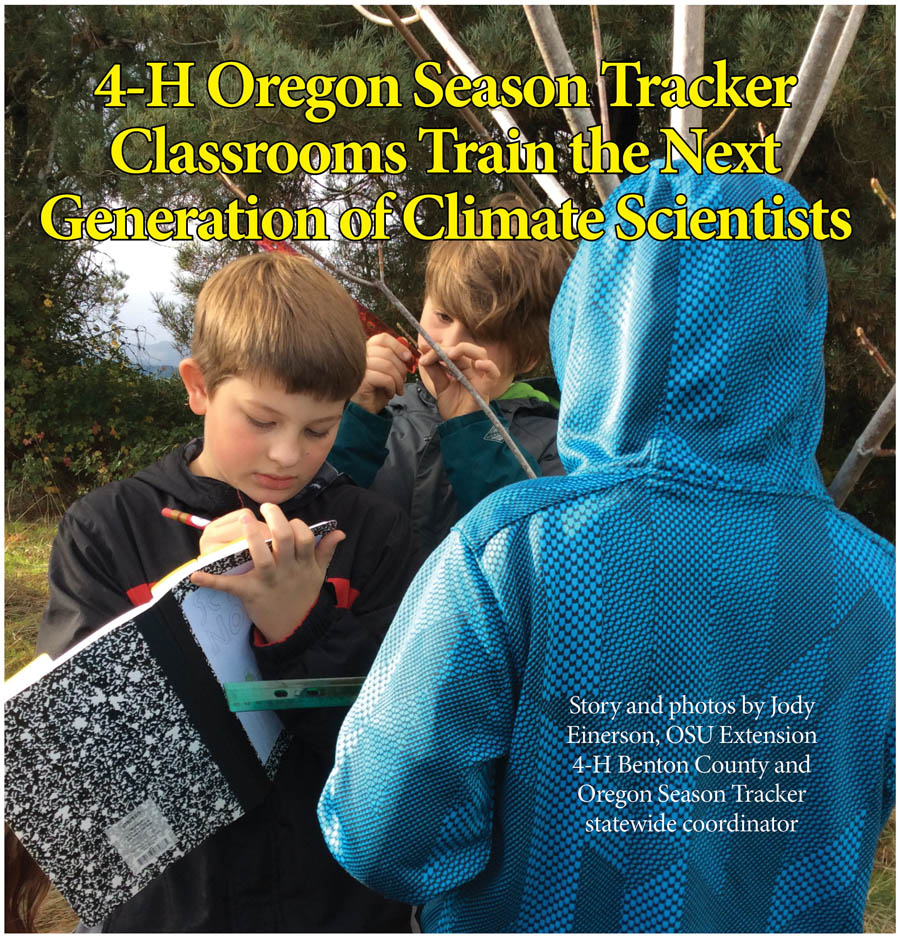
On a sunny fall day in Oregon students are outdoors learning about the new citizen science observation site in their schoolyard. With a mix of 4th and 5th grade exuberance and the seriousness of adults they are taking on the mission of gathering basic data for a section of their school yard scientific study and research area. These students are part of the Oregon Season Tracker 4-H classroom program that is regularly getting them outdoors for real world science. As the teacher explains, this is the first of many data gathering sessions as part of their yearlong commitment to the program. This real world data will support researchers to gain a better understanding of climate change across Oregon.
 regon Season Tracker (OST) 4-H classrooms are a companion to the Oregon State University Extension Oregon Season Tracker adult citizen science program http://oregonseasontracker.forestry.oregonstate.edu/ . In the adult program, volunteers are gathering and reporting their observations of precipitation and plant seasonal changes in a statewide effort. Started in 2013 and targeting adults, it quickly became evident to everyone involved that the program had clear applications to outdoor hands-on “experiential” science learning for students.
The foundation of the OST program is based on a partnership between OSU Extension and HJ Andrews Experimental Forest located in Blue River, near the midpoint of the Cascade Mountain range https://andrewsforest.oregonstate.edu/ . The Andrews is a leading center for long term research, and a member of the National Science Foundation’s Long-Term Ecological Research (LTER) Program. The 16,000 acre research forest in the McKenzie river watershed in the Cascade Mountains was established in 1948, with paired watershed studies and several long-term monitoring programs initiated soon after. Today, it is jointly managed by the US Forest Service and OSU for research into forest and stream ecosystems, and the interactions among ecological dynamics, physical processes, and forest governance.
Part of the success of the Oregon Season Tracker program is that we have also collaborated with national programs, Community Collaborative Rain Hail and Snow Network (CoCoRaHS) https://www.cocorahs.org/ and National Phenology Network (NPN) Nature’s Notebook https://www.usanpn.org/natures_notebook, as well as our local partner. A key role of our national partners is their ability to collect, manage and store the data, making it available both to professional and citizen scientists. This national connection makes sure the data is available long-term and easily accessible locally as well as nationally and beyond. Both of our national partners have easy to use web based visualization tools that allow volunteers and students to easily look at and interpret data. In the classroom this means not only are students helping ongoing professional research, they can also investigate or research their own science questions using the data of others. Partnering with these national database sites also allows OST to stretch our resources further, spending our time and energy supporting the volunteers and classrooms in our program.

Zero is important data when reading the rain gauge!
Back at the school, it is 8:30 am and a student team is checking and recording the level of precipitation for the last 24 hours. The rain gauge station is set up outside the school entrance and is clearly marked with a sign explaining what the students are doing. Parents and visitors can clearly see they are part of the Oregon Season Tracker 4-H program collecting precipitation and plant phenology data as citizen scientists. The sign calls attention to their efforts and gives the students a sense of pride in what they are doing.
Students use a program approved manual rain gauge that is standardized nationally. They become comfortable reading the gauge marked out in hundreds of an inch and how to conform to set data protocols. They learn not to round measurements for accuracy, to read using the bottom of the meniscus, and how to deal with an overflow event. All skills that have math applications for what they are doing. Depending on the grade of the students these skills are new or a refresher of what they already know, but important none the less.
Students learned the rain gauge skills at the beginning of the year in outdoor relay races using Super Soakers to simulate rainfall in their gauge. Teams vie to see who can get the most “rainfall” into their gauge. The casual observer might mistake this activity for recess, but they are having fun learning the needed math skills. By learning to read the manual gauge to .01 of an inch they are following the protocols set out by our national partner CoCoRaHS.
The daily precipitation observations are establishing a piece of the scientific process. As part of the team approach, the observations readings are verified before dumping out the day’s accumulation. Students begin to get a feel for what an inch of precipitation looks like, both as it falls from the sky and what it looks like in the gauge. The data collected is then passed on to another student team that hovers over the classroom computer, entering it in the national CoCoRaHS website. Data entered by 9:00 am is shared on an interactive map, for any visitor to the website to view.
The data submitted to the CoCoRaHS website is accessed and used by meteorologists, hydrologists, water managers, and researchers. It is also captured daily by the PRISM Climate Group, one of our local OSU partners. PRISM gathers climate observations from a wide range of monitoring networks (including CoCoRaHS), to develop short and long term weather models that are in turn used by still more groups and agencies reporting on and studying weather and climate. This is an important thing for all our adult and student observers to realize: their data is real, it is important, and it gets used.
So for those students that are worried that their data will just get lost in the mountains of reports submitted every day, I’d like to share this experience. This past year, I worked with a teacher that received an urgent email from the National Weather Service within a short time after the Monday morning rainfall report was entered in the database. The Weather Service continuously monitors for extreme weather, and were checking on the accuracy of the morning report of over 2 inches of rain. Quick sleuthing found the students had made an error in submitting their data. Instead of making a multiday report for the weekend they had made a single day report. This was an eye opening experience for the students, not only to realize their data is being used but also that scientists are depending on them to be accurate.
Monitoring a rain gauge is an easy lesson to expand or extend into other topics. Students can be challenged to look for weather patterns by comparing their own station with others across your county, state, and even the nation. Alternatively, by graphing daily data or comparing the rainfall data against topographic maps. These types of observations can challenge students to see patterns and make connections. This leads to investigating essential questions such as: how do these weather and climate patterns play out across the state and how does this effect what and who lives in these locations?
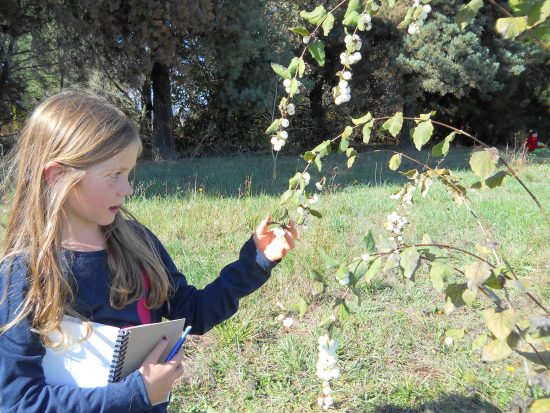
Observing fruiting on a common snowberry shrub.
OST students are also tracking plant phenology or growth phases over the year. They will be reporting on leaf out, flowering, fruiting, and leaf drop. By pairing these plant change observations with the precipitation readings, researchers have a powerful tool in the study of climate and the role it plays in plant responses. The OST program has identified eight priority native plant species that we encourage using if possible. These priority plants 1) mirror plants studied at the Andrews Forest, 2) have a large footprint across the state, and 3) are easy to identify. By targeting this small group of priority plants, we add density to the data collected making it more useful for our research partners. Our research partners at the Andrew’s Forest have many long-term studies looking at phenology and climate. They not only look at plant phenology but intensively study the ecosystem connections with watersheds, insects and birds. OST phenology data collected by students and volunteers allow the researchers to apply their findings and connections on a larger statewide scale.
Back at school, we now shadow a High School class. Students in an Urban Farm manage and work in a small farm on the school grounds, growing market vegetables and managing a small flock of egg laying hens. As part of their Urban Farm, they have planted a native pollinator buffer strip surrounding their large market garden. In this pollinator garden, they have planted vine maple, snowberry and Pacific ninebark, several of the OST priority plants, which they are observing weekly. They started their strip by studying the needs of the plants looking at soils, sunlight, and water needs. They then matched appropriate plants with their site, found a source and planted their buffer strip. Adding native plants to their buffer helps to attract and sustain the native pollinators in their garden. These students carry a field journal out to the garden and collect phenology data weekly as one of the garden jobs.
 Just like precipitation data, observing and reporting on plant phenology has a set of protocols that need to be followed to standardize the data, and ensure accuracy. OST and Nature’s Notebook (our national partner with the National Phenology Network) are looking for the timing of some distinct phenophases or plant lifecycle stages. The students concentrate on looking for leaf bud break, emerging leaves, flowers and buds, fruiting or seeds, and leaf drop. Nature’s Notebook has defined criteria for reporting each one of these stages.
We have found students as young as 3rd graders can be accurate and serious phenology scientists with a progression of training and understanding. It all starts with being a good observer, one of those important science skills. We have found one of the best tools to teach observation is to consistently use a field journal (e.g., field notebook, science journal, nature journal) when working outdoors. A field journal is a tool that helps to focus students and keep them on track, and to differentiate their outdoor learning time from free time or recess. A simple composition book works well, is inexpensive, and is sturdy enough to last through the seasons.
Start with a consistent expectation of what a field journal entry will include and help students to set this up before they go out in the field. Page prompts will help younger students focus on the task. At a minimum, all field journal entries should include the date, time, weather, and location. Depending on the focus of the day, have students include sketches, labels, and notes on colors. Have students include at least one “I wonder” question they would like to investigate and learn more about. Use the field journals as a tool to help students focus in on the plant they are observing for OST, but also encourage them to observe everything around them. This broader look is what leads students to make those ecological connections that just may spark their interest in science and lead to a lifelong study.

Phenology photo cards help with recording data.
As students get comfortable using a field journal we introduce phenology. Phenology is the study of nature’s seasonal changes, and a scientist who studies phenology is looking at the timing of those seasonal changes and the relationship to climate. Although OST focuses on plant phenology, the observational skills can apply to wildlife and insects, for example reproduction and migration. Phenology is an easy observable phenomena that can lead your science study and help meet Next Generation Science Standards http://www.nextgenscience.org/resources/phenomena .
We use a fun activity to introduce phenology and help students focus on what is happening outdoors in the natural world. Start by having students brainstorm in their field journal a list of all the things they can remember occurring outside during their birthday month. They can use plant cues, animal migrations, weather and light. For example,, “the earliest bud break has already happened, daffodils are blooming, the daylight hours become equal to the night hours, and the early bird migrants have arrived” (March). Once they have their list, pair them up with someone who does not already know their birthday. Then have them trade clues to see if they can guess each other’s birthday month. For younger students you may decide to help them with a class brainstorm and write the different nature clues on the board under headings for each month.
Once the student have a good understanding of the concept of phenology we go outside to start observing. OST has developed some handy plant phase field cards that have pictures and definitions for students to refer to and compare as we learn the phenophases in the field. Nature’s Notebook has printable data sheets that students can take out in the field to record their data. We have found that by copying these data sheets at the reduced size of 87%, they fit into the composition book field journal and can be glued in to create a long term record of data at the site.

Using technology to create an informational video.
Technology also plays a key role when doing citizen science with your students. Both Nature’s Notebook and CoCoRaHS have developed easy to use free apps. The versions work with both Apple and Android devices, so you could use them on phones and tablets as well as entering data online with classroom computers. We take it one-step further and use the tablets to document the student learning. Each student team works on creating an informational video of the project over the school year. We give them the option of creating a video to train other students or make a video to communicate their work back to our partner researchers at the Andrews Forest. This video becomes an assessment tool for teachers and is something that the students enjoy. We limit the videos to no more than a three minutes, which means they need to plan it out well. They spend some of the slower winter months creating a storyboard, writing scripts, filming and editing. A 5th grade teacher at Muddy Creek School said, “The iPads engaged my most distractible students. Also, everyone was vested in this project because of the fun the iPads bring to the table. Basically, iPads were a great motivation to learn the science.” For Apple products, you can download a free version of iMovie for creating and editing your final product. There are also free editing apps that can be used on Android devices. Here is one of our early attempts using a movie trailer format https://www.youtube.com/watch?v=1KdNPZp-1Fs
In exchange, “Researcher Mark” (Schulze) from the Andrews Forest is in a video we created for the students. Walking through the HJ Andrews Experimental Forest we visit one of the many phenology plots at the forest. Mark explains how the phenology plots are scattered across a gradient of elevations at the Andrews. This allows them to look at plant responses to weather and climate as well as delving much deeper, making connections to insects, birds, soils, drought and much, much more. Mark explains that he is gathering data on some of the very same species as the students, and looking for the same phenophases. He takes them on tour of one of the many meteorological stations at the Andrews to see the many different climate instrumentation and variables that they are studying. In the end, Mark shares how valuable their citizen science data is to the future study of climate.
So, what does the Andrews research community hope to get out of collaborating with OST citizen scientists? With the wealth of information they are amassing, they are also interested in seeing if the trends and patterns they are documenting on the Andrews hold true across the varied landscape of Oregon. There is no stream of funding that could finance this kind of massive scientific study except through tapping into the interest and help of volunteer citizen scientist including teachers and classrooms across Oregon. In this circular process of interactions between researchers and volunteers we hope to extend the conversations about climate science, and document the landscape level changes for the future.
It is easy to see how the students benefit, both by applying “real science” outdoors on a regular basis, and their career exploration as scientists. Teacher’s surveys report taking their students outdoors to work on science an additional 8 – 12 times per year because of this program. One Middle School science teacher says, “A great opportunity to get students collecting ‘real’ or authentic data. Given that the work is from a national source it also helped students take ownership of their project and feel its importance.” Students also learn and practice many of the NGSS standards and science practices working on and experiencing real world problems, not just reading about it in a text book.
Climate change is a real and sometimes overwhelming problem for many students, leaving them with a sense of helplessness. What impresses me the most with the students in the program is that they come away with a mindset of how they can have a positive impact in the field of climate science. When asked what they liked best about this program student surveys stressed that positive connection, “Helping scientists felt good.” “That I can make a difference.” “By helping researcher Mark, it was not just for fun it was real.” A good step in building the ecological thinkers and problem solvers we need for our future.
Jody Einerson is the OSU Extension 4-H Benton County and Oregon Season Tracker statewide coordinator.

by editor | Jan 15, 2019 | Place-based Education

Photo courtesy of Mike Brown.
Not One More Cute Project for the Kids:
Neal Maine’s Educational Vision
by Gregory A. Smith
Lewis & Clark College, Professor Emeritus
PART ONE
 eal Maine, now in his late-70s is an iconic figure for many environmental educators in the state of Oregon. Early in his teaching career in Seaside, he decided to shelve the textbooks in his biology classroom and base his teaching practice on the premise that “If we couldn’t do it, we weren’t doing it.” He then focused on getting his students outside onto the beach and into the estuaries of the northern Oregon coast as well as onto their city streets and into public meetings, believing that the way to stimulate deep engagement on the part of his students required personalizing what they were learning by designing educational experiences characterized by immersion, involvement, and meaningfulness.
Central to Neal’s approach is a belief that functional communities provide the authentic curriculum that should occupy the attention of educators and their students. The job of the teacher is to create experiences that provide young people with the opportunity to access the processes that make a community work. Also central is Neal’s belief that students are among a community’s most valuable intellectual resources. As he observes, “Where else in the community can you get 20 or more people in the same room that can do calculus?” Instead of teachers seeing their task as getting students ready to do something in the future, they ought to be engaging them in work and experience that is valuable to the community right now.
I first met Neal in the mid-1990s on a visit organized by my Lewis & Clark College colleague, science educator Kip Ault. Over the previous few years, Kip had worked with Neal in a variety of capacities and they had become friends. Well aware of my interest in environmental and ecological education, Kip figured I needed to get to know more about what Neal was up to.
The thing I remember most about that first meeting was Neal’s commitment to inducting children into the processes that citizens able to support a democracy need to know. He asserted that just as supportive strategies are put into place to teach kids how to play baseball (t-balls, pitching machines, smaller diamonds, fewer innings), similar supports and experiences ought to be used to teach young people how to be citizens. With regard to baseball, children learn how to play the sport not by reading about it but by getting on a baseball field and pitching, throwing, catching running, and making sure players on the opposing team are called out. The same kind of learning in context should happen in their community. To that end, he had overseen the development of memoranda of agreement with the city and county to tap children’s energy and expertise for community projects.
What I learned from Neal profoundly shaped my thinking about place- and community-based education and the impact that treating children as the citizens they are right now rather than in the future could have on both educational practice but also their civic practice as grownups. Neal claims that the most important thing children can offer to public dialogue is the fact that they aren’t adults; their thinking has not yet been fenced in by convention and conformity, and they have the capacity to offer fresh insights, creative solutions, and energy to the life of their community. Given my concerns about the link between schools and sustainability, I felt as though I had hit the jackpot.

Photo courtesy of Mike Brown.
Other people concerned about similar issues felt the same way after meeting Neal. When Paul Nachtigal, a widely respected expert in rural education from Colorado and the president of the Annenberg Rural Challenge, a national effort in the late 1990s aimed at helping schools and communities get better together, heard of Neal’s work, he quickly enlisted him as a board member of what was then a fledgling organization. I recently stumbled upon the business card Neal gave me when we first met, and it focused on this institutional association. I didn’t know anything about the Rural Challenge at the time, but I subsequently became a board member of the Rural School and Community Trust, the organization it morphed into after the initial funding from the Annenberg Foundation came to an end in the early 2000s. Both the Rural Challenge and then the Trust were advocates for place-based education and provided important support for early adopters of this approach, an approach influenced in important ways by the work Neal had been imagining and then enacting from Cannon Beach, Oregon to Long Beach, Washington.
In the summer of 2013, Neal invited me to spend another day with him at the coast to acquaint me with some of the projects that represented the essence of his work as an educator. As he mentioned at the time, he didn’t know how much longer he’d be around, and he wanted to make sure that some of his ideas outlasted him. He hoped that deepening my own knowledge about things he’d done and helped start would increase the likelihood that this might happen. To that end, I recorded our conversation as we traveled from site to site thinking that it might eventually make its way into an article. A mutual acquaintance of Neal’s and mine, Sylvia Parker (formerly a Rural Challenge steward and now an education professor at the University of Wyoming), helped get the five-hour recording transcribed, and I finally got around to rereading, coding, and analyzing what was shared that day in the spring and summer of 2018. Larry Beutler at Clearing Magazine expressed a willingness to publish what I was able to distill, and I set myself the task of trying to capture some of the central principles that undergirded Neal’s work in the hope that other Pacific Northwest educators might continue experimenting with some of the practices that have inspired me and many others both here and elsewhere for years.
In addition to his work as a biology teacher and football coach at Seaside High School, Neal spent more than a decade supporting teachers interested in adopting his out-of-classroom approaches after being requested to do so by the superintendent of the local school district. His impact on students—often those he described as being too creative to plow through the regular curriculum—had not gone unnoticed. They sought out his classes because “they had heard rumors that you got to do something there” and wanted to be part of the action. What they got to do had really meaning and purpose. While on the surface their work could be seen as little more than a “cute project,” what was actually happening went far deeper. They were being shown that their voices mattered and that their community could be made better if they spoke up and got involved. The following collection of place- and community-based learning experiences are emblematic of the educational vision Neal nurtured in the district.
A Compendium of Educational Experiments
Little Pompey Wetlands. Little Pompey Wetlands is located just a few blocks from the town center of Cannon Beach, a resort community nine miles south of Seaside. Somewhat more than two decades ago the city was interested in developing a nature trail for residents and tourists in the vicinity of the wastewater treatment facility and had hired a consultant to assist in this project. Aware of this effort, Neal approached the city manager about whether students might be able to participate in some aspect of this work as a means of honoring the memorandum of agreement that called on city and county agencies to make use of students whenever possible. The city manager was interested; Neal then found a teacher willing to rework her spring curriculum so that many of its goals could be met through the project. They presented their plan to the board, gained permission to proceed, and then with the students decided to create a sign about the wetlands and its species that could be shared with visitors.
This project required not only gaining knowledge about wetlands ecology in general and the variety of plants and animals found in the area (including birds such as red-winged blackbirds, shovelers, eagles, and fox sparrows, and during the winter, an occasional coyote or Roosevelt elk) but also the tasks of writing the text for the sign, naming the wetlands, overseeing the spending of $2000 allocated for the sign’s production and development, shaping and assessing the work of the artist hired to realize their vision, and selecting a sign maker to produce it. In most conventional classrooms, this process would have stopped with knowledge acquisition and most often a test or perhaps individual or group reports. In this instance, students not only had to collectively determine the most critical information to display; they also needed to act as a citizen committee responsible for the wise use of public dollars and as the employer of adults who had contracted with them to fulfill specific services. A project like this treats students as the citizens they already are and gives them the opportunity to practice decision-making skills generally reserved for adults, a task few people, regardless of age, have been prepared for in school.
Naming the wetlands introduced a whole new realm of adult activity when students and their teacher learned they couldn’t simply give a name to a wetlands but had to go through a complex legal process. Investigating other wetlands in Oregon, they could find none that had been named after a child. An earlier unit had acquainted them with Sacajawea and the Lewis & Clark Corps of Discovery; they decided to honor her infant son Little Pompey by naming the wetlands after him. Their commitment to a name they had chosen themselves propelled them through the legal requirements of the state and introduced them to processes often required to accomplish meaningful work in a community.
Democracies depend on the capacity of citizens to engage in civic life in these ways. Not uncommonly, the knowledge required to do so is limited to people whose parents understand the rules of public participation since these skills and insights are not made available to the general population in any systematic way. By giving school children the chance to acquire such knowledge and skill, educators like Neal Maine are inviting a broader group of people into the decision-making process and cultivating in them the ways of thinking, speaking, and acting needed to accomplish tasks they believe to be important. More than simple participation in marches and demonstrations, as important as these activities might be, “this is what democracy looks like.”
Friends of Haystack Rock. Central to Neal’s educational approach is its emphasis on the value of finding ways to situate learning experiences outside the school in the community or region, and in some instances creating new institutional structures to accomplish this end. Fittingly, the next part of our tour took us to a bluff overlooking the beach beside Haystack Rock, Cannon Beach’s geological claim to fame. Scores of people were clustered in small groups on the sand, looking through viewing scopes, examining displays on tables, listening to presentations. Neal explained that what I was seeing was the work of staff and volunteers at the Friends of Haystack Rock, an organization that has a cooperative agreement with the city to provide interpretive services to locals and tourists interested in learning more about the natural features of the area. Special attention is directed to the lowest tides of the year during the spring and summer when the marine gardens surrounding Haystack Rock are more accessible.
In existence now for more than 30 years, Friends of Haystack Rock grew out of Sea Week, a project Neal had started in the 1980s. During Sea Week, regular classes were suspended and students from throughout the school district would make presentations to the public about projects they had completed related to their home environment with the aim of preserving and protecting it. Sea Week as it was implemented then no longer exists, but the Friends of Haystack Rock essentially provides the same kind of educational experiences but over a more extensive period of time with the support of volunteers, many of whom are young adults. Its volunteers also become the teachers of the community’s children about marine resources, offering programs both in classrooms and then on the beach. Although the school district ended up not supporting this effort over the long-term, its advantages were apparent to city leaders and an ongoing collection of volunteers who have sustained it now for three decades. Given the fickle and short-lived nature of many educational reforms, organizations like the Friends of Haystack Rock offer a way to perpetuate educational experiences aimed at enhancing the public’s knowledge about their region.
Coastal Studies and Technology Center. For ten years, the Coastal Studies and Technology Center, located at Seaside High School, offered another way to strengthen the relationship between the school and community. Under the leadership of science and technology teacher Mike Brown, students were able to get course credit for engaging in research projects requested by either the city or even federal agencies like the Environmental Protection Agency. The Center provided the workspace and intellectual support that allowed students to contact resource people at the police department, the local hospital, or other governmental offices. One group of students, for example, investigated the economic impact of the Seaside youth riots that occurred over three Labor Days in a row in the early 1960s. I accompanied another group of Upward Bound students working through the Center one summer day in the early 2000s as they mapped the location of woody debris in the Neawanna estuary. Using GIS equipment, they tagged and identified the location of the debris, data that were later recorded on maps of the area that would be used to preserve and enhance salmon habitat.
The Center functioned as a non-profit entity within the context of the school. Its success in pursuing grant dollars and its independence from traditional decision-making structures in the district, however, led to the imposition of constraints that eventually resulted in a narrowing of its focus to technology education. Still, for several years it demonstrated the way that an organization that treats young people as researchers and actors rather than passive recipients of knowledge passed down by others can create engaging learning experiences and do so in ways that benefit others.
Earth Odyssey. Neal was also instrumental in encouraging two fourth grade teachers at the elementary school in Gearhart, a small town just north of Seaside, to collaborate on the creation of a curriculum grounded in the history and natural phenomena of the north Oregon coast. Modeled on a summer camp program called Sunship Earth, the teachers ended up naming their year-long educational adventure, Earth Odyssey. The day of my tour, we met over lunch with Jan Weiting, who had taught in this program for three years. The work of Jan and her partner Larry Nelson exemplify ways that Neal’s vision can be incorporated into the classroom over the course of an entire year. Students’ work in the fall, for example, started with a study of entomology. They moved on from there to the archeology of the North Coast and the Indians who have lived in the area for over 10,000 years, Lewis and Clark’s experience of spending the winter at Fort Clatsop a dozen miles north of the school, and then on to the mountain men and the Oregon Trail. Nearly all of the traditional subjects could be taught through these broad topics tied into the district-prescribed curriculum for fourth graders. Over and beyond this curriculum, students planted trees that are now a small forest outside their portable classroom, painted a mural on one of the building’s walls, and dug and planted a pond. After school Jan and Larry would take smaller groups of interested students on additional field trips to investigate things like sea kelp or to lend a hand with conservation projects, learning activities that brought them recognition as conversation educators of the year by the US Department of Agriculture.
An especially significant activity involved the annual publishing of the Coastal Geographic, a collection of student writing based on interviews with local characters like a famous clam digger. As Neal observed, “The interviews of the people were just so personal and written in such a way that only a kid could talk about, the ordinariness of a person as opposed to the world record they just set.” Although only published for three years, the Coastal Geographic served as a model for the Neawanna Journal, a project that was adopted by a high school teacher who worked with students who were potential dropouts. The students interviewed people who had been born on the Neawanna River in the 1900s, took photos, and wrote up their stories. Their efforts won them an award from the library delivered at a public reception. Neal remarked that “The kids had so much ownership, it was just fabulous.” He added, however, “What sense does this make to have to be so bad at school that you get to produce something that the people who are really good [at school] wouldn’t have a chance at?”
Other Neal-inspired learning experiences. During his years as a teacher support staff in the Seaside School District, Neal found many ways to provide similar instructional opportunities to a broad range of students. One year a group of seventh-grade teachers approached Neal about helping them get funding to take students from their health classes to Portland to see the “plastic lady” at the Oregon Museum of Science and Industry and learn more about bodily systems. Neal persuaded them to pursue a less expensive and potentially more productive idea—a health fair the students would put on for senior citizens in which student groups would be responsible for running booths focused on physical systems like digestion or circulation or respiration. Willing to try out this idea, teachers enlisted the support of staff at the hospital to instruct students and provide equipment like respirators and blood pressure machines they could legally use with people who visited their booths. A day was then set aside for the fair, advertising went out to the public, and arrangements were made to hold the event at the senior citizens center. The fair ended up being well attended by community elders interested in helping the kids. When Neal heard one of the older teachers saying “It’s the first time I’ve ever really enjoyed seeing kids fight,” he asked about what she was talking about. She said. “They were fighting over whose turn it was to do the test next.”
Another year, a seventh-grade social studies teacher got in touch with Neal about a project he had in mind that was not much different from the trip to see the “plastic lady.” Neal explored ways that he might do something that required more involvement, and together they proposed to the Seaside City Council that students audit the decades-old city charter, something the mayor didn’t even know existed. Drawing on the six career themes that were then central to the Oregon’s educational reform—industry and engineering, natural resources, human resources, health services, arts and community, and business and management—the teacher had each of his six classes take on one theme and compare what was written in the charter to what the city was currently doing. The students early on realized they’d need support to do credible work, so they designed a resource list of people they then invited to their classes. They went on site visits and synthesized what they were learning into a presentation.
At the end of the term, the mayor called the city council to order in the middle school gymnasium. With 137 people in attendance, it ended up being one of the largest city council meetings in the history of Seaside. As Neal remembered, “The kids started going to the microphone and presenting their audit results. Some of them were pretty harsh.” The school district, in particular, came in for some major criticism for its failure to spend the required one percent of money allocated for building projects on public art. The students noted that not one dime had been spent on art during a recent $7 million remodeling effort, something that shocked them after documenting the art works that had been incorporated in other local city and state building projects.
On earlier visits with Neal I’d learned about similar projects taken on by teachers and students from elementary school to high school that gave children and youth the opportunity to do school work that showed them what it means to be an involved citizen. Fourth graders one year visited a number of the parks in Clatsop County and then made recommendations about new playground equipment during one of the public meetings of the parks commission. Middle school science students did a species survey at an old mill site the city hoped to turn into a public park with federal urban renewal funding. High school pre-calculus students used trigonometry to determine the dimensions of all of the buildings on the tsunami plain so that emergency planners could use new software to determine the impact of smaller and larger tidal waves. Another group of fourth graders surveyed their families and neighbors about whether they changed the batteries in their smoke detectors when daylight savings time comes to an end in the fall. The possibilities for investigations like these are nearly endless; all it takes is the willingness of teachers to be alert to them and for community organizations to value and then make use of the intellectual resource provided by public school students.
Asking/answering questions of the world
Beyond inducting children and youth into the processes by which a community governs and cares for itself, I learned about two other elements of Neal’s educational vision on our tour that are worth discussing. The first of these is tied to his belief that the curriculum should in part arise from questions that children raise about their world. Early on in his career as a science teacher, Neal decided that restricting instruction to textbook experiments people already knew the answer to is a recipe for disengagement and boredom. What is critical instead is acquainting students with the value of raising questions that can be answered through the systematic gathering and analysis of data. For elementary school students, he designed a process to convey this understanding.
Students were asked to predict where a rubber-tipped dart shot from a toy gun taped to and stabilized on a tripod would land on a classroom wall. The first stage was to draw a circle that you knew the dart would hit. Some students chose to include the entire wall, absolutely guaranteeing success; others were more precise. Then they conducted the experiment. The next step was to refine their prediction, something that required discussion and decision making. Eventually they found that the gun fired pretty consistently and would hit a point within a three-inch circle. As Neal observed, “What they found was testing is so valuable, getting data, because it makes your answer so much better. So simple. But for fifth grade, it was perfect. It was fun and it was interesting. They’d never gotten to shoot a dart gun in their classroom before.”
With this understanding in hand, Neal would encourage students to then ask questions of things like their watershed and design experiments or procedures aimed at answering them. For example, one day a student said that when he was out hiking with his family, his grandpa said that moss always grows on the north side of the trees. He wondered whether this was right or not. The teacher and class ran with the question and designed a project that involved taking acetate sheets, cutting them the length of the circumference of a tree, pinning them in place after checking and marking the four cardinal directions, and then recording with different colors the location of lichen, moss, and any other growth on the tree. All of this teacher’s classes ended up doing the experiment in a forest close to the school, so there were hundreds of acetate sheets. Once they had all been collected, the sheets were then laid with those on the north side lined up, allowing the students to determine how much moss or lichen grew on different sides of trees in at least this one forested area. What they discovered ended up being published in the Seaside newspaper.
Other questions led students to design experiments aimed at determining what kind of material was falling from trees in the forest. They strung up 10 feet by 10 feet tarps from trees, put a rock in the middle, and then left the tarps alone for 48 hours. They came back and swept everything that had accumulated into the middle and took what they collected back to the classroom. They then examined what was there through a stereoscopic microscope. Neal still gets excited about what they discovered: “That one was mind boggling because the number of insect larvae was shocking. It was amazing that there’s tons of stuff falling out the trees that you don’t see.” The students also wondered about what it is about the soil in a forest that allows it to produce so much vegetative matter. The teacher invited soil scientists into the classroom who taught the students about the constituents of soil, itself. The scientists were followed by a master gardener who helped the kids gather the appropriate materials and make their own soil that was then placed in raised beds. They planted seeds, and the experiment was under way. “The idea was they’d learn the scientific method as a result of trying to get, pry, answers from the landscape.”
Expanding the boundaries of home
Beyond inducting students into the processes that govern their own community, Neal believed that students’ school experiences should ideally lead to a recognition of their home community’s relationship to other towns and cities in their region. As a former football coach, he had been concerned about the way that most interscholastic contact focuses on “beating the crap out of Astoria and all that kind of business.” He wanted students from different communities to recognize the value of learning from and working with one another, as well. On the day I spent with him, he told me of three projects that sought to achieve this end.
Towards the end of the morning, much of our conversation took place at an elementary school on the outskirts of Seaside on a hill up above the tsunami plain. This location was ideal for the educational experiences described above because of the proximity of the forest but also the proximity of Coho Creek, a salmon-bearing stream partly located on school district property that feeds into fresh water marshes and then the salt water marshes where salmon undergo the transition that allows them to become fish capable of living in the ocean. Neal and teachers at the school quickly saw the learning possibilities of this site, turning it into a watershed education center for students from other schools. After learning the ins and outs of the salmon life cycle, Seaside students became watershed guides for fifth-grade students from Knappa and Astoria, towns to the north. For Neal, this kind of opportunity made it possible for students to have experiences that helped them recognize their kinship with peers in other schools in the same region.
The inspiration for the second project was a 1974 issue of Life Magazine that featured photos aimed at telling a story about what happened in the United States over the course of a single day. Neal figured that something similar could be done for the “Columbia Pacific region” stretching from Seaside and Jewell and Warrenton in Oregon up to Ilwaco and Long Beach in Washington. After getting the Daily Astorian to agree to print and publish it, staff from the paper led a workshop that was attended by 74-75 students from the region. The plan was to send these students out for 24 hours on the day of May 4, 1999 to document photographically what they saw happening in their community. The hope was that they would begin to communicate with one another as citizens of a common region. With their cameras in hand, students found that people gave them acceptance and access as they captured their fellow citizens milking goats, making taffy, cutting trees, docking a fishing boat. Few of the students had ever spent a day in their own community just observing and speaking with people they didn’t know. After this experience, one girl said that “she gave up her old eyes” and had come to realize that she lived in a kind of paradise. The project turned out to be “monumental” according to Neal, being written up in The Oregonian, the state’s largest paper. It was also selected for a Library of Congress journalism program with which the Daily Astorian was involved.
A project with a similar aim was called “Crossing Boundaries.” It involved students from five middle schools throughout the region who were asked to develop a transect across the entire Columbia River based upon the collection of bottom samples. To do this work, students had to learn how to run a boat in a straight line using GPS equipment across a few miles of river. Mastering this skill this took a couple of days. Then, with a boat captain standing behind them, some of the students kept the boat on course while their compatriots dropped scientific gear into the water and gathered data. The report based on their findings, “New Designs: Youth Voices Building Communities,” touched on important land use planning issues for the region and became the foundation for subsequent investigations, like strategies for protecting beach areas inhabited by sanderlings, a kind of small sandpiper. What is striking about these projects is their creativity, the depth of learning they elicited, and the meaning they possessed for both student participants and the people throughout their region.
CLICK HERE FOR PART TWO
 Greg Smith is an emeritus professor who taught for 23 years in the Graduate School of Education and Counseling at Lewis & Clark College. He’s keeping busy in his retirement serving on the board of the Great Lakes Stewardship Initiative in Michigan and the educational advisory committee of the Teton Science Schools in Wyoming; at home, he’s co-chairing a local committee that is seeking to develop curriculum regarding the Portland-Multnomah County Climate Action Plan. He is the author or editor of six books including Place- and Community-Based Education in Schools with David Sobel.

by editor | Nov 18, 2018 | Outstanding Programs in EE
 NatureBridge Takes the Classroom Outdoors: Inspires Teachers and Students Through Discovery
by Karen West
for NatureBridge
“The future will belong to the nature smart… the more high-tech we become, the more nature we need.”
– Richard Louv, author of “Last Child in the Woods, Saving Our Children from Nature-Deficit Disorder’’
Jeff Glaser stood at the base of Madison Creek Falls in Olympic National Park, taking in the beauty of the water cascading 76 feet. As he hiked back toward the Elwha River, he recalled his nature-filled childhood, packed with camping, hiking and fishing trips throughout the Pacific Northwest.
He couldn’t help comparing the wilderness adventures of his youth to experiences of today’s generation, many of whom are growing up in an over-scheduled, technology bubble. “I love getting my students off their devices and into the natural environment where they can breathe, stretch and grow,’’ says Glaser, who teaches sixth grade math, science and religion at St. Louise School in Bellevue, Wa.
Glaser was one of more than a dozen teachers participating in a four-day professional development summer workshop at NatureBridge, an environmental education nonprofit with a campus in Olympic National Park on the shores of Lake Crescent. With environmental science at its core, the workshop was an example of how NatureBridge provides educators with training, resources and curriculum to help prepare their students to be the next-generation of environmental stewards.
The teachers from Washington, Oregon, California and New Jersey spent the week exploring marine and lowland forest ecosystems in Olympic National Park including the lower Elwha River watershed. NatureBridge educators, Olympic National Park assistant superintendent and rangers, and data driven scientists provided insight into how science, technology, engineering, and math skills inform decision making and management of this one million acre park.
In final projects, teachers in the workshop collaborated with their grade-level peers to submit classroom content for publication on the National Park Service’s K – 12 education site. Inspired by his visit to Rialto Beach, Glaser created a lesson plan focused on marine plastics – Where does the debris come from? What happens to it? And how much is generated?
“Many kids today don’t have these experiences – some don’t know their trees or their national parks,’’ says Glaser, whose parents integrated nature into his life-long learning. “It’s not just kids who are missing out on nature experiences. As teachers, we need to step it up and show our students these things.’’
The educational workshop is just one way NatureBridge collaborates with the national park to inspire teachers and students through critical-thinking skills, hands-on scientific research and inquiry-based learning.

OLYMPUS DIGITAL CAMERA
Letting Kids Get Their Hands Dirty
Founded in 1971 as Yosemite Institute, NatureBridge serves over 30,000 young people from more than 700 schools each year at its six national park campuses: the valleys of Yosemite, the watersheds of Washington’s Olympic National Park, the peaks of the Santa Monica Mountains, the marine sanctuary of the Channel Islands, the coastal hills of the Golden Gate National Recreation Area and the piedmont forest of Washington, D.C.’s Prince William Forest.
No matter what grade level or type of school, many of the teachers who go through a NatureBridge program all leave with the same discovery: Kids get excited about environmental science when they are immersed in a living, outdoor laboratory where they can become scientists in the field – and not worry about making mistakes.
“It’s all about discovery,’’ says NatureBridge educator Josh McLean, during a recent Elwha Exploration Day event. He says it’s more important for kids to think about and create questions than answering them correctly, adding that the most rewarding experiences often come when students are feeling out of their comfort zone.
“The struggles build our ability to persevere and find new knowledge,’’ McLean says, throwing in his favorite quote from poet William Blake who once said, “it’s the crooked paths that are the paths of genius.’’
NatureBridge offers three- to five-day residential programs primarily targeting students in grades 4–12. Olympic National Park is a place where kids and adults aren’t afraid to step in the mud. Students get to hold slimy salamanders, hike in an old growth forest or even touch snow for the first time. They walk across the bottom of what used to be a 60-foot deep lake conducting experiments like real-world scientists, touch springboard notches on tree stumps that were cut down 100 years ago and stand on a 210-foot slab of concrete that once was a dam.
“I can’t think of a better way to teach kids about nature,’’ says Stephen Streufert, vice president of education and Pacific Northwest director at NatureBridge. “By letting kids get their hands and feet dirty in outdoor classrooms, students acquire a deeper understanding of their environment and often begin a lifelong interest in science.’’

NatureBridge Changes Lives
Just ask high school senior Marisa Granados, NatureBridge’s 2018 Student of the Year. Before I had the opportunity to travel to Olympic National Park, I had begun to feel discouraged about the impact I really could make in the world.’’
Inspired by her first school trip to NatureBridge, Granados embarked on a 14-day NatureBridge Summer Backpacking program in 2017 that gave her renewed confidence in her ability to thrive and make a difference: “I was able to gain the confidence to speak up about what I wanted to do with my life. By gaining a stronger relationship with nature and discovering a deeper part of myself, I now see the influence of my actions and the amount of power that I have in creating change.’’
With the support of the U.S. Forest Service, she developed a handbook and curriculum for middle school students to learn and apply environmental stewardship effectively in her home state of New Mexico. She hopes to pursue a career in environmental engineering and outdoor education.
Granados is just one of thousands of students who has worked like a true scientist collecting and analyzing data in the Olympic National Park.
“There’s a mysticism around here that makes everything magical,’’ says Ingraham High School senior Jonathan Mignon on a recent scientific exploration in the Olympic National Park. “This is a place where you get sense of wild, untamed nature that speaks to me. It makes everything more tangible. You’re not only learning it but you’re feeling it.’’
When students hike in the Elwha River watershed, they don’t just hear that obstructions to river passage has changed, they see first-hand that salmon are now able to swim upriver and spawn in cobbled pools miles upriver from where the dams used to be. Students become part of the dam restoration story practicing scientific inquiry and critical thinking to understand complex issues associated with engineered environmental change.
“They think like scientists testing the quality of water, then transform into politicians, activists and concerned citizens engaging in debates about how the river and its salmon are managed,’’ says Streufert.
Students also get first-hand lessons in stewardship. “They learn that, for the Elwha dam removal to be successful, people had to listen, to engage with those they did not always agree with and to ultimately act, with multiple stakeholders and multiple outcomes in mind,’’ says Katie Draude, NatureBridge summer backpacking manager.

Bringing Back the Elwha
The Elwha Valley, where two dams were removed between 2011 and 2014, is a fertile learning environment for educators and students. The Elwha River Restoration Project – to date the largest dam removal in U.S. history – is one of the key areas of study for students visiting NatureBridge’s Olympic National Park campus. The $325 million National Park Service project entailed tearing down the 108-foot Elwha Dam and the nearby, 210-foot Glines Canyon Dam and restoring the river watershed.
Over the last several years, NatureBridge students have literally watched the river be reborn, recording its long and storied history.
The dams, the first of which was built in 1911, served their purpose of fueling regional growth by supplying much-needed electricity for the local timber and fishing industries. Though state laws required that construction of any kind allow for fish passage, both dams were built without it. But in 1992, after years of protest by many local tribes, lobbying and citizen outcry, Congress passed the Elwha River Ecosystem and Fisheries Restoration Act, which authorized dam removals. It took nearly two decades of bureaucratic wrangling before deconstruction began in 2011.
Meanwhile, the damage had already been done. The dams put a 100-year chokehold on migration of salmon just five miles upstream along the 46 mile river, disrupted the flow of sediment and wood downstream, and flooded the historic homelands and cultural sites of the Lower Elwha Klallam Tribe.
In its heyday, the Elwha River was home to one of the largest year-round salmon and steelhead runs of any river on the Olympic Peninsula and supported all five species of Pacific salmon. “People who were riding their horses up the trail just upstream from the river couldn’t cross,’’ Pat Crane, a longtime biologist for the Olympic National Park, told the professional development workshop teachers as they sat on what used to be the bottom of Lake Aldwell. “The horses refused to cross the creek because there were so many pink salmon in the creek.’’
That was in the late 1800s and 1900s, before there was electricity in Port Angeles and when steamboats were the region’s primary means of transportation – and before the dams were built. Back then, Crane estimates an average of 120,000 salmon came back to the river every year to spawn. “But by the time we go around to dam removal, we had between 100 and 200.’’
Today, the river, which flows from its headwaters in the Olympic Mountains to the Strait of Juan de Fuca, is the largest ecosystem restoration project in the National Park Service history – unleashing more than 70 miles of salmon habitat.
In September 2014, the first reported sighting of Chinook in the Elwha River above where the Glines Canyon Dam came down was confirmed, and they have slowly been returning ever since. In fact, as Crane was talking with the teachers during their workshop, he noticed a small stream near the river where dozens of baby salmon were gathering. “The fish are gambling they will be safe here,’’ Crane told the group. “They are safe for now but if the water dries up or a heron comes by, they could die.”
To kickstart the river’s recovery and help manage a century of accumulated sediment, Forest Service crews are planting 400,000 native plants and more than 5,000 pounds of native seed in the reservoir basins. But biologists say it could take a generation or more to heal.
What if We Taught Baseball the Way We Teach Science
Research shows that environmental outdoor education sparks student interest, helps improve academic performance and builds confidence. A Stanford University study measuring the impacts of environmental education for K-12 students showed that environmental education helps students enhance critical thinking skills, develop personal growth and increase civic engagement.
An educator in the Stanford study commented: “In my 20 years of teaching before using the environment-based approach, I heard, ‘Why are we learning this? When are we going to finish?’ And now when we are out in the field and sorting macroinvertebrates, for example, I have to make them stop after four hours for lunch. And then they say, ‘We don’t want to!’”
A recent report from the Kaiser Family Foundation found that the average eight to 18-year-old American now spends more than 53 hours a week using “entertainment media”, up from 44 hours five years ago.
“When you think about the pressures of youth today and the kinds of things they are dealing with their families and teachers, their primary interface is screens,’’ Streufert recently told a group of educators, donors and community leaders.“We know that the average time of kids outside on any given day is about seven minutes – that includes structured play (soccer practice) and unstructured play (playing out in the woods).’’
To illustrate the importance of hands-on learning, NatureBridge educator McLean recalls the writings of UC Berkeley professor Alison Gopnik, who believes “children are designed to be messy and unpredictable, playful and imaginative.” In her book, The Gardner and the Carpenter, Gopnik asks, “imagine if we taught baseball the way we teach science.”
McLean says it would go something like this: “In kindergarten or first grade we might bring a baseball into the classroom. You could look at it but not touch it—it might be dangerous… And if you got to the sixth or seventh grade level, now you can roll the ball across the room or perhaps swing a bat as long as you are well away from everyone else. In high school, with close, coach supervision, maybe you have an interview with a famous baseball player or maybe re-enact a play from some famous game. And it’s not until undergraduate level in college that you play a game of baseball. If we taught baseball that way, we would expect to see the same level of success in Little League that we currently see in our science classrooms – it’s not high.’’
In her book, Gopnik answers her question by saying: “learning to play baseball doesn’t prepare you to be a baseball player—it makes you a baseball player.’’
The same is true in environmental education—if you want kids to learn, to be scientists, to be stewards, you must involve them in the process. Take them into the woods, show them the rivers, let them experience the outdoors. These are the moments that will transform them into scientists. These are the moments that will inspire them to care for the natural world—not one day, but now.
# # #


