by editor | Sep 17, 2015 | Conservation & Sustainability
Environmental Education: The Science of Learning and Doing
by Cecelia Bosma
Trinity Lutheran School
Litchfield, Arizona
 e live on a planet with limited resources that are often consumed without caution. Finding ways to engage students in pro-environmental behaviors that conserve these limited resources rather than take them for granted is a priority for environmental educators. The human population also needs to work on understanding the benefits and risks we take with our daily behavior. Conserving the use of paper towels at home and in public is one easy pro-environmental behavior that will have a positive impact on the environment. Paper towels do not just use up trees, they also require large amount of water for production and they end up in landfills which generates pollution as they slowly decompose. However there are numerous alternatives to using paper towels at home and at school. These alternatives are efficient effective and financially thrifty. Often times conservation practices are rejected because they are time consuming and or costly. Alternatives to paper towels are neither. The financial benefit is an incentive for people that don’t relate to the environmental impact of using paper towels.
 Last fall, I designed a project to engage my eighth grade science class in a meaningful scientific inquiry project that assisted in deepening students’ understanding of the importance of conservation action through environmental education. The project action focused on eliminating paper towels in school bathrooms. There are many environmental benefits to reducing the amount of paper towels manufactured. One benefit is the reduction of trash in landfills because generally bathroom paper towels cannot be recycled. Another benefit is the reduction of chemicals leaching back into our soil from decomposing paper towels. This in turn saves trees from being processed into paper towels. Environmental benefits are also found in the amount of water consumed in the manufacturing of paper towels, and the reduced amount of fuel burned transporting paper towels.
Getting started on an inquiry project that is focused on building environmental knowledge through conservation action on the school campus can be a challenge. I have been working middle school students on various inquiry projects to build environmental knowledge for several years. Each time I start a project I am learning right along with my students. This project was no exception. Sharing ideas about inquiry and lessons that motivate students to learn and build knowledge is how we as teachers can help each other build stronger lesson plans that benefit our students and communities.
Project Inspiration
Educating adolescents about the impact they have on their environment is necessary for nurturing lifelong environmental stewardship (Nancy & Kristi, 2006). In the last twenty years, environmental education has been gaining a stronger foothold in classrooms across America (Stevenson, Peterson, Bondell, Mertig, & Moore, 2013). The purpose of environmental education is to teach students how to make responsible decisions, using critical thinking in order to take action to maintain or improve our environment (Short, 2010). Educators should encourage even small steps toward environmental conservation, as they are building blocks to lifetime environmental conservation action (Short, 2010). Accordingly, the primary goal of environmental education is to instill knowledge that leads to pro-environmental actions and behaviors for individuals, groups and society (Heimlich, 2010). I have found that engaging the learners in hands on actionable learning has a positive effect on the outcome of environmental education.
The burgeoning population of planet Earth has brought about observable changes in the environment both in populated and unpopulated regions of the world (Short, 2010). Scientists have observed these drastic changes in the form of melting ice caps, ozone depletion, deforestation and global warming, all of which can be attributed to human actions (Tidball & Krasny, 2010). Therefore, it is society’s responsibility to take action to improve the current environmental status that threatens the very existence of humans (Stevenson et al., 2013).
Additionally, it is important to incorporate positive actions into environmental education (Tidball & Krasny, 2010). Instead of focusing on what is wrong with our environment. Students are motivated by positive changes that help our environment such as recycling. Inquiry style learning is one way to incorporate positive action. Increasing environmental knowledge is a crucial part of environmental education (Grodzińska-Jurczak, Bartosiewicz, Twardowska, & Ballantyne, 2003). This project incorporated the inquiry process into the environmental education program. The students construct their learning by observing, asking questions and problem solving (Crawford, 2000). The inquiry process is a way for students to do science like a real scientist. Educating school children about environmental concerns now will promote action in the future (Evans et al., 1996).
The Project
A class of twelve eighth grade students took part in the paper towel conservation inquiry project. The project began with students watching the video that inspired me “How to use a paper towel” (Smith, 2012). Upon completion of the video, students were asked what they thought of the video and if they thought there were other ways that we could conserve paper towels in the bathrooms on our campus. Following the video students took a trip to the boys’ and girls’ bathrooms nearest to our classroom. Science class is at the end of the day, and students observed the piles of used paper towels in the garbage and on the ground.
They were challenged to develop a plan for measuring the volume of paper towels that were used daily for a week. Students worked in pairs to identify a plan which was presented the next day in class. Students then voted on the plan they thought would work the best and took steps to put it into action. One students brought in a scale from home and others created a data sheet for recording the measurements taken daily of the weight of paper towels used in each bathroom.
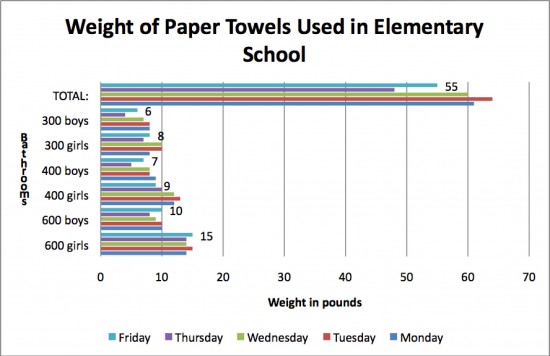
Table 1 Paper towel weight chart created by students
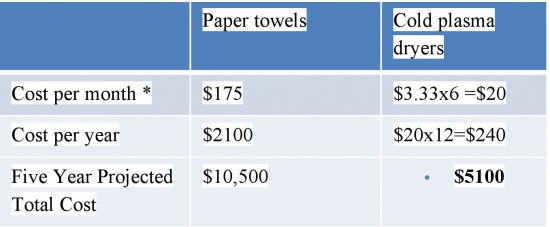
Table 2 Financial comparison of paper towels versus hand dryers created by students
The students tracked the amount, in pounds, of paper towels used in the 3 sets of boys’ and girls’ bathrooms for 5 days. This data was calculated and graphed to demonstrate the amount of paper towels that our school is disposing into the landfill each day. A total of 288 pounds of paper towels are thrown in the trash each week from the collective school bathrooms (figure 1). Students contacted the person on staff who handles the ordering of paper towels to determine that the school spends about $350.00 on paper towels each month. This information was tabulated into the final graph that compared the expense of paper towels versus the expense hand dryers (figure 2). The graph shown in figure 1 and 2 were developed by students; while it could be perfected it is meant to demonstrate the capabilities of middle school students. Upon completing the charts students noticed that the older students used considerably more paper towels than younger students did.
Students brainstormed alternative ideas to using paper towels. They researched hand dryers, cotton towel dispensers and looked at the practicality of using personal towels. After researching each option, they used the data they collected on alternatives to paper towels to create a presentation to share with fellow students, parents and the church board who has a strong influence on decision making changes. The conclusion of the study resulted in the student recommending the installation of new efficient hand dryers that dry hands in 12 seconds or less. As the students pointed out in their presentation the machines are also designed to kill germs in the air and on the skin (Gagnon, 2007).
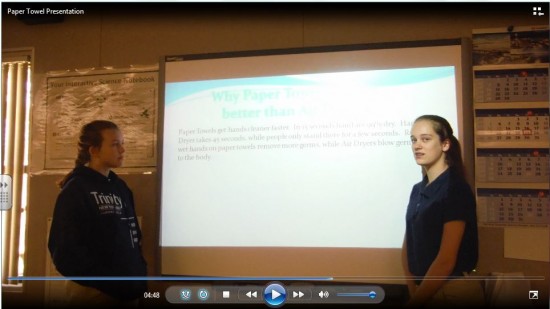 The presentation was videotaped and posted on the school website. Posting the video required getting permission from all of the parents. This was worthwhile effort because the students were then able to share what they had learned accomplished and produced with their own community of friends and neighbors. This made it possible to spread the idea of replacing paper towels with hand dryers to the larger community outside of our school.
The final piece of this project was to present a written proposal to the Board of Directors for consideration. Students were given the task and some guidelines and they had to collaborate and compromise to develop a well written proposal that included their research and data results. The objective of the assignment was to persuade the board to approve the installation of hand dryers in the bathroom. The proposal was completed and presented, and is now being considered for implementation.
Action and Reflection
The benefit of inquiry learning is that it provides a method for gaining deeper knowledge about a subject, in this case environmental education, and it also builds students skills in problem solving and analysis. This project provided students the opportunity to conduct science like a scientist. They observed and questioned. Then they looked for alternatives, conducted research, devised an action plan and carried out an investigation. The final part of the project included compiling their findings and presenting to decision makers. Encouraging and guiding students to learn about their environment and then to take action is taken to authentic level when it involves real and actionable projects. It is my hope that the board finds merit in the study and takes the necessary steps to change to electric hand dryers. This action will mitigate the burden, the use of paper towels, puts on our environment.
I know that this project was beneficial in bolstering students’ knowledge of environmental issues. Throughout the project students took ownership of each step and worked diligently to complete the work. The following are several comments from students at the end of the project.
“I liked being able to go outside for science.”
“I hope that hand dryers are installed in the bathrooms”
“I worked really hard on this project because it might be good for our school”
This paper towel action-centered conservation project works to build students conservation and knowledge that works to promote continued conservation action (Stevenson et al., 2013). Schools are looking for ways to keep the material fresh and relevant for the students incorporating inquiry science works towards that goal. We have a planet with limited resources, and an economic system that often ignores that fact. As time goes by the need for action is even more crucial for the survival of all of us. Paper towel reduction is one idea that students can be engaged in environmental education. We have to find ways for students to not only learn about importance of caring for our environment but that knowledge must lead to continued environmental action for the objective to be met.
As a teacher, focusing on improving techniques to guide inquiry learning, leads to discovering ways to make projects authentic and real. Utilizing inquiry in environmental education provides students an enriching learning environment. This is my story of a journey to use inquiry as a catalyst for environmental change. Embrace your story.
Bibliography
Crawford, B. A. (2000). Embracing the essence of inquiry: new roles for science teachers. Journal of Research in Science Teaching, 37(9), 916-937. doi: 10.1002/1098-2736(200011)37:93.0.CO;2-2
Evans, S. M., Gill, M. E., & Marchant, J. (1996). Schoolchildren as educators: The indirect influence of environmental education in schools on parents’ attitudes towards the environment. Journal of Biological Education, 30(4), 243-248. doi:10.1080/00219266.1996.9655512
Gagnon, D. (2007). Paper Trail. American School & University, 80(1), 30.
Grodzińska-Jurczak, M., Bartosiewicz, A., Twardowska, A., & Ballantyne, R. (2003). Evaluating the impact of a school waste education programme upon students’ parents’ and teachers’ environmental knowledge, attitudes and behaviour. International Research in Geographical and Environmental Education, 12(2), 106-122. doi:10.1080/10382040308667521
Heimlich, J. E. (2010). Environmental education evaluation: reinterpreting education as a strategy for meeting mission. Evaluation and Program Planning, 33, 180-185. doi: 10.1016/j.evalprogplan.2009.07.009
Short, P. C. (2010). Responsible environmental action: its role and status in environmental education and environmental quality. Journal of Environmental Education, 41(1), 7-21. doi: 10.1080/00958960903206781
Smith, J. (2012, March). How to use a paper towel. Retrieved from: https://www.ted.com/talks/joe_smith_how_to_use_a_paper_towel
Stevenson, K. T., Peterson, M. N., Bondell, H. D., Mertig, A. G., & Moore, S. E. (2013). Environmental, institutional, and demographic predictors of environmental literacy among middle school children. PLoS ONE, 8(3), 1-11. doi: 10.1371/journal.pone.0059519
Tidball, K. G., & Krasny, M. E. (2010). Urban environmental education from a social-ecological perspective: conceptual framework for civic ecology education. Cities and the Environment(1). Retrieved From: http://digitalcommons.lmu.edu/cate/vol3/iss1/11/
Wells, N. M., & Lekies, K. S. (2006). Nature and the life course: Pathways from childhood nature experiences to adult environmentalism. Children Youth and Environments, 16(1), 1-24.

by editor | Sep 17, 2015 | Questioning strategies
 What’s the Difference…
…between a single performer and an energetic band? Can students teach themselves?
by Jim Martin
CLEARING Master Teacher
 n an earlier set of blogs, we followed a middle school class whose science teacher had started them on a project to study a creek that flows at the edge of the school ground. The last time we saw them, groups were analyzing and interpreting the data and observations they collected on their first major field trip to the creek, and preparing a report to the class. The blog focused in on the group doing macros, macroinvertebrate insect larvae, worms, etc., who live on the streambed; aquatic invertebrates large enough to distinguish with the unaided (except for glasses) eye.
They eventually organized themselves into three groups, one to cover the process of collecting the macros, one to describe how they identified and counted them, and a third to find out how to use their macro findings to estimate the health of the creek. Sounds like they’re on a learning curve, moving from Acquisition to Proficiency. They would need some feedback, both from withn the group and from their teacher. She gave each group one more task, to find out what they could about effective student work groups.
The macro group prepared the presentation they would make to the class. Each of their groups prepared their part, then they gave their presentations within the group, and used this experience to tweak them into a final, effective presentation. Their presentation included the interpretation they made based on their collected data that the creek’s current health was Fair, tending toward Good.
They used the rest of their prep time to begin a search for information on effective student work groups. During their web search, they were surprised there was so little there about middle school work groups, since they are finding their work invigorating, and feel they are learning a lot. Some of the sites they visited were confusing, some targeted high schools, but most described college work groups. Among those things related to effective work groups they found and were interested in were those which described the work, maintenance, and blocking roles individuals play within work groups, and those which described how groups can make their work visible while they’re processing by using whiteboards, posters, etc. They saw how these aids would help clarify concepts as they were learning. They decided to report on these two findings, roles group members play and making the work visible so that it is easier to discuss and process.
Of the two group characteristics they decided to report on, the idea that individuals play roles in a group, and these roles affect the work of the group were the most interesting to them, and a bit of a revelation. They were especially intrigued by one of the Blocking roles, which interfere with a group’s capacity to complete its work. The one they found most interesting was the Avoidance Behaver role. Each of them had engaged this role when they were madly fighting for the D-net while first collecting macros. (By joisting to control the D-net and collecting tray, they were avoiding the work in the way in which they behaved. They had employed Avoidance Behaviors; each of them, as they joisted, was an Avoidance Behaver.) They still laughed at the fun they had been having, but also felt the odd juxtaposition of this role with the Work and Maintenance roles they also played to move the work along, clarify the processes they used and identifications they made, keeping communication lines open, and sending out consensus queries about what they thought they were finding out.
They were encouraged that most of the roles they assumed were positive ones which lead to a successful project. As they talked, they also came to consensus that this was a finding of their work as important as their findings indicating that the health of the stream was Fair, tending toward Good. A revelation for them, and would become one for their teacher.
This group has made good progress on their new learning curves, macroinvertebrates and group roles. One curve is facilitating their conceptual understanding of macros; the other curve is empowering them to understand the dynamics of an effective work group. They entered these learning curves because (1) their teacher set them up in the first place, and (2) the Acquisition phase included finding out about macros. And, perhaps inadvertently, their, and their teacher’s discovery of the importance of developing effective work groups. Because the students were first finding macros, then learning about them, they started their work seeking information and patterns which would help them know who was living on the bottom of the creek. They didn’t consciously couch their investigation in these terms, but this is what they were experiencing.
The experience of seeing if they could actually capture macros, and the fun involved in collecting and seeing them stimulated the limbic’s Seeking system in their brains, which added dopamine to the neural soup that facilitates human efforts to make work interesting. These feelings and felt interests, in turn, drove them to the books and the web to follow up on the needs to know generated by their inquiries. Under their own power. First, the excitement of learning how best to capture macros, then residual interest carried them to the manuals to begin to identify who was there. ‘Finding Out’ is a powerful student (and human) motivator, one we stamp out as students move through the grades we teach. Perhaps because many of us don’t understand the content we teach well enough to allow our students to have their own thoughts about it. (Parenthetical comment on the 50%)
We could learn to use this motivator to engage conceptual learnings in ways that involve and invest our students in their learnings, and empower them as persons. There is a big difference between memorizing for a test and trying to find out the same information. The difference between a single performer and an energetic band. One way that difference expresses itself is in our standing in global scales of learning, where we are consistently near the bottom, rarely in the upper half. Our current model of school is memorizing for tests. How well does that work? We need to rediscover this active, group-centered, collaborative way of being human, and exploit it in our classrooms and outdoor sites. Telling students what is before them doesn’t stimulate long-term conceptual memory; helping them find out does. I’d like to say, “Freeing them to find out,” but for many teachers those words, especially the first one, might be intimidating to hear.
Building effective work groups takes time and patience. Fortunately, it goes quicker if the process takes place while the groups are pursuing an inquiry. Engaging in this kind of work develops needs for just the sort of group processes which make inquiries successful. While she may not have consciously planned it, dividing the class into groups, each with its own part of the creek to study, set the stage with students who were ready to learn about effective work groups. They weren’t consciously aware that they were ready, but their needs to do the work did the job for them.
(I’m interested in Jaak Panksepp’s work at Washington State University on the brain’s limbic system’s Seeking System. It’s important to learning for understanding because this is one of the few instances in which engaging the relatively primitive Limbic System leads to effective activity in the cortex, where critical thinking happens. When educators speak of the brain and learning in the same sentence, eyes in just about any audience tend to either roll or glaze over. Even though the brain is our organ of learning, teachers and administrators tend to think of learning and publishers’ products as the only bundle that matters. No room for neuronal bundles. Connecting. In effective ways. Evolved bottom up, and may work best that way.)
First, by sending students to find out, the emotions of the Seeking system move them to the cortex and critical thinking. Then we organize the learners’ environment so the information they (their cortices) need to know is readily available. And we can watch as our students learn for understanding. My experience was this: First engage students in their inquiries, then see how much of the reading I would have assigned or lectured on that they get into on their own. My observations on learners over the years told me that any movement away from total inertia on the part of the student indicates a determined effort to learn even if it’s a small move, say 10% of the way to mastery. Perusing the research on the brain eventually clarified that particular parts of the brain, when they were working, elicited the learning behaviors I observed, and clarified students’ involvement and investment in the learning, and empowerment as persons, and prepared them to form effective work groups.
So, the teacher and her class were learning that one thing which will enhance student performance is to learn how to get group members to interact. You can facilitate this by ensuring that students’ work calls for the communication skills it takes to develop consensual decisions about complex topics. The teacher whose students we just followed did this by asking each group to research information about effective student work groups. They do the work, she gleans the information. Win-win. A further step would be deciding how to include minority opinions in final reports. Simple to do; you just announce that you allow it. In my experience, this helps students achieve ownership of their learnings. A surprise for me was that sometimes students presenting a minority report saw something other groups presented from a new perspective, that of observer, not of learner. Whether that altered their interpretation of findings wasn’t as important as the fact that they were developing the capacity to hear another view and think about it. And validate the right to hold it. And, holders of the majority opinion often did review their thoughts.
The macro group is moving through its own learning curve. Does their progress look like a learning curve? Where did they start? Where are they now? How does the learning curve differ for an individual student vs. an effective work group? I picture this difference as one between a single, good performer, and an energetic band; the interactions between group members, while they’re working, can make a routine school activity become an exciting experience, a performance to be remembered. If you’re a teacher, listen to that last word.
 This is a regular feature by CLEARING “master teacher” Jim Martin that explores how environmental educators can help classroom teachers get away from the pressure to teach to the standardized tests, and how teachers can gain the confidence to go into the world outside of their classrooms for a substantial piece of their curricula. See the other installments here, or search Categories for “Jim Martin.”

by editor | May 26, 2015 | Questioning strategies, Teaching Science
Can I become a science inquiry facilitator? . . . If I’ve never been one?
by Jim Martin
What do I need to be competent in, comfortable with, being a facilitator instead of a top-down teacher? I think a first thing is the recognition that people can learn on their own; that they don’t need to hear me say every single thing that I want them to know. To be free to allow that, facilitators have to be comfortable with their understandings of the content they are delivering. And, they need to be comfortable developing effective work groups. Actually, I can think of a bazillion things, but these three are, so I currently believe, essential to making the transition.
If the Common Core State Standards (CCSS) and New Generation Science Standards (NGSS) are going to become more than simply another swing of the pendulum that arcs through the schools with predictive regularity, then teachers need to rally to support and develop those pieces of these initiatives which are directly targeted at the deficiencies in our teaching. Deficiencies which have landed us in a mediocre position in the educational statistics describing achievement on the globe. We’re the only ones who can do it.
Both the CCSS and NGSS initiatives profess to be based on a constructivist, active learning model of teaching and learning. This, to me, is wonderful news. Our brain is admirably organized to learn by actively constructing conceptual schemata, conceptual learnings. It does this best by asking questions of the real world. This means that teachers aren’t , of necessity, people who put learning into other people’s brains; rather, they are people who can organize their teaching environments to draw out the learning potential which resides in their students’ brains. They facilitate those brains to enter a conceptual space, engage and discuss what is there, and find out as much as they can about it. Like the little robotic vacuum cleaners, when, once their switch is turned on, clean up all the dust and litter in the room. All by themselves, with no one directing them. Once you turn on a brain, it doesn’t turn off. Unless it loses its freedom to work.
I’ve observed this dichotomy of teaching practices as long as I have taught, and been a student. Didactic, teacher-centered practices, and constructivist, student-centered practices: Is it a matter of personality, or of comfort with the content and methods being used to teach it? That makes a teacher prefer one or another? I’ve had (and observed) teachers who told me what to learn and how to learn it, then tested me on the results. Twice, in high school, I had teachers who threw out an idea, then sat back as I tried to find out more about it. I remember what I learned by finding out 60 years later. And the excitement of the learning. I carry no specific memories of learnings from the rest, except for things which personally interested me, like diagramming sentences. Which, odd it may seem, I loved to do.
The didactic teacher I had from fifth through eighth grades was the kind who told me what to learn and how to learn it all the way to the last days of eighth grade. Then, she started us on the way to pre-algebra by saying, “You don’t have to learn this. Just see if you can follow the argument.” Then, she wrote on the board the first algebraic expression I’d ever seen, a + 2 = 6. I looked at that for awhile and thought, “Wow! You can use letters to stand for anything! You could learn about anything with that!” A mind, at last free to explore.
For that brief moment, my stern, demanding teacher had become a facilitator. All by herself. That was 1952. Had her stern and demanding exterior reflected a lack of comfort with the content she was teaching and the methods used to deliver it; or, was her exterior reflecting the personality within? I can’t answer that question, but the obvious interest and enthusiasm she brought to the introduction to equations suggest she may not have actually been a stern and demanding person. It seems almost, from hindsight, relief to be free to teach as she thought she ought that I observed those very few days at the end of eighth grade. Today, more teachers have experienced being facilitators, but many have not. What would you need to become one? How can you find out?
At this point, I should leave you to find out; but, I’ll barge ahead with my own ideas, just as any didactic teacher would. Hoping all along that you’ll adopt a constructivist approach to the subject. That said, let’s start with my offering of three things a person who is a facilitator must have encountered and successfully engaged.
The first is probably the most difficult for a teacher to entertain – recognizing that people can learn on their own. When I first experienced this, I was in my first year teaching below college, in a 7th grade self-contained classroom. I didn’t know it at the time, but I had begun employing a constructivist teaching paradigm. It was hard, exciting work, yet I always felt the anxiety-producing peer pressure from colleagues whose view of school was students sitting in rows doing quiet seat work. Luckily, I had a very supportive principal, who encouraged what I was doing. And I applied what I had so far learned from raising my own children, that they do best when they are following up on choices they have made, which I had offered them, and which were within the limits I knew were workable.
So, what did I learn about using constructivist vehicles for delivering 7th grade curricula? About whether and how students can learn on their own? One, that this worked. At least, for me. They had two and a half hours each morning for language arts. During that tiem, they scheduled and worked on open-ended (but contained) writing and reading assignments. We also used speech and drama to engage active learning. (I didn’t know that’s what it is called; I simply knew it worked.) For instance, while working in groups to write and deliver one-act plays to elementary classes, they also learned the current language arts curriculum I had to deliver. Students became involved and invested in their work, and I noticed they also seemed empowered as persons. These were outcomes of the work; I wanted to know how this involvement and investment in their educations came to be. And that started my lengthy, often-interrupted journey into the human brain. A long stretch for me, with my background in intertidal marine invertebrate communities!
How would a constructivist science-inquiry delivery look in an actual classroom in two very different activities? The first is a microscope activity, where students observe for the stages of mitosis in plant cells. The second is a field activity, where students observe the effects of streamside vegetation on the temperature and dissolved oxygen content of the water adjacent to it.
When you employ a constructivist paradigm to organize the delivery of your curriculum, the students’ job is to construct the concepts you hope they’ll acquire by examining the pieces of the concept they are acquiring. Instead of you telling them the concept, they learn its essential parts by engaging them, and then use these parts to tell themselves the concept. A different way to teach; but effective. The first few attempts call for courage and confidence on the part of the teacher. And, in time, the patience to take the time to allow the learning to happen.
How does this play out? In the mitosis activity, you might start by projecting a slide of plant tissue containing cells whose chromosomes have been stained; the usual root cells most of us have observed. You have students pair up to do two things: Locate as many chromosomal configurations as they can and draw them. Or, if you know your students well, ask them to find out if there is any underlying order in the mish-mash of chromosomal configurations they see. This done, they are to organize their drawings in the order they think they occur during the progress of cell division. If you’re truly brave, you might ask them to find and draw other cellular evidence to support your placements. That done, they can present their findings, then go to the books and internet to find what other scientists have found about cell division. They will learn as much, or more, than you would have taught them. And moved further on the road to becoming life-long learners; explorers of the world they live in.
In the streamside activity, you ask each group to take a reach along the stream, then find out the effect of the vegetation on temperature and dissolved oxygen in the water along that reach. Nearly all students can do this. You can provide gentle hints about overhanging vegetation if necessary. The hard part of this work for you is locating a stream which has enough overhanging vegetation for the number of groups in your class. When they’ve collected the data, they find out what they can about temperature and dissolved oxygen, and relate that to what they observed. Next, they prepare presentations about their work, what their data tell them, and what next steps would be if they have discussed them in their groups. (Note that these are things the students and teacher do. To know what they think, we need to go into the brain.)
Eventually, with a constructivist approach to conceptual learnings, coupled with a didactic approach to things like safely lighting a bunsen burner or using a dissolved oxygen probe, I became convinced that this consistently led to solid learning. So, I slowly began to learn about the brain we carry with us, and the ways that it learns. What I found reinforced what I observed; validated it as a teaching paradigm based on real evidence. I had observed evidence over the years that students seeking answers to their own questions involved and invested them in their work; but that was just me, making observations and inferences. As I learned more about how the brain processes input from the world outside the body, I discovered that what I observed was real. Students get better and better at this. Probably quicker than you do. This relates to students as autonomous learners. Autonomous because they are pointing their needs to know, and following up on them.
The other two things a facilitator must engage, comfort with understandings of content, and comfort with developing effective work groups, are our responsibilities. Here is how I approached them. First, I recognized that they are, indeed, our responsibilities. Just as it was my responsibility to take college and graduate courses to fill the gaps in my understandings when I taught in college. Goes with the job. We’re teaching professionals, and that places the onus on us to do what is necessary to become comfortable with the content we teach. The only way to do that is to learn the content. We can take courses in it, work out an internship with someone who does the work, or teach ourselves. It’s an unfortunate fact of American education that we’ll be asked more than once in our careers to teach content we’re either marginally prepared to teach, or know next to nothing about. It will take all of us, working together, to resolve that.
When I finally decided to teach in K-12 schools, I knew nothing about teaching reading. I’d taken literature courses in college, but could only recall that we read, then discussed, then wrote papers. Not much help. I’d noticed in the few teacher education courses I’d taken that the most informative were the special education courses, so I enrolled in a course in corrective reading. It was taught by Colin Dunkeld, and delivered within a constructivist paradigm. (This was in the early 1970s!) I became comfortable enough to make my own decisions about teaching language arts. The corrective reading course was very hard and time-consuming work, but had a great payoff – confidence in content and comfort in delivery. That, and my life-long love of words helped me build a useful / effective / profitable / worthwhile7th grade language arts curriculum.
When you decided to do the mitosis and streamside vegetation activities, you marshallled together your understandings about those topics. You’d observed slides of dividing onion root-tip cells in a genetics course you took in college, and felt familiar enough with the process and observations that you would probably only have to review and practice to come up to speed in the mitosis activity. You’d also taken two botany courses because you’ve always loved plants, so felt you could understand the vegetation part of the overhanging vegetation activity. Temperature and dissolved oxygen in streams is new to you, so you decide to ask around about finding help. You contact the school district science specialist who recommends a field trip program which focuses on the riparian (streams and their banks) which includes water temperature and dissolved oxygen in its offerings. As a real bonus, the program includes measuring the effect of streamside vegetation on temperature and dissolved oxygen near the stream bank, and a field trip for you and your students. Offerings like the one described are fairly common! You do have to ask.
If your circumstances are different for your preparation to teach these two activities, how would you approach them? Leave your thoughts as a comment for others who will, you can be sure, be interested. Or, leave a question for me to answer!
Aside from knowing and teaching the learner inside each student who enters your door, your becoming comfortable with content and its delivery is something you cannot bypass. Its effect on your students is profound. Think of yourself as being assigned to perform as a heart surgeon, even though you’d never done it. Would you be satisfied knowing that, while you did have experience in knee surgery, you had none in heart surgery? Like surgeons, we directly affect the quality of our students’ lives, and must be certain we are delivering the best education possible. We can’t do that if we’re uncertain about our content understandings and delivery methodologies. Knowing is our responsibility.
If you know the learner who lives within your students, and are comfortable with the content you teach, then you’re ready to become comfortable developing and using what I call Effective Work Groups. These are small groups of students who know how to work together to accomplish tasks, and who can coalesce into larger groups to carry out projects. Humans are social beings, and can learn to work together effectively. Let’s look at the two examples of constructivist approaches to learning as they would appear from within an effective work group, or team. First, make the groups, then have each group discuss the work and decide how to organize it. After each session, they will discuss how it went, decide on any modifications, and then continue. When the work is completed, and it’s time to move on to more curriculum, they in their groups, then as a class, nail down what they know about effective work groups. (Be sure to call them that, and that they know this is a goal. Toward the end of the year, have them develop a description of effective work groups.)
Now, here is what one group has decided to do. Mitosis: Identify chromosomes; find different examples of chromosomes; each person will use a microscope because they all need to develop this skill; sort chromosomes out; declare the steps in mitosis; research what other scientists have found out about chromosomes; develop and critique their report; report to the class; assess their work. Communication is important here; one of the keys to becoming effective. You have them assess the role of communication in the effectiveness of their work after they have found and identified chromosomes, sorted them into a process, and have prepared their report to the class. They decide they’ll each observe their own slide, and will show others what they find and what they think it means. They assign tasks when they present. Streamside vegetation: They divide into temperature and dissolved oxygen teams; each team learns how to do the observation, then teaches the other group; then they divide the reach. After they arrive on site, they decide to assign a group of Mappers to map the vegetation. The group works on communication when they discuss data’s meaning, and divide jobs when they look up other scientists’ work on web and in books. You ask them to assess their roles in their group, and the outcome of their working together.
Active learning within a constructivist paradigm is effective, even at the college level. Many teachers engage it, but far from enough. It takes confidence in your students’ capacity for autonomous learning, and confidence in your capacity to do and facilitate this kind of work. And patience; lots of it. If you don’t believe students of almost any age can engage this paradigm, find a class of young students which uses it and observe them at work. When they are born, children possess wonderful potential. The environments they develop in determine, to a large extent, whether they will generate the capacity to achieve their potential. If their environment believes they cannot, more than likely they won’t. If their environment recognizes the learner within, they more than likely will. And feel this is normal.
This is a regular feature by CLEARING “master teacher” Jim Martin that explores how environmental educators can help classroom teachers get away from the pressure to teach to the standardized tests,and how teachers can gain the confidence to go into the world outside of their classrooms for a substantial piece of their curricula. See the other installments here, or search Categories for “Jim Martin.”

by editor | Jan 21, 2015 | Place-based Education, Questioning strategies
Were You Assigned A Class You Have No Background or Preparation to Teach?
by Jim Martin
CLEARING Associate Editor
 ne year, I worked with a middle-school mathematics teacher who decided to engage his class in some work on a wetland and lake bordering a large river. He did this partly as a diversion from classroom struggles – his background and training weren’t in middle school mathematics; there was no one else available to do the work. And, he was interested in the concept of engaging his students in their community – project-based learning.
So, we went down to the site and took a tour. As we walked and talked, he suddenly stopped, took a few steps back, and stood looking down a shallow slope to the lake, then up the slope toward a wooded copse. I waited a few moments, then he remarked in an excited voice that everything changed as you looked from the water to the slope, and on up to the trees. He said something made that change, and it had to do with the slope. Then, he described what students would explore on a transect along the slope, and how. Wow! His class did the project, and, within two years, he developed into a very effective teacher.
What happened here? He knew he wanted to do something. He knew where he was in his mathematics teaching. And he was interested in his students. But he didn’t get any further until he took a walk, talked about what was there and what students had done, and noticed a slope – geological and mathematical – and, in terms of subsequent progress as a teacher, clarivoyant. The pieces of the puzzle suddenly came together.
How do we move from teaching our curricula one piece at a time, a disconnected clutter of disparate parts? Parts, learned long enough to refer to in a test; then, lost in a long trail of discarded artifacts. We need clear, strong trails if we are to lead effective, self-actualized lives. Learning has the potential to help us organize our selves so that our lives produce clear, permanent trails. In his teaching the middle school mathematics teacher began to build these clear trails, both for himself, and for his students. Part of the secret is learning about the curriculum in the real world, and its connection to the disparate clutter of artifacts we teach. In the classroom and on environmental education sites. I suggest we need to integrate them.
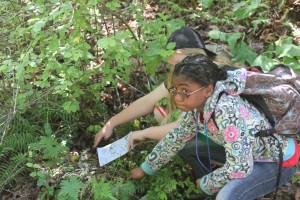 One thing this teacher did was to let the class in on the plan. Doing this at the start involved and invested them in the work, and began to empower them to take responsibility for its parts. Early on, he began to notice that students were doing good work, and that they brought different sets of skills and abilities to the work. This was a pleasant surprise for him, and he began to see the class as a group of individuals who could make the classroom work environment an interesting one to be part of.
Soon enough, he reorganized the class into work crews, each one responsible for part of the job of assessing a transect up the slope from water’s edge to wooded copse. Accomplishing this was an utterly new experience for him, but he took to it as if he’d done it for years. Within a few weeks, he was beginning to coordinate his curriculum to the work on the slope. Aware of the mathematics curricula he was charged with, he organized the school week into days dedicated to mathematics and to the project. Students didn’t divide their new sense of personal investment in school. They became reliable students each day. Why? I think, because they were learning as humans evolved to learn. How their brain is best organized to do that job. Go into the real world, find real work to do, then focus all resources on this.
I think there were several vehicles which enabled this classroom to navigate from struggling to self-powered learning place. Specifics varied among teacher and students, but each vehicle carried them through its part of the course. The teacher was charged with teaching mathematics, for which he wasn’t well-prepared to do. He was both interested in improving his teaching, and in engaging his students in learning projects in the community in which they lived. Then he saw something, a slope in a landform, that brought these two seemingly disparate entities into a dynamic construct, a conceptual foundation for real learning, learning for understanding.
His students also boarded their first vehicles: crews, embedded curricula, brain work. At first, their commitment varied, but nearly all became interested in the project when they heard about it from the teacher. At the beginning, they were randomly assigned to their groups; but, as the teacher became more aware of them as individuals, he began to reorganize them into effective working groups, crews organized to execute particular parts of the plan.
So, the relationships among the people in the class began to morph. The teacher became the project manager, and the crews became technicians and staff working with a crew leader. Project manager and crews learned to reach out to local experts for advice. The teacher, because he was managing the project, and feeling responsible for teaching mathematics, began to use the mathematics embedded in the work site and the work itself to deliver part of his curriculum.
Locating embedded curricula seems difficult at first thought, but once you try, it becomes relatively easy. For instance, students can measure the maximum width and length of a leaf, and calculate the width to length ratio. They repeat this with other leaves from the same tree to see if that ratio holds true. Then they can see if there is a ratio for the maximum width of a fir or pine cone and its length that is consistent among a sample from the same species. As they do, ratio and proportion becomes sensible, a conceptual tool to use, rather than something to memorize for a test.
This doesn’t apply just to mathematics and science. Look for examples of alliteration in a natural area or in the school’s neighborhood. I’m looking at an example just now – a small tree whose leaves are attached to thin branches in an alternating sequence. When I see a set silhouetted against the sky, their leaves tripping along the branch, I see alliteration. Looking out the same window, I see many metaphors. Metaphors which can activate the same parts of my brain that are activated when I am engaged in close pursuit of the answer to an inquiry question. A very useful brain tool.
Looking past the leaves and metaphors, I see examples of social studies, music, art, drama, history. It’s all out there, the curricula we teach, in a form our brain is organized to use. Once it is engaged, we can then move into the prepared curricula which lives in classrooms. With one difference – this curricula will come to life because it will be engaged by a need-to-know generated by the world we live in. And learned in a way that ensures it will be used. In time, you will find that you can milk the prizes found on one excursion from the classroom to the schoolground, neighborhood, or riparian area for more than the embedded curricula you find. What you find and use generally has links to other curricula, and you can extend these threads quite far before you’ve either used them up, or have become tired of them.
These are things the teacher I worked with learned during the time we explored learning for understanding. By moving into the world we live in and discovering the curricula embedded there, and the involvement and investment the experience invoked in his students, he began to reorganize his teaching. The mathematics he discovered on site clarified what he was trying to teach in the classroom. The energy and growing expertise his students brought to the work helped him learn them as persons, to know when they engaged what I call the moment of learning, and to use their individual strengths to overcome their weaknesses. And they all grew. Because, in my opinion, they engaged their brains in the way brains evolved to learn and cope. Once engaged, they were ready to enter the more formal, abstract curricula which lived in their classroom. To learn it, not to pass a test, but to build their lives.
This is a regular feature by CLEARING “master teacher” Jim Martin that explores how environmental educators can help classroom teachers get away from the pressure to teach to the standardized tests,and how teachers can gain the confidence to go into the world outside of their classrooms for a substantial piece of their curricula. See the other installments here, or search Categories for “Jim Martin.”
by editor | Jun 12, 2014 | K-12 Classroom Resources
Middle School Students Use Historic Snowpack Data to Gain Inquiry, Graphing and Analysis Experience
by Joe Cameron
Beaverton Middle School teacher

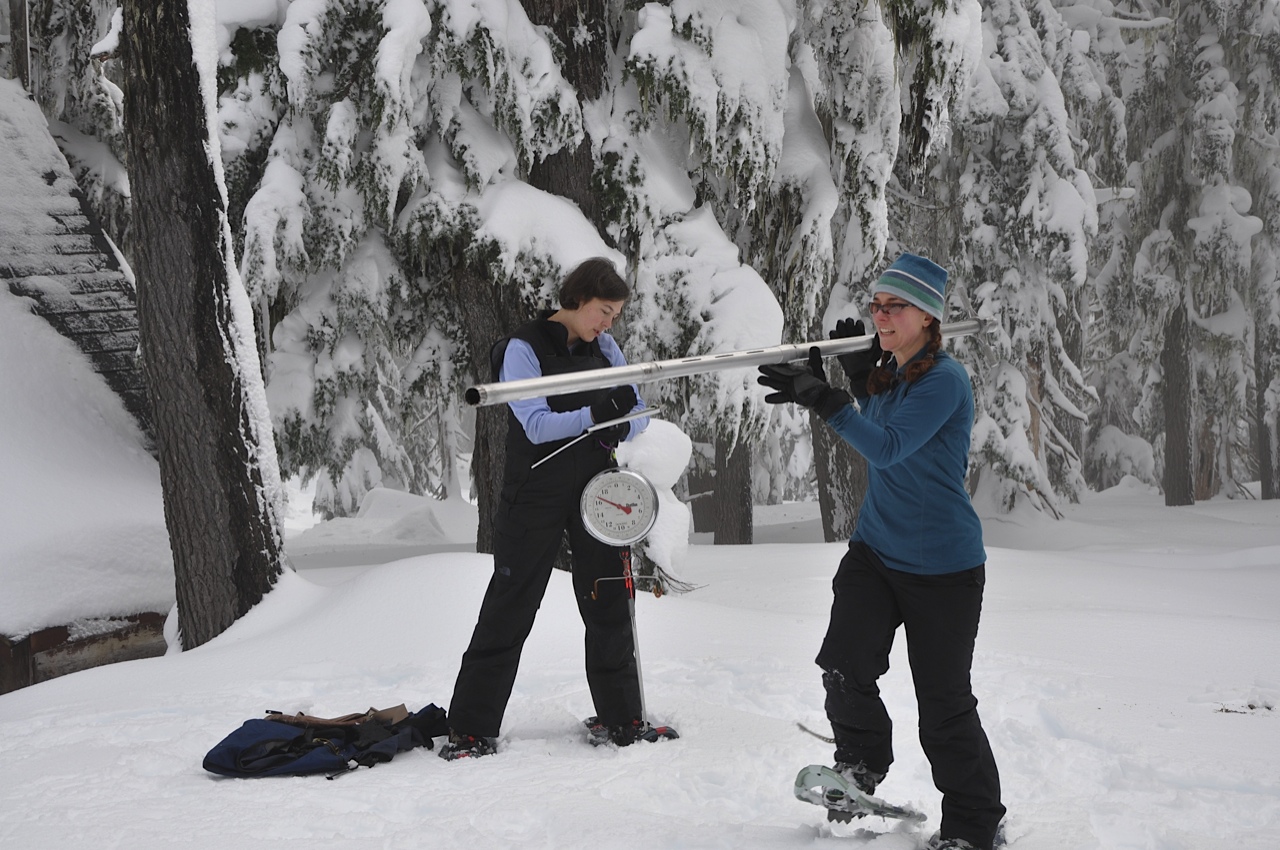
NRCS Oregon hydrologists Melissa Webb and Julie Koeberle measure snow on Mt. Hood. Courtesy of USDA.
What do you get when you mix researchers, teachers, authentic science opportunities and a group of GREAT people? You get three summers of intense work, reinvigorated teachers, new ideas for the classroom and lots of fun!
For the last three summers I was lucky enough to be involved in the Oregon Natural Resource Education Program’s (ONREP) Climate Change Institute where teachers are matched with researchers to bridge the gap between the classroom and field research. The last two years I worked with Oregon State University’s Dr. Anne Nolin and Travis Roth examining snow pack changes in the McKenzie River Watershed. Investigating snow collection sites and collecting data led to discussions on how best to get students involved in authentic research and science inquiry investigations.
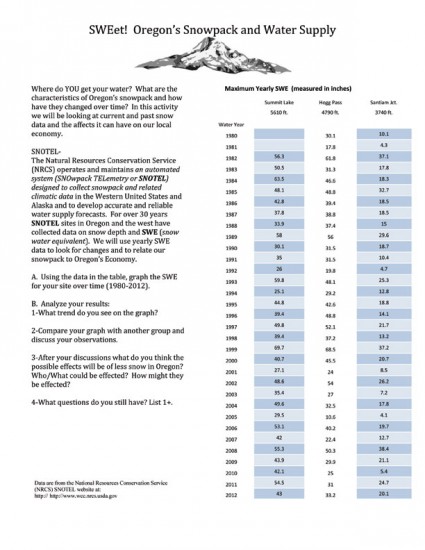
Handout for activity below.
One of my goals for the year was to get my students involved in authentic data collection and to gain more experience and practice in graphing. From this, SWEet! was born. SWEet is an activity that engages students in using historic snow data to investigate the SWE, or Snow Water Equivalent, and the changes taking place in the Cascade Mountains in Oregon. Students graph and analyze data from SNOTEL sites and compare their findings with others in class to make predictions about future snowpack. In extension activities students choose their own SNOTEL sites in the Western U.S. and monitor snow data monthly throughout the snow year. This type of activity will in turn introduce students to long-term ecological studies in progress and support them to begin studies of their own.
In doing this activity with my students we first investigated their particular sites. I found this helped them personalize the data and they were very involved, especially using this “local” data. Then using their data they were able to create comparative line graphs and look for trends in the data, even with a complex and varied data set. These trends were then used to hypothesize possible effects of changes in the snowpack to their world and the economy and ecosystems found in Oregon.
SWEet! Oregon’s Snowpack and Water Supply
Author: Joe Cameron
Time: 50+ minutes
Grade Level: 6-12
Background
SNOTEL-The Natural Resources Conservation Service (NRCS) operates and maintains an automated system (SNOwpack TELemetry or SNOTEL) designed to collect snowpack and related climatic data in the Western United States and Alaska in order to develop accurate and reliable water supply forecasts. For over 30 years, data on snow depth and SWE (Snow Water Equivalent) have been collected from SNOTEL sites throughout the western US. This activity will use yearly SWE data from three SNOTEL sites in Oregon to look for changes and relate our snowpack to Oregon’s economy and environment.
Introduction
Familiarize students with Snow Water Equivalent (SWE), which is the amount of water contained in the snowpack. A simple reference for background information is http://www.nrcs.usda.gov/wps/portal/nrcs/detail/or/snow/?cid=nrcs142p2_046155. Also, you can do a simple class demonstration by taking a 500ml beaker of snow (or blended ice) and melting it using a hot plate. I have students predict how much water will remain after the ‘snow’ is melted. Then, we calculate the percent water in the snow to give them an example of one way to analyze this type of data.
After getting the students comfortable with SWE, you can give them the SWEet! Oregon’s Snowpack and Water Supply activity page. When I led this activity, we read through the introduction as a class and then directed the students to graph the data provided, make sense of their plot, compare their results with others in class and then draw conclusions. This lesson leads to discussions of our changing climate and possible changes in store for the people, plants and animals of Oregon.
Objectives
Students will access long term ecological data.
Students will graph SWE data.
Students will compare their data with data from their classmates.
Students will identify possible effects of a decrease in snowpack.
Vocabulary
SWE-Snow Water Equivalent; the amount of water found in snow.
SNOTEL-automated system that records snow depth and related data in the western United States
Trend-a general direction that something is changing
Snowpack-the amount of snow that is found on the ground in the mountains; usually measured at specific sites.
Standards
Next Generation Science Standards (NGSS)
MS-ESS2-5. Collect data to provide evidence for how the motions and complex interactions of air masses results in changes in weather.
MS-ESS3-5. Ask questions to clarify evidence of the factors that have caused the rise in global temperatures over the past century.
Oregon Science Standards
Scientific Inquiry: Scientific inquiry is the investigation of the natural world based on observations and science principles that includes proposing questions or hypotheses, designing procedures for questioning, collecting, analyzing, and interpreting multiple forms of accurate and relevant data to produce justifiable evidence-based explanations.
Interaction and Change: The related parts within a system interact and change.
6.2E.1 Explain the water cycle and the relationship to landforms and weather.
7.2E.2 Describe the composition of Earth’s atmosphere, how it has changed over time, and implications for the future.
7.2E.3 Evaluate natural processes and human activities that affect global environmental change and suggest and evaluate possible solutions to problems.
8.2E.3 Explain the causes of patterns of atmospheric and oceanic movement and the effects on weather and climate.
8.2E.4 Analyze evidence for geologic, climatic, environmental, and life form changes over time.
Materials
For Demonstration:
1 500 ml beaker
1 50-100 ml graduated cylinder snow OR chopped/blended ice
1 hot plate
For Activity:
Copies of SWEet! Oregon’s Snowpack and Water Supply activity page
Graph paper
Optional: colored pencils/pens
Lesson Procedure
1. Give students the SWEet! Activity page.
2. As a class, read and review all directions.
3. Students may choose 1, 2, or 3 sets of data to graph. This option allows the activity to be modified to meet the individual students’ abilities. Also, students can create graphs that can be compared to multiple data sets.
4. Students graph the data in a line graph.
5. Students analyze the data. This part can be completed through drawing a trend line(s) on the graph, calculating averages, adding totals and/or comparing multiple data sets looking for similarities and differences. Note: having the students do their graphing using Excel spreadsheets is an option that is not always available in our school but from which the students would benefit.
6. Relate the observed trends in snowpack to possible effects in Oregon. Who/What will be affected? How will/might they be affected?
7. Students pose one other question OR concern they have after looking at their graphs and trends for possible additional exploration.
Extensions
1-Related current event articles from Science Daily:
Warming Climate Is Affecting Cascades Snowpack In Pacific Northwest
Found at http://www.sciencedaily.com/releases/2009/05/090512153335.htm
Global Warming to Cut Snow Water Storage 56 Percent in Oregon Watershed
Found at http://www.sciencedaily.com/releases/2013/07/130726092431.htm
2-Students can access current snow year data online. They go to SNOTEL website, choose a specific site and collect daily, weekly or monthly data for this site throughout the winter months (the snow year stretches from November to March). Students can also access historic data going back to the late 1970’s and early 1980’s for their sites.
References Science expertise was provided by the following Oregon State University Faculty: Dr. Anne Nolin – Professor and Travis Roth-Doctoral Student in the College of Earth, Ocean, and Atmospheric Sciences. Data are from the National Resources Conservation Service (NRCS) SNOTEL website at: http://www.wcc.nrcs.usda.gov
Acknowledgements These lessons were created using information learned in the Oregon Natural Resource Education Program’s Researcher Teacher Partnerships: Making Global Climate Change Relevant in the Classroom project. This project was supported by a NASA Innovations in Climate Education award (NNXI0AT82A).
Thanks to Dr. Kari O’Connell with the Oregon Natural Resources Education Program at Oregon State University and Dr. Patricia Morrell in the College of Education at University of Portland for their thoughtful review of this article.
Joe Cameron is a teacher at Beaverton Middle School in Beaverton, Oregon. He can be contacted at joe_cameron@beaverton.k12.or.us

 Last fall, I designed a project to engage my eighth grade science class in a meaningful scientific inquiry project that assisted in deepening students’ understanding of the importance of conservation action through environmental education. The project action focused on eliminating paper towels in school bathrooms. There are many environmental benefits to reducing the amount of paper towels manufactured. One benefit is the reduction of trash in landfills because generally bathroom paper towels cannot be recycled. Another benefit is the reduction of chemicals leaching back into our soil from decomposing paper towels. This in turn saves trees from being processed into paper towels. Environmental benefits are also found in the amount of water consumed in the manufacturing of paper towels, and the reduced amount of fuel burned transporting paper towels.

 The presentation was videotaped and posted on the school website. Posting the video required getting permission from all of the parents. This was worthwhile effort because the students were then able to share what they had learned accomplished and produced with their own community of friends and neighbors. This made it possible to spread the idea of replacing paper towels with hand dryers to the larger community outside of our school.

