by editor | Sep 15, 2025 | Adventure Learning, Conservation & Sustainability, Critical Thinking, Data Collection, Environmental Literacy, Experiential Learning, Forest Education, Homeschool, Inquiry, Outdoor education and Outdoor School, Place-based Education, Questioning strategies, STEM, Teaching Science
A Natural Fit: Homeschooling and the Establishment of a Research Forest
by Jess Lambright
For those open to an alternative educational path, a classroom with no walls or desks but instead trees, meadows, and streams, offers abundant opportunities for scientific exploration. My journey in outdoor education started by home-educating my own children, but soon expanded to include other students and families. Although making everyday a field day comes with certain challenges—such as very wet, cold winter days—it has also shown me how adaptable young people are, and how many spontaneous and fascinating learning opportunities present themselves when you commit to regular immersion in the natural world.
I have come to appreciate the vast range of possibilities in which students can acquire knowledge. While some homeschooling families follow packaged curriculum closely and monitor carefully to make sure their children meet state standards each year, others chose a less structured approach called unschooling, rooted in a deep trust for kids’ natural tendency and ability to learn. This philosophy can free a motivated young person to dive deeply into an ocean of learning powered by autonomy, inspiration, and infinite possibilities.
Connecting to place and stewardship of land
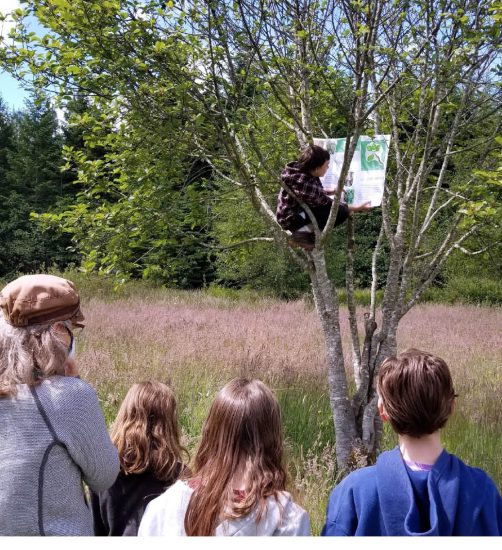
A multi-disciplinary unit study called My Tree and Me, where each student was connected with a specific tree which they measured (diameter, height, age) conducted secondary research about the species, wrote poetry, and created art with materials from the tree. One student decided to give his final poster presentation from the branches of the Cascara tree he had spent so many hours with.
The first outdoor program I hosted involved an established group of kids spending an entire day outdoors, once per week, for over four years. Week after week and year after year we returned to the same 40-acre woods from the first days of fall through the start of summer. It was common for our group to wander through the forest, without a destination or agenda, letting our innate curiosity lead the way. Wandering freely, with open eyes, allowed us to get in touch with what excited us and created opportunities for true discovery (Young et al., 2010, 56).
It filled me with satisfaction to watch the deep connection to place that developed over time in each of us. Monuments and landmarks, like a circle of giant old moss-covered stumps towards the southwest corner of the forest, acquired names and memories and provided comfort and familiarity when they were encountered. We would experience the wet meadow as a place that requires rubber boots to traverse in the wet months, a beautiful explosion of white flowers and soft grasses that dance in the wind in the summer, and a sea of delicate purple camas flowers in the spring. One year we returned to the same sit spots week after week, recording changes in our journals as spring brought all the growing things to life.
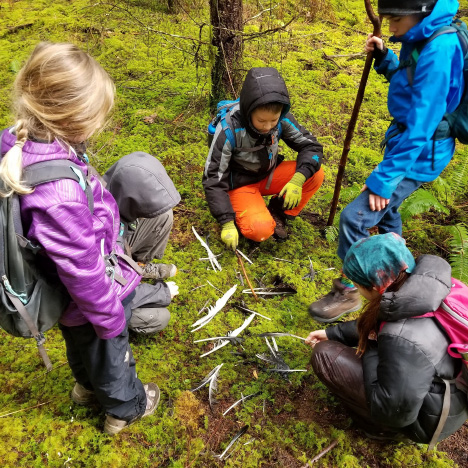
Students pause to examine a pile of feathers they discovered while exploring the woods on a rainy day. The group came up with a series of questions about what happened and brainstormed ideas about how they could investigate further to potentially find answers.
Spending time on a particular piece of land, through the seasons and years, inevitably leads to a sense of kinship and creates an urge to protect and enhance the natural environment. It’s been rewarding to teach students about which plants are non-native and potentially harmful to the local ecosystem, then see them step up as guardians of the land. When we wander through the woods, sometimes they spot a pocket of invasives and if we’re lucky enough to be carrying long-handled loppers, the team of weed warriors can quickly level a patch of Himalayan blackberry. In addition to studying and exploring, offering students an opportunity to actively participate in land management elevates their sense of purpose and deepens their connection to the natural world.
Full Family Learning
Homeschooling naturally leads to multiple ages and families all learning together. In the early days of our homeschool outdoor program the adults often observed activities and supported logistics. But over time it became clear that we truly were a mixed-age group of learners and explorers. Treating everyone as learners equally can have the effect of empowering young people. Sometimes kids master skills quickly. teaching what they’ve learned to adults. And sometimes the best exchange comes not from experts, who have a deep and longstanding understanding of a concept- but those who have recently experienced the gift of insight.
Mixed age learning is a mutually beneficial relationship fostering growth in multiple ways. Adults sometimes shelter in the security of topics they already understand and avoid venturing into areas less familiar. Conducting scientific inquiry in nature is ideal for having a high ceiling and a low floor: everyone knows something, and no one knows everything! Cultivating a growth mindset, by creating an atmosphere where mistakes are celebrated as learning opportunities, and where having a question is as valuable as having an answer (Boaler, 2015, 11), pairs beautifully with immersive study in nature.
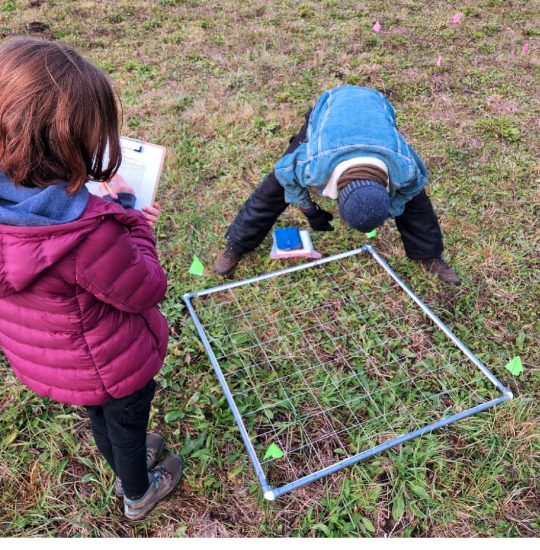
A team of researchers determine the percent meadow knapweed present in a one-meter plot square by examining each of 100 smaller squares for the plant of interest.
Authentic Curriculum
Each day that I meet a group of students in the natural world, I come prepared with a plan for that day. Sometimes my plans are elaborate and detailed, and sometimes they are less specific and open to input from my fellow adventurers. But without exception I am mentally prepared and openly delighted to be upstaged by the unexpected. Whether it is locating a dead porcupine after noticing an unusual smell, being suddenly pelted by large hail, being startled by the arrival of the cacophonous noise of a murder of crows, or being circled by two deer so distracted in their mating dance that they fail to notice us; being fully present for nature’s dramas is my top priority.
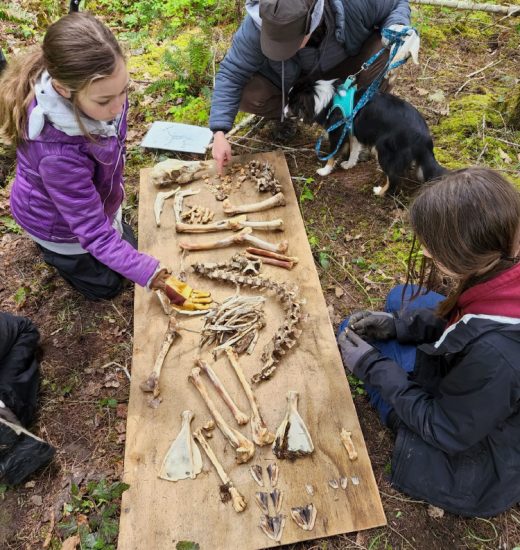
After waiting over a year for the soft tissue to decompose, students collect and sort bones from a deer that died of natural causes near the Bear Creek Wilderness.
One day, just as the families were arriving at the Bear Creek Wilderness, a truck with two wildlife professionals pulled up to examine a deer laying in the horse pasture adjacent to our meadow. Curious, we gathered to ask questions about what might have happened. When they offered to let us keep the recently deceased animal, we gladly accepted- and spent the day dragging it across the meadow into the woods, securing it with paracord, and setting up our two trail cameras to watch what would happen.
Each week we checked on the deer, and everyone brave enough to venture near got to experience first-hand what decomposition looks and smells like. The camera footage revealed a series of fascinating dramas involving a bobcat, opossums, neighborhood dogs, and finally turkey vultures. A year and half later we carefully collected the bones and spent hours sorting and reconstructing a full deer skeleton. Finally, we tried our hands at making bone tools. In my experience, the best learning opportunities are not planned or expected. But when we build regular rhythms and practices, it is possible to “lay the groundwork for the outbreak of authentic curriculum” (Sobel, 2008, 81).
Cultivating scientific inquiry

Students work to match specific leaves to nature journal pages. Each student found a leaf while wandering through the woods, then recorded details of that leaf in their nature journals using words, pictures and numbers. The leaves were collected, then each student selected a new leaf and found the corresponding journal page.
Getting to know a place, including its seasonal changes, provides a useful perspective when it comes to asking research questions. An invaluable tool to record and remember discoveries, questions and observations is the field notebook, or nature journal. Developing the habit of collecting data with pencil and paper while exploring the natural world takes ongoing dedication, is deeply personal, and will certainly evolve through the years if one continues the practice (Canfield, 2011, 187-200). Nature journaling techniques that involve close examination of specimens in order to draw them, often reveal details that would have been overlooked with a quick glace or photograph. Indeed, to truly get to know a specific plant species it is hard to imagine an activity more educational than carefully drawing each of its parts.
Foundational to scientific inquiry is the research question, or asking questions within the realm of science. There are plenty of valid and interesting questions that one might ask while pondering the wonders of nature, and it’s important not to shut down inquiry when a question like, “Does it make this tree happy when I climb it?” arise. If limited to knowledge bound by science, one may miss rich worlds of philosophy, spirituality, intuition, and other ways of knowing. Still, once we are ready plot our scientific course it’s useful to remind students that questions should be measurable (Laws & Lygren, 2020, 90-93).

At the start of a student-led wildlife study, one researcher, who had taken time to carefully read the manual and test out the equipment, teaches the other students how to label their memory cards and set up their trail cameras. This project was made possible by a generous grant from the Diack Ecology Education Program.
Research Methods
When guiding young people into the world of field research it is helpful to start with basic techniques and big picture, cross-cutting concepts. Keeping track of important details in a field notebook and not forgetting to record obvious but key information like the date and location takes practice before it becomes routine. Collecting data can be time consuming, but sometimes trying to interpret sloppily recorded field notes can lead to tedious and frustrating hours at home. Finding a doable and interesting research question, taking into account confounding factors, and dealing with the disappointment if all the hard work to apply different treatments on an invasive plant all result in similar outcomes, requires a certain level of maturity and commitment.
Digging into a full-fledged research project requires determination, perseverance, and time, but it is possible to introduce students to the exciting and fun parts without getting bogged down by details. I recently taught a research methods class to elementary and middle school students with the goal of having hands-on experience with sophisticated research equipment without requiring data analysis or report writing.
We practiced collecting samples, and at first, we recorded in our field notebooks all the important metadata. Inspired by collection and observation, but limited in time, we then simplified the process to maintain interest and focus. For the rest of our forest walk we collected whatever samples caught our eyes- and mentioned what we would record if we were doing a research project- but kept it fun and quick so we still had time to investigate them at the end with magnification. Keeping data collection fun and exciting for younger students makes for a useful introduction to scientific inquiry and sets them up for conducting their own research in the future.
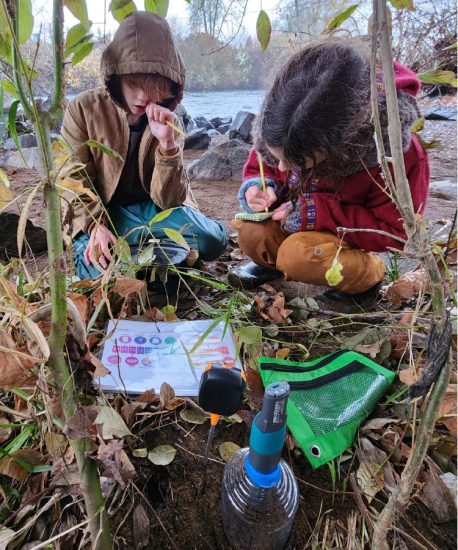
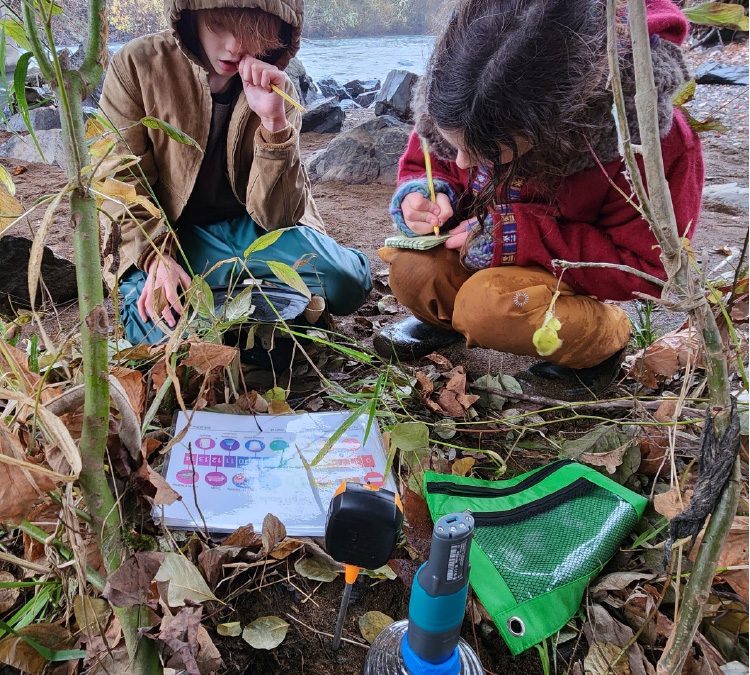
Students collect carbon dioxide and pH data from a patch of earth using equipment funded by the Diack Ecology Education Program during a research methods class with Wild Alive Outside.
Student-Led Research
In my experience, homeschoolers have a low tolerance for contrived activities, busywork and doing things for a grade. Any activity, assignment or project needs to be authentically meaningful. While it may be hard to force them to fill out a worksheet recording what we just discussed, they often thrive with open-ended activities and projects they can direct. It’s important to provide the appropriate scaffolding, and offer examples, but I have been impressed by how quickly and enthusiastically students construct their own research projects. As a mentor, I sometimes struggle with finding balance between requiring them to do something ‘right’ and encouraging critical thinking along with a safe place to fail, each of which are valuable learning experiences. Allowing students to take ownership in the learning process enhances the development of scientific thinking.
Once, a student created an elaborate plan to attract birds for his trail camera research project involving dead trees, peanut butter, and bird seed. There was tangible disappointment when the resulting images revealed many more rodents than birds, but it led to a new series of questions as well as an understanding about wildlife activity in that area. Field science is almost always iterative in nature, with new questions emerging from initial data and, ideally, the opportunity to inquire further and collect more data. With guidance and partnership students integrate information while maintaining natural curiosity.
Expanded Educational Support
Last year our outdoor program, Wild Alive Outside, received its first infusion of grant-funded scientific equipment. The Diack Ecology Education Program financed a set a trail cameras for our students to study wildlife activity at the Bear Creek Wilderness. Access to high-quality equipment has been a game changer for our little research group. Students felt empowered to design their own experiments by having full control over one of the trail cameras and two high-capacity memory cards. In addition to learning what wildlife passed through the area of the forest or meadow they selected, they gained experience with organizing and analyzing digital data. For some, it was their first exposure to spreadsheets, and others had to push their edges to patiently examine each of hundreds of photos. After months of data collection and conducting secondary research on one of the many wildlife species they discovered, they created posters to present their findings.
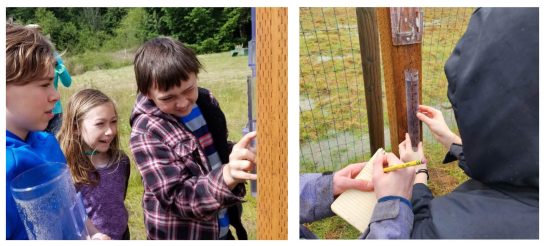
Students carefully measure the water in the rain gauge to determine rainfall over the previous week. Data is later reported to the CoCoRaHS website as part of a nationwide citizen science initiative.
For several years now, each day on the land begins with checking the rain gauge. Because we only visit once per week, we often have several inches of rain to carefully measure and record in the notebook. This simple ritual wakes up scientific thinking: “remember to look straight on before taking a reading,” connects us to what’s been happening while we were away: “no wonder there’s standing water in the meadow,” and gives us access to site-specific long-term data. At the end of the water year, shortly after the start of autumn, we can look back at the data we’ve collected, compare it to previous years, and make predictions for when the rains might come that fall. Additionally, we report our data through a sophisticated citizen science program called CoCoRaHS – Community Collaborative Rain, Hail & Snow Network with thousands of other citizen scientists across the country. I have found students take data collection quite seriously when they know they are part of a larger community of scientists, all doing their best to produce accurate results.
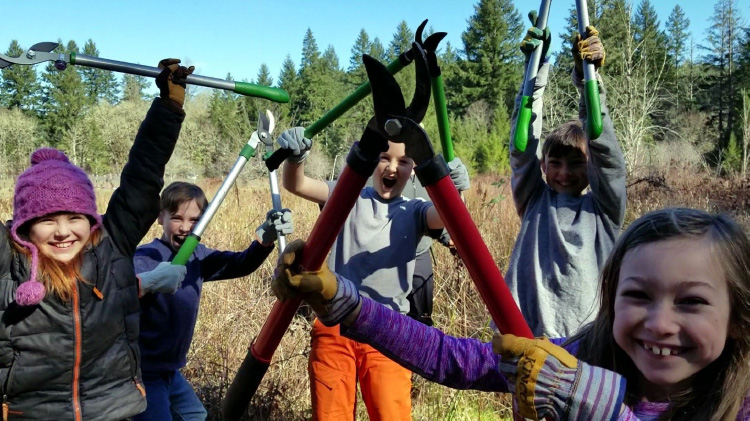
After tackling a large patch of invasive blackberry bushes, the Weed Warriors celebrate their contribution to protecting the wet meadow in the Bear Creek Wilderness.
The Bear Creek Wilderness and Student Research Forest
My program design is to plant the seeds for creating a student research forest where young people will have ongoing opportunities to learn scientific methods of field research and contribute to an ever-increasing body of knowledge through their own efforts. Just as the H.J. Andrews Experimental Forest welcomes graduate students and long-term ecological researchers and has amassed a wealth of knowledge and data about that site, we aim to support young emerging scientists with open minds and creative ideas to connect with place, nature, and make meaningful contributions to science within a community of knowledge seekers. Participants gain foundational skills together as they engage with the land, utilize scientific tools, grow as learners, and share knowledge with each other.
References
Boaler, J. (2015). Mathematical Mindsets: Unleashing Students’ Potential Through Creative Math, Inspiring Messages and Innovative Teaching. Wiley.
Canfield, M. R. (Ed.). (2011). Field Notes on Science and Nature. Harvard University Press.
CoCoRaHS – Community Collaborative Rain, Hail & Snow Network. Retrieved January 18, 2024, from https://www.cocorahs.org/
Diack Ecology Retrieved January 26, 2024, from https://www.diackecology.org/
H.J. Andrews Experimental Forest. Retrieved January 26, 2024, from https://andrewsforest.oregonstate.edu/
Laws, J. M., & Lygren, E. (2020). How to Teach Nature Journaling: Curiosity, Wonder, Attention. Heyday.
Sobel, D. (2008). Childhood and Nature: Design Principles for Educators. Stenhouse Publishers.

In 2019, Jess Lambright started a nature school for homeschool families where once per week kids and parents spend all day outside learning wilderness skills, exploring, developing naturalist knowledge, conducting field studies, and connecting with nature, themselves, and each other. She founded Wild Alive Outside in the summer of 2023 with the goal of getting more youth outdoors to discover wonder and inspiration in the natural world through science, outdoor skills, and wilderness connection.
by editor | Jan 16, 2024 | Environmental Literacy, IslandWood, K-12 Activities, K-12 Classroom Resources, Learning Theory
by Zachary Zimmerman
Bainbridge Island, WA
 s an outdoor educator, I often get sucked into the false binary that lessons are either fun or informative, that content must be sweetened with games, stories, and activities like applesauce for children’s medicine. But stories are one of the oldest forms of teaching known to humankind, and games and interactive activities help students interpret and internalize what they learn on trails, in classrooms, and at home. In this article, I invite you to stop apologizing for your content teaching and start weaving it into lesson sequences that include stories, games, writing activities, and more. Sequences can make your teaching practices more effective, more equitable, and yes, more fun.
Recently, I learned that teachers visiting Islandwood with their students were passing on the same feedback week after week: many of the lessons our instructors were teaching on ecosystems fell short because students didn’t fully understand what the word “ecosystem” meant. They might be able to give examples (“rainforest”) or describe them somewhat (“habitat”), but they were missing the definition and significance: communities of different living things that interact with each other and their physical habitats. An ecosystem isn’t just a place; it’s a dynamic arrangement of matter and energy; sunlight, water, and nutrients; life, death, and life again. Of course it needs some scaffolding
Because ecosystems are one of my favorite things to teach 5th graders, I took note immediately. Learning about ecosystems helps students understand the world in which they live, sets the stage for deeper sense-making outdoors, and aligns neatly with NGSS standards and cross-cutting concepts. Ecosystems are also teachers themselves, offering lessons on diversity, interdependence, resilience, and identity. When students see forests and intertidal zones as neighborhoods full of unique and diverse beings supporting each other through their mere existence, they may have an easier time valuing their own identities and thinking more about how they fit into their communities. To restate ecologically, they may discover their own niche.
As heady and enticing as these ideas are to me, I know that teaching for equity means letting go of preconceived notions of how students will use my lessons, and creating space and support for them to connect ideas presented in class to their own lives. It also means ensuring that all students are working from the same baseline of knowledge as they explore those more abstract spaces. In the past, I had equated “baseline” with “lecturing” and “lecturing” with “boring”, leading me to approach core content apologetically and half-heartedly.
To address my reluctance and reimagine content teaching as a part of, not apart from, the immersive fun and exploration that drew me to outdoor education, I started experimenting with lesson sequencing: using stories, activities, and games to bookend and contextualize core concepts. What started as an apologetic approach to content has proven an effective and equitable strategy for outdoor teaching that makes complex ideas like ecosystems meaningful, memorable, and fun. Below I outline a favorite lesson sequence on ecosystems that envelopes content with storytelling and modeling activities. But first, a few tips for developing your own sequences.
Work Backwards
Mapping the core concepts you need to scaffold into a larger lesson can reveal where your content time will best be spent. In the ecosystem example below, I use worksheets to get all my students on the same page about producers, consumers, and decomposers: what they are, what they need, and how they relate to each other. Knowing which concepts I need to teach about can also help me select starting lessons that introduce relevant terms or relationships.
Know Your Audience
Are your students quiet or chatty? Do they like individual reflections, pair-shares, or large group discussions? Maybe a combination? Do they ask a lot of questions, or wait for you to give answers? Do any of your students have IEPs or 504 plans? What other accommodations might one or many students need to feel safe, comfortable, and ready to learn and participate? Consider these questions when thinking about your group and reflect on how they might impact your plan. Maybe you need to switch out that starting story for a running game; maybe that running game works equally well walking or sitting.
Find Your Flow
Once you know what information, structure, and supports your students need to reach their learning targets, think about an order of operations that makes sense for the spaces you’ll be teaching, your style, and the energy you expect. Thinking about biorhythms can be a helpful clue here – if you’re starting this module right after lunch, will students be more or less active than if you began your morning with it? There’s no perfect formula here, but Ben Greenwood’s Lesson Arc (Introduction, Exploration, Consolidation) provides helpful inspiration. Personally, I like to start with something engaging that models the ideas we’ll use and end with a game or reflective activity – again, this is where art meets science, so get creative.
Now that you have some ideas for sequencing lessons, let’s look at an example.
Lesson Sequence: Ecosystems and Interdependence
Materials:
- Storybook
- Ecosystem worksheets (Islandwood journal is used in this example)
- Ecosystem cards (make your own or find publicly available regional sets like this one from Sierra Club British Columbia)
- Ball of string or twine
- Writing untensils
Lesson 1: Read The Salamander Room by Anne Mazer (read-along here
This is the story of a young boy who brings home a salamander to live in his room. As his mother continues to inquire about how the boy will care for the salamander (and eventually, to care for everything else he has added to his room in the process), students begin to see not only how different living things rely on each other, but the impacts of removing a more-than-human friend from its chosen home.
Additional discussion questions:
- How did the room change throughout the story?
- What else would you have changed?
- What relationships did you notice?
(Of course, any storybook of your choosing that describes habitats, food webs, nutrient/energy cycles, and interconnectivity will work – I just like this one!).
Lesson 2: Ecosystem Components and Definitions
Transitioning into the content component, begin by asking students if they have ever heard of the word “ecosystem” and what it means. While assessing answers, ask whether they saw an ecosystem in the story they heard. These discussions can help decenter the instructor as the holder of knowledge and assess potential leaders in your group.
Next, pass out worksheets/journals and give students 5-10 minutes to complete the assigned pages, encouraging them to quietly work alone or in small groups. Set clear expectations that they should do their best to fill out whatever they know, and that we’ll fill them out together as a group afterward.


Drawings from a student’s Islandwood journal. Mushrooms are depicted as decomposers, trees as producers, and squirrels as consumers. On the next page, sentence and word starters help students decode core definitions.
When students indicate that they are done, invite them back to a large group. Ask if anyone can give definitions of producers, consumers, and decomposers, or share examples that they drew or wrote in their journals. This helps individual students confirm or correct their answers without judgment and add test their knowledge by adding their own examples to the discussion. Talking through producer growth, animal consumption, and decomposition a few times helps reinforce how different inputs and outputs relate to the process and emphasizes its cyclical nature.
When students have completed their worksheets and all questions have been answered, move on to Lesson 3.
Lesson 3: Web of Life (adapted from Sierra Club British Columbia)
Because a full lesson plan is linked above, I focus here on ways that I consolidate knowledge from the above lessons, assess content learning, and prepare students to apply these new ideas to future exploration.
Pass out Web of Life cards to your students and save one for yourself. If you plan to introduce a new element later (e.g. birds migrating from habitat loss or new trees planted by conservationists), hold onto those cards.
As you pass out cards, ask students to take a moment and acquaint themselves with their element. Some questions you might ask:
- Are they a producer, decomposer, consumer, or something abiotic?
- What do they know about this element?
- What does this element need to thrive?
- What threatens it?
When students are ready, begin the lesson as described in the linked plan. Empower students to help correct or add to others’ ideas. For example, if a student assigned “worm” passes to “soil” and says, “I relat to soil because I eat it,” invite the group to discuss what they know about how worms relate to soil or how they get their energy (i.e. decomposition, which makes soil).
Once the web is fully developed, you can take this lesson in many directions, inviting students to consider what happens when one part of the web is removed or changed. When they can see that everything is connected, even indirectly, you’re ready to explore ecosystems!
Zachary Zimmerman (he/him) is an outdoor educator, teacher training facilitator, and insatiable problem-solver residing on the traditional Suquamish/Coast Salish land currently known as Bainbridge Island
Sources Cited
5-LS2-1 Ecosystems: Interactions, Energy, and Dynamics | Next Generation Science Standards. (n.d.). Retrieved May 25, 2023, from https://www.nextgenscience.org/pe/5-ls2-1-ecosystems-interactions-energy-and-dynamics
Greenwood, B. (n.d.). What is Lesson Sequencing and How Can it Save You Time? Retrieved May 25, 2023, from https://blog.teamsatchel.com/what-is-lesson-sequencing-and-how-can-it-save-you-time
Mazer, Anne., & Johnson, S. (1994). The Salamander Room (1st Dragonfly Books ed.). Knopf
Sierra Club BC. (n.d.). Web of Life. Sierra Club BC. Retrieved May 25, 2023, from https://sierraclub.bc.ca/wp-content/uploads/Web-of-Life-Game.pdf

by editor | Jan 27, 2020 | Equity and Inclusion, Outdoor education and Outdoor School
Providing opportunities for students of color to explore
the outdoors and science careers
Text and photos by Sprinavasa Brown
 recall the high school science teacher who doubted my capacity to succeed in advanced biology, the pre-med advisers who pointed my friend Dr. Kellianne Richardson and me away from their program and discouraged us from considering a career in medicine – biased advice given under the guise of truth and tough love.
I remember only three classes with professors of color in my four years at college, only one of whom was a woman. We needed to see her, to hold faith that as women of color, we were good enough, we were smart enough to be there. We were simply enough, and we had so much to contribute to medicine, eager to learn, to improve and to struggle alongside our mostly White peers at our private liberal arts college.
These are the experiences that led Kellianne and me to see the need for more spaces set aside for future Black scientists, for multi-hued Brown future environmentalists.
The story of Camp ELSO (Experience Life Science Outdoors) started with our vision. We want Black and Brown children to access more and better experiences than we did, experiences that help them see their potential in science, that prepare them for the potentially steep learning curve that comes with declaring a science major. We want Black and Brown kids to feel comfortable in a lab room, navigating a science library, and advocating for themselves with faculty and advisers. We hope to inspire their academic pursuits by laying the foundation with curiosity and critical thinking.
Creating a sense of belonging
Camp ELSO’s Wayfinders program is our main program for youths in kindergarten through sixth grade. What began as a programmatic response to our community needs assessment – filling the visible gap in accessible, affordable, experiential science, technology, engineering and math (STEM) programs for young Black and Brown children – quickly grew into a refuge space for youth of greater Portland. Wayfinders is all about creating a safe uplifting and affirming space for youth to engage in learning around four key areas: life science, ecology, community and cultural history. While our week-long sessions include field trip sites similar to many mainstream environmental education programs, our approach is sharply focused on grounding the youth experience in environmental justice while elevating the visibility and leadership opportunities for folks of color.
 We are creating a special place for Black and Brown youth to have transformative experiences, to create memories that we hope will stick with them until adulthood. Creating such a space comes with difficulties, the type of challenges that force our leadership to make tough decisions that we believe will yield the best outcomes for youth underrepresented in STEM fields. For instance, how to mitigate the undertones of colonization, nationalism, and co-opting of traditional knowledge – harmful practices ingrained in mainstream environmental education.
To do so, we invest in training young adults of color to lead as camp guides. We provide resources to support them in developing the skills necessary to engage youth of diverse ethnicities, backgrounds, socioeconomic status and family structure. Our guides practice taking topics and developing discussion questions and lesson plans that are relevant and engaging. We know that the more our staff represents the communities we serve, the closer we get to ensuring that Camp ELSO programming is responsive to the needs of children of color, authentic to their lived experience, and is a reflection of the values of our organization and community.
In 2019 nearly 100 children of color from greater Portland will participate in Camp ELSO’s Wayfinders program over spring and summer break, spending over 40 hours in a week-long day camp engaging in environmental STEM learning and enjoying the outdoors. We reach more children and families through our community outreach events like “Introduce a Girl to Engineering Day: Women of Color Panel” and “Endangered Species Day: Introduction to Youth Activism.”
The most critical aspects of our Wayfinders program happens even before we welcome a single child through our doors. With the intent of purifying the air and spirit, we smudge with cedar and sage to prepare the space. When a child shows up, they are greeted by name. We set the tone for the day with yoga and affirmations to the sounds of Stevie Wonder and Yemi Alade as we strive to expose our kids to global music from diverse cultures.
We have taken the time to ask parents thoughtful questions in the application process to help us prepare to welcome their child to our community. We have painstakingly selected what we feel is a balanced, blended group of eager young minds from diverse ethnic backgrounds: Black, Latinx, the children of immigrants, multi and biracial children of various ethnicities, fuego and magic. Our children come from neighborhoods across Portland and its many suburbs. They come from foster care, single-parent households, affluent homes, homes where they are adopted into loving and beautifully blended families, strong and proud Black families, and intergenerational households with active grandmas and aunties. Consistent with every child and every household is an interest and curiosity around STEM, a love of nature and the outdoors.
The children arrive full of potential and the vitality of youth. Some are shy, and nerves are visible each morning. By the end of the week we’ve built trust and rapport with each of them, we’ve sat in countless circles teaching them our values based in Afrocentric principles, values selected by previous camp guides representing the youth voice that actively shapes the camp’s culture.
 On our way to more distant Metro sites like Blue Lake and Oxbow regional parks and Quamash Prairie, we play DJ in the van. Each kid who wants to has an opportunity to share their favorite song with the group, and if you know the words, you’d better belt it out. We share food and pass around snacks while some children rest and others catch up with old friends. Many more are deep in conversation forging new friendships.
When we arrive, we remind the kids of what is expected of them. We have no doubts that each and every child will respect the land and respect our leaders. The boundaries are clear, and our expectations for them don’t change when problems arise. We hold them to the highest standards, regardless of their life situation. We respect, listen, and embrace who they are.
We are often greeted by Alice Froehlich, a Metro naturalist. Our kids know Alice, and the mutual trust, respect and accountability we have shared over the last three years has been the foundation to create field trips that cater to the needs of our blended group – and oh, it is a beautiful group.
At Oxbow, we are also greeted by teen leaders from the Oregon Zoo’s ZAP (Zoo Animal Presenters) program. These teens of color join us each year for what always ends up being a highlight of the week: playing in the frigid waters of the Sandy River, our brown skin baking under the hot summer sun, music in the background and so much laughter. Like family, we enjoy one another’s company.
Then we break into smaller groups and head into the ancient forest. Almost immediately the calm of the forest envelopes our youth. The serenity that draws us to nature turns our group of active bodies into quieted beings content to listen, observe, respond and reflect. It doesn’t take much for them to find their rhythm and adjust to nature’s pace. Similarly, when we kayak the Tualatin River or canoe the Columbia Slough, they are keen to show their knowledge of local plants and taking notice as the occasional bird comes into view. We learn as much from them as we do from our guides.
These are the moments that allow Camp ELSO’s participants to feel welcome, not just to fit in but to belong. To feel deeply connected to the earth, to nature and to community.
Encouragement for my community
 As a Black environmental educator I’m always navigating two frames of view. One is grounded in my Americanness, the other is grounded in my Blackness, the lineage of my people from where I pull my strength and affirm my birthright. I wear my identities with pride, however difficult it can be to navigate this world as a part of two communities, two identities. One part of me is constantly under attack from the other that is rife with nationalism, anti-Brownness, and opposition toward the people upon whose lives and ancestry this country was built.
I am a descendant of African people and the motherland. I’m deeply connected to the earth as a descendant of strong, free, resilient and resourceful Black people. The land is a part of me, part of who I am. My ancestors toiled, and they survived, they lived off, they cultivated, and they loved the land.
As a black woman, my relationship with the land and its bounty is a part of my heritage. It’s in my backyard garden, where I grow greens from my great-grandmother’s seeds passed down to me from my mother, who taught me how to save, store and harvest them. Greens from the motherland I was taught to cook by my Sierra Leonean, Rwandese and Jamaican family – aunties and uncles I’ve known as my kin since I was a child. It’s in the birds that roam my backyard, short bursts and squawks as my children chase them. The land is in the final jar my mother canned last summer when the harvest was good, and she had more tomatoes than we could eat after sharing with her church, neighbors and family.
Our connection to the land was lost through colonization, through the blanket of whiteness that a culture and set of values instilled upon us all as westerners living on stolen Indigenous land and working in systems influenced by one dominant culture. Our sacred connection with outdoor spaces was lost as laws set aside the “great outdoors” as if it were for White men only. These laws pushed us from our heritage and erased the stories of our forefathers, forgetting that the Buffalo Soldiers were some of the first park rangers, that the movement for justice was first fought by Black and Brown folks.
We grew our own food before our land was stripped away. We lived in harmony with the natural world before our communities were destroyed, displaced or forcibly relocated. We were healthy and thriving when we ate the food of our ancestors, before it was co-opted and appropriated. We must remember and reclaim this relationship for ourselves and for our children.
We are trying to do this with Camp ELSO, starting with our next generation. Children have the capacity to bring so much to environmental professions that desperately need Black and Brown representation. These professions need the ideas, innovations and solutions that can only come from the lived experiences of people of color. Children of color can solve problems that require Indigenous knowledge, cultural knowledge and knowledge of the African Diaspora. We want to give kids learning experiences that are relevant in today’s context, as more people become aware of racial equity and as the mainstream environmental movement starts to recognize historical oppression of people of color.
We need more spaces for Black and Brown children to see STEM professionals who are relatable through shared experiences, ethnicity, culture and history. We need spaces that allow Black children to experience the outdoors in a majority setting with limited influence of Whiteness – not White people but Whiteness – the dominant culture and norms that influence almost every aspect of our lives.
Camp ELSO is working to be that space. We aren’t there yet. We are on our own learning journey, and it comes with constant challenges and a need to continuously question, heal, build and fortify our own space.
 Sprinavasa Brown is the co-founder and executive director of Camp ELSO. She also serves on Metro’s Public Engagement Review Committee and the Parks and Nature Equity Advisory Committee.
Advice for White Environmentalists and Nature Educators
by Sprinavasa Brown
I often hear White educators ask “What should I do?” expressing an earnest desire to move beyond talking about equity and inclusion to wanting action steps toward meaningful change.
I will offer you my advice as a fellow educator. It is both a command and a powerful tool for individual and organizational change for those willing to shift their mindset to understand it, invest the time to practice it and hold fast to witness its potential.
The work of this moment is all about environmental justice centered in social justice, led by the communities most impacted by the outcomes of our collective action. It’s time to leverage your platform as a White person to make space for the voice of a person of color. It’s time to connect your resources and wealth to leaders from underrepresented communities so they can make decisions that place their community’s needs first.
If you have participated in any diversity trainings, you are likely familiar with the common process of establishing group agreements. Early on, set the foundation for how you engage colleagues, a circumspect reminder that meaningful interpersonal and intrapersonal discourse has protocols in order to be effective. I appreciate these agreements and the principles they represent because they remind us that this work is not easy. If you are doing it right, you will and should be uncomfortable, challenged and ready to work toward a transformational process that ends in visible change.
I want you to recall one such agreement: step up, step back, step aside.
That last part is where I want to focus. It’s a radical call to action: Step aside! There are leaders of color full of potential and solutions who no doubt hold crucial advice and wisdom that organizations are missing. Think about the ways you can step back and step aside to share power. Step back from a decision, step down from a position or simply step aside. If you currently work for or serve on the board of an organization whose primary stakeholders are from communities of color, then this advice is especially for you.
Stepping aside draws to attention arguably the most important and effective way White people can advance racial equity, especially when working in institutions that serve marginalized communities. To leverage your privilege for marginalized communities means removing yourself from your position and making space for Black and Brown leaders to leave the margins and be brought into the fold of power.
You may find yourself with the opportunity to retire or take another job. Before you depart, commit to making strides to position your organization to hire a person of color to fill the vacancy. Be outspoken, agitate and question the status quo. This requires advocating for equitable hiring policies, addressing bias in the interview process and diversifying the pool with applicants with transferable skills. Recruit applicants from a pipeline supported and led by culturally specific organizations with ties to the communities you want to attract, and perhaps invite those community members to serve on interview panels with direct access to hiring managers.
As an organizational leader responsible for decisions related to hiring, partnerships and board recruitment, I have made uncomfortable, hard choices in the name of racial equity, but these choices yield fruitful outcomes for leaders willing to stay the course. I’ve found myself at crossroads where the best course forward wasn’t always clear. This I have come to accept is part of my equity journey. Be encouraged: Effective change can be made through staying engaged in your personal equity journey. Across our region we have much work ahead at the institutional level, and even more courage is required for hard work at the interpersonal level.
In stepping aside you create an opportunity for a member of a marginalized community who may be your colleague, fellow board member or staff member to access power that you have held.
White people alone will not provide all of the solutions to fix institutional systems of oppression and to shift organizational culture from exclusion to inclusion. These solutions must come from those whose voices have not been heard. Your participation is integral to evolving systems and organizations and carrying out change, but your leadership as a White person in the change process is not.
The best investment we can make for marginalized communities is to actively create and hold space for leaders of color at every level from executives to interns. Invest time and energy into continuous self-reflection and selfevaluation. This is not the path for everyone, but I hope you can see that there are a variety of actions that can shift the paradigm of the environmental movement. If you find yourself unsure of what action steps best align with where you or your organization are at on your equity journey, then reach out to organizations led by people of color, consultants, and leaders and hire them for their leadership and expertise. By placing yourself in the passenger seat, with a person of color as the driver, you can identify areas to leverage your privilege to benefit marginalized communities.
Finally, share an act of gratitude. Be cognizant of opportunities to step back and step aside and actively pursue ways to listen, understand and practice empathy with your colleagues, community members, neighbors and friends.
Camp ELSO is an example of the outcomes of this advice. Our achievements are most notable because it is within the context of an organization led 100 percent by people of color from our Board of Directors to our seasonal staff. This in the context of a city and state with a history of racial oppression and in a field that is historically exclusively White.
We began as a community-supported project and are growing into a thriving community-based organization successfully providing a vital service for Black and Brown youths across the Portland metro area. The support we have received has crossed cultures, bridged the racial divide and united partners around our vision. It is built from the financial investments of allies – public agencies, foundations, corporations and individuals. I see this as an act of solidarity with our work and our mission, and more importantly, an act of solidarity and support for our unwavering commitment to racial equity.
by editor | Dec 1, 2019 | K-12 Activities
K-12 Activity Ideas:
Monitoring Biological Diversity
by Roxine Hameister
Developing a biodiversity monitoring project at your school can help students develop many skills in an integrated manner. Here are some simple ideas that you can use to get your students started.
Children and teachers are being pulled in many directions. Children want to “learn by doing/’ but because of societal fears for children’s safety, they are very often not allowed to play outdoors and learn at will. Teachers are encouraged to meet the unique learning styles of all students but the classroom reality often means books and pictures rather than hands-on experiences. In addition, children are under considerable pressure to be thinking about their futures and what further, post secondary, education they might be considering.
Sometimes children just like science. Many are of the “naturalist intelligence” and enjoy learning how to classify their world. Activities that meet all these requirements are within schools’ meagre budgets and are indeed possible. These projects are equally possible for the teacher with little science or biology background knowledge. The science skills are readily picked up; being systematic about collecting and recording the data is the main skill needed. The curriculum integration that is possible from these projects range from field studies to computer skills, to art and literature; the entire curriculum is covered in these activities. (more…)

by editor | Sep 27, 2019 | Equity and Inclusion, Outdoor education and Outdoor School, Teaching Science
by Sprinavasa Brown
I often hear White educators ask “What should I do?” expressing an earnest desire to move beyond talking about equity and inclusion to wanting action steps toward meaningful change.
I will offer you my advice as a fellow educator. It is both a command and a powerful tool for individual and organizational change for those willing to shift their mindset to understand it, invest the time to practice it and hold fast to witness its potential.
The work of this moment is all about environmental justice centered in social justice, led by the communities most impacted by the outcomes of our collective action. It’s time to leverage your platform as a White person to make space for the voice of a person of color. It’s time to connect your resources and wealth to leaders from underrepresented communities so they can make decisions that place their community’s needs first.
If you have participated in any diversity trainings, you are likely familiar with the common process of establishing group agreements. Early on, set the foundation for how you engage colleagues, a circumspect reminder that meaningful interpersonal and intrapersonal discourse has protocols in order to be effective. I appreciate these agreements and the principles they represent because they remind us that this work is not easy. If you are doing it right, you will and should be uncomfortable, challenged and ready to work toward a transformational process that ends in visible change.
I want you to recall one such agreement: step up, step back, step aside.
That last part is where I want to focus. It’s a radical call to action: Step aside! There are leaders of color full of potential and solutions who no doubt hold crucial advice and wisdom that organizations are missing. Think about the ways you can step back and step aside to share power. Step back from a decision, step down from a position or simply step aside. If you currently work for or serve on the board of an organization whose primary stakeholders are from communities of color, then this advice is especially for you.
Stepping aside draws to attention arguably the most important and effective way White people can advance racial equity, especially when working in institutions that serve marginalized communities. To leverage your privilege for marginalized communities means removing yourself from your position and making space for Black and Brown leaders to leave the margins and be brought into the fold of power.
You may find yourself with the opportunity to retire or take another job. Before you depart, commit to making strides to position your organization to hire a person of color to fill the vacancy. Be outspoken, agitate and question the status quo. This requires advocating for equitable hiring policies, addressing bias in the interview process and diversifying the pool with applicants with transferable skills. Recruit applicants from a pipeline supported and led by culturally specific organizations with ties to the communities you want to attract, and perhaps invite those community members to serve on interview panels with direct access to hiring managers.
As an organizational leader responsible for decisions related to hiring, partnerships and board recruitment, I have made uncomfortable, hard choices in the name of racial equity, but these choices yield fruitful outcomes for leaders willing to stay the course. I’ve found myself at crossroads where the best course forward wasn’t always clear. This I have come to accept is part of my equity journey. Be encouraged: Effective change can be made through staying engaged in your personal equity journey. Across our region we have much work ahead at the institutional level, and even more courage is required for hard work at the interpersonal level.
In stepping aside you create an opportunity for a member of a marginalized community who may be your colleague, fellow board member or staff member to access power that you have held.
White people alone will not provide all of the solutions to fix institutional systems of oppression and to shift organizational culture from exclusion to inclusion. These solutions must come from those whose voices have not been heard. Your participation is integral to evolving systems and organizations and carrying out change, but your leadership as a White person in the change process is not.
The best investment we can make for marginalized communities is to actively create and hold space for leaders of color at every level from executives to interns. Invest time and energy into continuous self-reflection and selfevaluation. This is not the path for everyone, but I hope you can see that there are a variety of actions that can shift the paradigm of the environmental movement. If you find yourself unsure of what action steps best align with where you or your organization are at on your equity journey, then reach out to organizations led by people of color, consultants, and leaders and hire them for their leadership and expertise. By placing yourself in the passenger seat, with a person of color as the driver, you can identify areas to leverage your privilege to benefit marginalized communities.
Finally, share an act of gratitude. Be cognizant of opportunities to step back and step aside and actively pursue ways to listen, understand and practice empathy with your colleagues, community members, neighbors and friends.
Camp ELSO is an example of the outcomes of this advice. Our achievements are most notable because it is within the context of an organization led 100 percent by people of color from our Board of Directors to our seasonal staff. This in the context of a city and state with a history of racial oppression and in a field that is historically exclusively White.
We began as a community-supported project and are growing into a thriving community-based organization successfully providing a vital service for Black and Brown youths across the Portland metro area. The support we have received has crossed cultures, bridged the racial divide and united partners around our vision. It is built from the financial investments of allies – public agencies, foundations, corporations and individuals. I see this as an act of solidarity with our work and our mission, and more importantly, an act of solidarity and support for our unwavering commitment to racial equity.
Sprinavasa Brown is the co-founder and executive director of Camp ELSO. She also serves on Metro’s Public Engagement Review Committee and the Parks and Nature Equity Advisory Committee.


