by editor | Mar 19, 2018 | Outdoor education and Outdoor School, STEM

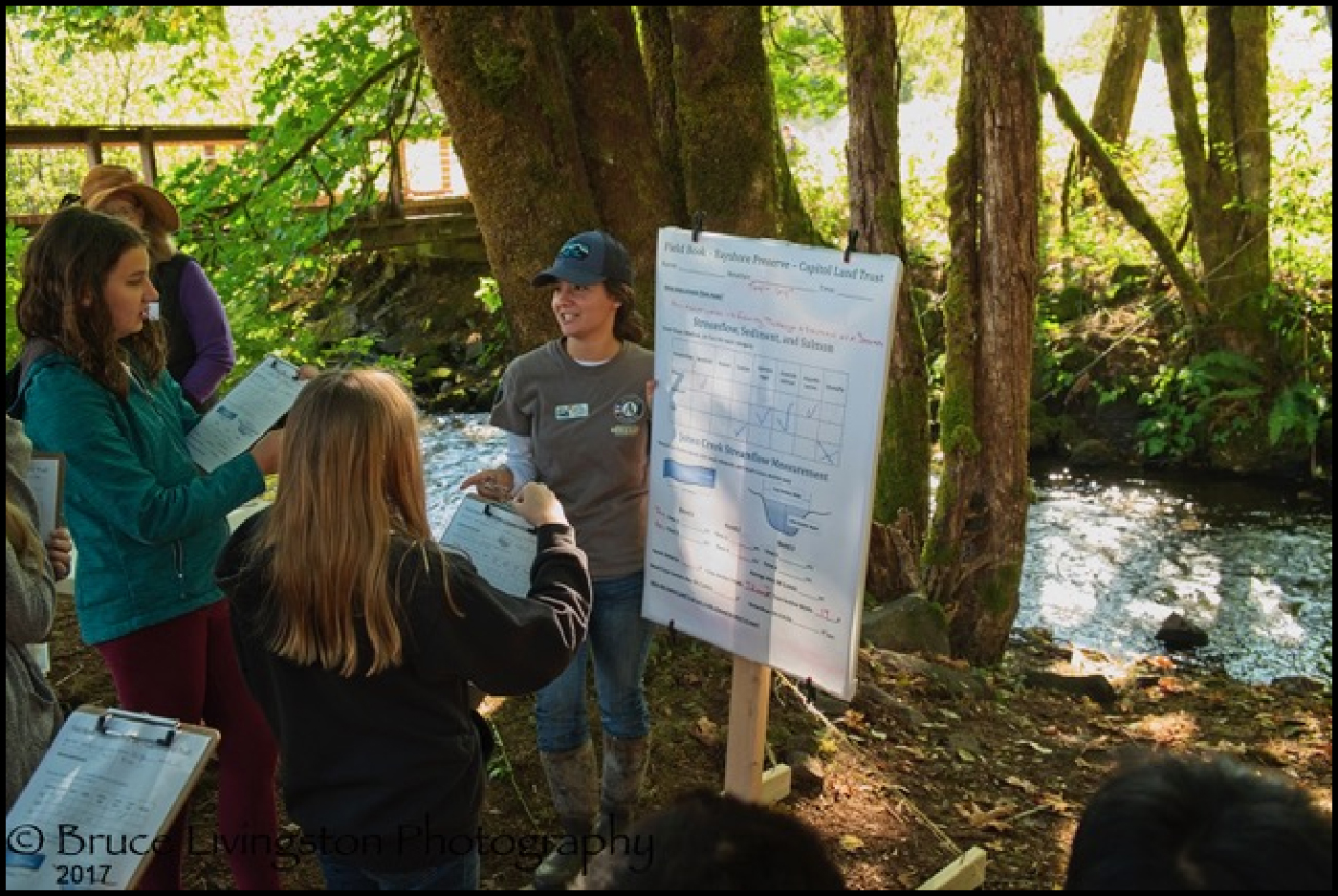
Mary Birchem, Restoration Coordinator with Capitol Land Trust, guides students through a discussion of streamflow next to Johns Creek on the Bayshore Preserve. Photo by Bruce Livingston.
Outdoor Learning in Shelton: A Surge of Hope
by Eleanor Steinhagen
Bayshore Preserve – Shelton, WA
 wo 7th graders have just tossed their pears into Johns Creek and are jogging downstream to see which one will cross the finish line first. Maneuvering around a large maple tree and jagged rocks on the stream’s bank, a handful of their classmates jog with them, including two “timers” who hold stopwatches in front of their chests, ready to hit the stop button when their designated pear reaches the finish line. The pears bob up and down for a moment, then drift into the creek’s swiftly flowing current and float eastward toward Oakland Bay.
The rest of the students are already standing at the finish line, peering upstream and cheering on their desired winner as they hunch forward and hide their hands in their sleeves to protect them from the frigid October morning air. It’s a sunny morning, but the temperature hovers in the high 30s and is slow to rise in the shade by the creek. As the winning pear crosses the finish line 25 seconds after the start of the race, several kids break into a loud cheer, while others throw their hands in the air, or turn away and yell, “Aw, man!” in disappointment.
The race was one of three that this group of 13 students conducted as a means of collecting the data they needed to measure streamflow in the creek at Bayshore Preserve, a 74-acre former golf course three miles northwest of Shelton, Washington, conserved by Capitol Land Trust in 2014. Before the race, the students learned about side channels and discussed how they impact flow; measured the distance from the race’s starting line to the finish line, or the “reach”; discussed key concepts they are learning in class, such as “ecosystem” and “biodiversity”; and, standing mere feet from the creek’s sand, cobble and stoneflies, they learned about the variety of sediments and creatures in northwest streams and where each can be found according to streamflow. Throughout the lesson, they used field journals to take notes and record data, including the depth and width of the section of the creek they were studying—information they would use to perform calculations in math class later that week.
The students’ work at Johns Creek is the culmination of three years of effort made by several groups to design and implement high impact field experiences for every student in the Shelton School District. The program started with a conversation at a community stakeholder meeting in 2014 between Margaret Tudor, then-Executive Director of Pacific Education Institute (PEI), Wendy Boles, Shelton School District Science Curriculum Leader and Science Teacher at Olympic Middle School, and Amanda Reed, Executive Director of Capitol Land Trust. Since the fall of 2015, Capitol Land Trust has been facilitating these field investigations for every 7th grader in the Shelton School District—serving around 300 students per year—using PEI’s trademark FieldSTEM model as a foundation for the work. In addition to Capitol Land Trust, Shelton School District and PEI, a handful of dedicated volunteers and other community stakeholders, such as the Squaxin Island Tribe, Mason County Conservation District, Green Diamond Resources and Taylor Shellfish, have stepped forward to support the program.

A student draws an example of a freshwater macroinvertebrate for his classmates to add to their field journals. Opportunities for students to share their work and learn from one another are built into the field investigation curriculum. Photo by Bruce Livingston.
This type of outdoor hands-on STEM learning appeals to many learner types and helps students overcome barriers to learning often found inside the classroom. During this first field investigation day, a group of students was asked why they liked learning science outside. Rian, a student at Olympic Middle School who used to go clamming near Bayshore with his mom and grandparents, said, ”I know some kids, they’re better with a complete visual. Not like a visual coming from a book, or written on a whiteboard.” Another student, Madison, said, “It’s good to be outside because you get physical education and you get to look at a lot of stuff,” she said. “I like coming out here to do hands-on learning and have fun with my friends.”
Capitol Land Trust in particular has done a lot of work to realize the initial vision of using Bayshore as a place to provide Shelton School District students with these learning opportunities. Daron Williams, Community Conservation Manager, and Mary Birchem, AmeriCorps Restoration Coordinator, are the land trust’s “boots on the ground,” making the improvements needed each year to transform the program from an average field trip to a PEI-style high impact field experience. Of his drive to help make these experiences happen for students, Daron said:
Doing FieldSTEM—where [students] can get the knowledge they need in a way that actually works for them—can help connect them with the land they live on. Shelton is an economically impoverished area. And a lot of families are struggling… As a small organization, we bring a capacity that the schools don’t have on their own. And that can make a difference in the students’ lives. Doing these project-based lessons, we could actually be helping students get through school that maybe wouldn’t have, and get them excited about science. This is a way to show them how science is connected to the real world.
To this end, Daron and Mary have worked tirelessly to increase student engagement and develop the program curriculum. When the program started in 2015, Daron collaborated with teachers to correlate what Bayshore offers and what is taught in the field to what students are learning in the classroom, ensuring that the lessons are aligned with state and national learning standards. In the summer of 2017, a year into her AmeriCorps service with Capitol Land Trust, Mary began recruiting additional volunteer teachers, and then designed and implemented a program to train them. Together, they have worked to adjust the schedule and coordinate the logistics of the field experience with district teachers. And on field experience days, both Mary and Daron work alongside the volunteer teachers to help them guide students through the FieldSTEM tasks.
This year especially, their effort shows. Viola Moran, student teacher at Olympic Middle School, shared her observation of Fiona (her name has been changed to protect her privacy) during the field investigation at Bayshore. A high-needs student in one of the district middle schools, Fiona doesn’t like to be the center of attention. As a rule, she doesn’t participate in activities or raise her hand in class. The commotion that comes with being in large groups of people makes her feel so uncomfortable that she waits in the bathroom until the hallways clear out during breaks before going to class. And when she gets there, she doesn’t want to sit with the other students.
When the Bayshore field investigation day was announced, Fiona said, “I’m not going. I’ll be sick that day.” But in spite of her reluctance, she got her permission slip in and ended up attending. And in the course of the afternoon, she became so engaged in the fieldwork that she and her classmates were doing that she volunteered to throw one of the pears during the fruit race. She also offered to draw an example of a macroinvertebrate on the board for the class—a profound shift from what Viola had observed in the classroom.
Throughout the first field investigation day, as well as the week following, Wendy, Viola, Mary, Daron and several of the volunteer teachers remarked that student engagement is at an all-time high this year. With the inevitable exceptions of “kids being kids,” the students listened attentively, asked questions, volunteered for a variety of tasks and diligently took notes and recorded their data. Viola and Wendy also observed that the students handled the creatures more gently this year than in the past. At the “Tidal Life” station, for example, on the first day of the field investigation, a group of students were so concerned about a hermit crab that had shed its shell in the molting process that they spent 10 minutes trying to persuade the crab to crawl into a shell they had found on the shore while offering various words of encouragement: “You want your shell!” and “Come on, man, you need a home!”

Students examine macroinvertebrates at the saltwater station. For many of them, this is the first time they’ve come into contact with the creatures that live in their surrounding area. Photo by Bruce Livingston.
Viola expounded on the above by adding:
Even though this is their community, there’s a good portion of [the students] that have never actually been around the creatures out there. And so, seeing the hermit crabs and the different specimens that they got to handle—they were just fascinated by that… And as they grow up, it’s right there. It’s a part of their environment.
What’s more, the impact of the field experience was evident in the classroom after the students went to Bayshore. “When we are going over ‘producer, consumer and decomposer,’” Viola said, “they are relating back to the information they got at Bayshore.”
Susie Vanderburg, retired elementary school teacher, former Thurston County Stream Team Coordinator and former Education Director for Olympia’s LOTT WET Science Center, agrees with Viola. “A lot of kids today are not getting exposed to the outdoors, not having experiences outside. They’re not given opportunities to love the land and be fascinated.” While her work as a volunteer is a big commitment, Susie does it because she believes that giving kids the opportunity to learn science outside, in the field, simultaneously gives them the opportunity to become stewards of the land they live on. “In environmental education we always say, once you get to know something, like a wetland or a prairie, then you begin to care about it. It’s personal. And if you care about it, then you’re willing to do something to protect it. If you never get outside and get to know the outdoors, you’re never going to care about it, you’re not going to protect it.”
While young people’s lack of exposure to the natural world poses a challenge, Wendy Boles, who is in her 15th year as a science teacher and is another major force behind implementing these powerful experiences for students, has begun to feel a surge of hope with a discovery she’s made in her classroom in recent years. It used to be that students entered her 7th grade class without any knowledge about (and very little interest in) the problems caused by issues such as overpopulation, resource depletion and pollution. In the past few years, however, Wendy has noticed in her students an increased awareness of and concern about climate change and environmental issues. She sees field investigations as an opportunity to help kids make the connection between these issues and how they impact their community. She hopes that by having real-world science learning experiences, her students will discover what they love to do, learn about science-related careers in their communities and be empowered to pursue them if that’s their dream.
Along with the work she does to help integrate the field investigation tasks with the district’s science curriculum, Wendy helps train volunteers and coordinate schedules with Capitol Land Trust, district teachers and the English language support staff that the district provides. “It is a lot of work. I mean a lot of work,” she said of the field investigation days. But all of that becomes worth it when she witnesses the new awareness among her students and their desire to safeguard the environment. “The kids are starting to go, Wow, we have to start caring about the environment. That to me is the biggest thing because if we aren’t taking measures to be good stewards, we are going to be in trouble. That’s my concern. Making sure that our planet can continue to support us in a way that we’re used to.”
At Bayshore, several individuals and community partners have come together to seize this opportunity by providing Wendy’s students, and every 6th and 7th grade student in the Shelton School District, with real-world, project-based, career-connected science education. The hope is that this education will enable them to lead richer and more meaningful lives, and that they, in turn, will draw from their time exploring and learning science out in their community to generate change where they can. Yes, it is a lot of work. Everyone involved agrees with Wendy on that. But they do it because they believe that the return will be well worth the effort.
Eleanor Steinhagen is the Communications Coordinator for Pacific Education Institute in Olympia, Washington.


by editor | Aug 27, 2017 | Outdoor education and Outdoor School
Outdoor Education —
Thoughts From an Elder
by Dan Kriesberg
Photo courtesy of Portland Audubon Society.
 uring college I was a waterfront director at a sleepaway camp and absolutely loved it. When my post college job search led me to residential outdoor education centers I was thrilled. It was summer camp all year round and it allowed me to follow my lifelong passion for the natural world. The perfect job. Twenty-five years later, after being a naturalist, 4th grade teacher, science teacher and environmental education consultant and having seen outdoor environmental education programs from the perspective of a parent and a teacher, I have decided this all makes me an outdoor environmental education elder.
First of all, what you are doing matters; this work matters. Don’t forget, be proud. The world needs outdoor education now more than ever. The world needs citizens with the knowledge, awareness and desire to live with the earth not against it. This is difficult when children are not spending enough time outdoors. Their lives are overscheduled with activities, they have less freedom to explore their neighborhoods and combined with fewer places to be in the “more than human world” they have become a generation indoors. You are the antidote because only by getting outdoors will children gain the appreciation, knowledge and sense of wonder needed to become stewards of the earth. We know from our own experience the rewards of being outdoors. Only by being outdoors will children reap the physical and psychological benefit the research and our own experiences has shown comes from getting out there.
There is a story to tell, so be a story sharer. Let the land, water and sky help you. Let the children help tell the story as well. Ecology is filled with fascinating characters, interrelationships, conflicts, heroes and more. Whatever it is that you are teaching, there should be a theme with the connections that will help children understand and remember. Don’t teach a bunch of random facts or activities. Share your story in the style that suits you. Back in the eighties I used an Indiana Jones adventure to connect lessons on ecology to save an endangered species. Wilderness survival classes began with a plane crash that required learning outdoor living skills to get back to safety. A lesson on forest ecology began with the story of a red eft. Geology is a journey back in time. It might a short story told in a 90 minute lesson or a longer story over 3-4 days. As the stories are shared, there are some things to keep in mind.
Teach local. There is amazing everywhere. The animals and plants living wherever it is you live, teach the same lessons as those in the jungle, desert or artic. Where you live has mind-blowing flora and fauna that inspire wonder. The best part of all, is that once children learn wonder at your nature center they will be more attentive to what is around their homes. They will be having direct experiences. The lessons from catching a frog far outweigh a website, movie or video of even the most amazing wildlife.
Connect to their home places. It helps to know something about the children with whom you are working. Learn about where they live, what animals and plants might they encounter back home. Talk to teachers about the community. Are there parks, forests, lakes or ponds you can refer to in your lessons? By reading their local newspapers you can relate what you are teaching to the environmental issues back home. Don’t prejudge the kids based on where they live as rich and spoiled or rowdy or whatever. Let them introduce themselves. Expectations lead to reality.
Teach love. Let there be no “ecophobia,” first described by David Sobel, this concept is important to those of us who work with children. Ecophobia is a “fear of environmental problems and the natural world.” Fear is not a great motivator. Love works much better. The stories you tell should be about the wonder of the “more than human world.” The stories should teach how it all works by fostering an awareness of our connection and love for the outdoors that comes from learning through play, exploration, guidance, fun and wondering.

Photo courtesy of the Gray Family Foundation.
Teach wonder. Look for teachable moments – the times when a child’s questions takes you off track but into a good place, or when a warbler lands on a branch just above your head while you are trying to explain how a sedimentary rock is formed, or when a rainstorm gives you a chance to define a watershed while standing in a puddle. These moments can become part of the story that you are telling. Be open and aware of teachable moments by learning about the place you are working. Explore by spending time walking and sitting. Learn by listening to people who know the land. Read. Gain your own sense of being by learning the natural and human history of the place. Then you can be aware of your part in the story. Be open. A sense of wonder is the greatest gift you can give children.
There are two parts to having a well-developed sense of wonder. One part is the ability to see the wonder in the world, the wow, the amazing, the how is that possible? It is also the ability to wonder, to ask questions, to know there is more to know. Let their curiosity guide the story you are sharing. Be sure the students know it is okay to wonder. Celebrate the good questions. When a child’s face lights up in the presence of wonder, you have done your job.
Teach science. Facts matter, a theory is not a guess. Knowledge is collected through experimentation and observation. Then, based on the accumulation of facts, theories are developed to explain what is going on. Decision making should be based on facts. Don’t just tell children how our knowledge was figured out. Have them figure things out for themselves through the activities and lessons you plan. The scientific method is not just for scientists. It is okay to say, “I don’t know, let’s find out.” even if you can’t find out at the moment. By figuring out a way to learn for themselves it can be an opportunity to experience how science works.
Teach hope. There are reasons to be optimistic. The wild is not all gone. There is still much beauty and wonder to be experienced. Human-caused problems have human solutions. Small actions multiplied by millions both cause and can solve problems. The Clean Air and Clean Water Acts have made a huge difference. The Montreal protocols, an international treaty banning chlorofluorocarbons has led to the closing of the hole in the ozone layer. Species that were once endangered are now safe from extinction. Yes, there is much to do, but by focusing on what is working you will inspire children more than focusing on what is not working. That just leads to doom, despair and hopelessness.
Teach action. Children need to understand their role in a democracy. This means having knowledge of environmental issues, at local, national and international levels. The knowledge will help them take action and not feel overwhelmed by the attitude there is nothing to be done. Children have the right and responsibility to let their elected officials know how they feel. They will be the ones making decisions in the future as voters and consumers.
Teach effectively. It is okay to expect good behavior, and if that means disciplining your students then do so, it doesn’t mean being mean. I have seen too many times educators talking when children are talking. I admit to having given too many chances and have to remind myself that I am not being fair to the kids that are behaving. Have expectations for their behavior and hold them to it. It’s as simple as waiting until you have their attention before speaking. If needed involve teachers to get support. Do not let one or two students prevent the whole group from having a positive experience. Kids do understand limits, just be fair and consistent, they don’t like hypocrites.
Another way to prevent discipline problems is to build relationships. This can happen by listening and talking while sharing a meal or while walking. Ask questions, make jokes, and connect with some knowledge of popular culture. Be yourself, don’t try to be too cool.
 Time is limited so avoiding distractions is key. While it is called outdoor education for a reason and it is true, there is no bad weather, there is only bad gear and lots of children have bad gear. Be aware: wet, cold and tired students are not going to learn. A shorter outdoor lesson with more focus is better than a longer lesson to the point of whining. Location, location, location, it matters where you teach. Think about the places you stop. Is there sun in their eyes? Is it noisy? Are there distractions? Is it wet? Is it safe? Is it safe for the plants and animals that live there?
Don’t be a slave to your agenda, sometimes it will be time to move on before you are ready and other times lessons slow down when children are so engrossed time stops. Whatever material you don’t get to, it will be okay. Don’t worry about not finishing, you are never going to teach everything anyway. Don’t be afraid to admit a lesson is a failure. It is better to cut your losses and move on rather than to plow through. Be aware of what they have already learned and activities they have already done. If you are at a center where more than one instructor will be working with the children be sure to know what the other naturalists are doing. There is too much to do and learn to repeat things. Outdoor education is less about the content and more about the experience. Almost always chose action over talking.
Enjoy, let the children see your passion and if you don’t have it anymore, it is time to do something else. Be the best you can be, don’t settle for mediocrity even if others are. Know why you’re doing what you are doing and do it with passion.
# # #
Dan Kriesberg is the author of A Sense of Place, Teaching Children about the Environment with Picture Books and Think Green, Books and Activities for Kids, as well as over 100 articles on environmental education and essays about his personal experiences in the outdoors. He lives on Long Island with his wife, Karen and two sons, Zack and Scott. Dan is a sixth grade science teacher at Friends Academy. Whenever possible he spends his time in wild places backpacking, hiking and hanging out.

by editor | Oct 20, 2016 | Outdoor education and Outdoor School

“Mr. D., that was the best science class I’ve ever had!”
The trials and successes of a classroom without walls
By Greg Derbyshire
he above feedback, made by a grade 8 student, is one of many similar comments made to me by students and parents who recognize and appreciate the opportunities provided by outdoor experiential education. That’s why I took students outdoors when I was a classroom teacher. Not for the accolades or ego stroking, but for the knowledge that I reached many students in a way that can’t be done inside the walls of a classroom. Few of us need to be informed of screen-time statistics when it comes to our modern society. A growing body of research is supporting what many of us know inherently, and the long-term impacts of the loss of exposure to the natural world are mounting. We now know that connecting with the natural world benefits many aspects of our being. Physical, social, spiritual, and mental health improve when we spend more time outdoors. Bullying decreases, ADHD symptoms are reduced, and social and cultural barriers diminish. For many of us, we know that we have an obligation as teachers to expose our students to the outdoors; it may be the only opportunity many of them get.
Herding Cats
The last class of my indoor teaching career was one of the nicest groups of grade 7 and 8s I’d had the pleasure of working with. They were energetic, creative, and enthusiastic. They weren’t, however, good listeners. During the first couple of weeks of September, I tried to help them develop better listening skills.
The usual strategies didn’t work; being late for gym class bothered them, but didn’t change their attentiveness.
With some trepidation then, I prepared them for a study of our schoolyard and the adjacent vacant land. The grade 7’s would investigate biodiversity for the Interactions in the Environment science unit and the grade 8’s would review the above, plus collect plant and water specimens for investigation with microscopes for the Cells unit.
Prior to going outdoors, we reviewed the expectations. Each small group would carry a clipboard, worksheets, scrap paper, pencils, measuring tapes or metre sticks and numerous zip-lock bags for collecting samples. Members of each group were to stay together and work together, solving problems on their own if possible.
I knew this class might be a bit challenging in an outdoor setting because of the struggles we’d had with listening skills in the classroom. But it was much worse than expected. Groups split up, metre sticks were used as swords, pencils got lost, and worksheets didn’t get filled out properly. And, that was just in the schoolyard! With thirty years as a classroom teacher under my belt, and with considerable experience at outdoor education centres, leadership centres and summer camps over the previous thirty-five years, I had no idea a group could be so frustrating. Despite the schoolyard behaviour, we moved to the adjacent vacant land and continued our study. When we finished our work and lined up at the school door to go back inside, I shared with them my dismay at their blatant disrespect for their peers, for me, and for the learning opportunity, which they had just spoiled. I told them that I had never had such a challenging group in all my years teaching outdoors, and that my experience that day was much like trying to herd cats. They knew Iwas upset, so they followed my instructions to return to class, sit down,open their reading books and remain silent.
I sat down at my desk to plan my lecture on respect and listening skills. After fifteen minutes, I asked for their attention.
Instead of my lecture though, I instinctively asked them to share what was good and what wasn’t so good about their outdoor learning experience. A few students offered the correct observations about poor listening skills and a general lack of following instructions. A couple of students suggested that the hands-on learning was a lot of fun. Then, the comment I’ll never forget: “Mr. D. – that was the best science class I’ve ever had!”
I paused. It was obvious that many other students felt the same. “Why then,” I asked, “were you so out of control out there?” It took some time, but some students shared that they seldom, if ever, went outdoors for anything but recess and gym class. They just couldn’t control themselves with the perceived freedom; it was too much like recess, despite having clipboards and worksheets in hand.
Even with this frustrating outing, the learning that followed was substantial. We spent many quality hours preparing plants for pressing, identifying species, mapping study plots with species variety, comparing schoolyard plots with vacant land plots, preparing slides for looking at samples through microscopes, identifying microscopic invertebrates, and preparing reports for presentation. Just one afternoon of outdoor learning provided plenty of extended learning opportunities in the classroom, and set up anticipation for future forays into outdoor experiential education.
In fact, the outdoors became our classroom without walls. Students began to ask if we could go outside to learn. We did. Over the course of the year, we left the classroom for language, math, history, geography, science, physical and health education, and the arts. The outdoors became a natural place to learn. And they became better learners as a result.
Benefits, Barriers, Basics and Beyond
As suggested above, there are dozens of benefits to outdoor experiential education. Students get more exercise, they socialize more, co-operate more and learn more.
They are exposed to new venues for learning where staff can share their expertise. Some students, who might find desk learning a bit of a struggle, shine in the outdoors; they often take leadership roles in groups – something they would not normally do inside. In my experience, students become motivated to work well together so that they don’t lose their outdoor learning opportunities.
The different venues open up different ways of learning. Most will know of Howard Gardner’s theory of multiple intelligences, (Frames of Mind: The Theory of Multiple Intelligences,1993).
There are now nine recognized intelligences: logical-mathematical, spatial, linguistic, bodily-kinaesthetic, musical, interpersonal, intrapersonal, naturalistic and existential. I am convinced that outdoor experiential education can support and enhance all nine intelligences.
Recently in education, differentiated instructionhas been touted as the way to reach more of our students. Take them outside, then! Some will thrive. Some will be challenged. All should benefit in their own ways.
There are, however, a few barriers to taking classes out regularly. A single permission form for a year of local outdoor excursions may not be allowed at some schools. On the other hand, many schools and boards are moving toward being “paperless,” so trip-specific permission forms could easily be completed electronically. Depending on administration, specific school and classroom compositions, the availability of volunteers may be a barrier. None are typically needed if you are staying on school property, and possibly if you are going “next door.” Other outdoor resources within walking distances would require volunteers. Individual schools and boards will have their specific requirements.
As is suggested by my “herding cats”experience, individual class dynamics will impact on the quantity and quality of outdoor experiences. Teachers must recognize the uniqueness of each class and the individuals within it, and plan accordingly. The reality is, some classes may not be able to get out as often as others. Regardless, the benefits of outdoor excursions will be palpable.Whether you’re a novice outdoor educator who needs support, or the experienced teacher who can provide that support, there are a few basics to keep in mind. The list below is a starting point. Adjust it as you see fit for each activity to suit your specific needs. The more experience you get at this, the easier it is.
- Get to know your local resources, (schoolyard, woodlots, vacant land, urban studies opportunities, talented parents or other adults in the community who might be able to help you with specific aspects of outdoor learning).
- Get to know your board and school policies and procedures for outdoor excursions; complete any required paperwork. Perhaps a generic permission form for occasional excursions close to school would suffice for those outdoor teaching opportunities that present themselves throughout the year.
- Arrange for volunteers, if needed.
- Know your students; what are their strengths and limitations?
- Plan the activity for your chosen curriculum area and topic, and gather materials and supplies.
- Carry out that plan; take those kids outside!
- Debrief the students to find out what they liked and didn’t like, and what they understood and didn’t understand. This feedback will prove very useful for future outings.
- Do follow-up activities to solidify learning.
Beyond the basics, here are some ideas for developing a network of outdoor educators within your school and district.
- Consult with colleagues to learn the basics.
- Share your ideas and experiences at regular meetings.
- Create outdoor activity resource documents specific to your schoolyard and local resources, (saved on your school’s server, of course). All teachers can contribute to it.
- Combine classes for some of your excursions. This is one way to team up experienced and inexperienced teachers, and more appropriate student groupings may be easier to arrange.
- Be an advocate for outdoor experiential education whenever you can.
So, why bother?
From my years of experience in the outdoor education and recreation sectors, I’ve seen what a difference going outdoors can make. Beyond all the wonderful benefits stated in research, there’s something that happens to children when they spend time outdoors. Their eyes soften. They begin to see the world in a different way. They’re more centred and at peace. They discover a part of themselves they didn’t previously know. What more could you want for your students?The bottom line is, if you don’t make the small effort to take your kids outside, who will?
Greg Derbyshire is a recently retired classroom teacher with the Grand Erie District School Board in Ontario, Canada. His many and varied outdoor interests and pursuits continue to occupy much of his time. More recently, his interest in promoting the benefits of outdoor experiential education has inspired the creation of a new venture, It All Comes Naturally.
This article first appeared in Stepping Into Nature, a publication of The Back to Nature Network, a multisectoral coalition oforganizations and agencies working to connect children and families with nature. The Network was established with the support of the Ontario Trillium Foundation through a collaborative partnership between Royal Botanical Gardens, Parks and Recreation Ontario and Ontario Nature.

by editor | Feb 22, 2016 | Outdoor education and Outdoor School
From Chattermarks
The Transformative Power of Wilderness Education
A graduate student finds an understanding of the effect of wilderness on the development of young people’s sense of self-worth
by Rory Crowley
 n July 7th, 2001 I lie huddled in my sleeping bag, shivering as I survey the cloud of water vapor that floats above my head. It’s 2:00 am and sleep is distant; I realize that I am unprepared for my first solo backpack. I’ve brought a waif of a summer sleeping bag into the high-country, and as snow covers my lonely two-man tent and the ground steals away the heat, I shiver. The Nalgene bottle under my knees is cold; I pull it out, undo the top and gulp the cool water. I open the tent door and pour the rest of the water into my camp stove. I am boiling water for the fourth time tonight; I watch the blue flame in anticipation. I need a warm water bottle under my knees to keep the night bearable.
“What am I doing here?” I say to myself, echoing what I’ve been thinking all night. I have come to Cathedral Provincial Park to test myself but I have also come in search of wildness, to find something that a city cannot supply. I just don’t know what I seek.
The simplicity of wilderness travel attracted me to strap on the hiking boots for that solo and embark on a career in environmental education. Carrying everything I need to survive a week, and leaving behind the overabundance of technology and distraction. Wilderness travel requires simplicity because of the load limits of the human body. Furthermore, wilderness travel resigns the distractions of the modern world to the subconscious. Gary Snyder eloquently warns people who seek the wild that
“Wilderness can be a ferocious teacher, rapidly stripping down the inexperienced or the careless. It is easy to make a mistake that will bring one to an extremity. Practically speaking, appropriate boldness, good humor, gratitude, unstinting work and play, and lots of walking brings us close to the actually existing world and its wholeness.” (Snyder 1990, 23).
During my first solo I was searching for my self-definition as an adult. Self-definition — ”defining, or interpreting ourselves to others, so that people in our social environment have a clearer understanding of who we are”— is a constant evaluation to see if our actions reflect our values (Williams et al. 1989, 170). I wanted to exhibit the “Mountain Man” persona as a symbol of my personal values. But there is also a cultural aspect; this self-image is desirable because the natural wonders of the wilderness are symbols spiritually and aesthetically unique to my Euro American culture. I came to Cathedral Provincial Park with a very anthropogenic goal. Unfortunately, like me at twenty-one, many “weekend warriors” do not go beyond the personal benefits of wilderness — views, peaks, the workout — disregarding their interconnections to the natural world. Learning is facilitated in wilderness when “the learning is necessary to solve basic problems of comfort and even survival” (Miles, 1987, 7). However, wilderness education needs to be sure to go “beyond the simple act of holding classes in the great outdoors” and embrace the experience and personal growth possibilities (Grumbine, 1999, 125).
www.evergreenescapes.com
Much of my summer (2004) was spent in the backcountry in North Cascades National Park. I was at the halfway point of a graduate program jointly administered by Huxley College of the Environment at Western Washington University and North Cascades Institute. The Master’s of environmental education is centered on place-based education, leadership and non-profit administration gave me the opportunity to teach in the backcountry while fulfilling course requirements.
During a 6-night canoe camp, my co-leader and I took a group of participants, aged 14-16, up a difficult hike to the top of Desolation Peak and a fire lookout. Rob, the oldest and most experienced participant who had attended two previous camps, set out to try and summit Desolation, a peak that his earlier instructors had never attempted with their groups. After ten minutes of strenuous hiking Rob sat down for a drink of water. Gasping he said, “I am never hiking that fast again, it sucked.” At this point I thought to myself, “okay, I guess we won’t make it to the top, but we’ll make a day hike out of it.” I was wrong. As the group quickly started leaving Rob behind, I sent Rob’s best friend in the camp, Stan, back to hike with him. Stan talked Rob all the way to the top, reaching the lookout just thirty minutes after the rest of the group. The weary hikers were greeted by a fire raging in the distance, the lookout making her daily observations, a helicopter flying through the smoke, and the ghost of past lookouts.
 About a month after the trip I received an e-mail from Rob’s father. Rob was doing really great in alternative school this year, especially in English class. Our lessons during the hike had centered on Jack Kerouac, who spent the summer of 1956 as Desolations Peak’s fire lookout. Our lessons, combined with the accomplishment of reaching the summit had convinced Rob to read both Desolation Angels and Dharma Bums. Most importantly, he had started writing. Although Rob said he hated hiking at the time, I am happy to hear that after some reflection he has incorporated some positives from the day into his daily life.
Rob was receptive to coming to the wilderness and striving towards self-improvement. His actions exemplified this commitment. The wilderness of Ross Lake differs from Rob’s daily hectic life in urban America. Contrast and attunement during time in the wilderness humbled and empowered Rob.
With increased visitation to wilderness areas as population grows, stress on our protected areas increases. As a result, programs that do not depend on the pristine wilderness should take place elsewhere. But if the program depends on the healing and restorative powers of wilderness the activity will be inferior elsewhere. In my opinion, Rob likely would not have received the same personal benefits if the canoe camp was on a local lake and the hike was on a less significant peak near his home.
During the summer of 2004 I also began to explore what it means to be a mentor and a facilitator. I tried to make the experiences I led as valuable as possible, exposing youth to wilderness’s restorative capabilities, while modeling positive behavior in the backcountry. Although a recent resident of the North Cascades, I have further sought to exhibit the qualities Barry Lopez suggests in his essay “American Geographies,”
It resides with men and women more or less sworn to a place, who abide there, who have a feel for the soil and history, for the turn of the leaves and night sounds. Often they are glad to take the outlanders in tow… they are nearly flawless in the respect for these places they love. Their knowledge is intimate rather than encyclopedic, human but not necessarily scholarly, it rings with concrete detail of experience. (Lopez, 1998, 132-133).
It was in this vein that I set out on successive hikes up Sourdough Mountain with participants from the Washington Conservation Corps.
“What are you doing Cait?” I yelled as I looked back to see Cait walking backwards down the trail. Cait, a member of the Washington Conservation Corps, was close to finishing a long day-hike to Sourdough Mountain lookout which included a talk with Northwest poet and fire lookout Tim McNulty.
“It feels like needles are poking into my toes! Like a thousand needles!” she shouted over her shoulder as she limped down the trail to catch up with the waiting group. “My stupid boots are cutting into my toes. Walking backwards makes it feel better.”
“What’s wrong? Do you want me to check for blisters?” I probed. We were still at least an hour from the trailhead.
“No, let’s just get down,” she said, tears swelling in her red eyes. “How long until we get down?”
“Ah… thirty-forty minutes…if you walk facing forward” I fibbed. We continued down the trail from Sourdough, one of the steepest and hardest hikes in North Cascades National Park, but also one of the most rewarding. From the fire lookout you can see six different river drainages; Ross, Ruby, Thunder, Stetattle, Big Beaver and the lower Skagit. We had an amazing day in the high country: blue skies, mountain flowers, views, poetry and writing advice. An hour and a half later we reached the vehicles and Cait immediately stripped off her dust-covered boots. Her toes were red, raw and inflamed but with no noticeable blisters. Her boots must really be terrible. Now in sandals, Cait soothed her toes in the cool river before we got into the trucks to go back to camp. Her feet will be fine tomorrow.
Back at camp I noticed that Cait was not at dinner. After climbing over 5,000 feet in five miles I expected everyone to be devouring their food. I tracked her down walking back from a payphone, her eyes red and swollen. She had phoned her boyfriend because she could not wait to tell her partner about her amazing day; so amazing she could not wait another minute to share it with him. As an aspiring writer, Cait met one of her idols and it has had a profound impact on her. It was at that point that I realized I had facilitated a day that Cait would remember for a long time. Cait’s amazing day can be summarized as experiential wilderness education.
Cait saw the hike up Sourdough was a once in a lifetime opportunity. Author Tim McNulty was in the lookout crafting his work. While at the lookout she observed his everyday tasks of a lookout. Cait understood the purpose of a writer spending time in seclusion and wilderness. Tim gave her advice of different techniques to make her writing better.
Since our hike Cait has had the opportunity to independently write and apply what she had learned. In a chance meeting she indicated her writing had never been better and that the advise from Sourdough was very helpful.
Cait and Rob exemplify the amazing metaphoric benefits to wilderness education. They have been able to apply the positives from the wilderness to their everyday lives. My time as wilderness educator has also been metaphoric for me as a leader. I knew wilderness could impact someone in a positive way, but I needed to actually witness a transformative experience to fully believe in the benefits of wilderness education.
Learning and teaching during my time working with North Cascades Institute causes me to reflect on my time huddled in my cold sleeping bag in the Wilderness of Cathedral Provincial Park. I was grasping for a connection to nature. The myth of the “Mountain Man” brought me to the wilderness, but the effect has been something deeper. For me wilderness has become a metaphor of a deeper connection to the land, a source of inspiration and, most importantly, a positive influence on me as a member of society, a citizen and a resident of the earth.
References
Grumbine, E.R., “Going to Basho’s Pine” ISLE, 6(2), 1990.
Krumpe, E.E., “Managing Wilderness for Education and Development.” Preparing to Manage Wilderness in the 21st Century, U.S. Forest Service, 1990.
Lopez, B.H., “The American Geographies” Barry Lopez: About This Life, Toronto: Random House, 1998.
Miles, J.C., “Wilderness as a Learning Place.” The Journal of Environmental Education, 18(2), 1986-1987.
Miles, J.C., “Wilderness as Healing Place.” The Journal of Experiential Education, 10(3), 1987.
Snyder, G., “The Etiquette of Freedom.” The Practice of the Wild, San Francisco: North point Press, 1990
Spray, R.H. & Weingert, P.D., “The Wilderness Environment: Training Wilderness Managers.” Wilderness Benchmark 1988, U,S, Forest Service, 1989.
Williams, D.R. et. al., “The Role of Wilderness in Human Development.” Wilderness Benchmark 1988, U.S. Forest Service, 1989.
Rory Crowley was a Graduate Student with Huxley College of the Environment at Western Washington University and the North Cascades Institute. Funding was provided by the Skagit Environment Endowment Fund who support conservation, stewardship and education in an around the Washington and British Columbia’s Skagit Watershed.

by editor | Sep 27, 2015 | Forest Education, Outdoor education and Outdoor School
Forest Schools and the Benefits of Unstructured Outdoor Play
 By Deanna Fahey
Miami University, Oxford, Ohio
 t is snowing outside and you’re getting your child ready to go to kindergarten. While other children may be wishing for a snow day so they can play in the snow, yours is excited to go to school! Why is your child unique? Your child attends a forest school. Forest schools and nurseries are popping up around the globe and gaining momentum. Though these schools have routines that are wide ranging, they all have a common core: allowing children to experience the freedom of playing outdoors as part of their learning.
ROAD TO DISCOVERY
As a graduate student, parent and nature lover, I questioned why some adults choose to make decisions based on ecological consequences while others do not. After all, in today’s day and age, we all are aware of the consequences of our modern lives on the environment. On walks with our daughter, my husband and I spent numerous conversational hours chipping away at adult psyches trying to figure out an answer to this apparent quandary. There has to be some keystone event, I argued, in a person’s life that generates a concern for their environment as adults. During my questioning, I came across an answer. Through interviews, researchers have come to find that a direct, positive experience in nature before the age of 11 promotes a long-term connection to nature. However, given the state of today’s society, our children spend less and less time outside. What does that mean for our environmental future? It was during this time of questioning I was introduced to Erin Kenny, co-founder and lead teacher of Cedarsong Nature School. My husband had been watching Nightline when he called me in. There Kenny and parents were discussing the joys of sending their children to a forest school. I had to know more!
 FOREST SCHOOLS
Friedrich Froebel opened the first kindergarten in Germany in 1837. The core of his curriculum integrated nature and play to provide children ages three to six a place to grow. Over time Froebel’s curriculum has morphed to become more academic in character and concern for children’s growth has been replaced by concern for preparation for elementary school. However, parents around the globe are uniting and fighting to bring nature back to their children. The result of this movement by parents is the reintroduction of forest schools.
Forest schools may fluctuate in their everyday routine but the core value of spending a majority of time engrossed in outdoor play remains the same. According to the American Academy of Pediatrics (Ginsburg, 2006), play is essential to the well-being of children. The varied terrain of nature stimulates imagination, encourages creativity, and builds motor skills. Undirected play allows children to learn to share, work in groups and negotiate. Children involved in play face and conquer fears while self-esteem is boosted as obstacles are worked out and overcome. Play is so important to the overall health and well-being of children it has been recognized by the United Nations High Commission for Human Rights as a right of every child (UNICEF).
In order for children to develop a love of nature, appropriate opportunities for interaction need to be provided. Too often in today’s society children know more about exotic flora and fauna from faraway places but have no idea of the beauty that lies right outside their own door. If children grow to adulthood with no love for, or worse yet a fear of, nature how can we expect them to become environmentally empathetic adults. According to White and Stoecklin (2008) children need to experience nature on a regular basis in order to develop pro-environmental values.
 CEDARSONG NATURE SCHOOL
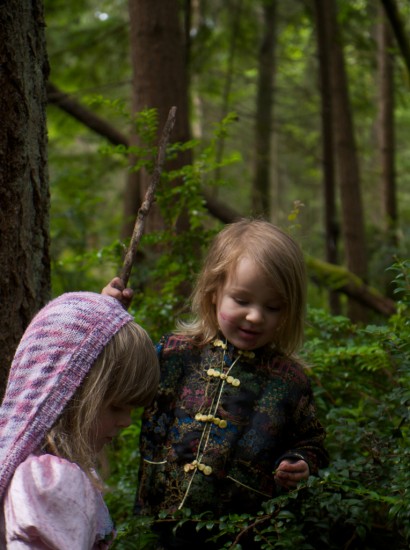
It was a clear morning as we drove through the forest on Vashon Island in Seattle. We were on the hunt for the elusive forest school. The sun glimmered off the dew hanging on the leaves, blinding us at times to the road ahead. Further and further we drove until at last we reached the end of the road. Where to from here though? Ah, just follow the sounds of the laughing children. We had reached Cedarsong Nature School. I was about to begin my journey into a school with no walls and where children lead the class instead of the teachers; a world virtually impossible for me to imagine but that I was eager to explore!
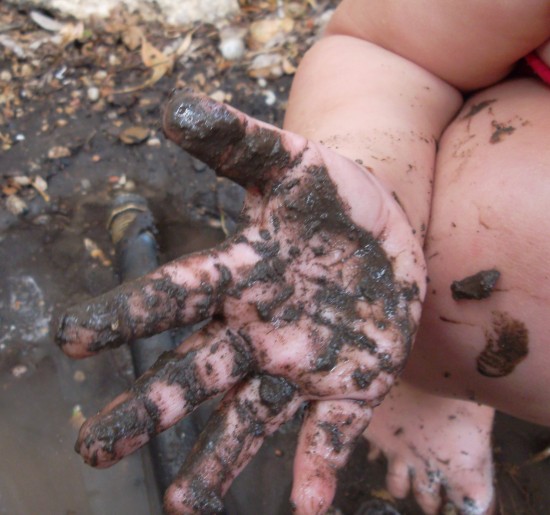
When I caught up with the children at Cedarsong, they were in the process of making some very delicious mud pies! The girls were covered head to foot in mud and they could not have been happier. They were standing in a circle chatting together over their work and discussing things only known to them. As I stood aside and watched, Erin Kenny, co-founder of Cedarsong, described to me how the children are the leaders of the day; their interests and observations dictate what will be learned. As a teacher myself, I questioned the logistics of this system. How does anything get covered when children decide what to learn? She told me how a random comment about tripping over a tree root can lead to a discussion on erosion and weather or the purpose of the roots of a tree to photosynthesis. The possibilities are endless! Changing seasons bring continual opportunities to track and record growth, and discuss hibernation and even death. New observations can lead to predictions, fallen trees and fungus can stimulate conversation on decomposition which can lead to discussions about habitats and niches. Teachers, it turns out, can just stand back and observe; it is from their observations that teacher’s take their cues of where to lead.
 A boy had decided to explore a bit more of the area; Kenny and I followed leaving the girls in safe sight of the teachers. As we followed the child further into the forest my “inner child” was awakened and I wanted nothing more than to climb the nearest tree or jump into one of the many puddles. My senses were stimulated by the sounds of the birds and insects calling out their warnings of strangers nearby and I desperately wanted to search out the sources of those warnings calls! However, I was there to observe the children and not to indulge my own inner child so I turned my attention back to the child we were shadowing.
Further along the path the child had found a tree to climb. Though Kenny moved a bit closer, she did not flinch or move to stop the boy. I inquired about fear of accidents given the freedom the children seem to be allotted. According to Kenny not many children do get hurt— they learn and respect their own limitations. On the rare occasion one does get hurt, there are emergency protocols that all teachers are familiar with. Teachers are certified and stay current in first aid and CPR. Kenny’s experiences with accidents are similar to those from forest schools in Europe.
Marga Keller is the founder of WaKiTa, a forest daycare located in Zurich, Switzerland. Keller stated, “Experience shows that in forest institutions fewer accidents happen than in mainstream schools.” She clarifies, explaining that because the teachers consciously learn how to handle risks with the children and help them strengthen their own skills, the children can assess risk situations better. The children also do not feel the need to rebel against overly restrictive rules or prove their courage because the school actually puts this as part of the program: the teachers offer the children age-appropriate challenges.
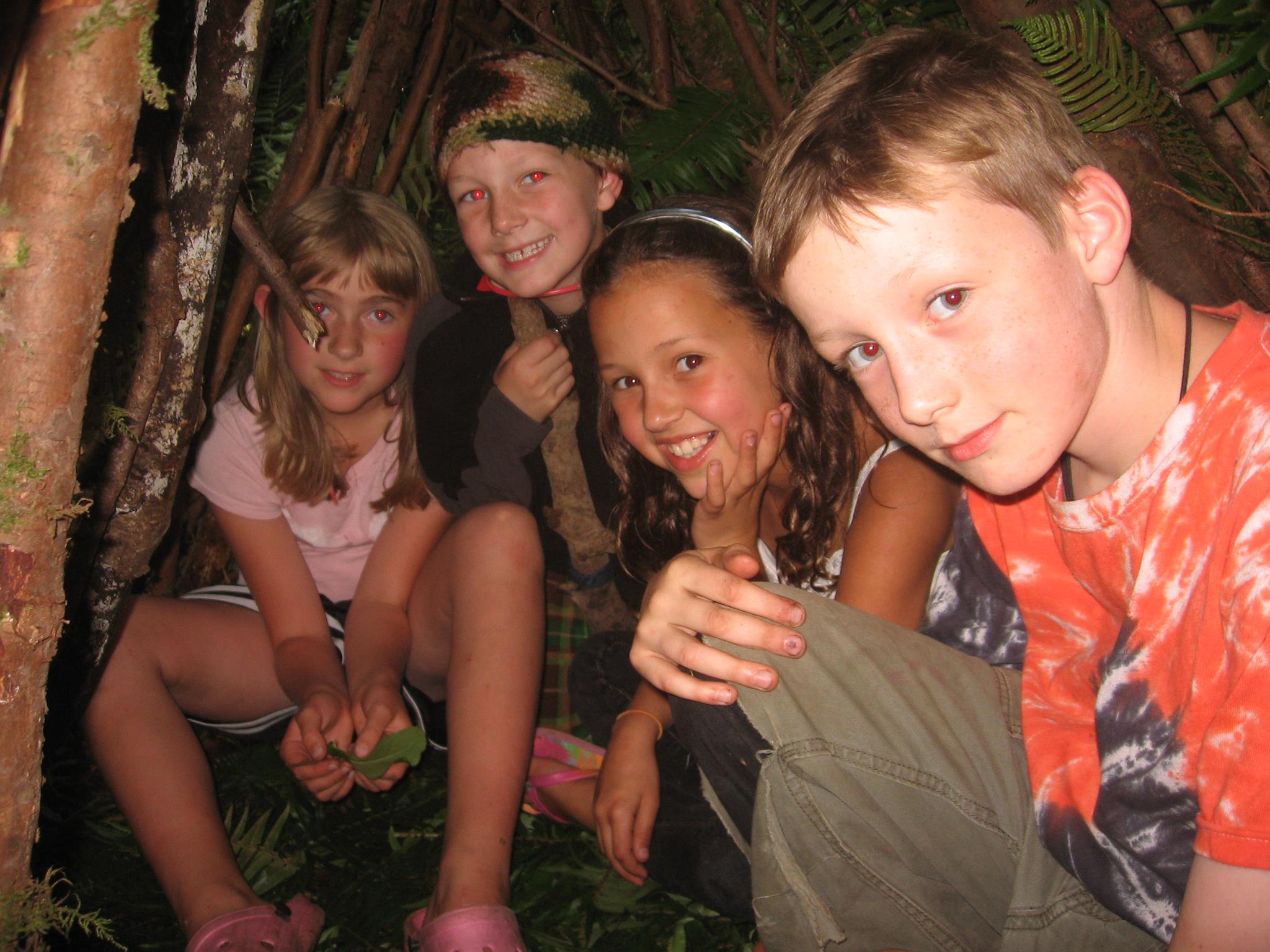
 Back with the main group, Kenny asked if anyone would like to lead a hike to show me the rest of the forest. All the children decided to go and we set off together. As we wandered through the forest, the children impressed me with their knowledge of the local plants and fungi. I was taken to forts and shelters camouflaged in the trees, the likes of which my own children would have gone crazy for! As we strolled on, the children dispersed to different areas of the trail and Kenny and I had another opportunity to discuss the school and the children’s role. “Children challenge themselves all the time in the outdoor setting,” Kenny told me. “They display great personal pride in their achievements.”
Each day is unique and brings new sources of inquiry and excitement! Children learn to work together and cooperate through imaginative play. According to Burdette and Whitaker (2005), when children play outdoors there is more opportunity for problem solving and creative thinking. The varied terrain and multiple stimuli which nature provides deliver the perfect environment for imagination.
As my time came to an end at Cedarsong, I felt encouraged with all that I had seen. The possibilities for incorporation of nature into the American education system seemed endless and the benefits for our future generations infinite!
Bringing Back Outdoor Play
Forest schools may seem ideal for the issues I was grappling with, but not all of our schools and children have access to nature in their backyard. Urban schools are at a distinct disadvantage for this type of schooling; however, there are schools working on solutions which could be sustainable for all urban schools. For example, Muscota New School, located in New York City, utilizes Inwood Hill Park and Bear Mountain State Park, making the most of the nearby outdoor areas available to them.
According to the California Department of Education (2011), environment-based education employs natural ecosystems as a context for learning. The “environment” may be a river, a forest, a city park, or a garden carved out of an asphalt playground.
It seems any environment can be employed as an area for incorporating outdoor play, opening doors for practical outdoor play solutions.
You cannot turn on the news today without hearing about school funding issues; yet funding concerns can be overcome through partnerships, grants and community volunteer days. Taft Elementary School in Redwood City, California, partnered with Hidden Villa, a non-profit outdoor education organization to create their school garden program. CitySprouts, based in Cambridge, Massachusetts, partners with public schools to develop school gardens. Citysprouts also works to educate teachers on the integration of existing curriculum with their gardens. The Lorrie Otto Seeds for Education Grant Program provides grants for large scale projects such as the “design, establishment and maintenance of a native-plant community such as prairie, woodland, wetland, etc. in an educational setting such as an outdoor classroom.”
Modifications select schools are making to outdoor immersion are providing sustainable and worthwhile results. Our children are gaining access to the outdoors, attaching to nature and initiating positive change in their well-being.
WHERE DO WE GO FROM HERE?
Even though forest schools may not be the catch-all answer I was looking for, they can be a viable solution to our children’s lack of outdoor play and keystone moments. For those schools without a sizable amount of accessible land, compromises can be made. Vegetable gardens are being employed to reinforce geometry sills, nutrition, life science and basic math. An extension can include cultural differences in gardening techniques and vegetable preferences as well as recipes, which of course can be utilized for basic math. Trees found on school grounds can be used to teach geometry, prediction, microhabitat, and chemistry. An ecosystem extension can be incorporated by linking with international schools to compare tree data; growth rates, circumference, etc. (sites such as Jane Goodalls – http://www.rootsandshoots.org/ are perfect for this type of linking). Logs and larger branches on the ground can be used for agility, microhabitat, decomposition, nutrient recycling, chemistry, prediction and even physics. Why are branches of similar size but different trees weigh different? Water sources – even puddles after a rain – can be used for chemistry, prediction, water analysis and physics. Have you ever wondered about the force of a foot splashing in the water and the correlation to height of the splash? Cultural stories and knowledge can be shared while observing and studying local plants. I for one have always wondered about the ability of plants to break rocks as the seeds grow. Sounds like a perfect inquiry-led question for a physics class. Ant hills can be an endless source of amusement and knowledge for younger children learning about habitat. Decomposing leaves on your school grounds can become the perfect place to discuss microhabitat, nutrient recycling and niche. Of course the simplest solution would be to get rid of the cement playground and replace it with a natural playground, one complete with grass, fallen and living trees and butterfly and vegetable gardens.
In our world today adults are making choices that are counter-intuitive to what is best for our environment. Without contact with their natural world our modern children will grow up to be less inclined to save the earth than some of us seem to be today. As adults we need to come together and give our children the access to nature they deserve. With the constraints of today a feasible solution to this problem is to bring back outdoor play to our school children!
Reference:
Burdette, H. & Whitaker, R. (2005. Jan.). Resurrecting Free Play in Young Children: Looking Beyond Fitness and Fatness to Attention, Affiliation, and Affect. Arch Pediatr Adolesc Med. Vol. 159. Retrieved from www.archpediatrics.com at University of California – Berkeley
California Department of Education. (2011). School Garden Program Overview ; An overview of the school garden program including its impact on children’s health, nutrition, and academic achievement. Retrieved from http://www.cde.ca.gov/ls/nu/he/gardenoverview.asp
Citysprouts. http://www.citysprouts.org/
Ginsburg, K. (2006. May). Testimony of Kenneth Ginsburg, MS, MS Ed, FAAP on Behalf of the American Academy of Pediatricians. Natural Resources Subcommittee on National Parks, Forests and Public Lands and Subcommittee on Fisheries, Wildlife and Oceans. “No Child Left Inside: Reconnectiong Kids with the Outdoors”.
Keller, M. WaKiTa Outdoor Daycare
Kenny, E. Cedarsong Nature School
Moving Outdoors in Nature Act. Retrieved from http://www.govtrack.us/congress/billtext.xpd?bill=h111-6426
Muscota New School. http://www.muscota.org/
Rymer, B. (2009. December). Taft Elementary School’s Garden Program; A Case Study. Retrieved from http://www.redwoodcity.org/manager/initiatives/gardens/helpful/Taft%20Case%20Study%20Draft.pdf
The Lorrie Otto Seeds for Education Grant Program. http://www.for-wild.org/seedmony.html
White, R. & Stoecklin, V. (2008). Nurturing Children’s Biophilia: Developmentally Appropriate Environmental Education for Young Children. White Hutchinson Leisure & Learning Group
UNICEF. http://www.unicef.org/rightsite/files/uncrcchilldfriendlylanguage.pdf