
by editor | May 27, 2022 | Equity and Inclusion, Indigenous Peoples & Traditional Ecological Knowledge, Tribes & Traditional Ecological Knowledge
River Newe: Creating
New Narratives On Historic Landscapes
In this article we present our work that directly addresses Justice, Equity, Diversity, and Inclusion (JEDI) for our tribal youth of the Shoshone-Bannock people. We have reimagined what JEDI means for us through environmental education activities as they relate to our efforts to reinhabit the traditional homelands where our people lived, gathered, hunted, and thrived since time immemorial.
by Jessica Matsaw, M.Ed,
Sammy Matsaw, Ph.D,
and Brant G. Miller, Ph.D
The landscapes of the Middle Fork of the Salmon River watershed and other usual and accustomed places of the Shoshone-Bannock are imbued with meaning and wisdom that we are actively seeking to connect our tribal youth with. The corridor is the heart of the largest wilderness segment in the lower 48 states with intact cultural sites and vast untouched lands with no cell service. The perfect place to disconnect youth and get them into a sense of what our ancestors knew about living without modern technologies and at the same time sharing in a true sense of unfragmented and connected riverscapes. The experience has been one where the students begin by wanting to go home to the final days of not wanting to leave and have real connection to place. We cannot stress how important this has been to our youth and tribal members.
To begin, we share a vignette that begins to capture the intentional and oftentimes dynamic approach we are taking to engage our Tribal youth deeply and meaningfully with experiences that give them grounding in the present, hope for the future, and a foundation for explorations using Traditional Ecological Knowledge and Western scientific methods to inquire about their curiosities.

Shoshone-Bannock young ladies, Abrianna (7) and River (15), gathering wild berries, and enjoying one another’s company in the homelands of their ancestors. Photo by Popp Photography 2021.
“We wake from many stressful days of preparation to get here. We arrived at Dagger Falls campground the evening before. Yesterday was so much work finalizing all the things, loading ice, food, and organizing the coolers and dry boxes by meals, days, and how to access them the best. The trailer is mostly organized to get out things we need for a short breakfast and some coffee. Not sure what we forgot but at this point we will just make do. Coming from the Rez, our lives are mostly about making do, so we’re good at it. No worries, as we enjoy coffee and visiting with new and old friends and family. The kids and some of the adults are checking out the falls, picking raspberries, journaling, taking in the scenes of a river carved valley. Taking down the tents, stuffing sleeping bags, some hair braiding, and another cup of coffee. It’s starting to feel like we should move over to the boat launch – ‘Alright, let’s load up and head on over!’
“After mounting the frames, we begin rigging the rafts with heavy coolers, dry boxes, groover and tanks, camp chairs, tables, and dry bags filled with our hygiene kits, tents, sleeping bags, and dry clothes. We leave space for future dreams and incoming memories made with new faces and ones we haven’t seen in a bit.
“As each raft gets fully rigged you can hear, ‘Hey everyone, can we get a hand over here?’ It takes a team to load our rafts onto the boat launch ramp and walking it down together.
“At the same time our youth were creating prayer bundles to mount on the front of our rafts made up of tobacco ties, sage, and lots of good thoughts and laughter.
“Before we begin our journey down the Middle Fork of the Salmon River, our women will ask the river for permission to travel with her. Once we make our offerings and give to the river a gift of our first foods and prayer, we can then open the circle. We acknowledge the land, water, rafts, and guides who will be working tirelessly to keep their hands on their oars, ears to their neighbors, and reading the water. She will tell us how to get down the river.
“The first two days will be rough as they are supposed to be. We are getting reacquainted with her again and she has lessons to teach us all. Mostly what is on our minds is the running of rapids like Sulfur Slide, and the big one for the day is Velvet Falls. We will arrive at our usual camp and enjoy a soak for the weary, just to relax, and some play for the young and old alike.”
The vignette above is a window into how we are approaching our ideas about place, homelands, and resituating Shoshone-Bannock culture into the 21st century, and reconnecting our youth with our memory traces left by our ancestors. We have a long history in the Middle Fork of the Salmon River watershed and to hear and see our young people couple Traditional Ecological knowledge with science, technology, engineering and mathematics through their own research, journaling, and artistic ways of capturing not only what they’re learning in mind, but also in heart and spirit, is to begin to see the future, and what is possible in this new, envisioned future. Each season and our planned activities can be thought of in this manner: traditional teachings, customs and protocols, tools, places across spatiotemporal distributions by elevation, weather, and climate, etc.
 Intergenerational traumas such as the boarding school era interact with living in desperate times of survival between two entirely different cultures through the onslaught of threats to our literal and cultural existence. In a contemporary setting we are still orally in our collective thought about how our knowledge already knew the recent findings in Western science, that we have unwritten theoretical frameworks. Indigenous storytelling is a rich metaphor for the bold and creative space of curious Indigenous minds, hearts, and souls for the betterment of our Sogope Bia (Mother Earth) and to support our nation-building. Our connection in thought, verb-based languages, and action is complex and adheres to the so-called messiness of ecology, and the nature of science. The broader issue affecting our communities’ reflexive abilities are daily conflicts from a racialized society upholding asymmetrical forms of reasoning and assumptions about human entitlement to, and extractions from, the natural world, that continues to separate humans from nature (i.e., the nature-culture divide, Bang & Marin, 2015). A more localized related problem begins at K-12 schools where we are losing our children to the norms of the education system, that continues into college and in the workplace where our voices are dead before arrival (Matsaw et al. 2020). As professionals, the expectation is exceptional fluency in scientific comprehension and writing, coding, statistical analysis, and Western scientific theory, principles, methodology, and methods. The social and environmental justice of our times is to rise above racist microaggressions to on-the-fly cultural competency affording cultural relevancy so that we can broker space, and time for sustainable pedagogies and methodologies to the benefit of our Indigenous Knowledge. Sadly, we are outnumbered, and our children are being left behind, the gap in between is continually ever widening, so our loss deepens and the attainability for our youth to replace us in the workforce is further out of reach.

Prayer ties created by our youth in respect of elements, directions, sky and earth, and medicines we use to keep us safe and healthy for attaching to our rafts. Photo by Popp Photography 2021.
To combat these issues, we are using traditional ecological-thinking through a Shoshone-Bannock seasonal round in our homelands doing STEM learning activities. Activities through protocols of consent asking our land and waterways permission to test the ideas of our frameworks with tools of Western science such as river trips down the Middle Fork Salmon River; hunting/gathering of our wild foods; interacting with places of the stories/knowledge/theories of our ancestors. Along the way we will collect data, observation, journaling, using tools from our digging sticks to iPads, spear poles to DNA and otolith (ear bone) collections from salmon. These activities will be used to evaluate pedagogies and methodologies rooted in Shoshone-Bannock Traditional Knowledge by building theories, study plans, experimental designs, methods, and technologies as a way of creating new/old pedagogies. Our old pedagogies have been interrupted by colonialism and now we are adapting using state standards to quantify our learning and transfer of knowledge in the form of new pedagogies so that our knowledge persists. Concurrently, working to vacate racist structures in our tribal institutions, situating our own tribal organization and leadership to support making effective and meaningful changes in policy and reframing thoughts of becoming teachers and STEM professionals that cross with traumas associated with boarding schools and objects of research.
The doorway we are intentionally and mindfully creating is one for our youth to begin to envision a renewed path through an ecosystem of opportunities that will lead to their own success. In many ways we are just beginning to reimagine how to rebuild our presence of the Shoshone-Bannock people back into the cultural riverscapes of our ancestors and how we still see the land, as our Sogope Bia. Our river trips along ancestral homelands are to facilitate observations of where we once lived, how the landscape once appeared, and how our people interacted, honored, and were sustainable co-inhabitants with our more-than human relatives.
Back to the river…we stop at cultural sites where there are pit house depressions, and/or pictographs. We exercise our imaginations of what we know today with how it must have been then. For instance, looking at the villages and how they are arranged and imagining the proximity of families amongst the larger community. We can imagine this because our community back home on the reservation still reflects a similar state, preserved by our natural, innate need to arrange as we always have. Families in family areas closer to relatives of similar clans, bands and where we were when we came to the reservation life. Each site is not a far-off imaginary. To open the imagination of our youth is to then see the STEM, the Indigenous Ecosystem builders we always have been and still are today.
We are also wanting to be respectful of those who inherited the wrongful displacement of our Tukadeka relatives over a century ago. We believe they are there in the most loving way they can be, and we want to reciprocate the relationship they have with our home. In that we are wanting to share with them how this place is not only special, but also largely intact from the way our ancestors left it when they were forcibly removed. For the most part what we have gathered is that the guides on the river are happy to see us back.
 Jessica Matsaw, M. Ed., is the Art, Civics & Tribal Government Teacher at the Shoshone-Bannock Jr/Sr High School. She combats educational systems of exclusion and cultural erasures by focusing culturally centered, equitable learning spaces of engagement to celebrate Indigenous ingenuity, intellect and inquiry.
Sammy Matsaw, Ph.D., is a grandfather, father, husband & extended family member amongst the Shoshone-Bannock and Oglala Lakota with a PhD in Water Resources. As co-founders, he and his wife are creating an intercultural STEAM pedagogy more agreeable with Indigenous peoples through a non-profit called River Newe.
Brant G. Miller, Ph.D., is an Associate Professor of Science Education at the University of Idaho. His research interests include Adventure Learning, culturally responsive approaches to STEM education, science teacher education, and technology integration within educational contexts.
For more information, check out https://rivernewe.org/
See more articles like this at https://clearingmagazine.org/fall-2021

by editor | Jan 15, 2019 | Learning Theory, Place-based Education
Photo courtesy of Mike Brown.
Not One More Cute Project for the Kids:
Neal Maine’s Educational Vision
by Gregory A. Smith
Lewis & Clark College, Professor Emeritus
PART TWO
(see Part One here)
Sustaining Neal’s Place-Based Vision of Education: Lessons Learned
Despite the power and attractiveness of these educational practices, few of them remain in evidence after the close to 20 years since Neal retired and started devoting his time to land conservation and nature photography, one of the reasons he sought me out to document central elements of his work in Seaside and the north coast. He is thus well aware of the difficulty of institutionalizing teaching approaches that run contrary to the direction embraced by most contemporary schools. Part of the reason behind this outcome might be related to the way this dilemma is framed in dualistic terms. Rather than seeing the implementation of Neal’s vision as an either-or proposition, a more productive strategy might be to adopt a both-and perspective and then find ways that more of the kinds of things that Neal encouraged could become part of the mainstream educational agenda, not replacing what is now familiar and widely accepted but balancing this with an approach capable of generating higher levels of student engagement, ownership, and meaning. To that end, here are six lessons I take from what I’ve learned from Neal over the years:
- Give as much priority to student questions as to required standards.
- Value excited learners as much as competent test takers.
- Make as much time for community and outside-of-classroom explorations as the mastery of textbook knowledge.
- Create organizational structures that encourage creativity as much as accountability.
- Encourage teachers to partner with students as co-learners as much as they serve as their instructors.
- Develop teachers as alert to unexpected learning opportunities as they are to curricular requirements.
Give as much priority to student questions as to required standards. Human beings are intellectually primed to investigate questions whose answers are not immediately apparent. Think of the appeal of mystery novels, movies, or television programs, our attraction to riddles, the appeal of crossword puzzles. Although these formats involve no ownership on the part of readers, listeners, or players, they still are capable of eliciting attention and time commitment. Even more powerful are the questions we come up with ourselves. Part of the power of the educational approach Neal encouraged teachers to develop lay in the way he tapped into this human desire. Here’s one more story from the tour as an example of the possible. The students who had been involved in the Pompey Wetlands project at one point got ahold of a tape recorder and oscilloscope and began recording one another’s laughter. They had been studying the sounds and images (on the oscilloscope) of whale songs. They wondered whether their individual laughter would have some of the same recognizable visual features on the oscilloscope as what they had observed with whales. They found that they did and after a time could associate different visual patterns with the laughter of specific students in the classroom. Imagine their fascination at having made this discovery. Such fascination is the stuff of serious learning.
Value excited learners as much as competent test takers. Making time for student questions Is one way to excite learning. Another is to provide the opportunity to do things as well as hear about them or meet people as well as read about them. Part of that doing can be as simple as taking a walk in the woods or planting a garden. Part of it could involve designing an experiment to see whether moss really does only grow on the north side of trees. Part of it could involve participating in a group that sees what’s on the river bottom across a transect of the Columbia River. The possibilities of the doing and the investigating are nearly limitless. Such learning opportunities take advantage of human curiosity and the pleasure our species takes in gaining new skills and competencies. I can imagine some of the stories that children who had learned to keep a boat on straight course across the Columbia must have told their parents when they got home that evening—or what students who participated as photographers in the Day in the Life project shared. Not all learning experiences in school will be as memorable or as exciting as these, but some of them should be and not only on an infrequent basis. Things should be happening in school that fire students’ imaginations and intellects, things that instill in them a desire to learn more. Mastery of information for tests of one sort or another is one the requirements of life in modern societies, and it is a mastery we desire from the experts we turn to when in need of medical, legal, or mechanical services. The demand for such testing is not going to go away. But what ignites deep learning is an emotional connection with different topics, the personalization of learning that Neal sought to spread throughout the Seaside School District, something much more likely to happen by getting kids into the thick of things and engaging them in projects that demand their involvement.
Make as much time for community and outside-of-classroom explorations as the mastery of textbook knowledge. The knowledge found within textbooks is not without value; it is, after all, one of the central tasks of education to transmit culture to the young. At issue is whether this culture is being linked to the lives of children and youth in ways that communicate its significance and meaning. In the past, the authority (and fear) invested in teachers, ministers, and older relatives was enough to ensure the attention of many children to these issues. This is no longer the case in part thanks to the media, to mass culture, and to the weakening of traditional institutions like the family, school, and church. Place-based educators argue that one way to address this issue involves situating learning within the context of students’ own lived experience and the experience of people in their community. When this learning also engages them in the investigation of important local issues and provides them with the opportunity to share their findings with other peers and adults, so much the better. One of the strongest motivators for human participation is the chance to engage in activities that are purposeful and valued by others. Experiences like the health fair described earlier can both encourage involvement and strengthen students’ mastery of the knowledge and skills their teachers are attempting to convey to them. More students, furthermore, seem likely to produce higher quality work when they grasp its social significance and know it will be viewed and examined by community members as well as their teacher.
Create organizational structures that encourage creativity as much as accountability. One of the consequences of the standards and accountability movement since the 1980s has been the tendency on the part of many educators to teach to the test and for their administrators to assess their competence on the basis of students’ scores. School administrators have also become more likely to require teachers to justify the activities they bring into the classroom on the basis of specific curricular aims or benchmarks. Given the degree to which schools, for decades, have failed to adequately prepare non-White and lower income students, accountability structures are clearly needed, but the way they are currently being used has resulted in a narrowing of the curriculum and a reduction in teachers’ ability to respond to learning opportunities presented by either students or community members. Place- and community-based education requires the capacity to improvise and make use of instructional possibilities that present themselves during the school year; these possibilities can’t always be anticipated. Embracing them demands the willingness of teachers to follow interesting leads while at the same time looking for ways that curricular requirements can be addressed by doing so. When schools impose both constraints and reward structures that inhibit this kind of flexibility, fewer teachers become willing to experiment in the way teachers who worked with Neal were able to. School districts can go a long way to encouraging creativity by inviting innovative teachers like Neal to share their expertise with others, either as teachers on special assignment or as members of within-district teams responsible for professional development. Addressing policies that affect daily schedules, the school calendar, and transportation requests can also do much to make learning in the community both possible and accessible.
Encourage teachers to partner with students as co-learners as much as they serve as their instructors. It is not surprising that teachers feel uncomfortable about venturing into unfamiliar intellectual terrain with their students, something that gaining knowledge about what may be a new or minimally examined place and community will necessarily require. The same thing is true of pursuing questions that aren’t going to be answered by the textbook but demand data gathering and analysis. Teaching in this way involves a certain relinquishment of control and the willingness to trust students to be engaged participants in a process of collective learning. This doesn’t mean that a teacher only becomes a “guide on the side” completely following students’ lead and offering assistance only when needed. The teacher instead becomes a “model learner,” the person in the room with more expertise in knowing how to frame questions, seek out information, assess its credibility, locate appropriate experts, create experiments, organize data and analyze findings, and prepare presentations. There will still be a need for mini-lessons about specific content tied into students’ investigations, but the primary task of a teacher with many place-based units will be—like a graduate school advisor—to demonstrate what it means to be an independent learner committed to uncovering the truth inherent in different situations—just as some of the students attempted to discover whether moss always grows on the north side of trees when they began asking questions of the watershed. Moving into a role like this will be disconcerting for many teachers, but the rewards can be worth their initial discomfort as they find themselves no longer teaching the same thing every year but joining their students in a process of intellectual discovery and knowledge creation.
Develop teachers as alert to unexpected learning opportunities as they are to curricular requirements. Enacting the previous five suggestions involves cultivating teachers who feel competent enough about their capacity as educators–drawing upon an analogy from the kitchen–to invent new and healthful dishes from ingredients at hand as they do following recipes. Recipes are certainly useful, but the test of an experienced cook is found in what they can create from scratch. Toward the end of our day together, Neal told a story about a storm-felled Sitka spruce in a park just across the street from a local middle school. Neal and a teacher there recognized the learning potentiality of this fallen giant and were able to forestall city employees for a couple of weeks as students conducted a tree necropsy. Especially valuable was the possibility of seeing at ground level the biological activity that goes on at the crown of a mature tree. In many instances, this learning resource would have been seen as no more than a mess to be cleaned up rather than an opportunity for an in-depth and unique scientific investigation. Novice and even experienced teachers need to be exposed to stories like this one that invite them to consider possibilities they may have never or rarely encountered during the course of their own education. Neal recognized that teaching in this way might be more of an art form than something that cab be easily taught but still offered the following guidance: “Don’t sleep on the way to school. Have your brain engaged. Always be looking for opportunities to make it come to life, especially if it’s community based. That really makes it work!”
Paying It Forward
My day-long journey through a partial history of Neal Maine’s work in Seaside deepened my understanding of his vision of the possible and at the same time his frustration with how difficult it has been to get many of his good ideas to stick. Early in our conversation he spoke of the way our society’s conventional vision of schooling constrains the education he believes needs to happen if young people are to grow into responsible citizens able to bring fresh and potentially more appropriate ideas to the challenges of living in the 21st century. Rather than asking students to be the passive recipients of information passed on to them by others in an effort to prepare them for adulthood and citizenship, educators need to give children the chance to participate now as data gatherers, knowledge producers, and community participants. As Neal put it, “You ought to exploit someone who is uncontaminated with having the same old answer. . . . How much could you exploit them, so to speak, in a positive, productive, humane, and sincere way? The irony of it is that the effort to exploit that capacity becomes the most powerful preparation possible for a later point in your life cycle which is what we should call adulthood.” This, not the creation of “one more cute project for the kids,” was Neal’s aim when he attempted to stimulate educational innovation in districts along the Northern Oregon and Southern Washington coast and influenced the thinking of rural educators across the United States as a board member of the Annenberg Rural Challenge.
He found that institutionalizing changes like the ones he enacted is not easy. A similar lesson was learned through the Rural Challenge, as well. As a board member of the Rural School and Community Trust I had a chance to be in touch with a number of the schools or districts that had received grants from the earlier Rural Challenge. Without the added resources and the network of support provided by that well-funded effort, it was difficult for teachers and administrators to sustain the work they had accomplished during that five-year period.
Regardless of these difficulties, ideas set in motion during that time are continuing to evolve. One of Neal’s Oregon colleagues, Jon Yoder, played a significant role in shaping the Great Lakes Stewardship Initiative in Michigan that has sought to make environmental stewards out of the state’s children and youth for over a decade. Much of the work done there bears the stamp of Neal’s efforts, affecting over 115,000 students since the program began in 2007 (https://greatlakesstewardship.org/). Across the United States, a survey of place- and community-based educators completed in 2016 surfaced over 150 schools that are retooling their curriculum and instruction in ways that advance the aims Neal pursued in the Pacific Northwest (https://awesome-table.com/-KlsuLBGU0pYWpjFH1uh/view). Many other schools were also surfaced through a project sponsored by the Getting Smart website that has created a blog where teachers have been able to post their own stories about place-based education (http://www.gettingsmart.com/categories/series/place-based-education/). Finally, well-established institutions like Eastern Michigan University (https://www.emich.edu/coe/news/2016/2016-05-10-a-new-wave-of-urban-education.php) and the Teton Science Schools in Wyoming (https://education-reimagined.org/pioneers/teton-science-schools/) are creating teacher education and professional development programs aimed at preparing teachers able to embrace and then deliver learning experiences likely to lead to the forms of participation, citizenship, and community change Neal hoped to engender.
Whether schools on their own will be able to support and sustain innovations like these remains an open question, but the persistence of these ideas and the possibilities they are stimulating seem hopeful. Believing as I do that cultures change more through the telling of stories than bureaucratic manipulation, I encourage readers to have conversations about the work of Neal Maine and his educational vision. Going even further, for those of you who are teachers, try some of these possibilities out in your own schools and communities and see what happens. Then share your experiences with others—both the things that work and those that don’t. Learn from one another. As a tribute to Neal and the future, let’s see how long we can keep these ideas alive and how far we might be able to spread them.
 Greg Smith is an emeritus professor who taught for 23 years in the Graduate School of Education and Counseling at Lewis & Clark College. He’s keeping busy in his retirement serving on the board of the Great Lakes Stewardship Initiative in Michigan and the educational advisory committee of the Teton Science Schools in Wyoming; at home, he’s co-chairing a local committee that is seeking to develop curriculum regarding the Portland-Multnomah County Climate Action Plan. He is the author or editor of six books including Place- and Community-Based Education in Schools with David Sobel.

by editor | Nov 18, 2018 | Outstanding Programs in EE
 NatureBridge Takes the Classroom Outdoors: Inspires Teachers and Students Through Discovery
by Karen West
for NatureBridge
“The future will belong to the nature smart… the more high-tech we become, the more nature we need.”
– Richard Louv, author of “Last Child in the Woods, Saving Our Children from Nature-Deficit Disorder’’
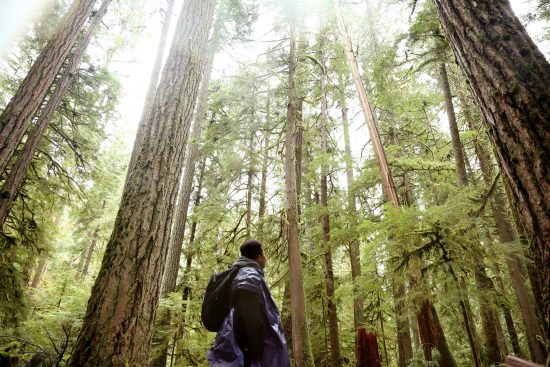
Jeff Glaser stood at the base of Madison Creek Falls in Olympic National Park, taking in the beauty of the water cascading 76 feet. As he hiked back toward the Elwha River, he recalled his nature-filled childhood, packed with camping, hiking and fishing trips throughout the Pacific Northwest.
He couldn’t help comparing the wilderness adventures of his youth to experiences of today’s generation, many of whom are growing up in an over-scheduled, technology bubble. “I love getting my students off their devices and into the natural environment where they can breathe, stretch and grow,’’ says Glaser, who teaches sixth grade math, science and religion at St. Louise School in Bellevue, Wa.
Glaser was one of more than a dozen teachers participating in a four-day professional development summer workshop at NatureBridge, an environmental education nonprofit with a campus in Olympic National Park on the shores of Lake Crescent. With environmental science at its core, the workshop was an example of how NatureBridge provides educators with training, resources and curriculum to help prepare their students to be the next-generation of environmental stewards.
The teachers from Washington, Oregon, California and New Jersey spent the week exploring marine and lowland forest ecosystems in Olympic National Park including the lower Elwha River watershed. NatureBridge educators, Olympic National Park assistant superintendent and rangers, and data driven scientists provided insight into how science, technology, engineering, and math skills inform decision making and management of this one million acre park.
In final projects, teachers in the workshop collaborated with their grade-level peers to submit classroom content for publication on the National Park Service’s K – 12 education site. Inspired by his visit to Rialto Beach, Glaser created a lesson plan focused on marine plastics – Where does the debris come from? What happens to it? And how much is generated?
“Many kids today don’t have these experiences – some don’t know their trees or their national parks,’’ says Glaser, whose parents integrated nature into his life-long learning. “It’s not just kids who are missing out on nature experiences. As teachers, we need to step it up and show our students these things.’’
The educational workshop is just one way NatureBridge collaborates with the national park to inspire teachers and students through critical-thinking skills, hands-on scientific research and inquiry-based learning.

OLYMPUS DIGITAL CAMERA
Letting Kids Get Their Hands Dirty
Founded in 1971 as Yosemite Institute, NatureBridge serves over 30,000 young people from more than 700 schools each year at its six national park campuses: the valleys of Yosemite, the watersheds of Washington’s Olympic National Park, the peaks of the Santa Monica Mountains, the marine sanctuary of the Channel Islands, the coastal hills of the Golden Gate National Recreation Area and the piedmont forest of Washington, D.C.’s Prince William Forest.
No matter what grade level or type of school, many of the teachers who go through a NatureBridge program all leave with the same discovery: Kids get excited about environmental science when they are immersed in a living, outdoor laboratory where they can become scientists in the field – and not worry about making mistakes.
“It’s all about discovery,’’ says NatureBridge educator Josh McLean, during a recent Elwha Exploration Day event. He says it’s more important for kids to think about and create questions than answering them correctly, adding that the most rewarding experiences often come when students are feeling out of their comfort zone.
“The struggles build our ability to persevere and find new knowledge,’’ McLean says, throwing in his favorite quote from poet William Blake who once said, “it’s the crooked paths that are the paths of genius.’’
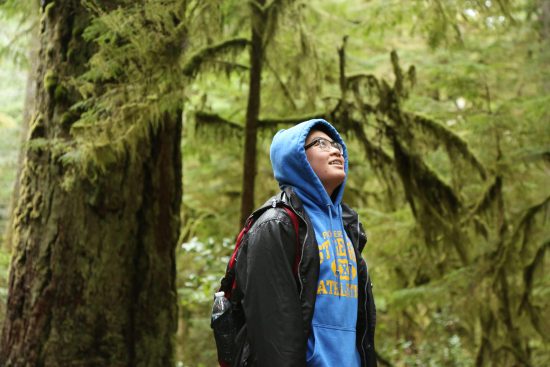
NatureBridge offers three- to five-day residential programs primarily targeting students in grades 4–12. Olympic National Park is a place where kids and adults aren’t afraid to step in the mud. Students get to hold slimy salamanders, hike in an old growth forest or even touch snow for the first time. They walk across the bottom of what used to be a 60-foot deep lake conducting experiments like real-world scientists, touch springboard notches on tree stumps that were cut down 100 years ago and stand on a 210-foot slab of concrete that once was a dam.
“I can’t think of a better way to teach kids about nature,’’ says Stephen Streufert, vice president of education and Pacific Northwest director at NatureBridge. “By letting kids get their hands and feet dirty in outdoor classrooms, students acquire a deeper understanding of their environment and often begin a lifelong interest in science.’’

NatureBridge Changes Lives
Just ask high school senior Marisa Granados, NatureBridge’s 2018 Student of the Year. Before I had the opportunity to travel to Olympic National Park, I had begun to feel discouraged about the impact I really could make in the world.’’
Inspired by her first school trip to NatureBridge, Granados embarked on a 14-day NatureBridge Summer Backpacking program in 2017 that gave her renewed confidence in her ability to thrive and make a difference: “I was able to gain the confidence to speak up about what I wanted to do with my life. By gaining a stronger relationship with nature and discovering a deeper part of myself, I now see the influence of my actions and the amount of power that I have in creating change.’’
With the support of the U.S. Forest Service, she developed a handbook and curriculum for middle school students to learn and apply environmental stewardship effectively in her home state of New Mexico. She hopes to pursue a career in environmental engineering and outdoor education.
Granados is just one of thousands of students who has worked like a true scientist collecting and analyzing data in the Olympic National Park.
“There’s a mysticism around here that makes everything magical,’’ says Ingraham High School senior Jonathan Mignon on a recent scientific exploration in the Olympic National Park. “This is a place where you get sense of wild, untamed nature that speaks to me. It makes everything more tangible. You’re not only learning it but you’re feeling it.’’
When students hike in the Elwha River watershed, they don’t just hear that obstructions to river passage has changed, they see first-hand that salmon are now able to swim upriver and spawn in cobbled pools miles upriver from where the dams used to be. Students become part of the dam restoration story practicing scientific inquiry and critical thinking to understand complex issues associated with engineered environmental change.
“They think like scientists testing the quality of water, then transform into politicians, activists and concerned citizens engaging in debates about how the river and its salmon are managed,’’ says Streufert.
Students also get first-hand lessons in stewardship. “They learn that, for the Elwha dam removal to be successful, people had to listen, to engage with those they did not always agree with and to ultimately act, with multiple stakeholders and multiple outcomes in mind,’’ says Katie Draude, NatureBridge summer backpacking manager.

Bringing Back the Elwha
The Elwha Valley, where two dams were removed between 2011 and 2014, is a fertile learning environment for educators and students. The Elwha River Restoration Project – to date the largest dam removal in U.S. history – is one of the key areas of study for students visiting NatureBridge’s Olympic National Park campus. The $325 million National Park Service project entailed tearing down the 108-foot Elwha Dam and the nearby, 210-foot Glines Canyon Dam and restoring the river watershed.
Over the last several years, NatureBridge students have literally watched the river be reborn, recording its long and storied history.
The dams, the first of which was built in 1911, served their purpose of fueling regional growth by supplying much-needed electricity for the local timber and fishing industries. Though state laws required that construction of any kind allow for fish passage, both dams were built without it. But in 1992, after years of protest by many local tribes, lobbying and citizen outcry, Congress passed the Elwha River Ecosystem and Fisheries Restoration Act, which authorized dam removals. It took nearly two decades of bureaucratic wrangling before deconstruction began in 2011.
Meanwhile, the damage had already been done. The dams put a 100-year chokehold on migration of salmon just five miles upstream along the 46 mile river, disrupted the flow of sediment and wood downstream, and flooded the historic homelands and cultural sites of the Lower Elwha Klallam Tribe.
In its heyday, the Elwha River was home to one of the largest year-round salmon and steelhead runs of any river on the Olympic Peninsula and supported all five species of Pacific salmon. “People who were riding their horses up the trail just upstream from the river couldn’t cross,’’ Pat Crane, a longtime biologist for the Olympic National Park, told the professional development workshop teachers as they sat on what used to be the bottom of Lake Aldwell. “The horses refused to cross the creek because there were so many pink salmon in the creek.’’
That was in the late 1800s and 1900s, before there was electricity in Port Angeles and when steamboats were the region’s primary means of transportation – and before the dams were built. Back then, Crane estimates an average of 120,000 salmon came back to the river every year to spawn. “But by the time we go around to dam removal, we had between 100 and 200.’’
Today, the river, which flows from its headwaters in the Olympic Mountains to the Strait of Juan de Fuca, is the largest ecosystem restoration project in the National Park Service history – unleashing more than 70 miles of salmon habitat.
In September 2014, the first reported sighting of Chinook in the Elwha River above where the Glines Canyon Dam came down was confirmed, and they have slowly been returning ever since. In fact, as Crane was talking with the teachers during their workshop, he noticed a small stream near the river where dozens of baby salmon were gathering. “The fish are gambling they will be safe here,’’ Crane told the group. “They are safe for now but if the water dries up or a heron comes by, they could die.”
To kickstart the river’s recovery and help manage a century of accumulated sediment, Forest Service crews are planting 400,000 native plants and more than 5,000 pounds of native seed in the reservoir basins. But biologists say it could take a generation or more to heal.
What if We Taught Baseball the Way We Teach Science
Research shows that environmental outdoor education sparks student interest, helps improve academic performance and builds confidence. A Stanford University study measuring the impacts of environmental education for K-12 students showed that environmental education helps students enhance critical thinking skills, develop personal growth and increase civic engagement.
An educator in the Stanford study commented: “In my 20 years of teaching before using the environment-based approach, I heard, ‘Why are we learning this? When are we going to finish?’ And now when we are out in the field and sorting macroinvertebrates, for example, I have to make them stop after four hours for lunch. And then they say, ‘We don’t want to!’”
A recent report from the Kaiser Family Foundation found that the average eight to 18-year-old American now spends more than 53 hours a week using “entertainment media”, up from 44 hours five years ago.
“When you think about the pressures of youth today and the kinds of things they are dealing with their families and teachers, their primary interface is screens,’’ Streufert recently told a group of educators, donors and community leaders.“We know that the average time of kids outside on any given day is about seven minutes – that includes structured play (soccer practice) and unstructured play (playing out in the woods).’’
To illustrate the importance of hands-on learning, NatureBridge educator McLean recalls the writings of UC Berkeley professor Alison Gopnik, who believes “children are designed to be messy and unpredictable, playful and imaginative.” In her book, The Gardner and the Carpenter, Gopnik asks, “imagine if we taught baseball the way we teach science.”
McLean says it would go something like this: “In kindergarten or first grade we might bring a baseball into the classroom. You could look at it but not touch it—it might be dangerous… And if you got to the sixth or seventh grade level, now you can roll the ball across the room or perhaps swing a bat as long as you are well away from everyone else. In high school, with close, coach supervision, maybe you have an interview with a famous baseball player or maybe re-enact a play from some famous game. And it’s not until undergraduate level in college that you play a game of baseball. If we taught baseball that way, we would expect to see the same level of success in Little League that we currently see in our science classrooms – it’s not high.’’
In her book, Gopnik answers her question by saying: “learning to play baseball doesn’t prepare you to be a baseball player—it makes you a baseball player.’’
The same is true in environmental education—if you want kids to learn, to be scientists, to be stewards, you must involve them in the process. Take them into the woods, show them the rivers, let them experience the outdoors. These are the moments that will transform them into scientists. These are the moments that will inspire them to care for the natural world—not one day, but now.
# # #

by editor | Feb 21, 2018 | Arts and Humanities, Schoolyard Classroom
By Shimshon Obadia
 hirty-one degrees Celsius and the air is dry to the touch in downtown Kelowna, BC. I whip my bicycle down the shoulder of Pandosy Street where the bike lane would be until I hit K.L.O. Road where I connect to the actual bike lane embedded in the road with a glowing grass-green path and neon white icons. My body feels like it is being hit with a light rain shower but it’s just my sweat in this Canadian desert’s air. Passing Fascieux Creek on Casorso Road, I glance at the luscious wetland full of tall cattails and a small sign indicating the creek’s adoption by École K.L.O. Middle School where I’m headed in a frantic rush. I switch gears and pedal faster. I cannot be late for this. The school is coming up on my right and checking both ways— the sidewalk is empty — I mount the curb. Launching myself through the pre-teen sized gap in the school’s fencing I walk my bicycle along the length of the garden. This is the garden Michelle Hamilton and her Environmental Education students have planted on the school grounds separating the school from the roadway. I am just on time.
Even though it may cost me my punctuality here, I have a little routine that I’ve taken to since beginning my eco-art work with the students at École K.L.O. Middle School. Standing at the side door to the school, I peer over to the creek that runs through the school’s grounds. Covered in old, cracked, sinking concrete pads with a ripple from the far end of the creek off the school grounds barely slipping through the water where a stream once flourished, this section of Fascieux Creek was once a luscious wetland like the section of it I pass on my way to this school, the perfect learning environment on this school’s grounds. It was covered as a decision made by the school’s administration many years earlier and now the school benefits from a legal-sized soccer field and an uninterrupted sightline across the entire property.
I begin to open the door as it is opened for me from the other side by Michelle Hamilton and her students. These are young people who have pledged their efforts and energy to reversing this concrete problem by way of their time spent in classes as well as the time they volunteer outside of them. These students were originally challenged to raise $100,000 by their school board for this habitat’s restoration; multiple “generations” of students remarkably raised $86,000. As of this writing, the first phase of re-naturalization is nearly complete and funding for the final phase is almost in place. But this community, originally only a few students, now an impressive mass of parents, concerned citizens, local naturalists, and environmental consulting firm, and more, fought for almost a decade against points of concern everywhere from the size of that soccer field to the idea of children-turned-flower-thieves at the sight of fresh, local flora.
This is when I came in. Working with the University of British Columbia’s (UBC) Eco-Art Incubator research initiative founded by UBC faculty members Nancy Holmes and Denise Kenney, I have been providing art as a means to attract attention to the work these students have been tirelessly committed to, while simultaneously providing a creative outlet for the environmental concerns directly impacting their education. This is why I wanted to be on time. We were going to the section of the Fascieux Creek on Casorso Road, which has not been disturbed or covered up, to approach this work a little differently.
In my backpack, I had three cameras, and attached to my bicycle were the accompanying tripods. Michelle Hamilton had given up this class (as one of quite a few over the years) to allow the students and me to create videos. Using visual storytelling. At that time, we had just begun tackling the concrete problem in the creek using art.
Fighting for the money to get their wetland restored was only one part of this work; fighting against the mainstream prioritization of what looks good on paper, such as outdated laptops for an entire school, versus what students want and need is another. This is the work these students have tirelessly been pushing for. In a stream like that of Fascieux Creek, fighting the current only gets so much attention; flowing gracefully up the stream can captivate passersby for the rest of their lives. In his book, Conversation Pieces, Grant H. Kester states, “[i]f any collective identity is inherently corrupt, then the only legitimate goal of community art practice is to challenge or unsettle the viewer’s reliance on such forms of identification”. [1] This is where eco-art comes into Fascieux Creek: when everyone else cannot imagine something changing, we began to make that change happen.
So how does art beat concrete? This is a question I asked myself when first starting the Daylighting the Classroom project. I wondered how this partnership with the University of British Columbia’s Eco Art Incubator, and École K.L.O. Middle School students and faculty could be used to restore the wetland habitat. This was a project for the home of Western Painted Turtles, a home currently occupied by the school grounds, and concrete pads sinking into the remains of what was once the main creek flowing through them, Fascieux Creek. I started out by picturing the whole project as a complex version of ‘rock, paper, scissors’; before even getting my feet on the ground, I was looking at a puzzle of what I could do to get the students to create change, or how to get an integrated learning ecological system for the students at École K.L.O. Middle school where they could have a mutually beneficial relationship with nature for the sake of their education. As is popular in artistic practice, however, my initial intentions were very far off the mark.
It turned out that the situation was far more complex than a logical puzzle of figuring out what paper I needed to write to remove the rock. When I first got to the school and met the people involved with this re-naturalization, I realized that a quick fix answer was not what was needed, and more importantly, was not going to get the job done. I became aware that the project of restoring this habitat at the school was a project that faculty member, Michelle Hamilton — the person who first contacted the University of British Columbia with this project proposal — had been working tirelessly towards for years now. More important than this was the fact that the students at École K.L.O. Middle school were already greatly invested in the project, and wanted to see it through for the benefit of their learning, their planet, and their community. Here my project quickly turned all the way around from being meant to restore a wetland through art, into a project meant to empower the students affected by this lack of integration with nature. This was not my own original idea: it was a problem they had already begun fighting for themselves.
As an artist, I drew from my performance background to give these students educational tools that would allow them to express themselves in the area of environmentalism as well as to expand their connection with nature for the sake of a more holistic learning experience. I work in applied drama, a form of performance which Helen Nicholson explains in her book of the same name to be “forms of dramatic activity which primarily exist outside conventional mainstream theatre institutions, and that are specifically intended to benefit individuals, communities and societies”,[2] meaning more or less, drama with an applicable, and direct, intended use. This is a necessity for students in today’s ecologically disconnected world; embodied, creative integration of a subject is vital to the learning of that subject. In his book, Last Child in the Woods, Richard Louv explains that our intuitive connection with nature should lie along the lines of existing as “the unquestioned belief that being in nature [is] about doing something, about direct experience — and about not being a spectator”.[3] Entering into this process, I took Louv as my first influence for content, and Nicholson as my initial influence for form. These were the first of many guideposts throughout this continually evolving artistic endeavour, but looking back at where I began now, I see this was where the Daylighting the Classroom project first stood up and began taking a tangible form. It was from these roots that everything else has grown.
In the work I have done thus far with the students at École K.L.O. Middle school, I have seen massive change in how students connect with what they are learning about in nature. This has been generated by both the approaches of Michelle Hamilton and myself, from the moment the students walk into the classroom from other classes, half asleep and in a deep state of non-interest and apathy towards any notion of learning. The difference when they begin their ‘hands on’ work in our classes is that they become alert, attentive and engaged in the work and learning they are doing. In this essay, I will be covering three ways in which I have used art and environmentalism to help these students overcome apathy in the classroom, and positively engage in learning outside the classroom over the course of the first year this project ran: having a class of grade eight students use video and the art of documentation; having grade seven classes put themselves at their ecosystem’s level and communicate with plant life through a participatory performance practice called ‘eco-drama,’ and through a dialogical performance series of lunchtime conversations which employed varying forms of communication between the students, myself and a camera.
Starting to work with such a compelling group of students, a young generation dedicated to saving their currently disappearing world by way of making it more sustainable, my first impulse was to gain their perspective. I wanted to capture that and share it with their community to help them build their own momentum for their own environmental actions, for it is truly an inspiring one to watch unfold. With the help of UBC’s Faculty of Creative and Critical Studies as well as the UBCO.TV media centre on UBC’s Okanagan Campus, I was able to get cameras into the hands of each of the students in Michelle Hamilton’s grade eight Environmental Education class. There I taught them how to put together a documentary video piece in small groups. Each of these students was passionate about integrating the natural ecological system we all depend on into their learning and every day lives more effectively. To see this through, each had already been involved extensively in initiatives such as the creek restoration, a school compost project, and gardening with local species of plants on school grounds. I had them document these initiatives on video, incorporating subjective and creative elements, to bring out their own points of view on each topic. I had these groups of students use creative storytelling tactics to show, through the lens of their cameras, what they saw in the work they were doing. This gave them the opportunity to creatively integrate themselves with what they were studying and align their passions accordingly. The resulting videos created by these students were inspiring. I saw this in both the positive tone, and their evident commitment. These videos ranged from a spoken word set, to a montage, to songs, and a music video inspired by social media trends. What these students did was share their perspectives, but in the process, they ended up doing what Helen Nicholson describes as being one key goal of drama in application, “traveling into another world […] which offers both new ways of seeing and different ways of looking at the familiar”.[4] Although they were all shooting the same setting, the familiar environment around their school’s creek, each video had a unique perspective to share. For example, the spoken word video just featured one student sitting on a bridge overlooking the flooded concrete covered creek. But when intercut with shots of ducks trying to eat garbage off of the concrete slabs, at the line “they put it there, and they didn’t care,” all of a sudden it becomes overwhelmingly apparent how out of place that concrete creek is in the everyday lives of those students, like the boy sitting on that bridge.
With the grade seven classes, I focused on a different angle. I wanted to take the brilliant Environmental Education class curriculum designed by Michelle Hamilton and provide a creative way in which her students could embody and explore this knowledge. In her classes, Hamilton’s students were already on their hands and knees in the dirt learning about local plant species, face-to-face with them. The class was broken into groups and each group was designated a section of the local-species-garden planted by Hamilton the year before. The school’s prioritizing of limited resources on a tight budget has put the restoration of an embodied natural learning ground below that of items such as a class set of laptop computers. My intention was to provide the students with a different kind of tool: eco-drama, a growing trend in eco-art discourse described by Dalia Levy — an eco-drama practitioner whose participatory research in education has directly influenced my own work: an art form that “employ[s] performance as a tool to explore and learn about complex issues [empowering people] to think critically and creatively, to be vulnerable and engaged, to be active about […] learning about the earth. […] It can take a host of forms and is a consistently inclusive forum in which everyone can participate”.[5]
The students had by this point in the year already developed a deep attachment to their sections of the large local-species-garden and were caring as well as learning from it with great attention. What I decided to do was put them on the next level with their garden by having them communicate with it. To use the term created by Robert A. Heinlein’s science fiction novel, Stranger in a Strange Land, I did not want them to just understand the garden they were learning from, I wanted them to ‘grok’ the garden: to understand it as if it lived as part of themselves. In greeting, praising and giving performative gifts of sound and movement to the garden, these students used their knowledge of the plant life to communicate with it on a completely different level than they were used to. This was very well received by them (and the plants) and allowed them to land right into the system of the work they were learning about and from. The earliest of these conversations often consisted mainly of “hello plant, how are you,” but as these conversations progressed, the communication became more genuine. One student even spent an entire class period doing nothing but sitting between a Saskatoon and a dandelion that threatened it. When I asked her what she had done that class, she just told me she was listening to them.
In our information-saturated age, there is no doubt that knowledge is invaluable. We see the advantages the children of today have over the children of only a couple of generations ago such as intimate knowledge of other cultures, not just through websites, but through the kind of online social networking that can connect one to a stranger from the other side of the world at the click of a button. A lot of this is due to access to and availability of an infinite amount of information and opinions on the internet and interconnection through social media between people, ideas and things. However, having online databases and textbooks means nothing without the natural ecological system which can teach hands-on and without the context for information which the natural ecological system can provide. My experience as a performer has led me to believe this is because these sources lack the natural ecological system which can teach this through embodiment. In this practice, I look at that embodiment as the context for information which the natural ecological system which it comes from. A popular truism in the art world is that without context, there is nothing; anything could be anything else but what one is trying to learn about. Context comes from dialogue between the elements that are being explored and learned about and that just cannot happen holistically out of a text alone. One can use an audio/visual interactive software to learn every word, grammatical rule, possible syntax and inflection that could be used to speak a language such as Quebecois French, but when standing in the middle of Rue du Trésor in Quebec City admiring the outdoor oil paintings, you won’t be able to get more than a word in before the local passerby you are trying to hold a conversation with begins talking to you in English out of pity. Technically, your Quebecois French might have been perfect, and yet without learning it from being in contact directly with the culture, it doesn’t take three words to show how little you knew about what you thought you knew. My eco-drama work with the grade seven Environmental Education classes at École K.L.O. Middle school continued with the work Michelle Hamilton had begun putting the students I was working with right into the ecological system they were learning about, this time encouraging their creative faculties to more holistically experience their ecological system. This allowed them to take their database knowledge and place it into a tangible setting. In Conversation Pieces, Grant H. Kester plainly states, “[t]here is nothing inherent in a given work of art that allows it to play [a given] role; rather, particularly formal arrangements take on meaning only in relationship to specific cultural moments, institutional frameworks, and preceding art works”.[6] The formal arrangement here was what I consider to be the original arrangement: nature. We are natural creatures who benefit from natural experience and connection to everything comes out of our original, corporeal, sensory interaction with our natural ecological system. This is where we have come from for millions of years. With education, why would we break away from the very context that, from our origin as a species, has defined us? Through my eco-art work with these students, by pairing the scientific knowledge of the grade sevens with a creative tool to engage the knowledge about the ecological system they were learning in their classes, a context was forged and thus the presence of a noticeably fuller learning was at hand. Using movements and sounds as gifts to their more-than-human natural counterparts in the garden, I observed students beginning to change the simple ways they would interact with the plants they had worked so tirelessly to maintain in their school grounds. Initially, these plants were lucky to be addressed by their species label instead of “that plant there,” but throughout this process, I began to see students talk to me about the plants they were working with in similar ways to how they talked about the events of their day or another classmate, or even used a tone typically reserved exclusively for gossip. In her eco-art text book, To Life!, Linda Weintraub defined the eco-artist’s purpose as having to “align art’s expressive, narrative and ethical significance with the physical components of experience”.[7] This is not the experience gained from studying a plant from a text book. The text book experience is valuable but the very way that information is made available removes the student from what they are studying. Planting these plants to learn that same information brings a fuller connection to them. Then, creatively engaging the natural ecological system creates empathy and allows the student to learn in a fashion that appears to be almost instinctive, like how they might have learned to eat from a parent as an infant.
The eco-art work I have done with the students at École K.L.O. Middle school so far has been surprising, and rewarding. Working with them has reminded me how valuable it is to be able to have expectations broken. Coming in to work on a small summer project, I have now committed to working the next year with these students. They are aware of their natural ecological system and how that directly impacts their learning; they are also committed to taking action to change their world for the better. The dedication I have seen from these students to connect with the natural world that they (as we all do) depend on for survival is extremely refreshing in a world so eager to turn its back on that. But what was missing, and what I felt compelled to provide as an outside artist coming into this school’s ecological system, was an alternative to their school work and school-run extracurricular activities to freely express what these students were thinking and feeling in relation to their current situation. More and more the integration of the natural elements which they are learning about in their world is being blocked. This lack of integration is creating a disconnected form of learning that unfortunately can result in the disconnection of people from education and their world. People like Michelle Hamilton will not let this happen overnight but it is possible that a removed education will become the norm if it is not so already. This is why these students need creative expression. Spending time with roots in hand to learn about local flora will teach a student what the plant is, and planting and watering and maintaining that plant into maturity will teach that student to respect their natural ecological system, but when creatively engaging that same plant, that same student may learn what they didn’t know they could learn: they can learn compassion, they can learn sensation and ecstasy, they can learn to feel and think as their natural ecological system does, and with that they can grow.
Once to twice a week I would hold lunchtime conversations by the concrete-padded creek with a video camera and some free pizza for those willing to share their words — a very effective barter method with middle school students — in which students could speak their minds on environmental issues in an interactive performance-based dialogical series. Through the method of having a conversation and the added presence of a camera, these became a kind of performance which allowed the students to embody what they were talking about and to directly address the issues they care about critically and creatively. The methods we used in these interactive dialogical performances started out simply with our first conversation being a question and answer period on the students’ thoughts on the creek and what they would like to see there one day as well as why. As we gained momentum and a regular group of students began coming to these sessions, we delved deeper into our creative faculties to bring out more interesting ways to engage the issues we were talking about. One day we would only speak in questions: another day, only communicate in statements describing what we saw and what we wanted to see in the creek: and one day only in the animal noises of animals which would have lived in the creek but could not due to the concrete. This allowed the students to creatively express themselves without feeling like they had to fill a check box or pass a test: “working in the ‘imaginary space’ of drama enables participants to juxtapose different narrative perspectives, to fictionalize life as it is experienced and, conversely, to make the imaginary world of fiction tangible and ‘real’”.[8] In these conversations, opinions about the environmental situation I had not previously seen surface with these students came out, and in a way that was very well articulated. The students were adamant that they needed the natural habitat of their school grounds to be restored so that they can experience a better, more integrated, embodied learning. One girl who has been very committed to this project since she started attending École K.L.O. Middle School told me something very powerful that has stuck with me throughout the entire course of the Daylighting the Classroom project: “We learn from the garden so much. There’s lots of plants and stuff we can learn from. If this was a wetland, we wouldn’t even need to be in class anymore, like we could do all our things out here and everyone would actually have fun actually being at school.” She later translated this into an appropriated language of BC’s local Lynx Canadensis with outrageous hisses and growls. That was coming from a student who, when I first met her, would barely speak a word to anyone unless she was asked to recite a fact in class. This was a common trend with even the most dedicated students to their cause. Though they may be passionate about the ecological promotion they were working on, they often would shy away from publicly expressing that. After some time engaging that same passion through eco-art experience, they have become comfortable embodying their own passions. Even though they have only just had a taste of this kind of learning through their work with Michelle Hamilton and myself, they are already fully aware of how valuable it is and how advantageous it can be for them. These students were not talking meaningless “L.O.L.s” as I was at their age; they were demanding that a peaceful coexistence and mutual learning be available for them with their natural ecological system. These students were aware of exactly how valuable their world is and exactly how vulnerable it is, particularly at this time.
Linda Weintraub asserts in, To Life!, “[t]he history of civilization is chronicled as a narrative of yearning and striving, not satisfaction and contentment”.[9] These students are hard set on yearning and striving, much more than I would have ever expected from a group of prepubescent school children. Against every cliché we know of this generation, I have seen students taking real action: building compost, planting gardens, fundraising, grant writing (with the assistance of passionate community members such as the school’s Green Parent committee), and everything else they can do to change their situation for the better just because they’ve had a taste of what they know they can get. What the students I have worked with over the past school term are fighting for is a better future, not just for them in their immediate trajectory, but for us all through better learning which, for reasons beyond reason, is not readily available to them: an embodied, integrated, applied learning that connects students to their ecological system. And that places those learning in direct contact with what they are learning about. Living with such a sense of corporeal connectivity to nature, as if it is living as part of you, is needed for this to work. Clearly these students thrive from this kind of integration. In the videos the students at École K.L.O. Middle School have created, the eco-drama they have done with me and the lunchtime conversation series I’ve conducted where they have expressed themselves and their desire for change in how their future is readied for them, these students have had a taste of the sustainable future they can have, and they see that it is not the world they currently have.
My hope is that these students will not settle for second best in a world that needs this particular brand of care. In all my work so far with these students, I have been a catalyst to help them get where they want and need to go; because of the inspiring spirit I have seen in them, three years later, I find myself still intensely committed to continuing my work with these students — and because of them, now students from many other schools in the Okanagan Valley — to see them gain more tools to help us all move into a better, more sustainable state of being. Art might just beat out concrete after all, if not this round, then in round two or three.
*********
We are walking back now. The students, Michelle, and I are headed back towards the school. The dry, unforgiving heat of the day has not yielded but instead feels as if it has doubled. I wish I had brought a hat. The undisturbed, wild Fascieux Creek at Casorso Road is behind us, almost as behind as Michelle’s students who are trying to find a balance between keeping up with our pace and talking to each other about the videos they have just shot.
One girl in the class steps up her pace, dragging her two close friends with her until the three have broken clear of the pack and are keeping up with Michelle and me. She begins talking to us about the creek; her and her friends’ video focused specifically on the work the three of them have been doing for the creek’s restoration. She begins complaining about how long it has taken and how they have seen no progress: “I think they should make it easier for this to really happen already,” she complains. “It’s so stupid how long this takes […] we have the money, why can’t we do it already? Can’t [the school’s administration] just let us have the creek? It’s not like it’ll hurt anyone.” Michelle reminds her that they are still about fifteen thousand dollars short of their goal and that it is important to work from within a system to achieve an objective rather than pushing people too far, too fast. It isn’t until Michelle and I are clear of the pack and back at the front of class that she expands on this point.
She told me then, in her warm French Canadian accent, that she wished she could just push all this through, that it hadn’t taken five years, that they had had more support from the school. However, she restated to me what she had told Daylath moments earlier, “You can’t fight everyone, Shimshon. You will be alone if you do. You have to show them why they want what we want. That’s why I have you here. That’s too much work for me to do and teach them. You think I don’t need to eat or sleep too?” She was right. This is not all about the fight to get up the stream; it’s about the flow to get up there pleasurably and playfully so that everyone can learn and benefit.
[1] Kester, “Conversation Pieces,” 159
[2] Nicholson “Applied Drama,” 2
[3] Louv “Last Child in the Woods”
[4] Nicholson “Applied Drama,” 13
[5] Levy, “Participatory eco-drama,” 40
[6] Kester, “Conversation Pieces,” 90
[7] Weintraub “To Life!”
[8] Nicholson “Applied Drama,” 64
[9] Weintraub “To Life!”
Bibliography
Kester, Grant H. Conversation Pieces. London: University of California Press, 2004. Print.
Levy, Dalia. “Participatory eco-drama: unconventional dramatic forms that foster critical thinking and environmental learning.” Green Teacher 91 (2011): 40-43. Print.
Louv, Richard. Last Child in the Woods. 2nd ed. New York: Algonquin, 2008. Ebook.
Nicholson, Helen. Applied Drama: the gift of theatre. New York: Palgrave MacMillan, 2005. Print.
Weintraub, Linda. To Life! Eco Art in Pursuit of a Sustainable Planet. Berkeley, Los Angeles and London: University of California Press, 2012. Ebook.
Bio
Shimshon Obadia is an Eco Artist living in Kelowna where he studies Interdisciplinary Performance at the University of British Columbia’s Okanagan campus. Obadia has presented this essay in 2014 at the Association for Environmental Studies and Sciences annual conference in New York, and the International Association for Ecology and Health’s biannual conference in Montreal. Obadia works as a research assistant for the Eco Art Incubator Research Initiative. There, he is currently leading this project, Daylighting the Classroom, working with public school students to merge environmentalism, education, science and art.
by editor | Mar 25, 2015 | Indigenous Peoples & Traditional Ecological Knowledge, Marine/Aquatic Education, STEM
CMOP: The Best Environmental Education Program You’ve (Probably) Never Heard About
 .
.
.
Coastal Margin Science and Education in the Era of Collaboratories
by Vanessa L. Green, Nievita Bueno Watts, Karen Wegner, Michael Thompson, Amy F. Johnson, Tawnya D. Peterson and António M. Baptista

.
 nterdisciplinary science is needed to make big decisions when it comes to complex and fragile ecological environments such as the Columbia River estuary. Effective communication of that science is necessary to engage students and to work across scientists, educators. policy-makers and the general community. For these reasons, the Center for Coastal Margin Observation and Prediction (CMOP) has developed a “coastal margin collaboratory,” which brings together sensor networks, computer models, cyber-infrastructure, people and institutions to better understand the Columbia River coastal margin ecosystem as a whole (Baptista et al. 2008).
CMOP scientists study the Columbia River and transform the openly shared data and tools into a better understanding of current conditions and into the anticipation of future trends from increasing climate and anthropogenic pressures. Many types of users access CMOP data for their own needs and/or collaborate with CMOP on joint scientific and educational efforts. Through the collaboratory, CMOP enables a common understanding among interested groups such as natural resource managers for local, state, federal and tribal agencies, enabling effective discussions and long-range planning.
WHAT ARE COASTAL MARGINS?
 Coastal margins, broadly defined as the interface between land and ocean, contain important and highly productive ecosystems. They often mitigate the negative impacts of human activities from local to global scales, for example ‘filtering out’ excess nutrients that enter watersheds from fertilizer applications. Coastal margin environments are naturally variable because of tides, seasons and year-to- year differences in the forcing from rivers, oceans, and the atmosphere. Ecosystems adapt to that natural variability, but are often less well equipped to adjust to major shifts caused by population growth, economic development and global climate change. CMOP seeks to understand how biological and chemical components of the Columbia River interface with and are affected by physical processes, with the ultimate goal of predicting how they might respond to climate change and increased regional development.
A recent study (Frontier Economics Limited 2012) estimates that the world’s ten most populated river basins account today for l0% of the global gross domestic product, and that by 2050 that share will grow Io 25%, which will be more than the combined gross domestic product of the United States, Germany and Japan. This type of growth could be ecologically devastating, locally and globally, should it not be managed in a perspective of long-term sustainability and with the support of sound science. The datasets and predictions provided by the CMOP collaboratory can serve as useful examples that can be “exported” to other similar river and estuary systems worldwide.
THE COLUMBIA RIVER-TO-OCEAN ECOSYSTEM
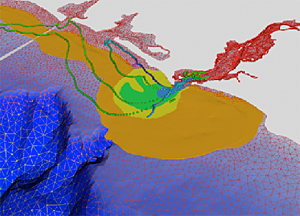 The Columbia River watershed extends across seven states in the United States and two provinces in Canada, and contributes about 70% of the freshwater input to the Pacific Ocean between San Francisco and Juan de Fuca (Barnes et al. 1972). Big decisions are needed to determine policy about the hydroelectric dams, protection and regulation of the migratory salmon, and changes in water quality such as ocean-driven estuarine hypoxia and acidification. All of this is set in the context of continued population growth, economic development and climatic change-and amidst a complex regulatory environment that includes the Endangered Species Act, a federal treaty between the U.S government and Native American tribes, and a soon-to-be renegotiated treaty between the U.S. and Canada.
CMOP science has already led to the identification of previously unrecognized environmental issues, from a benign but ecologically relevant seasonal red water bloom in the Columbia River estuary (Hertfort et aI. 2012) to the development of seasonal and severe ocean-driven estuarine hypoxia (Roegner et al. 2011) and potential acidification- and is showing how those apparently distinct processes are tied together. CMOP science is also contributing to an understanding of anthropogenic and climatic changes to estuarine and ocean processes, which affect salmon habitat and life cycle.
THE CMOP EDUCATIONAL PATHWAY
Progress towards our scientific goals has opened exciting opportunities to entrain a new and diverse workforce in coastal margin science. CMOP offers an educational pathway that includes a broad range of age-appropriate activities for students and teachers. Our pathway includes short courses; camps; sustained professional development programs for teachers; curricula for high school classes; individualized research experiences through high school, undergraduate and teacher internships; interdisciplinary graduate curricula through Oregon Health & Science University (OHSU) and affiliated degree programs at partner universities; and lifelong opportunities for scientists and natural resources professionals to incorporate outcomes of CMOP science in their activities and decision-making processes (Figure 2).
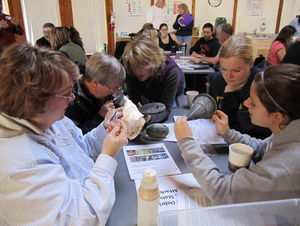
From left, Sam Case third-grade teacher Fanny Drews, Newport Intermediate fifth-grade teacher Christie Walker, Taft Elementary fifth-grade teacher Valerie Baker and sixth-grade teachers Beth Parsons and Kara Allen identify microbes that live on marine debris. Photo courtesy of NewsGuard of Lincoln County, Oregon.
Teachers and informal educators engage with CMOP in a variety of ways. Teachers access data through user-friendly modules that can be used to plot time series and explore correlations between estuary variables. As an example, teachers could design an experiment that demonstrates how red water blooms influence dissolved oxygen levels, using CMOP’s models to explore various scenarios. CMOP offers a regularly updated activity archive on the CMOP website (Science Activities and Curriculum URL). Lessons are designed for adaptability between age groups and data are appropriate for math, science, and social science classrooms. These lesson plans align with the essential principles of Ocean Literacy and the Next Generation Science Standards (Ocean Literacy Guide URL) and were generated through an interactive teacher professional development workshop. Teachers can engage in individualized internships of their own, conducting original research within CMOP teams and incorporating their experiences into their classroom curricula.
A three-year collaboration of the Oregon Coast Aquatic and Marine Partnership (OCAMP) consisting of CMOP, the Lincoln County School District, Hatfield Marine Science Center, Oregon Sea Grant, Oregon Department of Fish and Wildlife/Oregon Hatchery Research Center, the Oregon Coast Aquarium, and the Bureau of Land Management’s Yaquina Head Outstanding Natural Area aimed to provide teachers with the tools needed to carry out meaningful field experiences and inquiry driven learning while improving ocean literacy during sustained, year-round professional development colloquia as well as summer workshops. A follow-up program, entitled the Oregon Coast Regional STEM Center, extended OCAMP’s partnership to include Tillamook School District, Western Oregon University, and a variety of local businesses and agencies, and seeks to support teachers in their use of problem-based learning to improve student outcomes in STEM disciplines through engagement and the incorporation of 2lst century skills. The latter program is being carried out in a blended model of professional development, with in-person and web-based activities. CMOP can also engage with an entire school community through the CMOP- School Collaboratories (CSC) program. Cohorts of teachers from CSC partner schools can engage with CMOP to develop an integrated curriculum that emphasizes an inter-connected environment (Hugo et al. 2013).
THE VALUE OF A SCIENCE AND TECHNOLOGY CENTER
 The structure of the National Science Foundation Science and Technology Center program (NSF STC) has greatly enabled the development of this educational pathway through the decade-long investment in exploratory yet rigorous, potentially transformative science. lt is this structure that allows CMOP to expose students to a multi-disciplinary approach, engaging scientists from a broad range of relevant fields and from several collaborating universities, as well as practitioners from many state, federal and tribal agencies and from industry. The longevity of the STC investment has also contributed to our ability to effectively engage in sustained efforts to broaden participation among Native American, Alaska Native (Bueno Watts and Smythe 2015) and other groups underrepresented in Science, Technology, Engineering and Math (STEM) disciplines.
The synergy among anchoring academic partners (OHSU, Oregon State University and University of Washington, in the case of CMOP) is critically important to the success of a STC. Also critical is the engagement of regional stakeholders, which offer a natural, realistic, enriching and often pressing context for our science and education programs. For instance, Native American tribes of the Columbia River have historically been active and effective stewards of the land, water and natural resources in the basin. The Columbia River lnter-Tribal Fish Commission (CRITFC) has partnered with CMOP to identify potential threats to salmon and lamprey through investigation of factors that influence habitat quality. This collaboration has effectively engaged several Native American students in the CMOP education pathway and has also educated non-Native students on tribal cultures and natural resource management strategies.
DEVELOPING THE COASTAL MARGIN WORKFORCE
 CMOP students are engaged at all levels of the collaboratory. They participate in the development of sensors and models, and take active part in oceanographic cruises that might range from research to mariner-training vessels, autonomous underwater vehicles (Figure 3) and even kayaks (Rathmell et al. 2013). CMOP students, from high school to graduate, conduct research projects that relate to important biological hotspots, attempting holistic descriptions of their underlying physics and biogeochemistry that cover gene-to-climate scales. Students learn, shoulder-to-shoulder with researchers and practitioners, how to characterize, predict and inter-relate processes driving estuarine hypoxia and acidification. plankton blooms, and the biogeochemistry of lateral bays and of estuarine turbidity maxima (ETM)-turbid water regions located at the heads of coastal plain estuaries near the freshwater/saltwater interface. CMOP students also gain an understanding of broad topics that provide context to CMOP research science initiatives, such as global nutrient cycles, climate change, managing natural resources, mitigating natural hazards, and protecting fragile ecosystems.
Within the curriculum or with their mentor teams, students conduct fieldwork in the Columbia River estuary and in the coastal waters of Oregon and Washington using a variety of approaches, ranging from simple  river-front water sampling from a dock to participation in major research campaigns aboard University-National Oceanographic Laboratory System (UNOLS) vessels. Students gain hands-on experience within laboratories, using state-of-the-art equipment such as imaging flow cytometers (FlowCAM), an Environmental Sample Processor (ESP), a Conductivity, Temperature, and Depth Sensor (CTD), or a Scanning Electron Microscope. Students also gain exposure to the “Virtual Columbia River,” a data-rich simulation environment that offers multiple representations of circulation and ecological processes, including their variability and change across river-to-shelf scales (Virtual Columbia River URL). The models that form the Virtual Columbia River simulate estuarine conditions, enabling predictions of changing physical properties (tides, currents, salinity and temperature) and biogeochemical cycles (e.g., nitrogen and carbon) important to ecosystem management. Comparisons between field observations and model simulations allow for continued learning and refinement of the process.
INCORPORATING CMOP SCIENCE INTO THE CLASSROOM
 Curricula available on the CMOP website combine elements of coastal oceanography, environmental microbiology, biogeochemistry, computational sciences, and information technology. Student participants in K-12 activities have continued working with CMOP, ‘graduating” to more sophisticated, longer-term participation as undergraduate interns. Likewise, undergraduate interns have continued their research by matriculating into the CMOP-affiliated M.S./Ph.D. Environmental Science and Engineering degree program offered through the lnstitute of Environmental Health (IEH) at OHSU. IEH graduates have gone on to related careers in academia, private research, and with related federal and state agencies. To date, CMOP has served over 800 K-l2 students, over 70 teachers, over 100 undergraduate students, and has graduated 28 M.S. and Ph.D. students. CMOP students have graduated from the Environmental Science and Engineering Program at Oregon Health & Science University; the Ocean, Earth and Atmospheric Sciences Program at Oregon State University; the Computer Science program at Portland State University; the Marine Estuarine Environmental Sciences program at the University of Maryland; the Computer Science program at the University of Utah; the Physical Oceanography Program and the Biological Oceanography Program at the University of Washington. Students who have engaged in the CMOP Education “pathway” have become citizen scientists with a nuanced knowledge of coastal-margin science issues, and many have gained expertise and skills that have enabled them to contribute to a growing professional workforce in coastal margin science.
For middle- and high-school students, CMOP offers classes. day-camps and high-school internships in partnership with Saturday Academy, a non-profit organization dedicated to providing hands-on, in-depth learning and problem-solving activities. Past topics have included microbiology, marine biology, oceanography, and ocean technology. The curriculum is designed to enable students to easily identify the importance of coastal-margin related issues to their own academic interests and personal lives.
Undergraduate interns join CMOP mentor teams, which include a “Frontline Mentor” and a “senior Scientist.” The Frontline Mentor-typically a graduate student, staff member or post-doctoral fellow-establishes a project relevant to one or more CMOP research initiative. The Senior Scientist mentor provides guidance and ensures academic caliber. Over the course of the ten-week program, interns gain autonomy within their mentor teams as they gain contextual knowledge and skills. lnterns regularly interact with each other and with other CMOP participants through professional development seminars encompassing scientific themes, career opportunities and scientific ethics. lnterns visit sites along the river from Bonneville Dam to downtown Portland and to the mouth of the Columbia River estuary, to gain a first-hand understanding and appreciation of the complex interactions of biological, chemical, and physical processes. lnterns document their work through a daily lab notebook, a weekly blog (Undergraduate lnternships URL), a final presentation and a synthesizing paper. lntern research projects have been thoroughly incorporated into CMOP research; interns have co-authored CMOP publications in peer-reviewed journals (Publications URL) and have presented at national and international conferences (Presentations URL).
ASSESSING IMPACT
The CMOP Education program seeks to make full use of the resources available to this NSF STC to enable a wide range of teachers, students, and other users to learn more about and contribute to place-based knowledge of coastal margins. The University of Washington’s Office of Educational Assessment regularly evaluates the effectiveness of our program. Evaluations include surveys and focus groups with each participant cohort as well as follow-up surveys for longitudinal data. Data analyses demonstrate that high school and undergraduate participants in CMOP programs have increased interest in STEM education; increased confidence in their ability to engage in STEM research; enhanced relevant technical and professional skills, and, for undergraduate students, clarified research foci both within their degree programs and related to their decision of graduate programs. Eighty-seven percent of undergraduate survey respondents who obtained bachelor degrees went on to matriculate into STEM graduate programs, 4O% in fields related to their internships. All of these graduates agreed or strongly agreed that “Being part of the [CMOP] summer internship strengthened my application to this graduate degree program.”
ACKNOWLEDGEMENTS
CMOP is primarily supported by the National Science Foundation, through cooperative agreement OCE-O4246O2. Crant CEO-I034611 extended our CSC program to Native Alaskans.
REFERENCES
Baptista, A., Howe, B., Freire, J., Maier, D., & Silva, C. T. (2008).
Scientific exploration in the era of ocean observatories. Computing in Science & Engineering, l0 (3),53-58.
Barnes, C. A., Duxbury, A. C., and Morse, B. (1972). Circulation and selected properties of the Columbia River effluent at sea. ln: The Columbio River Estuory and Adjocent Oceon Woters: Bioenvironmental Studies, edited by A.T. Pruter and D.L. Alverson. Seattle: University of Washington Press, pp. 71-80.
Bueno Watts, N. & Smythe, W F. (2013). It takes a community to raise a scientist:A case for community-inspired research and science education in an Alaska Native community. Current: The Journal of Morine Educotion 2B(3).
Frontier Economics Limited. (2012). Exploring the links between woter ond economic growth: A report prepared for HSBC. London, England: Frontier Economics Limited.
Herfort, 1., Peterson, T. D., Prahl, F. C., McCue, L. A., Needoba, J. A., Crump, B. C., Roegner, C. C., Campbell, V., & Zuber, P. QO12). Red waters of Myrionecto rubrq are biogeochemical hotspots for the Columbia River estuary with impacts on primary/secondary productions and nutrient cycles. Estuories ond Coqsts,35 (3), B7B-891.
Hugo, R., Smythe, W., McAllister, S., Young, B., Maring, B. & Baptista, A. (2013). Lessons learned from a K-’12 geoscience education program in an Alaska Native community. Journal of Sustainability Education,5 (SSN 2-51:7452).
Ocean Literacy Cuide URL http:,/www.coexploration.orgl ocean literacy/documents/Ocea n LitC u ide_LettersizeV2.pdf
Presentations URL http://www.stccmop.orglknowledge_transfer/presentations
Publications URL http://www.stccmop.orglpublications
Rathmell, K., Wilkin, M., Welle, P., Mattson, T., & Baptista, A. (2015). A very smart kayak. Current: The Journal of Marine Education QB)3.
Roegner, C. C., Needoba, J. A., & Baptista, A. (20I). Coastal upwelling supplies oxygen-depleted water to the Columbia River estuary. PLoS ONE, 6 @), e18672.
doi:1O.137 1 /journal.pone.00l 8672
Science Activities and Curriculum URL http://www.stccmop.org/education/teacher/activityarchive
Undergraduate lnternships URL http://www.stccmop.org/education/undergraduate
Virtual Columbia River URL http://www.stccmop.org/datamart/virtualcolumbiariver
AUTHORS
Vanessa L. Green M.S. serves as Director of Student Development and Diversity at the NSF Science and Technology Center for Coastal Margin Observation and Prediction. Having earned a M.S. in Higher Education Administration she has focused her career on broadening participation and increasing engagement, persistence and retention among first-generation and underrepresented students in high school, undergraduate and graduate programs. She served as a founding faculty member and Dean of Students at the King George School in Vermont and served as a member of the Board of Trustees at Marlboro College. She currently serves on the Education and Outreach Steering Committee for the Center for Dark Energy Biosphere lnvestigations (C-DEBI).
Nievita Bueno Watts Ph.D. is a geotogist, science educator and Director of Academic Programs at the NSF Science and Technology Center for Coastal Margin Observation & Prediction. She conducts research on broadening the participation of underrepresented minorities in the sciences and serves on the Board of Directors of the Geoscience Alliance, a national organization dedicated to building pathways for Native American participation in the geosciences.
Karen Wegner MSW was rhe first Director for K-12 Education for the NSF Science and Technology Center for Coastal Margin Observation & Prediction. She brought years of experience as a wildlife biologist and environmental educator to CMOP. Along with education partners Saturday Academy and the SMILE Program she developed K-12 programs initially offered at CMOP. She credits the success of the K-12 program to the fantastic support offered by CMOP researches and students. Karen is now a Palliative Care Social Worker and Program Manager in Montana.
Michael Thompson Ph.D. is the Education and Outreach Coordinator at the NSF Science ahd Technology Center for Coastal Margin and Observation. He has an M.S. in Biochemistry and a PhD in Chemical Education with a focus in Engineering Education. He has been instrumental in the establishment of the EPICS High-school program, development and implementation of teacher training workshops, STEM learning communities for undergraduates, and service-learning experiences for high-school and undergraduate students.
Amy F. Johnson M.S, serves as the Managing Director for the NSF Science and Technology Center for Coastal Margin Observation and Prediction. Having earned an M.S. in Management in Science and Technology, she has years of experience managing in science and technology companies and education institutions. Prior to joining CMOP she was the Assistant Dean for Craduate Education at the OCI School of Science & Engineering at the Oregon Health & Science University.
Tawnya D. Peterson Ph.D. is an Assistant Professor in the Institute of Environmental Health at Oregon Health & Science University. She holds a Ph.D. in Biological Oceanography and carries out research that seeks to identify the factors that shape planktonic community diversity and function in aquatic systems. ln addition to scientific research, she is interested in the development and implementation of professional development programs for K-l2 teachers.
Antonio M. Baptista Ph.D. is a professor and director of the lnstitute of Environmental Health, Oregon Health & Science University and the director of the NSF Science and Technology Center for Coastal Margin Observation & Prediction. He has 25 years of experience in team science and graduate-level teaching, and uses leading edge coastal-margin science and technology as a catalyst for informed management decisions, workforce development and broadening participation.
PHOTO CREDITS
All Photos: Courtesy of CMOP staff member Jeff Schilling
Reprinted from Current, the Journal of the National Marine Education Association


