by editor | Sep 18, 2025 | Adventure Learning, Conservation & Sustainability, Critical Thinking, Data Collection, Environmental Literacy, Experiential Learning, Forest Education, Inquiry, Student research, Sustainability, Teaching Science
Expeditionary Learning: Exploring Healthy Forests
By Val McKern and Greg Goodnight
What is a healthy forest? That is the question that Kettle Falls Elementary School fourth graders have been grappling with all winter. In order to examine this question, fourth grade teachers Sally James, Sydney Potestio and Judy Galli have designed an expedition with carefully scaffolded projects for their students. Through these in-depth, service-learning projects, students have been engaged in reading, writing, math, science, social studies and technology. In Kettle Falls we firmly believe that it takes a village to educate a child and we count on a cross curricular approach of teachers and many experts to make any expedition a success for our students. Our priority is creating engaging expeditions that have rigorous learning for ALL students.
Kettle Falls Elementary: an expeditionary learning school
An expedition is the format Kettle Falls Elementary uses to combine adventure and service with learning state standards. Each expedition has standards strategically embedded in fieldwork. The healthy forest expedition will combine many “I can” learning targets based on state standards, with snowshoeing, animal tracking, trail cameras and forestry. In the end, students will deliver PowerPoint presentations to the North East Washington Forestry Coalition (NEWFC) as an authentic audience for their service learning work product. The expedition will provide an exciting and adventurous outlet for student learning and assessments on rigorous state standards. As an Expeditionary Learning School, Kettle Falls Elementary believes that expeditions are the primary way of organizing curriculum.
The subject matter of a learning expedition is a compelling topic derived from content standards. Expeditions feature linked projects that require students to construct deep understandings and skill and to create products for real audiences. Learning Expeditions support critical literacy, character development, create a sense of adventure, spark curiosity and foster an ethic of service. They allow for and encourage the authentic integration of disciplines. (Expeditionary Learning Schools Core Practice Benchmarks p.8.)
 This learning expedition began as all expeditions begin at Kettle Falls Elementary. The staff went through a careful study of the new Washington State standards and determined the “priority standards” at each grade level. The standards are then written as long-term learning targets. Once these standards were determined, teams researched case studies that could become the focus of the learning expeditions. The life science standards addressed focused on life cycles, animal structures and behaviors, food webs, ecosystems and human impacts as the center of the expedition.
Literacy is embedded with in the expedition. Priority learning targets are written based on the standards of reading and writing. Reading comprehension strategies and the traits of writing are the focus of these targets. A content map is designed that assigns long term learning targets to each of three expeditions through out the school year. Each expedition runs for eight to twelve weeks.
Learning targets are at the heart of our work. There is clear criteria for posting and referencing learning targets school-wide. Long- term targets, project targets, and scaffolding steps are organized so that students can track their achievement during the daily debrief. We emphasize “learning together, but assessing independently.” Anchor charts that hold the thinking of the class are posted near the targets. The anchor charts will collect information that makes the learning target clear, whether it is knowledge or meta-cognitive thinking. All students are independently assessed on all learning targets.
Kettle Falls Elementary as a 21st Century School
Expeditionary Learning Schools set an expectation for service and authentic work. Kettle Falls Elementary teachers create expeditions that foster service in authentic ways.
Benchmark 3: B. Authentic Audiences
1. Products often meet an authentic need and have an audience and purpose beyond families or the classroom teacher.
2. Some of the products are particularly motivating because in themselves they are acts of service.
(Expeditionary Learning Schools Core Practice Benchmarks p.13.)
We are a Learn and Serve Grant recipient, which has helped us focus on the service aspect of our expeditions. This grant gave teachers release time to write rigorous expeditions and make the community contacts necessary for authentic service. It also supported the expedition through fieldwork and materials for a new expedition.
We knew that this expedition was an outstanding opportunity to educate our students in sustainable education. It meets many of Jaimie P. Cloud’s EfS Frameworks:
Responsible Local/Global Citizenship — The rights, responsibilities, and actions associated with leadership and participation toward healthy and sustainable communities. Students will know and understand these rights and responsibilities and assume their roles of leadership and participation.
Healthy Commons — That upon which we all depend and for which we are all responsible. Students will be able to recognize and value the vital importance of the Commons in our lives, their communities, and the places in which they live.
Multiple Perspectives — The perspectives, life experiences, and cultures of others, as well as our own. Student will know, understand, value and draw from multiple perspectives to co-create with divers stakeholders shared and evolving visions and actions in the service of a healthy and sustainable future locally and globally.
A Sense of Place — The strong connection to the place in which one lives. Students will recognize and value the interrelation- ships between the social, ecological and architectural history of that place and contribute to its continuous health. (Cloud, p. 172-173.)
The North East Washington Forestry Coalition (NEWFC) agreed to partner with Kettle Falls Elementary School. This expedition reaches each of these components of Cloud’s framework. It is the basis of an expedition with an authentic purpose, service, purposeful fieldwork, multiple perspectives and rigorous content.
 Kettle Falls Elementary Bangs monitoring project
Three KFE classes will be engaged in a hands- on learning experience that includes in-class preparation and learning and fieldwork designed to teach them about the life cycles of natural systems, sustainable resource management, and community collaboration. The project will include wildlife, tree, and plant monitoring within the Bangs Mountain Wildland Urban Interface project on the Colville National Forest, as well as presentations and instruction from school and community experts in the field and in the classroom, including members of the Northeast Washington Forestry Coalition. The students will work with the Coalition to complete a final report in the form of a PowerPoint presentation, documenting their monitoring work and educational experience with photos and written reporting. The final report may be posted on the Coalition’s web site, and a final press release may be prepared for local newspapers to share the outcome of the project with the broader community. Derrick Knowles, Education Outreach, NEWFC.
NEWFC is a local organization that believes in demonstrating the full potential of restoration forestry to enhance healthy forests, public safety, and community economic vitality. Because Kettle Falls is community that relies on the timber industry to survive, we wanted to create an expedition that would have many viewpoints. We felt that NEWFC would have the multiple perspectives within the organization that would make our study to compelling to students and community members, since NEWFC is comprised of members who come from the timber industry to those in Conservation Northwest. Our students are seeing that there is not one “right” answer to their question of “What makes a healthy forest?”
Kettle Falls Elementary fourth grade expedition: the stories tracks tell
Case Study One: Indicator Species of Bangs Mountain
Our Learn and Serve Grant gave a team of six staff members the opportunity to participate in a SEA (Service, Education and Adventure) training this fall. This adventure included learning to track with Tom Murphy of Edmonds Community College and the LEAF (Learn-n-serve Environmental Anthropology Field) school. This so engaged the teachers that we were determined to give our students the same opportunity. Murphy was able to create an alterna- tive winter course that brought 12 college students to Kettle Falls for a week. During that time, the LEAF school taught the students how to recognize tracks and gaits of our local animals. The focus was on five animals: whitetail deer, turkey, snowshoe hare, lynx and coyote. These animals were chosen with help from the Forest Service because of their status as indicator species for the Bang’s Mountain area. Students spent time in the forest that week, learning to track, photograph tracks, and measure tracks. They also learned to set trail cameras along trails in order to capture photos of the elusive animals.
Students from Kettle Falls High School Wildlife class with teacher Jono Esvelt participated in each of these activities sup porting the fourth graders throughout this expedition. They also took on the task of writing “field guides” for the fourth graders to use in their work.
This project focused on the learning targets of
- I can independently sort animals by the structures and behaviors that help them survive in their environment.
- I can independently list 4 parts of an animal and describe how the parts help the animal meet its basic needs.
- I can independently generalize from multiple forms of text to learn about forest animals.
- I can independently elaborate using details and/or examples about one forest animal.
- I can edit for capitals against the class capitalization chart.
Students learned about each animal through predicting structures and behaviors by analyzing a collage of photos and You Tube videos. Predictions were recorded before reading field guides and predictions were confirmed or not. Once the recording sheets were completed, the students wrote expository papers on the survival structures and behaviors of each animal. These were combined to create PowerPoint slides that will be included in their final product, some with actual photos of the tracks or animals that were photographed at the Bangs Mountain site. The good news was that some animals were captured by the trail cams, but some remained elusive!
Case Study Two: Food Webs of Bangs Mountain
This project really focused on the interdependences within the forest ecosystem. Learning targets in this investigation focused on giving students the knowledge to be able to complete the narrative prompt:
You are a wildlife biologist researching animals on Bangs Mountain. One of your jobs is to report to the community of Kettle Falls the stories the animal tracks of an indicator species told you while doing your fieldwork. To do this you will need to describe where the tracks were found and your inferences of what the tracks are telling you about that animal’s daily life:
- I can describe the interdependences in a forest ecosystem.
- I can explain how a forest ecosystem impacts animal population.
- I can independently generalize from multiple forms of text to learn about forest ecosystems.
- I can write a narrative with a clear beginning, two events and a clear ending.
In order to make this narrative realistic students needed to understand the actual role of a wildlife biologist. Learning about careers while in engaging expeditions opens our students’ eyes to the world of possibilities. Students continued their fieldwork, checking their trail cams, snag counts (their first monitoring experience), searching for tracks and other sign of life in their plots and were prepared for snowshoeing (though there simply wasn’t enough snow for them this year). Using the reading skill of “generalizing to understand” helped student comprehend the interdependence of the forest and was built through reading, photography, experts, media, data and many simulation games. After each activity students recorded “new learning” on anchor charts that build the content schema. They also recorded their use of the skill “generalizing” on anchor charts to show their ability to be meta-cognitive about comprehending new material. Students were able to use the information gathered from the multiple sources to write their narrative.
Case Study Three: Bangs Mountain as a Changing Ecosystem
Now that the students have developed a level of knowledge about the interdependence of forests they are ready to move on to the changing ecosystem. This is when they really become experts and begin to look at the many stakeholders of the forest. Their fieldwork becomes very data based. Through skill building in P.E. they learn about pacing. Each child is responsible for pacing off 104 feet, using a compass to keep their lines straight, they determine a half acre plot for their team. They use a tape to measure their accuracy after pacing and the corners are marked on the GPS so that their plot can be found on Google Earth. Students are now collecting data on the canopy by measuring open and covered areas. They have learned to use transect lines during their monitoring. This data is part of the baseline that will be used in the study. They identified three plants in the understory and did a plant count of their plot. Their study of the animals in their plot also continued, with data from tracks and trail cam photos. The most common track and photo taken was squirrels, though they are not one of the indicator species. Students found little evidence of the lynx at their plot. Animal population changes will be one indicator of increased health of the forest over time.
During this project students learned about many changes that can happen to forests over time. The learning targets for this project are:
- I can independently describe how onepopulation may affect other plants and/or animals in the forest ecosystem.
- I can independently evaluate one population in different forests, determine which will thrive and give clear reasons.
- I can independently describe three ways that humans can improve the health of the forest ecosystem.
- I can independently assess the author’s effectiveness for a chosen audience.
- I can independently organize my writing.
This means:
- I will write an introduction, supporting details using examples, and conclusion in an expository writing.
Each day of this project focuses on a change in the forest ecosystem. Some are changes that have taken place at the Bangs Mountain Project and some are changes that could eventually happen. All students receive the same reading each day, but they read the articles for a different purpose: natural or man-made changes, population changes, or gradual or rapid changes. Each student becomes an “expert” on their article. The students then “jigsaw” their articles once they have recorded the important information. The student experts then share out in small groups, creating a real need for students to comprehend and analyze their text. Special Education and Title I students are pre-loaded with vocabulary and content before the article increasing their ability to fully participate while in class. Once the information has been analyzed students come together to complete anchor charts where they record the changes and determine if human impact was positive or negative. They also determine the author’s purpose and if the author was successful in delivering their message.
By the end of this case study they have a thorough understanding of thinning, prescription fires, recreation management, forest flu and other healthy management issues.
We believe that reading is only one vehicle to understanding new ideas. Fieldwork, media and experts are also key components to creating powerful learning tools. Experts from the timber industry, Forest Service, Conservation NorthWest, and Department of Fish and Wildlife have all volunteered to work with our students, ensuring that students are learning realworld applications of the knowledge. Each of these experts will not only share their expertise on managing forests and their per- sonal perspectives of what makes a healthy forest, but also about their careers.
The students will complete this project with a simulation from Project Learning Tree, “The 400 Acre Wood.” Students will determine the actions taken to manage a forest much like their plots on the Bangs Mountain Project. This project has a balance of Vibrant Economy, Healthy Environment, and Equitable Society, as recommended by The Sustainable Design Project Teacher Manual. (Wheeler, Bergsman, Thumlert 2008.)
 The Final Presentation of “What is a Healthy Forest?”
The final project is a culmination of all of the data that the students have collected while completing this project. Data is compiled in a variety of ways. The ani- mal monitoring is a graph of the sightings caught on the trail cams, the plant monitor- ing is a graph as well, both done on Excel. The canopy is drafted on graph paper, indicating the cover and open space. There is also the map from Google Earth, indicating each plot for future reference and to gauge changes over time. This work is gathered in a Power Point to be presented to NEWFC at a future meeting.
Kettle Falls Elementary: expeditionary learning and 21st century intertwined
Our students had the opportunity to become engaged in their local forest, gathering a respect for the land, observing the interdependence and understanding the decisions made by others that use our forests. Students were able to meet rigorous learning targets and assessed independently on each target. They collaborated to create authentic projects that reach beyond their school walls.
The expedition included many different modes of learning during this project that are key to Heidi Hayes Jacobs’ Tenets for Purposeful Debate leading to Content Upgrades:
- • A personal and local perspective is developed and presented in the content area, where natural and viable.
- • The whole child’s academic, emotional, physical and mental development is thoughtfully considered in content choices.
- • The possibilities for future career and work options are developed with an eye to creative an imaginative directions.
- • The disciplines are viewed dynamically and rigorously as growing and integrat- ing in real-world practice.
- • Technology and media are used to expand possible sources of content so that active as well as static materials are included. (Jacobs p 31).
Through compelling expeditions students at KFES achieve many 21st century outcomes. Students build strong habits of work, through both performance (traits that enable students to perform to their potential) and personal relationships (traits that enable students to be good people and community members). They are motivated to learn. Students believe that they have the ability to meet their targets, have clear targets that they can self-assess their progress against, and are connected to their school through the work they do. We believe that academic achievement is increased when students are engaged in learning. Through authentic expeditions like “The Stories Tracks Tell” students build life and career skills. Real world problems increase students’ critical thinking and problem solving skills. The use of technology opens the classroom to wider world, with meaningful examples of the work our students are doing. Our students increase their understanding of 21st century themes such as environmental literacy. (Hulleman, Hartl & Ciani 2009). Through compelling expeditions our students are engaged, supported and held accountable to high standards.
References
Hulleman, C., Hartl, S., & Ciani, K. (2009). Character, Motivation, and Engagement in Expeditionary Learning Schools, Review of the Relevant Literature and Available Measurement Instruments. Nellie May Education Foundation. Expeditionary Learning Core Practice Benchmarks (2003). Garrison, NY: Expeditionary Learning Outward Bound.
Jacobs, H. H. (2010). Curriculum 21: Essential Education for a Changing World. Alexandria, VA: ASCD.
Wheeler, G., Bergsman, K., and Thumlert, C. (2008). Sustainable Design Project Teacher Manual. Olympia, WA: Office of the Superintendent of Public Instruction.
Greg Goodnight is superintendent at Kettle Falls School District.
Valerie McKern is principal at Kettle Falls Elementary.

by editor | Sep 7, 2025 | Conservation & Sustainability, Critical Thinking, Environmental Literacy, Experiential Learning, Learning Theory, Questioning strategies, Service learning, Sustainability
Empowering Elementary Students through Environmental Service-Learning
by Eileen Merritt, Tracy Harkins and Sara Rimm-Kaufman
“We use electricity when we don’t need to.”
“When we use electricity we use fossil fuels and fossil fuels pollute the air and fossil fuels are nonrenewable.”
“We use too many non-renewable resources to make energy.”
“One problem that we have with the way that we use energy is that we often taken it for granted, leaving lights on when it’s unnecessary, and plugging in chargers without using them.”
“We are literally putting pollution on the blanket of the earth!?”
The problems listed above were identified by fourth grade students in the midst of an environmental service-learning unit. These powerful words, and many similar ideas shared with us by other fourth grade children, show that children care a lot about our planet. They notice when we waste resources, pollute our air, water or land, or cause harm to other living things. Their concerns must be heard, to motivate others to confront the environmental crises that we are facing today. Greta Thunberg has recently demonstrated how powerful one young voice can be, mobilizing people around the world to take action on climate change.
How can educators help students develop skills to be change agents, offering creative and feasible solutions to problems they see around them? Service-learning is one powerful way to build students’ knowledge and skills as they learn about issues that matter to them. Recently, we worked with a group of urban public school teachers to support implementation of environmental service-learning projects in their classrooms. In environmental service-learning, students apply academic knowledge and skills as they work together to address environmental problems. High quality service-learning, according to the National Youth Leadership Council (NYLC), provides opportunities for students to have a strong voice in planning, implementing and evaluating projects with guidance from adults and engages students in meaningful and personally relevant service activities that address content standards (NYLC, 2008). We designed Connect Science, a curriculum and professional development program, with these goals in mind (Harkins, Merritt, Rimm-Kaufman, Hunt & Bowers, 2019). As we have analyzed student data from this research study, we have been inspired by the strength of conviction that students conveyed when they spoke about the environment and the creative solutions they generated for problems they noticed. In this article, we describe key elements of lessons that fostered student agency (see Table 1). First, two vignettes below exemplify service-learning projects from two classrooms.
 In another classroom, students launched a campaign to reduce the use of disposable plastic containers at their school. They made posters to educate others about single-use plastics, explaining how they were made from petroleum (see Figure 1). Students and teachers in their school were encouraged to take a pledge to use reusable water bottles, containers and utensils in their lunches. Sign-up sheets were placed near posters around the school. Several hundred people took the pledge.
What both groups have in common is that they participated in a science unit about energy and natural resources. In the first part of the unit, they discovered problems as they learned about different energy sources and how these energy sources produce electricity. They began to recognize that fossil fuels that are used for transportation, electricity production and plastic products, and that their use causes some problems. This awareness motivated them to take action. Later in the unit, each class honed in on a specific problem that they cared about and chose a solution. Below, we summarize steps taken throughout the unit that empowered students.
1 Choose an environmental topic and help students build knowledge
Students need time to develop a deep understanding of the content and issues before they choose a problem and solution. Many topics are a good fit for environmental service-learning. Just identify an environmental topic in your curriculum. Our unit centered around NGSS core idea ESS3A: How do humans depend on earth’s resources? (National Research Council, 2012). Students participated in a series of lessons designed to help them understand energy concepts and discover resource-related problems. These lessons can be found on our project website: connectscience.org/lessons. Fourth grade students are capable of understanding how the energy and products they use impact the planet (Merritt, Bowers & Rimm-Kaufman, 2019), so why not harness their energy for the greater good?
There are many other science concepts from NGSS that can be addressed through environmental service-learning. For example, LS4.D is about biodiversity and humans, and focuses on the central questions: What is biodiversity, how do humans affect it, and how does it affect humans? Environmental service-learning can be used to address College, Career and Civic Life (C3) standards from dimension 4, taking informed action such as D4.7 (grades 3-5): Explain different strategies and approaches students and others could take in working alone and together to address local, regional, and global problems, and predict some possible results of their actions (National Council for the Social Studies, 2013). Language arts and mathematics standards can also be taught and applied within a service-learning unit.

2 Generate a list of related problems that matter to students
Partway through the unit, each class started a list of problems to consider for further investigation. Collecting or listing problems that kids care about is an effective way to get a pulse on what matters to students. Fourth graders’ concerns fit into three broad categories:
• Pollution (air, water or land)
People need to stop littering. Before you even throw everything on the floor, think about it in your head… should I recycle, reuse? I can probably reuse this…
• Not causing harm to people, animals or the environment
Plastic bags suffocate animals.
• Wasting resources (e.g. electricity, natural resources or money)
If people waste energy, then their bill will get high and it will just be a waste of money.
Co-creating a visible list for students to see and think about legitimizes their concerns and may help them develop a sense of urgency to take action.
3 Collectively identify an important problem
The next step was for students to choose ONE problem for the upcoming service-learning project. Each teacher read the list of problems aloud, and students could cast three votes for the problems that they cared about the most. They could cast all 3 votes for one problem, or distribute their votes. Most teachers used this process to narrow in on one problem for their class to address. One teacher took it a step further by allowing small groups to work on different problems. Either way, allowing students to CHOOSE the problem they want to work on fueled their motivation for later work on solutions. Different classes honed in on problems such as wasting electricity, single-use plastics, foods being transported a long distance when they could be grown locally, and lack of recycling in their communities.
4 Explore possible solutions and teach decision-making skills
Students were introduced to three different ways that citizens can take action and create change. They can work directly on a problem, educate others in the community about the issue or work to influence decision-makers on policy to address the problem. They broadened their perspective on civic engagement as they brainstormed solution ideas in each of these categories. After deciding to work on the problem of lights left on when not in use, one class generated the following list of possibilities for further investigation (see Figure 2)
 After considering ways to have an impact, students were ready to narrow in on a solution. Teachers introduced students to three criteria for a good solution. This critical step provides students with decision-making skills, and helps them take ownership of their solution. Our fourth graders considered the following guiding questions in a decision-making matrix:
- Is the solution going to have a positive impact on our problem?
- Is the solution feasible?
- Do you care a lot about this? (Is it important to the group?)
At times, this process prompted further research to help them really consider feasibility. Of course, teachers needed to weigh in too, since ultimately they were responsible for supporting students as they enact solutions. When discussing impact, it’s important to help students understand that they don’t have to SOLVE the problem—the goal is to make progress or have an impact, however small.
While many groups chose the same problem, each class designed their own unique solution. Most focused on educating others about the topic that mattered to them, using a variety of methods: videos, posters, announcements, presentations to other students or administrators, and an energy fair for other members of the school community. The process of educating others about an issue can help consolidate learning (Hattie & Donoghue, 2016). Some groups took direct action in ways such as improving the school recycling program or getting others to pledge to use less electronics or less plastic (as described above). These direct actions are very concrete to upper elementary school children since impacts are often more visible.
5 Support students as they enact solutions
Social and emotional skills were addressed throughout the unit. During project implementation, teachers supported students as they applied those skills. Students developed self-management skills by listing tasks, preparing timelines and choosing roles to get the job done. At the end of the unit, students reflected on the impact that they made, and what they could do to have a larger impact. One group of students noticed that every single student in their class switched from plastic to reusable water bottles. Another student felt that their class had convinced people not to waste electricity. Some groups recognized that their solution wasn’t perfect, and wished they could have done more. For elementary students, it’s important to emphasize that any positive change makes a difference. Critical thinking skills develop when students can compare solutions and figure out which ones work the best and why. The instructional strategies described in this article have been used by educators across grade levels and subjects for other service-learning projects, and can be adapted for different purposes (KIDS Consortium, 2011).
Student-designed solutions yield deeper learning
One challenge that teachers faced when implementing environmental service-learning was that it took time to work on projects after the core disciplinary lessons, and curriculum maps often try to fast forward learning. Deeper learning occurred when teachers carved out time for service-learning projects, allowing students to apply what they know to a problem that mattered to them. There are always tradeoffs between breadth and depth, but ultimately students will remember lessons learned through experiences where they worked on a challenging problem and tried their own solution. School leaders can work with teachers to support them in finding time for deeper learning experiences. The students that we worked with cared a lot about protecting organisms and ecosystems, conserving resources and reducing pollution. They had many wonderful ideas for solutions that involved direct action, education or policy advocacy. For example, one student suggested the following solution for overuse of resources, “Go out and teach kids about animals losing homes and people polluting the world.” The voices of children around the country can be amplified through civic engagement initiatives such as environmental service-learning. Citizens of all ages are needed to actively engage in work toward solutions for climate change. Why not help them begin in elementary years?
References
Harkins, T., Merritt, E., Rimm-Kaufman, S.E., Hunt, A. & Bowers, N. (2019). Connect Science. Unpublished Manual. Charlottesville, Virginia: University of Virginia, Arizona State University & Harkins Consulting, LLC.
Hattie, J. A. & Donoghue, G. M. (2016). Learning strategies: A synthesis and conceptual model. Science of Learning, 1, 1-13.
KIDS Consortium. (2011). KIDS as planners: A guide to strengthening students, schools and communities through service-learning. Waldoboro, ME: KIDS Consortium.
Merritt, E., Bowers, N. & Rimm-Kaufman, S. (2019). Making connections: Elementary students’ ideas about electricity and energy resources. Renewable Energy, 138, 1078-1086.
National Council for the Social Studies (NCSS). (2013). The college, career, and civic life (C3) framework for social studies state standards: Guidance for enhancing the rigor of K-12 civics, economics, geography, and history. Silver Spring, Md.: NCSS. Accessible online at www.socialstudies.org/C3.
National Research Council. (2012). A framework for K-12 science education: Practices, crosscutting concepts and core ideas. Committee on a Conceptual Framework for New K-12 Science Education Standards. Board on Science Education, Division of Behavioral and Social Sciences and Education. Washington, DC: The National Academies Press.
National Youth Leadership Council. (2008). K-12 service-learning standards for quality practice. St. Paul, MN: NYLC.
Acknowledgements:
The research described in this article was funded by a grant from the Institute of Education Sciences, U.S. Department of Education (R305A150272). The opinions expressed are those of the authors and do not represent the views of the funding agency. We are grateful to the educators, students and colleagues who shared their ideas throughout the project.
 Eileen Merritt is a research scientist in the Department of Forest Resources and Environmental Conservation at Virginia Tech and former Assistant Professor in Teacher Preparation at Mary Lou Fulton Teachers College, Arizona State University. She developed her passion for environmental education along the banks of the Rivanna River with her students at Stone-Robinson Elementary. She can be reached at egmerritt@vt.edu.
Tracy Harkins, of Harkins Consulting LLC, works nationally guiding educational change. Tracy provides service-learning professional development and resources to educators to engage and motivate student learners. https://www.harkinsconsultingllc.com/
Sara E. Rimm-Kaufman is a Professor of Education in Educational Psychology – Applied Developmental Science at the Curry School of Education at the University of Virginia. She conducts research on social and emotional learning in elementary and middle school classrooms to provide roadmaps for administrators and teachers making decisions for children.

by editor | Aug 18, 2016 | Service learning
These tips, developed by The Straub Environmental Learning Center, may be helpful for teachers who are beginning to integrate a service learning component into the classroom:
1.Start small, and find other teachers who are interested in doing a community project. Support and collaboration are critical for success as you begin this work.
2. Use available community resources. Don’t let issues like transportation and funding stand in your way. Be creative and persistent, and employ all available community resources.
3. Get to know community partners. Be prepared to make calls and meet with prospective partners. They will probably be more than willing to work with you, and may have resources you can use.
4.Don’t let your class become a work crew. The work you do should be the work of your partner. This is not a field trip or guest presentation, but authentic involvement in your partner’s work.
5. Be organized and plan ahead. You can never foresee all possibilities, but staying organized will make you more successful with students and partners.
6. Promote the program. It’s not about you; it’s about the students and their capacity to serve as a resource for their community.
7. Involve students in the selection of their work, and in designing their products. This may be the first time they have some control over their learning. It can be empowering for them.
8. Consider sustainability. As your work expands, think about ways for the program to sustain itself after you leave.
9. Don’t worry about having to know the content, or being in charge of direct instruction. You will become a facilitator; instruction comes from the community partner and the curriculum resources you organize. One of the great joys of this approach is that you often get to learn along with your students. Sometimes, they can even teach you. In other words, the teacher is not the “sage on the stage,” but the “guide on the side.”
10. Remember: This is about community! The work students do must have a clear context. They should come out of their study knowing what their community is, how it functions and how they can participate. This approach also fosters community building within the classroom, as students reconnect with themselves and each other.
by editor | Jun 20, 2015 | Place-based Education, Service learning
 Sowing the Seeds of Place and Community-based Learning
by Becs Boyd
 Place and Community Based approach can be transformative for students and teachers, schools and communities. Making this approach work means taking a fresh look at the school community, the wider community and the environment, and working out how they can best support each other. Change takes time, and success, naturally, relies on a healthy physical and social learning environment, with good relationships between educators, administrators and students. Many schools will already be connecting students with their local place and helping them discover how to make their own Place in the world a positive one.
Here are some pointers drawn from the experiences of real schools, students and teachers to help plant the seeds of Place in new school communities. (more…)
by editor | Oct 13, 2014 | Place-based Education, Service learning
To view this article in .pdf format, click here: MyMcKenzie
An environmental education professional development program using
place-based service-learning
by Kathryn Lynch
University of Oregon Environmental Leadership Program

 here does your drinking water come from? It is a simple question, and given that humans can survive only a few days without water, a critical one. Yet, too many people cannot answer this most basic question. In Eugene, this lack of connection is often compounded by the transient nature of a large sector of the population (university students) who are often just passing through on their way to careers elsewhere.
To respond to this serious disconnect with nature, the Environmental Leadership Program (ELP) launched a set of new EE projects in 2012 focused on helping students develop a connection to the sole source of their drinking water, the McKenzie River. This stunning 90-mile long river provides many gifts: clean drinking water, fish and wildlife habitat, recreation, hydropower, and inspiration. The watershed offers fascinating and complex geology and geomorphology, multi-faceted and controversial land use issues, and a strong sense of community and history tied to place. Many organizations are doing work in the watershed, which provides opportunities for students to directly engage in conservation issues. In sum, the watershed provides a great laboratory for interdisciplinary, place-based education and service learning.
 The two main goals of the new EE effort were to: 1) create a year-long program for UO students interested in EE careers (that would provide them with the knowledge, skills and confidence to develop and implement place-based, experiential programs) and 2) develop age-appropriate, engaging MyMcKenzie curricula for local youth, grades 1-8, that promotes the stewardship of the McKenzie River.
To prepare the undergraduates for their service projects, we offered a new fall course called Understanding Place: the McKenzie Watershed. The goal was to provide the necessary foundation for them to become effective place-based educators. During the 10-week course, we examined the geological, ecological, historical, social, and political influences that shape the McKenzie watershed. Six field trips took us from the headwaters to the confluence, where we explored lava flows, springs, hiking trails, dams, hatcheries, restoration projects, historical sites and more. Guest speakers provided diverse perspectives on Kalapuya culture, salmon restoration, water quality and management, and sustainable agriculture, among other topics. We wanted students to hear directly from the farmers, anglers, residents, scientists, policymakers and regulatory agencies that shape the watershed’s past, present, and future. Through diverse hands-on, student-led activities, the class gained a spatial and temporal understanding of the McKenzie, and contemplated the meaning of “place,” what contributes to a sense of place, and how it influences people’s worldviews and choices.
In the subsequent winter course, Environmental Education in Theory & Practice, UO students learned how to transform their new knowledge of the McKenzie River into engaging place-based educational programs. Participants gained a working knowledge of best practices in EE through readings, guest lectures, field trips, and most importantly, their service-learning project in which they developed educational materials for their community partners. The “Critters and Currents” team worked in partnership with Adams Elementary School to develop two classroom lessons and one field trip for each grade level. The “Canopy Connections” team developed and facilitated field trips for middle-schoolers that included a canopy climb, building watershed models, and mapping, among other activities. All the activities used the McKenzie River as the integrating context, and placed particular emphasis on systems thinking, and how the health of the river directly affects us, as the river provides our drinking water.
While the specifics of the curricula were left up to the teams to determine, all teams were required to: 1) incorporate an interdisciplinary approach, 2) include multicultural perspectives, 3) use experiential, inquiry-based methods, 4) promote civic engagement, and 5) articulate assessment strategies. Their materials were pilot-tested at the end of winter term, and then the teams worked with their community partners to implement their EE programs throughout spring term. Each UO student completed approximately 120 hours of service, which entailed facilitating field trips, classroom visits and developing supplemental educational materials (e.g. websites, presentations). What follows next are descriptions of the two 2013-2014 projects, written by the team members themselves.
 Case Study 1:
Critters and Currents
By Leilani Aldana, Leah Greenspan, Courtney Jarvis, Claire Mallen, Anna Morgan, Trevor Norman, Makenzie Shepherd, Tony Spiroski, Britney VanCitters, Cheyenne Whisenhunt, Alicia Kirsten (graduate project manager).
 iking along the McKenzie River trail is unlike anything else in its breathtaking beauty and awe. The trees tower above, the firs paint the horizon green, and the moss blankets the forest floor. Squirrels dart back and forth, winged insects buzz through the misty air, and regal ospreys circle above the river, spying on possible prey below. All these organisms work together in the carefully orchestrated equilibrium that is a Pacific Northwest forest. And although the forest can be serene, delicate, and quiet, it also tells a bold and enduring story to those who are willing to listen and fortunate enough to hear.
The forest’s tale is told by the many plants, fungi, animals, and humans that call it home. At one point, the entire McKenzie watershed told this story; the indigenous Kalapuya and Molalla people lived closely with their varied and unique plant and animal neighbors, constructing a narrative out of the reciprocity that encouraged a long-lasting relationship. Eventually the plot of this story was thrust in another direction, as the influx of newcomers would alter the face of this territory through extensive land management techniques and exploitation of natural resources. Today, the story of the McKenzie River watershed illustrates the growing disconnection between forests and our society brought by global urbanization. But the story is not yet over, and we have the unique opportunity to transform it.
The prominence of technology and urbanization in the 21st century has established an obvious distinction between the urban and natural worlds. Younger generations, increasingly disengaged and separated from their local natural environments, exhibit symptoms of what is colloquially called “nature-deficit disorder” (Louv 2008). Marked by rising levels of ADD/ADHD, obesity, depression, and muted creativity, nature-deficit disorder will accelerate if not immediately and holistically addressed.
Nature has the ability to inspire us, teach us, and transform our lives. By giving children the chance to explore the natural world, we allow them to experience the story nature has to tell. Utilizing place-based lessons and hands-on activities, environmental education helps students gain an ecological awareness and an understanding of natural processes. Infusing curricula with environmental themes and concepts has proven to foster stewardship and improve support for conservation (Jacobson 2006).Communities need to work collaboratively to ensure that children are provided with the awareness, knowledge, attitudes, and skills necessary to tackle future environmental problems. As environmental educators, we have enthusiastically decided to face this task; we are working to encourage deep and meaningful connections between students and nature, with the goal of nurturing responsible and active citizens.
The 2014 Critters and Currents team worked to help students connect to and build kinship with the McKenzie watershed.Our team of ten undergraduate students and project manager collaborated for six months with Adams Elementary School to bring children to visit the Delta Old-Growth Forest, the H.J. Andrews Experimental Forest, and Green Island which is managed by the McKenzie River Trust. We created curricula that promotes environmental awareness, inspires respect and compassion for the natural world, and encourages positive environmental action now and in the future.
Building connections and gaining understanding is crucial to implementing environmental education. David Sobel, whose work focuses on place-based education, states, “If we want children to flourish, to feel truly empowered, let us allow them to love the earth before we ask them to save it.” (Sobel 1996:39). By encouraging children to experience and explore the McKenzie River, students will become empathetic and compassionate toward their local ecosystems.
Throughout the spring, students at Adams Elementary School in Eugene, Oregon were able to participate directly in the narrative of the McKenzie River watershed. By constructing and decorating fabric bird wings that they can wear, our students were able to become the birds that live in the McKenzie River watershed; by developing proper habitats for real life decomposers such as pill bugs, sow bugs, and earthworms, our students were directly responsible for the lives of those who prolong McKenzie River ecosystems; by intimately learning about a particular McKenzie River critter through storytelling and haiku writing, our students became empowered to protect and defend that critter and its home. Providing our students with activities that nourish empathy for the McKenzie River watershed and its inhabitants inspires a sense of love and awe that lasts, like the narrative itself, a lifetime.
 As adults, we often overlook the joys of simply being in the natural world. A childlike sense of wonder allows us to tap into long-forgotten natural connections that help foster a symbiotic relationship with nature once again, one that not only takes our breath away but also fills us with life. We stand in awe of the towering pines and vibrant mosses that carpet the old-growth forest floor; we are struck with silence as the wings of the great osprey beat the air above us and the tiny patterns of a water skimmer are drawn across a serene pond. These subtle, yet profound, experiences allow us to narrate our own story about the environment that surrounds us and how we as a community will care for it.
Let us persist with our place-based environmental education movement, where classrooms shift from hard desks and chalkboards to engaging the senses and producing first-hand experiences; where students can form intimate relationships with the story told by an old-growth forest or the wetlands of a floodplain forest, rather than reading about it in a textbook. Let us begin the shift to the great outdoors, where we can learn from the greatest storyteller of all: nature itself.
Case Study 2:
Canopy Connections
By Justin Arios, Brandon Aye, Jen Beard, Cassie Hahn, Megan Hanson, Tanner Laiche, Hannah Mitchel, Christine Potter, Meghan Quinn, Christy Stumbo, Jenny Crayne (graduate project manager).
 he 90-foot tall Douglas-fir swayed gently in the wind. Multiple ropes hung from the top, waiting to be climbed. The students buzzed with excitement and nervousness as Rob and Jason from the Pacific Tree Climbing Institute prepared them to climb. On their own effort, most students ascended to the top of the tree, swaying with the tree and seeing the forest with a bird’s-eye view.
 Canopy Connections 2014 was developed and facilitated by 10 undergraduate students and included a 50-minute pre-trip classroom lesson and an all-day field trip to HJ Andrews Experimental Forest. Through our field trip, we sought to immerse students in nature, foster a connection to place, and teach students about the processes and biology of an old growth forest. Connecting to nature at an early age combats Richard Louv’s theory of “nature-deficit disorder” and instills a culture of respect and awe for the natural world and hopefully, the long-term protection of natural places.
We built our field trip around the theme of “Students as Scientists,” integrating both science and the humanities. In addition to ascending into the canopy of a Douglas-fir, participating students collected scientific data, sketched native plant species, creatively expressed their observations through journaling, and built a debris shelter. Each lesson incorporated activities of various disciplines and catered to different learning styles. This rationale is supported by Howard Gardner’s multiple intelligences theory which argues that students learn and process information many different ways. We used this reasoning to construct activities that engaged students’ learning habits via kinesthetic, linguistic, visual, inter- and intrapersonal, naturalist, and logical learning methods.
Our first interaction with the students was during the pre-trip lesson. We built upon their knowledge of geography to construct a map of Oregon, highlighting cities, mountain ranges, and rivers connected with the McKenzie River. At Fern Ridge Middle School, the students were eager to add other features to the map as well, including the Long Tom, the small river flowing behind their school. Once complete, half the class was given a term relevant to the field trip such as “geomorphic” and “species richness” while the other half was given definitions. The students mingled in the class, helping each other to match the terms with the definitions.
On the morning of their field trip, the students arrived at HJ Andrews, armed with the knowledge gained from the pre-trip lesson. As they filed off the bus, we were there to greet and guide them to the staging area. After an introduction to HJ Andrews, the community partners, and the field trip agenda, each group journeyed into the forest to the first of their four stations.
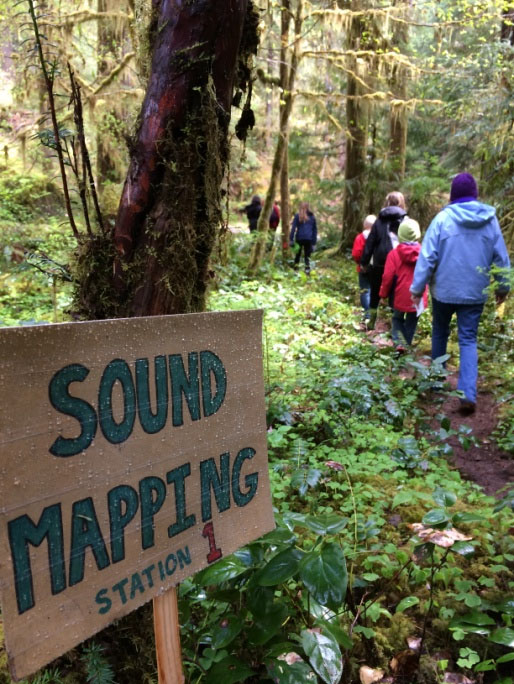
 Nestled at the end of the Discovery Trail was the River Reflections station. Here students learned about the complex interactions and disturbances that occur in a riparian zone through scientific observation and personal reflection. This station reflected the essence of the ongoing work at HJ Andrews by focusing on the Long Term Ecological Research and Long Term Ecological Reflections programs, highlighting the value of using both scientific and artistic lenses to understand the natural world. As scientists, the students compared the temperature, humidity, canopy cover, and species composition between two plots, one adjacent to the river and another 10-15 meters from the river. From our position on the creek bed, students saw a gravel bar in the middle of the river that provided a perfect example of the species found in newly disturbed areas. The students then journaled quietly by the river. To our surprise, students were so engaged in the journaling activity, they did not want to leave the station! Every student filled his or her own page in journals dedicated to collecting Canopy Connection’s Ecological Reflections.
At another station, students discovered the diversity found in old-growth forests, both in terms of composition and structure. They did this by identifying plants as tall as a western redcedar and as small as stairstep moss. Each student sketched and learned about a different plant and reported back to their group. After getting a close up view of forest biodiversity, the students embarked on a riddle quest to discover what makes an old-growth forest different from other forests. Every hidden riddle led them to a location on the trail identifying snags, woody debris, old trees, and canopy layers, which are the 4 main features of an old-growth forest. The students gathered in a circle to discuss how to mitigate threats to biodiversity through conservation measures.
 At the “Stewardship in Action” station, the students reflected on the importance of taking care of nature by learning about and applying the Leave No Trace principles. Each student described their favorite place in the outdoors and how they felt there. This led to a discussion about the Leave No Trace principles. Students creatively expressed the principles through a short rap, poem or skit. The highlight of this station was applying the Leave No Trace principles by constructing and deconstructing a survival shelter using only debris found in the forest. The students were excited to get their hands on the branches and debris to build a shelter and crawl in for a picture!
The most profound experience was the tree climbe at the “To Affinity with Nature and Beyond” station. Each student had the opportunity to climb into the canopy of a 90-foot tall Douglas-fir tree using a system of ropes. Ascending the tree was a unique experience because students had to overcome any fears they might have had to get to the top of the tree. While climbing, students observed the change in temperature in the canopy layers and were surprised to discover that (on sunny days) it was 10 degrees F warmer at the top. While this station incorporates scientific observation, what most students will remember for the rest of their lives is the sheer wonder of viewing the old-growth forest from the canopy.
Between each station, the students found a compass bearingwritten on a slip of paper and hanging on a tree. This bearing led them to a riddle hidden 20-30 feet down the trail. The riddle related to the previous station the students had left not long before. This activity was a fun way to keep students engaged during the transition time between stations, while helping them reflect on what they learned at each station. The students learned how to read and use a compass, a valuable skill, while we were able to quickly assess if we met our learning objectives.
All in all, the Canopy Connections team spent over 1,800 hours to create and facilitate field trips for 6 middle schools and 230 students. While each field trip held the same content, every student left with his or her own distinct experience.
 One student from Roosevelt Middle School said, “I learned a lot about old growth forests that I did not know before, and I think I am more likely to participate in activities taking place there.”
Throughout this program, our team and our students gained a great deal of knowledge, while fostering a connection to place and respect of old-growth forests. We have inspired our students to be curious, and want to learn more, about old-growth forests and the natural world. Ultimately, we hope these students will be more environmentally aware and will continue to care about the forest and natural environments as much as we do. As much as we hope to have touched their lives, the overall experience of working with these students has motivated us to continue pursuing careers in environmental education and work to nurture a healthier environment in the future.
Acknowledgements
We would like to thank the Luvaas Family Foundation of the Oregon Community Foundation and Steve Ellis for their generous contributions that made these projects possible. Special thanks also to our community partners: the children, teachers and staff at Adams Elementary School, the McKenzie River Trust, Kathy Keable and Mark Schulze from HJ Andrews Experimental Forest, who hosted the field trip, and Rob Miron and Jason Seppa from the Pacific Tree Climbing Institute (PTCI), who facilitated the tree climb.
Works Cited
Jacobson, Susan Kay, Mallory D. McDuff, and Martha C. Monroe. Conservation Education and Outreach Techniques. Oxford: Oxford UP, 2006. Print
Louv, Richard. Last Child in the Woods: Saving Our Children from Nature-deficit Disorder. Chapel Hill, NC: Algonquin of Chapel Hill, 2008. Print
Sobel, David. Beyond Ecophobia: Reclaiming the Heart in Nature Education. Great Barrington, MA: Orion Society, 1996. Print
 Kathryn Lynch is Co-Director of the Environmental Leadership Program. Katie is an environmental anthropologist who has a strong commitment to participatory, collaborative and interdisciplinary approaches in both her research and teaching. She has worked in Peru, Ecuador, Indonesia and the United States examining issues of community-based natural resource management. This has included examining the role of medicinal plants in Amazonian conservation efforts and the potential for engaged environmental education to promote conservation. Before joining UO she was a researcher at the Institute for Culture and Ecology, where her research focused on the relationships between forest policy and management, conservation of biodiversity, and nontimber forest products. She has also facilitated various courses and workshops that examine the nexus between environmental and cultural issues.

 This learning expedition began as all expeditions begin at Kettle Falls Elementary. The staff went through a careful study of the new Washington State standards and determined the “priority standards” at each grade level. The standards are then written as long-term learning targets. Once these standards were determined, teams researched case studies that could become the focus of the learning expeditions. The life science standards addressed focused on life cycles, animal structures and behaviors, food webs, ecosystems and human impacts as the center of the expedition.