Cultivating Environmental Literacy and Sustainable Food through a Community Ambassador Program
Cultivating Environmental Literacy and Sustainable Food through a Community Ambassador Program
by Jessica Day, Claudia Ludwig, and Nitin S. Baliga,
Institute for Systems Biology
Project Feed 1010 (PF1010) was founded in 2015 in response to a need identified by educators: students need to understand and be prepared to positively impact our food system in the future. Globally, one in three people (2.6 billion) suffer from some form of malnutrition1, and in 2015, 12.7% of Americans were not food secure2. By definition, these individuals experiencing food insecurity do not have access to sufficient, safe, and/or nutritious food to maintain a healthy and active lifestyle. Our food system itself is also headed toward a catastrophic situation resulting from water shortage (at least 40% gap between demand and supply by 2030), and rapid shrinkage of per capita arable land3. In addition, population growth (expected to reach 10 billion by 2050) is outpacing agricultural innovation, creating a demand that the industry will not be able to satisfy4. Put in simple terms, food insecurity is a complex issue with complex consequences. Understanding complexity and finding solutions to these real-world issues requires systems thinking – both in research and in education.

See student perspective on this program at https://clearingmagazine.org/archives/20457
In 2015, the United Nations led a call to action by announcing the 17 Global Goals for Sustainable Development, which aim to improve lives by 2030. Goal 2, Zero Hunger, pledges to end hunger, achieve food security, improve nutrition and promote sustainable agriculture5. Fortunately, as the need for innovation becomes more apparent to reach this goal, job opportunities in STEM (science, technology, engineering, math) fields are rapidly expanding. First-hand, real-world experience in systems biology and sustainable agriculture can prepare students to enter and be successful in these career fields. Furthermore, these experiences inspire and motivate non-STEM track students to stay informed on local and global issues as an environmentally-literate citizen.
 Embedded within an award-winning education program (Systems Education Experiences; SEE) at Institute for Systems Biology (ISB), the PF1010 Ambassador Program set out to prepare high school students for success in future careers through innovating solutions to complex issues (such as food insecurity), and advocating as a leader for local community needs. Students gain critical thinking and complex problem-solving skills by applying SEE’s proven curriculum and systems-thinking strategies to find solutions to real-world phenomena. For example, one real-world problem identified by the scientific community was the gap in knowledge regarding the composition of the agricultural microbiome in aquaponic systems – sustainable food-growing systems gaining in popularity due to their low dependence on natural resources and relatively high plant yield. Using this real-world problem as a prompt, students designed experiments to explore microbial communities and contributed to meaningful scientific research, all while learning valuable skills they could apply to solving complex problems in the future. The broader impact of this program manifests itself as students apply their new knowledge, skills, and interests to address needs in their own communities as community ambassadors.
PROGRAM OBJECTIVES
PF1010’s commitment to environmental literacy, building leaders in Environmental Education (EE), and advancing efforts to motivate the public to take informed actions on environmental and civic issues, is evidenced through its Ambassador Program. The year-long program is comprised of an immersive, on-site summer internship opportunity followed by an ambassador-designed community outreach experience during the school year. It was strategically designed to provide hands-on experiences for students to gain knowledge and skills that are essential for 1) solving complex problems central to future innovation and discovery and 2) serving in leadership capacities 3) communicating effectively both personally and professionally.
In addition, the PF1010 Ambassador Program was also developed to address the enormous gap between the number of high school students who apply for rigorous, authentic STEM internship experiences, and lesser number of positions actually available. For example, SEE receives nearly 300 high school internship applications each year to fill between 10-12 positions. Including the PF1010 Ambassador Program as a summer experience allows SEE to provide an opportunity for 6-18 additional students each summer. These students serve as both community leaders and peer trainers, making this model a scalable solution that requires relatively little time management and financial support.
PROGRAM TIMELINE
The PF1010 Ambassador program is comprised of 6 to 18 high school students, who are trained in food security, sustainable agriculture, and systems-thinking through an intensive 6-8 week summer internship experience at ISB. To ensure equitable, inclusive EE, participants of various backgrounds and community needs are recruited. Ambassadors gain content knowledge and skills using SEE’s NGSS-aligned curriculum6 and conduct aquaponic and hydroponic experiments in both greenhouses and laboratory environments; however, the exact framework of these experiences is modified annually to reflect community needs and institute resources. As their summer learning experiences end, the students’ role as an ambassador begins. Ambassadors use their newfound knowledge, skills, and confidence to design and implement a program in order to take action on environmental issues of concern to their community. They also transfer the knowledge they gain through this process to open-access, online resources (blog posts, integration plans, materials lists, blueprints, grant proposals, etc.) accessible through their PF1010 ambassador profile7. This profile serves as a valuable resource as it creates a positive online presence for each student and aids them during their academic and career journeys. Finally, throughout the school year, ambassadors are mentored and supported by the PF1010 team and ambassador alum through monthly virtual meetings. The team uses this time to ask questions, provide advice, and share successes. At the end of the school year, PF1010 organizes an Ambassador Showcase, where family, friends, and PF1010 community supporters gather at ISB to hear final presentations and celebrate the ambassador’s impact and hard work.
PROGRAM IMPACT
Developed to diversify and strengthen the environmental research field, as well as provide skills training and authentic research experiences for students, this scalable year-long program has cultivated and supported 3 cohorts of 36 total high school students since 2016 from the Puget Sound region in Washington state, mostly from underrepresented and marginalized groups. To date, this program has provided ~200 hours of interdisciplinary EE focusing on sustainable agriculture, food security, aquaponics, systems biology and career exploration. Through program evaluation, all ambassadors agreed that the internship contributed positively to their self-confidence, felt it would be a valuable experience for others, and that it increased their interest in pursuing research in the future.

PROGRAM DEVELOPMENT
In addition to providing an authentic, hands-on experience for students to become inspired and empowered, PF1010 modified this program each year to reflect additional needs in research and educational resource development within ISB. This program could easily be modified to account for specific institute objectives and/or needs.
For example:
Additional research technicians were needed to maintain and sample experimental aquaponic systems for scientists in 2017; therefore, ambassadors were each assigned a system to manage and sample throughout the summer as part of their training experience.
The Seattle Youth Employment Program (SYEP) requested ISB be a host for Seattle youth in search of 150 hours of employment experience in 2017; therefore, 2017 Ambassadors were recruited and financially supported through SYEP during their summer experience at ISB.
PF1010 developed a new, standards-aligned curriculum module which needed to be field-tested in 2018; therefore the 2018 Ambassador program was structured as a “short course” in which Ambassadors received a 33-hour course completion certificate from SEE.
Due to the success we observed in both ambassadors and the development of our program and research, we recommend other educators also strategically develop their programs to address the needs of their communities while also making progress toward achieving milestones in their own organizations. This real-world application and career-connected learning piece will provide ambassadors with context and relevance in an otherwise siloed experience. If you are an educator interested in developing an Ambassador program, consider asking yourself a few key questions as you begin planning.
For example:
- What student and environment-related needs exist in your community? Ex: STEM internships, aquaponic research, curriculum development
- What resources and/or incentives are available for students? Ex: Stipends, short course certifications
- Which local and/or national organizations could you partner with to legitimize the experience? Ex: Seattle Youth Employment Program, Seattle Parks and Recreation
- How will you measure the impact the program has on students? The community?
Summary
As evidenced by the success and feedback from ambassador alumni, the PF1010 Ambassador Program has proven to be an effective experience that prepares students and citizens to be confident community leaders and complex problem solvers. Alumni are compelling communicators and innovators who care about making a difference in their various fields of interest. Due to the student-led ambassador training model, this program is highly scalable, requires low time management, and is relevant in many contexts. We believe it can be leveraged in many environments – schools, universities, nonprofits, after school programs, etc. – anywhere an educator can develop opportunities for students to feel empowered and supported to make a difference in their communities.
Acknowledgements
The success of this program is possible due to the generous training and resources provided by ISB scientists (Jake Valenzuela, Wei-ju Wu, Serdar Turkarslan, Rachel Calder, Annie Otwell, Matt Richards), ISB visiting scholars (Shari Carswell, Barb Steffens, Emily de Moor, Emily Borden, Amanda Cope, Dexter Chapin), the ISB communication team (Hsiao-Ching Chou, Allison Kudla, Joe Myxter), ISB undergraduate intern Kourtney Tams, and ISB high school interns (Linnea Stavney, Ivan Esmeral, Sarah Brossow, Annabelle Smith); donation of greenhouse and classroom space from the Black Farmers Collective’s Ray Williams and Northeastern University; web-based data management hub development by Ian Gorton and Northeastern University graduate students; engineering and construction support from Jeff King and Ray Williams; donation of aquaponic kits from AquaSprouts and aquarium materials from Fred Hutchinson Cancer Research Center; student project support from ambassador high schools; and funding from the Seattle Youth Employment Program, the Microsoft Giving Campaign, CrowdRise donors, DonorsChoose, and the National Science Foundation (NSF MCB-1616955, MCB-1518261, DBI-1565166, MCB-1330912).
1. World Food Programme. <https://www1.wfp.org/zero-hunger>. Web Accessed Mar 4 2019.
2 Coleman-Jensen, A., Gregory, C., & Singh, A. Household Food Security in the United States in 2013. USDA Economic Research Service. 2014.
3 “The business opportunity in water conservation”, The McKinsey Quarterly 2009. McKinsey and Company. Dec 2009.
4 “Creating a Sustainable Food Future”. Synthesis Report. World Resources Institute. Dec 2018.
5 Sustainable Development Goal 2. Sustainable Development Goals Knowledge Platform. United Nations. <https://sustainabledevelopment.un.org/sdg2>. Web accessed Mar 4 2019.
6 Modeling Sustainable Food Systems Curriculum. Systems Education Experiences. <https://see.systemsbiology.net/modeling-sustainable-food-systems/>. Web Accessed Mar 4 2019.
7 Project Feed 1010 Ambassador Profiles. Project Feed 1010. <http://www.projectfeed1010.com/ambassador-profiles/>. Web Accessed Mar 4 2019.
AUTHORS
 After Jessica Day received her master’s degree in wildlife science, her passion for both science and science education led her to inspire others as a high school science teacher in Texas. Compelled to make a wider impact, Jessica later transitioned into project management at Institute for Systems Biology in Seattle in 2015. Here, with the support of ISB’s scientists and educators, she developed and managed Project Feed 1010 until 2018. Jessica continues to pursue opportunities to impact science and education, and currently manages agricultural research and extension projects at Clemson University in Clemson, South Carolina.
Claudia Ludwig grew up in the midwest where she always found ways to explore nature, even in the midst of Chicago. With degrees in Biology, Chemistry and Education, Claudia taught middle and high school science and made her way to Washington state. Experiential learning brought her to Institute for Systems Biology where she learned how to bring systems science to her students and to other teachers. She continues her work at ISB by striving towards a world where all people, especially those from underserved communities, participate in systems science.
Nitin S. Baliga grew up in Mumbai, India where, at a young age, he witnessed disparities in education and food security which have fueled his work. After completing his degrees in microbiology and marine biotechnology, he came to the Univerisity of Massachusetts, Amherst to complete his PhD in microbiology. He then joined ISB in Seattle, as one of its founding scientists in 2000. Since that time he has made significant contributions to systems-level cellular studies and to science education by translating his research into teaching modules and new programs.
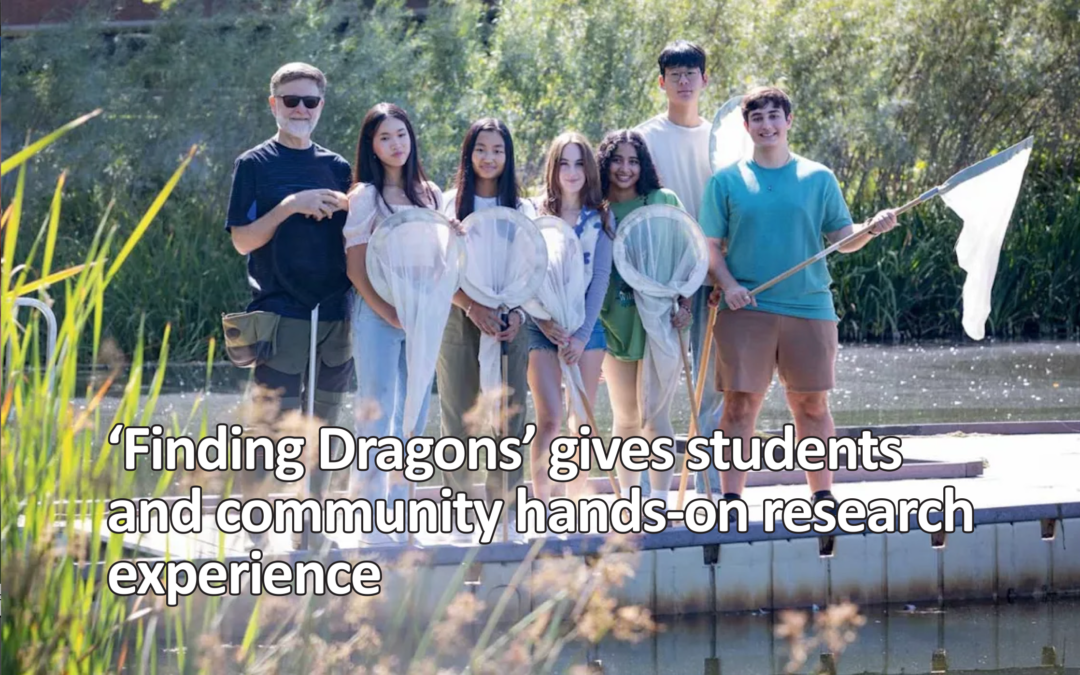
 n the summer of 2023, a group of high school students and adults converged over their shared interest in science and dragonflies.
 The Charisma of Dragonflies