
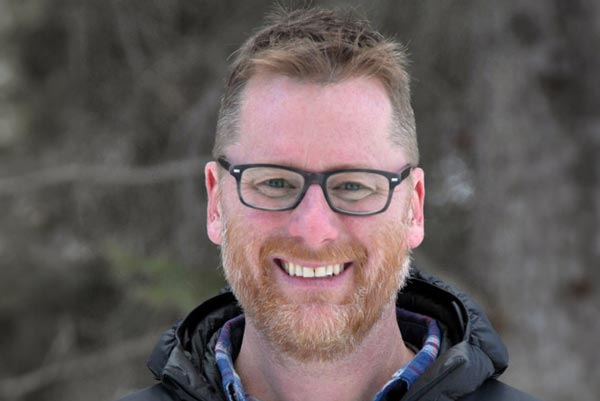
Colin Harris is the founder and executive director of Take Me Outside, and initiated the organization by running across Canada, going into 80 schools across the country and engaging 20,000 students in conversations around their time spent in front of screens compared to their time spent outside, being active and connecting to nature. Take Me Outside, a Canadian charitable organization dedicated to ensuring that every students’ day includes time spent outside, is a leading national organization helping advance the work of outdoor learning. Colin is also a PhD Candidate in Educational Research at the Werklund School of Education at the University of Calgary.
Tell us a little about yourself? Do you remember your first experience in nature as a child?
I grew up in various parts of Canada during the late 70s and early 80s, so the default setting then was to have consistent outdoor experiences. For the most part, my family lived in cities, but there were always outdoor spaces nearby that shaped me and who I’ve become.
Did any events in your youth play a role in your development as an environmental educator?
I don’t have any definitive experiences from childhood that led to my work in this field. In large part, I think it was simply a cumulation of my time spent outside that helped grow my desire to feel more connected to the land and the environment. Numerous experiences shaped this, but as I worked in the outdoor and environmental education field in my twenties, I wanted to find a way to marry my work and my personal dream.
And what was that dream?
When I was about 16 years old, I started developing a dream of wanting to run across Canada. I had been inspired by Terry Fox, as well as the Olympic torch relay when the winter Olympics were held in Calgary, Alberta in 1988. I was by no means a great runner, and yet this dream persisted.
Wow. So how did you manage to bring them together?
There was emerging research about the impacts of excessive screen time affecting physical health, and so I decided to run 7600 km across Canada, going into schools and helping to raise awareness about the importance of spending less time in front of screens, and more time outside. [And] this run across the country launched Take Me Outside – the non-profit I founded.
 How long did it take you to complete the run?
The run took 9 months total – I ran approximately 40-50 kilometres a day for 5 days a week. And on the other days, I would go into schools and connect with students. Over those 9 months, I ran 181 marathons to get from the Atlantic to the Pacific Ocean.
What did you see and learn as you visited classrooms and teachers along the way?
I saw that students were well aware of the negative impacts too much time in front of screens have. I also saw inspiring examples of students and teachers who were committed to learning that happened outside. I saw a commitment from teachers who saw the potential of learning that could happen outside of the four walls of the classroom.
 So you founded a non-profit. What is the status of Take Me Outside today?
Take Me Outside continues to evolve in our work. On that front, we’re really trying to sink our teeth into systems level-change. So much of the work in this field can often be a bottom up approach – connecting with frontline teachers and educators who care about these issues. But we need to address more systemic change within the education system, and so we’re working with school system leaders to try and make that happen. On a personal level, I’m also trying to finish a PhD in Educational Research at the University of Calgary exploring teacher relationships with digital technologies and outdoor learning.
What was a particularly memorable moment in your career?
It would be tough to pick out one moment. I think what stands out in reflecting on nearly 25 years in this work, are the relationships I’ve been fortunate to build and the amazing people I’ve met. After 9 months of running across Canada, dipping my toe into the Pacific Ocean to finish my run across the country was a highlight. But getting to share that with so many people, and the relationships that have grown and been developed since that moment, definitely stick out.
What have you learned in your years of being an outdoor/environmental educator?
While I think the term “outdoor and environmental educator” has been used quite commonly in the past, I think a shift is needed. I view myself as an educator – broadly speaking – that cares deeply about the environment and the outdoors. I think all educators can (and should) embed the environment into their pedagogical approach so that OEE doesn’t feel like a specialization. Our goal should be to have all educators be environmental educators.
What changes have you seen in EE during your career?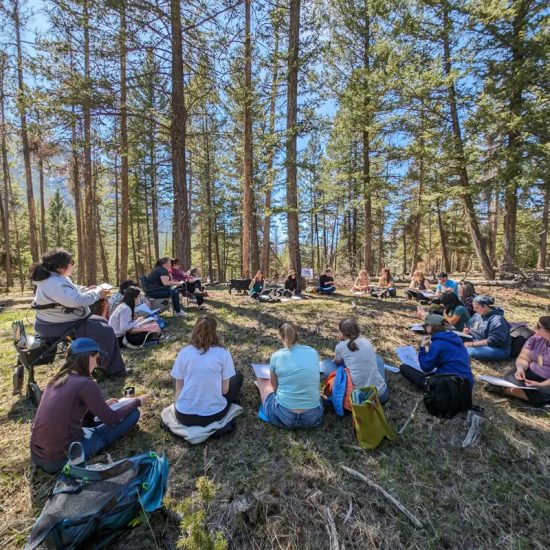
As mentioned, I think I’ve seen a shift away from the perceived specialization of being an outdoor and/or environmental educator. As David Sobel indicates, good education is in essence environmental education. While I think issues like climate change, pollution, and biodiversity loss are extremely important, I think the pathway to addressing these issues are students spending more time outside – developing and nurturing their own relationship with the land and the outdoors. I think we need to ensure that amidst all the bad news that seems to drive some of these issues, that there is a sense of hope for the future. And for me, that sense of hope comes from simply spending more time outside.
What’s the future of EE?
It’s really hard to say. So many people claim to have insights on what the future will hold in various areas, yet there are too many factors that make it hard to predict. It definitely feels like we are in some volatile and polarizing times politically. We are entering this new age of AI and all the promises of its potential. In all of this, I think we need to continue to ask “What is the purpose of education?”
If you were to ask 100 people immersed in education this question, I’d bet you get at least 70 different answers. From my vantage point, education that focuses on our connection with the outdoors and the environment, can help us flourish, and can help the planet flourish.
What keeps you motivated?
The more time I spend outside, the more motivated I get. The more time I spend scrolling social media, reels, and the news – it’s tough to stay motivated. For my own health, I know where my priorities need to lie. It’s not pitting one against the other – it’s just ensuring that I have good balance in my life, and for me, that means trying to spend as much time outside as possible.
What inspires you now? What people have inspired you?
Honestly, while there are some people that inspire me (I think of my parents), it’s non-humans that are inspiring me the most these days. Trees inspire me, rivers inspire me, learning about whales or sea turtles or coyotes or birds inspire me. I know it sounds like a cheesy or hippie answer, but I’m finding the natural environment way more inspiring these days than humanity.
Who are your environmental heroes?
Rachel Carson and David Suzuki.
What books are currently on your nightstand?
The Digital Delusion by Dr. Jared Horvath
Capitalism by Sven Beckert
The Extinction of Experience by Christine Rosen
You undoubtedly were familiar with the recently discontinued Green Teacher Magazine. What is your view regarding the value of publications like GT and CLEARING as resources for teachers?
Both of these publications have been extremely valuable, providing rich and useful resources for educators interested in outdoor and environmental learning. In an educational landscape that is increasingly being promised transformation through AI and other digital tech, I still believe that human-centred approaches to learning are and will be crucial. Publications like CLEARING contribute to this and provide a solid foundation for building the kind of learning blocks that will result in good education.
And finally, do you have favorite places to go when you need to connect with nature?
I struggle a bit with the phrase “connecting with nature” as I think it’s easy to have different interpretations of what “nature” is. If we equate nature to these wilderness experiences or vast landscapes, that it really makes nature inaccessible to a lot of people. I was in downtown Toronto for a conference a few weeks ago, surrounded by skyscrapers. But the simple act of going for a walk outside was enough. In an ideal world, we’re fortunate to pursue experiences that get us on the water or hiking through a forest. But simply going for a walk and getting some fresh air outside, is what I need most often.
Are you hopeful about the future?
I feel there’s no other choice. I have recently been reading How To Be Hopeful by elin Kelsey, and while we live in a world that focuses on doom and gloom, there are plenty of reasons to be hopeful – to have evidence-based hope. They’re a little bit harder to find in this sea of doomism, but they’re out there.
I’d like to learn more about this program, so I can develop and share additional building blocks with other educators on my tribal reservation and beyond.
Nisqually Environmental Team (NET) is housed within the Nisqually Tribe’ Natural Resources and try’s to promote K – 12 and beyond students outdoor activities year round with visits to our two (2) salmon hatcheries, connecting with non tribal partners that engage with public schools and share resources, Community events that bring attention to the state of the Nisqually (River) Watershed.
We also partner with Tribal Fish and Wildlife Enforcement from time to time, with river and beach shoreline cleaning.
While our attempts are to long to list, like so many other organizations, NET is not funded and it’s proven difficult to pull together groups for meaningful and ongoing activities w/o having reliable resources.