by editor | Feb 8, 2010 | K-12 Classroom Resources
 Reviewed by Ella Inglebret and CHiXapkaid (D. Michael Pavel)
The salmon serves as an indicator species reflecting the overall health of the natural environment in the Pacific Northwest. For Native American tribal members, the salmon has played a central role in sustaining communities both historically and in contemporary daily life. Based on the importance of the salmon to all people living in this region, tribal leaders, environmental organizations, government agencies, and educators formed a partnership to create curriculum resources that bring awareness to the status of the salmon population as it interconnects with the broader ecological system. The outgrowth of these efforts is the Shadow of the Salmon curriculum, designed to prepare eighth- grade students with 21st century critical thinking, problem solving, and communication skills as they address environmental issues.
Building partnerships for education
The recently completed study, “From Where the Sun Rises: Addressing the Educational Achievement of Native Americans in Washington State,” (http://www.education.wsu.edu/nativeclearinghouse/achievementgap/) identified the formation of partnerships between tribes and schools as critical to promoting the educational achievement of Native students. The report echoed the Millennium Agreement signed by state and tribal leaders in 1999 by recognizing the contributions that tribes can make to education for all students in Washington State. The Shadow of the Salmon curriculum serves as an example of how Native cultural knowledge can help inform problem solving and development of potential solutions regarding environmental concerns.
Tribes contributed to the development of the Shadow of the Salmon curriculum through the leadership of the Northwest Indian Fisheries Commission who brought together multiple partners. Additional contributors who saw the possibility of enhanced education opportunities through partnership included the environmental organizations: Salmon Defense, the North- west Straits Commission, Environmental Education Association of Washington, Hood Canal Coordinating Committee, and Adopt-A-Stream Foundation. Washington State agencies also assisted, including the Office of the Superintendent of Public Instruction, Department of Fish and Wildlife, and Department of Ecology. Educational organizations and institutions involved were the Washington State Indian Education Association, Washington State University, University of Washington, and the Pacific Education Institute. Further assistance came from the Affiliated Tribes of Northwest Indians and the Boeing Corporation.
A partnership product
A key component of the curriculum-development partnership involved communication with members of local tribes to learn about and portray the perspectives of Native people. The outcome of this partnership, the Shadow of the Salmon curriculum, is a multi-media product consisting of a docu-drama and a curriculum guide. The docu-drama tells the story of Cody Ohitika, a 15-year old boy from Pine Ridge, South Dakota, who comes to the Pacific Northwest to visit his Coast Salish relatives. He learns about the importance of caring for and respecting the natural environment through stories, observation, and hands-on experiences shared by youth, elders, and other community members. More specifically, he participates in an environmental studies class with peers, observes the consequences of an oil spill, and watches his relatives take measurements to monitor the health of a stream near a hatchery. The curriculum guide provides a variety of materials and activities to complement presentation of the docu-drama. These include traditional stories of the salmon with suggested discussion questions and follow up activities. A section on stewardship presents watersheds, as part of an ecological system heavily impacted by human use. Challenges to the sustainability of the salmon population are discussed, focusing on hatcheries, hydropower, harvest, and habitat. Suggestions are made for related information sources that can be explored through the internet. Communication skills are enhanced as students and teachers explore diverse communication modes, such as storytelling, art, music, and dance, in addition to meeting with local tribal members to hear their perspectives regarding the natural environment.
Building critical thinking and problem solving skills
Real life interactions between humans and the natural environment are portrayed in the Shadow of the Salmon curriculum as they relate to the decline of the salmon population. Students are provided with opportunities to build their critical thinking and problem solving skills as they analyze the challenges faced by salmon through- out their life cycle. The curriculum guide provides opportunities to explore potential solutions and to take action through being a “doer” and not a “worrier.” For example, after viewing the docu-drama, students are encouraged to research news articles regarding environmental issues of relevance to their local community. They then critique suggested solutions and identify ways they can personally take action to address identified concerns, such as through removing litter or planting trees along a stream.
Additional suggestions are provided for activities that promote the development of critical thinking and problem solving skills that align with Essential Academic Learning Requirements (EALRs) in various content areas, such as science, math, reading, writing, and communication. (See Table 1 for an example of alignment with a communication EALR.) Implementation of the curriculum might involve tribal and non-tribal experts serving as guest speakers to talk about what sustainability means, to provide information on local challenges, and to lead a discussion on the pros and cons of strategies being used to address these challenges. Students might gather information by taking a field trip to a fish hatchery or to a salmon habitat restoration project. As an alternative, students might explore the land and water resources located on or near their own school grounds and produce a “Schoolyard Report Card.” These activities then provide the basis for planning an “Action Project” to be carried out by the class. This might involve adopting a stream for cleanup or reintroduction of salmon. Students can then develop a presentation for a local government, tribal, or educational group to gain support that can then lead to implementation of their “Action Project.”
Extending existing educational efforts
The Shadow of the Salmon curriculum is designed to build upon environmental education efforts that already provide out- door education experiences for students in schools. For example, 600 schools currently participate in the Salmon in the Classroom Project, sponsored by the Washington Department of Fish and Wildlife (http:// wdfw.wa.gov/outreach/education/salclass. htm). This project provides students with the opportunity to receive salmon eggs that they raise in the classroom. Salmon fry are eventually released into local waterways that biologists have determined to provide suitable habitat. The Salmon in the Class room Project has served as one focal point for partnership development. For example, the Yakima Basin Environmental Education Program brings together the Yakama Nation, state and federal agencies, irrigation districts, private groups, municipal and county agencies, and individual land owners to offer the Salmon in the Classroom experience to students and teachers in the region. The Shadow of the Salmon curriculum parallels and extends the Salmon in the Classroom Project as students learn about the natural environment through activities, such as mapping and monitoring the status of their local watersheds, participating in environmental fairs, communicating with local community members, recording cultural histories associated with the waterways, and exploring potential responses to the dilemmas encountered.
Concerns pertaining to environmental issues and sustainability of natural eco- systems in the Northwest have resulted in the formation of additional partnerships developed to enhance educational opportunities. The Hood Canal Salmon Enhancement Group partners with the Skokomish Nation and the Port Gamble S’Klallam Nation to provide educational opportunities for students enrolled in schools in the Hood Canal watershed. The Stillaguamish Tribe has formed a relationship with nearby schools to provide hands-on educational opportunities at its fish hatchery. Through the Dungeness River Audubon Center, the Jamestown S’Klallam Tribe, the River Center Foundation, and the Audubon Society come together to provide river-monitoring field trips and other educational opportuni- ties regarding watershed management. The Shadow of the Salmon curriculum provides an additional and readily accessible resource to enhance the educational efforts of these collaborative groups.
Conclusion
Environmental issues pose one of the great- est challenges for humans across the world today. In the Pacific Northwest, the salmon serves as an indicator species reflecting the health of the overall natural environment. Recognizing the significance of the salmon to all people across the region, Native American tribes partnered with environ- mental organizations, government agencies, and educators to develop the Shadow of the Salmon curriculum. This curriculum provides a tool for promoting the development of critical thinking and problem solving skills for eighth-grade students as they learn about and address real-life environmental concerns. The curriculum is designed to build on existing environmental education efforts and serves as a tool to promote cross- cultural communication and relationships.
Availability of the Shadow of the Salmon curriculum
The Shadow of the Salmon video and curriculum guide are available, upon request, from the Indian Education Office of the Washington State Superintendent of Public Instruction (P.O. Box 47200, Olympia, WA 98504, 360-725-6160). The video can also be viewed online at http://www.Salmon Defense.org and the curriculum guide can be accessed at http://www.education.wsu. edu/nativeclearinghouse/achievementgap/. A document displaying the alignment of the Shadow of the Salmon curriculum with state standards can be accessed at http:// libarts.wsu.edu/speechhearing/overview/ native-american.asp.
Ella Inglebret is an Associate Professor in the Department of Speech and Hearing Sciences at Washington State University. Her research examines factors associated with Native American student success.
CHiXapkaid (D. Michael Pavel) is an enrolled member of the Skokomish Page Nation and Professor of Higher Education at Washington State University. He specializes in promoting American Indian and Alaska Native educational access and achievement.

by editor | Feb 1, 2010 | Place-based Education

Using the local community as a starting point for teaching interdisciplinary concepts and connecting students to the real world.
By Kim Stokely
Sixteen years ago, after attending a workshop on science teaching, I was driving home over a mountain pass when I stopped and looked out over the mountain valley. I thought, “Look at this science classroom! “Why isn’t this dynamic, inspiring world being used more for educating our children?” I went on to think, “Wouldn’t it be possible to connect our learning to something real, something tangible, something meaningful? What is the physical place that is common to all of us, defines a community, and binds us together? A watershed. Might we be able to connect learning to this? Could our watersheds be a container or focus for all our learning? Could we actually practice caring for a piece of land together?” Surprisingly, similar thinking, focusing on local landscapes and communities, was awakening or reawakening all over the globe, and from it emerged the practice of Place-Based Learning.
ALERT: You need to be a CLEARING subscriber to read the rest of this article.
(enter password then hit return button on your keyboard for best results)
[password]
“We boast of our system of education, but why stop at schoolmasters and schoolhouses? We are all schoolmasters and our schoolhouse is the universe. To attend chiefly to the desks or schoolhouse, while we neglect the scenery in which it is placed, is absurd.” (Thoreau in Williams, 1998)
What is Place-Based Learning?
What is Place-Based Learning? It is simply using our place — where we live — as the context for learning. Place-Based Learning engages students in critical thinking and meaningful projects. It helps them connect to each other, their community, and the land.
David Sobel, in Place-Based Education: Connecting Classrooms and Communities (The Orion Society, 2004), defines Place-Based Education as, “The process of using the local community and environment as a starting point to teach concepts in language arts, mathematics, social studies, science, and other subjects across the curriculum. Emphasizing hands-on, real-world learning experiences, this approach to education increases academic achievement; helps students develop stronger ties to their community; enhances students’ appreciation for the natural world; and creates a heightened commitment to serving as active, contributing citizens.”
Another way to think about this focus on place is to understand that a “grounded” or “rooted” learner stands within the world, acting on its many elements, rather than standing outside looking in, acting in large measure as an observer, which is the typical stance expected of students in schools. What is noticeable from our close observation of student work that has an embedded quality— meaning the student is in the community, researching aspects of its history, learning about local lore, researching and reconstructing aspects of a local watershed, etc.— is that the quality of the work deepens greatly, is more carefully attended to, assumes genuine meaning.
Students easily distinguish this rooted work from typical work in which they stand outside. A grounded, rooted learner understands that his/her actions matter, that they affect the community beyond the school. It is out of this particular formulation that the “student as resource to the community” takes shape — that understanding that students need to be thought of as productive assets to the health of a community. A pedagogy of place, then, recontextualizes education locally. It makes education a preparation for citizenship, both locally and in wider contexts, while also providing the basis for continuing scholarship (Rural Challenge Research and Evaluation Program, 1999).
The goals of Place-Based Learning commonly are to:
Enhance education. Place-Based Learning roots education in the community. Teaching practices and learning experiences encourage critical thinking, active engagement, high expectations, and meaningful experiences. It makes learning authentic and alive.
Encourage stewardship. The practice of getting to know a place and its people, of caring for that place, of monitoring its well-being over time, and of educating the community all encourages a deeper relationship with the place and a sense of caring and responsibility for it.
Inspire hope. When we come together for the good of our community and participate in maintaining and improving the well-being of our neighborhoods through civic action and environmental restoration, it inspires hope and helps us realize that we can make a difference.
Build community vitality. The hope, caring, and community spirit that develops from participating in things like “the simple act of planting a tree” helps a community appreciate its place and builds a sense of community spirit.
The following examples help tell the story of Place-Based Learning.
As a high school teacher of second language learners, I want students who feel disconnected from their homeland, their heritage, and culture to be able to reconnect here. I want them to acquire reading, writing, and speaking skills, and be able to use them proficiently. I want them to feel comfortable in our community and creative and competent in their skills. I want them to connect to their culture and place and be proud of who they are. Ultimately, I want them to love language, a diversity of cultures, and their environment. I want them to be able to work cooperatively with others, participate in our community, and develop a sense of profound citizenship and stewardship of the land.
You can imagine my delight in discovering the River of Words curricular model. When I first asked some of the students from the MHS Writer’s Club what they thought about the idea, they responded by asking, “We have a river?” I knew then how important it was to learn about our watershed together.
Our project focuses upon our specific community and watershed environment while using language acquisition methodologies that empower English Learner students. This model of connectivity reflects the focus of Paolo Friere’s critical pedagogy of place. He advocates “reading the world.” “Reading the world always precedes reading the word, and reading the word implies continually reading the world” (1987). Like Friere, I believe that when teachers and students engage in action and reflection to help them understand the world, they can change the world. It is this interaction with the world, the community, that is at the heart of Place-Based Learning. (Ocean Jones, Teacher, Merced, CA).
After his students participated as docents along the San Joaquin River, collected water quality data, propagated and restored native plants, removed graffiti from rocks along the river, and presented in classrooms, Steve Starcher, of Fresno Central High School, had this to say, “My special education high school students can now write a good five paragraph essay because they have something interesting to write about. They have motivation to write. Students enrolled in the watershed education program are ascending to new heights and viewing their world from a new perspective. As students learn about their watershed, they learn about themselves and contribute to the community.”
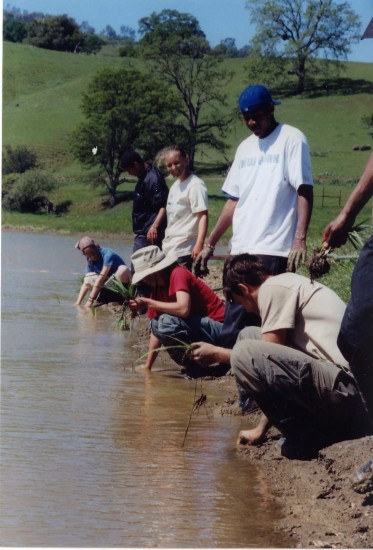
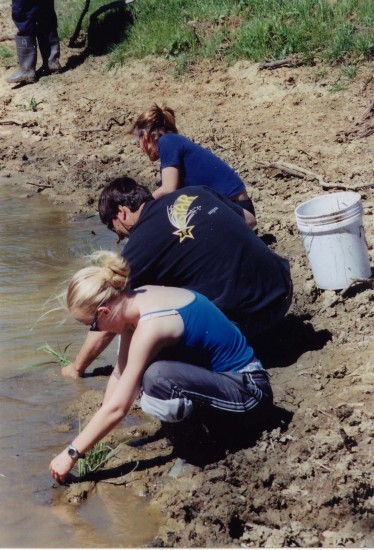
In SLEWS (Student and Landowner Education and Watershed Stewardship), a program of the Center for Land Based Learning, local high schools adopt privately-owned farms and ranches where they perform habitat restoration projects for the length of the school year.
 The Defining Features of Place-Based Learning
Although Place-Based Learning evolves out of each community, and is therefore flavored with the characteristics of that place, commonalities exist from community to community:
• Place (local environment and community) is the context and the classroom.
• Community is the textbook.
• Content is specific to the geography, ecology, sociology, politics, and other dynamics of place.
• Curriculum and activities arise from the individual qualities of specific communities and the creative impulses of particular teachers and students (and community members) (Smith, 2002).
• The process engages students in real work that meets a real community priority. It is inherently experiential.
• Community is the teacher.
The questions and interests of the students become the center of the curriculum.
Teachers act more as co-learners and facilitators of learning rather than as instructors.
Collaborative, reciprocal partnerships develop between students, teachers, and the community.
Place-Based Learning is rooted in teaching practices that hold common principles, including: service-learning, project-based learning, problem-based learning, school-to-work, and Using the Environment as an Integrating Concept. Taken together, the defining features of each of these approaches forms the common core of Place-Based Learning.
Different Reasons to Engage
In our work, we have found that people come to Place-Based Learning from three major directions— school improvement and academic achievement, preserving and restoring environmental quality, and creating vital communities by building social capital.
It is the overlap of all three of these areas where high quality place-based learning is found.
There is a dynamic tension between these three elements — that together form a three-legged stool that will not stand if any of the legs is missing. Try to improve a school without actively engaging the community and your efforts won’t garner the budget support and human capital necessary for success. Emphasize community development without the involvement of the school and you won’t have the youthful energy that makes projects work. Build thriving local economies with little concern for the environment and you’ll find that businesses will have trouble attracting workers because people aren’t willing to raise children amidst deteriorated air and water. “When schools focus only on how education benefits the individual, they become the enemy of the community. They educate young people to leave and so fulfill the prophecy that these places are doomed to poverty, decline, and despair. Instead, we intend to rally communities to reinvent their schools as engines of renewal for the public good.”
(Cushman, 1997; Sobel, 2004).
 Points of Departure Into the Place-Based Learning Process:
• Student Identified Need.
• Students complete a mapping project and school environmental audit.
• Students define problem, need, potential solutions.
• Students lead implementation; teacher facilitates.
Example: Through community mapping and environmental audit, students find that there is little recycling done at the school and that there is a serious trash problem on the school grounds and in nearby streams. Students research, design, and implement a school recycling program. They design a play about not littering, based on the book The Warthog Wizard, that they share with younger students.
• Community Identified Priority.
• Community asks for assistance (agency, business, parent).
• Students, teachers, and community partner identify learning opportunities.
Example: The local public utility would like to educate students, and the community, about keeping the local creek clean, because it is a source for drinking water. The students complete a mapping project to find the community and cultural perspectives of the creek, and to identify the most serious water quality issues. They complete a creek clean-up, plant native vegetation along the stream banks, and write, illustrate, and distribute a brochure to their neighborhood about how to help keep their drinking water clean.
• Standards Curriculum, content skills
• Identify specific content and skill areas to be addressed
• Select an area that supports classroom learning
• Look for additional learning opportunities from other subject areas
Example: Study expository writing, the history of the different cultures in the community, their roots and historic relationship to the land. Students collaborate with the local parks department and develop projects to make the parks more accessible to the varied cultures of the community. Students collaborate on articles, artwork, and photo essays on their vision for the parks. Students translate articles into Spanish.
A Common Vision
In whatever community and form that Place-Based Learning takes, students are engaged in real learning. After reading a description of a project in which fifth graders created an elegant guidebook for an historic walking tour of the city of Antrum, New Hampshire, David Sobel creates a picture of the benefits of Place-Based Learning:
“As I finish reading this, my throat tightens and tears come to my eyes. This feels right to me — this is what school is supposed to be. Let me see if I can articulate the crucial elements. The students and teachers here were all involved in solving a real problem: the preserving of history and the publication of a useful document for the town. In the process, they became creators, not just consumers, of knowledge. The teachers fostered an atmosphere of shared commitment —each student had a distinct, important job, and many parent volunteers, discipline experts, local business people, and senior citizens got swept up in making the project happen. The students developed articulated skills, and the teachers knew how to scaffold activities so that practice made perfect. The students did numerous practice interviews before doing the real ones. No slapdash efforts here —each piece of work was refined. There was an attentive nearness to beauty in many of the details of the process —the white tablecloths and Sunday best the interviews, followers and photos for the community participants, the elegance of the final publication. And finally, there was a community audience, at the Presbyterian Church and among all the users of the tour guide. The guides are so popular; they’ve already had to do a second printing. And the impact on the community? As Barbara and Anne commented in their description of the project, “Townspeople are overwhelmed! People are amazed that fifth graders can do this.”
I believe we will see this form of education take hold. People crave getting reconnected with their community and the land. People crave meaningful education. Sixteen years ago it was difficult to find a community that was practicing Place-Based Learning — water quality testing with students, removing graffiti along stream banks, teaching writing through completing a project to reduce homelessness in the community. Now, it is hard to find a community that isn’t doing something in this regard. If our vision is a better world for our children’s children, I think we are on our way.
References
Williams, B. (1998). The genius of place. In V. Perrone (Ed.), Toward place and community. Granby, CO: Annenberg Rural Challenge.
Fontaine, C. L. (2000, June). School and community partnerships: A model for environmental education. A report to the Community-based Environmental Education Program, Antioch New England Graduate School.
Sobel, D. (2004). Place-based education: Connecting classrooms and communities. Great Barrington, ME: The Orion Society.
Rural Challenge Research and Evaluation Program. (1999). Living and learning in rural schools and communities: A report to the Annenberg Rural Challenge. Cambridge, MA: Harvard Graduate School of Education.
Smith, G. (2002). Going home. Educational Leadership, September, 2002, 30-33.
Cushman, K. (1997). What rural schools can teach urban systems. Challenge Journal, 1(2). (The Journal of the Annenberg Challenge.)
Senge, P. (1994). The fifth discipline: Strategies and tools for building a learning organization. New York: Doubleday.
[/password]
Kim Stokely is the Education Director for Adopt-a-Watershed in Hayfork, California. She can be reached at (530) 628-5334 or via e-mail at kim@adopt-a-watershed.org.


 ISBN: 0-88899-458-3