
by editor | Oct 19, 2016 | Marine/Aquatic Education
An Interview with Rus Higley
2016 Marine Education Classroom Educator of the Year
Rus Higley has worked as Manager at the Marine Science and Technology Center at Highline College since its opening in 2003. He was born in Alaska, but grew up in Des Moines and graduated from Western Washington University with a B.S. in Marine Biology. He then went on to get his M.S. in Curriculum & Instruction from Old Dominion, and Master of Marine Affairs from the University of Washington. Besides managing the MaST Center, Rus teaches classes at Highline College in Marine Biology, Environmental Sciences and Oceanography, and teaches Environmental Sciences at the University of Washington, Tacoma.
Rus Higley was recently named the 2016 Marine Educator of the Year by the Northwest Aquatic and Marine Educators (NAME).
Congratulations on being named the 2016 Outstanding Classroom Educator by NAME. So what led you to becoming an environmental educator in the first place?
After college, I joined Peace Corps where I taught science to high school students and worked at a catfish hatchery. While doing that I learned that I enjoyed teaching and so have continued to develop opportunities. When I returned to the Northwest, I had a non-teaching position with Highline College. Shortly, after I started, I got a call from the VP for instruction who knew my background and had an oceanography class without an instructor…the catch was it started in 3 days. 17 years later I’m still teaching!
Did you have a specific experience as a child that connected you to the natural world?
I’m originally from Sitka, Alaska and spent most of my childhood summers up there. My friends and I always played on the beach looking for animals, getting stuck in the mud, and fishing. It always seemed like the only choice.
What are you working on right now?
In addition to everything else, I’m working with Washington SCUBA Alliance on the creation of an artificial reef for divers here in Redondo, WA. A recent meeting with Senator Karen Kaiser gave us a lot of hope for this to move forward. Part of the motivation for this is that the state is removing toxic materials, such as pilings and tires, from the Puget Sound. Although a long term gain for the health of the Puget Sound, it is a short term loss of some beautiful habitat and dive sites. This reef would use natural materials to build appropriate structures for local marine life. One big aspect we are working on is the research that is needed to show that this in truly a “good” idea, so we are working to develop a suitable research program to look at the diversity of life both before and after it is built.
 What is your favorite part of your job?
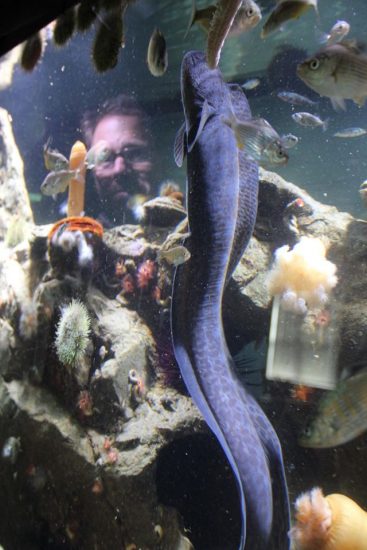
If you’d asked me 10-15 years ago to describe my perfect job, except for the warm and tropical part, I’ve got it. Not only do I get to teach oceanography and marine biology to college students, I get to run an amazing community sized marine aquarium. The MaST Center is a 3,000 gallon aquarium facility for Highline College that not only has college classes but brings in thousands of school kids and thousands of visitors every year. Our small crew of staff and volunteers have done so many amazing things and continue to push the limits.
Can you share a story about a project that worked really well, or a particular student you remember?
Over this fall quarter, as the technical advisor, I am working with the Foss Waterway Seaport and Tacoma Public Schools to articulate a 23 foot gray whale skeleton. We started this project last Christmas, when it was found dead on the beach. Since then, we’ve conducted a necropsy, flensed the meat off, composted the bones, and are now articulating the skeleton. The work is being done by 15 Stadium High School students who during the quarter have talked to an engineer about the structural limitations including a proposed “pose” for the animals, an ethical conversation on whether it should or should not be named, a naturopathic doctor to compare human and whale bones, the lead scientist for the necropsy to help determine why it died. While all of that has been going on, the students are literally putting the whale together.
[Note: Check out The Tacoma News Tribune article on this project]
What are your biggest concerns about the state of marine/aquatic education today?
Most kids have a passion for the ocean but it is limited to whales, sea turtles, and Nemo. My biggest concern and goal is taking that passion and using it to grow them into educated citizens and maybe even a scientist.
You’re a strong advocate for environmental justice. How do you incorporate that into the work you’re currently doing?
Highline College is one of the most diverse colleges in America and serves in South King County one of the most diverse populations. Helping people realize that they are a part of the environment and need to take ownership for their choices is really important. Much of our outreach is focusing on the non-traditional “student”. As a teacher, working with students to explore ideas like internal and external cost. For example last year, one of my classes dug really deeply into a proposed methanol plant in Tacoma which was eventually cancelled before being built.
Do you have any advice for someone starting out in this field?
Build your résumé. My daughter is a sophomore in college where it is easy to get lost especially at the larger schools. Being in the top 10% of a class of 500 students does not stand out. What else have you done? Referring back to the whale, imagine the resume of the Stadium High School students who took all these great classes AND BUILT A WHALE! Get connected with your teachers and professionals as they often know of opportunities that you may not have heard of. Also, find your dream job(s). If you don’t know where you want to be in 10 years, it’s hard to work for that. Even though I’m not looking for a new job and in fact love my job, I have literally over a hundred job descriptions of possible jobs for me in the future. Every time I see a job description that sounds interesting, I save it in my file. Also get on professional organizations and look for their job boards. For example, if you want to work in an aquarium, the Association of Zoos and Aquarium job/internship board has opportunities from all over.
Where do you find inspiration for the work you do?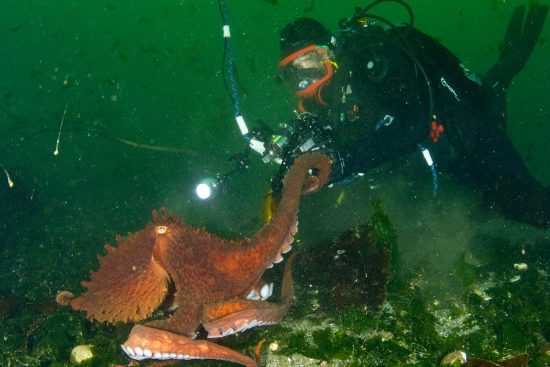
The students are an obvious answer and are some of my biggest inspiration. Seeing them make the connections, seeing them open their eyes to a new thing or way of thinking, is amazing. Also, I try to keep current in the field to help motivate me to continue to push myself.
What is your favorite resource or tool for teaching marine science?
The web has so many real time, global sized resources. One of my new favorite visualizations for the planet is earth.nullschool.net which has a nearly real time model of wind, temperature, ocean currents, etc.
What’s your favorite marine creature?
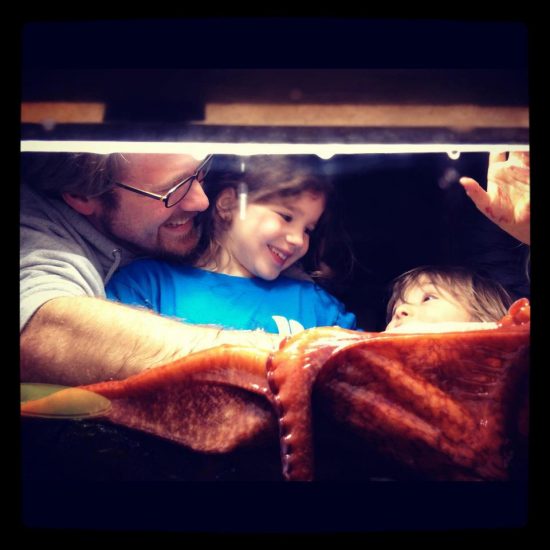
Like a lot of divers in the Pacific Northwest, I love the octopuses. Any dive that finds an octopus is a good dive. At my marine center, we have the opportunity to work with several animals for long periods of time. Watching them grow, learn how to recognize people, and play is amazing. Last year, I even took an octopus to prison for a talk on octopus intelligence. I also generally dive with our octopus during our Octopus Graduation event where we release them back into the Puget Sound and follow them with a streaming camera so the audience can watch real time on the surface. Google “octopus graduation” and you can find some of the old videos.
Where do you go when you want to recharge your batteries?
I’m a river rafter and have been guiding for over 20 years. Getting on the river feeds me. This past August, my wife and I, along with a group of friends, spent 18 days rafting the Grand Canyon. Although a challenging experience, living on “river time” changes the way I look at things.
Do you have a favorite place to visit in the Pacific Northwest?
We love to go camping and two of my favorites are Cape Disappointment which is down by the mouth of the Columbia River and Salt Creek Recreation Area up by Port Angeles. Both feature the ocean but are significantly different environments.
 Are you reading any great books at the moment?
I’m currently working on Energy for Future Presidents by Muller. Although I don’t agree with everything he says, he really works to try to make honest comparisons and has me reevaluating some of my opinions. For example, how does solar power compare to nuclear to natural gas. I’d really love to have a follow up conversation with him because I think he glosses over some of those external costs.
Another favorite is Shell Games by Craig Welch who explores the illegal trade of geoducks here in the Puget Sound area. It’s a factual book that reads like a crime fiction novel.
And finally, who do you consider your environmental heroes?
Rachel Carson whose work Silent Spring played a role in the start of the modern environmental movement. Her science was amazing and her strength to stand up to all the people who thought women can’t be scientists continues to inspire me.
Nowadays, Elon Musk and his push for game changing improvements in alternative energies. We need people to think big.
Thank you for taking the time to talk with us.
Thanks for including me in your great publication. Being recognized for doing the stuff I love is a true honor.
# # #
Open every Saturday from 10 a.m. to 2 p.m. to the public, the MaST Center, mast.highline.edu, is located at 28203 Redondo Beach Drive S.—halfway between Seattle and Tacoma and about 5 minutes south of the main Highline Campus.
Ear to the Ground is a regular feature of CLEARING. Check the website for previous interviews.
by editor | Oct 19, 2016 | Environmental Literacy
Critical Questions
1. What kinds of support are available in your school, district and community for supporting environmental educational activities?
2. In what ways can environmental education activities enhance learning?
3. What are the most effective strategies for integrating environmental education across all content areas?
4. In what ways do students, teachers and communities benefit from classrooms engaged in environmental educational projects?
5. What are compelling environmental issues that can be explored through environmental educational projects?
Possible Actions
1. Become well informed about the characteristics of environmental education, effective models and strategies for integrating across subject areas taught in school.
2. Share this information with your colleagues, friends, and others interested in integrating environmental education into their classrooms or conducting environmental action projects in their communities.
3. Know your national, state, and local school standards. You will find them on the Internet. Consider ways in which environmental education activities can achieve many of the standards across various content areas.
4. Learn effective strategies for guiding students in conducting comprehensive and sophisticated research about environmental issues, solving specific local environmental problems, and acting on their solutions.
5. Encouraged by recent brain research, many educators recognize the value of hands-on, project- and problem-based learning methods, and integrated-interdisciplinary approaches. Use the natural environment and local community as the framework, and integrate environmental education into your everyday teaching.
-from New Horizons for Learning
by editor | Aug 18, 2016 | Learning Theory
Chymograph
by Jim Martin·
kymograph (‘wave writer’): a device that produces traces on a piece of smoked paper clamped onto a rotating drum, a mechanically amplified graphical representation of spatial position over time, such as the rise and fall of a worm’s blood vessel as pulses of blood travel through it. Invented by Carl Ludwig in the mid-1800’s, it consists of a revolving drum wrapped with a sheet of smoked paper on which a stylus connected to the tissue being measured moves up and down, recording changes of motion. (Adapted from Turtles, all the way down: A scrapbook about various hacks and obscure topics.
Chymograph
beautiful
clear grey skin
a touch of blue
the blade reaches deep
line unfolds
reveals skin has edges
and depth
beneath the line
aortic arches pulse
beat out the rhythm
of life
vibrant
vital
vivacious
determined to live
to live
Life
bursts from the wound
an emotional visual
physical
blow to my mind
my soul
can I
because I teach
sacrifice this life
so a line may be scratched
on a piece of smoked paper
❧
Early in my teaching career, I was demonstrating how to set up a chymograph to measure the pulse rate of blood as it was pumped through an angle worm’s dorsal aorta. The set up was simple, but had to be done with great care. Students in the lab class would then introduce their worms to water baths at various temperatures and measure the worms’ response to these environments via changes in pulse rate.
I made the incision along the worm’s long back, exposing the pulsing aortic arches, five blood vessels that pumped blood from the long ventral vein up to the dorsal aorta. These arches perform the same function as our heart, and may represent an ancient step in the ultimate development of the mammalian heart.
As the pulsing arches were exposed, I saw the worm very clearly, not as Lumbricus terrestris, the common angle worm, but as a living being, determined to continue to live at any cost; I saw life itself, and its right to its own existence, and remarked on this to the class. The beauty and persistence of life. An odd comment from a zoology teacher who was showing students how to kill an animal to learn about it.
My life took an unexpected turn at that moment; both my teaching and my personal life. At the time, I was in the early stages of starting to deal with my experiences in the Gulf of Tonkin, where I learned that some human lives were sacrosanct, others were not. I asked then, and still do now, ‘How does a life, valued and valuable, just and humane where it lives, become valueless and inhumane to those who live elsewhere?’ Is there some connection between this human phenomenon and how conceptions of deities and heavens change with changes in time, culture, and circumstances? Experiencing the worm, I began a long transition in my view of life.
The analog line the worm’s pulse traced on the chymograph’s slowly rotating smoked paper was thin and eloquent, instructive and inspiring; its own cognitive beauty. The ‘heart’ was marking its own course, its own activity, its own life and demise. Surely this is a worthy thing to contemplate, reflect upon, and to refocus one’s thoughts and beliefs about life on Earth.
The very first thing that wavering line did was to expand my view of life, to consider it to be more than the lives of humans, their worth and rights. I had a clear cognitive understanding of the evolution of life from the components of cells to cells to multicellular life, but had never personally considered the thought that these lives of all creatures were lived, that they persisted until they could persist no more. My view now began to include the right of all living things to their lives, including human living things.
Because we need to eat, the facts of ecology and nutrition were a stumbling block for awhile, until I realized that all things are in the process of becoming other things. They have to do this in order to live; a paradox built right into the fact of life on Earth.
One thing has seemed to me to separate how humans go about this business of living from the way of all other life. Each living and non-living thing in every ecosystem goes about its work with integrity. They don’t cheat, so, together, they produce a remarkably efficient and effective economy. We don’t exercise this ethical integrity, and create endless problems for the rest of life on Earth. Confucius spoke the only realistic solution to this human dilemma when he suggested we know ourselves, our inner selves, and remain true to that person; doing this he knew we would learn we should treat others as we would wish to be treated ourselves. And so, I began to concentrate on learning to do this, to know myself and to know others; not their externals, but the person deep within.
That person is difficult to miss once you’ve learned to locate it. Eventually, you recognize patterns, and come to the certain understanding that we’re all people, just people. That sets everything straight.
I began to appreciate the relevance of Dryas’ [the author’s late wife — ED.] inclusive spirituality, her sense of the personal and spiritual connection among all living things. The scientist in me needed mechanisms, and continued to look for them, but I could not deny the strength and universal relevance of the spirit that I began to perceive which pervaded all living beings. And I began a search for how humans have perceived this during all of their history in Earth; I continue to try to make sense of our search for spirituality and the traps that are built into being human which impede and disrupt that search. Since we can never know for certain, we are all searchers.
My teaching began to organize itself so that I and my students could observe intact organisms while doing them little or no harm. For instance, you can hold an angle worm still (try it on a moist paper towel) and count the pulses as each bolus (blob) of blood moves down the dorsal aorta. Time them or count how many there are per minute. This provided information about the worm’s response to temperature as useful as that gained from the chymograph. After all was done, the worm went out into the yard. The effect of this change in direction was to focus my students on the organism they were studying, and not on the instruments they might use to make their observations. They began to notice behaviors and other relevant phenomena associated with the environmental perturbations they introduced their subjects to. And I, in turn, turned my focus to the students’ behaviors and relevant phenomena while they went about their work and their thinking. In the end, I learned more from them than I ever did in my education and inservice coursework.
I discovered that organizing my delivery so that students come into my classroom to become scientists did more to involve and invest them in their educations, and empower them as persons, than coming in to learn about science, and being tested on it, ever did. They began to focus on following up on the needs-to-know that their inquiries generated, rather than getting the right answer, then forgetting immediately after the test. And so they carried the weight of their learning, while I busied myself getting reference works on the shelves, providing lab particulars they needed, and so forth. My lectures, which were good ones, were reduced to small mini-lectures, often delivered at a lab table, in response to questions students posed. I recall one sunny afternoon, walking through the lab as the class worked away, wondering what I had done to my stable world of lecture, lab, exam.
And so where does this take me in responding to my original concern about my right to take a life so that a line may be scratched. If I truly respect all life, can I sacrifice an animal’s life in order to know more about it? How about a plant’s life? A paramecium’s? Are there circumstances where this is ethically permissible? I’m not an ethecist, but I think that any time my only resort is to use a life to learn what may be applied to the benefit of others, I must look upon it as a sacrifice and ensure that whatever is done is humane, is as it would be done with a human.
Fortunately, we managed to eliminate these sacrifices in my curricula without short-changing my students’ understandings about the phenomena they studied. In the process, I’ve learned to find the person behind the outward appearances we learn to attend to, the inner light that shines in each of us, that holds our hopes and aspirations, that wants to be recognized and appreciated, and which recognizes and appreciates others.
I’m still working on the insight an angle worm gave me forty years ago. I know from my personal experience that it does no harm to communicate directly with the person who lives at the heart of each of us. And that it usually helps us all relax and appreciate one another’s company on the road we all travel. Together, whether we acknowledge it or not.
When next you see an angle worm, look carefully on its back for a long, dark line. Observe it carefully, and you’ll see either a recognizable pulse, or the line will fade and reappear on a regular schedule. When you see it, you’ll know that its aortic arches are doing exactly what your heart is doing for you. And for the rest of us.
❧

by editor | Aug 18, 2016 | Service learning
These tips, developed by The Straub Environmental Learning Center, may be helpful for teachers who are beginning to integrate a service learning component into the classroom:
1.Start small, and find other teachers who are interested in doing a community project. Support and collaboration are critical for success as you begin this work.
2. Use available community resources. Don’t let issues like transportation and funding stand in your way. Be creative and persistent, and employ all available community resources.
3. Get to know community partners. Be prepared to make calls and meet with prospective partners. They will probably be more than willing to work with you, and may have resources you can use.
4.Don’t let your class become a work crew. The work you do should be the work of your partner. This is not a field trip or guest presentation, but authentic involvement in your partner’s work.
5. Be organized and plan ahead. You can never foresee all possibilities, but staying organized will make you more successful with students and partners.
6. Promote the program. It’s not about you; it’s about the students and their capacity to serve as a resource for their community.
7. Involve students in the selection of their work, and in designing their products. This may be the first time they have some control over their learning. It can be empowering for them.
8. Consider sustainability. As your work expands, think about ways for the program to sustain itself after you leave.
9. Don’t worry about having to know the content, or being in charge of direct instruction. You will become a facilitator; instruction comes from the community partner and the curriculum resources you organize. One of the great joys of this approach is that you often get to learn along with your students. Sometimes, they can even teach you. In other words, the teacher is not the “sage on the stage,” but the “guide on the side.”
10. Remember: This is about community! The work students do must have a clear context. They should come out of their study knowing what their community is, how it functions and how they can participate. This approach also fosters community building within the classroom, as students reconnect with themselves and each other.

by editor | Jul 26, 2016 | Features on Outstanding Programs, Outstanding Programs in EE
Environmental Learning Center:
Restoration project heals environment, community and college
Written by Shelly Parini, CCC senior executive project manager
 he Environmental Learning Center at Clackamas Community College (CCC) represents something different to everyone. Some see it as a place to stroll and commune with nature. Some see it as an outdoor learning laboratory. And others see it as a pioneer in recycling.
As the college marks its 50th anniversary, the Environmental Learning Center (ELC) is entering a new phase with the restoration of the headwaters of Newell Creek on the CCC Oregon City campus.
The ELC is located on a 5-acre natural area containing the headwaters of Newell Creek. The site is part of the 1800-acre Newell Creek watershed, a steep forested canyon that is bordered by the neighborhoods and businesses of Oregon City.
The restoration efforts of the site are made possible through a Metro Nature in Neighborhood grant and the contributions of others who have stepped forward.
The restoration will:
- Enhance water quality within the Newell Creek watershed
- Increase the capacity of the ELC to serve as an educational resource for college students, schools and teachers, industry members and families
- Provide passive recreation for east metro communities
- Leverage the ongoing support of community partners committed to protecting the health and sustainability of the Newell Creek watershed
Concurrent with the restoration plans, CCC undertook an extensive community engagement initiative, the ELC Historical Preservation Project in 2016. The college invited community members, students, faculty and staff to share memories of the past, as well as dreams for the future of the site. Hundreds of people have participated in this process.
The college and the ELC have shared a long history together. The relationship, while sometimes rocky, was shaped around a vision of environmental learning and stewardship. Today, the ELC is a coveted indoor and outdoor classroom for college-wide programs such as Water and Environmental Technology. It is also continues to attract regional universities and local community educational partners to the site. As the restoration project moves forward into the summer of 2017, the college is pausing to reflect on the history of this place and the many people who shaped its shores.
The Visionaries
In his memoir “Transforming Lives,” CCC past president emeritus John Keyser wrote, “The ELC developed early in the college’s history under the leadership of President John Hakanson, as a response to intense community interest in developing new strategies for living in harmony with nature.”
 The ELC has a rich history as an educational resource for the college, regional schools, industry and the community. Located on the site of a former Smucker’s processing plant, the ELC was created to demonstrate what people could do to reclaim industrial sites, address storm water issues and restore wildlife habitat in urban areas.
The idea of creating the ELC gained momentum in 1973, when a group of students under the leadership of Leland John, an art instructor, formed a committee and drafted a plan. “At the ELC, art, community and the environment came together in a singularly unique way, celebrating all three because people were willing to work together for the benefit of their creation,” ELC founder Jerry Herrmann said.
Herrmann had the uncanny ability to recruit volunteers and talent to the ELC. One of his more infamous efforts was recruiting the Oregon National Guard to excavate the site; transforming it into what we know today as the “ecology ponds.” Herrmann always dreamed big when it came to the ELC. In 1977 he hired Nan Hage to design the center’s first pavilion. Hage designed the building to enhance the environment. It was built in 1981 and cost a mere $10,000. Being astute recyclers, Herrmann and Hage got a much of the materials donated. All of the cabinets and flooring are Malaysian mahogany. The boards are ballast from the bottom of ships.
Recycling became a driving force for the visionaries. Herrmann developed a recycling depot at the ELC for the community. It soon became a full-service recycling center, putting the ELC on the map. In fact, it was one of the most successful recycling depots in the state at that time, handling up to 100 tons of material a year.
Stories were also recycled at the ELC. In 1984, storyteller Dean “Hawk” Edwards worked alongside volunteer coordinator Leslie Rapacki to develop and care for Hawk Haven, also known as the birds of prey exhibit.
“The goal was to create an educational wildlife habitat on an industrial site. In essence to recycle the industrial site itself,” Hage said. Clearly they did that, and then some.
In 1987, Lakeside Educational Hall was completed, providing a place for the community to gather and take classes. “Eighty percent of the construction material in this facility was simulated wood made from recycled plastics,” Keyser said. The lighting was recycled from marijuana grow lights donated by local law enforcement officers.
The next visionary to land on the scene was astronomer and scientist Ken Cameron. It was his connections that led to the Haggart family dome donation to the ELC. The Haggart Observatory, as it is now known, opened March 7, 1989, so the community could view the partial eclipse of the sun occurring that day.
The Guardians
As recycling revenue began to decline in the 1990s and CCC subsidies dwindled, the ELC suffered setbacks which strained its relationship with the college. The ELC was in need of a new champion. After a number of interim executive directors, Keyser, who was then president, stepped forward to put the ELC back on track by providing several years of stable funding and critical infrastructure updates. This investment attracted environmental educator John LeCavalier, who was hired in 1996 to reactivate the ELC.
LeCavalier’s leadership was instrumental in attracting like-minded partners, like Larry Beutler of Clearing Magazine, to the ELC [Ed note – CLEARING actually moved to the ELC several years before LeCavalier began his tenure as director.]. His contributions also include developing new programs and initiatives. He further established an endowment for the ELC that would keep it resuscitated for many years to come.
LeCavalier believes the ELC has a life of its own. During his interview he noted, “There is nothing to indicate that the tenacity of this physical place at the headwaters of Newell Creek and the people that have been involved it will not continue well into the future.”
When LeCavalier departed due to budget cuts in 2006, Alison Heimowitz took over as the ELC’s education coordinator. Even as a part-time instructor, Heimowitz developed critical environmental educational partnerships that are still in place today. Together, these partnerships bring hundreds of children to the site each year to learn in an outdoor living laboratory. Heimowitz was also the spark plug behind the writing and designing of the Metro Nature in Neighborhood Capital Grant, which was approved by the Board of Education in 2013. The CCC Foundation Board of Directors also stepped forward to support the grant by committing to raise the critical match to make the grant possible.
The Future
The Newell Creek Headwaters Restoration and Education Project brings together a range of public agencies, conservation groups and community members to engage in a collaborative impact initiative. This project brings to life the best of what the ELC has been and provides hope for what it still can be. After hundreds of hours of conversation with the multitude of community members who consider themselves friends of the ELC, the relevancy of this place and what it has to offer is as important today, as it ever was.
When asked about the relevancy of the ELC’s future, the retired U.S. Rep. Darlene Hooley said quite simply, “Environmental learning never goes out of style.
If you would like to stay engaged with the ELC and the restoration and education efforts, visit www.clackamas.edu/ELC.
