
by editor | Jan 23, 2015 | Environmental Literacy, Place-based Education
No Fooling: Exploring the Nature of Responsibility, Progress, Success, and Good Work
How we answer a challenge raised over half a century ago regarding the way we handle the blessings of nature will go a long way towards determining our future.
by Peter Hayes
In the roughly 10,000 years since members of our species first began to call the Pacific Northwest home, many good questions have been asked. Of all that have been posed, one continues to stand out as the most important. In 1938 during a noontime luncheon address to a group of prosperous citizens in Portland, Oregon, the thoughtful, worldly generalist, Lewis Mumford asked this question: “I have seen a lot of scenery in my life, but I have seen nothing so tempting as a home for man than this Oregon country… You have the basis here for civilization on its highest scale and I am going to ask you a question which you may not like… Have you enough intelligence, imagination, and cooperation among you to make the best use of these opportunities?”
Though he spoke to one group of people in reference to the future of one region, the question applies equally well to our entire species and our total habitat — this planet — “do we have the qualities necessary to successfully live here for the long haul?” That is the most important question in the world. The only answers which matter are those expressed through actions, not words. And what do the consequences of actions taken since Mumford’s 1938 question say about our success? There is certainly good news in the form of the development of a more crash resistant economy, a country and world which may have made progress toward the challenge of judging people by the quality of their character instead of the color of their skin, and the imagination, endorsement, and enforcement of laws which help the powers of care, cooperation, and foresightfulness get the upper hand on the powers of selfish, shortsighted greed trying to turn our commonwealth into their personal wealth.
But overall the evidence of actions taken, and not taken, since 1938 indicate that our answer to Mumford’s question is: “no, we don’t yet have the qualities necessary to successfully live here. Our perceptive abilities, values, and ethics have not yet evolved in the ways that they must in order to develop and use those qualities”.
If meeting the challenge is a matter of fundamental survival, why haven’t we done it? If we are clever enough to pull off such feats as walking on the moon, splitting atoms, and cloning creatures, why not attend to our most basic survival? The answer is that we choose to fool ourselves. Fueled by the powerful forces, including the omnipresent media and our systems of schooling, we fool ourselves in four main ways. Progress toward meeting Mumford’s challenge — our most basic responsibility — depends on recognizing and correcting the ways that we’ve been fooled and continue to fool our children.
The fooling happens in how too many of us answer these four questions: 1) What is success?, 2) What is our greatest challenge?, 3) What is the basis for our decision making?, and 4) What are schools for?
What is Success?
One major reason for our continuing failure to meet — or even acknowledge — Mumford’s challenge is that for the majority of our species the challenge is not seen to be important enough to even pay attention to; for many, there is no connection between our personal yardstick of what it means to be a successful person and progress toward the challenge. Our systems and competitive instincts program us to be amused and preoccupied by other challenges and measures of success — accumulating more money than we need, proving that we are better than other people — whether on the sports field, in the classroom, boardroom, stock exchange floor, or battlefield, and basing our identities and sense of success on the acquisition of power, prestige, and comfort — on what we can take instead of what we choose to give. So, much like the highly capable student who flunks a course because she just didn’t choose to try, the first reason we continue to not meet Mumford’s challenge is that too many of us continue to be fooled into believing that success is measured by actions which take us further from meeting the challenge instead of toward it. Tellingly, Mumford prefaced his question to Portland’s City Club with the caveat that he had a question which his audience probably would not like. Wasn’t this because it presented — to people who already saw themselves as successful — an alternative, ultimately more important, measure of success, which if recognized, stood to threaten and/or limit their accepted notions of success?
What is the Challenge?
As a teacher, I owe thanks to my students for helping me recognize the second way that we fool ourselves. Year after year class discussions devolve into a familiar debate over which of the challenges on humanity’s plate is most important and deserving of our attention and energies. Here is a sampler of predictable excerpts: “Yes, I know that all of the problems with the environment, such as saving the salmon, are important, but you’ve got to realize that we have to look out for the well being of our own species first; people are starving and that must be our top priority.” Or “These efforts to help people learn to treat each other well, and to solve environmental problems like global warming are important, but we have to be sure to do nothing which might threaten quarterly profits and harm the economy; if we don’t have a strong economy, things will fall apart”. They have learned what they have been taught — and been fooled, just as I was fooled. We have inherited a flawed conceptual model which is based on the assumption that our species faces three, competing challenges: the challenge of people learning and choosing to successfully live with one another, the challenge of humans learning and choosing to live within the limits of what the land can provide, and the challenge of learning and choosing to develop an economic system which can endure over time. I fell for it; conclusions such as Aldo Leopold’s: “We end, I think, at what might be called the standard paradox of the twentieth century: our tools are better than we are, and grow better faster than we do. They suffice to crack the atom, to command the tides. But they do not suffice for the oldest task in human history: to live on a piece of land without spoiling it.” fooled me into the mistaken belief that one of the three competing challenge was paramount. I now see that from birth my culture conditioned me to see myself as positioned in the center of a triangle, with compelling, competing, and insistent voices from each corner vying for my attention. Across from Aldo’s siren call come the words of Martin Luther King Jr. and others, such as “We must either learn to live together as brothers or die together as fools.” And from the third corner come the powerful economic cautions of Alan Greenspan, Wall Street, and the WTO advising that without a functioning economy we have nothing. After investing twenty five years of my working life in the wholehearted, and often zealous, service of one of the three challenges — helping people learn and choose to live within the limits of what the land can provide – I have come to see that I was wrong because my work has been based on a flawed conceptual model of the real nature of the challenges. Aldo was right, but he was also wrong; King was right, but he was wrong; Greenspan is right, but he is wrong.
While each is essential, none is in itself sufficient. An economy dependent on the degradation of land or people will never succeed; a healthy land community depends on a functional economy and healthy human community; and humans cannot resolve their differences as long as the ecosystems and economies on which they depend are in disarray. As Jared Diamond described in a post September 11th letter to the Washington Post: “If a dozen years ago you had asked an ecologist uninterested in politics to name the countries with the most fragile environments, the most urgent public health problems, and the most severe overpopulation, the answer would have included Afghanistan, Burundi, Haiti, Iraq, Nepal, Rwanda, Somalia, Yugoslavia, and Zimbabwe. The close match between that list and the list of the world’s political hot spots today is no accident.” Though the world around us continues to do its best to fool us into seeing three competing challenges, the evidence from a careful look at how the world really works convinces me that these are not three challenges, but one — building communities which can survive and thrive indefinitely. For me, the competitive triangle model has been replaced by an interdependent, cooperative circular model of three links of chain. Healthy communities depend on meeting the challenges represented by each link, and our success is only as strong as the weakest link.
Progress depends on each of us learning to let go of our drive to see our highest priority corner or link prevail over the other three (think Earth First, WTO), and instead develop a higher commitment to the whole of being a citizen and community member than to any one of the links. Ironically it seems that the longer and harder we continue to push on our chosen corner of the competitive triangle model — as well meaning as we may be — the less likely we are to make progress toward any of the challenges. Success depends on turning all of our environmentalists, human rights activists, and economic development enthusiasts into just plain citizens — knowledgeable about and committed to all three links of the chain. These people fit into Wallace Stegner’s notion of choosing to be “stickers” instead of “boomers”, and follow the advice of Gary Snyder and others that one of the most radical — an useful – things we can do is to stay put.
What is the Basis of Our Decisions?
The third way that many of us continue to fool ourselves is pretending that the basis of our decisions can reasonably shift if distanced by time and/or space. When reduced to the most local scale, our moral evolution, as a species, has progressed toward basing an increasingly percentage of our actions on what is right to do as opposed to what we have the power to do.
Even if I am bigger and tougher than my two eating mates, I don’t eat more than my third of the pizza because that is the right thing to do; sharing a common pasture with other farming families, I choose to graze only as many cattle on it as the land can provide for, because that is the right thing to do; even if certain investments could be unusually lucrative, I choose not to invest in them because they are bad for the community. Each of these represents a choice to base decisions on ethics instead of power. In contrast to the progress we have made in what might be called moral evolution, we continue to fool ourselves with arbitrary blinders and barriers in terms of what we consider to be the domain of ethics and what is the domain of power.
Curiously something which is based on ethics when close to us in space or time, can slip back to being based on power when removed to greater distance. An example is the land use choices of forest products companies based in the Pacific Northwest. When operating within the United States the company uses a set of land use practices which their full page newspaper ads tell us are shaped not by laws, but by an abiding, ethically based commitment to land stewardship. Yet when the same companies transfer capital from domestic investments to forestry in other countries, their treatment of land is much less careful and, in the absence of land use laws in places like Russia, the basis for company decision making apparently shifts from ethics to what they have the power to do. Similarly, though I might buy a shirt made using child labor paid at unreasonably low rates — if it came from a very distant place, I would refuse, on ethical grounds, to eat at a local restaurant whose existence and profits depended on similar human abuse. Though a fisher would choose for ethical reasons not to steal fish from the hold of a fellow fisher’s boat moored alongside of his, he sees no ethical problem with overfishing a species, such as Atlantic Cod, to commercial extinction, which is effectively stealing fish from the holds of the fish boats of his children and grand children. Why do so many of us continue to fool ourselves into believing that our responsibility for ethical decision making decreases in proportion to how distant and anonymous the consequences become in space and/or time? Isn’t a consequence a consequence, no matter where and when they happen?
The Work of Schools
Mumford’s question — do we have the characteristics necessary to successfully live here — begs a preceding question: what characteristics are most important to us as we seek to meet the challenge?
Though he suggested intelligence, imagination, and cooperation, what would be your top ten essential attitudes, skills, and habits? What letter grade would you give the success of the five schools closest to your home at developing these characteristics in their students? What limits their success in doing this? The schools in my community are failing in this most important responsibility because they don’t recognize it as being their responsibility and are never held accountable for success. Instead, their missions, parental pressure, and deadening effect of school reform standards focus their attention and resources on maintaining and increasing students’ upward mobility — or put more bluntly – using the fair winds of competitive instinct to train good predators. Because of this, the final of the four barrier between us and rising to meet Mumford’s challenge is that too many of us fool ourselves into believing that our schools can be considered to be successful when they continue to put a disproportionate emphasis on preparing students to take/pursue personal gain — instead of developing in students the readiness to give in proportion to what they take, which is the measure of responsible citizenship. This status quo of schooling is a road toward diminishing returns because the pursuit of individual gain at the expense of our commonwealth leaves a dwindling world to be upwardly mobile in. We will know that this barrier is behind us when our schools are as, or more, effective at encouraging moral evolution and developing the characteristics of citizenship as they are in preparing students for upward mobility.
I was born into a world where the imbalance between what people asked of our communities and what those communities had the capacity to provide led to progressive erosion of community health and vitality. Though the decline continues, I am optimistic that within my lifetime it is possible for us to turn the corner by reconciling what our species demands with what the systems can sustainably provide. Every day I become increasingly convinced that the key to success is waking up to the four crucial ways that we fool ourselves and continue to fool each succeeding generation. What makes me hopeful is that when you look closely, in the right spots, it is easy to find, learn from, and be inspired by many remarkable examples of work that are successfully beginning to rebuild community vitality. Their success is the result of choosing to end the foolishness by redefining progress and success, re-envisioning three competing community challenges as one challenge, expanding the universe of ethical responsibility, and reshaping schooling to acknowledge that educating for responsible citizenship is our highest responsibility.
Among all of the candidates proposed as yardsticks for a successful life – educational pedigree, net worth, level of influence — is not the ultimate measure of our value and good work the degree to which we help equip our culture and its children to answer “yes” to Mumford’s challenge?
Peter Hayes is the former Ecological Studies Coordinator at Lakeside School in Seattle. He now manages a family tree farm in the Coast Range of western Oregon.

by editor | Jan 22, 2015 | Gardening, Farming, Food, & Permaculture
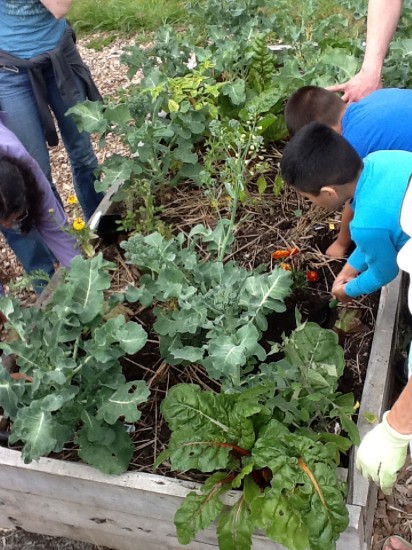
Figure 3: Students and teachers search for critters (aka, decomposers) in the raised garden beds at their school. Photo courtesy of Sybil Kelley.
Can School Gardening Help Save Civilization?
(An Essay in Four Parts)
by Carter D. Latendresse
The Catlin Gabel School
Abstract
This paper is an argument for gardening in schools, focusing on two months of integrated English-history sixth grade curriculum that explores the relationships between a number of current environmental problems—notably hunger, water scarcity, topsoil loss, and global warming—and the land-use practices that led to the downfall of ancient Mesopotamia. This paper suggests that world leaders today are repeating some of the same mistakes that caused desertification to topple the Sumerian empire. It then explains how our sixth grade class explores solutions to the existing emergencies by studying Mesopotamia, ancient myth, gardening, and contemporary dystopian fiction. Finally, this paper posits a new cosmology that might help to remake western civilization, saving it from the threat of present-day ecological crises.
See previous posts:
Part I: Four Enduring Understandings
Part II: Nine Reasons for a Garden
Part III: Mesopotamia and the Garden
Very early in our unit on ancient Mesopotamia, we show the students a twenty-minute video segment featuring writer and host Michael Wood (1991), who points out that the world’s first cities were developed in Iraq, in old Sumer, in the south of Mesopotamia, which means, in Greek, “the land between the two rivers,” the Tigris and Euphrates. The first law, science, astronomy, schools, literature, map of the world, writing, calendar, wheel, wheel-turned pottery, and war were in Iraq. “The history of Iraq,” Wood says, “is rich in splendors and sorrows, the most gifted of civilizations, and yet the most tragic, the first attempt by humankind to bring people together in organized societies with a measure of happiness.” We want to affirm our first enduring understanding—that people seek meaning in closeness, in relationship—before we turn to the catastrophes that we humans visit upon our planet and ourselves. We therefore point out that the Bible names Iraq as the cradle of the human race, containing the great cities of Ur, Nineveh, Babylon, and Uruk, which are some of the most famous in the history of the world, and source of some of the greatest stories in the world: the creation, the flood, the great ark, the Garden of Eden, the Tower of Babel, and the heroic quest for everlasting life. Gilgamesh was, in addition to being the first story ever written in 2500 BCE, also the king of the world’s first great city, Uruk, in southern Iraq.
 We continue the celebration of the place so that the students can rise above the sterile, shallow, and sometimes racist TV news representations of Iraq. Today the marsh Arabs of southern Iraq, we show them in another short video segment, are trying to take back their reed bed towns from the genocidal attempt by Sadam Hussein to wipe them out. In a 60 Minutes (Pelley, 2009) feature that re-aired this past year, Azzam Alwash, an Iraqi-American engineer, returns to the land of Mesopotamia and reminds us that the marsh people of southern Iraq are named by the books of Genesis and Gilgamesh as the first people created by God, and their land has been identified as Eden.
After hopefully giving some profound depth to the region in this way, we return to our second and third enduring understandings—that multilayered, sequential problems of the past are repeating themselves today, and that they insist upon broad-based, commitments across a number of issues. Before turning our attention back to the beginning, though, we point out that today all that remains of the world’s first cities are sand storms and barren dessert. Now Uruk is mounds of sand and bones, a crumbling wall just visible under sand drifts, and a temple mound ziggurat that once held a great statue of the goddess Inanna. Uruk’s population, as already alluded to, doubled within a few decades, and the population’s hunger destroyed the fertility of the earth and their capacity to feed themselves (Wood, 1991).
How did it all happen, and why is Mesopotamia so significant? we ask. It all started with good dirt, water, and wheat, we tell our students, as we stand in our school’s garden in early September next to a bed of ripened and harvest-ready red spring wheat. We then cut, thresh, winnow, and grind the wheat in a lesson my colleagues and I learned at the Edible Schoolyard Project in Berkeley, California, a few summers ago. Our Director of our Food Services visits and does two lessons on cooking with local ingredients, and we being our study of chapters 3-6 of the textbook History Alive! Ancient World (Frey, 2004) that we use as a supplemental resource. The students see how adopting crop agriculture and domesticated animals in settled communities was the most fundamental shift in human history. Hunting and gathering in groups of 30 – 100 were egalitarian, but the settled agrarian communities of Mesopotamia saw the rise of specialization within society and “the emergence of religious, political and military elites and a state with the power to direct the rest of society. At the root of these social changes was a new attitude to the ownership of food” (Ponting, 1991, p. 53-54).
Soon after creating the flour, the students and I fire up the cob oven and use the flour to make a pita bread in a piece of technology very much like the ovens used in Mesopotamia five thousand years ago. Meanwhile, the students continue to distinguish between the hunting and gathering groups—who viewed food sources, whether plant or animal, as available to the entire group, owned by none—and the settled agrarian towns of Mesopotamia—who grew crops in fields and herded flocks, thereby coming to view these living beings as resources and property.
The main advantage of agriculture over hunting and gathering, the students learn, as they are chomping away on the tabouli and hummus and pita we make for our Mesopotamian feast, was that once the einkorn wheat, emmer wheat, or barley seed was saved and replanted, and once goats and sheep were domesticated for the milk and manure 10,000 years ago, the crops, grown year after year in wonderfully augmented soil, would produce surplus. The surplus wheat allowed the farmers to feed non-farming families that included craftsmen such as potters, weavers, masons, and toolmakers. One of the early tipping point moments, though, was when “ruling groups, probably religious at first and then political, rapidly took over the distributive functions. Societies emerged with large administrative, religious and military elites able to enforce the collection of food from peasant farmers and organize its distribution to other parts of society” (Ponting, 1991, p. 54).
Priests and warriors then emerged. What is interesting to us in the sixth grade is that the complex social arrangements and emerging hierarchies allow us to ask our students which jobs should be valued more than others, and in what ways do the jobs cooperate with one another to build a functioning society. Students are asked to research one of the city-states in Sumeria and create an artistic advertisement that entices others to move to their location. Each group, representing a different city-state, puts together a Visitor’s Center style presentation with at least two pieces of information, geographic and social, which are unique to their city-state.
More strands are woven in: we also teach that the great civilization of Mesopotamia was built on cereal, but the grandeur of the civilization was made possible by the intersections of water, draft animals, grain, and writing. The world’s first intensive agriculture system, J. Donald Hughes (2001) argues, was made possible by the ox-pulled plow and irrigation, which facilitated surplus yields and an expanded non-farming urban population (p. 36). Similarly, Jeremy Rifkin (2009) points out that the most successful large scale domestication of plants and animals, wherever it was in the ancient world—the Middle East, India, China, Mesoamerica—was made possible by “large engineering projects . . . including the establishment of elaborate hydraulic systems to irrigate fields” (p. 33). Digging canals and underground aqueducts to supply the fields with water were huge engineering projects. Ponting adds that the first farming was “dry farming,” precariously reliant on rainfall; however, in 5500 BCE, in the east of the Mesopotamian empire, irrigation was developed. The technology was mainstreamed and then thousands of irrigation workers had to be fed and housed, which required surplus food and buildings. Therefore the food production, food storage, home building, pottery, and irrigation industries developed apace in Mesopotamia in mutually supportive ways. To stretch this out to its end, one can also see that because the surplus was able to feed non-farmers, potters emerged that allowed farmers to store their seed for years, and the metallurgical arts developed gold, copper, silver, lead, tin, and, most important for empire expansion, as Jared Diamond (1999) shows in Guns, Germs, and Steel, iron.
To emphasize the hydraulic aspect of Mesopotamia, a feature most of us ignore when we think of the deserts of the Middle East, my teaching partner has her class create an Irrigation Treaty between the aforementioned city-state groups that answers the following questions: 1. Why must city-states cooperate to maintain the system? 2. What actions must each city-state take to maintain the system? 3. What consequences will happen for those city-states that do not follow the treaty?
After focusing for periods of time on food of the region, city-state uniqueness, and water, we present Rifkin’s notion that the writing of Mesopotamia, called cuneiform, was developed as a way to “oversee and supervise the vast complex operations required to maintain the whole hydraulic enterprise. Record keeping allowed Sumerians to track all of the operations, including monitoring the day-to-day storing and distribution of the grain” (p. 35). Ponting’s analysis goes further into the inequalities of power-relations when he suggests that once the seeds were collected and the irrigation system was established, writing was control for the religious and political elites, as they used writing to take over what he calls the “distribution functions” of the surplus food (p. 54).

From Preceden
Around 5000 BCE, Mesopotamia had a fairly uniform culture, with towns scattered along riverbanks between the Tigris and Euphrates, employing subsistence farming, hunting, and fishing to feed themselves. In southern Mesopotamia, however, beginning in around 4500 BCE, large temples began being built in eight large Sumerian cities, with populations of at least 10,000 people. This early urbanization with a central focus on massive, central temples, led to increased control over food production, storage, and distribution by the religious elite and specialized craftsmen, as the grain would be collected, stored, and distributed at or near the temple by the priests and their politicians. “Control of the surplus also involves determining who owns and works the land and who has rights to the food. From the start the temple played a key role in the organization” (Ponting, 1991, p. 57). Even in the first civilizations, we tell our students, the temple priests and administrators, in a move that prefigured the European feudal system by several millennia, came to own the land, collect the grain, mill it, and distribute it back, in rations, to the farmers who, ironically, had grown and harvested it. The power of the pen and the authority claimed from the gods invested the temple officials with their power to institute their own control and to visit targeted hunger upon those whom they chose.
By 3000 BCE, the city states were very stratified: slaves were on the bottom; most people were peasant farmers; craftsmen helped with irrigation, food collection, storage, transport, and distribution; administrators who could write tracked the food surplus; all the while, religious, military, and cultural elite secured their positions at the top (Ponting, 1991, p. 58).
Around this same time, beginning in 3000 BCE or so, private property was claimed by families, and by 2500 BCE the elite class of warriors, rulers, religious personnel and their administrators had risen to prominence by appropriating the agricultural surplus that they themselves could not produce. “Societies that were broadly egalitarian [hunter-gatherer] were replaced by ones with distinct classes and huge differences in wealth” (Ponting, 1991, p. 65).
At this point, we ask the student to do a compare and contrast activity between ancient Sumeria and modern America. How different is our society, with its top 1% and the other 99%, from ancient Mesopotamia? What would an Occupy Wall Street movement look like in Sumeria?
 Also at this same time, I have started my contemporary dystopian novels literary circles unit that imagines ecological catastrophes of the 21st century. Simultaneously, too, students continue their reading of nonfiction and receiving mini-lectures on how Ponting goes on to detail, in ways that prefigure Jared Diamond’s argument in his book Collapse, exactly how the Sumerian empire falls. To recap: first, draft animals are used to plow fields, which are planted in flood plains of fresh water rivers, where massive hydraulic construction projects are undertaken to tame the seasonal floods and use a series of interconnected dikes, canals, and underground aqueducts to irrigate the fields. Nearby, settled communities develop with rising populations and surplus food that is used to feed non-farmers, including growing military, temple, and cultural elite, who claim ownership of the surplus food, using writing to track the food surplus. Then, these new elite classes employ military with metal to invade other lands for more surplus food to feed their swelling populations. However, an irreversible strain has been put upon the land because the empire has outgrown its capacity to feed itself.
In a sequence of events already covered in this essay, more land is cleared of native trees and natural ground cover, which exposes the land to wind and rain erosion. Greater manure from animals is needed to make up for the topsoil loss, and greater water is needed from canals to irrigate stripped soils, since the natural biodiversity of the humus has been removed by erosion and the monocropping of wheat or barley decade after decade. Eventually the extra water drains but stacks upon the water table, causing waterlogged clay soils, the rising of deep minerals brought up in suspension, and the salinization of the land. The irony that we want our students to see is that the very majesty and success that we celebrate—abundance, cultural diversity, job specialization, surplus food—led to the first civilization’s downfall. In order to support both the growing population of the Sumerian empire and the growing trade with other peoples, more and more land was pressed into service in shorter periods of time. “Farmers shortened the period of fallow, overplanted, plowed marginal lands, and intensified irrigation, practices which led to salinization” (Hughes, 2001, p. 27).
Not only do we explain this process of desertification as it happened in Mesopotamia, but we also teach that this dangerous process is today claiming 25 million acres of our world’s fields each year (Pearce, 2006, p. 25). For our purposes, then, as sixth grade teachers, as we look backward into the distant past of Mesopotamia, we are also looking at our expanding world of deserts today—just as Jared Diamond finds disquieting similarities between the current salinization of Montana state’s soils and the salt-caked fields of Mesopotamia (2005, p. 47-49). What’s more, we also have to admit to our students that in the near future, some reports suggest a worldwide population of 9.4 billion people in 2050, when my students are fifty years old (Suddath, 2011, para. 6). These swollen numbers will only ratchet up the need to convert more woodland to farm land and restart the process elucidated in this essay section—unless, of course, the students can think up another better way of feeding everyone.
We can follow the history of Mesopotamia as a kind of warning, then: in 3000 BCE Sumerian became the first literate society in the world, producing in 2500 BCE the first written story, Gilgamesh, which our sixth graders read. By 1700 BCE, due to high levels of salt in the soil of southern Mesopotamia, wheat production was gone. “Between 1300-900 BCE, there was an agricultural collapse in the central area [of Mesopotamia] following salinization as a result of too much irrigation” (Ponting, 1991, p. 72).
We remind our students of sequence of environmental missteps in Mesopotamia before sharing Vandana Shiva’s five-step process that she uses in her book Earth Democracy (2005) to explain how the food corporations gained control of the contemporary industrial food system. The parallels between 3,000 years ago and today are unnerving:
- The exclusion of people from access to resources that had been their common property or held in common.
- The creation of ‘surplus’ or ‘disposable’ people by denying rights of access to the commons that sustained them.
- The creation of private property by the enclosure of common property.
- The replacement of diversity that provides for multiple needs and performs multiple functions with monocultures that provide raw material and commodities for the market.
- The enclosure of minds and imagination, with the result that enclosures are defined and perceived as universal human progress, not as growth of privilege and exclusive right for a few and dispossession and impoverishment for the many. (p. 20)
Even though Shiva is critiquing the world of this decade and the seizure of family farms and waterways in India, Africa, and South America by giant agribusiness corporations like Monsanto, Cargill, Phillip Morris, Nestlé, Suez, Bechtel, and Vivendi (again, we leave out the names of these corporations, as our intention is not to guilt trip or demonize, but to think of solutions), it is startling just how precisely her analysis also applies to the fall of Mesopotamia and the Sumerian empire. One is reminded of George Santayana’s pithy line, “Those who cannot remember the past are condemned to repeat it.”
As a counterpoint to both current agribusiness and to the ancient seizure and commodification of the surplus Sumerian wheat and barley by the elite in that empire, we point our students to examples of what Vandana Shiva calls earth democracy, small farmers and local food communities who stand up to global food export corporations by insisting on healthy local economies while honoring indigenous knowledge and biodiverse food traditions. A local example includes Growing Gardens here in Portland, the organization that organizes “hundreds of volunteers to build organic, raised bed vegetable gardens in backyards, front yards, side yards and even on balconies. [They] support low income households for three years with seeds, plants, classes, mentors and more” (Growing Gardens, 2012). On a national level, the Slow Food USA movement joins an international group of over 225 chapters that “envisions a world in which all people can eat food that is good for them, good for the planet, and good for those who produce it” (Slow Food USA, 2012). An exemplary international movement embodying earth democracy is the bi-annual conference in Turin, Italy, called Terra Madre. The last Terra Madre conference, in 2010, was attended by over 5,000 delegates from over 100 countries, and it featured seminars on a variety of topics including GMO foods, water rights, organic food, and the threats that globalization poses for indigenous cultures (Terra Madre, 2010). These three movements implicitly overlap in their commitments to combatting poverty, food insecurity, topsoil and water scarcity, and empty calories.[1]
These movements provide our children with avenues for healthy food choices in healthy communities; however, without a change of global consciousness, they may be fighting uphill battles their whole lives long. At this point in the unit, just after they have finished their dystopian novels, the students are asked in groups to create a civilization somewhere in the world right now that articulates policies for topsoil and water conservation, green energy sourcing, employment for the employable, economic justice, and quality education. They are told that if they choose the site of London, for example, they are to imagine that the place is empty; however, they have to explain why they selected that site. The last and perhaps trickiest civilization characteristic they have to provide is cosmology, or what the civilization tells itself about its relation to Earth’s beginning, its bioregions, and its other animals.
At this point, to provide the students with a little background, I look backward one more time, this time to southeastern Turkey. Before Mesopotamia was founded, another astonishing event took place in 9600 BCE. The Ice Age has just ended and Hunter-Gatherers were finding more abundant vegetation and wildlife. Their wonderment led, simultaneously, to the birth of religion and to farming in Gobekli Tepe in southern Turkey, 500 miles northwest of Gilgamesh’s great city, Uruk. There, near the town formerly known as Urfa, hunter-gatherers build the world’s first temple, 11,000 years ago (Mann, 2011). Archaeologists had long assumed that agriculture had predated religion, as Ponting and Diamond assumed, but the discovery in Turkey in 1994 has changed the way historians view ancient life in the Middle East. The devotional space and figurines for worship suggest that religion, in fact, predates agriculture, or at least was contemporaneous with it rather than following it—which also suggests that the thirst for the divine, or instinctual awe of humans for the “mysterium tremendum,” as Rudolf Otto (1958, p. 12) calls it, is hardwired into homo sapiens as we gaze up into the night sky and contemplate our place in the seemingly infinite cosmos. In any case, the students are asked to account for their cosmologies after they tell us where they get their jobs, justice, dirt, water, food, and energy for their new civilization.
I want to return now to the original question, “What does the garden have to do with English or history class?” In his book, An Environmental History of the World, J. Donald Hughes (2001), answers the question succinctly: “In Mesopotamia, of all regions studied by ancient historians, there is the clearest relationship between environmental devastation caused by humans and the decline of cities and their civilizations” (p. 38). Simply put, we study Mesopotamia in our garden so that we can understand, with our minds, hands, and taste buds, what they did to both build up and then drive their empire to extinction. In doing so, we hope to analyze the entwined mistakes made several thousand years ago so that we can provide our students with mutually-supporting and variable alternatives to avoid such a miserable end in the coming century, as they face some of the same interlocking problems such as overpopulation, deforestation, desertification, water scarcity, and hunger.
We are intuiting here that new strategies and technologies aren’t enough. Without new paradigms, new cosmologies, we can only borrow faddishly temporary liberal or conservative practices, but we cannot adopt reliable and flexible orientations that will remain sturdy enough and economically and environmentally just for all when problems multiply, overlap, and worsen across the globe. In short, we need a new story for our species, one about a global, empathic civilization, which brings me to the last section of this essay.
[1] I also return to favorite resources throughout this unit when needing reminders about balanced relationships between humans and their complicated biomes, including the following: Gardening at the Dragon’s Gate, by Wendy Johnson (2008); How to Grow More Vegetables, by John Jeavons (2006); Big Ideas, by the Center for Ecoliteracy (2008); The One-Straw Revolution, by Masanobu Fukuoka (2009); Gaia’s Garden, by Toby Hemenway (2009); Growing Vegetables West of the Cascades, by Steve Solomon (2006); Seed to Seed, by Suzanne Ashworth (2002); and the books and pamphlets of the Biodynamic Farming and Gardening Association.

by editor | Jan 21, 2015 | Place-based Education, Questioning strategies
Were You Assigned A Class You Have No Background or Preparation to Teach?
by Jim Martin
CLEARING Associate Editor
 ne year, I worked with a middle-school mathematics teacher who decided to engage his class in some work on a wetland and lake bordering a large river. He did this partly as a diversion from classroom struggles – his background and training weren’t in middle school mathematics; there was no one else available to do the work. And, he was interested in the concept of engaging his students in their community – project-based learning.
So, we went down to the site and took a tour. As we walked and talked, he suddenly stopped, took a few steps back, and stood looking down a shallow slope to the lake, then up the slope toward a wooded copse. I waited a few moments, then he remarked in an excited voice that everything changed as you looked from the water to the slope, and on up to the trees. He said something made that change, and it had to do with the slope. Then, he described what students would explore on a transect along the slope, and how. Wow! His class did the project, and, within two years, he developed into a very effective teacher.
What happened here? He knew he wanted to do something. He knew where he was in his mathematics teaching. And he was interested in his students. But he didn’t get any further until he took a walk, talked about what was there and what students had done, and noticed a slope – geological and mathematical – and, in terms of subsequent progress as a teacher, clarivoyant. The pieces of the puzzle suddenly came together.
How do we move from teaching our curricula one piece at a time, a disconnected clutter of disparate parts? Parts, learned long enough to refer to in a test; then, lost in a long trail of discarded artifacts. We need clear, strong trails if we are to lead effective, self-actualized lives. Learning has the potential to help us organize our selves so that our lives produce clear, permanent trails. In his teaching the middle school mathematics teacher began to build these clear trails, both for himself, and for his students. Part of the secret is learning about the curriculum in the real world, and its connection to the disparate clutter of artifacts we teach. In the classroom and on environmental education sites. I suggest we need to integrate them.
 One thing this teacher did was to let the class in on the plan. Doing this at the start involved and invested them in the work, and began to empower them to take responsibility for its parts. Early on, he began to notice that students were doing good work, and that they brought different sets of skills and abilities to the work. This was a pleasant surprise for him, and he began to see the class as a group of individuals who could make the classroom work environment an interesting one to be part of.
Soon enough, he reorganized the class into work crews, each one responsible for part of the job of assessing a transect up the slope from water’s edge to wooded copse. Accomplishing this was an utterly new experience for him, but he took to it as if he’d done it for years. Within a few weeks, he was beginning to coordinate his curriculum to the work on the slope. Aware of the mathematics curricula he was charged with, he organized the school week into days dedicated to mathematics and to the project. Students didn’t divide their new sense of personal investment in school. They became reliable students each day. Why? I think, because they were learning as humans evolved to learn. How their brain is best organized to do that job. Go into the real world, find real work to do, then focus all resources on this.
I think there were several vehicles which enabled this classroom to navigate from struggling to self-powered learning place. Specifics varied among teacher and students, but each vehicle carried them through its part of the course. The teacher was charged with teaching mathematics, for which he wasn’t well-prepared to do. He was both interested in improving his teaching, and in engaging his students in learning projects in the community in which they lived. Then he saw something, a slope in a landform, that brought these two seemingly disparate entities into a dynamic construct, a conceptual foundation for real learning, learning for understanding.
His students also boarded their first vehicles: crews, embedded curricula, brain work. At first, their commitment varied, but nearly all became interested in the project when they heard about it from the teacher. At the beginning, they were randomly assigned to their groups; but, as the teacher became more aware of them as individuals, he began to reorganize them into effective working groups, crews organized to execute particular parts of the plan.
So, the relationships among the people in the class began to morph. The teacher became the project manager, and the crews became technicians and staff working with a crew leader. Project manager and crews learned to reach out to local experts for advice. The teacher, because he was managing the project, and feeling responsible for teaching mathematics, began to use the mathematics embedded in the work site and the work itself to deliver part of his curriculum.
Locating embedded curricula seems difficult at first thought, but once you try, it becomes relatively easy. For instance, students can measure the maximum width and length of a leaf, and calculate the width to length ratio. They repeat this with other leaves from the same tree to see if that ratio holds true. Then they can see if there is a ratio for the maximum width of a fir or pine cone and its length that is consistent among a sample from the same species. As they do, ratio and proportion becomes sensible, a conceptual tool to use, rather than something to memorize for a test.
This doesn’t apply just to mathematics and science. Look for examples of alliteration in a natural area or in the school’s neighborhood. I’m looking at an example just now – a small tree whose leaves are attached to thin branches in an alternating sequence. When I see a set silhouetted against the sky, their leaves tripping along the branch, I see alliteration. Looking out the same window, I see many metaphors. Metaphors which can activate the same parts of my brain that are activated when I am engaged in close pursuit of the answer to an inquiry question. A very useful brain tool.
Looking past the leaves and metaphors, I see examples of social studies, music, art, drama, history. It’s all out there, the curricula we teach, in a form our brain is organized to use. Once it is engaged, we can then move into the prepared curricula which lives in classrooms. With one difference – this curricula will come to life because it will be engaged by a need-to-know generated by the world we live in. And learned in a way that ensures it will be used. In time, you will find that you can milk the prizes found on one excursion from the classroom to the schoolground, neighborhood, or riparian area for more than the embedded curricula you find. What you find and use generally has links to other curricula, and you can extend these threads quite far before you’ve either used them up, or have become tired of them.
These are things the teacher I worked with learned during the time we explored learning for understanding. By moving into the world we live in and discovering the curricula embedded there, and the involvement and investment the experience invoked in his students, he began to reorganize his teaching. The mathematics he discovered on site clarified what he was trying to teach in the classroom. The energy and growing expertise his students brought to the work helped him learn them as persons, to know when they engaged what I call the moment of learning, and to use their individual strengths to overcome their weaknesses. And they all grew. Because, in my opinion, they engaged their brains in the way brains evolved to learn and cope. Once engaged, they were ready to enter the more formal, abstract curricula which lived in their classroom. To learn it, not to pass a test, but to build their lives.
 This is a regular feature by CLEARING “master teacher” Jim Martin that explores how environmental educators can help classroom teachers get away from the pressure to teach to the standardized tests,and how teachers can gain the confidence to go into the world outside of their classrooms for a substantial piece of their curricula. See the other installments here, or search Categories for “Jim Martin.”

by editor | Jan 3, 2015 | Environmental Literacy, Learning Theory
Bias and the Educator in the Mirror
Our inherent perspectives color the world we share with our students.
by Victor Elderton
Many of us in environmental education strive to create lessons and activities which we hope will facilitate greater understanding and stimulate higher levels of environmental inquiry among our students. The number of positive programs and initiatives which have been started is not vast compared to Language, Social Studies or Mathematics curriculum materials, but at the same time there are enough representative samples around to say there is significant interest in the field.
The very fact that CLEARING can publish articles about different points of view as to the most effective ways of teaching and learning about the environment is testament to how interested a number of us are in how we teach and how students should be instructed about the environment. I have found this a very healthy debate, which has led me to question my own teaching and methodology. How often in our teaching zeal do we question what we are actually teaching, though? We often discuss at length and with passion how we teach, but do we really ask the question: what are we teaching? What are the biases we inherently teach as environmental educators?
If we look at locally developed materials or materials that are produced for a wider educational milieu, what are the perspectives and examples which are used to help students understand the world better? It is my experience that the topics and examples reflect who is writing them – namely homo sapiens sapiens. As a result, our best attempts at writing and developing programs about our investigation of the environment, with few exceptions, come from our own narrow biological bias. In many ways this makes perfect sense because we have to write this way because we are writing for our species. We have a natural interest in those things that are like us.
It seems to me there are some basic biases that we need to recognize when it comes to better understanding of the environment.
The deepest of these is that we are sepraphilic. We like to see ourselves as separate from everything else. I’d argue that if we saw ourselves as intraphilic – part of something else, we would have no environmental dilemmas because the separation of ourselves from the Earth would not be recognized. My experience tells me that there are other world views which recognize a closer integration with the earth but I would also argue that this is not a basic human characteristic. Being separate is very much about who we are.
We are also tremendously macrophilic. What triggers our imaginations are the big things that we see around us. Most of this is due to the fact that our eyes are limited in their perception so thinking about small microscopic things is not common. Yet we know that it is really the microbes which run the planet biologically. How many inverted food pyramids have you seen lately? Imagine what a different teaching straegy we would use if we drew those pyramids so that everything worked from the microbes down to us. Imagine if mammals and birds were at the bottom and we were under everything else. Perhaps it would have a humbling effect on our view of the world.
Since sight is our dominant sense, how we design programs and what we do in environmental education is often built around daylight observations and conclusions based upon those findings. While at any time we may be in daylight, half the Earth or more is in darkness or the half-light of dusk or dawn. For the Earth, no light is more the reality than daylight. How often do our programs look at the systems in darkness as opposed to light? Even at an environmental field study centre, like the North Vancouver Outdoor School, breaking from species and cultural tradition and doing things which are designed to investigate the planet at night are rare.
If being macrophilic and photophilic are part of being, so is being terraphilic. Seldom do we consider that Earth is 75% seawater. Even though our blood has the salinity of salt water, we have lost our connection with it. When we consider world depletion of forests, do we also put equal or greater importance on the real phytoplankton producers of the oceans? Think of the examples that we use to get students thinking about human concern about the Earth. They all stem from issues like forest depletion.
I feel that there are many more of these basic perceptions of the Earth that we as environmental educators perpetrate and continue to embellish. Think about it – we’re kinetaphilic (things that move), and zoophilic (animals as opposed to plants), just to mention a few. These examples don’t even cover perceptions which may be cultural.
In fact, because we have created these limits to our interpretation that are often better covered when we develop programs/curriculum. What I am more concerned about is the fact that they permeate so much of what we teach and we never engage in discussing them. We don’t talk about how we can work to introduce these basic perspectives. I also do not believe that perspectives will be discovered by students by themselves because some of them go against our very make-up as a species. They are not natural perspectives for our kind.
I am hoping that in some small way this article generates some discussion and starts the process of looking at what we teach and how we can better teach based on what we have come to understand as the way Earth systems work. How do we open the doors of understanding and interpretation for ourselves and our students instead of continually limiting them? I believe that artists and poets are attempting to do this, but I also believe our ecological investigations could do a better job as well.
We have never lived at a time when our physical perceptions could be more acute with the prospect of becoming even more refined and immediate. Isn’t it time that we made our mirror two-way and put it on a pivot and gave it a mighty spin?
Victor Elderton is the former principal at the North Vancouver Outdoor School, in addition to being a member of the Board of the Environmental Educators of BC and director of the Pacific Foundation for Understanding Nature Society.


