
by editor | Nov 20, 2014 | K-12 Classroom Resources, Outdoor education and Outdoor School

Early literacy skills can be developed and enhanced through journaling and data collection. Even the youngest learners can feel successful.
Effective Education: Turning the Classroom Inside Out
By Indira Dutt
 s a child at school I remember sitting in a stuffy portable looking out the window to the field and houses beyond. I felt constrained: my seat was attached to the desk, the classroom was just barely big enough to fit all of us, the windows were small, and the air was stale. I also remember the playground outside. I played hide and seek in the small stand of trees beside the field; I helped friends pile up the leaves in the fall and we all jumped in; I imagined an extraordinary museum of found objects–we made displays of the natural oddities that intrigued us and told stories about each treasure.
The two sides of the portable wall felt inexorably different and though I did well in school I was often wrangy in the classroom, wanting a little more of the freedom I felt when I was outside. Funny then that I should chose a career that keeps bringing me back into classrooms.
As a teacher I notice that, when the outside and inside feel completely separate, there is a problem. My teaching needs to be both connected and applicable to the everyday lives of my students and they need to feel free enough to be creative and capacious in their thinking so they can meaningfully participate in their education.
The literal and metaphorical notions of the outdoors are vital for me and so I work to soften the edge between inside and out.
One way I can do this is by creating and embellishing meaningful indoor–outdoor relationships. Connections between indoor spaces and outdoor areas are important “so that the outdoors becomes a natural extension of indoor learning” (Nair, Fielding & Lackney, 2009, p.111). This area of school design is sometimes overlooked or minimized by architects and educators, and this negatively influences students’ relationships to the natural world (Taylor, Aldrich & Vlastos, 1988).
Indoor–outdoor interfaces facilitate indoor–outdoor relationships. These interfaces are points, areas or surfaces that serve as a juncture between the inside and outside of a building. They include features that provide connection to the outdoors such as windows, skylights, natural building materials, aquariums, plants, interior living walls and porches. Even multimedia devices connected to the outside world via the Internet can bridge the gap between interior and exterior.
In 2009 I conducted a qualitative study that explored how intermediate students’ experience of the natural world was mediated by the design of their school building. My study site was the Bowen Island Community School (BICS) located on Bowen Island, a 20-minute commute by ferry from West Vancouver. The school was built on public land, parceled out of west coast rainforest. There are numerous large cedars and Douglas firs surrounding the property. I worked with grade six and seven students at BICS and collected data from two focus groups, semi-structured interviews, photographs and field notes.
One of the major findings of this study was that a school occupant’s experience of being inside their school building extends beyond the physical boundaries of the structure. When I asked students about their experience inside the school, they repeatedly spoke about the school grounds.
From a child’s perspective the whole school site as well as the school’s immediate A school occupant’s experience ofbeing inside their school building extends beyond the physical boundaries of the structure surroundings is a substantive part of their school experience. As well as being drawn to the outside, students expressed the significance of their sense of freedom, joy and beauty. Despite a focus on the fixed structure of the school building and school grounds, the student interviews were saturated with instances in which students reflected that indoor–outdoor connections deepened their freedom of movement, solitude, expression and imagination as well as the freedom to take mini-breaks from work. At BICS these instances of freedom were always associated with their connection to the exterior of the building. Students also recounted joy and places of beauty as critical in their learning.
I believe that my experience as a child varies little from students today. It is no surprise to any of us who have spent time in the classroom with children (of any age) that students’ attention is often drawn away from the topic or task at hand. I think that as teachers we get caught up in expending energy on refocusing, directingand corralling our students into the confines of the classroom, when instead we could find ways to capitalize on students’ desire to move outside. At times this movement is literal, but students’ imaginations can and do take them out in a figurative sense as well.
At BICS, teachers work with the imaginative drive and thirst for freedom that children have. The teachers at BICS incorporate the indoor–outdoor interfaces into the teaching process; they use the view from their classroom windows to highlight relevant elements of curriculum and they bring the children out into the hallway to stand or sit under the skylight and talk about the clouds outside. There is an active engagement with the outdoors from within the structure of the school.
While BICS is situated in what some might consider an idyllic teaching environment, certain aspects of the BICS students’ experience can be generalized to any location, rural or urban. If we can acknowledge the importance of freedom in the life of our students we can start to embrace and incorporate the interfaces to which we have access instead of thinking of classroom windows as distractions and covering them up using blinds or construction paper.
 As a part of my research, I asked 55 grade six and seven students to draw an ideal school building, one that they thought would foster their connection with the natural world. I asked them to label important features they included. The most dominant features of these drawings were plants and animals. During my study I found that students expressed great joy witnessing the complete life cycle of plants. At BICS students could see the garden from their large classroom window. One student exclaimed, “It’s fun to watch everything [in the garden] because you go in the beginning of the year and there are little sprouts and then you go later and there are big shoots and stuff.” At a more urban school in Toronto each class grows a different kind of seed (grade one grows peppers while grade two grows tomatoes) and later in the spring they transplant their seedlings into the garden. In both these examples students develop relationships with food they eat in addition to having an indoor–outdoor connection.
When resources permit, adding indoor–outdoor interfaces by creating a “living things zone” (Nair, Fielding & Lackney, 2009) can delight students and inspire observation and investigation. I noticed students would consistently gather around a seaquarium in the foyer at BICS and watch the sea creatures inside. One student exclaimed with joy, “You don’t see a seaquarium everyday. It’s my favourite. Sea cucumbers, yeah, they spit out their guts for protection.” Students used their excitement about sea creatures and ability to watch them for long periods of time to write daily observations and creative stories in their journals.
Living things zones can include elements such as plants, sprouts, a window farm, living walls, an aquarium and small animals. In some Waldorf classes, one daily routine (first and last thing of day) consists of each child retrieving their potted plant from a table top, bringing it to their desk for the day and then putting their plant back on the tabletop at the end of the day, watering it when need be. Each child sees their plant change over time, while having something small for which they are responsible, and they always have a living thing close at hand. Even this very small and relatively easy version of a living thing zone has a profound effect on students.
If we take a broader view of nature, and humans’ place within it, we might even conceive that the very busy urban street below a school window has natural lessons waiting to be learned. Rich conversations result when we explore what is happening beyond the walls of the classroom regardless of where our school is situated.
With our students’ best interests in mind we can utilize existing indoor–outdoor interfaces to enhance curriculum. While I feel a particular affinity for green spaces and places where dirt and water and clean air are easily accessed, in reality many schools occupy sites with precious little green or naturalized space. We can find ways to incorporate the nature outside, be it the trees or the bustle of humanity on city streets, in our classrooms to create an expanded sense of freedom and joy in our students.
References
Nair, P., Fielding, R. & Lackney, J. (2009). The language of school design: Design patterns for 21st century schools. Rev. ed. Minneapolis, MI: DesignShare.
Taylor, A., Aldrich, R.A. & Vlastos, G. (1988). Architecture can teach … and the lessons are rather fundamental. In Context, 18(Winter), 31–38.
Wilson, E.O. (1993). Biophilia and the conservation ethic. In S.R. Kellert and E.O. Wilson (Eds.), The biophilia hypothesis (31–41). Washington, DC: Island Press.
Indira Dutt is a graduate of the Center for Cross-Faculty (Architecture and Education) Inquiry in Education at University of British Columbia. She is currently participating in a Participatory Design Process at Cassandra Public School and working at Outward Bound, Evergreen Brickworks. This article was originally published in Pathways: The Ontario Journal of Outdoor Education 2010 23(2).

by editor | Nov 20, 2014 | Gardening, Farming, Food, & Permaculture
Can School Gardening Help Save Civilization?
(An Essay in Four Parts)
by Carter D. Latendresse
The Catlin Gabel School
Abstract
This paper is an argument for gardening in schools, focusing on two months of integrated English-history sixth grade curriculum that explores the relationships between a number of current environmental problems—notably hunger, water scarcity, topsoil loss, and global warming—and the land-use practices that led to the downfall of ancient Mesopotamia. This paper suggests that world leaders today are repeating some of the same mistakes that caused desertification to topple the Sumerian empire. It then explains how our sixth grade class explores solutions to the existing emergencies by studying Mesopotamia, ancient myth, gardening, and contemporary dystopian fiction. Finally, this paper posits a new cosmology that might help to remake western civilization, saving it from the threat of present-day ecological crises.
Why Garden in School?
Part I: Four Enduring Understandings
During the fall months in my 6th grade English class, I teach gardening, ancient flood stories, contemporary dystopian literature, and ancient Mesopotamia. My colleagues and I ask our students to look backward to identify essential characteristics of the first human civilizations, so that they might look forward and imagine remaking Western civilization in the 21st century. During these lessons, my history teacher partner focuses on the development of agriculture in the Neolithic Age (8000 BCE to 3000 BCE), the rise of Sumerian city-states, the four empires of Mesopotamia, and the characteristics of ancient civilizations. In my English class, my curriculum parallels and interweaves with these topics at crucial points, especially around issues of soil, water, food, climate, environmental justice, and the stories we tell ourselves as humans to orient ourselves to Earth, to one another, to the other animals, and to the cosmos. Sixth grade students and teachers at our school can often be found outside during September and October, harvesting apples, grinding wheat, learning about bee keeping, planting overwintering lettuce, or baking pita bread in the garden cob oven. Several people have asked, “What does the garden have to do with English or history class?” or “Why do you garden in school?” This essay is an attempt to answer these questions.
The sixth grade teaching team begins its unit from the principles enunciated in the seminal curriculum design text, Understanding by Design, by Grant McTighue and Wiggins (2005). The authors show that the best teaching is, paradoxically, in preparation for college while it is also, at the same time, as John Dewey (1897) says, part of an informed “process of living and not a preparation for future living” (Article Two: What the School Is section, para. 2). We strive to present riveting, relevant, future-thinking curriculum that is rooted in solving the problems and celebrating the wisdom that exist today. The problem-based teaching with a backward design process outlined in Understanding by Design offers us a good model on how to remain, simultaneously, college preparatory and focused on today’s most pressing issues. The garden is our place of intersection for the teaching of ancient history, the novel, writing, economics, politics, anthropology, religion, myth, and science. Pedagogically, we have nine reasons for teaching the Sumerian empire in our organic garden behind the middle school building. These nine reasons grow up out of the four enduring understandings we want our students to chew on for the rest of their lives.
The first enduring idea or understanding is that the aims and desires of most people on Earth have been fundamentally similar since hunter gatherers first domesticated crops and animals in Iraq 10,000 years ago, and we can empathize with those people because we too desire, at bottom, the same things, which are connection and belonging. As humanities teachers, we do not present what some might term a traditional history curriculum to our students that focuses on names, dates, generals on battlefields, or famous men elected president. Such a presentation presupposes that the victors of confrontations make history, and that conflict, violence, and the will to power are the unconscious driving impulses scaffolding the metanarrative of the human species. Instead, influenced by new scholarship focusing on empathy, mirror neurons, the lives of women, the colonized, and ordinary people throughout history, we begin by asking, Whose stories get left out of history, and why? We unearth representative stories that could stand for the great silent majority of human history, and we presuppose, along with Jeremy Rifkin (2009, p. 9-26), that the deepest unconscious desires of Homo sapiens include companionship in towns that provide nutritious food, clean water, and safe homes for our children. By studying Mesopotamia, we get a snapshot of people putting these desires into action when they created the world’s first cities.
Our second enduring idea that we want our students to return to throughout their lives is that there exists today a phalanx of interwoven problems facing the human species—global warming, hunger, biodiversity loss, deforestation, poverty, water scarcity, topsoil depletion, each of which is exacerbated by overpopulation. While these global issues may feel both overwhelming and unapproachable, during the autumn of the sixth grade year, we teach that several of these problems are causal, one giving way to the other, and all have their roots in practices one can find in Mesopotamia. Such practices included clearing the land of trees, erecting massive irrigation systems, then farming monocultures, which led to erosion, then desertification, and then later empire collapse.
Ten years ago, Time magazine, in its August 26, 2002 edition, released a Special Report entitled How to Save the Earth. “Up to a third of the world,” the authors noted, “is in danger of starving. Two billion people lack reliable access to safe, nutritious food, and 800 million of them—including 300 million children—are chronically malnourished” (Dorfman & Kluger, 2002, p. A9). The authors also presented startling statistics on water scarcity: “At present 1.1 billion people lack access to clean drinking water and more than 2.4 billion lack adequate sanitation. ‘Unless we take swift and decisive action,’ says [then] U.N. Secretary-General Kofi Annan, ‘by 2025, two-thirds of the world’s population may be living in countries that face serious water shortages” (Dorfman & Kluger, 2002, p. A10). Whereas Time magazine did not then connect the dots on the ecological problems it investigated, other writers since that time have.
J.R. Rischard’s (2002) High Noon was similarly foreboding but more thorough. The former vice-president of the World Bank gave us twenty years to address twenty pressing and mutually destructive environmental concerns such as global warming, deforestation, biodiversity loss, fisheries depletion, and water shortages. One wonders how far we’ve come in half our twenty years. Joining the chorus, the eminent historian Jared Diamond (2005) likewise proposed, in his book Collapse, his own list of eleven similar and overlapping ecological problems that require immediate attention: problems such as—pardon the repetition—deforestation, coral reef destruction, fisheries depletion, erosion and topsoil loss, the end of peak oil, lack of potable water, toxic chemical pollution, global warming, and overpopulation (Diamond, 2005, p. 487-496). Similarly, Clive Ponting (1991) argued that each empire, whether Sumerian, Egyptian, Roman, or Mayan, follows the same paradigm, already alluded to, during its downfall: deforestation, erosion, monocropping, overwatering, desertification, and eventual collapse.
What we want our students to investigate, as part of this second enduring understanding, is that these problems are interconnected. Global warming, peak oil, the global food crisis, poverty, the loss of healthy local economies, and biodiversity loss are mutually-supporting spokes of a wheel that continues to roll over the backs of billions, especially in the southern hemisphere. “It is wrong to grow temperate-zone vegetables [as monocrops for export, such as bananas] in the tropics and fly them back to rich consumers,” Vandana Shiva (2008) writes, articulating some of the sometimes hidden interplay between injustice and ecology. “This uproots local peasants, creates hunger and poverty, and destroys local agro-biodiversity. . . . Since vegetables and fruits are perishable, transporting them long distances is highly energy-intensive, contributing to climate change” (p. 128). Throughout the years, Shiva has continued to elucidate the point that the global food industry perpetuates economic and environmental injustice for local, most southern hemisphere economies that export monocultured cash crops such as sugar, bananas, coffee, cotton, chocolate, and tea to more wealthy countries overseas. Healthy local economies and ecosystems overseas are compromised, even ruined, by the industrialized global food system.
Carolyn Merchant (1989, p. 52) and Shiva (2008, p. 105) likewise note the tendrils connecting seemingly disparate issues: when lands are cleared for monocrop exports, pesticides and inorganic nitrate fertilizers are typically poured into the diminishing soil, which then invites pests and disease—as monocultures have easier genetic codes to crack than biodiverse fields—which in turn increases the need to clear and deforest more land for cultivation. So-called free trade agreements and exporter-friendly loaning institutions—such as the World Bank and the World Trade Organization—conspire to wrest land from local subsistence farmers so that the multination agribusiness corporations can buy out smaller farmers and expand.
Noting the preceding, concerned parents might worry that their children will look around the world—at India, Mexico, Ecuador, Indonesia—and assume that we in the U.S. are foisting our relative strong economy on other nations and therefore insisting that the errors of Mesopotamia be repeated in other modern countries today. We teachers share this concern, but we lean toward the notion that people, in their deepest recesses, seek belonging and connection rather than power and exploitation. In addition, we resist the hard-hearted theory of British economist Thomas Malthus (1999), who in 1798 proposed that population growth would outrun the ability of the world to produce food. Overpopulation, he said, would lead to war, famine, disease, and other calamities that would curtail human reproduction in a kind of macabre, unsentimental balance. Instead of simply cataloguing wrongdoing across the world and assigning blame, shrugging our shoulders in an unfeeling social Darwinism—which is counterproductive, in the end, to the creation of the empathic civilization that we hope to create—we sixth grade teachers like to move quickly to our third enduring understanding, which seeks to empower the students with problem-solving strategies.
The third enduring understanding we unpack for our students is that just as the current aforementioned global problems are interwoven and therefore seemingly intractable, multiple solutions will be employed this century on an international scale, and we, paradoxically, might most easily help on campus by studying local, organic food, responsible water use, and enlightened community engagement. If we grow organic vegetables at school, for example, in raised beds using low-evaporation drip irrigation, using seed we’ve collected from the previous year, and then we later harvest and eat that produce at lunch in our salad bar, we show the students how to support healthy, local, biodiverse economies—and overseas farming economies, by extension, who might convert their fields back to feeding their own peoples—while also reducing the use of inorganic fertilizers and pesticides, as well as diminishing global warming that follows energy-intensive global packaging, refrigeration, and shipping.
Paul Hawken (2007) states that the movement to establish a more sustainable world “has three basic roots: environmental activism, social justice initiatives, and indigenous cultures’ resistance to globalization, all of which have become intertwined” (p. 12). We in the sixth grade teach all of these topics during our fall Mesopotamia unit so that our students begin to see that environmental movements are really about social justice and health, at bottom, just as biodiversity is about local sustainability.
Various historians and social theorists suggest ways to live in post-oil economies. Indeed, the genre has become a nonfiction subgenre, claiming whole sections in bookstores. In addition, leading intellectuals, such as Richard Tarnas (2012), are pointing to ecovillages, intentional communities, and small, independent schools such as Catlin Gabel as ways to address a coming crisis of living in the world with more people and dwindling fossil fuel reserves, since smaller nontraditional living and educational sites can more deliberately incorporate the use of alternative energy sources and the new paradigms that are needed to sustain them.
What becomes clear after reviewing the three enduring understandings—human desire creates multilayered problems requiring multilayered solutions—is that the vision of human history we are presenting is paradoxical. Surely, the overall quality of life for most people on the planet today is more comfortable, safe, and enjoyable than it was for people living in the city of Ur in 2500 BCE. Smallpox vaccinations, electricity, indoor plumbing, telephones, computers, automobiles, and a thousand other technological innovations have bettered the quality of human life since the great cities of Mesopotamia fell and were reclaimed by the desert. However, we also live in an age of contradiction, during a time of converging ecological emergencies, and climate scientists might easily join Hamlet in his enigmatic assessment:
“What a piece of work is a man! how noble in reason!
how infinite in faculty! in form and moving how
express and admirable! in action how like an angel!
in apprehension how like a god! the beauty of the
world! the paragon of animals! And yet, to me,
what is this quintessence of dust?” (Shakespeare, 2.2.295-300)
How should we synopsize these seeming contradictions? The students live on a beautiful, amazing planet, but one that is engulfed in growing environmental calamities. It’s our job as educators to resist dichotomous, simplistic thinking; rather, we strive to admit the complex truths and to problem solve collaboratively across coalitions and issues. It is also our job to resist cynicism, hopelessness, and paralyzing guilt as we explore these topics with our students. When we look to the past with our students, we can see the choices our ancestors made when they settled around reliable food sources in the Middle East at the end of the last ice age, building the world’s first cities, and we can imagine remaking our future cities this century with smaller carbon footprints.
Our curriculum design around Mesopotamia and the garden is to explicitly connect issues while resisting reductionist mono-issue, silver-bullet thinking. We do not proceed with the idea that a hydrogen economy will replace the topsoil, the fish in the ocean, or the trees being clear-cut in the Amazon. At the same time, we don’t deny it won’t help. We agree, in short, with Paul Hawken’s (2007) premise, in his book Blessed Unrest, that there is a massive social justice and environmental conservation movement afoot without one monolithic mission statement or central leadership. This movement is systemic, global, and broad, focusing on many issues and comprised of thousands of groups—for clean air, better public education, water conservation, and bans on GMO in food, for example. Despite the fact that there does not exist some central agency dispensing strategy and dogma, their aims intersect around two main principles: social justice and environmental conservation, which both lead to our last pedagogical goal.
Our fourth enduring understanding is that the stories a culture tells itself about its origins, its purpose, and its future will determine to a large extent that culture’s ability to survive the tests of time. Another way of saying this is that the stories we tell ourselves will help us to imagine the solutions we will need to fix the problems we have created. We teachers find that we are able to present both the intersecting problems and the possible solutions by retelling the oldest stories humanity has told itself about its creation, its place in the cosmos, its meaning and purpose. I therefore teach Gilgamesh (McCaughrean, 2003), the first of all written stories, from Mesopotamia. I also teach Genesis (Holy Bible, 2003), perhaps the world’s most influential narrative, plus a host of Greek myths, from the beginnings with Gaea and Uranus, through Cronos to Zeus, Prometheus, and Pandora, finally culminating with Deucalion and Pyrrha (Baker & Rosenberg, 1992). Similarities jump out when the three narrative strands are laid side-by-side: Gods create the world, including humanity; humans either lose or try to gain eternal life and fail; Gods become displeased with humans and send a flood, killing all except for a favored few, who survive in a boat and then go on to repopulate the world with the Gods’ blessings. The fact that the oldest stories all focus on an ecological catastrophe that is not dissimilar to the one featured on our nightly news today is not lost on our students. They see, for example, that global warming is melting the polar ice caps today, threatening coastal civilizations with flooding. This isn’t a grim news story “out there” somewhere or a tall tale easily relegated to a bookshelf labeled “myth and legend.” NOAA reports that half of Americans live within fifty miles of the coast (2011). If the ice caps melt, hundreds of millions worldwide will become ecological refugees. Studying the ancient stories in the contexts of both the founding of human civilization and our current ecological predicaments makes sense, then, as we want the students to analyze the old stories in order to eventually imagine new narratives for the coming century that will include heroic deeds of collaboration in order to create a just global village.
In addition to studying the world’s oldest stories, I also teach contemporary dystopian literature to explore a number of possible reactions to potential environmental troubles of the future. The science fiction and fantasy novelists have been at the vanguard of imagining solutions to life’s problems for over a century. The students are directed to probe the reasons for civilization collapse in their novels and to imagine resurrections based upon sustainable principles involving soil, water, food, housing, and energy production. I also pair the dystopian novels and civilization creation projects with nonfiction reading of four National Geographic articles on the first civilizations, food insecurity, topsoil loss, and water scarcity. Students are asked to image themselves creating their own civilizations in the next century, given certain definitions for advanced civilization and all of the ecological challenges we are facing right now.
Taken together, these four enduring understandings undergird our nine reasons for teaching in the garden. We want to provide students with the backstory for how we got to 2012 as a human species, emphasizing that the study of human history should elicit our empathy rather than condemnation. We also want to provide our students with interpretive lenses with which they can analyze both our current human impact and utter reliance upon Earth. Last, we want to offer students the schemata to remake a more sustainable, just, and enjoyable civilization for the world’s citizens in the 21st century.
Click here for Part 2

by editor | Nov 20, 2014 | Critical Thinking, Environmental Literacy, Learning Theory
 Helping Teachers Gain Competencies in a Technological Age
Is Active Learning, Learning?
by Jim Martin
Because active learning requires practice and feedback on thinking like an expert (a scientist), it demands considerably greater subject expertise by the teacher. . . . [A problem that] will remain until college science teaching improves to the point that all students, including future K-12 teachers, graduate with a solid understanding of science and a better model for good science teaching and learning. . . . Most people, including university faculty and administrators, believe learning happens by a person simply listening to a teach¬er. That is true if one is learning something very simple, like “Eat the red fruit, not the green one,” but complex learning, including scientific thinking, requires the practice and interaction described earlier to literally rewire the brain to take on new capabilities.
– Carl Wieman
Wieman is describing what I view as the historical residuals that impede effective teaching in today’s schools: We are leaving the educational needs of the Industrial Revolution, and embarking on the needs of our Technical age, and evolved social and cultural structures. Rote learning limits human empowerment, yet we still, in large part, rely on it.
The two issues Wieman describes both limit the education our students receive, and perpetuate the problem because under-prepared graduates make under-prepared teachers. Teachers are the only people who can correct this. Teachers can’t give effective feedback to learning students if they haven’t the requisite extensive experience and knowledge of what they are teaching to do so. A teacher who has done the science, and comprehends the concepts and processes involved in what is being learned, will have a much better perspective to process a student’s efforts, place them within a meaningful context that the student can respond to, and observe for first, critical, steps toward learning for understanding. For a teacher without the background to comprehend and do the science, a student’s efforts which seem to be going in the wrong direction might be interpreted as being altogether wrong, the appropriate material in the text or instructions pointed to, and the student moved on; perhaps even to learn what was to be learned, but not empowered as an autonomous learner. And less likely to become a competent student. Ultimately, what was to be learned will not be learned well enough to remain in memory after the test.
If teachers are to engage their students in active learning, which has the capacity to produce effective long-term conceptual memory, we all need to help build an environment where teachers are assisted to become competent in the concepts and processes they teach. Since I started tracking teacher preparation for the content they are asked to teach, about half are reported to have had the coursework and/or experience to teach it. Wieman finds a similar pattern. Even those who teach teachers aren’t immune. A chemist, who mentored science teachers for a federal education support agency, didn’t know that cold creek water which was overhung by vegetation and aerated by an upstream riffle might have what appears to be an elevated dissolved oxygen content. This is a real deficit, and we all need to do something to resolve it.
Environmental educators have generated an enlightened public which has produced a State, Oregon, that is an epicenter for streambank restoration in the world. We’re now faced with a nation which is near the bottom in science education among the highly developed nations. Environmental educators can help inexperienced science teachers gain the confidence and expertise they need to improve science education in our classrooms. Everything we need to do that is on our sites and in our heads. We only need the bootstrapping will to take the first step – sit down with someone of a like mind, talk about what needs to be done, then, together, sit with someone else and do the same.
Here’s one I experienced years ago at a constructed pond within a large industrial area. The pond was connected by a canal to a large natural lake. There was a parking lot on one side of the rectangular pond; a large drain pipe removed water from the parking lot and surrounding area and dropped it about ten feet from its open end into the pond. We visited one Spring as part of a science inquiry workshop. Teacher participants were practicing water quality observations, and asked to decide in each of their groups where to make their observations.
As we gathered to review their findings, most groups’ dissolved oxygen (DO) measurements were within the range we’d expect for pond water at the temperatures they’d recorded. Two groups, however, recorded very high DO values. One group had made their observations in the center of a large algal bloom at one end of the pond, and they decided that, since these were algae producing the high DO levels, the levels observed there represented excellent water quality. The other group had measured water quality at the place in the pond where water flowing out of the drain pipe splashed into the pond. Their DO measurements were higher than those in the algal bloom. This group decided that, since the water leaving the drain pipe must be polluted, the high DO values represented very poor water quality.
What would you have interpreted from the DO data and places where the observations were made? Those teachers were using the science they knew, and taught, but in a place outside the classroom or lab. What might they have thought and said if it were their students who made the observations, and their interpretations of the results were different? Perhaps even the opposite of those they had made themselves?
We’ve all been faced with dilemmas like this. How do we respond? How might a teacher respond who has never made a scientific observation outside the classroom? Perhaps never made one at all? (Or the chemist who didn’t understand dissolved oxygen dynamics in a natural environment?) How might an environmental educator respond to this issue? By that last, I don’t mean give the correct answer; I mean relieve the deficits in experience and understandings that brought the problem into existence.
Most issues in education become issues because we don’t lay the practical and conceptual foundation our careers require. To fix it, we need to jack up our structures, rebuild their foundations, lower the structure back on a solid foundation, then let the creaks, groans, and cracks in the structure tell us how to reorganize it. This is something our top-down educational organization is unable to do. We have to do it ourselves. I say that teachers who are comfortable teaching inquiry science, and environmental educators who are comfortable reaching out to teachers, need to get together to bring science back to young people in ways which restore its inherent interest, excitement, and empowerment.
Working together, environmental educators and teachers who routinely engage their students in inquiry, are a practical hope for building a stronger science edifice in our schools. Current efforts from the top of education’s administrative structure to embed a common core curriculum and new science standards in the schools haven’t, to date, funded the basic professional development support that a large number of teachers will need to bring these initiatives to life, and make them a basic part of all education in the nation. A good way to make this happen, in an effective, non-punitive, way is for the work to start in the classroom, supported by teacher mentors and environmental educators.
Why do I include environmental educators in words about science inquiry education in classrooms. Because inquiry education relies on active learning, which is an effective way to build conceptual learnings into long-term memory. Active learning is the teaching modality that most environmental educators use. The familiar concrete referents students and their teachers will use at an environmental site make learning to do and understand science inquiry much more effective. And because school curricula, even though it may be so disguised that it seems appropriate only to school, is actually about the world we live in. You can find it embedded in nearly every place you see, from a busy neighborhood business area to a riparian forest or a mountain stream.
It’s been my experience that teachers respond well to developing the capacity to take charge of their science curricula by beginning with inquiries in a natural environment, zoo, or school neighborhood. Inquiry workshops which introduce groups of teachers to science inquiry in places with familiar concrete referents, then use these experiences to transition participants into science inquiry with the materials they have in the classrooms, are a good first step in improving science education. If it could be arranged, environmental educators and teacher mentors would ensure that a large number of these teachers would complete the journey to become those who, along with their students, routinely learn for understanding. And are willing to help empower other teachers.
Here are two sets of five assessment statements which have been used with effect, and which would emerge from the classrooms of teachers who have been freed to teach science as it should be taught. Freed because they have overcome the obstacles their teacher preparation and current punitive emphasis on standardized test results place on them. Freed to give effective feedback to their learning students. A teacher who has done the science, and comprehends the concepts and processes involved in what is being learned, will have a much better perspective to process a student’s efforts, place them within a meaningful context that the student can respond to, and observe for first, critical, steps toward learning for understanding.
National Board for Professional Teaching Standards teacher certification program effective professional teaching propositions:
1. Teachers are committed to students and their learning;
2. Teachers know the subjects they teach and how to teach those subjects to students;
3. Teachers are responsible for managing and monitoring student learning;
4. Teachers think systematically about their practice and learn from experience; and,
5. Teachers are members of learning communities.
I believe that #2 above is not effectively addressed by current reforms. The five propositions listed above lead to what comes next:
Bill and Melinda Gates Foundation Measures of Effective Teaching and Cambridge Education Project teacher assessment assessors developed by students, themselves:
1. Students in this class treat the teacher with respect,
2. My classmates behave the way my teacher wants them to,
3. Our class stays busy and doesn’t waste time,
4. In this class, we learn a lot almost every day, and
5. In this class, we learn to correct our mistakes.
Becoming comfortable and experienced in teaching inquiry-based science is a fundamental step in meeting these propositions because it engages a paradigm shift which provides you with a more realistic perspective about science and students becoming scientists.
 This is a regular feature by CLEARING “master teacher” Jim Martin that explores how environmental educators can help classroom teachers get away from the pressure to teach to the standardized tests,and how teachers can gain the confidence to go into the world outside of their classrooms for a substantial piece of their curricula. See the other installments here, or search Categories for “Jim Martin.”
by editor | Nov 20, 2014 | K-12 Classroom Resources
EE Research: Storytelling as a Tool for Young Learners
Using storytelling is the best way to engage very young students
from EE Research Bulletin
Nicole Ardoin, Editor
Research suggests that lasting attitudes toward nature and the environment form in the first few years of a child’s life; thus, instilling environmental awareness in very young children represents a key challenge and an exciting opportunity for environmental educators. Although firsthand experiences in nature in early childhood have been shown to contribute to environmental awareness, educators working in urban areas may find it difficult to arrange such experiences. In these circumstances, fictional or non-fictional narratives about nature and the environment may offer an alternate means of exposing young children to environmental subjects.
To investigate the effectiveness of storytelling as an environmental education tool, the authors of this study developed a short, fictional, preschool-level story about deforestation. The authors structured the story around the “binary opposite” concepts of security and insecurity (i.e., trees provide security, while deforestation leads to insecurity). Prior research has shown that this type of simple dichotomy, especially when paired with other narrative tools such as mystery, imagery, morals, and metaphor, can effectively capture the attention of very young children and help them construct meaning from new experiences.
In addition to the story, the authors designed a second lesson to present the same ideas in a more traditional expository format. Both the story and the expository lesson included information about important environmental regulation functions that trees perform, such as oxygen production, flood control, and air filtration.
The study took place in Southeastern Europe, a region heavily affected by deforestation. A total of 79 students from eight urban preschools with attendance from predominantly middle-class families, participated in the story-based lesson, while a control group of 80 students from the same schools received the expository lesson. Researchers assessed all students’ ideas about the importance of trees, and level of interest in tree planting as a free-time activity, prior to the lessons. A second assessment took place one week after the lessons, and a third followed about two months later.
In reviewing the assessment results, the authors found that students in the storytelling group demonstrated significantly better recall of key ideas from the lesson. One week after the lessons, when asked to explain why trees are important to humans, students in the story group focused almost exclusively on environmental regulation functions. Students in the expository group mentioned fewer regulation functions, and many students also mentioned raw material functions such as making furniture or paper. The differences between the two groups became even more pronounced eight weeks after the lesson, suggesting that the storytelling approach also improved long-term retention of the lesson material.
Both lessons increased students’ interest in tree planting as a free-time activity. Prior to the lessons, only a few students in each group chose planting trees in their hometown when asked to select two free-time activities from a list of seven options. In post-lesson assessments, over half of the students in the storytelling group and about one-third of those in the expository group selected tree planting. The authors surmise that the students gained new interest in planting trees as a result of learning about trees’ ecosystem functions and role in supporting human life. Students in the story group, who demonstrated a more significant knowledge benefit from the lesson, also exhibited a greater awareness of deforestation as a problem and a stronger motivation to act.
Despite the effectiveness of the storytelling approach, presenting very young children with vivid narratives about environmental problems does raise ethical issues.
As the authors note, stories that evoke powerful anxiety are usually inappropriate for young children. Children exposed to these narratives could develop negative feelings about the environment in general, and a desire to disengage from the natural world.
However, shielding children from environmental problems is both inappropriate and impractical. Societies will need long-term engagement from their youngest members to address these issues. And in many parts of the world, even the youngest children already have firsthand experience with the consequences of environmental degradation.
Given these observations, the authors conclude that stories designed to communicate both knowledge and hope can give young children a healthy awareness of environmental problems and help them contribute to long-term solutions.
THE BOTTOM LINE: Presenting information about an environmental problem in the form of narrative (fiction or non-fiction) may help raise environmental awareness among very young students. In this empirical study, students who participated in a story-based lesson about deforestation retained more key ideas about the problem, and demonstrated higher motivation to contribute to solutions, than did students who participated in a content-equivalent expository lesson. Stories aimed at young students should be structured around “binary opposite” concepts (such as security in a healthy environment versus insecurity in an unhealthy environment) and should include vivid imagery as well as elements of mystery and wonder. For young students in particular stories abut environmental problems should emphasize solutions and hope.

by editor | Nov 20, 2014 | K-12 Classroom Resources
Reviewed by Mike Weilbacher
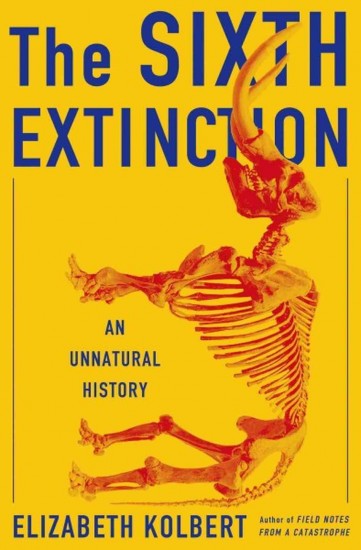
The Sixth Extinction: An Unnatural History
By Elizabeth Kolbert
Henry Holt. 319 pp. $28
We inhabit an extraordinary planet overflowing with an abundance of life: massive coral reefs built by billions of tiny invertebrates, rain forests teeming with uncountable plants and animals, frogs and toads singing in vernal ponds, bats flitting over summer meadows.
But we also live at an extraordinary moment when all of the creatures named above, and millions more, might disappear in our lifetime. And while climate change gets all the attention as an environmental game-changer, the loss of biological diversity, the burning of the Tree of Life, has too quietly slipped below the cultural radar screen.
Until now. Elizabeth Kolbert, staff writer for the New Yorker and author of the acclaimed Field Notes From a Catastrophe about climate change, has just published the definitive book on the biodiversity crisis. It is a must-read for every citizen of this planet.
As a science writer and reporter, Kolbert has few peers. Just as she did so effectively in Field Notes, Kolbert travels to the front lines of the issue, visiting the biodiversity hotspots you might expect, such as the Amazon rain forest and Australia’s Great Barrier Reef. But she also mixes in a ton of surprises, and much of the joy of the book is discovering where she ends up next: an Icelandic museum to visit a stuffed great auk, the last of which vanished in the 1840s, or the “Frozen Zoo,” a California lab that cryogenically stores cells from nearly a thousand species of extinct and nearly extinct species.
Kolbert begins in Panama, where she walks alongside scientists frantically searching for vanishing frogs, too quickly succumbing to a little-understood fungus. Frogs are amphibians, a group that “enjoy[s] the dubious distinction of being the world’s most endangered class of animals.” While creatures have always vanished throughout geological history, the natural extinction rate is incredibly small; amphibians, Kolbert reports, are now disappearing at a rate 45,000 times higher than normal.
The book also travels through the human understanding of extinction; these early chapters alone are worth the price of admission. She traces the history of extinction itself, the title alluding to five previous, natural, very large extinction events. The last big extinction occurred when that now-famous asteroid smashed into the Yucatan peninsula 65 million years ago, wiping out T. rex and maybe two-thirds of all life on Earth; she walks us through the science that painstakingly led to the theory, then covers the ensuing debate.
How bad is the sixth extinction? “It is estimated,” she observes, “that one-third of all reef-building corals, a third of all freshwater mollusks, a third of all sharks and rays, a quarter of all mammals, a fifth of all reptiles, and a sixth of all birds are headed toward oblivion.” That bad.
While extinction is natural, her book’s subtitle signals her impatience with anyone declaring the sixth extinction “natural.” Never before has one species so rearranged the planet, or so greatly altered the planet’s chemistry and biology, that so many creatures could die out. “This time,” one scientist says ominously, “we are the asteroid.”
The toughest part of the book is its last two chapters, where she visits not only the Frozen Zoo, but also the Neander Valley in Germany to see where fossils of our cave cousins – a separate human species that once lived alongside us – were discovered in 1856. Turns out that Homo sapiens likely killed off Neanderthals while, at the same time, intermingling with them (lots of us still carry Neanderthal genes). But “man the wise,” as our Latin name translates, seems to have been foolishly killing off life from Day 1. From Ice Age mastodons 10,000 years ago to flightless moas in New Zealand killed off in the 1400s, extinction has trailed in our wake for millennia.
We are burning tropical rain forests, poaching animals such as elephants and rhinos beyond their capacity to recover, and introducing invasive species everywhere (10,000 different species carried in ship ballast every single day worldwide). But the sixth extinction also has more subtle causes: Overheating the atmosphere with carbon dioxide changes land habitats, but also affects oceans, now acidifying from the excess carbon. Acidifying oceans are killing off coral – and possibly one-third of all ocean life as it does. The sixth extinction has multiple causes, but we are at the root of each.
Her last chapter, titled “The Thing with Feathers,” alludes to Emily Dickinson’s famous poem about hope, and she struggles to end on a hopeful note. “Though it might be nice to imagine there was once a time when man lived in harmony with nature,” she concludes “it’s not clear that he ever really did.”
Our “enduring legacy,” she ends, will be the sixth extinction.
The language of the Earth is losing nouns, names being plucked from the landscape: little brown bat, golden toad, Sumatran rhinoceros, Guam rail. While the book is not intended as a call to action, I hope its readers will rally around the burning Tree of Life, and agree that the preservation of this language is our highest calling, the necessary work of our time.
Mike Weilbacher directs the Schuylkill Center for Environmental Education in Roxborough, an island of biological diversity in Philadelphia. He can be reached at mike@schuylkillcenter.org.

 As a part of my research, I asked 55 grade six and seven students to draw an ideal school building, one that they thought would foster their connection with the natural world. I asked them to label important features they included. The most dominant features of these drawings were plants and animals. During my study I found that students expressed great joy witnessing the complete life cycle of plants. At BICS students could see the garden from their large classroom window. One student exclaimed, “It’s fun to watch everything [in the garden] because you go in the beginning of the year and there are little sprouts and then you go later and there are big shoots and stuff.” At a more urban school in Toronto each class grows a different kind of seed (grade one grows peppers while grade two grows tomatoes) and later in the spring they transplant their seedlings into the garden. In both these examples students develop relationships with food they eat in addition to having an indoor–outdoor connection.
