by editor | May 14, 2010 | K-12 Classroom Resources, Marine/Aquatic Education
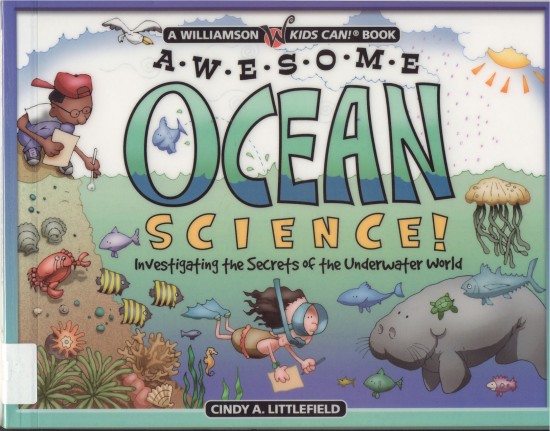
Investigating the Secrets of the Underwater World
By Cindy A. Littlefield
Illustrations by Sarah Rakitin
Published by Williamson Publishing, 2003, 120 p.
Reviewed by Sharon A. Hollander
I review children’s books, and I read through plenty on science and nature. I can honestly say that I felt a wave of relief when I came upon Awesome Ocean Science! Investigating the Secrets of the Underwater World, a Williamson Kids Can! Book.
I recently took home a big stack of books on the environment, and I was disappointed, not to mention bored by most of them. Perhaps appropriate as sources for school reports, I can’t imagine a child spontaneously picking one up for leisure reading. In fact, some of these books would test even an adult without bulletproof interest in the topic. Well-written and visually appealing, Awesome Ocean Science! stood out in the crowd. (more…)

by editor | May 14, 2010 | Interviews with Educators & Leaders
 What is your current job title?
I am a Field Science Educator for the Olympic Park Institute.
How did you get into this field?
My educational background is in Biology and Secondary Education, and when I graduated from college, I just wasn’t ready to teach in the classroom. I had an urge to be outside; to live in and experience natural places. Teaching in an outdoor setting seemed to be the best of both worlds.
What are you working on right now?
Right now I’m working on developing a bird feeding behavior/natural history curriculum that is usable for a wide range of students. I’m also at the early stages of developing a hands on, long-term river ecology program which would get students to monitor – via underwater video footage, as well as stream health monitoring – changes or consistencies in the river ecosystem we have access to near our facility.
What is your favorite part of your job?
Opening students eyes to the natural world, and giving them the tools to learn about it and enjoy it keep me coming to work every day.
If you could change anything about your work, what would it be?
I’d love to have more time to impact students. If I had the ability, I would love to see longer programming.
Where do you find inspiration for the work you do?
I find my inspiration from the beautiful places I work, and from the people teaching by my side. To see my fellow educators teaching to their passions about this place inspires me.
What is your favorite resource or tool for teaching about the environment?
My favorite tools for teaching about the environment are current issues. Here on the Olympic peninsula logging and land management are a great resource to get students thinking about land as a resource, and how it is cared for and managed. Frequent field trips to various sites around the peninsula give students great access to seeing clear cuts and other managed lands, which can lead to phenomenal discussions.
Where do you go when you want to recharge your batteries?
Moving water and big mountains recharge my batteries. By either playing or exploring in them, going for a run near them, or just taking them in, I feel myself being recharged.
What is your favorite place to visit in the Pacific Northwest?
The Northwest is way too spectacular to pick one favorite place! Unfair question! I do find myself drawn to rivers, with the Solduc being closest to my house.
What is your favorite nature/environment book?
My current favorite book is Gary Larson’s ‘There’s a hair in my Dirt’. I like that students often miss some of his adult humor, but are still able to take home his message.
Who do you consider your environmental hero?
I can’t pick one name to represent my environmental hero, but I consistently look toward my students as heros. They have the power to make informed, positive decisions, and are the sponges which soak up information and experiences and can help make a positive impact.
by editor | May 6, 2010 | K-12 Classroom Resources, Place-based Education
By Mark Costigan
reprinted from The Oregon Daily Emerald
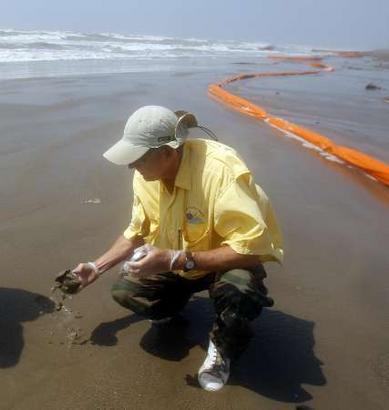
Andrew Nyman, Associate Professor Wetland Wildlife ... Andrew Nyman, Associate Professor Wetland Wildlife Management & Ecology of LSU AgCenter, takes samples of beach sand beside oil booms at the coast of South Pass, south of Venice, Louisiana, where oil leaking from the Deepwater Horizon wellhead continues to spread in the Gulf of Mexico, May 2, 2010. A huge wind-driven oil slick bore down on the U.S. Gulf coast on Sunday, threatening an environmental catastrophe, and the Obama administration heaped pressure on BP Plc to halt the uncontrolled spill from its ruptured Gulf of Mexico well. Since the explosion and sinking last week of the Deepwater Horizon rig, a disaster scenario has emerged with hundreds of thousands of gallons of crude oil spewing unchecked into the Gulf and moving inexorably northward to the coast. REUTERS/Carlos Barria
It’s sad that it takes a threat of crude oil reaching American beachfront property for people to wake up.
It seems the only way people unite around fighting environmental degradation is when the effects become visible and personal. If only there were some way to make the color of carbon dioxide highlighter yellow or jet black. Then perhaps people would wake up to the havoc they’re wreaking on my playground.
That’s right. My personal playground, the outdoors, continues to get pushed around like a new kid being picked on by a 12-year-old bully — except nature is a little older than the humans who bully it.
It took 24 days in the wilderness with the National Outdoor Leadership School for me to wake up to the effects of climate change. A month before moving to Eugene, I embarked on an outdoor educator expedition in the Absaroka wilderness in Wyoming. Between eating a third of the amount of food I normally eat, nearly dying on a glacier, and conquering 13,000-foot peaks, the expedition not only gave me a new appreciation for wild places, but it humbled me to something similar to my original human form. (more…)
by editor | May 4, 2010 | Outdoor education and Outdoor School, Schoolyard Classroom
 by Julie Lancaster
Last year, I left the OE world that I love so much and went back to school to get my teaching credential/MA Education. I felt that loving education as much as I do, it would be extremely beneficial to study it! Finding myself headed toward student teaching in the classroom, I kept reaffirming my commitment to OE, and vowed that I would reenter that world once I was finished with my program.
Well, I survived learning and teaching in a traditional classroom setting, and I still have a love of teaching and learning outdoors (of course). After finishing my program this past July, I jumped into a new direction that bridged OE and the school system. I have become the Special Programs Director at an elementary school, where as one of my primary jobs is creating and teaching K-6 in a school garden (AKA Life Lab or Garden Classroom). It is absolutely wonderful. (more…)
by editor | May 4, 2010 | Conservation & Sustainability, Environmental Literacy
If you’re starting from scratch, use these steps as a guide to create an environmental group in your school or community. If you’re already part of a high school class or club that addresses environmental issues, consider joining National Wildlife Federation’s Earth Tomorrow network to share ideas and successes with groups nationwide. (more…)


