
by editor | Sep 15, 2025 | Conservation & Sustainability, Data Collection, Experiential Learning, Inquiry, Integrating EE in the Curriculum, Schoolyard Classroom, Student research, Teaching Science
Scotch Broom Saga:
Restoring a School Habitat as Project-Based Learning and Inquiry
by Edward Nichols and Christina Geierman
Since the advent of No Child Left Behind, many schools have turned their focus inward. Students rarely leave the classroom. Teachers often deliver purchased curricula that attempt to make meaningful connections for students. Lessons may contain examples from the real world, but these exist only on paper and are not explored within a real-world context. This article describes how an elementary school (K-5) on the southern Oregon coast addressed a real-world problem– the presence of the invasive Scotch broom (Cytisus scoparius) plant on the school campus. It began as a plan to improve an outdated writing work sample but became a school-wide project that allowed ample opportunities for students to authentically practice research skills while developing a sense of value for the world around them.
North Bay Elementary School is located in the temperate rainforest of rural Oregon, just a few miles from the Pacific Ocean. It serves about 430 students, over 95% of whom qualify for free and reduced lunch. The property was purchased many decades ago when the lumber mills were booming and so was the population. It was built as a second middle school, and the grounds had plenty of room to build a second high school. But the anticipated boom never came, and the property eventually became an elementary school surrounded by a small field and a 50-acre forest. At some time in the past, an enterprising teacher had cut trails through the forest for student access. When that teacher retired, the trails largely fell into disuse.
The Seed of an Idea
In Oregon third-grade students must perform a writing work sample each year. The topic in North Bend, which had been handed down from previous teachers, was invasive species. The class would work together to write a paper on an invasive species found in Florida, then apply their writing process knowledge to produce a sample on an Oregon invasive. They were given three curated sources created by using a lexile adjuster on the Oregon Department of Fish and Wildlife website. This project existed in a relative vacuum– invasive species were not mentioned before or after the work sample. Its only connection to the rest of the curriculum was the writing style. The students were interested in the topic and produced decent work, but Edward Nichols thought they could do better. He had long noticed multiple patches of Scotch broom growing just off the school playground. This invasive plant out-competes native ones and does not provide food or useful habitat for other native species. He wondered if they could do something with this to enhance the writing work sample and turn it from a stand-alone project to something more meaningful.
Fertile Ground
That summer, Edward attended a Diack Training held at Silver Falls State Park. In addition to providing excellent professional development on how to perform field-based inquiry with your students, it is also a place where you get to meet other educators with similar mindsets.
A chance conversation with Julia Johanos, who was then serving as Siuslaw National Forest’s Community Engagement and Education Coordinator, led to the idea of having an assembly on invasive plants for all students at North Bay Elementary. Edward was also a member of the Rural STEAM Leadership Network, and he met Jim Grano in their monthly Zoom sessions. Jim is a retired English teacher who is now focused on getting students outside. He has helped several schools in the Mapleton area start Stream Teams, which got students outside restoring stream habitat and collecting data on salmon. He routinely led student groups into the field to remove English ivy and Scotch broom. Edward invited him to help lead a similar event at North Bay.
 The Big Event
After weeks of planning, North Bay held a service learning day on March 17, 2023. The kickoff happened the day before when Julia Johanos led an engaging school-wide assembly on why invasive species are bad for our environment. The next day, the entire school participated in removing Scotch broom from the forest. The students came out one grade band at a time in 45-minute shifts. Each grade had a different task. Kindergarten students pulled the seedling Scotch broom by hand. Slightly larger stalks required “buddy pulls”, where two students worked together. Fourth and Fifth grades used weed wrenches to remove bigger plants. Alice Yeats from the South Slough NERR briefed each group on safety. And dozens of parent volunteers kept everybody safe. The Coos Watershed Association donated native plants, and the second grade came out at the end of the day to plant coyote bushes and red flowering currant, native strawberries, Oregon grape, and a variety of evergreen trees in the spaces the broom used to occupy. After school, Christina Geierman, a science teacher at North Bend High School, brought high school volunteers from the Science National Honor Society to help pull the biggest broom of all and clean up after the event.
Sustaining the Excitement
It is a tradition at North Bay to have a variety of fun activities for the last day of school. This year, in addition to the stalwarts of bubble soap, bicycles, and bounce houses, the event also contained a Scotch broom pull led by Jim Grano. Students could do whatever activity they chose, and many students chose to remove the broom from the edge of the playground. A representative from OSU Extension was also there, showing the kids how to make bird feeders, and folks from the South Slough NERR returned to lead nature hikes. The Confederated Tribes of Coos, Lower Umpqua, and Siuslaw Indians (CTCLUSI) also ran a booth and taught students about conservation and had them play a native game called nauhina’nowas (shinny), which involved using tall, carved sticks to pass and catch two balls connected by twine.
A second, school-wide Scotch broom pull occurred this past fall. Edward also started a Forestry Club at North Bay, which featured guest speakers from the Bureau of Land Management and had the students planting more native species. Plans are underway to have a school-wide pull each spring and a forestry club each fall to plant native species just before the rainy season hits.
 Applying Their Knowledge
Students participating in the Scotch broom pull apply their classroom knowledge in various ways. In mathematics, they record and tally the number of plants removed, practicing authentic math skills. They observe and document the plant’s lifecycle during the pull, connecting classroom biology lessons to real-world applications. North Bay uses the Character Strong curriculum to address social-emotional learning, and the broom pull allows students to apply traits like perseverance, cooperation, and service. Students can immediately and directly see the results of their efforts when they go outside for recess. This gives them a sense of pride in their accomplishments. There have been many reports of students educating their parents about why Scotch broom should be removed from the environment and even a few tales of students removing invasive plants from their own properties.
While participating in the Scotch broom pull, the students met a variety of scientists and conservationists. They were able to make a connection between this sort of work and future job opportunities. Jim Grano showed them that, if you feel passionately about something, you can make a difference as a volunteer. Alice Yeats, Julia Johanos, and Alexa Carleton from the Coos Watershed Association showed them that women can be scientists and do messy work in the field just as well as men can. Although it will take many years to tell, we hope that a few students will be inspired by this work to pursue careers in natural resources management.
Into the Future
This past fall, North Bay was named a NOAA Ocean Guardian School. This means that NOAA will provide the funds necessary to carry this project forward and expand it. The grant is renewable for up to five years. This spring, a group of students from North Bay will host a booth at Coos Watershed’s annual Mayfly Festival. There, students will present their project to members of the public and urge them to remove Scotch broom and other invasives from their own properties.
This spring, the North Bend High School Science National Honor Society (SNHS) will partner with North Bay students for a Science Buddies Club that will take place after school. Thanks to a Diack Grant awarded to Christina Geierman and Jennifer Hampel, the SNHS has a variety of Vernier probes and other devices that can be used to collect data in the forest. In the first meeting, the North Bay students will guide the high schoolers down the forest trails and describe their Scotch broom project. The SNHS members will show them how the probes work and what data we can gather. The guiding question will be, “Why do Scotch broom live in some areas of the forest, but not others?” The students will come up with hypotheses, focusing on one variable like temperature, light availability, etc. and then work together to gather and analyze the data. Students will present their data in a poster at the Mayfly Festival and possibly the State of the Coast Conference.
Members of the North Bend High School Science National Honor Society and family volunteers have reopened the trails through the forest. Plans are underway to expand these trails and partner with the CTCLUSI to create signage. The forest is being used by the school once again. Classrooms that earn enough positive behavior points can choose nature walks through the forest as potential rewards. Dysregulated students are taken down the path to calm them. Increasing student and community use of the forest is one of our future goals.
 Edward Merrill Nichols is a 3rd-grade Teacher at North Bay Elementary in North Bend, Oregon. Growing up on the southern coast of Oregon instilled in him a love of and respect for his natural surroundings. With over six years of experience, he fosters student growth through engagement and respect. Edward actively engages in STEM education, leading Professional Development sessions and extracurricular clubs. He holds a Bachelor of Science in Education and a Master of Science in K-8 STEM Education from Western Oregon University.
 Christina Geierman has taught physics, biology, and dual-credit biology at North Bend High School for eleven years. She is a published scientist, a proud union member, a decent trombone player, and a world traveler. She enjoys spending time outside with her husband, Edward Nichols, and dog, Aine.

by editor | Sep 5, 2025 | Climate Change & Energy, Conservation & Sustainability, Critical Thinking, Data Collection, Environmental Literacy
Integrating Watershed Science in High School Classrooms
The Confluence Project Approach
High school students in northern Idaho learn about watersheds and the impacts of climate change through an intensive field science program that aligns with the Next Generation Science Standards.
by Audrey Squires, Jyoti Jennewein, Mary Engels,
Dr. Brant Miller and Dr. Karla Eitel
“It’s not just because I personally love snow and skiing and snowshoeing and all that. It’s not just because I love to teach science outdoors in the field. It’s not even just because I value connecting my students with real scientists every chance I get. It’s honestly not any one of these particular things alone that has made the Snow Science field trip the absolute favorite part of my Environmental Science curriculum over the last four years. Instead, it’s the simple notion that for this generation of teenagers in the Inland Northwest, the impacts of climate change on the hydrology of snow within our watershed might be the most valuable social, economic, and ecological topic to cover in the entire school year. Snow is the backbone of our way of life in North Idaho, and the sense of awareness and empowerment my students develop as a result of this Confluence Project three-lesson unit is absolutely critical for their growth and progress as young adults heading into the 21st century.”
– The Confluence Project Teacher,
Advanced Placement Environmental Science
Clean water matters, immensely, to all of us. We desperately need education that promotes deep understanding of how water is important to students. Fortunately, water as a theme is easily incorporated into numerous scientific disciplines. From the basics of the water cycle in foundational science courses to the complexities of cellular processes in advanced biology; and from energy forecasting with anticipated snow melt in economics to the nuances of water as a solute in chemistry, water is foundational to a variety of subjects and can be incorporated into the learning objectives with a little creativity and willingness to step outside the box.
Over the past three years in high schools across Northern Idaho we have been working to develop a water based curriculum that has the flexibility to be used in many types of classroom, and that provides students with firsthand experience with water and water related issues in their local watershed. The Confluence Project (TCP) connects high school students to their local watersheds through three field investigations that take place throughout an academic year. These field investigations are designed to integrate place-based educational experiences with science and engineering practices, and focus on three themes: (1) water quality, (2) water quantity, and (3) water use in local landscapes. During these field investigations, students actively collect water, snowpack, and soil data and learn to analyze and interpret these data to the ‘big picture’ of resource quality and availability in their communities.
 Before each field investigation, students are exposed to the pertinent disciplinary core ideas in class (National Research Council [NRC], 2011; NGSS Lead States, 2013), explore issues present at field sites, read relevant scientific articles, and learn field data collection techniques. Students then collect data in the field with support from resource professionals. After each field investigation, students analyze their data and use the results to discuss how to solve ecological issues they may have encountered. Adults guide students through this process at the beginning, with the goal that students will develop the necessary skillset to conduct independent, community-based, water-centric research projects by the end of the academic year (Figure 1). Students are ultimately challenged to creatively communicate their research projects, including both the scientific results and their proposed solutions to environmental issues encountered in their watershed, at a regional youth research conference (e.g. Youth Water Summit).
 Originally created to serve as a sustainable method to continue outreach efforts from a National Science Foundation Graduate STEM Fellows in K-12 Education (GK-12) grant (Rittenburg et al., 2015), the development of TCP coincided with the release of the Next Generation Science Standards (NGSS) (NGSS Lead States, 2013). With a strong emphasis on science and engineering practices, disciplinary core ideas, and coherent progressions (Reiser, 2013), the TCP model closely aligns with these new standards. Given that much of the curriculum developed for the older National Science Education Standards is content-focused (NRC, 1996), TCP fits the need to create curriculum that includes opportunities for students to explain how and why phenomena occur and to develop the critical thinking skills associated with scientific investigations.
Pedagogical Framework
Sobel (1996) wrote that “authentic environmental commitment emerges out of first hand experiences with real place on a small, manageable scale” (p. 39). In TCP, authentic learning often emerges as students engage in first-hand exploration. Using the local watershed as a lens for field investigations enables students to connect with their landscapes and develop new depths of understanding of the world around them. By connecting students’ lived experiences and local landscapes with scientific information we are able to generate a unique learning setting, which in turn sparks continued interest in exploring the familiar from a new perspective. As one student from the 2015-16 program wrote:
This localized learning approach is often referred to as place-based education (PBE), which engages students in learning that utilizes the context of the local environment (Sobel, 1996; Smith, 2002). PBE seeks to connect students to local knowledge, wisdom, and traditions while providing an authentic context to engage students in meaningful learning within their everyday lives.

TCP also uses a project-based learning (PBL) approach (Bell, 2010) to help students frame the field investigations and the subsequent analysis and interpretation of collected data as foundations for their own research projects. These practices emphasize student construction of meaningful and usable scientific concepts and, perhaps more importantly, relating these concepts to their own lived experience. For example, one student wrote the following reflection after a class water quantity field investigation:

These types of reflections demonstrate an internalization of curriculum unit topics, which in turn motivates students to continue learning.
Importantly, PBE and PBL are used as frameworks to align lessons with the NGSS. The pedagogical features of PBL match well with the eight science and engineering practices at the core of the NGSS framework, which include: (1) asking questions and defining problems; (2) developing and using models; (3) planning and carrying out investigations; (4) analyzing and interpreting data; (5) using mathematics and computational thinking; (6) constructing explanations and designing solutions; (7) engaging in argument from evidence; and (8) obtaining, evaluating and communicating information (Bybee, 2011). In TCP, these pedagogical approaches provide a meaningful context for students to engage in developing understandings of disciplinary core ideas, while the curriculum creates new, effective ways to enact the NGSS.
Empirical evaluation of student learning in the program (Squires et al., under review) indicates that after participation in TCP, students expressed greater concern for local ecological issues, recognized the efficacy of science as a tool to address environmental issues in their communities, and were more engaged in science when PBE and PBL pedagogies were used.
Project Implementation
“Yesterday my entomology class went to a local creek to study the bugs and life around it. It was really cool to fish a lot of bugs out of the water. We got lots of benthic macroinvertebrates such as a mayfly (dragonfly), damselflies, all in different instars (sic) [stages of growth] …. We tested the pH of the water, the transparency of the water, and the dissolved oxygen in it…This was really a fun project, it was great getting all of the bugs I’ve been learning about and it was really cool to use my knowledge about them… I suggest that anyone should go and do this, you could learn a lot about your region’s water quality.”
–TCP Entomology Student
 TCP curriculum aligns with several Performance Expectations and Disciplinary Core Ideas from the NGSS (Table 1), and can also easily adjust to fit within multiple courses. TCP curriculum has been incorporated into less flexible, standards-driven courses like Biology and Chemistry, as well as more flexible courses like Environmental Science, Entomology, and Earth Science. While each class participates in the same three units (water quality, water quantity, and water use), teachers tailor these units to the learning objectives of their courses.
For example, environmental science teachers have been able to tie the water quantity unit to global climate change, land and resource use, and local economics. Students analyzed collected snowpack data to determine how much water would be available in their watershed for growing crops and sustaining lake and river-based tourism economies. They also compared their data to historical figures to understand how climate change has impacted water availability in their watershed over the past several decades.
By contrast, TCP biology teachers have successfully incorporated TCP units as part of their yearlong curriculum aligned with rigorous biology standards. For example, as part of the water use unit one teacher discussed sustainable water use in an agriculture setting by focusing on concepts like plant growth and cellular function. Other teachers have presented photosynthesis, primary productivity, and fisheries biology during the water quality unit, and speciation, biodiversity, and habitat as core topics during the water quantity unit.
Even in very specialized science classes there is room to engage with this curriculum. For example, one entomology teacher was able to highlight the role of macroinvertebrates as indicators of stream health when teaching the water quality unit. He taught students insect characteristics, discussed growth and metamorphism, and then showed students how to tie flies in order to solidify that knowledge in a unique, hands-on way. The class then visited a stream near their school to identify macroinvertebrates and learn their importance in evaluating water quality. Last but not least, TCP curriculum was designed for the potential of cross-course collaboration, which gives students the opportunity to apply and link concepts and skills learned in science class to their other courses while developing critical thinking skills. Several program teachers have collaborated with colleagues in their schools to integrate content across disciplines and open students’ eyes to interdisciplinary study.
 Connecting with local professionals
The most valuable thing that we learned on our field trip to [the restoration site] was learning about the processes that were taken to restore the creek, and why they did it… We think that this field trip has shaped our understanding of these careers by actually experiencing the job and their daily tasks that can do good to the environment (sic). Following the field trip, we can say that we have a better understanding of just how time consuming and difficult the process of restoration in an area such as [the restoration site] can be. –TCP student water quality field investigation post trip reflection
Teachers often struggle to plan activities beyond the day-to-day classroom lessons, which is one reason why local professionals and leaders are an essential facet of TCP. Agency scientists, Tribal land managers, and graduate students provide scientific support to teachers and students during field investigations, in-class pre- and post-lessons, and final research projects. This gives students an opportunity to collaborate with and learn from specialists and practicing scientists in their communities, allowing the students to gain experience carrying out science and engineering practices alongside experts. In addition, students learn about career opportunities and restoration efforts in their local watersheds from TCP partners.
Examples of past TCP partners include universities (extension, graduate students, and professors); Tribes (environmental agencies and Elders); state agencies (environmental quality and fish and game); federal agencies (Natural Resources Conservation Service, United States Forest Service, Bureau of Land Management, and National Avalanche Center); and local organizations (environmental nonprofits, homeowner’s associations, and ski resorts).
Since these collaborations are critical to the success of TCP program we have developed a Reaching Out to Potential Partners checklist to help teachers contact and recruit community partners. The checklist helps teachers develop a coherent narrative to use with busy professionals which highlights the mutual benefits of collaboration.
Keeping costs to a minimum
Admittedly, implementation requires some capital investment to cover essential program costs such as busing, substitute teachers, and field equipment. However, these costs can be minimized with some creative organization. Multiple TCP schools have been able to eliminate busing costs by using streams near or on school property. Supportive administrators can creatively minimize substitute teacher costs (in one case the principal agreed to cover the class instead). Field equipment is certainly necessary to collect data (see Resources), but the equipment required may potentially be borrowed from agencies or university partners. A classroom supply budget or a small grant from the booster club or other local organization can also help cover such costs and build supplies over several academic years. While regional youth research conferences, such as the Youth Water Summit are excellent ways to motivate students, it is possible to get the research benefits without the associated costs. We suggest inviting partners and other local experts to attend research project presentations at school. This way students can still benefit from external feedback as well as gain research and presentation skills.
Conclusion
TCP has provided a valuable framework for school-wide exploration of local water-related issues. TCP provides hands-on, place-based and problem-based learning while addressing key Next Generation Science Standards and preparing students for the kind of inter-disciplinary problem solving that will be increasingly necessary to address the complex challenges being our students will face as they become the workforce and citizens of the future.
Resources
The full TCP curriculum including lessons, standard alignment, field trip planning, and other recommendations can be found at: http://bit.ly/2cNdNIm
Interested in learning more from the TCP’s leadership team? Contact us at theconfluenceproject@uidaho.edu
Acknowledgements
A program like this requires dedicated and creative teacher and program partners. Without the enthusiastic commitment of our past and present teachers and partners TCP would never have been actualized. We’d like to thank Rusti Kreider, Jamie Esler, Cindy Rust, Kat Hall, Laura Laumatia, Jim Ekins, and Marie Pengilly for their aid in program design and implementation, as well as for continued programmatic effort and support. Furthermore, thank you to Matt Pollard, Jen Pollard, and Robert Wolcott; along with graduate students Paris Edwards, Courtney Cooper, Meghan Foard, Karen Trebitz, Erik Walsh, and Sarah Olsen for your dedication to TCP implementation. In addition, we would like to acknowledge funding from the NSF GK-12 program grant #0841199 and an EPA Environmental Education grant #01J05401.
Audrey Squires, Jyoti Jennewein and Mary Engels are past program managers of TCP. Squires is currently the Restoration Projects Manager for Middle Fork Willamette Watershed Council while Jennewein and Engels are PhD students at the University of Idaho (UI). Dr. Brant Miller, UI science education faculty, was the Principal Investigator of the EPA grant that funded TCP in 2015-16. Dr. Karla Eitel is a faculty member and Director of Education at the McCall Outdoor Science School, a part of the UI College of Natural Resources.
References
Bell, S. (2010). Project-based learning for the 21st century: Skills for the future. The Clearing House, 83(2), 39-43.
Bybee, R. W. (2011). Scientific and engineering practices in K–12 classrooms: Understanding a framework for K–12 science education. The Science Teacher, 78 (9), 34–40.
NGSS Lead States. (2013). Next Generation Science Standards: For states, by states. Washington, DC: The National Academies Press.
National Research Council. (1996). National Science Education Standards. Washington, DC: National Academy Press.
National Research Council. (2011). A framework for K-12 science education: Practices, crosscutting concepts, and core ideas. Washington, DC: The National Academies Press.
National Science Teachers Association (NSTA), 2013. Disciplinary Core Ideas in the Next Generation Science Standards (NGSS) Final Release. http://nstahosted.org/pdfs/ngss/20130509/matrixofdisciplinarycoreideasinngss-may2013.pdf Accessed 22 April 2016.
Reiser, B. J. (2013). What professional development strategies are needed for successful implementation of the Next Generation Science Standards? Paper presented at the Invitational Research Symposium on Science Assessment. Washington, DC.
Rittenburg, R.A., Miller, B.G., Rust, C., Kreider, R., Esler, J., Squires, A.L., Boylan, R.D. (2015). The community connection: Engaging students and community partners in project-based science. The Science Teacher, 82(1), 47-52.
Smith, G. A. (2002). Place-based education: Learning to be where we are. The Phi Delta Kappan, 83 (8), 84–594.
Sobel, D. (1996). Beyond ecophobia: Reclaiming the heart in nature education (No. 1). Orion Society.
Squires, A., Jennewein, J., Miller, B. G., Engels, M., Eitel, K. B. (under review). The Confluence Approach: Enacting Next Generation Science Standards to create scientifically literate citizens.

by editor | Sep 1, 2025 | At-risk Youth, Critical Thinking, Data Collection, Technology
by Greta Righter
As an instructor at IslandWood, an environmental learning center on Bainbridge Island, WA, my week with students is fleeting. I have four days during IslandWood’s School Overnight Program (SOP) to explore and investigate the natural world with groups of 4-6th graders, and it never seems to be enough time. At IslandWood, students gather for four days of learning on 250 acres of a forest ecosystem, engaging in science, arts, and team-building activities and lessons. Just as they are beginning to distinguish a Western hemlock from a Douglas fir, and communicate well as a team, it’s time for them to pack up and head home. Most of the students are from the Seattle area, coming from various socioeconomic backgrounds, and may or may not have access to nearby green spaces in their home neighborhoods. As a newcomer to the field of experiential outdoor education, I still have a nagging voice that wonders if my students might walk away feeling like they can only engage with the natural world if they are in the forest. One aspect of teaching outdoor education that often feels most challenging is the transfer of learning: how can I best encourage students to carry their wonder and excitement of the natural world home with them, even if home is an urban setting? In this article I will describe an experiment with integrating technology into my field studies, and how it made that nagging voice in my head a little quieter.
Transfer of learning, or the ability to apply knowledge learned in one context to new contexts, can feel like the ‘achilles heel’ of outdoor education (Brown, 2010). Students are removed from indoor classrooms, plopped into the woods for a week to learn about nature, and then shuttled back to their desks a few days later. As one outdoor educator put it, “a major and persistent challenge for outdoor adventure education is the extent to which the learning experiences of students affect change beyond the immediate outdoor environment” (Brown, 2010, p.13). Programs like IslandWood’s SOP seek to create continuity in this experience through pre- and post-visit lessons to the classroom. Still, many outdoor education programs do not have any means of assessing transfer of learning. As I wave both hands goodbye to the buses pulling away each week, a little voice in the back of my head always wonders… “What will they remember? Did I make an impact?”
 Citizen Science & Phone Apps
Recently, I decided to focus my field instruction on the theme of citizen science. The National Geographic Society defines citizen science as “the practice of public participation and collaboration in scientific research to increase scientific knowledge” (National Geographic Society, 2012). With my student field group we broke down this term and defined citizen science as ‘regular people who make scientific observations’. I also provided some examples to my students of large citizen science projects that are going on around the world. In the interest of weaving citizen science work into my lessons, I experimented with the iNaturalist app in the field because it is user-friendly, it has a generalist focus on species identification and location, and it has the ability to connect users to other citizen scientists making similar discoveries. iNaturalist describes its function as ‘a place where you can record what you see in nature, meet other nature lovers, and learn about the natural world’ (iNaturalist.org, 2012). It seemed like the perfect tool to integrate into SOP, which focuses on making observations, and supporting claims with gathered evidence. The iNaturalist app provides a more interactive medium for recording and utilizing data, while also connecting those observations beyond the IslandWood setting.
The Struggle with ‘Screen time’
I felt some apprehension about introducing technology into outdoor education. As someone who experiences the outdoors as sanctuary, a place to escape the dings and rings of computers and phones, it made my heart hurt a little bit to bring a glowing screen into my field studies. I wondered, are technology and place-based learning inherently at odds with each other? Does gazing into a glowing screen detract from the experience of being immersed in the natural processes of the world? As a self-proclaimed luddite, one who fears and avoids the rapid progression of our tech-focused society, it felt like going against the grain to introduce technology into my field instruction. Worries about technology failures, lack of access to the internet, and encouraging more screen time amongst a generation of students who I honestly believe need less screen time riddled my mind. There are many who share this concern – a number of studies have linked the increase in mobile screen use among children to a variety of adverse outcomes including (but not limited to): decreased ability to recognize human emotions (Uhls, et.al., 2014), increase in childhood obesity rates (Chen, et.al., 2014), difficulty sleeping (Cajochen, 2011), and increased anxiety and depression (Twenge, et.al., 2017).
On the other hand, I believe that nothing is ever black and white. Technology does not have to be the enemy, and teachers and parents should not have to be suited up in a constant battle against it. Screens are here, and they are here to stay, and there are many good reasons for integrating technology into all areas of instruction. The need for future generations to be highly proficient in various forms of technology is of increasing importance (Haberman, 2010, p. 85). Also, technology offers a different medium of learning, and can broaden students’ connection with the world beyond their classroom. But that’s the classroom… how would it work to use an iPod out in the field?
How Did It Go?
The learning goals for our week of citizen science studies were for students to 1.) work together so that each student would input a new species identification into the iNaturalist app 2.) be able to describe what citizen science is, and 3.) give an example of how and where they would use this technology at home. In order to ensure successful integration of technology in the field, I made sure to establish some ‘tech norms’ before getting started:
Tech Norms:
Only the instructor (myself) will carry and use the iPod.
We will only utilize the phone for the iNaturalist app.
Everyone will contribute one species identification to the database.
We will work as a team to help each other identify and input new species.
 On our second full field day each student chose a specialist name tag – they chose between: Mycologist, Botanist, Zoologist, Entomologist, Ornithologist, & Marine Biologist. I explained that this was not the only thing they could explore – in fact, everyone’s goal for the day was to be a leader of investigating their specialization for the whole group. The mycologist could call others over when they found a mushroom they wanted help identifying. The ornithologist could ask others what colors they saw on that bird that just landed in a nearby tree. Our goal was to work together. Each student was equipped with a unique field guide, and other tools they might need to study the details of organisms, such as binoculars, magnifying glasses, and jars to collect specimens.
I immediately noticed that students were highly motivated to identify the plants and creatures they were discovering because of their interest in the iNaturalist app. Just as writing assignments geared towards a real audience can increase student motivation, so does recording observations and species identifications for a world-wide database (Norton-Meier, Hand, Hockenberry, & Wise, 2008). We talked about the fact that our identifications may not be accurate, but that was not the goal of the lesson. I reminded them that their goals are to practice using field guides, to work together to identify species, and to contribute their findings to the iNaturalist database for other citizen scientists, just like them, to review.
Our first species identification was at Blakely Harbor – a Purple Shore Crab (Hemigrapsus nudus). Students were eager to identify the gender of the crab, and wondered if there was a place to input that data into the app. I wasn’t sure so we searched together, and we found that there is a space to add general field notes so we put the gender there. After the Purple Shore Crab, we identified a Glaucous Winged Gull (Larus glaucescens) and an Acorn Barnacle (Balanus glandula). Back in the woods there were ambitious plans for moss and mushroom identification. I input all of the ID’s just as the students wanted me to, even if we weren’t 100% sure that they were correct. That’s part of the beauty of the iNaturalist app – it connects us to other people who are making the same discoveries, reviewing our pictures, and it allows them to reach out to us if they think we may have erred. Just as my students worked together to pour through the pages of their field guides, all scientists work together to make discoveries and make sense of the world around us.
Transfer of Learning through Technology
Apps like iNaturalist provide a familiar and intriguing medium for recording observations and create a means to transfer those observation skills from the outdoor education experience back to the student’s life at home. Each of my students left IslandWood with iNaturalist written down in their journals and a location they thought might use the app at home. This week I gave my students a tool – a real live tool. Not a theoretical idea or feeling, but something tangible that they can walk away with and use in their day-to-day lives at home or school. They can use this tool to continue practicing their observation skills, nurturing their own interest in the environment, and connecting with other citizen scientists. Through sharing this technology with my students, I realized that even though I chose to limit my own screen time, it is unrealistic for me to expect the same of upcoming generations. As long as the generations of a highly technological world are going to be using phones and tablets, then perhaps we, as educators, should be striving to create the best possible outcomes for this screen time.
References for this article can be found on the web version at http://www.clearingmagazine.org/archives/
Greta Righter is an instructor and graduate student at IslandWood on Bainbridge Island, WA. She is pursuing her M. Ed. in Curriculum & Instruction at the University of Washington.

by editor | Aug 9, 2024 | Data Collection, Environmental Literacy, Experiential Learning, Place-based Education
Sophie Diliberti, Justin Hougham, Brad Bessler, and Brooke Bellmar
 ocusing on specific aspects of learners’ local context can increase their engagement in environmental education. One way for educators to pinpoint a community’s specific environmental circumstances is by adapting existing locally focused sustainability resources. After establishing the environmental issues that are relevant to the community, educators can maximize the geographic benefit of a local focus by incorporating geographic awareness and in-person exploration into their curriculum. This paper examines a case study in Milwaukee, Wisconsin: a lesson plan which adapts existing environmental education resources to pinpoint the local issue of stormwater management. The lesson also uses a StoryMap and walking tour to foster geographic awareness.
Community-specific issues: Strategies for educators to produce a more local focus.
Too often, environmental education focuses on issues that are removed from students’ lived experiences. Although melting icebergs and starving polar bears are compelling images, students must recognize that many types of environmental problems–and solutions–occur right in their backyards. Localized environmental education has been shown to be effective at increasing educational outcomes and sustainable behavior within communities (Ardoin, 2020, Fisman, 2010). Using specific community context ensures that the content of the lesson will be relevant to the lives of the students. While a field trip to a zoo or state park can certainly be interesting, knowledge about the environmental issues in places where students actually live provides a different kind of educational value.
Many communities have existing environmental outreach materials regarding specific local issues. Whether they come from university extension divisions, grassroots political organizations, or other local sources, these materials reveal issues that are important for community members to understand. Even if they are too young to understand those exact resources, students deserve this community knowledge, so the resources are worth adapting for them to consume.
Making the most of a place-specific focus by incorporating maps and in-person exploration.
Assuming a lesson plan centers around the specific context of the school and community, the next step is to maximize those benefits by explicitly focusing on geographic awareness and spatial reasoning in the lesson plan.
Using maps can increase spatial awareness and embodied learning for students, making maps a good starting point to accomplish this goal (Taylor, 2019). StoryMaps, a web-based Esri software which allows the user to incorporate maps, legends, text, photos, and videos into a spatial narrative, can provide a great resource for educators looking to incorporate maps into their curriculums. The interactive nature of a StoryMap allows students to engage with the geography of where they live and has been proven to increase geographic awareness (Purwanto et al., 2022).
Another way to harness the benefits of place-specific education is to provide opportunities for students to get outside and explore. In-person tours can be more productive if students have already learned the background of what they are exploring through a StoryMap or similar resource. Their questions will likely be less superficial after learning the basic context in the classroom.
Case study background: Milwaukee and green infrastructure.
Milwaukee is a city lucky to be situated at the confluence of three rivers and Lake Michigan. The city relies heavily on these bodies of water for drinking water, industry, transportation, and recreation, and they must be stewarded carefully to ensure long-term health. The city’s combined sewer system, which cleans wastewater and stormwater at the same time, is the foundation of many of its stormwater management challenges. The combined sewer system is useful most of the time: it filters pollutants out of runoff before releasing the stormwater into the lake. However, during some major storm events, the treatment plant receives too much water and experiences an overflow. During an overflow, the plant is forced to release unfiltered wastewater and stormwater into the lake. To avoid sewer overflows during storms, the city must minimize the amount of water that reaches the sewer system in the first place.

Milwaukee’s water-rich environment comes with essential benefits and difficult challenges.

A Milwaukee sewer overflow in 2010.
Green infrastructure (GI) is any modification to a built environment that mimics natural systems to provide some type of ecosystem service. GI is often applied to stormwater management, where it harnesses natural systems to filter and slow down water right where it falls instead of funneling it directly into sewer systems. Native plants with deep roots, rain gardens, bioswales, and rain barrels are all examples of GI used for stormwater management. The Village of Shorewood, a Milwaukee suburb that lies between the Milwaukee River and Lake Michigan, has implemented many beneficial GI projects as a response to its uniquely water-rich location and subsequent stormwater management issues.
Creating a map and walking tour for the Village of Shorewood.
In August of 2023, UW-Madison Extension worked with the Village to create a StoryMap that listed all the GI in the village (called “Shorewood’s Water Walk”). “Shorewood’s Water Walk” was useful in many ways but lacked a clear audience or use-case. This map is still linked on the village website, but has no designated users or associated events. You can find this this map here: https://arcg.is/15rmf90
In the summer of 2024, I redesigned “Shorewood’s Water Walk” so it could be used by local elementary schools. The new lesson plan, titled “Where Does My Water Go? Exploring the Shorewood Watershed,” includes a more targeted StoryMap and two walking tours, one that starts from each elementary school in the district. Instead of living on the village website, the new StoryMap and walking tours would go into the curriculum of local teachers to educate students about a very specific sustainability issue in their community. You can find this 2024 map here: https://arcg.is/10HvTX
The lesson’s StoryMap begins with a section called Shorewood’s Water History. This section uses pictures and diagrams to explain some key ways Indigenous water and land management differed from the city’s current stormwater management and combined sewer system. This section includes the interactive slider displayed below, which can be moved side-to-side to allow students to visualize temporal differences in state geography and Indigenous land.

An interactive sliding map to visualize Indigenous land before European colonizers arrived compared to in the present day.
Shorewood’s Water History also introduces the significance of the city’s combined sewer system and explains the concept of a watershed, which may be new to students using the map,

The map at the end of the StoryMap gives the students the opportunity to practice identifying GI before they leave the classroom to explore examples in the real world.
In the next section–Types of Green Infrastructure–the map provides picture-heavy identification and categorization tools for GI, using, when possible, pictures directly from examples in the village. This system of categorization is designed to give students the tools to identify and understand GI in the village. It uses categories designed by the Center for Neighborhood Technology. The image below captures an example of one of the types of GI included in the StoryMap.

Permeable pavement is one of nine types of GI that students will learn to identify from the StoryMap.
The StoryMap ends with a section called Identifying GI in Shorewood: an interactive map which shows different types of GI throughout the village. This adds geographic literacy in an interactive form, as students can zoom and click around the map. It also incorporates an application of the lesson’s content by asking students to identify what type of GI is located at each spot based on a picture and short description.

This one-mile walking tour demonstrates different types of GI located close to the elementary school.
The second part of the lesson plan is a walking tour designed to be led by the teacher after the students have spent time interacting with the StoryMap. The walking tour helps contextualize the StoryMap’s information in the real world, cementing it more firmly in the students’ understanding. The StoryMap, completed before the walking tour, should give the students enough context to ask more insightful questions, allowing the tour to focus on curious investigation rather than basic concepts.
Conclusion
Every community has climate and sustainability-related problems, needs, and solutions. From tree cover to invasive species to food sovereignty to public transportation, community awareness of these issues has the potential to create and manage environmental solutions. Toomey (2016) frames conservation as “…a social process that engages science, not a scientific process that engages society,” (p. 623) highlighting the importance of community outreach and education.
“Where Does My Water Go?” was initially a response to this need–an attempt to clarify and improve the engagement of the old StoryMap, “Shorewood’s Water Walk,” by narrowing its intended audience to elementary-aged students. During this process, it became apparent that adapting existing community resources can also be useful for environmental educators. It ensures relevance and contextual engagement for students, as well as provoking community engagement around important issues.
This lesson plan demonstrates two useful practices for creating environmental education lesson plans. First, it creates specificity and place-based relevance in district education by focusing on an environmental issue that is uniquely important to the area. Second, it maximizes that local focus by incorporating a map-based narrative (the StoryMap) and in-person exploration (the walking tour). These practices aim to spark student inquiry and curiosity.
In order to encourage even more active participation in the lesson, the ideal extension of this project would ask students to help create the StoryMap themselves. The co-generation of knowledge that this process could provide would keep students engaged and provide a unique opportunity to synthesize their lived experiences with information they learn from other sources.
Sources
Ardoin, N.M., Bowers, A.W., Gaillard, E. (2020). Environmental education outcomes for conservation: A systematic review. Biological Conservation, Elsevier. https://doi.org/10.1016/j.biocon.2019.108224
Bodzin, Alec M. “Integrating Instructional Technologies in a local watershed investigation with Urban Elementary Learners.” The Journal of Environmental Education, vol. 39, no. 2, Jan. 2010, pp. 47–58, https://doi.org/10.3200/joee.39.2.47-58.
Fisman, Lianne. “The effects of local learning on environmental awareness in children: An empirical investigation.” The Journal of Environmental Education, vol. 36, no. 3, Apr. 2005, pp. 39–50, https://doi.org/10.3200/joee.36.3.39-50.
Niemiec, R. M., N. M. Ardoin, C. B. Wharton, and G. P. Asner. 2016. Motivating residents to combat invasive species on private lands: social norms and community reciprocity. Ecology and Society 21(2):30. http://dx.doi.org/10.5751/ES-08362-210230
Taylor, K. H. (2017). Learning Along Lines: Locative Literacies for Reading and Writing the City. The Journal of the Learning Sciences, 26(4), 533–574. https://www.jstor.org/stable/48541101
Toomey, A.H., Knight, A.T. (2016). Navigating the Space between Research and Implementation in Conservation. Conservation letters. https://doi.org/10.1111/conl.12315
Purwanto, P., Astuti, I. S., Hartono, R., & Oraby, G. A. (2022). ArcGIS story maps in improving teachers’ geography awareness. Jurnal Pendidikan Geografi, 27(2), 206–218. https://doi.org/10.17977/um017v27i22022p206-218
Images
[Digital Map] Milwaukee Estuary AOC Boundary. Wisconsin Department of Natural Resources, City of Milwaukee, WI, Milwaukee County Land Info, Esri, HERE, Garmin, SafeGraph, METI/NASA, USGS, EPA, NPS, USDA. https://dnr.wisconsin.gov/topic/GreatLakes/Milwaukee.html
Was, M. (2010). [Photograph]. Milwaukee Journal Sentinel. https://archive.jsonline.com/news/milwaukee/getting-milwaukees-rivers-to-meet-state-water-quality-standards-wont-be-easy-b9948758z1-262245161.html
[Digital Map]. Milwaukee Public Museum. https://www.mpm.edu/educators/wirp/nations
[Digital Map]. Wisconsin Tribal Nations. Travel Wisconsin. https://www.travelwisconsin.com/article/native-culture/native-american-tribes-in-wisconsin
[Digital Image]. Earth.com. https://www.earth.com/earthpedia-articles/what-is-a-watershed-am-i-in-one/
Prostak, C. Charted Territory [basemap]. Esri. July 9, 2024. (July 2, 2024).
Author bio
 Sophie Diliberti is an undergraduate at Macalester College. She is working in watershed education and outreach with the UW-Madison Division of Extension.
by editor | Mar 17, 2024 | At-risk Youth, Critical Thinking, Data Collection, Environmental Literacy, Equity and Inclusion, IslandWood, Learning Theory, Outdoor education and Outdoor School, Place-based Education, Questioning strategies, Schoolyard Classroom, Teaching Science
At-risk students are exposed to their local environment to gain an appreciation for their community, developing environmental awareness built on knowledge, attitudes, and behaviors applied through actions.
Lindsay Casper and Brant G. Miller
University of Idaho
Moscow, Idaho
Photos by Jessie Farr
 n the last day of class, I walked with my students along a local river trail shaded by cottonwood trees and surrounded by diverse plants and animals. The shaded areas provided spots for us to stop, where students assessed the condition of the local river system and the surrounding environment. The class had spent the previous week by the river’s mouth, and the students had grown a connection to the local environment and to each other. This was evident in their sense of ownership of the environment and their lasting relationships, which were expressed as the students discussed what they had learned during the class.
A month earlier, the class began differently. The students were focused on themselves and their own needs. They stood alone and unwilling to participate. Many expressed feelings of annoyance by being outside, forced to walk and unsure about what to expect in the class. My students were disengaged in their community, education, and the environment. Most had spent little time outside and lacked environmental knowledge and displayed an uncaring attitude toward their local community.
The class included a group of Youth-in-Custody (YIC) students, those who were in the custody of the State (the Division of Child and Family Services, DCFS; and the Division of Juvenile Justice, DJJS), as well as students who are “at-risk” for educational failure, meaning they have not succeeded in other school programs.
Most of my students came from challenging circumstances, with little support for formal educational opportunities, and live in urban areas below the poverty level. Students below the poverty level have fewer opportunities to access nature reserves safely (Larson et al., 2010), and children who live in neighborhoods where they do not feel safe are less likely to readily apply environmental knowledge and awareness to their community (Fisman, 2005).
Despite these setbacks, I wanted to expose my students to their local environment and help them gain an appreciation for their community. I wanted to increase their environmental awareness, built on knowledge, attitudes, and behaviors applied through actions.
The summer education program approached the environmental curriculum via an action-oriented strategy, which takes learning to a level where the class and the outside world integrate with actual practices and address environmental problems (Mongar et al., 2023). The students began to show an understanding of how knowledge can affect their environment and exhibited purpose behind their action. The steps in an action-oriented approach involves students identifying public policy problems, then selecting a problem for study, followed by researching the problem, and developing an explanation, and then finally communicating their findings to others (Fisman, 2005).
Students explored science content, studied sustainable issues, read relevant scientific literature, developed and carried out research, and analyzed data. This multi-step program enabled students to stay active and engaged in environmental science practices and processes, increased their environmental awareness, encouraged them to implement these practices in a real-world environment, and allowed them to immerse in the learning experience. The program developed a connection with environmental restoration, crossed cultural borders and demographic diversity, created a sense of ownership and attachment, and developed a sense of belonging.
Week 1: Invasive Species in Mount Timpanogos Wildlife Management Area
The first week, students monitored a local problem of invasive plants by conducting a field project on vegetation sampling at a wildlife management area. Students researched the area and the issues with the invasive species of cheatgrass. They examined the characteristics that make cheatgrass invasive and used skills to identify local native plants and introduced species in the wilderness. Students determined the problem and used a transect line and percent canopy cover to determine the area’s overall percent cover of cheatgrass. Students used the results of the survey to evaluate the cheatgrass invasion in the area. They compiled their research and presented the issue to local community members to educate and inform them about the possible environmental problems in the area.

Students working in the national forest studying the role of trees in carbon cycling.
Week 2: Carbon Cycling in Uinta-Wasatch-Cache National Forest
During week two, the program evaluated forest carbon cycling within a wilderness area, part of the Uinta-Wasatch-Cache National Forest. The students’ projects involved carbon cycling models and forest carbon sinks to build a comprehensive summary of all the structures and processes involved in trees to help reduce the impact of human activity on the climate. Students identified problems in their local forests by researching the role of forests in carbon sequestration and evaluating climate change. They then selected a problem for the class to study involving the effects of deforestation. Additional research included students discovering how trees sequester carbon and researching how much carbon trees and forests can hold over a given time. Students used their results and data collection to determine how effective trees are for carbon sequestration, compiled their research, and presented the issue to local community members to educate and inform them of the possible environmental problems in deforestation and the need for forested area protection.
Week 3: Jordan River Watershed Management
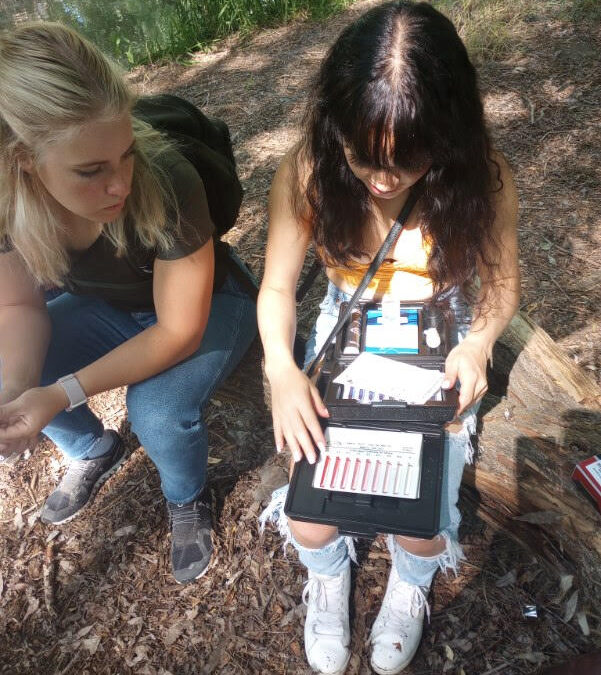
Week three focused on watershed management, during which students investigated a local river and evaluated its watershed and continued pollution. Students identified problems in their community by reading articles and examining data concerning a local river’s environmental issues, proposed solutions, as well as the progress that has been achieved. Students then made qualitative statements about the river’s current condition based on abiotic and biotic measurements. Students used the information gathered and discussed issues concerning the current quality of the river and discussed why water quality is essential. Students researched the issue by conducting river water quality experiments using flow rate measurements and collected macroinvertebrates. Based on their experimental results, students developed a portfolio with a problem explanation, alternative policies, and a public statement concerning the current Jordan River water quality. Students then presented their findings to community members to help inform and educate them about the river contamination and improvements.
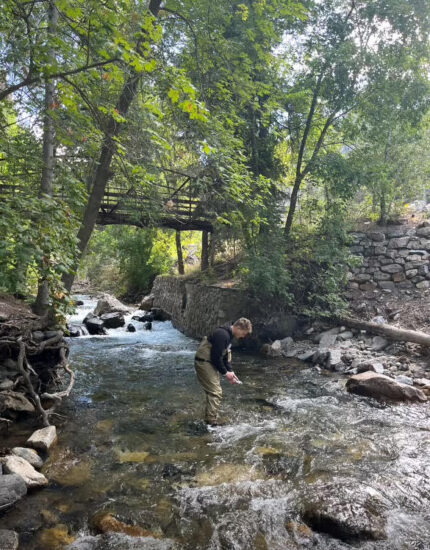
Student collecting water samples.
Week 4: Provo River Delta Restoration Project
During the last week, students examined a river delta restoration project for its effectiveness in restoring a wetland and recovering an endangered fish species. Students investigated the role and importance of river systems and wetland areas, monitored the status of the wetlands, and evaluated the current project’s future effectiveness. Students identified problems in their community by reading articles and examining historical data concerning the lakes environmental issues and made qualitative statements about the lake’s current condition. Students used the information gathered and discussed matters concerning the delta project to protect the local endangered species of June Sucker (Chasmistes liorus). In addition, students toured the construction site and participated in a stewardship activity planting new trees and helping to disperse cottonwood seeds around the area. Based on their stewardship project, a site tour, and experimental results, students developed a portfolio with a problem explanation, alternative policies, and a public statement concerning the current delta restoration project. Students presented their findings to others with the intent to inform and educate them about the project.

Student Impact
This program placed students as critical participants in sustainability and gave them ownership of their education, and knowledge of local environmental issues to give students a deeper appreciation and increased environmental awareness. This curriculum could be adapted for various populations although it is especially essential for those with disadvantaged backgrounds and those underrepresented in science. Creating an opportunity for my students to access nature and build environmental knowledge is important for them to build awareness and an increased ownership of their community. After completing the course, students wrote a reflection on their experience and a summary of what they learned concerning environmental awareness and feelings regarding their connection to nature.
“At first, I hated being outside, but it grew on me, and I had a lot of fun learning about the different invasive species and how they negatively affect the land.”
“I really enjoyed being outside for school. I liked the shaded and natural environments. It was enjoyable and easier to understand because I was learning about everything I could feel and touch.”
“I liked seeing the things we were learning about. It was easier to focus outside.”

Student working on writing assignments during the last day of class.
“I have had a lot of issues with school my whole life. I have never felt like what I was learning was useful. I felt like I was repeating work from former years over and over again and never getting anything out of it. After this experience, I began thinking that maybe the problem wasn’t what we were learning but where we were learning it. It was enjoyable being outside and seeing how what we were learning applied to the world around us. I got to see what we were being taught in action. We did tests with the world and not in a classroom. For the first time, I was really interested in what was being taught, and I realized that the problem wasn’t me.”
The importance of connecting at-risk youth to the outdoors is evident in their reflections. Their reflections indicate an appreciation for being outdoors, a more remarkable ability to focus their attention, and an advantage of learning in the world instead of the classroom. Students’ perception of environmental issues impacts their ability to make educated decisions. The increase in students place identity resulted in a deeper connection to the environment. Their knowledge, attitudes, and actions had changed.
Conclusion
On the last day of class, walking along the river trail with my students, I listened to their conversations, questioned their learning, and gathered their insights. I recognized how the connections made in class developed over time by building relationships, collaboration, trust, and teamwork. My students developed empathy for each other and their environment. As a class, we visited four distinct settings in our local area. My students could grasp the larger perspective by recognizing the cumulative effect of those areas as a whole. They identified the invasive species of cheatgrass studied in week one had made its way downriver and recognized the importance of carbon cycling studied during week two in the cottonwood trees flanking the banks of the river in addition to the value in wetlands studies in week three shown in the progress made on the restoration project. The sequence of each week was purposely built on the following week with a cumulative effort at the river delta restoration project, put in place to help solve many of the environmental issues identified in the previous week’s lessons. This program focuses on increasing student connection and ownership of the environment and identifying how isolated environmental concerns significantly impact the whole ecosystem. Additionally, I wanted my students to notice how environmental restoration and protection alleviate some of these issues. These connections came naturally to the students after the time spent outdoors and investigating environmental issues. Exposing them to new areas and increasing their knowledge and skills affects their awareness.
The environmental science program provided environmental concepts, fostering a deeper appreciation for nature and the outdoors. It engaged all senses, made learning more interactive and memorable, and encouraged more profound connections with the natural world, building ownership of the local area. This program initiated an attachment of students to the local area. It engaged students in environmental issues through science by participating in experiential outdoor education. It kept students engaged with relevant current topics, formed a connection to the natural world, and involved them in direct, focused experiences to increase knowledge, skills, and values.
 Lindsay Casper is a graduate student in Environmental Science at the University of Idaho, in Moscow Idaho and teaches Environmental Science to at-risk youth at Summit High School in Utah.
 Brant G. Miller, Ph.D., is an Associate Professor of Science Education at the University of Idaho. His research interests include Adventure Learning, culturally responsive approaches to STEM education, science teacher education, and technology integration within educational contexts.


 Edward Merrill Nichols is a 3rd-grade Teacher at North Bay Elementary in North Bend, Oregon. Growing up on the southern coast of Oregon instilled in him a love of and respect for his natural surroundings. With over six years of experience, he fosters student growth through engagement and respect. Edward actively engages in STEM education, leading Professional Development sessions and extracurricular clubs. He holds a Bachelor of Science in Education and a Master of Science in K-8 STEM Education from Western Oregon University.
 Christina Geierman has taught physics, biology, and dual-credit biology at North Bend High School for eleven years. She is a published scientist, a proud union member, a decent trombone player, and a world traveler. She enjoys spending time outside with her husband, Edward Nichols, and dog, Aine.


