
by editor | Aug 26, 2025 | Arts and Humanities, At-risk Youth, Environmental Literacy, Language Arts
By Emilie Lygren
I am a poet and outdoor science educator.” This is what I say when asked what I do for work. For me, poetry and outdoor science are complementary ways of looking at the world. They’re both rooted in common attitudes of attention, curiosity, and humility. They both require being present with the world in a deep way. And both fields of study can support learners, educators, and communities to develop environmental literacy and a sense of place.
My own relationship with poetry and outdoor learning started early. While growing up in the Monterey area in California, I loved spending time outside. I liked to study nearby trees, plants, animals, and bodies of water, and I often composed poems in my mind based on what I saw. Paying close attention to my surroundings helped me feel grounded and connected to place. Learning through my own observations made me curious to know more. In part, these interests emerged from having access to outdoor spaces and parents who encouraged me to express myself creatively. I was also fortunate to learn through an ecosystem of experiences in nature and generous individuals and groups I’d known.
I had a fantastic sixth-grade science teacher who invited students to engage in curious, careful investigation of the mysteries of the world. At the beginning of a class period, he’d hand out binoculars and field guides, then say, “Go out and find out what birds we have on campus. Come back in an hour and tell me what you saw.” Throughout the school year, our class mapped which plants grew around the schoolyard, collected and sketched insects, searched for fence lizards, and discussed how the school’s water use impacted nearby animal and human communities. By the end of the year, I’d gained a set of tools and mindsets for nature study that continues to sustain me to this day; environmental education made a difference in how I perceived myself as a learner and as a community member.
But not everyone has the access to the outdoor spaces and environmental learning opportunities that I did. In fact, access to green space and educational opportunities is often stratified by race and class. Many organizations in California and beyond are working to address these disparities and expand access and inclusion in the outdoors, including affinity-based organizations like Latino Outdoors and Outdoor Afro, education and advocacy organizations like Justice Outside, networking and community-building organizations like Ten Strands, and many more. Policy efforts such as “A Blueprint for Environmental Literacy” lay out a vision and strategies for “educating every California student in, about, and for the environment.” And there are hundreds of providers across the state that offer outdoor learning experiences. The work of all of these organizations is important and necessary to support environmental literacy.

I have spent most of my time in the outdoor education world working with the BEETLES Project, based at the Lawrence Hall of Science at UC Berkeley. Since its beginning in 2011, BEETLES has focused specifically on shifting the culture of outdoor teaching toward learner-centered pedagogy, encouraging instructors to be curious about students’ ideas, to represent science as a way of thinking rather than a list of facts, to help learners develop transferable thinking tools, and to focus on common and accessible parts of nature. BEETLES professional learning sessions, like “Making Observations,” offer learner- and nature-centered practices, paired with research and theory behind why they are effective. BEETLES student activities, like “Discovery Swap,” offer practical, learner-centered resources for instructors to use. Supporting resources, such as “Engaging and Managing Students in Outdoor Science” and “BEETLES Guide for Outdoor Science Program and Organization Leaders,” offer general support for instructors and organizations.
Prior to working for the BEETLES Project, I was an instructor at residential outdoor education schools, where I spent every day outside with students. My goal was to offer learners a range of different ways for being outdoors, from direct observation and close study of organisms to discussions of environmental issues to nature journaling to exuberant play. I also called on my love of poetry and facilitated writing exercises with students. I found that learner-centered, observation-based teaching practices and nature journaling in particular fed easily into poetry. My poetry eye quickly noticed that lists of observations, questions, and connections that students said out loud often sounded a lot like poetry––which is teeming with observations, questions, and connections. It wasn’t hard to encourage budding young writers to transform their scrawled notes, memories, and firsthand observations into poems, which they were often eager to share.
Ada Limón, the national poet laureate, says, “Poetry offers us a way to be closer to who you are.” In my experience, poetry also offers us a way to be closer to where we are through the process of careful observation, as in Brooke Maren Yokell’s poem:
My Backyard in the Spring
Brooke Maren Yokell, third grade
I sit in the backyard for
hours looking up and noticing the
clouds swiftly drift by
When I’m there I hear the bees
buzzing, the birds chirping
and wind gently blowing the trees.
I let the low wind hit my face
with warm spring air.
I let the warm air flood through
my body.
I sink into the
hot grass trying
to figure out
the shapes of
the clouds. The
wind gently pushes the
trees toward us.
Writing and sharing poetry in the context of environmental learning supports learner-centered teaching, making room for students to share their perspectives and experiences, as in Lena Nguyen’s poem:
My Old Old Old neighborhood
Lena Nguyen, third grade
My old old old neighborhood
where I used to live
was a home to me.
It had everything I needed.
Playground behind my house.
And every time I was sad
it would calm me with
sweet hushing rain.
When I was not scared
it would scare me with thunder.
If I was bored it would let
the sun out and welcome me to play.
Every year it would celebrate
with different decorated trucks
depending on the year.
My old old old neighborhood
used to cheer me up all the time.
Writing poetry is also a way to reflect on responsibility, making sound choices, and reflecting how actions may impact communities, places, and people––as in Ada Limón’s “A New National Anthem.” Writing poetry offers a way to slow down, notice, and adorn the ordinary with attention, as the luminous poet Naomi Shihab Nye describes in “Valentine for Ernest Mann.” And, writing poetry can be a way to name and cherish meaningful memories of places, people, and communities, as in my own poem about elders teaching children how to plant seeds.
On the following page are two poetry exercises that integrate poetry into environmental and outdoor programming (suggested for students age seven and older). Use them with groups of students, or respond to them as writing prompts yourself!
Throughout my career in environmental and outdoor science education, reading, writing, and teaching about poetry has helped me to stay connected to purpose and place. I have returned to poetry again and again and been sustained by the joy and perspective I’ve found there. I hope this article offers ideas for calling on poetry as a means to support environmental learning with your students and communities.
Resources for Further Study of Poetry and Science, and Learner-Centered Instruction
Poets for Science, an exhibit curated by Jane Hirschfield
Voices of Nature Series in Poetry of Resilience, a series of interviews with poets who write about nature, facilitated by James Crews and Danusha Laméris
Ada Limón interview “To Be Made Whole,” from On Being with Krista Tippet
Naomi Shihab Nye interview “Pay Attention. Be Kind. Live Large,” on No Small Endeavor
“I Notice, I Wonder, It Reminds Me Of,” a BEETLES activity that can be used to support science learning or poetry
“Offering I Notice, I Wonder, It Reminds Me Of as a Tool for Social Emotional Learning,” from the BEETLES Project blog
Poems with themes of outdoors, place, and observation (a few of many!)
“Everything Comes Next,” by Naomi Shihab Nye
“Sparrow Envy,” by J. Drew Lanham
“What We Were Born For,” by Emilie Lygren
Emilie Lygren’s story was originally published by Ten Strands, a California–based nonprofit working to strengthen the partnerships and strategies that will bring climate and environmental literacy to all of California’s TK–12 students.

by editor | Aug 26, 2025 | Environmental Literacy, Equity and Inclusion, Indigenous Peoples & Traditional Ecological Knowledge, Tribes & Traditional Ecological Knowledge
Indigenous Perspectives
and Environmental Education:
Connecting Youth with Plants, Places,
and Cultural Traditions
INTRODUCTION
These are exciting times in our region. We are fortunate to live at the confluence of two currents: the growing integration of Indigenous perspectives in both formal and informal education, and a surge of cultural revitalization in Indigenous communities. In the state of Washington, the 2015 passage of Senate Bill 5433 requires public K-12 schools to teach Indigenous history, culture and sovereignty in collaboration with the tribes nearest their schools. Educators have a rich variety of curricular materials to draw upon, beginning with the Since Time Immemorial curriculum. In the state of Oregon, the 2017 passage of Senate Bill 13 Tribal History/Shared History has led to similar developments in curriculum creation and collaboration between schools and tribes. Simultaneously, Indigenous communities around the region are experiencing a dramatic and wide-ranging cultural resurgence, including language revitalization and the revival of traditional pre-colonial practices. This fertile convergence offers a wealth of new opportunities to both Indigenous and non-Indigenous educators and their students. This special edition’s essays, including contributions by both Indigenous and non-Indigenous practitioners, introduce you to these currents and opportunities by focusing on Indigenous relationships with the more-than-human world, and particularly our ties to our plant relatives. We hope that these essays will inspire and guide you as you explore ways to enhance your teaching by accurately and respectfully integrating Indigenous experience and knowledge.
—Rob Efird and Laura Lynn
Co-editors

by editor | Aug 26, 2025 | Environmental Literacy
Activating Schoolyards through Garden Enrichment
by Bekah Marten, WSU Clark County Extension
School Garden Coordinator
In my current role as a School Garden Coordinator in SW Washington state, I have been able to work alongside school staff to help develop garden programming at area elementary schools. Often the schools that I have partnered with are excited about establishing a school garden, but they struggle with how to incorporate the garden spaces into the daily rhythm of their classes or do not feel confident in knowing how to plan, plant and manage a garden. Creating garden enrichment programs in these schools has been a successful way to activate their outdoor learning spaces as well as overcome some of the barriers staff expressed.
Garden enrichment programs can be incorporated into the school day without taking time from classroom learning. They can be led by staff or by parent or community volunteers. These types of programs allow students to explore their schoolyard in a different way. Lastly, garden enrichment affords students an opportunity to share something about themselves as well as gain natural world experiences in a non-academic setting.
One example of this would be to host an open garden time during a school’s lunch recess. A recess garden program can scale based on your number of adult staff or volunteers and what your goals are for the program. It can meet once a week, every other week, or monthly. This is a low-cost program that can be run regardless of whether your school has a set garden space or growing area and would be open to all students in the school.
When designing a recess garden time, choose a theme for that week’s session. In the fall you may want to explore leaves, spiders, or squash. In the spring months, insects, birds, vegetables, flowers or weather are all great options. Once your theme is picked, choose activities or stations that will be accessible to both the youngest primary grades as well as hold the attention of older grade school kids. For example, providing found natural objects (leaves, twigs, cones, small stones, etc) and allowing kids to make temporary art with them is an accessible project for the youngest students while still allowing for older children to create more intricate art pieces.
I have found that setting up three stations helps to manage the flow of students through the garden area. In choosing station activities, I like to have one that is a hands on and exploratory, a creative station, and a “Did you know” type station where student’s can learn something about the given weekly theme. This allows for all learning styles and interest levels to be accommodated. The “Did you know” stations are a great opportunity for students who have prior gardening experiences or knowledge about the natural world to share those stories or information with the station adult and their peers. Staff have noticed that students who are often more reserved in class open up when they can share their personal stories or things they know in the garden.
Enrichment programs like this are a great experience for all involved. Many of the schools where I work have a student population that does not have immediate access to an outdoor space to explore. Their schoolyard and the loose structure of a recess garden program allows for that freedom of exploration, creativity and learning in an outdoor setting. This fall, one student shared his excitement with me about learning how to prepare a garden bed for winter. When I asked what was most exciting about it, he said that his grandmother really wanted to learn how to garden, and now he will be able to teach her. Even many of the parent volunteers share that they walk away having learned or discovered something new about the natural world around them.
Rebekah Marten is the School Garden Coordinator with the Clark County Master Gardener Program. Our program offers a variety of ways to support local schools. We work directly with teachers and classes in the garden with activities and lessons that teach about soil, plants, and insects.

by editor | Jan 5, 2025 | Environmental Literacy, Experiential Learning, Inquiry, Learning Theory, Outdoor education and Outdoor School
Holding the Space: Supporting Our Children’s Innate Sense of Wonder

By David Strich, M.Ed.
“If a child is to keep alive his inborn sense of wonder, he needs the companionship of at least one adult who can share it, rediscovering with him the joy, excitement, and mystery of the world we live in.”
— Rachel Carson, The Sense of Wonder (1965)
When the boys were exploring the side of the creek last week, I couldn’t help but think of Rachel Carson and her words of wisdom. I watched as my twelve nine-year old mentees took to Whatcom Creek like it was their birthright. The next thing I knew, I was diving off a rock with seven boys into the refreshing water. Three others used dip nets to catch water striders while another mentor was showing them the three crawdads he caught. The last two were running along the banks in their own little worlds, ducking under tree limbs and splashing along the edges.
The work I’ve done as a nature connection mentor for the Boys Explorers Club program of Wild Whatcom has changed my approach to environmental education and to being a teacher. Over the past two years I have moved from an objective-based model to simply being a supportive guide. I still have goals for my participants and I still assess their learning, but I have come to realize that it is not my instruction that teaches them.
My role is to simply hold the space for them to learn on their own. Their first-hand experiences in our local Bellingham city and Whatcom County parks develop unique relationships with the watersheds, amphibians, trees, birds, and plants. And it is THOSE natural elements that are their teachers.
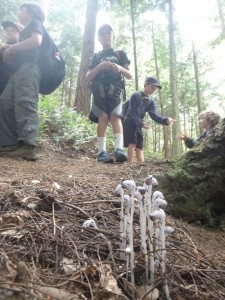 Recently Explorers’ curiosity led them to inquire about Indian Pipe (Monotropa uniflora) growing on the forest floor. They wondered if it was a plant because it isn’t even green. I started to pontificate about rhizomal relationships with conifers, habitat considerations, and that the plant has been used as medicine. But the boys will undoubtedly remember this ghostly plant more because it is said that Indian Pipe grows where wolves have urinated. That made them laugh.
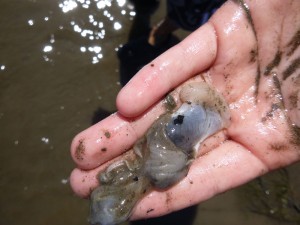
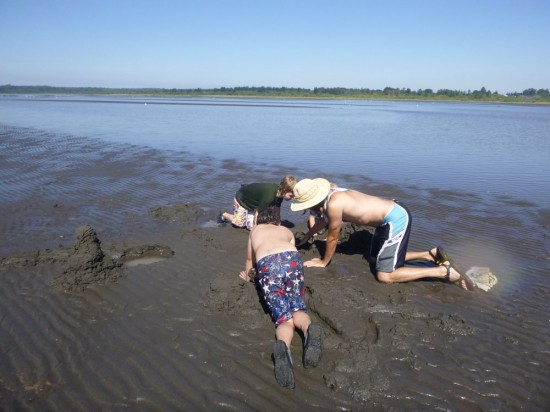
Later in the week, when an Explorer accidentally broke open a clam shell while digging in the mud, he learned about shellfish biology and how delicate those animals are. In addition, and perhaps more importantly, he practiced compassion for another living being and the skill of forgiving himself for hurting that creature. He might have learned about clam biology if we had dissected some using a scientific investigatory approach that I prepared for them. However, he’d have missed a chance for vital interpersonal growth that came from his own exploration and experience.
 So I have to let go of my objectives to teach the boys about plants because I never know what will spark their interest as we wander through the forest together. I can share knowledge from my adult perspective and perhaps nuggets of information will root into their heads so they can recall it later. But by just being there alongside them, as Rachel Carson encourages, l am rediscovering the mystery with them, fostering their sense of wonder and ability to learn on their own.
———
Our afterschool program called Neighborhood Nature is another opportunity for students to get outside with adult companions, as boys and girls explore natural areas near their schools. One second grade girl’s words speak clearly to the importance of this work. When we walked to the nearby park one Monday afternoon she told me, “I’m bored.” After a day of stimulation in school her nervous system was very amped up. She was ready for the next entertainment or thing to do. When she said it again, I replied, “Good.”
“No, I am not supposed to be bored,” she said, implying that as an adult it was up to me to make sure she had something to do. I just smiled and told her that I thought it was good that she was bored. She dismissed me with a huff and then sat down in the dirt. And there the magic happened.
In previous years I would have given her a task and helped her to accomplish it, having some objectives for her growth in my head. It would have been a contrived way for me to teach her something that she may or may not have wanted to learn. Instead, I observed her physical response to boredom and the subsequent transformation.
(article continues below)

She sat down in the dirt and then her nervous system slowed down. Naturally her hands fidgeted with the dirt. Soon she looked up to see another girl digging a hole in the ground near her. She watched for a moment and then asked to join in digging a tunnel and then creating a burrow and home for an unknown animal. The girls connected and laughed together while playing in the dirt. They too practiced compassion in making a home for another living being in the forest, one they hadn’t even seen. They practiced intrapersonal skills and learned how to work well with one another.
Had I gone into my previous teacher mode and tasked her with something to do, then this authentic learning would have been lost. Once her body slowed down and her amped-up nervous system relaxed, her curiosity took over and her social tendencies took over. This girl had to be “bored” and I had to let it happen. As a supportive guide the best course of action for me was to deliberately take no action. When it was time to head back to school to meet the parents, it was all I could do to cajole her into leaving so the groups wouldn’t be more than 10 minutes late.
 This is a reminder to all of us that we have to let go of the adult agenda in education. Our children know how to learn; they simply need the space to do so. They need us to let them be bored so their curiosity can show up. And it is us who ought to be present and engaged with their curiosity. We may have scientific and logical answers to teach and share but we may have forgotten the mystery that our children are exploring for the first time.
Like Carson says, a child needs an adult with whom to share and discover the joys and mystery of this world. But we adults should recognize that we need the children to remind us of the magic and mystery in our natural world. We have to be OK with slowing down, being bored and being present with our children so we can rediscover what we learned as children.
David Strich is the Program Coordinator for the Boys Explorers Club program of Wild Whatcom. He lives in Bellingham, Washington with his wife and can be reached at d.strich@gmail.com

by editor | Sep 12, 2024 | Environmental Literacy
Landscape and Language
Going outside can enhance language arts skills and open childrens’ eyes to the wonder of nature.
By Lorraine Ferra
 When the German poet Rainer Maria Rilke admitted to his sculptor friend Rodin that he had come to a standstill in his writing, the artist suggested that Rilke leave his desk, visit the zoo, and look at an animal for a long time. For several weeks perhaps, Rilke acted on the advice. He singled out a panther and watched it until he could see it and then wrote a memorable poem which reverberates with the monotony of the panthers pacing back and forth behind the bars of its cage. As a sculptor, Rodin understood the necessity of keeping the senses alert, an ability considered basic to the visual arts but often neglected in language. And so we continue encouraging children to produce grammatically flawless compositions and stories — writing that is often devoid of visual and tactile imagery, music, and that aura of silence which can draw us further into the depths of an experience.
I have been looking at the beginnings of two stories by fifth-graders about Utah floods. The first was written by a child who was asked in a creative writing class to describe the event:
One year there was a great flood is Salt Lake City. Stores were closed, and homes were destroyed by the rough water…
Well written grammatically, but echoing in tone the nightly reports of newscasters on local Utah television stations.
The second story’s opening was composed by a child who was advised to go to the scene and witness it firsthand. Besides observing the flood waters, she was to listen to bystanders’ conversations, discern facial expressions and notice the surroundings and activity:
Would you like to meet the father of a flood, stacking sandbags with tears in his eyes? His son ran away in the spring…
What a magnetic invitation to enter the story! The imaginative intelligence and emotional engagement in these lines could have been generated only by attention and sensitivity to detail. Moreover, the fact that the child was present, looking and listening, enabled her to internalize the event, a necessary component of transforming the writing process into more than a mere exercise.
As a poet-in-education, I have been passing along Rodin-like advice to children “This evening, sit outside and watch the sunset. What does it remind you of? What does it smell like? Write a poem about your ideas while you watch the sun fall behind the mountains.” As a result I receive poems describing the sun on the horizon “quiet as a pumpkin sitting in my backyard or “slipping away like someone turning off a lamp in the late evening.” A first-grade boy, whose attention had been diverted by a rainbow, handed me this short poem:
What is a rainbow? Sometimes
I think it is a beautiful bracelet
That turns on a girl’s wrist.
-Rick Lee Robins
The beauty of this poem lies not only in the product, but also in the process; the child did not simply follow the “assignment” in writing about a subject, but rather gave himself over to the few brief moments of the rainbow’s sudden appearance. He was “looking in the purest sense, without the self-consciousness that sees the object or occurrence as homework, without that myopic vision which blurs the possibilities awaiting the peripheral vision of the imagination.
Beyond asking children to observe and write outside the classroom, I have been taking them on what I call “poetry field trips” to meadows and canyons, migratory bird sanctuaries, aviaries, farms, city parks, even cemeteries. The decision on a location could be connected to a current geography, science or social studies unit, or best, could be simply contingent and spontaneous. But regardless of the relationship to the curriculum, it is perception and the act of writing that are integral to the awakening of language.
Early one fall morning I arrived with a group of fifth graders at Utah’s Bear River Bird Refuge, one of the country’s largest sanctuaries on the Pacific Flyway. The sun was still low in the east as shadows of cattails lengthened across the narrow road through the river channels. As we began the twelve-mile auto tour through tall reeds, the children, having spent much of the commuting time consulting various field guides and wagering over who could spot the most species of birds, suddenly quieted in the wild beauty of the place.
In preparation for the experience, I had suggested that they practice looking and wondering the way Walt Whitman did when a child brought him a clump of grass, and I recited parts of Whitman’s poem for them:
A child said What is the Grass? Fetching it to me
With full hands;
How could I answer the child? I do not know what it is any more than he.
I guess it must be the flag of my disposition,
Out of hopeful green stuff woven.
Or I guess it is the handkerchief of the Lord,
A scented gift and remembrancers designedly dropt,
…
Or I guess the grass is itself a child, the
Produced babe of the vegetation.
…
And now it seems to me the beautiful uncut hair of graves.
-from Walt Whitman, Leaves of Grass (from “Song of Myself” section 6)
Although they all readily agreed that the last image was “weird,” they were, nevertheless, enchanted by its mystery and haunting sense of beauty. *I recited that line in a lower, reverential tone of voice which lent to the ambivalence and left them wondering at its openendedness). They like the way Whitman initially confessed his helplessness in satisfying the child’s curiosity and then enumerated the various “answers.” I reminded them that the poems they would write about the birds would not rhyme, explaining that always trying to find a rhyming word often cuts off the flow of their ideas and feelings. The Whitman poem was a good example, filled as it is with its playful exploration while moving in tune with the natural rhythm of the human voice. It was also an inspiring model for a new way of looking and imagining. As we drove deeper into the refuge, the boy who had been reciting the familiar nonsense about “the pelican —his beak holds more than his belly can,” pulled his tablet and pencil out of his backpack while watching a flock of magnificent birds descending a hundred yards away and began his poem: “Pelicans resting like huge white clouds on the blue river…” I sense we were on our way.
One girl, convinced that there were no birds more wonderful than the whistling swans, composed this gracefully tangled mixture of images:
They float like leaves over the river,
Like crowned kings, but different in ways—
Their long necks resemble arches
That have been standing for thousands of years.
–DeAnn Perkins
Besides capturing the majesty of swans in “crowned kings,” she unconsciously unfolds her thinking process, making it part of the movement of the poem as she pauses with “but different in ways—” and then works out the association of swans with arches. The association was real for her, since she had lived as a very young child in southern Utah near the Arches rock formations. The sight of swans had evoked that childhood world which she transformed into a magical kingdom in her poem.
All the children were overwhelmed by the wide variety of bird life, but one boy was particularly charmed by the snowy egret’s alternating displays of stately and comic posturing. His poem evolved into a “candid camera” clip of what he found to be the bird’s human-like quirks of vanity:
THE QUESTION MARK
The snowy egret flaps his wings once
Or twice, to show his pride. But
When a noise comes near, he pokes
His head up out of the water
Like a question mark.
–James Fairbanks
It was unmistakable that observing the birds intensified the children’s pleasure in writing about them. They clearly wanted to write and read their poems as the went along. The experience was similar to coming upon a secret and longing to tell it to someone who would also find delight in the excitement and wonder of it all. Their poems were spontaneous celebrations of being in this landscape of strange and wonderful birds, not written assignments after the fact.
Ultimately, the “secret” children stumble upon in writing poetry is an inner landscape, that realm of language (a place all their own) in which they can wander about and conceptualize the world in such a way that trying to communicate where they have been requires a new way of speaking. Moreover, the accumulated experiences of reading and writing outside the classroom can encourage a habit of spontaneity among children. The next poem, in which the young writer saved the breathtaking moments of watching a Cooper’s hawk devour its prey in her yard, is an example of this spontaneous writing:
THE HAWK IN MY YARD
The hawk comes in
on silent wings
and perches high atop
the old bare-branched tree.
His piercing beak pokes
his dead prey
and little sparrow features
fall to the ground.
He sits with his back to me
and, with a wary eye,
turns his head
to watch
over his shoulder,
then shifts his feet
and ruffles his feathers
as the cold night air draws near.
–Allison Prescott
The writer just happened to be outside when the hawk came in “on silent wings.” Her poem reads like an eyewitness account by a reporter at the scene of a mysterious event, and her last line, “as the cold night air draws near,” leaves us shivering with her in the darkening yard filled with the hawk’s awesome presence. Also, this tactile ending of the poem points to the fact that once the wonder of looking and seeing is encouraged, the other senses seem to open naturally as we allow the daily events of our lives to penetrate the shell of routine.
With the same group of fifth-graders I led another poetry field trip to a canyon just a few miles outside of Salt Lake City. It was a weekday morning, and, as I had expected, we found ourselves alone on the canyon trail. Alone, that is, with aspens and pines, hawksbeard, lupine, and perhaps a dozen other newly opened, wild flowering plants.Each child had access to booklets on the regional wildflowers and had already thumbed through the pages filled with color photos of variegated flower accompanied by their “wild” names: Rose Pussy Toes, Goatsbeard, Prairie Rocket, Yellow Monkey Flower, Creeping Barberry… The names were enough to excite their imaginative instincts.
Before going off on the search, we gathered together and I read them a poem by Denise Levertov in which she speaks of tulips “becoming wings/ears of the wind/jackrabbits rolling their eyes…”
Rarely do I ask children to write without first reading them a poem or two from selections of classical or contemporary poetry. Doing this results in the stimulation of ideas and exposure to the various ways language can be explored. I ask them to recall favorite lines and to tell why they suppose the poet chows a particular word out of so many possibilities. This habit invokes a necessary attentiveness to language and consequently to careful writing.
The Levertov model was the right choice. Its associations broadened the list of exotic names the children had learned in the field guides, and its last stanza established the perfect mood: “some petals fall/with that sound one/listens for.”
These last words drifted off in the cool mountain air, and so did the children, quietly, as if listening for the flowers. One by returned, after sitting for a while beside a wild rose, with his poem:
THE WILD ROSE
High in the silent forest
a wild rose sits, in its center
a harmless sun rests. Its petals
are wings of a baby chick.
Its leaves are hands waving goodbye.
–Adam Lewis
The delicacy of language and imagery parallels the fragility of the rose. “A harmless sun” is a wonderful metaphor for the flower’s sun-like stamens. And the las image in which leaves are seen as “hands waving goodbye” suggests the transience of all living things, not only of the flower. These kinds of insight come from the children when we gather again to share our poems. “It makes the flower seem like a person who’s going somewhere. Maybe not coming back for a long time,” one child thought. Some children affirm the idea while others volunteer new perspectives, and the writer listens, sometimes shyly, mostly pleased, and often happily surprised by his or her poem.
Commenting on each other’s work, especially outside the classroom environment, creates a unique communal experience and noncompetitive atmosphere in which children learn things about themselves and the world that they never considered before. And what better place to write and read about a wild rose than in the mountains on a spring morning while its fragrance mingles with the smells of pine and canyon life?
The following poem approaches that place in poetry where the barriers between thought and speech dissolve into simple acts of praise:
SHOWY GREEN GENTIAN
What are you,
a falling start,
or hidden fire growing
quietly by yourself?
Showy Green Gentian,
What a beautiful name!
–Rosemary Fairbanks
The effortless conversational tone, so spontaneous and direct, reveals an intimacy with the subject which the young writer might not have achieved at her desk by simply looking at a wildflower picture. It also accents the personal impact of the observing-writing process that keeps children connected to what is most human in themselves and in their perceptual relationship with their environment.
The idea of “poetry field trips” does not imply that creative writing cannot happen in the classroom, for imagination can be stirred in any environment. But the imagination relies on senses not dulled by routine, by schedules, or by school bells that move us so quickly from one activity to another that we no longer hear them.
# # #
Lorraine Ferra was born and raised in Vallejo, California, a seaport on the east side of the San Francisco Bay. She was a nun for seven years in a community in Fremont, California, where she majored in theology and education and taught in elementary and secondary schools.
After leaving the convent, she lived for several years in Salt Lake City, pursuing seminars in modern and contemporary poetry and creative writing under the directorship of Robert Mezey at the University of Utah.
Her poems have appeared in many literary journals and anthologies since 1976, and some are collected in Eating Bread (Kuhn Spit Press, 1994) and What The Silence Might Say (One-Crow-Dancing Books, 2012).
Her creative writing book, A Crow Doesn’t Need A Shadow: A Guide To Writing Poetry From Nature (Peregrine Smith Books, 1994) has been endorsed by the National Council of Teachers of English.
Ferra is a recipient of a Utah Arts Council Award in Poetry and a Westigan Poetry Award selected by John Haines.
She has worked extensively for many years as a poet-in-residence with various state arts programs across the country and, since 2002, through the Skagit River Poetry Foundation in La Conner, WA.
Lorraine and her spouse, Deborah Trent, have lived for twenty-three years in Port Townsend, WA.

by editor | Aug 9, 2024 | Data Collection, Environmental Literacy, Experiential Learning, Place-based Education
Sophie Diliberti, Justin Hougham, Brad Bessler, and Brooke Bellmar
 ocusing on specific aspects of learners’ local context can increase their engagement in environmental education. One way for educators to pinpoint a community’s specific environmental circumstances is by adapting existing locally focused sustainability resources. After establishing the environmental issues that are relevant to the community, educators can maximize the geographic benefit of a local focus by incorporating geographic awareness and in-person exploration into their curriculum. This paper examines a case study in Milwaukee, Wisconsin: a lesson plan which adapts existing environmental education resources to pinpoint the local issue of stormwater management. The lesson also uses a StoryMap and walking tour to foster geographic awareness.
Community-specific issues: Strategies for educators to produce a more local focus.
Too often, environmental education focuses on issues that are removed from students’ lived experiences. Although melting icebergs and starving polar bears are compelling images, students must recognize that many types of environmental problems–and solutions–occur right in their backyards. Localized environmental education has been shown to be effective at increasing educational outcomes and sustainable behavior within communities (Ardoin, 2020, Fisman, 2010). Using specific community context ensures that the content of the lesson will be relevant to the lives of the students. While a field trip to a zoo or state park can certainly be interesting, knowledge about the environmental issues in places where students actually live provides a different kind of educational value.
Many communities have existing environmental outreach materials regarding specific local issues. Whether they come from university extension divisions, grassroots political organizations, or other local sources, these materials reveal issues that are important for community members to understand. Even if they are too young to understand those exact resources, students deserve this community knowledge, so the resources are worth adapting for them to consume.
Making the most of a place-specific focus by incorporating maps and in-person exploration.
Assuming a lesson plan centers around the specific context of the school and community, the next step is to maximize those benefits by explicitly focusing on geographic awareness and spatial reasoning in the lesson plan.
Using maps can increase spatial awareness and embodied learning for students, making maps a good starting point to accomplish this goal (Taylor, 2019). StoryMaps, a web-based Esri software which allows the user to incorporate maps, legends, text, photos, and videos into a spatial narrative, can provide a great resource for educators looking to incorporate maps into their curriculums. The interactive nature of a StoryMap allows students to engage with the geography of where they live and has been proven to increase geographic awareness (Purwanto et al., 2022).
Another way to harness the benefits of place-specific education is to provide opportunities for students to get outside and explore. In-person tours can be more productive if students have already learned the background of what they are exploring through a StoryMap or similar resource. Their questions will likely be less superficial after learning the basic context in the classroom.
Case study background: Milwaukee and green infrastructure.
Milwaukee is a city lucky to be situated at the confluence of three rivers and Lake Michigan. The city relies heavily on these bodies of water for drinking water, industry, transportation, and recreation, and they must be stewarded carefully to ensure long-term health. The city’s combined sewer system, which cleans wastewater and stormwater at the same time, is the foundation of many of its stormwater management challenges. The combined sewer system is useful most of the time: it filters pollutants out of runoff before releasing the stormwater into the lake. However, during some major storm events, the treatment plant receives too much water and experiences an overflow. During an overflow, the plant is forced to release unfiltered wastewater and stormwater into the lake. To avoid sewer overflows during storms, the city must minimize the amount of water that reaches the sewer system in the first place.

Milwaukee’s water-rich environment comes with essential benefits and difficult challenges.

A Milwaukee sewer overflow in 2010.
Green infrastructure (GI) is any modification to a built environment that mimics natural systems to provide some type of ecosystem service. GI is often applied to stormwater management, where it harnesses natural systems to filter and slow down water right where it falls instead of funneling it directly into sewer systems. Native plants with deep roots, rain gardens, bioswales, and rain barrels are all examples of GI used for stormwater management. The Village of Shorewood, a Milwaukee suburb that lies between the Milwaukee River and Lake Michigan, has implemented many beneficial GI projects as a response to its uniquely water-rich location and subsequent stormwater management issues.
Creating a map and walking tour for the Village of Shorewood.
In August of 2023, UW-Madison Extension worked with the Village to create a StoryMap that listed all the GI in the village (called “Shorewood’s Water Walk”). “Shorewood’s Water Walk” was useful in many ways but lacked a clear audience or use-case. This map is still linked on the village website, but has no designated users or associated events. You can find this this map here: https://arcg.is/15rmf90
In the summer of 2024, I redesigned “Shorewood’s Water Walk” so it could be used by local elementary schools. The new lesson plan, titled “Where Does My Water Go? Exploring the Shorewood Watershed,” includes a more targeted StoryMap and two walking tours, one that starts from each elementary school in the district. Instead of living on the village website, the new StoryMap and walking tours would go into the curriculum of local teachers to educate students about a very specific sustainability issue in their community. You can find this 2024 map here: https://arcg.is/10HvTX
The lesson’s StoryMap begins with a section called Shorewood’s Water History. This section uses pictures and diagrams to explain some key ways Indigenous water and land management differed from the city’s current stormwater management and combined sewer system. This section includes the interactive slider displayed below, which can be moved side-to-side to allow students to visualize temporal differences in state geography and Indigenous land.

An interactive sliding map to visualize Indigenous land before European colonizers arrived compared to in the present day.
Shorewood’s Water History also introduces the significance of the city’s combined sewer system and explains the concept of a watershed, which may be new to students using the map,

The map at the end of the StoryMap gives the students the opportunity to practice identifying GI before they leave the classroom to explore examples in the real world.
In the next section–Types of Green Infrastructure–the map provides picture-heavy identification and categorization tools for GI, using, when possible, pictures directly from examples in the village. This system of categorization is designed to give students the tools to identify and understand GI in the village. It uses categories designed by the Center for Neighborhood Technology. The image below captures an example of one of the types of GI included in the StoryMap.

Permeable pavement is one of nine types of GI that students will learn to identify from the StoryMap.
The StoryMap ends with a section called Identifying GI in Shorewood: an interactive map which shows different types of GI throughout the village. This adds geographic literacy in an interactive form, as students can zoom and click around the map. It also incorporates an application of the lesson’s content by asking students to identify what type of GI is located at each spot based on a picture and short description.

This one-mile walking tour demonstrates different types of GI located close to the elementary school.
The second part of the lesson plan is a walking tour designed to be led by the teacher after the students have spent time interacting with the StoryMap. The walking tour helps contextualize the StoryMap’s information in the real world, cementing it more firmly in the students’ understanding. The StoryMap, completed before the walking tour, should give the students enough context to ask more insightful questions, allowing the tour to focus on curious investigation rather than basic concepts.
Conclusion
Every community has climate and sustainability-related problems, needs, and solutions. From tree cover to invasive species to food sovereignty to public transportation, community awareness of these issues has the potential to create and manage environmental solutions. Toomey (2016) frames conservation as “…a social process that engages science, not a scientific process that engages society,” (p. 623) highlighting the importance of community outreach and education.
“Where Does My Water Go?” was initially a response to this need–an attempt to clarify and improve the engagement of the old StoryMap, “Shorewood’s Water Walk,” by narrowing its intended audience to elementary-aged students. During this process, it became apparent that adapting existing community resources can also be useful for environmental educators. It ensures relevance and contextual engagement for students, as well as provoking community engagement around important issues.
This lesson plan demonstrates two useful practices for creating environmental education lesson plans. First, it creates specificity and place-based relevance in district education by focusing on an environmental issue that is uniquely important to the area. Second, it maximizes that local focus by incorporating a map-based narrative (the StoryMap) and in-person exploration (the walking tour). These practices aim to spark student inquiry and curiosity.
In order to encourage even more active participation in the lesson, the ideal extension of this project would ask students to help create the StoryMap themselves. The co-generation of knowledge that this process could provide would keep students engaged and provide a unique opportunity to synthesize their lived experiences with information they learn from other sources.
Sources
Ardoin, N.M., Bowers, A.W., Gaillard, E. (2020). Environmental education outcomes for conservation: A systematic review. Biological Conservation, Elsevier. https://doi.org/10.1016/j.biocon.2019.108224
Bodzin, Alec M. “Integrating Instructional Technologies in a local watershed investigation with Urban Elementary Learners.” The Journal of Environmental Education, vol. 39, no. 2, Jan. 2010, pp. 47–58, https://doi.org/10.3200/joee.39.2.47-58.
Fisman, Lianne. “The effects of local learning on environmental awareness in children: An empirical investigation.” The Journal of Environmental Education, vol. 36, no. 3, Apr. 2005, pp. 39–50, https://doi.org/10.3200/joee.36.3.39-50.
Niemiec, R. M., N. M. Ardoin, C. B. Wharton, and G. P. Asner. 2016. Motivating residents to combat invasive species on private lands: social norms and community reciprocity. Ecology and Society 21(2):30. http://dx.doi.org/10.5751/ES-08362-210230
Taylor, K. H. (2017). Learning Along Lines: Locative Literacies for Reading and Writing the City. The Journal of the Learning Sciences, 26(4), 533–574. https://www.jstor.org/stable/48541101
Toomey, A.H., Knight, A.T. (2016). Navigating the Space between Research and Implementation in Conservation. Conservation letters. https://doi.org/10.1111/conl.12315
Purwanto, P., Astuti, I. S., Hartono, R., & Oraby, G. A. (2022). ArcGIS story maps in improving teachers’ geography awareness. Jurnal Pendidikan Geografi, 27(2), 206–218. https://doi.org/10.17977/um017v27i22022p206-218
Images
[Digital Map] Milwaukee Estuary AOC Boundary. Wisconsin Department of Natural Resources, City of Milwaukee, WI, Milwaukee County Land Info, Esri, HERE, Garmin, SafeGraph, METI/NASA, USGS, EPA, NPS, USDA. https://dnr.wisconsin.gov/topic/GreatLakes/Milwaukee.html
Was, M. (2010). [Photograph]. Milwaukee Journal Sentinel. https://archive.jsonline.com/news/milwaukee/getting-milwaukees-rivers-to-meet-state-water-quality-standards-wont-be-easy-b9948758z1-262245161.html
[Digital Map]. Milwaukee Public Museum. https://www.mpm.edu/educators/wirp/nations
[Digital Map]. Wisconsin Tribal Nations. Travel Wisconsin. https://www.travelwisconsin.com/article/native-culture/native-american-tribes-in-wisconsin
[Digital Image]. Earth.com. https://www.earth.com/earthpedia-articles/what-is-a-watershed-am-i-in-one/
Prostak, C. Charted Territory [basemap]. Esri. July 9, 2024. (July 2, 2024).
Author bio
 Sophie Diliberti is an undergraduate at Macalester College. She is working in watershed education and outreach with the UW-Madison Division of Extension.


