
by editor | Sep 1, 2025 | At-risk Youth, Critical Thinking, Experiential Learning, K-12 Activities, Schoolyard Classroom
by Abigail Harding and Corwyn Ellison
“We do not learn from experience, we learn from reflecting on experience.”
-—John Dewey
When we walk silently in the forest we allow ourselves to deepen our connection and strengthen our appreciation for the natural world. Suddenly, we hear animals unfamiliar to us, and observe natural phenomena we never stopped to notice. Exposure to the natural world and reflection is beneficial to physical and mental well-being. The psychological power of a reflective solo walk is astounding—so much so that conscious reflective thought has been shown to change the very structure of our brains.1 Experience-based learning is more powerful when coupled with reflection. Reflection is defined as an intentional effort to observe, synthesize, abstract and articulate the key learnings gathered from an experience.2 When implemented intentionally, solo walks provide a context in which both experiential education and mindfulness converge for the benefit of student learning.
A solo walk is a relatively simple concept: an individual walks alone on a trail or perhaps through the neighborhood to connect, reflect or reason through an event, emotions, or anything else that comes up during that time. It is not novel, but can be revolutionary for the individual participating in it. Using solo walks to introduce observation and reflections skills to students is not only effective in learning, but also important in connecting with themselves, the community, and the environment. In this article we will provide a framework for conducting solo walks with students in natural settings.
What is a solo walk?
A solo walk is an independent, thought-provoking walk through a relatively isolated area. A key goal of a solo walk is to practice observational skills and promote critical thinking, and introspective thought in students. This is accomplished through both the solo walk itself, and reflective journaling and debriefing after. During the walk students are guided both in their direction on the trail and mindful awareness by cards spaced ten to twenty feet apart on the ground. The cards may include a topical quote, a prompt for journaling or action, a direction, or perhaps a question to ponder. These cards can be customized and adjusted to suit the needs of the students and to meet learning goals. Common categories for cards include introduction/closing, thought-provoking questions/quotes, observation/sensory prompts, directional signs, and anything in between. For example, a card may say, “Stop here until you hear two bird songs” or “Where was this boulder 100 years ago? 1,000 years ago?”
How do you do a solo walk?
A non-complex trail or route should be chosen ahead of time. To avoid confusion, a card indicating direction of travel should be placed at all junctions the students encounter during their walk. A typical trail length is approximately ¼ mile. Two instructors or adults are necessary for the solo walk. The process and implementation should be discussed ahead of time. Students begin by gathering at the head of the route. Instructor A will introduce the solo walk as a reflective activity and play a game with the students as they wait to begin their solo walk. Be clear to students about expectations, the benefits of doing a solo walk, and why it is important for them to walk slowly and silently throughout. Emphasize that if they see someone in front of them, they should slow down, perhaps spend more time at the current card, and give the person ahead time to walk out of sight.
After roll-out, Instructor B leaves to set out the cards on the trail. Approximately five to ten minutes later, instructor A begins sending one student at a time down the trail for the solo walk. Each student is sent down the trail in two-minute intervals. The order in which they are sent can be determined ahead of time by the instructors or the decision can be student-directed.
At the end of the solo walk, Instructor A will be waiting in an area in which students may silently sit and journal reflectively about their experience. This location should be large enough for the entire group and should be comfortable for students. After all students have returned and journaled, Instructor B will walk the trail, pick up the cards, and rejoin the group. At this point a debrief will occur. Since students will be arriving to the end location at different times, it is important to have an activity ready for them to complete while they wait. This could be journaling, drawing or using watercolors to illustrate something they noticed during the walk, sitting quietly and observing, or any other quiet independent activity.
The debrief
Debrief is one of the most important components of a solo walk, particularly when it is focused on reflecting, synthesizing, and sharing their experience. Responding to one to two pre-written questions in a journal while students wait for the rest of the group is a constructive activity that prepares them for sharing later. To accommodate different learning styles, offer students a choice of responding in a way that feels valuable to them i.e. writing, sketching, or a combination. Once all students have completed the walk and journaling, give them an opportunity to share in pairs and/or as a group. The act of sharing their experiences can be very powerful, but also recognize that not all students will want to share to a large group and, in those cases, sharing with one other person is sufficient.
Some examples of debrief questions can include:
What surprised you about this experience?
What was your favorite card? What cards would you include?
What advice would you give other students for their solo walk experience?
What are two things you learned and can use in daily life?
Use a mix of questioning strategies to draw out student reflection, and be clear about discussion norms to ensure emotional safety during a group debrief. Using the solo walk cards again for debrief is an effective way to provoke group discussion. Solo walk cards can be placed in a pile on the ground, students can then pick their favorite card and share with the group why this card was chosen. Similarly, cards with a variety of emotions written on them may be used to promote a deeper discussion about feelings.
Table 1. The solo walk implementation guide
Goal To practice reflection, critical thinking, introspective thought, and scientific observation skills.
Objective Students will be able to:
· Journal in a reflective manner
· Complete a solo walk in an isolated area
· Participate in group discussion in a meaningful way
Audience Age group: any age
Number of individuals: 10-15
Duration How long is the lesson? 60 minutes
How long will it take to follow up the field experience? 10-20 minutes for debrief
Location An appropriate trail route and length based on the group’s abilities and needs. Check location ahead of time to identify potential risks. Alternative options include: school hallways, or any green space that provides opportunity for solitude.
Management and safety Students are supervised at beginning and end of trail. Trail is appropriate in level of difficulty and complexity. Junctions are marked with clear directional signs. Emotional safety is addressed by partner walking or pairing a child with an adult.
Equipment · Prompt cards (25-50)
· Activity for before and after solo walk
· Writing utensils
· Student journals
The debrief activities are an excellent opportunity for both teachers and students to assess student experience, knowledge and insight resulting from a solo walk. This information can be used to guide future learning activities and goal setting.
Teaching applications
Solo walks as a tool
For teachers, a solo walk is a versatile tool that can be planned to meet a variety of learning objectives. How you frame the activity, when you conduct it, what cards you choose, the order in which they appear on the trail, and the debrief strategy are all opportunities to guide students towards a specific goal or outcome. For example, a solo walk can be used:
In the beginning of a week to introduce students to and help them connect with a new setting
To ground a group of individuals with mindful awareness and space for reflection
At the end of a week so students can reflect on all that they have accomplished and how they might transfer these skills to their daily lives
Before and/or after a team building activity
Solo Science
In science education settings, students are often bombarded with new techniques and terminology. Solo walks provide the solitude necessary for students to ponder, dissect, and make sense of complex concepts in a tangible way. Because solo walks are inherently independent, students can use scientific tools without any external influence, and think critically of the world around them without fear of failure. Instructors may choose an investigative topic to center the solo walk around or design a mini independent investigation to be conducted during the solo walk. For example, an investigative topic may be plant and animal adaptations. The pictures below are examples of how we have woven scientific practice into the solo walk experience.
Connecting to classroom and beyond
Solo walks offer an incredible opportunity for students to develop awareness and practice active reflection that is an essential and valuable tool in lifelong learning. It can be a transformative experience and its adaptability make it a valuable tool for teachers. Give your students ownership over their experience by having them create their own solo walk cards. Cards can be written in any language, made of recycled material, cut into shapes, etc. Get creative and make it work for you and your students!
Advice from the field
Here are some tips gathered from a survey of 39 outdoor educational professionals with experience facilitating solo walks:
• Keep objectives broad, learners will get different things from the experience. The learning goal can be as simple as having time alone in the woods and it will still be powerful.
• Utilize a variety of cards and consider how the cards you use will support a larger theme or create a desired experience or outcome. Use short, relatable quotes from a diverse group of people with different backgrounds and cultures.
• Check the trail ahead of time and bring a few extra cards and markers to take advantage of teachable moments. Let the trail speak to you. If it is windy, use rocks to weigh the cards down and if you are teaching in a place like the Pacific Northwest, make sure your cards will survive the rain.
For some students, walking alone in the woods can create anxiety or bring out behavioral challenges. Work with students on ways to help them feel safe and explain that it can be a challenge by choice. You can help by sharing your own experience with solo walks, pairing students together or with an adult, being intentional with the line order, giving directions silently, etc.
Have fun and get creative!
References
Kolb, David A. (2014). Experiential learning: Experience as the Source of Learning and Development. Case Western Reserve University. Prentice Hall PTR, Englewood Cliffs, New Jersey
Giada Di Stefano, Francesca Gino, Gary Pisano & Bradley Staats. March 2014. Learning by Thinking: How Reflection Improves Performance. Harvard Business School Working Knowledge. Retrieved from https://hbswk.hbs.edu/item/learning-by-thinking-how-reflection-improves-performance.
Wilson, Donna & Conyers, Marcus. (2013). Five Big Ideas for Effective Teaching: connecting mind, brain, and education research to classroom practice. New York, NY: Teachers College Press.
Zelazo, P. (2015). Executive function: Reflection, iterative reprocessing, complexity, and the developing brain. Developmental Review. Volume 38, 55-68.
 Abigail M. Harding and Corwyn A. Ellison are environmental educators and graduate students at IslandWood and the University of Washington.

by editor | Jan 5, 2025 | Environmental Literacy, Experiential Learning, Inquiry, Learning Theory, Outdoor education and Outdoor School
Holding the Space: Supporting Our Children’s Innate Sense of Wonder

By David Strich, M.Ed.
“If a child is to keep alive his inborn sense of wonder, he needs the companionship of at least one adult who can share it, rediscovering with him the joy, excitement, and mystery of the world we live in.”
— Rachel Carson, The Sense of Wonder (1965)
When the boys were exploring the side of the creek last week, I couldn’t help but think of Rachel Carson and her words of wisdom. I watched as my twelve nine-year old mentees took to Whatcom Creek like it was their birthright. The next thing I knew, I was diving off a rock with seven boys into the refreshing water. Three others used dip nets to catch water striders while another mentor was showing them the three crawdads he caught. The last two were running along the banks in their own little worlds, ducking under tree limbs and splashing along the edges.
The work I’ve done as a nature connection mentor for the Boys Explorers Club program of Wild Whatcom has changed my approach to environmental education and to being a teacher. Over the past two years I have moved from an objective-based model to simply being a supportive guide. I still have goals for my participants and I still assess their learning, but I have come to realize that it is not my instruction that teaches them.
My role is to simply hold the space for them to learn on their own. Their first-hand experiences in our local Bellingham city and Whatcom County parks develop unique relationships with the watersheds, amphibians, trees, birds, and plants. And it is THOSE natural elements that are their teachers.
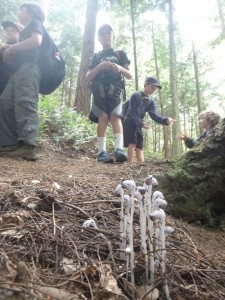 Recently Explorers’ curiosity led them to inquire about Indian Pipe (Monotropa uniflora) growing on the forest floor. They wondered if it was a plant because it isn’t even green. I started to pontificate about rhizomal relationships with conifers, habitat considerations, and that the plant has been used as medicine. But the boys will undoubtedly remember this ghostly plant more because it is said that Indian Pipe grows where wolves have urinated. That made them laugh.
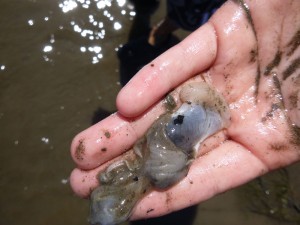
Later in the week, when an Explorer accidentally broke open a clam shell while digging in the mud, he learned about shellfish biology and how delicate those animals are. In addition, and perhaps more importantly, he practiced compassion for another living being and the skill of forgiving himself for hurting that creature. He might have learned about clam biology if we had dissected some using a scientific investigatory approach that I prepared for them. However, he’d have missed a chance for vital interpersonal growth that came from his own exploration and experience.
 So I have to let go of my objectives to teach the boys about plants because I never know what will spark their interest as we wander through the forest together. I can share knowledge from my adult perspective and perhaps nuggets of information will root into their heads so they can recall it later. But by just being there alongside them, as Rachel Carson encourages, l am rediscovering the mystery with them, fostering their sense of wonder and ability to learn on their own.
———
Our afterschool program called Neighborhood Nature is another opportunity for students to get outside with adult companions, as boys and girls explore natural areas near their schools. One second grade girl’s words speak clearly to the importance of this work. When we walked to the nearby park one Monday afternoon she told me, “I’m bored.” After a day of stimulation in school her nervous system was very amped up. She was ready for the next entertainment or thing to do. When she said it again, I replied, “Good.”
“No, I am not supposed to be bored,” she said, implying that as an adult it was up to me to make sure she had something to do. I just smiled and told her that I thought it was good that she was bored. She dismissed me with a huff and then sat down in the dirt. And there the magic happened.
In previous years I would have given her a task and helped her to accomplish it, having some objectives for her growth in my head. It would have been a contrived way for me to teach her something that she may or may not have wanted to learn. Instead, I observed her physical response to boredom and the subsequent transformation.
(article continues below)

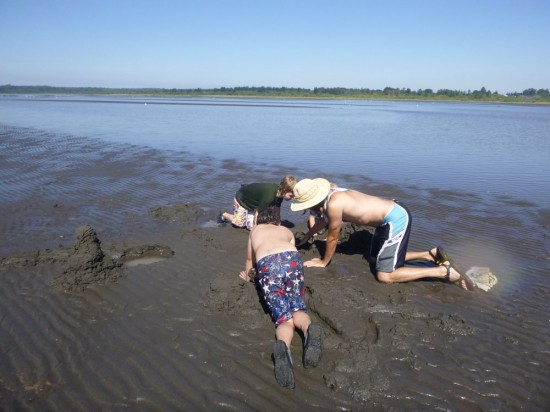
She sat down in the dirt and then her nervous system slowed down. Naturally her hands fidgeted with the dirt. Soon she looked up to see another girl digging a hole in the ground near her. She watched for a moment and then asked to join in digging a tunnel and then creating a burrow and home for an unknown animal. The girls connected and laughed together while playing in the dirt. They too practiced compassion in making a home for another living being in the forest, one they hadn’t even seen. They practiced intrapersonal skills and learned how to work well with one another.
Had I gone into my previous teacher mode and tasked her with something to do, then this authentic learning would have been lost. Once her body slowed down and her amped-up nervous system relaxed, her curiosity took over and her social tendencies took over. This girl had to be “bored” and I had to let it happen. As a supportive guide the best course of action for me was to deliberately take no action. When it was time to head back to school to meet the parents, it was all I could do to cajole her into leaving so the groups wouldn’t be more than 10 minutes late.
 This is a reminder to all of us that we have to let go of the adult agenda in education. Our children know how to learn; they simply need the space to do so. They need us to let them be bored so their curiosity can show up. And it is us who ought to be present and engaged with their curiosity. We may have scientific and logical answers to teach and share but we may have forgotten the mystery that our children are exploring for the first time.
Like Carson says, a child needs an adult with whom to share and discover the joys and mystery of this world. But we adults should recognize that we need the children to remind us of the magic and mystery in our natural world. We have to be OK with slowing down, being bored and being present with our children so we can rediscover what we learned as children.
David Strich is the Program Coordinator for the Boys Explorers Club program of Wild Whatcom. He lives in Bellingham, Washington with his wife and can be reached at d.strich@gmail.com

by editor | Aug 9, 2024 | Data Collection, Environmental Literacy, Experiential Learning, Place-based Education
Sophie Diliberti, Justin Hougham, Brad Bessler, and Brooke Bellmar
 ocusing on specific aspects of learners’ local context can increase their engagement in environmental education. One way for educators to pinpoint a community’s specific environmental circumstances is by adapting existing locally focused sustainability resources. After establishing the environmental issues that are relevant to the community, educators can maximize the geographic benefit of a local focus by incorporating geographic awareness and in-person exploration into their curriculum. This paper examines a case study in Milwaukee, Wisconsin: a lesson plan which adapts existing environmental education resources to pinpoint the local issue of stormwater management. The lesson also uses a StoryMap and walking tour to foster geographic awareness.
Community-specific issues: Strategies for educators to produce a more local focus.
Too often, environmental education focuses on issues that are removed from students’ lived experiences. Although melting icebergs and starving polar bears are compelling images, students must recognize that many types of environmental problems–and solutions–occur right in their backyards. Localized environmental education has been shown to be effective at increasing educational outcomes and sustainable behavior within communities (Ardoin, 2020, Fisman, 2010). Using specific community context ensures that the content of the lesson will be relevant to the lives of the students. While a field trip to a zoo or state park can certainly be interesting, knowledge about the environmental issues in places where students actually live provides a different kind of educational value.
Many communities have existing environmental outreach materials regarding specific local issues. Whether they come from university extension divisions, grassroots political organizations, or other local sources, these materials reveal issues that are important for community members to understand. Even if they are too young to understand those exact resources, students deserve this community knowledge, so the resources are worth adapting for them to consume.
Making the most of a place-specific focus by incorporating maps and in-person exploration.
Assuming a lesson plan centers around the specific context of the school and community, the next step is to maximize those benefits by explicitly focusing on geographic awareness and spatial reasoning in the lesson plan.
Using maps can increase spatial awareness and embodied learning for students, making maps a good starting point to accomplish this goal (Taylor, 2019). StoryMaps, a web-based Esri software which allows the user to incorporate maps, legends, text, photos, and videos into a spatial narrative, can provide a great resource for educators looking to incorporate maps into their curriculums. The interactive nature of a StoryMap allows students to engage with the geography of where they live and has been proven to increase geographic awareness (Purwanto et al., 2022).
Another way to harness the benefits of place-specific education is to provide opportunities for students to get outside and explore. In-person tours can be more productive if students have already learned the background of what they are exploring through a StoryMap or similar resource. Their questions will likely be less superficial after learning the basic context in the classroom.
Case study background: Milwaukee and green infrastructure.
Milwaukee is a city lucky to be situated at the confluence of three rivers and Lake Michigan. The city relies heavily on these bodies of water for drinking water, industry, transportation, and recreation, and they must be stewarded carefully to ensure long-term health. The city’s combined sewer system, which cleans wastewater and stormwater at the same time, is the foundation of many of its stormwater management challenges. The combined sewer system is useful most of the time: it filters pollutants out of runoff before releasing the stormwater into the lake. However, during some major storm events, the treatment plant receives too much water and experiences an overflow. During an overflow, the plant is forced to release unfiltered wastewater and stormwater into the lake. To avoid sewer overflows during storms, the city must minimize the amount of water that reaches the sewer system in the first place.

Milwaukee’s water-rich environment comes with essential benefits and difficult challenges.

A Milwaukee sewer overflow in 2010.
Green infrastructure (GI) is any modification to a built environment that mimics natural systems to provide some type of ecosystem service. GI is often applied to stormwater management, where it harnesses natural systems to filter and slow down water right where it falls instead of funneling it directly into sewer systems. Native plants with deep roots, rain gardens, bioswales, and rain barrels are all examples of GI used for stormwater management. The Village of Shorewood, a Milwaukee suburb that lies between the Milwaukee River and Lake Michigan, has implemented many beneficial GI projects as a response to its uniquely water-rich location and subsequent stormwater management issues.
Creating a map and walking tour for the Village of Shorewood.
In August of 2023, UW-Madison Extension worked with the Village to create a StoryMap that listed all the GI in the village (called “Shorewood’s Water Walk”). “Shorewood’s Water Walk” was useful in many ways but lacked a clear audience or use-case. This map is still linked on the village website, but has no designated users or associated events. You can find this this map here: https://arcg.is/15rmf90
In the summer of 2024, I redesigned “Shorewood’s Water Walk” so it could be used by local elementary schools. The new lesson plan, titled “Where Does My Water Go? Exploring the Shorewood Watershed,” includes a more targeted StoryMap and two walking tours, one that starts from each elementary school in the district. Instead of living on the village website, the new StoryMap and walking tours would go into the curriculum of local teachers to educate students about a very specific sustainability issue in their community. You can find this 2024 map here: https://arcg.is/10HvTX
The lesson’s StoryMap begins with a section called Shorewood’s Water History. This section uses pictures and diagrams to explain some key ways Indigenous water and land management differed from the city’s current stormwater management and combined sewer system. This section includes the interactive slider displayed below, which can be moved side-to-side to allow students to visualize temporal differences in state geography and Indigenous land.

An interactive sliding map to visualize Indigenous land before European colonizers arrived compared to in the present day.
Shorewood’s Water History also introduces the significance of the city’s combined sewer system and explains the concept of a watershed, which may be new to students using the map,

The map at the end of the StoryMap gives the students the opportunity to practice identifying GI before they leave the classroom to explore examples in the real world.
In the next section–Types of Green Infrastructure–the map provides picture-heavy identification and categorization tools for GI, using, when possible, pictures directly from examples in the village. This system of categorization is designed to give students the tools to identify and understand GI in the village. It uses categories designed by the Center for Neighborhood Technology. The image below captures an example of one of the types of GI included in the StoryMap.

Permeable pavement is one of nine types of GI that students will learn to identify from the StoryMap.
The StoryMap ends with a section called Identifying GI in Shorewood: an interactive map which shows different types of GI throughout the village. This adds geographic literacy in an interactive form, as students can zoom and click around the map. It also incorporates an application of the lesson’s content by asking students to identify what type of GI is located at each spot based on a picture and short description.

This one-mile walking tour demonstrates different types of GI located close to the elementary school.
The second part of the lesson plan is a walking tour designed to be led by the teacher after the students have spent time interacting with the StoryMap. The walking tour helps contextualize the StoryMap’s information in the real world, cementing it more firmly in the students’ understanding. The StoryMap, completed before the walking tour, should give the students enough context to ask more insightful questions, allowing the tour to focus on curious investigation rather than basic concepts.
Conclusion
Every community has climate and sustainability-related problems, needs, and solutions. From tree cover to invasive species to food sovereignty to public transportation, community awareness of these issues has the potential to create and manage environmental solutions. Toomey (2016) frames conservation as “…a social process that engages science, not a scientific process that engages society,” (p. 623) highlighting the importance of community outreach and education.
“Where Does My Water Go?” was initially a response to this need–an attempt to clarify and improve the engagement of the old StoryMap, “Shorewood’s Water Walk,” by narrowing its intended audience to elementary-aged students. During this process, it became apparent that adapting existing community resources can also be useful for environmental educators. It ensures relevance and contextual engagement for students, as well as provoking community engagement around important issues.
This lesson plan demonstrates two useful practices for creating environmental education lesson plans. First, it creates specificity and place-based relevance in district education by focusing on an environmental issue that is uniquely important to the area. Second, it maximizes that local focus by incorporating a map-based narrative (the StoryMap) and in-person exploration (the walking tour). These practices aim to spark student inquiry and curiosity.
In order to encourage even more active participation in the lesson, the ideal extension of this project would ask students to help create the StoryMap themselves. The co-generation of knowledge that this process could provide would keep students engaged and provide a unique opportunity to synthesize their lived experiences with information they learn from other sources.
Sources
Ardoin, N.M., Bowers, A.W., Gaillard, E. (2020). Environmental education outcomes for conservation: A systematic review. Biological Conservation, Elsevier. https://doi.org/10.1016/j.biocon.2019.108224
Bodzin, Alec M. “Integrating Instructional Technologies in a local watershed investigation with Urban Elementary Learners.” The Journal of Environmental Education, vol. 39, no. 2, Jan. 2010, pp. 47–58, https://doi.org/10.3200/joee.39.2.47-58.
Fisman, Lianne. “The effects of local learning on environmental awareness in children: An empirical investigation.” The Journal of Environmental Education, vol. 36, no. 3, Apr. 2005, pp. 39–50, https://doi.org/10.3200/joee.36.3.39-50.
Niemiec, R. M., N. M. Ardoin, C. B. Wharton, and G. P. Asner. 2016. Motivating residents to combat invasive species on private lands: social norms and community reciprocity. Ecology and Society 21(2):30. http://dx.doi.org/10.5751/ES-08362-210230
Taylor, K. H. (2017). Learning Along Lines: Locative Literacies for Reading and Writing the City. The Journal of the Learning Sciences, 26(4), 533–574. https://www.jstor.org/stable/48541101
Toomey, A.H., Knight, A.T. (2016). Navigating the Space between Research and Implementation in Conservation. Conservation letters. https://doi.org/10.1111/conl.12315
Purwanto, P., Astuti, I. S., Hartono, R., & Oraby, G. A. (2022). ArcGIS story maps in improving teachers’ geography awareness. Jurnal Pendidikan Geografi, 27(2), 206–218. https://doi.org/10.17977/um017v27i22022p206-218
Images
[Digital Map] Milwaukee Estuary AOC Boundary. Wisconsin Department of Natural Resources, City of Milwaukee, WI, Milwaukee County Land Info, Esri, HERE, Garmin, SafeGraph, METI/NASA, USGS, EPA, NPS, USDA. https://dnr.wisconsin.gov/topic/GreatLakes/Milwaukee.html
Was, M. (2010). [Photograph]. Milwaukee Journal Sentinel. https://archive.jsonline.com/news/milwaukee/getting-milwaukees-rivers-to-meet-state-water-quality-standards-wont-be-easy-b9948758z1-262245161.html
[Digital Map]. Milwaukee Public Museum. https://www.mpm.edu/educators/wirp/nations
[Digital Map]. Wisconsin Tribal Nations. Travel Wisconsin. https://www.travelwisconsin.com/article/native-culture/native-american-tribes-in-wisconsin
[Digital Image]. Earth.com. https://www.earth.com/earthpedia-articles/what-is-a-watershed-am-i-in-one/
Prostak, C. Charted Territory [basemap]. Esri. July 9, 2024. (July 2, 2024).
Author bio
 Sophie Diliberti is an undergraduate at Macalester College. She is working in watershed education and outreach with the UW-Madison Division of Extension.

by editor | Jun 19, 2024 | Critical Thinking, Environmental Literacy, Experiential Learning, Features on Outstanding Programs, Marine/Aquatic Education, Outdoor education and Outdoor School, Outstanding Programs in EE, Place-based Education, Teaching Science
How to Design Field-based Research Experiences
By Molly L. Sultany, msultany@nwacademy.org
High School Teacher, Northwest Academy, Portland, Oregon
Navigating Unchartered Waters
How can educators help students feel more connected to the outdoors while engaging with the work of research scientists? Scientific research may feel elusive to high school students, an unknown world hidden behind a technical paper, a puzzling chi-square analysis, or a p-value waiting to be deciphered. Yet, participating in field-based research may improve students’ intrinsic motivation, build resiliency, and enhance their sense of personal agency and responsibility (Marley et. al, 2022). I believe that teaching students outdoors introduces novelty and authentic learning opportunities into an existing science curriculum (Behrendt & Franklin, 2014). In addition, field-based research experiences provide a compelling alternative to a digitally dominated learning environment, often inundated with electronic media. Benefits to students’ well-being may include a longer attention span, multi-sensory experiences, deeper context for learning, a sense of comradery and feelings of community belonging, as well as reduced stress and fewer signs of ADHD (Grimshaw et. al, 2016). Overall, introducing a fieldwork component to existing curriculum may enhance student engagement, improve critical thinking, and foster positive interpersonal skills.

At our field site in Cannon Beach, Ofregon, students measured 3,807 ochre sea stars with 54 total search hours.
How to Engage Students in Field-based Research Projects?
· Build Your Professional Network: Connect with other educators at your school, district, or area interested in developing student-led research projects. Attend professional development opportunities for science education.
· Partner with Local Non-Profit Organizations: Become a member of regional and national non-profit groups dedicated to environmental conservation. This may provide opportunities for volunteering where you can meet like-minded individuals and build lasting community connections to enhance your understanding of local environmental issues.
· Lead with Student Interests: Brainstorm ideas for research projects with students. Start with a field trip to a nearby park, green space, or natural habitat. Find ways to discuss local conservation issues as part of your curriculum. Be inspired by students’ own personal interests, curiosity, and inquiry.
· Create a Science Lunch & Learn Program: Invite STEM professionals from your school community or region to give a presentation during the lunch hour for students about science career pathways, current research, or ways to become involved with the larger scientific community.
· Video Chat with a Scientist: Get inspired by programs offered through NASA, NOAA, and the Nautilus Live: Ocean Exploration Trust to connect students virtually to scientists to learn more about their research.

Wearing hip waders and waterproof gloves, Northwest Academy students measured ochre sea star (Pisaster ochraceus) size classes, and observed signs of sea star wasting syndrome.
Local Spotlight: Diack Ecology Education Program
After attending an Oregon Science Teachers’ Association (OSTA) meeting, I learned about the inspiring work of the Diack Ecology Education Program. This unique program provides Oregon educators with financial support and pedagogical resources through grants, workshops, and programming. Their goal is to provide guidance for teachers to develop effective student-centered, field-based science inquiry experiences. I admire the program’s values: commitment to local stewardship, opportunities for student leadership and decision-making, and an emphasis on outdoor experiential learning. Through their website (https://www.diackecology.org/), teachers can apply to attend bi-annual workshops taught by experienced science educators, where they learn how to construct a science inquiry project centered on local field work. The Diack program strives to help teachers develop greater scientific literacy and build civic engagement on themes related to local ecology, natural history, and environmental science.
Over the past ten years, the Diack Ecology Education Program has funded multiple student research projects at Northwest Academy, an independent high school in Portland, Oregon. Participation in this program has connected my high school students to the larger scientific community, including The Johnson Creek Watershed Council, Portland State University, U.S. Stockholm Junior Water Prize Conference, and the Oregon Environmental Science Summit where students had the opportunity to present their research in person to Dr. Jane Goodall. These experiences have transformed our high school science research program, and introduced students to the wonder, joy, and complexity of the natural world. Past projects have included a study of local stream health (2014), the role of diatoms as indicators of water quality (2015), and microplastics in beach sand (2017). Our most recent project (2022) had a dual focus on how marine biota respond to environmental change by studying the prevalence of sea-star wasting syndrome in ochre sea stars (Pisaster ochraceus) and documenting nesting success of cormorants during the summer breeding season.
 Benefits to Students
After our field research at the Oregon Coast in 2022, I learned that participating in field research has many direct benefits to adolescents, with transformative effects on socio-emotional learning, scientific literacy, and the development of a civic identity. By taking part in challenging field tasks in an unpredictable outdoor environment, students may develop an improved positive self-concept and increased self-esteem, seeing themselves as capable learners. One of my students reflected: “I learned that I have much more patience that I give myself credit for, and that I am also good at paying attention to details when I am observing.” In addition to these changes in self-perception, I believe there is value in helping students see science in action beyond textbook learning. This may, in turn, deepen students’ respect for the natural world. The student leader of our field team shared: “I learned about the shocking effects of sea star wasting syndrome, and what this damage for the sea star population could mean for the rocky intertidal ecosystem. With little prior knowledge of the effects of climate change or any practical interactions with climate change, seeing the effects of sea star wasting syndrome on the sea stars was immediately eye-opening.”
Lastly, participating in a science project with relevance to a region may strengthen students’ civic identity and build meaningful connections with their local community. It may also help students cultivate a personal connection with the natural world. While exploring the tidepools, each field day brought novel discoveries, keen observations, and many more scientific questions. By the end of our project, my students had become fiercely protective of our beach field site, which hosted incredibly diverse rocky intertidal habitat home to invertebrates, from crabs to chitons. One of my students shared: “walking through the sea cave at the tidepools and seeing all the biodiversity, from sea stars to isopods, was my favorite part of fieldwork. I want people to treat the world around us with respect. Interacting with the public and teaching them about this small part of marine conservation was meaningful and important to me.” This newfound sense of stewardship for the natural world was accompanied by their desire to teach others, share what they had learned, and reinforce proper tidepool etiquette at the beach.
Fostering Teacher Professional Learning Goals
Immersing students in dynamic environmental field research may also benefit educators in terms of curriculum design, pedagogy, and improved content knowledge. Inspired by field experiences with my students, I decided to incorporate themes related to marine biodiversity, ocean conservation, and anthropogenic global climate change into my high school science classes. Fieldwork reinforced the value of fostering creative and critical thinking with a flexible mindset in my approach to science teaching. It emphasized an inquiry model of the scientific method, fostering science process skills from observation to questioning. For many students who participated in fieldwork, this experience led to other opportunities to share their research findings at local science fairs, conferences, and school events. All in all, I believe that participating in field-based research projects will remain a valued tradition for our science program at Northwest Academy.
Acknowledgments
A special thank you to Mike Weddle, from the Diack Ecology Education Program, & Jesse Jones, CoastWatch Program Manager.
Works Cited
• Behrendt M & Franklin T. A review of research on school field trips and their value in education. International Journal of Environmental & Science Education. 2014 9 (10).
• Grimshaw M, Curwen L, Morgan J, Shallcross N, Franklin S, Shallcross D. The benefits of outdoor learning on science teaching. Journal of Emergent Science 2019, 16 (40).
• Marley SA, Siani A, Sims S. Real-life research projects improve student engagement and provide reliable data for academics. Ecol Evol. 2022, 8 (12).

by editor | Jun 1, 2024 | Experiential Learning
Experiential Learning to Create Authentic Learning
by Haley Korcz
 hen in your academic career did you question why you were learning something or how it would benefit you in real life? Did real-life connections from your academic learning impact your career choice? When I started my undergraduate career in environmental biology I found it hard to relate to what I was learning in some courses. I gravitated to environmental sciences because they were more understandable from experiences and questions I already developed. Outdoor labs were a huge component of those courses, we learned outside with real examples and tools that people in that field used in their careers. In a wetland ecology course, we learned about delineating a wetland using our knowledge of wetland indicators and put it into practice delineating a plot of land. This took the knowledge from what we discussed about wetlands, types, features, how delineations work, and the flora and fauna and built it into one activity where I truly understood my learning because I learned by doing.
These experiences led me to Islandwood, an outdoor school because I realized in order to teach science and conservation, students have to understand what they are being taught and be able to make connections to their lives and what is happening in the world around them. The purpose of the education system is to prepare students “for both their personal and professional lives – education and life should not be isolated from each other” (Pearce 2016, p.3). As an educator, how can we best serve our students in preparing them for life beyond a classroom?
Experiential learning, which can be used inside or outside classrooms, occurs during environmental education and creates authentic learning for students.
 What is Experiential Learning?
“Learning from experiences”, “learning by doing”, “trial and error learning”, “experience-based learning” are all concepts that describe experiential learning (Schwartz 2012, p. 1 and Gentry 1990, pp.1-2). Experiential learning theory is an interdisciplinary approach where students engage in intentional learning activities that can be applied to real-world situations (Gentry 1990, p. 10 and Schwartz 2012). This method combines many academic areas, like science, math, and art, into one project that could be applied to a professional career. Reflecting on these experiences are also just as important as the experiences themselves. Reflection by the learners is a critical component to create metacognition, thinking about thinking, “to develop new skills, new attitudes, or new ways of thinking” (Schwartz 2012, p. 1). This process can help students form new perspectives on situations. To model and reflect real life, outcomes from experiential activities should vary and be unpredictable and there should be many outcomes and means of getting there (Schwartz 2012). This process is similar to how engineers can develop different designs to solve the same problem.
Sophocles’ quote from 400 B.C., “One must learn by doing the thing, for though you think you know it-you have no certainty, until you try.” (Gentry 1990, p. 9). Students given an opportunity to demonstrate concepts, ideas, or theories in an interactive setting are learning by doing. Learning by doing can be used to demonstrate student learning to the teacher and help identify any misconceptions or gaps in learning that the student may have.
The role of instructors and learners is different in experiential learning. Students manage their own learning by identifying the knowledge they need to gain, how they can acquire it themselves, being able to provide evidence to their claims, and reflecting on learning (Schwartz 2012). Instructors are present to facilitate learning by providing resources, support, and questioning students to “tell me more” and “why?” (Schwartz 2012).
How to Design an Experiential Learning Activity
Long-term goals for students should include making meaning and transfer of knowledge and making goals prevalent when planning lessons and activities to help your students reach your goals (Wiggins 2013). When planning an experiential learning activity it is foremost to identify which part of the lesson would be most effective as an experiential learning activity that provides an equitable and culturally relevant experience for everyone. Then think of a real-world problem that relates to your goals and create an activity based on the problem that is challenging but manageable, provide clear expectations, allow necessary time, and allow students to change topics because a lack of interest is a lack of learning (Schwartz 2012).
There is a set of principles that define an activity as experiential (Schwartz 2012):
● mixture of content and process
● absence of excessive judgment
● engagement in purposeful endeavors
● encouraging the big picture perspective
● role of reflection
● creating emotional investment
● re-examination of values
● presence of meaningful relationships
● learning outside of one’s perceived comfort zone
To elaborate on these principles it is important to have experiential activities with content learning embedded. Students have a zone of proximal development, where they are cognitively prepared to learn with guidance, and when students are pushed out of their zone of proximal development learning may not occur even with guidance (Vygotsky 1986). Creating a safe place where students feel a lack of judgment can be accomplished by participating in team building, discussion norms, modeling culture of error and how to learn from those mistakes. It is important for students to understand why they are doing an activity or learning about something so that it has a purpose and meaning to them and instructors can help create an emotional investment through a relevance in students’ lives (Schwartz 2012). Reflecting on an activity can help students relate the topic to a bigger picture, learn about a different perspective of thinking, and provide a space to think about what they have learned.
Water-Themed Experiential Learning Activities:
Islandwood is an outdoor school that has a school overnight program on Bainbridge Island. As an instructor, I receive a different group of students from a different school each week ranging between 4th-6th graders. My lesson plan focuses on water and human interacts in an outdoor setting but this plan can be adapted for a classroom setting. When planning a water-themed week my objective for students is to understand the movement and cycle of water, water supply in their home, and where pollution can come from and to demonstrate this through discussion, reflection questions, and activities. The activity that I designed from a real-world problem was pollution released into Puget Sound. There was a series of lessons and activities scaffolded to help increase meaning and the ability to transfer student learning into other settings.
My first lesson is a discussion and game about the movement and cycle of water. In order to hook my students into the first water-themed lesson, I use a blow-up globe that the students toss around and say where their left thumb landed on, water or land. Then I ask students how much of the Earth do they think is covered in water. Next, ask the students why they think it is important to understand the water cycle. This engages students physically, mentally, and emotionally at the beginning of the lesson as well as giving a purpose. Students may quickly identify water as an essential limited resource but a common misconception may be that we are losing water instead of water just changing forms. The discussion continues with where the water is found, its forms, and how the water moves. This will help identify students’ prior knowledge and provide new content. To follow up the discussion students played a water cycle game where they pretended to be a water drop moving through the cycle. This game consists of nine stations: oceans, rivers, lakes, groundwater, glaciers, plants, animals, clouds, soil and students move through the methods of precipitation, transpiration, evaporation, percolation, sublimation by rolling dice to receive their method of movement to their next location. Students should track which stations they went to and their method of movement. They can then share their paths as a water drop with a partner or as small groups. Reflection questions for this activity could be: why was everyone’s journey different? and what are the similarities and difference between the game and the real water cycle? Knowledge could also be evaluated in a Venn diagram comparing the real water cycle and water cycle game and then asking why they think those differences exist. Depending on student knowledge or the prior lesson discussion students may understand that humans can change the water cycle and that is not reflected in the game. Humans may change the flow of rivers, build dams, increase impermeable surfaces which increase runoff and many others.

Student journal from water cycle lesson and activity. Photo by Haley Korcz.
To continue my water-themed week I used a relief map of Islandwood, a new space that they will be exploring but it could be adapted for a space that students are familiar with, like their schools watershed. My opening question was to ask students about their knowledge of what a watershed is. Once explained I asked students to view the map from a bird’s eye perspective and a ground level perspective and to identify how water flows across Islandwood’s landscape. Students identify high and low points of the map and where a water drop would flow to. In Islandwood’s watershed water flows to Blakely Harbor which is part of Puget Sound. Most of the children who come to Islandwood are from the Puget Sound area and this is a relatable place for them. As a follow-up activity, students pour water on a watershed relief map so that they can visually track the flow of water from different starting points. After these activities students have the ability to walk to Blakely Harbor and explore the shape of the landscape.
The next water-themed activity is to have students map the water supply in their homes by drawing using details and labels. Students identified where their water comes from, how it is used within their homes, and where it goes after it goes down the drain. This activity provides an opportunity for students to share their prior knowledge with the group. Each student may have knowledge about a different aspect of this activity, like where their water is sourced from a well or city and if they have a septic tank or sewer system. Once children understand where their water is coming from they can think about how it is used in their home and what is being added to the water that goes down the drain. Students can be asked what is happening to the other “stuff” that goes down the drain. They may think that wastewater treatment plants remove all of the other “stuff” which opens up a conversation of what cannot be remove and what happens to the system when it is overloaded. A relatable example is that caffeine cannot be removed by wastewater treatment plants and high amounts have been found in the Puget Sound. As an instructor, you could also use this moment to examine other ways pollution enters into waterways. This creates an emotional investment for students because it is using a space they care about and are familiar and comfortable with. This helps put meaning to their learning by connecting what is occurring in their homes on a larger scale of what is happening in the world. In my experiences, students have developed a lot of questions about where their home water supply comes from and pollution that is going down their drains. This activity helps create that “ah-ha” moment what students realize the impact each individual has on a bigger scale. Reflections questions for this activity could be: what happens to all the water and stuff that goes down our drains? how do you think we get clean water in our homes? and why do you think learning about water is important? Students should be able to collaborate while developing maps and present their work. This allows an option for students to ask questions to each other and increase their knowledge for their own maps.
On Islandwood’s campus, there are many composting toilets that the students use. These provide a setting for discussing water use, composting, and human feces pollution. At first, most students predict it will be disgusting and smell bad but once they experience the end of the compost cycle they decide the moist wood shaving aren’t so bad. Together we explore how the nutrients we take in when we eat can be returned to nature and help increase the nutrient availability for plants to grow. This is also a positive option to reduce water consumption to share with students in comparison to flush toilets. In a setting where composting toilets are not available, videos, diagrams, and other tools may help replicate the experience.
Another teaching location at Islandwood is the living machine, where campus wastewater treatment is occurring. The liquid waste goes through a series of vegetated tanks, sand filters, UV light, and chlorination before being returned to the environment. This system demonstrates the power of plants and the effort and time it takes to reduce human waste pollution. This lesson connects students back to their water supply mapping activity and elaborates their knowledge. Touring a wastewater treatment facility would be a great alternative lesson.
The final activity to connect all of the water-themed lessons and activities is for students to design a solution to clean up the Puget Sound from the scenario of an earthquake releasing a massive amount of pollution into the sound. The students’ solution should be a detailed drawing with written explanations. This problem is realistic, current, and can be solved through a variety of methods. A path map of lessons and activities from student learning should be created to help get students brains flowing with ideas. Additional background content for students can come from YouTube videos about ocean cleanup efforts and noise pollution around Puget Sound. The videos I have chosen demonstrate skills engineers use like seeing room for improvement, re-designing, making models and repeating the process over and over before building the final product. This leads to a discussion about what being an engineer means and continuous improvements. One video shows a young person who designed their own ocean cleanup method, which can be more relatable to young children. Students should be offered the option to collaborate to continue learning from their peers as well as the ability to change their idea. When checking in with each student about their project, discuss the resources that would go into their solution and ask questions like “tell me more” and “can you explain how that will work” to help them notice any flaws their design has. Students can then make edits they feel are necessary. This allows students to reflect without judgment and create a polished design. Students should present their design to the class.

Two students’ pollution cleanup design. Photo by Haley Korcz.
What is Authentic Learning?
Authentic learning theory is learning intended to connect classroom experiences that are interdisciplinary, complex, ambiguous, and can be solved through various methods to reflect “real world issues, problems, and applications” (Pearce 2016, p.1). This theory has three goals of learning: acquisition, making meaning, and transfer (Pearce 2016). Acquisition is the learning or development of new skills which can be achieved through critical thinking and problem-solving. Children need to make meaning of learning, otherwise without a connection to prior or new knowledge it may be forgotten. The connection that is formed between prior knowledge and new learning helps transfer learning to new situations. This can also be aided through wrap-ups of activities or new activities that build off to relate it to something familiar to the students.
Maya Angelou once said, “I’ve learned that people will forget what you said, people will forget what you did, but people will never forget how you made them feel” (Pearce 2016, p. 2). Student engagement and meaningfulness increases when activities are relevant to students’ lives outside of the classroom. Understanding cannot be told to students by instructors but it can be aided by using assessment as part of the learning process, learning with students, reflection, and relating the topic to real-world applications.
How Was Authentic Learning Created During Water-Themed Experiential Learning Activities:
The final water-themed activity, designing a solution to clean up pollution in Puget Sound, built off of planned scaffolding throughout the week. The engineering activity created authentic learning through the use of a real-world problem, designing an applicable unique solution, using interdisciplinary skills including art, English language arts, critical thinking, and science. This project could even be expanded to include project materials and cost estimates to include mathematics. Students were able to feel emotionally connected to their project, link prior and new knowledge, transfer learning to design a solution, and use critical thinking skills.
Experiential learning is focused on the reflection of the experience while authentic learning is focused on making meaning and transferring those skills into a new situation. The most effective method for creating authentic learning is through experiential learning.
References:
Gentry, J. W. (1990). What is Experiential Learning? Retrieved from: https://wmich.edu/sites/default/files/attachments/u5/2013/WHAT%20IS%20EXPERIENTIAL%20%20LEARNING%3F%20%20.pdf
Pearce, S. (2016). Authentic learning: What, why, and how? e-Teaching Management Strategies for the Classroom. Retrieved from: http://www.acel.org.au/acel/ACEL_docs/Publications/e-Teaching/2016/e-Teaching_2016_10.pdf
Schwartz, M. (2012). Best Practices in Experiential Learning. Retrieved from: https://www.ryerson.ca/content/dam/lt/resources/handouts/ExperientialLearningReport.pdf
Vygotsky, L. (1986). Thought and Language. Cambridge, Massachusetts: The MIT Press.
Wiggins, G. [AVENUESdotORG]. (2013, February 28). Grant Wiggins – Understanding by design. [Video File]. Retrieved


