by editor | Sep 15, 2025 | Conservation & Sustainability, Data Collection, Experiential Learning, Inquiry, Integrating EE in the Curriculum, Schoolyard Classroom, Student research, Teaching Science
Scotch Broom Saga:
Restoring a School Habitat as Project-Based Learning and Inquiry
by Edward Nichols and Christina Geierman
Since the advent of No Child Left Behind, many schools have turned their focus inward. Students rarely leave the classroom. Teachers often deliver purchased curricula that attempt to make meaningful connections for students. Lessons may contain examples from the real world, but these exist only on paper and are not explored within a real-world context. This article describes how an elementary school (K-5) on the southern Oregon coast addressed a real-world problem– the presence of the invasive Scotch broom (Cytisus scoparius) plant on the school campus. It began as a plan to improve an outdated writing work sample but became a school-wide project that allowed ample opportunities for students to authentically practice research skills while developing a sense of value for the world around them.
North Bay Elementary School is located in the temperate rainforest of rural Oregon, just a few miles from the Pacific Ocean. It serves about 430 students, over 95% of whom qualify for free and reduced lunch. The property was purchased many decades ago when the lumber mills were booming and so was the population. It was built as a second middle school, and the grounds had plenty of room to build a second high school. But the anticipated boom never came, and the property eventually became an elementary school surrounded by a small field and a 50-acre forest. At some time in the past, an enterprising teacher had cut trails through the forest for student access. When that teacher retired, the trails largely fell into disuse.
The Seed of an Idea
In Oregon third-grade students must perform a writing work sample each year. The topic in North Bend, which had been handed down from previous teachers, was invasive species. The class would work together to write a paper on an invasive species found in Florida, then apply their writing process knowledge to produce a sample on an Oregon invasive. They were given three curated sources created by using a lexile adjuster on the Oregon Department of Fish and Wildlife website. This project existed in a relative vacuum– invasive species were not mentioned before or after the work sample. Its only connection to the rest of the curriculum was the writing style. The students were interested in the topic and produced decent work, but Edward Nichols thought they could do better. He had long noticed multiple patches of Scotch broom growing just off the school playground. This invasive plant out-competes native ones and does not provide food or useful habitat for other native species. He wondered if they could do something with this to enhance the writing work sample and turn it from a stand-alone project to something more meaningful.
Fertile Ground
That summer, Edward attended a Diack Training held at Silver Falls State Park. In addition to providing excellent professional development on how to perform field-based inquiry with your students, it is also a place where you get to meet other educators with similar mindsets.
A chance conversation with Julia Johanos, who was then serving as Siuslaw National Forest’s Community Engagement and Education Coordinator, led to the idea of having an assembly on invasive plants for all students at North Bay Elementary. Edward was also a member of the Rural STEAM Leadership Network, and he met Jim Grano in their monthly Zoom sessions. Jim is a retired English teacher who is now focused on getting students outside. He has helped several schools in the Mapleton area start Stream Teams, which got students outside restoring stream habitat and collecting data on salmon. He routinely led student groups into the field to remove English ivy and Scotch broom. Edward invited him to help lead a similar event at North Bay.
 The Big Event
After weeks of planning, North Bay held a service learning day on March 17, 2023. The kickoff happened the day before when Julia Johanos led an engaging school-wide assembly on why invasive species are bad for our environment. The next day, the entire school participated in removing Scotch broom from the forest. The students came out one grade band at a time in 45-minute shifts. Each grade had a different task. Kindergarten students pulled the seedling Scotch broom by hand. Slightly larger stalks required “buddy pulls”, where two students worked together. Fourth and Fifth grades used weed wrenches to remove bigger plants. Alice Yeats from the South Slough NERR briefed each group on safety. And dozens of parent volunteers kept everybody safe. The Coos Watershed Association donated native plants, and the second grade came out at the end of the day to plant coyote bushes and red flowering currant, native strawberries, Oregon grape, and a variety of evergreen trees in the spaces the broom used to occupy. After school, Christina Geierman, a science teacher at North Bend High School, brought high school volunteers from the Science National Honor Society to help pull the biggest broom of all and clean up after the event.
Sustaining the Excitement
It is a tradition at North Bay to have a variety of fun activities for the last day of school. This year, in addition to the stalwarts of bubble soap, bicycles, and bounce houses, the event also contained a Scotch broom pull led by Jim Grano. Students could do whatever activity they chose, and many students chose to remove the broom from the edge of the playground. A representative from OSU Extension was also there, showing the kids how to make bird feeders, and folks from the South Slough NERR returned to lead nature hikes. The Confederated Tribes of Coos, Lower Umpqua, and Siuslaw Indians (CTCLUSI) also ran a booth and taught students about conservation and had them play a native game called nauhina’nowas (shinny), which involved using tall, carved sticks to pass and catch two balls connected by twine.
A second, school-wide Scotch broom pull occurred this past fall. Edward also started a Forestry Club at North Bay, which featured guest speakers from the Bureau of Land Management and had the students planting more native species. Plans are underway to have a school-wide pull each spring and a forestry club each fall to plant native species just before the rainy season hits.
 Applying Their Knowledge
Students participating in the Scotch broom pull apply their classroom knowledge in various ways. In mathematics, they record and tally the number of plants removed, practicing authentic math skills. They observe and document the plant’s lifecycle during the pull, connecting classroom biology lessons to real-world applications. North Bay uses the Character Strong curriculum to address social-emotional learning, and the broom pull allows students to apply traits like perseverance, cooperation, and service. Students can immediately and directly see the results of their efforts when they go outside for recess. This gives them a sense of pride in their accomplishments. There have been many reports of students educating their parents about why Scotch broom should be removed from the environment and even a few tales of students removing invasive plants from their own properties.
While participating in the Scotch broom pull, the students met a variety of scientists and conservationists. They were able to make a connection between this sort of work and future job opportunities. Jim Grano showed them that, if you feel passionately about something, you can make a difference as a volunteer. Alice Yeats, Julia Johanos, and Alexa Carleton from the Coos Watershed Association showed them that women can be scientists and do messy work in the field just as well as men can. Although it will take many years to tell, we hope that a few students will be inspired by this work to pursue careers in natural resources management.
Into the Future
This past fall, North Bay was named a NOAA Ocean Guardian School. This means that NOAA will provide the funds necessary to carry this project forward and expand it. The grant is renewable for up to five years. This spring, a group of students from North Bay will host a booth at Coos Watershed’s annual Mayfly Festival. There, students will present their project to members of the public and urge them to remove Scotch broom and other invasives from their own properties.
This spring, the North Bend High School Science National Honor Society (SNHS) will partner with North Bay students for a Science Buddies Club that will take place after school. Thanks to a Diack Grant awarded to Christina Geierman and Jennifer Hampel, the SNHS has a variety of Vernier probes and other devices that can be used to collect data in the forest. In the first meeting, the North Bay students will guide the high schoolers down the forest trails and describe their Scotch broom project. The SNHS members will show them how the probes work and what data we can gather. The guiding question will be, “Why do Scotch broom live in some areas of the forest, but not others?” The students will come up with hypotheses, focusing on one variable like temperature, light availability, etc. and then work together to gather and analyze the data. Students will present their data in a poster at the Mayfly Festival and possibly the State of the Coast Conference.
Members of the North Bend High School Science National Honor Society and family volunteers have reopened the trails through the forest. Plans are underway to expand these trails and partner with the CTCLUSI to create signage. The forest is being used by the school once again. Classrooms that earn enough positive behavior points can choose nature walks through the forest as potential rewards. Dysregulated students are taken down the path to calm them. Increasing student and community use of the forest is one of our future goals.
 Edward Merrill Nichols is a 3rd-grade Teacher at North Bay Elementary in North Bend, Oregon. Growing up on the southern coast of Oregon instilled in him a love of and respect for his natural surroundings. With over six years of experience, he fosters student growth through engagement and respect. Edward actively engages in STEM education, leading Professional Development sessions and extracurricular clubs. He holds a Bachelor of Science in Education and a Master of Science in K-8 STEM Education from Western Oregon University.
 Christina Geierman has taught physics, biology, and dual-credit biology at North Bend High School for eleven years. She is a published scientist, a proud union member, a decent trombone player, and a world traveler. She enjoys spending time outside with her husband, Edward Nichols, and dog, Aine.

by editor | Sep 12, 2025 | Environmental Literacy, Inquiry, Language Arts, Learning Theory, Teaching Science
The wild turkeys on my street don’t wear booties in the winter and the mouse in my house doesn’t wear bonnets from a closet! Should environmental education start with realism in the early years?
by Suzanne Major Ph.D.
Anthropology of Early Childhood Education
Books and movies have made animals, insects and plants so charming and sympathetic, and at times so frightfully magnificent and impressive. Can young children do without these entertaining animations and anthropomorphism, that is, making animals, insects and plants look and behave like humans? Do we dress them up, make them talk and have them drink tea from porcelain cups because we don’t know anything about them? Or do we think that young children can’t appreciate them for what they are? Young children across the world easily demonstrate that they are capable of perceiving, observing and remembering the descriptive elements belonging to an animal, a plant or insect. They can collect information and draw knowledge from it. My friend Omar in Cairo, three years old, knows not to treat the wild dogs as pets if only, because they are infested with fleas. My neighbour Maddy learned at two-years-old not to bother the bees in the hive hanging from the apple tree. Jenny, in Moncton New Brunswick, four years old, can identify the leaves of poison ivy in the forest and knows to wear long pants to protect her legs when she goes for walks with her family. Children learn very early on what is dangerous or not, comestible or not, pleasant or disagreeable. They are also capable of attaching symbolic value to things. Children everywhere offer flowers to their mothers and grandmothers to express their feelings or to create a nice event! As you know, they learn using observation, imitation, repetition or as Piaget wrote “perception, assimilation and accommodation”. They also identify with the knowledge of others or the information offered by nature. They encode it just because others use it, or they happened to observe it. They sometimes need information quickly, so they identify with the information others have, to fill the gap until they can adapt or replace it with more personal information. Through a very individualistic process of thought creation they retain or ignore elements of information and knowledge. They set the ones they favour in memory and replay others in thought, all sorts of ways assessing what works or not.
Finding animals, insects, plants or things cute, vulnerable or charming stems from the capability of empathy which is more difficult to use for what is ugly, threatening or disgusting. This notion of finding things cute is a cultural one that is cultivated and exploited by stories, books, animations and movies. Empathy is used to ensure survival among our own and can be transferred to animals, insects and plants. But it also allows sentiments to emerge that can be directed, intentions that can be instructed and behaviours that can be modelled. It is often used because of marketing interests but it can also serve pedagogically to create empathy. “Charlotte, the spider” is a good example!
The question here is do we need to create stories to nurture environmental education with children? Are we trying to sell them nature? Do we need to manipulate them towards environmental education or can we let them acquire a more significant first-hand experience? Should we not have a more functional approach about how everything has a place and time and is part of a balance of all and everything in the universe? Should we not let nature imprint itself on children, so they can sense by themselves their place on earth? Is that not fascinating enough? Let’s take the booties and the bonnets off the turkeys and the mice on these pages to see where this can go! Pink and white mice are mammals of the order of Rodentia and the genus MUS.[1] Wikipedia tells us that they are climbers, jumpers and swimmers and have lots of energy. They use their tail for tripoding so they can observe, listen and feel their environment. They can sense surface and air movements with their whiskers and use pheromones for communication. It is difficult for them to survive away from human settlements and in our houses, they actually become domesticated! They eat plant matter or anything else they can get their paws on. They will even eat their own feces for nutrients produced by intestinal bacteria. They are great at reproducing. They have a 19 to 21 days gestation, have 3 to 14 pups and 5 to 10 litters a year and females are sexually mature at 6 weeks. Do the math! We like them outside in the fields and not in our houses. Where I live, coyotes can hear and smell them and eagerly feast on them. Small falcons and owls can see them easily and pick them up in a flash. Last summer was very warm and wet. The vegetation exploded as well as the mice population. As I walked in my garden, they would jump up right and left to move away from me.
What can we infer from this information for environmental education? Young children spontaneously sit on their legs, hold up their bent hands and wiggle their noses to imitate mice. By observing mice and comparing their bodies with them, young children can engage in an array of locomotive and motor activities. Experimenting with sensing surfaces and air movements with their skin and their hair they can discover how this gives them information and knowledge. They can explore and sense space with the whole body like the security of a small shelter and the unsettling feeling of wide-open spaces. Discovering smells and odours for two and three-year- olds can be a lot of fun and for older children, linking those to chemical reactions can awake them to science. Seeking the mice out in the fields can be very interesting as they make little tunnels that go everywhere under the snow and through the dried grass. Reflecting with young children over three years old on the mice population in relation to the weather and the consequences this brings is interesting because the phenomenon attracts coyotes near houses which creates a real threat to house pets and small farm animals.

Let’s consider wild turkeys or Meleagris Gallopavo. Wikipedia informs us that the females are called hens and the males are known as toms. The males have huge tails they fan out to attract the females and impress the other males. They have up to 6,000 feathers and they can fly for 400 metres. To protect themselves from storms, they can roost up to 16 metres above ground in tall conifers. They gobble and emit a low-pitched drumming sound. If cornered, they can be aggressive towards humans. They are omnivores but prefer nuts, seeds and berries. They will eat amphibians, snakes and reptiles. Their babies are called poults. The hens lay 10 to 14 eggs and incubate for 28 days and the little ones are ready to go 12 to 24 hours after hatching. They can fall prey to coyotes, grey wolfs, lynxes and foxes.
The adults are around four feet tall and the big males can weigh some 37 pounds. I observe them regularly around my house. Hens flock together with the young ones, 12 or 14 together as they walk around the fields and woods. When they cross the road, one leads on and at least one or two stay behind to gather everyone. They are very attentive, looking right and left and right again. One might even stand guard in the middle of the street to make sure everyone has crossed. I am told they made a comeback in recent years as they had disappeared because of over hunting. At night in the summer, when there is a storm, we can hear them gobble after each clap of thunder.
What can we infer from this information for environmental education? It’s a magnificent bird when it struts around displaying its beautiful black tail, but I reckon a young child would be impressed even afraid if it came face to face with a tom or a hen on the street or in the back yard. It certainly offers the opportunity to acquire new vocabulary with the wattle or snood hanging from its beak, the caruncles pending from its neck, its hairless head crown and beard or beards on a single bird, the spurs on the back of its legs and the three long toes on its feet. Two and three- year-olds would delight in knowing by heart the body parts of the wild turkey and comparing it with the ones of a chicken. Young children would also be impressed to measure themselves against the life-size drawing of a male turkey. Three and four-year-olds could explore what low-pitch drumming sounds are and could discuss why the turkeys gobble after the clap of thunder and even do a little research. As an educator, I would not miss the chance to make a parallel between the turkeys looking right and left and right again before crossing the street and children attempting to do the same but unable to fly away from danger! Finally, with older children it would be interesting to place the mice, the turkeys and the coyotes in their environment and talk about the relation between them.
Nature provides real and fascinating animations all by herself and children can appreciate the reality of animals, insects and plants. All sorts of elements can create the desire for observation and exploration. Exploration calls on focus which brings attention to details which creates in turn the need for manipulation. Manipulation and/or representation will lead to curiosity for functions which is knowledge. Knowledge for young children establishes the feeling of competence. Competence cultivates initiatives and permits the experience of trials and successes. In turn, the need and the pleasure for demonstration can take place, then patience to practice, to persist and develop skills becomes a reality. Later, mastering will open the cognitive door to metaknowledge.
Observation, exploration, focus, manipulation, representation, curiosity, knowledge, competence, initiative, demonstration, patience, mastering, metaknowledge, is a pedagogical sequence that young children can start experiencing when they are just a few months old.
 Suzanne Major is an anthropologist and early childhood educator. She received her Ph. D. in 2015, with mention of excellence, in Anthropology of Early Childhood Education from the University of Montreal, Quebec, Canada. She also has a master’s degree in Child Studies which was obtained in 2004 at Concordia University, in Montreal, Canada. She has worked 12 years as Director for the Early Childhood Studies Program of the University of Montreal’s Faculty of Permanent Education.

by editor | Jan 5, 2025 | Environmental Literacy, Experiential Learning, Inquiry, Learning Theory, Outdoor education and Outdoor School
Holding the Space: Supporting Our Children’s Innate Sense of Wonder

By David Strich, M.Ed.
“If a child is to keep alive his inborn sense of wonder, he needs the companionship of at least one adult who can share it, rediscovering with him the joy, excitement, and mystery of the world we live in.”
— Rachel Carson, The Sense of Wonder (1965)
When the boys were exploring the side of the creek last week, I couldn’t help but think of Rachel Carson and her words of wisdom. I watched as my twelve nine-year old mentees took to Whatcom Creek like it was their birthright. The next thing I knew, I was diving off a rock with seven boys into the refreshing water. Three others used dip nets to catch water striders while another mentor was showing them the three crawdads he caught. The last two were running along the banks in their own little worlds, ducking under tree limbs and splashing along the edges.
The work I’ve done as a nature connection mentor for the Boys Explorers Club program of Wild Whatcom has changed my approach to environmental education and to being a teacher. Over the past two years I have moved from an objective-based model to simply being a supportive guide. I still have goals for my participants and I still assess their learning, but I have come to realize that it is not my instruction that teaches them.
My role is to simply hold the space for them to learn on their own. Their first-hand experiences in our local Bellingham city and Whatcom County parks develop unique relationships with the watersheds, amphibians, trees, birds, and plants. And it is THOSE natural elements that are their teachers.
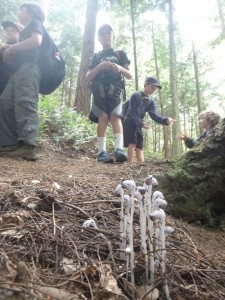 Recently Explorers’ curiosity led them to inquire about Indian Pipe (Monotropa uniflora) growing on the forest floor. They wondered if it was a plant because it isn’t even green. I started to pontificate about rhizomal relationships with conifers, habitat considerations, and that the plant has been used as medicine. But the boys will undoubtedly remember this ghostly plant more because it is said that Indian Pipe grows where wolves have urinated. That made them laugh.
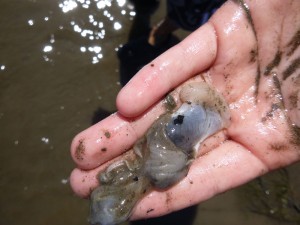
Later in the week, when an Explorer accidentally broke open a clam shell while digging in the mud, he learned about shellfish biology and how delicate those animals are. In addition, and perhaps more importantly, he practiced compassion for another living being and the skill of forgiving himself for hurting that creature. He might have learned about clam biology if we had dissected some using a scientific investigatory approach that I prepared for them. However, he’d have missed a chance for vital interpersonal growth that came from his own exploration and experience.
 So I have to let go of my objectives to teach the boys about plants because I never know what will spark their interest as we wander through the forest together. I can share knowledge from my adult perspective and perhaps nuggets of information will root into their heads so they can recall it later. But by just being there alongside them, as Rachel Carson encourages, l am rediscovering the mystery with them, fostering their sense of wonder and ability to learn on their own.
———
Our afterschool program called Neighborhood Nature is another opportunity for students to get outside with adult companions, as boys and girls explore natural areas near their schools. One second grade girl’s words speak clearly to the importance of this work. When we walked to the nearby park one Monday afternoon she told me, “I’m bored.” After a day of stimulation in school her nervous system was very amped up. She was ready for the next entertainment or thing to do. When she said it again, I replied, “Good.”
“No, I am not supposed to be bored,” she said, implying that as an adult it was up to me to make sure she had something to do. I just smiled and told her that I thought it was good that she was bored. She dismissed me with a huff and then sat down in the dirt. And there the magic happened.
In previous years I would have given her a task and helped her to accomplish it, having some objectives for her growth in my head. It would have been a contrived way for me to teach her something that she may or may not have wanted to learn. Instead, I observed her physical response to boredom and the subsequent transformation.
(article continues below)

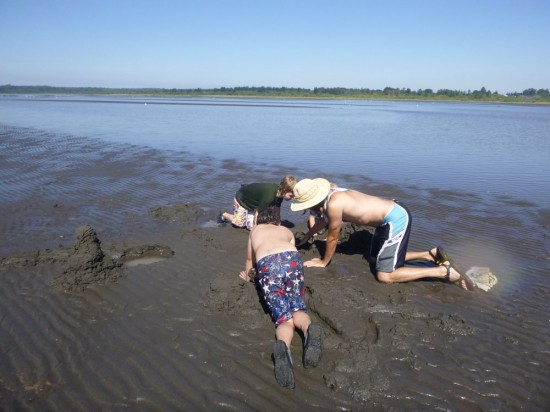
She sat down in the dirt and then her nervous system slowed down. Naturally her hands fidgeted with the dirt. Soon she looked up to see another girl digging a hole in the ground near her. She watched for a moment and then asked to join in digging a tunnel and then creating a burrow and home for an unknown animal. The girls connected and laughed together while playing in the dirt. They too practiced compassion in making a home for another living being in the forest, one they hadn’t even seen. They practiced intrapersonal skills and learned how to work well with one another.
Had I gone into my previous teacher mode and tasked her with something to do, then this authentic learning would have been lost. Once her body slowed down and her amped-up nervous system relaxed, her curiosity took over and her social tendencies took over. This girl had to be “bored” and I had to let it happen. As a supportive guide the best course of action for me was to deliberately take no action. When it was time to head back to school to meet the parents, it was all I could do to cajole her into leaving so the groups wouldn’t be more than 10 minutes late.
 This is a reminder to all of us that we have to let go of the adult agenda in education. Our children know how to learn; they simply need the space to do so. They need us to let them be bored so their curiosity can show up. And it is us who ought to be present and engaged with their curiosity. We may have scientific and logical answers to teach and share but we may have forgotten the mystery that our children are exploring for the first time.
Like Carson says, a child needs an adult with whom to share and discover the joys and mystery of this world. But we adults should recognize that we need the children to remind us of the magic and mystery in our natural world. We have to be OK with slowing down, being bored and being present with our children so we can rediscover what we learned as children.
David Strich is the Program Coordinator for the Boys Explorers Club program of Wild Whatcom. He lives in Bellingham, Washington with his wife and can be reached at d.strich@gmail.com


 Edward Merrill Nichols is a 3rd-grade Teacher at North Bay Elementary in North Bend, Oregon. Growing up on the southern coast of Oregon instilled in him a love of and respect for his natural surroundings. With over six years of experience, he fosters student growth through engagement and respect. Edward actively engages in STEM education, leading Professional Development sessions and extracurricular clubs. He holds a Bachelor of Science in Education and a Master of Science in K-8 STEM Education from Western Oregon University.
 Christina Geierman has taught physics, biology, and dual-credit biology at North Bend High School for eleven years. She is a published scientist, a proud union member, a decent trombone player, and a world traveler. She enjoys spending time outside with her husband, Edward Nichols, and dog, Aine.