by editor | Apr 26, 2009 | Place-based Education
By Kristina K. Sullivan
“Knowledge of the nearest things should be acquired first, then that of those farther and farther off.” — Comenius, 17th C. educator (Dubel and Sobel, 2008)
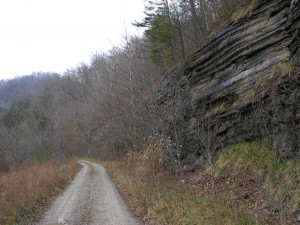
On the day of my twenty first birthday, I arrived in the small Appalachian town of Whitesburg, Kentucky (population 2,000) on a university field study. Though not yet a credentialed teacher, I was assigned the position of reading specialist for a small group of unmotivated yet adequately intelligent 5th-7th grade students at Cowan School, about five miles off the main highway.
It took very little time to discover that the traditional methods of schooling were not going to work, the problem exacerbated by my status as a California “outsider”. At that idealistic age despair was not a consideration; I had no choice but to embrace our differences. Rather than following a rote lesson plan, it seemed more promising to ask them questions about themselves.
(more…)

by editor | Apr 21, 2009 | K-12 Classroom Resources, Place-based Education

By Shamu Fenyvesi Sadeh
Portland State University, Center for Learning and Teaching West (NSF)
If students were asked to define “environment” and “community” what would they come up with? What would it look like if students designed their own methods for investigating community environmental issues? What would it mean if the teacher encouraged students to make connections between what they know about their neighborhood and scientific concepts such as diesel particulate pollution and carcinogens?
These are the central questions guiding a collaborative research and teaching project between an eighth-grade science teacher in a Northeast Portland middle school and myself, a long-time environmental educator turned doctoral student.
Our goal is to empower students to make connections between personal knowledge and environmental learning in ways that promote participation and learning in science class. To be responsive to the students’ interests and to facilitate our own continual learning, we use the model of action research – a spiral process of planning, implementation, evaluation and re-planning. The general approach of our plan-as-we-go curriculum is to get students involved in learning about and acting on community environmental issues of their choosing.
ALERT: You need to be a CLEARING subscriber to read the rest of this article.
(enter password then hit return button on your keyboard for best results)
[password]
Community-based or place-based programs share our emphasis on the local context but few programs that we have read or heard about turn power in the classroom over to the students. In my first years of teaching environmental education I spent a lot of energy trying to get the students to understand and adopt my (enlightened) environmental perspective and absorb my (considerable) scientific expertise. Historically much of the environmental education curriculum and research does the same: it focuses on either 1) carefully planned and tested activities designed to encourage the adoption of environmentally friendly behaviors that are pre-determined by the teachers and researchers, or 2) packaged units on environmental knowledge designed to be easily fed to the cooperative (but passive) student.
It was working with Native American, poor European American and African American students that helped me to shift towards student-centered learning. Approaching urban and minority students with my standard nature-as-wilderness bag of tricks was simply not working. Slowly, I began to do more listening than talking and to adapt my teaching to the particular needs and interests of the students and their communities. Now I know that to make environmental and scientific fields more diverse and to teach effectively to underserved populations I have to drop my agenda and listen to theirs. Particularly for populations such as urban, low-income African American and Latino students, who historically have not had a voice in scientific and environmental fields, honoring student knowledge and empowering student decision-making in the curriculum is crucial.
The Community Environmental Health Project at Columbia Middle School
In our work with low-income African American, Latino, Asian and European American middle school students, the collaborating teacher and I have worked hard to put the students’ perspectives at the center of the classroom. For example, when we began this fall by asking students about environmental issues in their community we got a lot of confused looks and blank stares. We decided we needed to take a few steps back and have the students define the concepts we were using. We decided to start using the words like “neighborhood”, “community” and “health”, rather than just “environment”, because we found that those words made sense to the students.
The discussion on “What is Community to You” was one of several that delved into students’ intense curiosity about race and poverty. Why is it as one student, Devon, observed “On this block we got Mexicans, on this block white, on this block white.” Why is the majority of industry located in minority neighborhoods? These were some of the liveliest conversations we have had in class this year. Few off-the-shelf environmental education curricula, even community-based programs, address race or class. Yet we found that culture, race and class are central to the students’ experience of community issues and are, of course, central elements in the field of environmental justice.
As a way of generating excitement on an issue close to the student’s experience, we read an article on the building that housed our school just four years ago. Many students in the class had older brothers and sisters, cousins or even parents who had attended school in the old building. The article describes how the building was contaminated with high levels of radon and toxic mold for many years. However, most shocking were three facts in the article: 1) radon exposure causes severe headaches and a lowering of cognitive abilities, 2) students at this school had the lowest test scores and among the lowest attendance rates in the entire state, and 3) some school officials knew for many years about the radon contamination and did nothing, despite repeated complaints by students, parents and teachers.
Many of the students were shocked and some, angry. One student, Sara, wrote in response to the article “If they knew about it for so long, how come they didn’t tell nobody or do anything?” The article showed students that there are important environmental issues affecting their community, introduced the concept of environmental justice, and in the words of the teacher, “got them riled up!”
After helping students to find their homes on city maps, we decided to engage in some neighborhood investigations at a scale that makes sense to the students: three block surrounding their house, apartment or trailer. From their observations, and from surveys the students designed and conducted in their neighborhoods, we generated a list of community issues. Homelessness, violence and graffiti were frequently raised together with more traditional environmental justice issues such as air pollution and asthma. Each class of students voted on an issue to investigate further and to take action on. Three classes chose air pollution and asthma and one class chose homelessness. Although homelessness and graffiti do not appear in scientific accounts of environmental problems, nor are they topics usually studied in science class, we decided to include them on the “community issues ballot” because they reflect student and community interest. If we want a science and environmental education that reflects the full diversity of our society, than we must expand the boundaries of “science” and “the environment.”
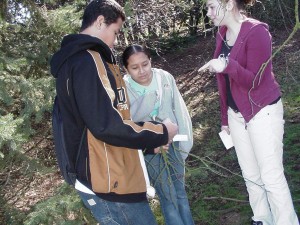 Other activities we have done as part of the community environmental health project include: writing a scientific autobiography, conducting community surveys, dialoguing with guest speakers, taking field trips, watching a video on pollution issues in a San Francisco neighborhood made by middle school students, conducting a lichen (as air quality indicators) survey, and making presentations to 6th and 2nd graders.
Challenges
Accomodating the time demands of this way of teaching and learning is not easy. Since the students design their own assignments and choose projects to work on, the teacher and I cannot plan the curriculum in advance. Additionally, our community investigations involve lots of reading and group work that demand lots of class time and need to be balanced with other 8th grade science units. Moving from teaching as telling to teaching as finding out requires a huge shift in thinking that posed a challenge to both the teacher and myself. This shift involves letting go of control and expertise and leaving room for mistakes and uncertainty. From my experience in environmental and science education, it is the path that all of us, whether college professors, nature center naturalists, or middle school teachers need to take.
A Little of What Have We Learned
Although we are still deep in data analysis, evaluation and reflection, a few patterns and lessons have emerged from the last year.
The Community Environmental Health Project is seen by some students as exciting and “real” compared to the usual school work of “sit and listen”, “facts” and “books”.
Many students who were typically unmotivated by science class emerged as energetic and vocal participants in the community environmental health project.
Many students were able to make personal connections to science through observations they made in their daily lives, conversations with neighbors and family, concerns about justice, and feelings of compassion for those suffering from asthma, cancer, lead poisoning, or homelessness.
Students showed understanding of concepts such as: the health effects of environmental toxins, using lichen as air quality indicators, environmental justice, mapping, community activist resources, and the effects of personal choices on environmental health.
Students’ comments and participation in extracurricular activities related to the project (producing a youth radio show for local community radio) demonstrate the empowerment many students feel being part of the project.
When a normally shy student proclaims “I want to know what it is like to be a homeless person,” and another confides to me that she likes studying air pollution because “my friend has asthma and I can cure her,” and a third tells me “So now that I see these things around me, all this air pollution, I know what to name it cause before I didn’t really pay attention to it,” we feel good about the work we have done.
(Names of the school and students have been changed)
[/password]
by editor | Apr 10, 2009 | Indigenous Peoples & Traditional Ecological Knowledge, K-12 Classroom Resources, Place-based Education, Service learning
Connecting Kids and Caribou
by Sue Steinacher, Alaska Dept. of Fish and Game
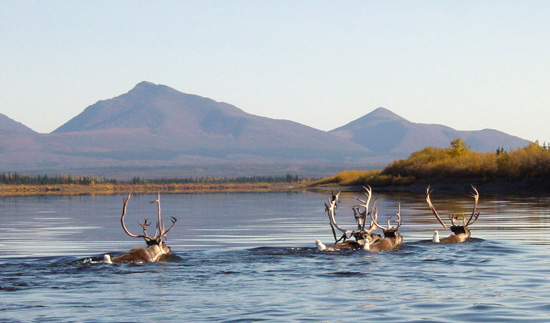
Teenagers can be a tough audience to impress. The students from northwestern Alaska let it be known they’d seen plenty of caribou, and had been riding in boats and camping all their lives. So coming to a place called Onion Portage, downriver from Ambler on the Kobuk River, didn’t seem like such a big deal — even to help with an Alaska Department of Fish and Game caribou collaring project.
But that all changed once they got their hands on a live caribou.
(more…)

by editor | Oct 22, 2008 | Outstanding Programs in EE, Place-based Education
Students Use Real World Data to Make ‘Green Maps’ of their Community
by Todd Burley
Homewaters Project, Seattle
“Green Mapping connected Cleveland’s students to their community by opening up their eyes to the environmental benefits and detriments around them. It gave the students a sense of ownership, pride, and responsibility. The culminating presentation at City Hall was the icing on the cake–students were able to share their voice with students from other schools and show what they found from their research.”
Amy Baeder, 10th Grade Teacher, Cleveland High School
How can we bring the titanic issues of community health – both environmental and social – down to a level that can be taught in the classroom? How can we make pollution immediate, income disparity tangible, and historical landscape changes apparent to the average tenth grade student? And how can we show the connections among all these issues including the students themselves?
Ten years ago, the seed of an answer to these questions germinated in New York’s Green Map System. This nonprofit organization facilitates the creation of ‘green maps’ around the world that make visual the sustainable features – and problems – in a local community. Green maps are locally created, but use an international set of icons as a shared language.
(more…)
by editor | Sep 11, 2008 | Place-based Education
By Kristen Cook
This year I learned that EarthCorps
don’t only make the forest a better
place, they teach other people how
to take care of the forest and some
of those people are us.
— Joseph, 5th grader
As the youth outreach coordinator for Earth Corps, a Seattle-based conservation corps, I provide in-depth service learning projects for youth using habitat restoration as the context. For the past six years, I have been working with teachers and students from Dearborn Park elementary in Seattle’s Beacon Hill neighborhood.
This area of southeast Seattle is away from the wealthier waterfront neighborhoods and properties which look out over the city skyline and Puget Sound. This is an area of the city whose parks and small bits of forest have historically been overlooked, not unlike its residents, many of whom are, to use the current terminology, “underserved.” Within this urban ecosystem, you’ll find ethnicities and languages spanning the globe, and if you drive down from Beacon Hill, or up from Rainier Valley, you’ll come across a tiny gem of a forest, not quite three acres in all. This is the Dearborn Park Children’s Forest.
(more…)

 by Victoria Lewis