by editor | Jan 2, 2014 | K-12 Classroom Resources
By Jim Martin
CLEARING Associate Editor
 hat if science teachers did science before they began teaching? Might a teaching model like this be possible to employ? Instructive to explore? There have been initiatives which followed up on this possibility. Their results were encouraging, but never replaced learning about science in publishers’ materials via college teacher education courses, which are simpler and less expensive to do when they are textbook-centered. The fruits of this choice have been a large fraction of K-12 graduates who haven’t achieved their potential.
What do students have to say about the way they are taught? Might some insights emerge from their comments? There is very little record of K-12 education from students’ own personal view point. Do they know whether their educations are worthwhile? A few people have looked into this, and have found that, when asked, students feel that classroom time is well spent when students treat the teacher with respect, behave the way their teachers want them to, stay busy and don’t waste time, learn a lot almost every day, and learn to correct their mistakes. Perhaps they have an intuitive understanding of an environment conducive to learning. The National Board for Professional Teaching Standards teacher certification program finds that students do well in school when their teachers are committed to them and their learning, know the subjects they teach and how to teach those subjects to students, are responsible for managing and monitoring student learning, think systematically about their practice, learn from experience, and are members of learning communities. Two complimentary views of what underlies effective education.
Taken together, these findings indicate that students know when they are taught well, and present the foundation of a clear plan for teacher pre- and in-service education. Had the K-12 graduates who didn’t achieve their potential applied questions such as stay busy and don’t waste time, learn a lot almost every day, and teachers know the subjects they teach and how to teach those subjects to students, to their teachers and curricula, and their assessments been considered in improving science teaching, might they have led to science courses which encouraged students to achieve their potential? Would they have led to pre-service science teachers actually doing science as part of their preparation for teaching science?
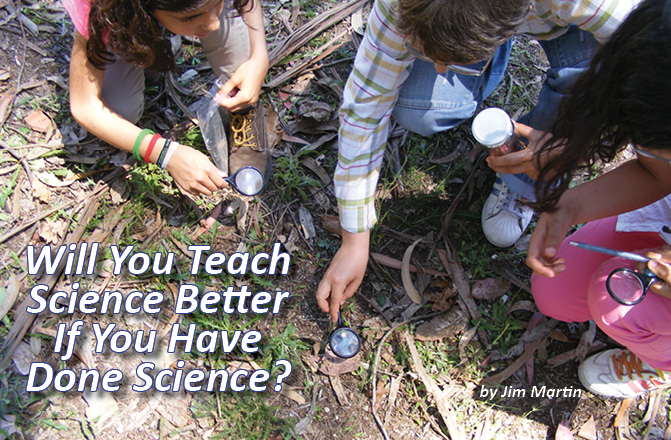
My experience tells me that doing science is important for science teachers. The need for science experience is a need that environmental educators have the capacity to respond to. The environments they work in abound with the kind of work pre- and in-service educators can do: mitigation, restoration, assessment, etc. They all contain the kernels of science inquiries to do. Working in collaboration with environmental educators, agency staff, and teacher education faculty and staff, pre- and in-service teachers could gain hands-on experience on the ground that they could get in no other way. My own experiences tell me that what emerges from this kind of collaborative work is science teachers involved and invested in the content that they teach, and empowered as teachers unencumbered by bureaucratic pressures outside their classroom doors; the experience necessary to change teachers’ views of science, a paradigm shift, that moves their locus of control for teaching science to within themselves, and away from the political winds that blow through schools. A key piece of the puzzle, this respite gives them a chance to develop effective science curricula.
What is it about doing science in environments outside the school that makes it so effective? I’d say that the reasons are many. An obvious one is that doing science in a familiar setting is less intimidating than doing it in a lab, which is much less familiar than, say, a quiet streambank. Another is that our brain learned to learn in the world outdoors. So learning science in a natural environment means learning in the brain’s inductive-constructivist way of learning. I’ve learned that, when teachers begin by doing science in a natural environment, they develop reasons to go into the lab, and labs become familiar places. What if we tried that? What would happen if environmental educators, agencies and organizations, and schools of education gathered together to explore the idea of a collaboration to provide pre- and in-service hands-on science education for teachers? There are all kinds of possibilities in collaborations like this.
If you’re a teacher, think back to your pre-service classes. Did you learn about a thing in class, then go out to experience it? How closely did what you experienced resemble the picture you had in your head back in the class? What if you had done the work first, then returned to the class to learn the underlying conceptual structure? Imagine a pair of pre-service teachers working together with an environmental educator, a restoration specialist from the City’s Bureau of Environmental Services, and a teacher with her students, to restore a reach of a stream flowing through a residential area near a school. Imagine further that the pre-service teachers are charged that day to identify and describe the characteristics of effective work groups. This in addition to doing the scheduled work of the morning.
The next day, back in the School of Education, all of the members of the class relate their experiences and report the characteristics of effective work groups that they had observed. Might discussion and negotiation of meaning elicit a clear concept of effective work groups, and posit connections between that and other elements of human learning? How might experiences like this influence these pre-service teachers when they do their one-year teaching internship? Would they affect the quality of their students’ educations when these interns begin full-time teaching? How would this look if a full-time teacher worked with the group from time-to-time as a mentor? If the full-time teacher would be the supervising teacher when the interns did their year in her classroom? This may never happen, but you can organize your own experiences to make this kind of experience one that you achieve yourself. All of the pieces of the puzzle are out there; they’re just not seen as elements of a functional whole. We have to learn to open our minds to recognize the relationships between what seem obviously disparate elements in a confusing world.
We’re not going to have this handed to us. But you can hand it to yourself. Find an environmental educator who is doing a restoration. Work with her. Then get your students on board. You’ll be outside your comfort zone. That’s okay. Keep your focus on what you want your students to learn, and make sure that part works. Look for workshops and institutes that provide valuable experience. In one summer institute, a teacher who had never ventured outside the classroom experienced her first encounter with the real world. By the end of the institute, she knew how to find a wetland, figure out its parameters, and design a project for her students. She had done science, and moved it into a perspective that removed its anxiety, made it eminently teachable. So she looked up an environmental educator she had met during the institute who suggested a wetland restoration project along a city-sponsored trail. The environmental educator agreed to help her plan, meet City bureau of environmental services staff, provide a training for her students, and point her toward a private granting organization which funded just this sort of project. She did the project, and continued on this path.
Let me step away from science for a moment and tell about plays my 7th graders performed when I first began teaching below college level. If I hadn’t done drama, I’d never have just hung two sheets from the ceiling light fixtures along the length of the room and said, “The side toward the windows is the audience, the side toward the blackboard is the stage. What shall we do?” My locus of control would have been too far away from me to even think of doing that. Luckily, I’d done plays for years. We picked a play, edited it, gave it. Then students, in groups, asked to write and do plays for the lower grades. And did them. I’d have been scared to death if I hadn’t acted, directed, constructed, written programs, made props, etc. I’d have simply followed a published play with directions. To the letter. And thought I was teaching drama. And I’d certainly not let them go off to the lower grades on their own. They’re seventh graders; get real.
Once you do science, it is not as intimidating as you first perceive it to be. Like me if I’d never done drama. Or, for all of us, the first time off the diving board, hitting a softball, etc. Now, you are focusing on particulars, so experience no unfocused anxieties about vague worries. We’re all good at that; once we focus on particulars, we begin to nail them down and work toward mastery. Get the start, so you know what you want to understand and do, then look around for resources like courses, workshops, knowledgeable people. Experience doing the work, then take control of your curriculum.
 This is a regular feature by CLEARING “master teacher” Jim Martin that explores how environmental educators can help classroom teachers get away from the pressure to teach to the standardized tests,and how teachers can gain the confidence to go into the world outside of their classrooms for a substantial piece of their curricula. See the other installments here, or search Categories for “Jim Martin.”

by editor | Jan 2, 2014 | K-12 Classroom Resources
Strategies for Community-based Education: Developing Healthy Partnerships
by Pat Willis
Oregon State University 4-H Extension
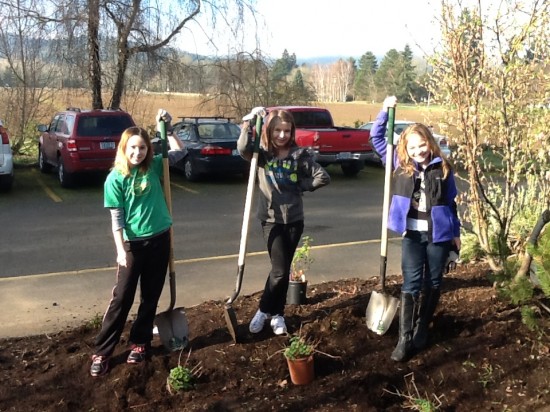
 ommunity-based education is an approach to teaching and learning that connects learners to community and place. Educators who adopt this approach investigate local culture, natural features and resource issues, economic challenges and opportunities, and community governance. Students are often given the opportunity to participate in work that is valuable for the community, with community members having the opportunity to share their knowledge and expertise with students. When community-based education is well implemented, the boundary between schools and communities becomes permeable, and students and community members benefit from the partnerships created. This article will share ideas and strategies to help community-based program leaders develop long-lasting and productive partnerships for implementing rewarding and impactful programs.
Partnerships for effective community–based education
There is too much to do. So much that needs to be cared for, brought to the public’s attention, built, maintained, monitored, and observed. There is no shortage of need. There is however a chronic shortage of resources. There is never enough staff, enough money, or enough time. But with a change in thinking, a shift in how resources are allocated, combined with good planning, all partners in a community-based program benefit.
Why people and programs need healthy partnerships is often more complex than who needs partnerships. There are the pragmatic needs for staffing, transportation, supplies, information and services, but there is also a human need of working together that must be addressed. Healthy partnerships can help accomplish many objectives by providing the needed resources to do work that enriches our communities. This is often work that helps make us feel a part of something larger than ourselves. These accomplishments can connect us in unexpected ways, to each other, and to our community. A community-based program with healthy partnerships can become healing and empowering.
What is a partnership?
For many of us involved in the work of helping students be actively engaged in their community, partnership is a word that is trotted out like a new pet pony or waved like a flag, yet partnerships often fall far short of what is envisioned or desired. A partnership is not just a cash donation, a one-time guest speaker, or a guided field trip. It starts with a conversation and it is participatory. All parties must benefit from the partnership, and at its best, society at large should be enriched. Healthy partnerships are long-lasting, goal driven, and must be enjoyable.
Being prepared for partnerships
Perhaps the most critical skills we need to develop to create and maintain successful partnerships are being able to identify access points within the community. An access point can be as simple as a well asked question, a community need, or a community change. It may be born trying to solve a local problem or seeking information that doesn’t yet exist. An access point can be any project or place or set of societal or environmental conditions which allow or promote community engagement to meet a need.
As with any project and partnership, thoughtful planning is key. Plans are meant to be flexible, to be revised and to offer a road map to where you might go. Don’t let your plan control you, but use it as your guide. With a clear definition of goals it becomes much easier to see who you might need as a partner, what kinds of tools and equipment might be required, what kind of expertise will be needed, how much time the project might take to complete, and how much money may be needed. A well written plan or program proposal will serve you in many ways. It will save everyone time by clarifying the project outcomes. Doing your homework here will never be regretted.
Partnership Responsibilities
To make partnerships work for all sides in the relationship, we must assume specific responsibilities. These are two-way relationships and like all relationships they will require time and tending. To carry the metaphor further, like human relationships that span a range from a casual acquaintance to a full-out marriage, there will be different levels of commitment and richness with your various partners.
All your program partners will understand the need for reliability, dependability, and high quality work. No one wants to do a job over. Whatever your community based project is, i.e.: wetland restoration, planting of native species, developing a community oral history program, to food desert inventories, projects must be done well. There must be an understanding and commitment of the time and planning needed to the make a community-based project and partnership successful. Because partnerships are a two way street, there must be communication, trust, and dependability.
Where to look for partners:
Partnership potentials are everywhere. The community is full of resources to help meet potential financial needs, labor needs, and human needs. The local school, service club, scout group, small or large business to the resource agency, planning agency, parks department, nature center–all need partners. The key is being an active observer and listener. Get to know your potential partner; learn what needs or interests they have. Through the ever important use of skilled, open and honest two-way communication, partnerships will thrive.
Project Plan Outline
Another important part of beginning a program is the time spent early on in the planning phase. If you take the time to examine your hopes and limitations, to determine what your goals are and to commit those to paper, you will have come a very long way toward establishing something concrete to build the program on.
The proposal form (Figure 1) will help you to create a document you can use to approach school administrators, fellow staff members, and potential partners. It will help you clarify your group’s goals and priorities. Your proposal form, or “white paper” describes the vision and who should participate, the benefits of participation, and the benefits to the community. In addition, the project plan often contains language very useful in future grant proposals. Whether your project is simple or complex, you and your group will benefit from taking the time to ask yourselves the questions contained in the form.
Figure 1.
Project Plan
Project/Program Name/Title:
(The name of a project gives it a life—spending time on a catchy name is time well spent)
Community-based Program Lead Partner:
(This is usually your school/classroom, etc.)
Mission Statement:
(A mission statement should be 7-10 words in length and fit on t-shirt. This way everyone can remember it)
Program Impact
(What will be the impact of this program-what will be different after it is completed?)
Location(s):
Educational Goals and Objectives:
Brief Description of the Program:
(Describe how/what the project will benefit and why. What changes or improvements will be the end result?)
Figure 2.
Program Specifics
Current leadership or project manager:
Expected/desired partners:
Expected audience:
Your expected role:
Steps for meeting program goals and objectives:
Specific needs (ideas, information, equipment, funds, etc.):
Expected outcomes (be as specific as possible):
Program timeline:
Contact information:
Conclusion
Community-base programming can be a transformative experience for both young and older citizens. It literally does take a community to do this kind of work in the community, so partnerships will soon become the norm for your program verses the exception. Healthy partnerships also take time to build and nurture. The key to success is the ability to start small, take time, expect some failures, learn from the mistakes, celebrate the small successes, and be persistent. Give yourself and your partners plenty of pats on the back, and your program will take you to horizons you may never had considered possible
Pat Willis is a long-time environmental educator currently working for OSU Extension 4-H in the Portland, Oregon area. Pat’s previous incarnations include stints at the Oregon Museum of Science and Industry (OMSI) and the Jackson Bottom Wetlands in Hillsboro.

by editor | Jan 2, 2014 | K-12 Classroom Resources
We need to provide opportunities for students to establish connections with the natural world, to be in awe of its power and beauty.
 t was February 2012 in northwestern Ontario. I was in teachers college and my outdoor, environmental education cohort was on a winter camping trip. Cold winds blew outside, but inside of our cabin it was cozy as my peers snuggled up under blankets, ready for story time. I was about to share with them Stuart McLean’s “Burd”, a short-story from the author’s Home from the Vinyl Café.
“Burd” tells the story of Dave, a second hand record store owner, who becomes a reluctant new birder when an unexpected visitor begins to frequent Dave’s backyard birdfeeder. The visitor is a summer tanager, completely off-course from its usual winter habitat of Mexico or Brazil. Dave comes to cherish the time he spends with his bird; waking up early to feed the bird, and coming home from work at lunch so that the bird does not go hungry. When, on an early May morning, Dave discovers that his bird has left, he is heartbroken and hopes she will return next winter.
“Burd”, in its simple way, speaks to the pain and gratification that can come with the beauty and wonder of the natural world. Can you recall a time when the natural world overwhelmed you? Have you ever felt in awe of the beauty of nature? Have you sat in salutation to the sun, or in quiet reverence to the river? Has nature left you speechless? When I posed these questions to my peers, in anticipation of reading “Burd”, they shared stories about thunder storms and the stars. Of canoe trips that they wished had never ended. One friend talked about that moment at night when you roll over in bed and catch a glimpse of the full moon outside your window. Magic moments, courtesy of our natural world.
But what about heartbreak? Nature provides those moments too. As educators of environmental literacy we can all surely reflect back on moments of loss, as something from the natural world was taken from us. It may have been as small as returning to your childhood home to find that the tall birch tree in your front yard had been cut down. Or it might be bigger – those lost fights against short-term gains and corporate interests that take away our rivers, our lakes, and our forests.
Does this sense of loss have a place in our classrooms? Indeed it is our students’ generation that is going to be handed the consequences of greed and inaction – rising sea levels, frequent and severe natural disasters, a complete disconnect from the natural world. If we continue down our current path, their losses will be far greater than anything we have experienced.
And yet, a feeling of loss necessitates that a connection has been established in the first place. In a world where children and adults alike are spending increasingly less time outdoors, these connections to the natural world are precious. For every story we have of loss, we each have a million more of those little moments of taking time for nature – time to be in awe, to slow down and find connection. If it weren’t for these moments, we wouldn’t be working as hard as we are to ensure a healthy and sustainable future for our children. The environmental movement wouldn’t exist. Dave’s summer tanager may not have survived an unplanned Canadian winter.
It is moments to build connection, awe, and wonder then that we must help create for our students. Moments that connect our students to the natural world, for not only is time in nature good for them, but they will then be good to the natural world. We can share our own experiences and the experiences of others, like Dave’s romance with a bird. But we must also provide opportunities for our students to have their own experiences – to establish connections with the natural world, to be in awe of its power and beauty. We know this already, it is why we seek out resources like CLEARING to inspire us to rely less on our four-walled classroom.
The most powerful story I can share, of my own experience creating space for awe, is from a most unlikely place: a suburban Grade 8 classroom. It was mid-December, the air was chilly, the sky was clear, and anticipation was building…snow would be coming soon. And sure enough it did, just as I started an afternoon lesson on local hunger issues. I didn’t notice the snow at first, but rather the sudden excitement on students’ faces as they began whispering and furtively pointing to the window. I looked outside and there it was – the first snow of the year! Big, beautiful snowflakes whipping around outside of the window.
I had two choices: as a student teacher I could maintain “classroom order”, aware that my teacher advisor was evaluating me, or I could allow space for awe. I chose the latter: “It’s snowing – look outside!” And then my students cheered. Suddenly, without any prompt from me, they ran to the window and cheered for snow. I cheered with them and also made a promise to myself: if I was ever lucky enough to be in front of a classroom again when snow fell for the first time outside, my class would bundle up, run outside, and lift our faces to the sky.
I made this promise because the first snow only happens once a year. Because nature has a way of spontaneously providing beautiful and powerful teaching moments, with no lesson plan required. And because these are the moments that students remember, and are the reason us educators do the work that we do.
Dave was heartbroken when his bird left. Not only had he lost a bird that he had come to care for, but he had also lost that very real connection to the natural world. In a world that is continually spinning faster and faster, Dave had found something small and vulnerable to focus on and to care for. He had been gifted with a reason to sit and watch nature – and to wonder. Why did this bird come to his backyard, of all places? How did it get there? Would it return? Dave did not know all of the answers and that was okay, because the answers were not what mattered. What mattered was that Dave knew how his bird looked in warm sunlight, and from what direction she flew in from the hedge to be fed. That is the beauty of “Burd” –it makes you want to go outside, sit by a bird feeder, and see what happens.
Let us make a promise to ourselves that as educators we will allow more time for awe. For wonder. For connection. That we will consider it a lesson well done if all our students do is sit by a bird feeder to see what happens.
Kim McCrory is a certified teacher and experienced outdoor educator from Ontario, but now calls Victoria, British Columbia home. Kim works for Sierra Club BC as the organization’s environmental educator, traveling the province to reconnect students with the wild products of our Temperate Rainforest.
Bibiliography
McLean, Stuart. 1998. Home from the Vinyl Café. Toronto, ON: Viking by Penguin Books Canada Ltd. P. 256. ISBN 0-14-027743-9.
by editor | Dec 10, 2013 | K-12 Classroom Resources, STEM
 1. Across the Spectrum: Resources for Environmental Educators
This downloadable collection of resources, perspectives, and examples will help nonformal environmental educators learn more about the field of EE, access resources, and gain skills to improve their practice and, over time, build a community of practitioners to advance the field. The document covers the foundations of EE, strategies, trends, and tools.
http://www.naaee.net/sites/default/files/publications/eebook/EEebook_download.pdf
 2. Christopher Columbus Awards
The Christopher Columbus Awards for Middle School Students is a community-based STEM program. Students work in teams of three to four, with an adult coach, to identify a problem in their community and apply the scientific method to create an innovative solution to that problem. The deadline for submission is February 3, 2014.
http://www.christophercolumbusawards.com/
 3. Green Living Project Student Film Project
Green Living Project’s Student Film Project is a filmmaking competition that encourages students, from middle school through college, to produce a short film telling a compelling story about a local or global sustainability-related project. The deadline for submission is January 17, 2014.
http://glpfilms.com/education/student-film-project/
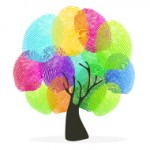
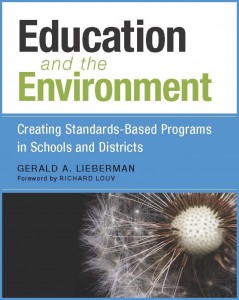 4. Education and the Environment
This newly published book by Gerald Lieberman (Harvard Education Press 2013) provides an innovative guide to creating and implementing effective environmental education that combines standards-based lessons in language arts, math, history, and science with community investigations and service learning projects. By connecting academic content with local investigatons, Lieberman shows how environmental study becomes an engaging, thought-provoking context for learning multiple subjects. Look for a full review soon in CLEARING.
http://hepg.org/hep/book/198/EducationAndTheEnvironment
 5. Climate Stewards Education Project – Online
NOAA’s Climate Stewards Education Project provides formal and informal educators working with elementary through university students with sustained professional development, collaborative tools, and support to build a climate-literate public that is actively engaged in climate stewardship. Participants are eligible for a variety of funding resources. Hurry – the deadline for application is December 13, 2013.
http://oceanservice.noaa.gov/education/climate-stewards/

by editor | Nov 4, 2013 | K-12 Classroom Resources
 by Jim Martin
CLEARING Associate Editor
 mbedded curricula. The curriculum that you can find just about anywhere you go: Fractions, transportation, velocity, acceleration, centrifugal force, metaphor, alliteration, poetry, drama, communities, transportation, and on. Topics we study in school, complete with real examples. Everywhere. We need to learn how to find it in natural places, and how to help our students use it in meaningful, empowering ways. Using it means we have to pay close attention to how we teach.
The way we teach directly affects the way we learn, and what we learn. Let me illustrate two poles of learning with a real-life example, two teaching methods that affect how and what students learn. This is a true story about two field trip station leaders, one who engages a centuries-old teaching paradigm, another who engages a paradigm based on the current state of knowledge about the neuropsychology of learning. One field trip leader stands ankle-deep in a stream, and tells eight students lined up on the bank about dissolved oxygen, its importance to life in the stream, and the range of dissolved oxygen concentrations which contribute to a healthy stream habitat. Then he measures the actual dissolved oxygen level where he stands, compares its value to the range for a healthy stream, and declares this stream healthy. After that, he moves on to do the same with turbidity.
 Another leader shows her eight students how to measure dissolved oxygen, and has them do two practice trials, one in each working group of four. Then, she has them combine to do a third test on their own. The students talk about the numbers they derive, and decide to calculate their average since all three are similar. The leader congratulates them on their careful work, and sends them to reference material on the stream bank to find out what their average dissolved concentration means in terms of stream health. Students scramble, pages fly, eyes and mouths communicate, and the group returns to announce that their average dissolved oxygen concentration is healthy. They attribute that in part to the riffle just upstream, and in part to the cool temperature of the water, phenomena which they learned about while reading. Based on their readings, they think that, in addition to the oxygenation of water by riffles, the cold water holds more oxygen than warmer water. Which group learned most? Best? Will recall what they learned next Spring? Will always see riffles as oxygenators when they view them in passing? Which station would you prefer if you were learning? Why? Teaching?
Think about the last word in the previous paragraph. We won’t all respond to it in the same way. When I first began to confront the realization that how I taught affected how and what my students learned, I eventually asked, “Am I an automaton who simply clerks what I receive, telling my students what I have learned, at least the part that was in the texts I used, and asking them to tell it back to me, or am I a professional educator who can build my own effective curricula?” I began to ask myself about the excitement of science, my own personal thoughts about it. And about the topics I was teaching; some were pertinent, others rather meaningless space fillers in a section that needed more lessons to make it seem complete. Could I transmit the joy of science to my students? The natural interest in science that we’re all born with? This posed a problem for me, something I found I needed to resolve, and slowly led to better teaching and more involved and invested students. Doing this, I learned two things: I have to be the person who decides what and how I teach; and I really have to understand how brains learn.
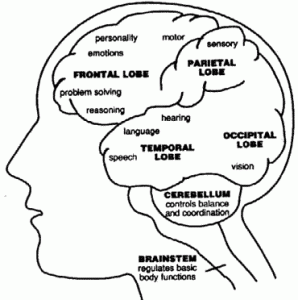 How does our brain learn? There is good evidence that we learn best when we begin new learnings by handling real objects in the real world. Do we really need to be physically involved in a learning to master it? Shouldn’t we simply be able to listen, write, and recall what is taught? Do we have to engage objects in the world to learn about them? I say that the answer to this is yes and no; there is a place for a didactic:deductive delivery, like that of the first station leader, and a place for a constructivist:inductive delivery, like that by the second leader. For instance, if the students in the first group had previously done inquiries in which they measured water quality and discussed the results of their inquiries, there would be no need to help them learn how to make the measurements, and the relationship of the station leader’s observations to a set of water quality standards would make good sense, and they could move on from there to new learnings. Once we have engaged content and concepts in the real world, we can enhance our learnings by reading, listening, and writing. And they can be extended in the real world via homework assignments that place students there. There is an appropriate time for reproducing knowledge and one for creating knowledge. Each way of teaching engages particular parts of the brain, and generates a particular kind of learning.
F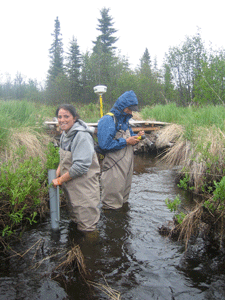 or instance, a teacher has his students identify trees along a riparian transect, and they use this information to assess that small piece of watershed. Students are shown how to start a transect at the water’s edge, and carry it, perpendicular to the stream, 100 meters up the stream bank. When they start at the water’s edge, they record this as Meter 0, and use a manual to name the trees within a 5-meter diameter and their trunk diameter and heights. Then, they move 10 meters up the transect, and record the same information within a 5-meter diameter centered on the tape measure’s 10-meter mark. They continue until they have assessed the trees in this way along the entire 100 meters, then use this information to determine the ranges of each tree species, and formulate questions based upon their distributions. When they return, they will carry out inquiries based on their questions. (They started by being told what to do, how to do it, and why. In the end, they were telling themselves what to do and how to do it because they were becoming capable of working on their own. Are they transitioning to the teaching model illustrated by the second field trip station leader?)
Back at school, they discuss their results and formulate questions they will attempt to answer the next time they are in the field. Here, they will engage the real world and try to make sense of it in terms of what they already know, and what they will find out. The next day, their teacher has them start a new unit, a street tree inventory in which they will count trees by species, height, diameter, and distance from the corner of the block they are on. So, now their transect is the block the trees are on; a transect determined by the block face and tree locations rather than 10-meter intervals on a tape measure. They’ll use this information to make inferences about CO2 absorption by leaves, but the teacher’s plan includes using the work to transition their math class into the study of ratio and proportion. He does this by establishing the protocols for measuring the distances of the trees from the corner. Students will measure their stride, then count steps as they walk from the corner to tree to tree. Before doing the work, each student carefully measures her or his stride to the nearest inch. When they make their measurements on the block, they’ll attempt to consistently walk with the same stride. They’ll use the ratio of one step to feet and inches to convert their steps walked on the block to feet and inches of its length. They make the calculation by multiplying feet and inches per step by the number of steps. In math, students will use the steps they used to convert their stride along the block to feet and inches by developing ratios and using them to make the distance calculations.
So, they start at the edge of a corner, pace to the center of the nearest tree, and record the number and fraction of a pace to get there. They continue this way to the end of the block. He’ll have them continue the work until they’re comfortable, then start the ratio and proportion unit in math. He’ll also assign them to do the same study on the block they live on, or one with trees if theirs has none. They’ll do this as a homework assignment. Now, he’s identified and used an example of embedded curricula in the real world. The curriculum is out there; we have to learn to find it.
Embedded curricula is effective curricula, probably because the student has to discover and exploit it, something our evolved brain is very good at. (I say, ‘brain,’ but I mean ‘central nervous system,’ the total set of nerve cells in the system that is coordinated by the brain.) If the brain is where we learn, then why not use it in designing the ways that we learn, both in school and on-site?
By the time the class goes out to implement the investigations engendered by their inquiry questions, they will be in charge of their learnings. The teacher has transitioned his delivery from didactic:deductive to constructivist:inductive. He started with an activity that he thought might generate students’ interest, then used that interest to engage them in self-directed learning that met his curricular objectives in science and mathematics.
Environmental educators can help teachers engage their students’ brains in effective ways. It doesn’t matter what the environmental educators offer, their sites contain embedded curricula, just waiting to be mined. They also know the classroom teachers who are serious about what they do. Put two of their heads together, and they can locate and describe curricula available on site. A team like this would be invaluable to Meredith. We have the power to bring them together, and might do that.
Here’s an anecdote to illustrate how curriculum discovered on site empowers students. Several years ago, some teachers in a middle school decided to exploit some man-made ponds and a ditched creek adjacent to the school to develop the curricula embedded there. They did this for most of the school year, then participated in the school’s Parent Science Night. That evening, the halls were filled with students who manned tables exhibiting science projects they had worked on. Parents and other adults wandered around, checking out what the students had done. The students whose projects were developed in the standard science classes used their texts and lab books to explain the experiments they were displaying. When asked a question, they inevitably read either from their books, or from notes they had written; often with a finger moving along the words. Students who worked on the ponds and creek spoke from what they knew, from what was in their heads. They answered questions, sometimes after quiet thought; always with confidence, with ownership of the learning and personal empowerment in their eyes. I’ve observed this often, but never in such fortuitous mixed company. We can learn for understanding and empowerment, but we have to do it using our brain’s evolutionary history to guide the ‘how’ of the learning.
This is a regular feature by CLEARING “master teacher” Jim Martin that explores how environmental educators can help classroom teachers get away from the pressure to teach to the standardized tests,and how teachers can gain the confidence to go into the world outside of their classrooms for a substantial piece of their curricula. See the other installments here, or search Categories for “Jim Martin.”

by editor | Nov 4, 2013 | K-12 Classroom Resources, Marine/Aquatic Education

1. Climate Change: Connections and Solutions
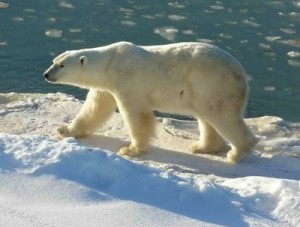
Facing the Future offers this free two-week curriculum unit for middle school and high school which encourage students to think critically about climate change and collaborate to devise solutions. Students learn about climate change within a systems framework, examining interconnections among environmental, social, and economic issues.
https://www.facingthefuture.org/Curriculum/PreviewandBuyCurriculum/tabid/550/List/1/CategoryID/16/Level/a/Default.aspx#.UmbDNBCRh8k
2. Climate Change Teacher Resources
Windows to the Universe provides interlinked learning resources that support a variety of topics, including online content for browsing or to support an introductory online course on climate change, teacher professional development resources, classroom activities, and online interactives.
http://www.windows2universe.org/teacher_resources/climate.html

3. ClimateChange LIVE! – Resources and Online Webinars
The U.S. Forest Service and partners offer this website to bring climate learning to you through a series of webcasts, webinars, and online climate education resources. The materials include climate education resources and programs gathered from 17 federal agency and NGO partners. The National Wildlife Federation is hosting a series of six webinars in connection with the ClimateChange LIVE! materials; you may register for one or more webinars at a time.
http://climatechangelive.org/

4. Teaching Climate
Teaching Climate offers a searchable database of reviewed K-12 climate education resources. The resources have been reviewed by subject experts for scientific accuracy, pedagogical soundness, and usability. Topics include Climate Systems, Measuring & Modeling Climate, Human Responses to Climate, and more.
http://www.climate.gov/teaching

5. Citizen Science: Project FeederWatch
Those interested in citizen science can join the thousands of FeederWatchers across North America who count the birds at their feeders from November through early April. All participants receive the project’s annual summary publication and the Cornell Lab’s quarterly. New project participants receive a bird-identification poster, bird-feeding information, and instructional materials.
https://store.birds.cornell.edu/Project_FeederWatch_s/42.htm

6. CMOP: Studying Coastal Margins
The Center for Coastal Margin Observation & Prediction, an NSF Science and Technology Center partnership of Oregon Health & Science University, Oregon State University, University of Washington and others, focuses on coastal margins. The website offers a collection of activities and curricula that can help you use their data resources. Check out the materials on coastal hypoxia, vertical density gradients, drifters and currents, and more. Some of the materials are available in both English and Spanish.
http://www.stccmop.org/education/k12/teacher_resources/activityarchive
7. Urban EE Resources for High School Teachers
The LEAF Anthology of Urban Environmental Education is available online. The anthology is a collection of lessons and activities designed to help high school educators infuse urban environmental themes into their curriculum. Sections include Natural Cities, Human Cities, and Evolving Cities.
http://www.nature.org/about-us/careers/leaf/resources-for-teachers/leaf-anthology-of-urban-environmental-education.xml


