by editor | Mar 15, 2010 | Gardening, Farming, Food, & Permaculture, Higher Education & Career Development, Outstanding Programs in EE, Schoolyard Classroom
by Veronica Gaylie
University of British Columbia
Introduction
There are no larger fields than these, no worthier games than may here be played.grow wild according to thy nature…let the thunder rumble…take shelter under the cloud…Enjoy the land, but own it not. (Henry David Thoreau, From Walden)
How does eco-centred teacher education promote ecological ideals while transforming the teacher training process? How can a campus garden engage student teachers in environmental philosophy while promoting new metaphors for eco-centred practice?
One response to these inquiries was to build a campus “Learning Garden,” a model school garden and learning site for student teachers. Through research, physical labour and collaborative learning, the garden grew as a narrative where students learned to become teachers with heart, and earth, in mind. The Learning Garden also exposed new teachers to a concept of the land as both a physical space and an experiential learning process, concepts involving responsible land management, risk taking and community commitment.
 A community learning model, with garden work at the core, promoted local and global knowledge of drought, food systems and farming practices; the model inspired students to want to acquire such knowledge and experience in the first place. The garden shifted learner awareness from personal achievement to the environment itself: from student stewardship of the garden to the impact of that stewardship beyond the garden and into the world. The garden challenged assumptions of ‘teacher success’ and also some of the ideals of environmental education. It was especially the challenges that helped realign ideals and exposed students to the unpredictable processes of both teaching and the natural world.
The critical challenges of teaching teachers in the garden can be described through two metaphors: garden as (physical) environment and garden as community. The garden as environment, a literal outdoor space, involved awareness of local climate conditions and the necessity for drought tolerant plants and native species. An awareness of the garden as environment also promoted concepts of ecological and social justice, with, for example, the decision to donate produce from the garden to the local food bank. In the garden as community, student teachers learned the importance of respecting and interacting with their location; the learning garden was (and continues to be) strongly influenced by local Okanagan Tradition, which challenged a focus on individual achievement common to most academic programming. In this way, the garden, both as physical space and as a conceptual model, also challenged the roots of teacher training.
 School Gardens in the Context of Environmental Education
David Orr (2004) calls for the integration of environmental education across the curriculum, and a Science curriculum linked to history, environmental ethics, citizenship, Globalization and first hand awareness of how scientific knowledge affects the world outside the classroom. Such a curriculum supports the belief that “…knowledge carries with it the responsibility to see that it is well used in the world.” (13)
Other environmental writings (Bowers 2006, Shiva 2005) discuss the reclamation of public space as a way of developing socially engaged, knowledgeable communities. Shiva discusses ‘living democracies’ that promote biodiversity, local action, and ‘reinventing citizens’ and provide a solution to monoculture and socio-economic injustice. (84)
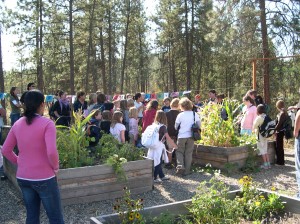
Researchers also outline the need for practical and critical understandings in school gardens and the need to examine concepts such as direct food, globalization and anthropocentric learning models. Such a need can be realized through teacher education that supports critical, eco-centred concepts with first hand experience of land and food. The garden provides a place where students can consider, up close, the threats to local food sources through global agri-business, the commoditization of a basic life source (land and seeds), and various forms of embedded knowledge that contribute to ecological damage. As gardens grow in North American schools, teacher education must prepare future teachers in critical, eco-centred methods and philosophy while exposing them to tangible, contextual awareness of the learning process itself.
Garden as Environment
Work in the garden began with an Environmental Education class made up of student teachers and practicing teachers. While we weeded, we considered some conceptual approaches to guide the garden: sustainability (passing on the garden to future learners); interdisciplinary learning (connected learning); hands-on learning (learning by doing); xeriscape as alternative to green lawns (responding to local water issues); organic (a contextual awareness of our surroundings as ecological systems); aboriginal traditions (community minded teaching and learning); rotating stewardship (respect for future groups in the garden). The means of developing the garden’s principles were also meant to create a tradition of discussion that would be passed on to future groups, who could discuss, change, solve or adapt the founding principles. The basic plan was for a food/drought tolerant/flower mix that would create a blend of “beauty” and “use” while showing how native, non-native and invasive species responded to drought. If the flowers and vegetables withered due to a water shortage, and the xeriscape plants lived, students would have a visual example of the effects of drought. The plan was not to create a showcase of local plant life but to support a learning process where mistakes could bring understanding. This would be a valuable, difficult lesson for new teachers.
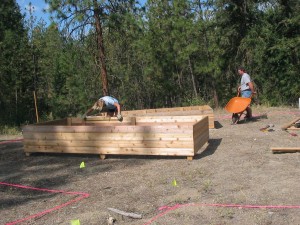
The idea of a “Learning Garden” took hold and local businesses eagerly made donations. The first donation was from a local lumber yard which donated one thousand dollars of red cedar for raised garden beds, with promises of supplying more at wholesale prices. Other local businesses in the small community recognized that their own children, and family members, would benefit from school gardens.
With so much imported produce in local grocery stores, most of it hauled by truck North on one highway, the students considered the value of maintaining local farms as a means of challenging global food trade. What were the land ethics, the issues of eco-justice involved in building large scale, permanent condo developments on fertile agricultural? What was the connection between a local garden and globalized food ethics? How could students involve themselves in this knowledge by learning and working in school gardens?
The students engaged in conversations around the larger context of their local work, providing a practical context for their readings in Globalization from previous course work and personal interest. While students thought of innovative ways to bring this knowledge to their own classrooms, the method of linking local and global concepts through hands-on learning would challenge teacher education focused on performance standards, organizational abilities and classroom management. By learning in the garden, and in considering the role of the garden in the local and global agricultural community, students began challenging their own teacher training.
 The Pond
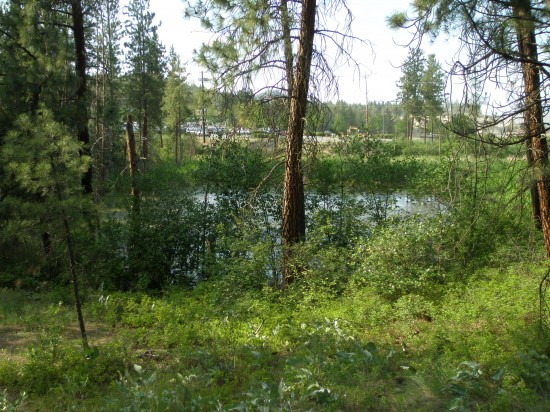
The garden is located next to a pond filled with a variety of migratory ducks, red-winged blackbirds and other wildlife. One early idea was to use the pond to water the garden, using a pump.
What was the environmental impact of draining the pond? How did we interfere with goals for long term, sustainable land and water use by removing water from the pond? Why was our first impulse in moving toward sustainable land management to destroy it? What previous learning had lead us to seek short term gains, while destroying other life forms? Leaving the pond alone seemed like an obvious, ecoliterate choice; however the process of coming to this decision was our first instance where a practical need lead directly to questions of environmental ethics. The shift from seeking solutions to asking questions about ecological justice began with contextual awareness, occurring organically within community, within the decision making process itself. Students learned that eco-centred decisions require a constant, conscious effort to weigh the ecological impact of human actions within an ethical framework of ecological justice.
A second example of contextualized decision making occurred when the students developed their garden design plans. The designs were placed on a screen in the classroom, and included a mix of hand-drawn symbols, squares, circles, combined with computer generated garden designs. One design clearly stood out: it was irregularly shaped, with the exterior parameter of the garden bulging into and oddly shaped arc. This design was in the actual, irregular shape of the land itself, with areas drawn for garden beds which lead out from a (natural, tree-shaded) classroom area to the composter and soil areas. The plan was organic, irregular, and fit the imperfectly shaped land perfectly. The students were beginning to work with the land by listening to the land itself.
 Garden as Community
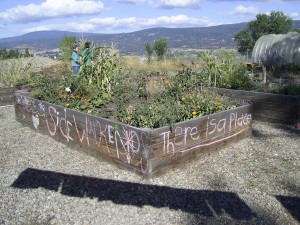
A community model of teaching and learning grows from school gardens. Instead of prizing ‘ownership’ of land or ideas, the learning garden was focused on an ideal of shared local knowledge. The new cohort of students typically wanted a quick, practical route to becoming teachers. Most of the students had recently completed four year undergraduate degrees in single teaching specialties; they were conditioned by an academic system of independent achievement and individualized recognition. Students emerged from academic undergraduate conditioning and most wanted to know instead of learn in a learning garden. When I told the students they would be developing curricula, methods and lesson plans around native plants, global education, local food and other eco-centred issues, a handful seemed interested. One student told me: “I hate nature.” During the second garden cohort, ideals for an eco-centred, community model of teacher education seemed at odds with a college system biased towards grades and individual stamina and success. In Spring, a dedicated group of the middle school cohort, post-practicum, continued building the infrastructure of the garden by building up the soil and designing the beds. We learned of a plan to drain the pond to make way for the new business/engineering building. Our very presence seemed to challenge the land development that suddenly surrounded us on campus. When I told the students, they wondered how a campus that prides itself on ‘sustainability’ could consider removing a pond. The argument for removing the pond was that the pond was man-made, and therefore not ‘natural.’
The water issue found us taking personal responsibility for decisions which would have a lasting impact. Our first lesson in making positive, conscious decisions for the garden, taught us the importance of listening to all members before making decisions. The land taught us to stay still. And listen.
The students and I were suddenly aware of the power structures that surrounded us. One student offered to live in a raft on the pond in order to save it from destruction. At this time, we learned the challenges of building eco-centred community within previous, existing models of learning. We experienced the growing pains of eco-centred teacher education; their academic, undergraduate education had not nurtured a collaborative learning model and, through eco-centred teacher education, the students and I learned, with some difficulty, how to build community from scratch.
What is the role of a teacher educator in guiding student teachers toward community based, eco-centred learning? Planning the garden, then planning and replanting the garden during the second teacher education cohort, brought forward the importance of process. Nurturing plants from seedlings, observing their growth, at the same time students and teachers learn from the garden, is a powerful way to help future teachers learn how to learn. Initial reluctance largely gave way when students worked together to apply their knowledge. I observed how problems resolve with the literal manifestation of abstract plans and knowledge. If, for example, a student wants to plant a rose, instead of native, drought-tolerant plants, a prolonged, decontextualized discussion could ensue in a classroom environment. In the garden, however, it is obvious that a rose in our local climate requires a lot of water and care. Is the student willing to provide that? Is a rose practical in a desert landscape? What are the cultural assumptions that lead the students to believe a rose is ‘beautiful’ if it uses one hundred percent more water than a local plant, such as an Oregon grape? For students new to a garden, learning does not lie in certainty, but in mistakes, and in defying preconditioned notions of learning.
 During the first year, threats to the garden community (physical, ethical, external, internal) all somehow related to concepts of individual ownership. In a western model of education, it seems that just as people care about land, they also want to control it. The experience of the garden as a co-operative, shared model of learning made us aware of land models based on ownership and profit. Building the garden made visible the larger learning community, and prompted new understandings of the role of teacher education within that model. Is the role of a teacher educator simply to teach students how to exert control over all other natural species, including their students? As Wendell Berry (2002) states, a community “…must change in response to its own changing needs and local circumstance, not in response to motives, powers, or fashions coming from elsewhere.” (163) When learning supports peace, community, and environmental awareness, new values emerge that help learners make ecologically just decisions that challenge ingrained learning patterns. In this way, a garden challenges teacher education at its very roots.
“Hope Trumping Despair”
The story of the learning garden is about the impact of local, small scale actions on larger systems. One school garden, with sometimes just a single teacher’s involvement, can produce far reaching effects.
Garden-based teacher education puts the ideals of environmental education into practice. Conceptualizing new forms of eco-centred teacher education also helps remove the myth of control and knowledge “ownership” for new teachers. It would be impossible for one person to build and maintain a school garden, and it would be purposeless, since land cultivation is always rooted in a process of shared knowledge. A school garden is always, simultaneously, environment and community.
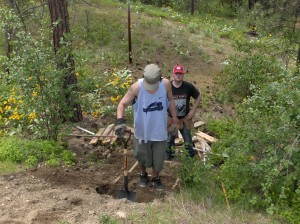 As David Orr and others have stated, while it is vital to inform students of the scientific facts about environment, it is even more important to change the ways of living and thinking that have contributed to environmental destruction. Working in the garden teaches teachers to approach the land in the same way they might approach their students, taking a holistic, process-oriented approach. Such a community depends on individuals succeeding within and for the survival of the community; in working the land, students see how their efforts helped the land produce at a level that is sustainable, in context, with minimal impact on surroundings. In a garden, students are not silenced into discipline or disciplined into silence; the reasons for both talk and silence are apparent. Community becomes both the process and goal of learning. As taught in aboriginal Tradition, a garden teaches young people to also learn ‘how our actions are always tied to others, and how some actions disappoint and hurt.’ (Armstrong et al. 2000)
Beginning with visions and ideals about the land and learning, the students teachers and I grew alongside the garden: unpredictably, in the context of organic life. A garden reveals how the process of learning, rooted in the context of one’s surroundings, becomes the lesson itself. To learn in a garden with students is to be in a constant state of environmental and community activism. As veteran social activist Grace Lee Boggs states, a community garden is a sign of “hope trumping social despair” at the grass roots level where we ‘regain our humanity in practical ways.’
Veronica Gaylie, Assistant Professor in the Faculty of Education at the University of British Columbia Okanagan, has worked as a high school English teacher and is now a teacher educator in interdisciplinary, ecology-based learning. She is the founder of the learning garden at UBC Okanagan.
by editor | Mar 11, 2010 | Schoolyard Classroom
by Sandy Frost and Ben Swecker
For many people, a trip to Alaska is the dream of a lifetime. Yet cost and logistics keep many people away. In 2002, a group of dedicated educators joined forces to make such a visit— if only a ‘virtual’ visit—a reality for thousands of children across the Western Hemisphere. Blending good, old-fashioned interpretation and education know-how with technology, the Winging Northward—A Shorebird’s Journey distance-learning project brought the amazing resources of the Copper River Delta, Alaska to a diverse audience. This innovative and ambitious project developed over three years. The following article chronicles the miles traveled, and those yet to come, for this effort.
The Copper River Delta
Each spring, a wildlife spectacle on the scale of the great game migrations of Africa takes place throughout coastal Alaska. Along intertidal mudflats, millions of shorebirds rest and refuel on their long journey to their breeding grounds in western and northern Alaska. These migratory birds rely on critical wetland habitats throughout their journey. Many people are passionate about shorebird conservation and education. No one who has had the opportunity to witness this spectacle can fail to understand the critical need to conserve migratory birds and the habitats that they rely on. Shorebirds, in their spectacular and dramatic migration, can provide a “hook” for educating people about the plight of Neotropical migratory birds and wetlands.
It is difficult to overestimate the importance of the Copper River Delta to North America’s migratory birds. This productive coastal wetland supports a rich and varied array of fish, wildlife, and human uses. Brown bears stalk the tidal marshes where trumpeter swans nest, coho salmon spawn in groundwater-fed streams, and mountain goats scale the rugged peaks.
Much of this incomparable wetland ecosystem is public land, managed by the Chugach National Forest. Recognizing the significance of the Copper River Delta to the fish and wildlife resources of Alaska, in 1980, the Alaska National Interest Lands Conservation Act (ANILCA) stipulated the delta be managed chiefly for the “conservation of fish and wildlife and their habitats.” Throughout the National Forest System, there is only one other area with a similar congressional mandate.
The Partners
Over the last decade, the Cordova Ranger District successfully developed an innovative education and interpretive program focused on the fish and wildlife resources of the Copper River Delta. However, the relatively small number of people reached with their education effort continued to be a concern. In an effort to widen the education ‘net’ and leverage their limited resources, the district gathered a powerful coalition of partners who shared their passion and goals. The Western Hemisphere Shorebird Reserve Network stepped up to the plate as the lead nongovernmental partner, while the US Fish & Wildlife Service (National Conservation Training Center) provided critical guidance and support. Finally, the linchpin of the effort was the exceptional work of the Prince William Network—an educational institution affiliated with the Prince William County Schools in Manassas, Virginia.
 Although these partners brought great energy and vision to the table, they did not bring large pots of money. Instead, the early efforts of the project were focused on securing funding through a number of sources. A project of this scope requires a significant investment. The partners were successful in securing over $100,000 in competitive grants from the National Fish & Wildlife Foundation, the Alaska Coastal Fund, Ducks Unlimited, Wild Outdoor World Magazine, the US Forest Service—Conservation Education grants, and US Forest Service-International Programs. These funds were matched with generous in-kind contributions of labor, materials, and services.
Through the generous support of program partners and sponsors, the entire program was available at no charge to students and teachers.
The Project
“Winging Northward—A Shorebird’s Journey” is a comprehensive education project focused around a live, satellite-broadcast “field trip” from the Copper River Delta on May 8, 2002—the peak of shorebird migration. Although the highlight of the project was the broadcast, an entire web of supporting materials was spun around the televised event. The partners launched a dynamic website in November 2001, supported a live webcast, produced supplemental education materials, and developed an evaluation program.
In an age when it is challenging for teachers to arrange natural resource field trips, especially in urban areas, an electronic field trip reaches kids where they are—in the classroom. The ‘virtual’ field trip used satellite and internet technology to beam the shorebird excitement into classrooms in Alaska, Canada, the U.S., Puerto Rico, and Mexico.
Teachers, parents, and students used online monthly activities and entered a poster contest to prepare for the field trip. The website offered a teacher resources center and exciting classroom activities that supported the monthly theme and were correlated to national education standards. Maya, the western sandpiper, was the program and website host and led children through her world as she journeyed from her wintering grounds in Mexico, north, to her breeding grounds in western Alaska.
Just as shorebirds know no boundaries, so did the project reach across the Western Hemisphere. Partners in Mexico provided critical links to the Spanish-speaking world and resource information about the shorebird’s wintering grounds. The website was bilingual and the broadcast was simultaneously translated in Spanish. The English broadcast was also close- captioned.
Interactive elements pulled the students into the wetland world of the Copper River Delta in the grand finale broadcast. Students learned about shorebird adaptations, wetland habitats, and migration across international boundaries. They met biologists and local Cordovans, watched as Alaskan students explored the mudflats and observed the swirling shorebird flocks, and interacted through e-mail, fax, and phone to relay questions and game answers. From the Virginia studio, classrooms won prizes—such as a 4-foot fleece shorebird—during the mystery game.
The project also featured a live webcast during the broadcast. This webcast reached many additional children and was available, on-demand, for six weeks after the live program. The combination of satellite and internet technology assured the broadcast was accessible to the largest possible audience.
Marketing for the project included a full-page advertisement and feature story in SatLink Magazine (the leading publication for distance-learning programs), a full-color brochure sent to schools across the country, numerous notices posted on educational and resource list serves, presentations to professional organizations, and rigorous working of established networks.
Following Up
Looking back at a project, and analyzing its strengths and weaknesses, is an important step that’s often skipped in education and interpretive projects. Realizing the value of a rigorous
evaluation for future distance learning projects, the partners have developed a comprehensive plan to take a critical look at the effort and share that information with others.
This evaluation includes informal feedback from teachers and students, and a pre- and post- assessment test that will quantify the educational effectiveness of the project. These results are being synthesized, but preliminary results show an excellent educational response. Test results suggest that students showed a 20% increase in knowledge about shorebirds after they watched the program.
The partners are also committed to producing follow-up projects that will leverage the educational value and life of Winging Northward. These projects will be available by December 2003, on a CD and will include a project report, complete curriculum, complete website, an edited version of the broadcast, and supplemental information.
We estimate that well over 300,000 children took part in the live broadcast. Over 850 sites in the U.S., Canada, Mexico and Puerto Rico registered for the program. During the broadcast, 1266 emails flooded the network.
Conclusion
Technology makes all the world our backyard. By forming coalitions, rigorously focusing on educational objectives, and celebrating what makes our piece of the world special, the partners effectively reached children across the Western Hemisphere.
Winging Northward brought shorebirds and wetlands to kids who may never have the chance to experience hundreds of thousands of migratory birds teeming on mudflats and swirling in the air. They didn’t come back from the electronic field trip muddy, but they learned that everyone, whether urban or suburban, plays a role in conservation. When the broadcast was over and the shorebirds moved on, students carried with them a little piece of a national treasure—the Chugach National Forest. Our vision is that they will channel that energy into nurturing a local habitat.
For More Information
“Winging Northward—A Shorebird’s Journey” http://shorebirds.pwnet.org/ Chugach National Forest http://www.fs.fed.us/r10/chugach/cordova Copper River Delta Shorebird Festival http://www.ptialaska.net/~midtown/ Sister Schools Shorebird Project http://sssp.fws.gov/
Western Hemisphere Shorebird Reserve Network
http://www.manomet.org/WHSRN/index.html
by editor | Mar 10, 2010 | Outdoor education and Outdoor School, Schoolyard Classroom
A Teacher’s Guide to Using the Schoolgrounds for Environmental Studies
Review courtesy of Fletcher Brown, University of Montana
Author unknown
Environmental education for children growing up in urban areas is often limited to a single trip to a forest preserve or state park. The hidden message behind such field trips is that the environment must be sought, and that their local community is not a part of a greater ecology. Helen Ross Russell believes that environmental education can be taught in all locales, including the hard-topped schoolyards common in urban areas. Ten-Minute Field Trips provides opportunities for students to learn about the natural processes occurring all around them, to develop a concern about the misuse of this planet, and foster a willingness and ability to initiate and support positive action on the basis of this knowledge.
The book begins with a short chapter making a strong case for schoolyard field trips — they are available to all schools; are conducive to repeated trips throughout a day, week, or school year; can easily and spontaneously be integrated into a daily lesson, even in a tightly structured teaching environment; and can be the springboard for a greater depth of inquiry by students. Before launching into field-trip ideas, there is a short chapter emphasizing the importance of fostering curiosity in learners of all ages. Russell believes that:
If schools are going to have a meaningful role in today’s world, they
must be more than dispensers of information and places to read; they
must keep alive the natural spark of curiosity, they must nurture the
ability to think, they must permit a child to grow.
The remainder of Ten-Minute Field Trips is filled with ideas for providing students opportunities to do the above. The activities are divided up under the headings of “Plants,” “Animals,” “Interdependence of Living Things,” “Physical Science,” “Earth Science,” and “Ecology.” Each section is divided into several subsections. For example, “Animals” is broken into Vertebrate Animals, Birds, Animal Tracks, Insects and Other Arthropods, and Earthworms. Each section and subsection provides background for the teacher about the general subject, classroom activities that may be taught in conjunction with the field trips, suggestions for teacher preparation, and field trip possibilities. The field trip ideas are intentionally fairly vague, so as to be relevant to a wide variety of age groups, skill levels, and school environments. For example, one of the Earth Science field trips suggests observing nearby waterways, including gutters of city streets. In this field trip, students are asked to observe the difference in the load carried by rapidly flowing water compared to slowly moving water; to find waterfalls, deltas, canyons, or outwash plains; to build a dam and observe the change in water flow and siltation. Students in urban or rural schoolyards, from kindergarten through high school, could engage in this activity, focusing on anything from an aesthetic appreciation of water systems to the physics of water dynamics.
Although originally published in 1973, Ten-Minute Field Trips is as relevant today as it was thirty years ago. It is full of great ideas for teachers who may not think that their teaching environment is conducive to hands-on environmental education, as well as for those who do. With stories and obvious excitement for the topic, Russell creates both a useful manual and an interesting read. Although written in the context of schools, most of the activities could be integrated into day and residential camp programs, nature centers, or family experiences. As Russell points out, Ten-Minute Field Trips is not a complete teaching guide, it merely “suggests possibilities which the teacher can select and adapt as a starting point.” Whether teaching in a hard-topped city school, or wild and green summer camp, this book can be a valuable resource for educators of all subjects who want to infuse their curricula with experiential activities that bring the local environment home.

by editor | Feb 25, 2010 | Outdoor education and Outdoor School, Place-based Education, Schoolyard Classroom
 Hood River Middle School Outdoor Classroom Project
The Outdoor Classroom Project is a work in progress where students are the researchers, engineers, designers, architects, builders, and users of a multidisciplinary, multi-sensory learning experience.
What you see when you approach the schoolgrounds at Hood River Middle School is nothing short of remarkable. From solar panels on the roof to a working greenhouse in the back, Hood River Middle School exhibits the markings of a unique and visionary school of the future.
As more and more schools around the country are beginning to organize their curriculum to include concepts of ecology, community, and sustainability, some programs, through innovation, vision and determination, move forward in meshing those concepts into a cohesive, integrated and successful program and serve as a model for others to follow. The Hood River Middle School Outdoor Classroom Project has become an exemplary program that began small and grew to encompass an ecological framework that gives students a unique blend of science, technology and permaculture that connects them to real world issues within their community.
Since 1998, science teacher Michael Becker has guided a program that offers students a higher level of connectivity between school and community. Using a hands-on approach to solving real-life problems, students at HRMS accelerate through the basic skills and concepts outlined in the Oregon Academic Benchmarks. The Outdoor Classroom Project is a work in progress where students are the researchers, engineers, designers, architects, builders, and users of a multidisciplinary, multi-sensory learning experience. The Outdoor Classroom Project connects students to key concepts in sustainability through a field based, experience-driven curriculum. Key themes of the project include Diversity, Water, Food, Energy, and Waste.
The Outdoor Classroom Project is divided into three separate strands. (more…)

by editor | Jul 8, 2009 | Environmental Literacy, Outstanding Programs in EE, Place-based Education, Schoolyard Classroom, STEM, Sustainability, Teaching Science
by Mike Weilbacher
With the new wave of interest in the environment, will we finally give students the tools they need to become environmentally literate citizens?
In just a few weeks, high school seniors all around the United States will walk proudly across stages, hoisting their diplomas as they graduate from formal K–12 education. As their teachers, we’ll look on with some wistfulness, for the world into which they are graduating—one of spiraling financial crises coupled with huge international challenges—is vastly different from the one in which they started their senior year only 10 months ago.
But wait, it gets worse. If you place your finger on the pulse of the planet, this is what you’ll discover: global surface temperatures rising, glaciers melting, oceans warming, sea levels rising, rain forests burning, coral reefs dying, old-growth forests disappearing, deserts spreading, the world’s population increasing, and species vanishing at the highest rates since the extinction of the dinosaurs.
In short, the ecology that underpins our economy is also collapsing. And the solutions to this challenge elude not only most of our graduates, but also us—their teachers, administrators, and parents.
Will our graduates be ready for these new realities? Will they confidently stride into this world as college students, workers, voters, consumers—in short, as competent, caring adults capable of making good decisions on the pressing issues of the day?
(more…)

by editor | Feb 19, 2009 | Outdoor education and Outdoor School, Schoolyard Classroom

by Lyanda Haupt
Seattle Audubon Society
Birds are everywhere. Their lives hold myriad ecological lessons, some obvious, some subtle. No matter where we live, or where we teach, there are birds to be found. They may not be wondrous, rare, or exotic. They may be an uninspired mix of starlings and pigeons. But they ARE birds, living definitively avian lives, and as such, they are the perfect subjects for schoolyard studies of bird behavior, flight, social habits, feeding preferences, and much more.
We’ve all seen hot-shot birders, calling out the name of every bird that flies by. It’s easy for teachers to feel intimidated, and believe that since they don’t have that level of competence, or perhaps don’t know the names of any birds at all, that they are not qualified to teach students about birds. The truth is, all you need is a schoolyard with a pigeon or a crow in it, to begin studying birds with some depth. The secrets of birds lie not in their names, but in their lives. Observation is the best, and most direct pathway to learning about our avian neighbors. Explore birds holistically, and learn their names as you go.
The study of birds can complement any environmentally minded program. Avian observation increases understanding of adaptations, species, biodiversity, and food webs. Schoolyard observations can lend depth to concepts such as native versus non-native species, and biodiversity. Watching birds can even complement studies in paleontology, since many prominent geologists now believe that birds are living dinosaurs! With guidance, students can gain competence in data collection and field identification. Perhaps the most enriching aspect of schoolyard birding is that it increases students’ awareness of the natural world as it surrounds them day to day. When they journey to a natural place, they will be awakened to the presence of birds, and ready to see more.
Birdwatching with Kids
The most important thing on a bird walk with young people is to have an enjoyable time that increases their interest in birds and the natural world. You don’t have to be seriously and silently slinking around, stalking birds every second. It’s probably best to go on a bird watching walk – a fun hike punctuated by times that everyone stops to look for birds.
Being in the outdoors, working with binoculars, field guides, and searching for birds is a lot to do. You don’t have to overload the time with planned activities. Here are some simple suggestions that can be incorporated into your walk. These are foundational ideas that can form the basis of a bird walk for any age group or experience level.
Enter a Place Quietly. Groups of people have to be particularly aware of the noise they make. Try to plan your bird walk before a recess, or well after one, so the birds have time to recover from frolicking youth. The less talking on a bird trip the better. If you enter a place quietly and respectfully, the birds will grace you with rare glimpses into their lives.
Starting Off. Sometimes a group of students will be pretty hyped up at the beginning. Try to start with an activity that gets students quieted down and focused on their surroundings. With eyes closed, have students listen for birds around them. Give them some time – four or five full minutes. Have them open their eyes, and still sitting in one place, quietly notice any signs of birdlife around them, without trying to identify or analyze any of it.
Experiment with Birding Methods. What works best? Some birders walk around and just see what they see. Some birders see a bird from afar, and then quietly sneak up on it until they have a good view. Some birders sit quietly in one place that looks promising and wait for the birds to come near. Have students experiment with these methods, and see what they think works best. Do some birding strategies work better for some species of birds than others?
Use Real Names. Young people are ABLE and WILLING to learn the real names for birds, other animals, and plants. Look at how well some five year olds can rattle off the long scientific names for dinosaurs! Use complete real names for the species of birds that you know, and encourage students to do the same. If the name of a species is difficult, repeat it together several times.
“Pishing.” This is a secret technique that birders use to get birds to come out of the bushes and show themselves. Make a sort of spitty pishing sound – “PISHHH-PISHHH-PISHHH.” Many birds are curious about this sound, and will come out to investigate. If you sit very still and don’t talk (other than to PISH) some birds may come startlingly close. Very fun!
Field Notes. Keeping a field notebook is probably the best thing anyone can do to learn to appreciate birds in the field. It’s a place to record individual observations, sketches, strange things that birds do, new species, and literally anything that occurs during the day that may help a student to remember a bird walk, and the birdlife experienced. It’s a place to ask questions and seek answers from the birds themselves. By putting pencil to paper in the field notebook, observations become crystallized, and experience becomes focused. Field Notes can include a record of the day – weather, time, other observers, etc., a list of species seen and their behaviors, vocalizations, habitats, sketches and descriptions, anything that makes the experience memorable.
Expect UFOs. Even expert birders encounter unidentifiable flying bird-objects. Let the kids know that not all birds can be identified by everyone, and that’s O.K. It’s part of the mystery that keeps bird watching fun.
A Note About Attracting Birds to School Grounds.
There are many great resources that can assist you in choosing native plants and feeders to create an avian sanctuary on school grounds. With work, you can attract new species to an urban area. Just make sure to use feeders specific to the kinds of birds you want to attract, and take steps to minimize use by non-natives. Don’t let worries over the long-term existence of your feeding station stop you. Contrary to popular belief, it IS okay to feed birds for awhile, and then to stop. Birds use feeders because it’s easy, not because they have to. When your feeders are removed, the birds will go back to natural sources for food.
Birds are everywhere! One great thing about watching birds is that you can pretty much always find one. Crows, pigeons, and starlings are all good examples of “birdness” that are readily available. They are walking around vocalizing and exhibiting interesting behaviors all day long. Even if you can’t swing a major field trip or uncover an exciting avian rarity, you can take advantage of the birdlife that’s around you everyday, and engage birds as a powerful educational tool.
Resources at the Seattle Audubon Society
Seattle Audubon offers an educational kit called “Birds in the Field.” Ten field bags contain binoculars, field guides, bird calls, and field notebooks for each student to keep. A leader’s pack contains all of the above, plus flash cards and the booklet “Sharing Birds With Students,” to help you get started with field guides, binoculars, identification, taking walks and field trips, using field notes, etc.
We also have two other kits to complement bird studies. “Symphony of the Birds” is an audio-visual introduction to avian vocalizations. “Feathers, Fossils, Flight” is a hands-on introduction to the adaptations that birds have for flight. It includes a reproduction of the first fossil bird Archaeopteryx, as well as many wings, bones, feathers, and more”
Kits are available to rent for one week at a time, or a Seattle Audubon naturalist can visit your site to present a program. Contact Lyanda Haupt, Seattle Audubon Education Coordinator at (206)523-0722, lyandah@seattleaudubon.org
Schoolyard Birds
Here is a short introduction to the species that you are likely to encounter in an urban or suburban schoolyard. With a little practice and observation, the various species can come alive in their uniqueness. Many of the common schoolyard birds are non-native birds that thrive in disturbed habitats. While it may make them less interesting ecologically, many of these birds exhibit fascinating behaviors, and are quite intelligent. They are still great tools for learning about birds in general.
Eurasian Starling Many people call starlings “blackbirds,” because they are about the size of a blackbird, and they are certainly black. Actually, they are not closely related. The starling can be separated from the locally common Red-winged blackbird by its yellow bill, and spangled plumage. In the summer, the starling looks like it is covered with iridescent jewels, as bright flecks of gold mingle with its black feathers. People are often mistakenly convinced that a bird they have seen up close could not possibly be a starling, because their bird was so pretty! Winter starlings are more drab, and the first-year birds are all brown, with a black beak and legs.
Starlings were introduced to the U.S. in the late 1800’s, and have proved to be an ecological disaster. They compete with native birds for nest sites and food, and are implicated in the decline of many sensitive native species. Even so, starlings are extremely intelligent and interesting. They are one of the best bird mimics in the country, imitating the calls of gulls, killdeer, cats, honking horns, and whatever else strikes their fancy. Listen for their long, fanciful whistles, and complex vocalizations. Starlings can learn to talk as well as mynah birds and parrots.
Rock Dove Calling the pigeon by its “real” common name, the Rock Dove, makes it sound a little more interesting. Like the starling, the Rock Dove is not native to our area. Rock Doves were introduced from their native homes in Europe, North Africa, and India. Most of the birds that we see in the schoolyard are passerines, or perching birds. The Rock Dove is not – its feet are adapted for roosting, rather than grasping tightly onto branches. Pigeons are unique in that both males and females produce a milk-like substance in their digestive system to feed their young. The baby doves plunge their bills down the parents’ throat and suck out the milk. The typical gray and purple pigeon resembles the extinct Passenger Pigeon. The numerous hybrids among city pigeons produce some intriguing color combinations – genetics in action!
House Sparrow Yup. Another introduced bird. And this one isn’t even properly named! Taxonomically, the House Sparrow is not a sparrow at all, but an Old World Finch. Find it at the very end of your field guide, rather than in the sparrow section. These are the small, brown birds that jump around under your feet at outdoor cafes, awaiting the crumbs of your bagel. They also chirp about the shrubbery of schoolyards, and nest noisily beneath the eves. The males have a gray cap and black throat. Females are a drab gray-brown, with a light brown eye stripe. House Sparrows have a beak made for seed-eating. Watch them forage on the ground for bits of plant material.
American Crow The amazing black bird with the raucous “CAW CAW CAW!” The crow is one of the most intelligent birds out there. They are known to use tools, problem-solve, mourn the loss of family members, and PLAY. Crows are scavengers that will eat just about anything, but they prefer meat. Even though they are so large, crows are passerines, or “songbirds,” just like robins and chickadees.
Steller’s Jay The Steller’s Jay is in the crow family – closely related to the larger American Crow. If you have trees around your schoolyard, you may attract this brilliant blue bird with the unwieldy black crest. Like crows, Steller’s Jays are quite intelligent, and will think up all kinds of mischievous way to win more food than all the other birds. They will even sit at feeders and imitate the call of a Red-tailed Hawk to scare smaller birds away. Jays can cause problems for other birds, attacking and eating their eggs and nestlings.
Black-capped Chickadee This is another bird that requires some cover – at least small trees or shrubs. These tiny gray and white birds with black masks are a birdwatcher’s treasure. They are common, but constantly delightful, gleaning insects, caterpillars, and seeds from the branches. The chickadee repeats its own name in its call – a nasal “chickadee-dee-dee.”

 A community learning model, with garden work at the core, promoted local and global knowledge of drought, food systems and farming practices; the model inspired students to want to acquire such knowledge and experience in the first place. The garden shifted learner awareness from personal achievement to the environment itself: from student stewardship of the garden to the impact of that stewardship beyond the garden and into the world. The garden challenged assumptions of ‘teacher success’ and also some of the ideals of environmental education. It was especially the challenges that helped realign ideals and exposed students to the unpredictable processes of both teaching and the natural world.
 School Gardens in the Context of Environmental Education
 The Pond
 Garden as Community
 During the first year, threats to the garden community (physical, ethical, external, internal) all somehow related to concepts of individual ownership. In a western model of education, it seems that just as people care about land, they also want to control it. The experience of the garden as a co-operative, shared model of learning made us aware of land models based on ownership and profit. Building the garden made visible the larger learning community, and prompted new understandings of the role of teacher education within that model. Is the role of a teacher educator simply to teach students how to exert control over all other natural species, including their students? As Wendell Berry (2002) states, a community “…must change in response to its own changing needs and local circumstance, not in response to motives, powers, or fashions coming from elsewhere.” (163) When learning supports peace, community, and environmental awareness, new values emerge that help learners make ecologically just decisions that challenge ingrained learning patterns. In this way, a garden challenges teacher education at its very roots.
 As David Orr and others have stated, while it is vital to inform students of the scientific facts about environment, it is even more important to change the ways of living and thinking that have contributed to environmental destruction. Working in the garden teaches teachers to approach the land in the same way they might approach their students, taking a holistic, process-oriented approach. Such a community depends on individuals succeeding within and for the survival of the community; in working the land, students see how their efforts helped the land produce at a level that is sustainable, in context, with minimal impact on surroundings. In a garden, students are not silenced into discipline or disciplined into silence; the reasons for both talk and silence are apparent. Community becomes both the process and goal of learning. As taught in aboriginal Tradition, a garden teaches young people to also learn ‘how our actions are always tied to others, and how some actions disappoint and hurt.’ (Armstrong et al. 2000)

