
by editor | Sep 1, 2025 | At-risk Youth, Critical Thinking, Experiential Learning, K-12 Activities, Schoolyard Classroom
by Abigail Harding and Corwyn Ellison
“We do not learn from experience, we learn from reflecting on experience.”
-—John Dewey
When we walk silently in the forest we allow ourselves to deepen our connection and strengthen our appreciation for the natural world. Suddenly, we hear animals unfamiliar to us, and observe natural phenomena we never stopped to notice. Exposure to the natural world and reflection is beneficial to physical and mental well-being. The psychological power of a reflective solo walk is astounding—so much so that conscious reflective thought has been shown to change the very structure of our brains.1 Experience-based learning is more powerful when coupled with reflection. Reflection is defined as an intentional effort to observe, synthesize, abstract and articulate the key learnings gathered from an experience.2 When implemented intentionally, solo walks provide a context in which both experiential education and mindfulness converge for the benefit of student learning.
A solo walk is a relatively simple concept: an individual walks alone on a trail or perhaps through the neighborhood to connect, reflect or reason through an event, emotions, or anything else that comes up during that time. It is not novel, but can be revolutionary for the individual participating in it. Using solo walks to introduce observation and reflections skills to students is not only effective in learning, but also important in connecting with themselves, the community, and the environment. In this article we will provide a framework for conducting solo walks with students in natural settings.
What is a solo walk?
A solo walk is an independent, thought-provoking walk through a relatively isolated area. A key goal of a solo walk is to practice observational skills and promote critical thinking, and introspective thought in students. This is accomplished through both the solo walk itself, and reflective journaling and debriefing after. During the walk students are guided both in their direction on the trail and mindful awareness by cards spaced ten to twenty feet apart on the ground. The cards may include a topical quote, a prompt for journaling or action, a direction, or perhaps a question to ponder. These cards can be customized and adjusted to suit the needs of the students and to meet learning goals. Common categories for cards include introduction/closing, thought-provoking questions/quotes, observation/sensory prompts, directional signs, and anything in between. For example, a card may say, “Stop here until you hear two bird songs” or “Where was this boulder 100 years ago? 1,000 years ago?”
How do you do a solo walk?
A non-complex trail or route should be chosen ahead of time. To avoid confusion, a card indicating direction of travel should be placed at all junctions the students encounter during their walk. A typical trail length is approximately ¼ mile. Two instructors or adults are necessary for the solo walk. The process and implementation should be discussed ahead of time. Students begin by gathering at the head of the route. Instructor A will introduce the solo walk as a reflective activity and play a game with the students as they wait to begin their solo walk. Be clear to students about expectations, the benefits of doing a solo walk, and why it is important for them to walk slowly and silently throughout. Emphasize that if they see someone in front of them, they should slow down, perhaps spend more time at the current card, and give the person ahead time to walk out of sight.
After roll-out, Instructor B leaves to set out the cards on the trail. Approximately five to ten minutes later, instructor A begins sending one student at a time down the trail for the solo walk. Each student is sent down the trail in two-minute intervals. The order in which they are sent can be determined ahead of time by the instructors or the decision can be student-directed.
At the end of the solo walk, Instructor A will be waiting in an area in which students may silently sit and journal reflectively about their experience. This location should be large enough for the entire group and should be comfortable for students. After all students have returned and journaled, Instructor B will walk the trail, pick up the cards, and rejoin the group. At this point a debrief will occur. Since students will be arriving to the end location at different times, it is important to have an activity ready for them to complete while they wait. This could be journaling, drawing or using watercolors to illustrate something they noticed during the walk, sitting quietly and observing, or any other quiet independent activity.
The debrief
Debrief is one of the most important components of a solo walk, particularly when it is focused on reflecting, synthesizing, and sharing their experience. Responding to one to two pre-written questions in a journal while students wait for the rest of the group is a constructive activity that prepares them for sharing later. To accommodate different learning styles, offer students a choice of responding in a way that feels valuable to them i.e. writing, sketching, or a combination. Once all students have completed the walk and journaling, give them an opportunity to share in pairs and/or as a group. The act of sharing their experiences can be very powerful, but also recognize that not all students will want to share to a large group and, in those cases, sharing with one other person is sufficient.
Some examples of debrief questions can include:
What surprised you about this experience?
What was your favorite card? What cards would you include?
What advice would you give other students for their solo walk experience?
What are two things you learned and can use in daily life?
Use a mix of questioning strategies to draw out student reflection, and be clear about discussion norms to ensure emotional safety during a group debrief. Using the solo walk cards again for debrief is an effective way to provoke group discussion. Solo walk cards can be placed in a pile on the ground, students can then pick their favorite card and share with the group why this card was chosen. Similarly, cards with a variety of emotions written on them may be used to promote a deeper discussion about feelings.
Table 1. The solo walk implementation guide
Goal To practice reflection, critical thinking, introspective thought, and scientific observation skills.
Objective Students will be able to:
· Journal in a reflective manner
· Complete a solo walk in an isolated area
· Participate in group discussion in a meaningful way
Audience Age group: any age
Number of individuals: 10-15
Duration How long is the lesson? 60 minutes
How long will it take to follow up the field experience? 10-20 minutes for debrief
Location An appropriate trail route and length based on the group’s abilities and needs. Check location ahead of time to identify potential risks. Alternative options include: school hallways, or any green space that provides opportunity for solitude.
Management and safety Students are supervised at beginning and end of trail. Trail is appropriate in level of difficulty and complexity. Junctions are marked with clear directional signs. Emotional safety is addressed by partner walking or pairing a child with an adult.
Equipment · Prompt cards (25-50)
· Activity for before and after solo walk
· Writing utensils
· Student journals
The debrief activities are an excellent opportunity for both teachers and students to assess student experience, knowledge and insight resulting from a solo walk. This information can be used to guide future learning activities and goal setting.
Teaching applications
Solo walks as a tool
For teachers, a solo walk is a versatile tool that can be planned to meet a variety of learning objectives. How you frame the activity, when you conduct it, what cards you choose, the order in which they appear on the trail, and the debrief strategy are all opportunities to guide students towards a specific goal or outcome. For example, a solo walk can be used:
In the beginning of a week to introduce students to and help them connect with a new setting
To ground a group of individuals with mindful awareness and space for reflection
At the end of a week so students can reflect on all that they have accomplished and how they might transfer these skills to their daily lives
Before and/or after a team building activity
Solo Science
In science education settings, students are often bombarded with new techniques and terminology. Solo walks provide the solitude necessary for students to ponder, dissect, and make sense of complex concepts in a tangible way. Because solo walks are inherently independent, students can use scientific tools without any external influence, and think critically of the world around them without fear of failure. Instructors may choose an investigative topic to center the solo walk around or design a mini independent investigation to be conducted during the solo walk. For example, an investigative topic may be plant and animal adaptations. The pictures below are examples of how we have woven scientific practice into the solo walk experience.
Connecting to classroom and beyond
Solo walks offer an incredible opportunity for students to develop awareness and practice active reflection that is an essential and valuable tool in lifelong learning. It can be a transformative experience and its adaptability make it a valuable tool for teachers. Give your students ownership over their experience by having them create their own solo walk cards. Cards can be written in any language, made of recycled material, cut into shapes, etc. Get creative and make it work for you and your students!
Advice from the field
Here are some tips gathered from a survey of 39 outdoor educational professionals with experience facilitating solo walks:
• Keep objectives broad, learners will get different things from the experience. The learning goal can be as simple as having time alone in the woods and it will still be powerful.
• Utilize a variety of cards and consider how the cards you use will support a larger theme or create a desired experience or outcome. Use short, relatable quotes from a diverse group of people with different backgrounds and cultures.
• Check the trail ahead of time and bring a few extra cards and markers to take advantage of teachable moments. Let the trail speak to you. If it is windy, use rocks to weigh the cards down and if you are teaching in a place like the Pacific Northwest, make sure your cards will survive the rain.
For some students, walking alone in the woods can create anxiety or bring out behavioral challenges. Work with students on ways to help them feel safe and explain that it can be a challenge by choice. You can help by sharing your own experience with solo walks, pairing students together or with an adult, being intentional with the line order, giving directions silently, etc.
Have fun and get creative!
References
Kolb, David A. (2014). Experiential learning: Experience as the Source of Learning and Development. Case Western Reserve University. Prentice Hall PTR, Englewood Cliffs, New Jersey
Giada Di Stefano, Francesca Gino, Gary Pisano & Bradley Staats. March 2014. Learning by Thinking: How Reflection Improves Performance. Harvard Business School Working Knowledge. Retrieved from https://hbswk.hbs.edu/item/learning-by-thinking-how-reflection-improves-performance.
Wilson, Donna & Conyers, Marcus. (2013). Five Big Ideas for Effective Teaching: connecting mind, brain, and education research to classroom practice. New York, NY: Teachers College Press.
Zelazo, P. (2015). Executive function: Reflection, iterative reprocessing, complexity, and the developing brain. Developmental Review. Volume 38, 55-68.
 Abigail M. Harding and Corwyn A. Ellison are environmental educators and graduate students at IslandWood and the University of Washington.

by editor | Sep 1, 2025 | Critical Thinking, Environmental Literacy
Tangible Connections
The Value of Community Agreements
by Alyssa Caplan and Summer Swallow
ABSTRACT
Student-generated community agreements serve to create a positive learning community in residential outdoor environmental programs. This activity is essential and creates opportunities to reveal connections between people and ecosystems by weaving together Native Education, diversity, team building, and hands-on learning. Visualizing connections make community agreements both tangible and meaningful for students. In fostering these connections through collaboration, students are introduced to stewardship through four lenses (Embracing Adventure, Helping the Environment, Exploring Here and There, and Living and Learning in Community). Students reflect on time spent building their community and experiences of stewardship by creating a web out of yarn.
The world is full of connections, and as educators we strive to facilitate appreciations and awareness among students by helping them to see the benefits of diversity, and how, through our differences, communities become stronger. As instructors at IslandWood, an outdoor school in the Pacific Northwest located across the Puget Sound from Seattle, we provide an immersive residential outdoor educational experience for fourth through sixth grade students. We have four days to create memorable experiences for our students, and this hinges upon quickly creating a community of trust and support, especially given that many students who come to us have spent little to no time in a forest setting.
The Four Pillars of Stewardship
At IslandWood, our goal is to create positive and impactful experiences where children are engaged with their natural environment while also connecting with IslandWood’s four pillars of stewardship: Embracing Adventure, Helping the Environment, Exploring Here and There, and Living and Learning in Community. While at IslandWood we encourage students to “Embrace Adventure” by trying new things in the garden, climbing the forest canopy tower (a 118- foot tall retired fire lookout station which allows students to see the various layers of the forest canopy), participate in a night hike, work as a team to ‑complete challenges and more. Students “Help the Environment” by reducing food waste, learning about compost, becoming a lifelong member of the ‘Dirty Pocket Club’ (picking up trash) and learning the principles of “leave no trace”. We help students to “Explore Here and There” by making connections between IslandWood and their home communities such as helping them identify fauna and flora they may see at home. Our last pillar of stewardship is “Living and Learning in Community”. Students are constantly engaged in this pillar with community agreements, trail roles, repeated opportunities to turn and talk about a prompt, meet people outside their normal friend groups, and meet children from other schools in the dining hall and during group games. Throughout the week we honor moments in which we see students exemplifying these pillars and ask them to reflect upon moments in which they saw others doing the same. This scaffolding encourages students to take responsibility for their impact upon the community and realize their individual influence.
In order to create a positive community atmosphere and set our students up for success, our team collectively creates a Community Agreement, which elicits knowledge from the students about what makes a caring and healthy community. Using a scaffolded approach, we begin by asking our students to reflect on community agreements they may have already encountered at their schools, in their classrooms, or with sport’s teams. Most, if not all, of those elements are applicable here at our IslandWood campus, as this is a “School in the Woods” not a sleepaway camp. There are many ways to make a community agreement, some of which are thematically illustrated in the form of a tree or tea, others can simply be a list of ideals. Specifically, we would like to focus on the construction and implementation of the Community Web, our twist on a communtiy agreement. Regardless of the theme, the Community Agreement is a living document and it can be added to and adjusted as different situations arise within the team.
Creating a Community Web
“Humankind has not woven the web of life. We are but one thread within it. Whatever we do to the web, we do to ourselves. All things are bound together. All things connect.”
—Chief Sealth (Chief Seattle)*
Field groups read this quote out loud to initiate a conversation on the concept of community. Additionally, it is used for brainstorming who Chief Sealth was and his impact on creating connections between native and non-native people (for more information on teaching children about tribal sovereignty, see resources below). Many of our students, being from the Puget Sound region of Washington, know a little about Chief Sealth’s impact. When asked to recall information we often hear responses such as “he was a famous Native American chief who talked with settlers.” Recognition of the historical importance of Chief Sealth and how he contributed to building bridges between people is an example of how one can strive to increase connections and strengthen positive interactions within diverse communities. This also pays homage to Chief Sealth and his people, whose ancestral land we now occupy, helping students to forge meaningful connections between their neighborhoods and IslandWood.
 Once we’ve discussed the power of interconnections and prior experiences with community agreements, we then unveil the template for our team agreement on a large piece of butcher paper. In the center is the foundation of our web with the title, “[Team Name] Community Agreement” surrounded by a strand for each of our students, chaperones and instructors (Figure 1). Before we begin filling it out, we discuss characteristics of each visible aspect. Each team member chooses a strand to which they add their name and a strength that they will contribute to the team this week, it is important that they then share that strength out loud to the team. Generally these strengths are characteristics such as humor, artistic, problem-solver, helpful and kind. Occasionally, students respond with traits such as ‘crazy’, without context this could be misinterpreted, for this student it meant having lots of energy and therefore carried a positive connotation. By verbalizing traits, not only are we checking for understand but also learning how students view themselves and how they are comfortable contributing towards the team. Once each team member has added their name and positive attribute, we then brainstorm what sort of behaviors we want to see within our team. The goal with this is to establish team behavior norms to ensure we have a safe and fun week of learning and exploring. Behaviors brainstormed here generally include: be respectful, listen to each other, have fun, to be safe and neighborly (Figure 2). We explain that as team members exemplify these behaviors, they will get to draw a line that connects themselves to that behavior, thus increasing connections between team members and showcasing personal growth. In acknowledging the daily progress of our students, we are tapping into the reward pathway of the brain (Zadina, 2014, p. 102).
At the end of each day we revisit and review the community agreement, add our behavior lines and a loop around the outside which symbolizes team building and connections becoming stronger between the team members (Figure 3). These additions enable the students to literally see the connections being created within our team, being able to visualize these connections adds meaning to the activity and utilizes the visual oriented regions of the brain (Zadina, 2014). This can be used as a formative assessment to see how connections between students, and behaviors of an individual, have changed over time.
Creating these tangible bonds allows us to take the web a step further and make an analogy in which we discuss how our community is similar to those within a natural ecosystem. Different organisms rely on one another for support and if one were to be removed from the web, the whole system would change. This then leads to conversations about interdependent relationships occurring in nature, as well as discussions about how diversity make a system stronger. This can begin with a conversation on diversity within natural ecosystems – the more connections within a system, the greater the resilience in the face of change; “higher-diversity communities generally are more productive and are better able to withstand and recover from environmental stresses, such as droughts. More diverse communities are also more stable year to year in their productivity” (Reece, Wasserman, Urry, Minorsky, Cain & Jackson, 2014, p. 1217). This same principle coincides with diversity within human populations – the stronger and more diverse the connections, the stronger the community, “students benefit from exposure to cultural as well as intellectual heterogeneity, and they learn from one another” (Haberman, 1991, p. 294). This allows for a transfer of learning to the classroom or home community, and can lead to discussions about how students can increase their connections and build bridges between communities. For example, teachers could create opportunities for service learning projects in which students are directly interacting with their larger ecological and personal communities such as habitat restoration projects. As Haberman puts it in his article, Pedagogy of Poverty versus Good Teaching, “we need graduates who have learned to take action in their own behalf and in behalf of others” (1991, p. 293). With such a project, students would utilize elements of collaboration, apply practical skills and continue their engagement with the four pillars of stewardship.
 Tying It All Together
We end the week in a circle around our community agreement, for a final review, we reflect upon the connections we built this week and the ways in which we have engaged in stewardship. During a quiet minute of reflection, we prompt the students to think about how they have honored the agreement, and how their teammates have done the same. Students use the four pillars as a framework for sharing a time they themselves exemplified a pillar and then honor a moment they saw a teammate doing the same. Once everyone has had time to collect their thoughts we pull out a ball of yarn and explain that they will be creating their own stewardship web. One student begins sharing how they accomplished a pillar and then, while still holding the end of the yarn, passes the ball to any teammate and shares with the group a moment they saw that member demonstrate a pillar. Whoever receives the yarn does the same, first for themselves, then for a teammate. This continues until the last person to receive the yarn honors the first person who spoke. Once someone has received the yarn, they may not receive it again. The yarn is then tied off, the web having been completed (see photo above).
We ask the students to hold the yarn loosely in their hands, then together take a collective step backwards and ask if they could feel the yarn being pulled through their hand. At this point we revisit the words of Chief Sealth and explain to our students that everything they did this week impacted everyone in the team. That all of our actions are truly connected, no actions truly occur in isolation. We tell the kids how proud we are of their hard work and dedication during our week together, asking them to remember this team and community as they prepare to leave IslandWood. We then invite them to break off a piece of the yarn to carry with them, as an ever present reminder that they, and their actions, matter.
Our ultimate goal towards creating a positive learning experience for these students ideally is then transferred to their regular school and home life. The strength of connections is fundamental to becoming an active world citizen. Highlighting the contributions of all team members serves to illustrate the value of diversity and inclusion. Regardless of their young age, the power of their actions creates a ripple in the vast and ever-changing web of life.
Author Notes: More information on teaching children about Tribal Sovereignty can be found through the Washington Office of the Superintendent of Public Instruction’s (OSPI) office of Native American Education’s curriculum: Since Time Immemorial: Tribal Sovereignty in Washington State (indian-ed.org)
Summer Swallow, an avid bryophyte enthusiast, and Alyssa Kaplan, a passionate social justice advocate, enjoy spending their time teaching 4th – 6th graders at IslandWood, an residential outdoor school, on Bainbridge Island, Washington while working on their Master degrees at the University of Washington.
by editor | Jul 29, 2010 | Marine/Aquatic Education, Place-based Education
The Colquitz Watershed Stewardship Education Project
By Pam Murray
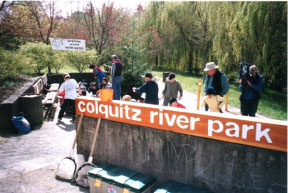
A school class at Colquitz River Park in Victoria, BC
Along the Cowichan River, surrounded by the smell of cottonwood resin, an elementary school student discovers that dragonfly larvae look like aliens. In a quiet wetland, a middle school teacher marvels as a guest expert shows his class how to fold cat-tails into duck shaped toys and send them downstream with wishes. In a municipal office, a bureaucrat considers a community proposal, initiated by an elementary school class, to create a new park.
Since 1994, the Colquitz Watershed Stewardship Education Project (CWSEP) has been bringing students, teachers, and the community together to experience educational turning points like those above. Headed by teacher Lenny Ross, the award winning project has successfully instilled an environmental ethic in students of all ages and their teachers by connecting them to the watersheds in which they live.
Flowing through two school districts near Victoria, B.C., Colquitz Creek is an urban salmon-bearing stream affected by development, runoff, encroachment and other negative impacts from the increasing population density within its watershed. The care of watersheds like the Colquitz is often championed by local naturalists and activists who feel a sense of stewardship towards their local environment and community. Creeks are much longer lived than people, and so it is crucial to pass on this ethic to young people who can continue to act as stewards of natural places in the future. Fostering this ethic, however, is difficult through textbook-based classroom learning. Depressing environmental stories of polluted rivers and decreasing salmon returns may actually turn students off of learning about their environment (Sobel, 1996). How then, did this project manage to instill a strong environmental ethic and sense of stewardship in the students and teachers who participated in it?
Inspired by a growing number of environmental education programs, including the Streamkeepers program and Project Wild, which were becoming available in British Columbia during the early 1990’s, Lenny Ross developed the CWSEP during a summer at the Wetlands Institute in the U.S. Over the years, the program has branched out and changed course, but throughout all of these changes, the essential goal has remained the same. “Students learn”, according to Ross, “to appreciate their environment, understand scientific concepts of watershed ecology and take action to help the watershed, and thus become responsible citizens of their community.”
A watershed, as defined by ecologists, is an area which drains into a common body of water, such as a river or stream. As well, the term can be used to describe a turning point in a process. The point at which a course of events is irrevocably altered may be described as a ‘watershed moment’. The CWSEP began with such an event, in which political and school district boundaries were set aside in favor of a new method of defining borders – the watershed of Colquitz Creek. Ten schools were identified within those boundaries, and at each school an environmentally minded teacher agreed to participate. Grant proposals were prepared and submitted with successful results due to the clear focus, goals, and objectives of the program. The project was on its way with a budget to work with.
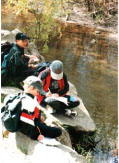
Students take time to reflect along Colquitz Creek.
Over the years, a variety of methods have been utilized to engage students in learning about their watershed. As well, changing focus slightly each year has kept the CWSEP fresh for the growing number of teachers who implement the program in their classroom year after year. In the 1999 – 2000 school year, classes went on watershed tours of Colquitz Creek while teachers used curriculum materials developed around music and literature. The following year, teachers received a curriculum package focusing on fish biology and their classes traveled to the watershed of the Cowichan River to compare it to the Colquitz. Other years have tied into community events such as Rivers Day or Science and Technology Week. This flexible focus has also helped the project make use of available funding which may require that specific themes are addressed. The essential components of the program, however, have remained the same each year and are as follows:
• Development of curriculum resources and provision of in-service training for participating teachers
• Implementation of curriculum materials and resources in the classrooms of participating teachers
• Field trips, during which classes participate in field studies and environmental assessments, often assisted by high school students who have received special training.
• Students then work on class projects and stewardship activities such as planting native plants or cleaning up streams
• All participants are involved in a community celebration during which they help educate members of the public and are recognized for their accomplishments.
Together, these components make up a project that has catalyzed ‘watershed moments’ for students and teachers alike.
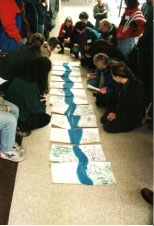
Teachers try out an activity during the “Project Wet” workshop.
Teachers as Students
An integral part of the CWSEP’s success has been providing curriculum resources, in-service workshops, and the knowledge of local ‘experts’ to teachers involved in the program. Many of the teachers who have taken part in the CWSEP do not have science backgrounds. Lenny Ross’ own professional background was originally in special education. The opportunity for professional development motivates teachers by giving them the resources they need to tackle topics like stream ecology and bird identification. Through the years, these resources have variously included lessons in fish biology, contributions from local government agencies such as park departments and water districts, guest speakers from the local natural history society, a partnership with musician Holly Arntzen to create classroom activities which use songs celebrating watersheds, and a guide using a literature-based approach to investigating freshwater ecosystems.

Teachers received Stream Team vests after completing training.
According to Lenny Ross, teachers are also attracted to the program because “As research out of the U.S. shows, if you integrate education around an environmental theme,
children’s test scores across all aspects of the curriculum go up because the learning is relevant and meaningful to their world. Such socially responsible education affects more than just grades. Student behaviour improves as children see that their work is valued in the community, and teacher enthusiasm goes up because they know this type of education is effective and it feels worthwhile when they see they are having a positive effect on the community as well.(Lieberman & Hoody, 2000) As one teacher said, “It makes for a really strong personal connect and that’s how you make a change.”
The program also benefits from the sense of community which develops between the teachers as they take on new challenges at workshops or eat meals together while planning the year’s activities. In 2001, the project partnered with the Freshwater Eco-Centre and Vancouver Island Trout Hatchery in Duncan, B.C. to assist in adapting activities for a “Fish Ways” manual, which provided teachers with activities for exploring the biology and ecology of fish with their classes. At the in-service in Lenny Ross’ school, teachers sat in groups for a hands-on lesson in fish anatomy and ecology facilitated by a naturalist from the Freshwater Eco-Centre. This included watching a fish dissection, counting rings on fish scales, and discovering that they could tell, even with paper bags on their heads, that the skin of a flounder, embedded with star-shaped scales, feels like sandpaper.

A Stream Team student shows a turbidity wedge to younger students.
Students as Teachers
The Colquitz Watershed Stewardship Education Project has involved teachers and students from Grade 1 to Grade 12. In general, any class that has expressed interest in the program has been allowed to participate. As a result, it has been necessary to develop relevant and challenging components of the program to suit students of various ages. When high-school students became involved, the project partnered with Streamkeepers, a college-level course provided through the Department of Fisheries and Oceans Canada, to train them in the skills needed to assess stream quality. Students were provided with sophisticated equipment which enabled them to determine the pH, oxygen content, and temperature of streams, as well as with training in many aspects of stream stewardship. This group of students, through the vision of middle school teacher Angus Stewart, evolved into the “Stream Team” and began helping with field trips for younger students.
 In the 1999/2000 school year, participating classes spent a day touring the entire watershed of Colquitz Creek, from its headwaters at Beaver Lake, through their community, to where the creek meets the ocean. By visiting three different stations along the creek and taking short hikes, the classes experienced the watershed first hand and began to see how it conncts their community. Students examined water quality, sampled and identified stream invertebrates, and completed reflective activities to record their impressions of the experience.
Throughout the tour, high school Stream Team students acted as teachers. Set up at stations along the route, the Stream Team students helped with activities for three or four classes a day, each day throughout the week. Given the opportunity to teach the younger students, on an ongoing and repetitive basis, the Stream Team participants quickly became adept at sharing their knowledge and acted as role models for the younger participants.

Students student stream invertebrates in a “mini pond.”
Students as Scientists
As much as the CWSEP has positively affected the teachers and students involved, it has also had tangible successes in improving the quality of the Colquitz watershed. Early in the program’s history a group of high school students from Spectrum Community School became involved with the project. Using their Streamkeepers equipment provided by the CSWEP, they recorded water quality data from the creek and used this data to plot graphs.
By doing so, they discovered that an area known as Quick’s Bottom, just downstream from the headwaters at Beaver Lake, had an elevated water temperature and low oxygen levels which would be deadly for salmonids. As it happened, many schools in the area were also involved in a “Salmonids in the Classroom” program where they were provided with equipment to rear salmon fry in their classes. These fry were then released into appropriate streams, including Colquitz Creek. The favored location for salmon releases in the Colquitz Watershed was just upstream of the warm, low oxygen area discovered by the students – an area that they renamed “Quick Death Bottom”.
After this discovery, it was decided that a new location for salmon releases should be found. A nearby park was located, safely downstream from the “Quick Death” area, where earlier habitat enhancement projects had already created excellent conditions for salmon fry. Classroom-reared salmon fry began to be released into this new location, greatly improving their chances of survival.
Students in the Community
After field trips are completed each year, students participate in class projects which apply their knowledge of environmental stewardship. Stream cleanups, plantings, and recycling projects have all taken place. Salmon have been raised in classrooms, invasive plants have been removed, and storm drains have been marked. Classes have done research projects to create posters and help educate their community about their shared watershed.
At Strawberry Vale School, where Lenny Ross teaches, mapping activities took place. In becoming more aware of their watershed, students and teachers noticed an open natural area near their school, owned by the Municipality of Saanich. Students helped work on a community proposal that resulted in this land being designated as a park, which the students named “Strawberry Knoll.”

Holly Arntzen leads students in a song and dance during an end of year festival.
As well, the program has involved community festivals. Displays have been erected in a local mall to highlight student’s work, and celebration concerts featuring local musician Holly Arntzen – who has also contributed to curriculum resources – have brought together participants to finish the year. In 2001, students came together from four school districts to Fort Rodd Hill National Historic Site near Victoria to highlight what they had learned in an ecology fair called the Salish Sea Festival.
Watershed Moments for Schools
The CWSEP has had lasting effects not only on students, teachers, parents, and community members, but on entire schools. In the case of Strawberry Vale School, the elementary school where Lenny Ross teaches, the project has been partly responsible for inspiring a new school design.
Located in a semi-rural area within the Colquitz Watershed, Strawberry Vale was intimately involved with the CWSEP from its very beginning. Not only Lenny Ross, but almost every teacher in the school, was involved with the project each year. When, during the project, the opportunity to build a new school arose, the teachers’ interest in environmental education helped to shape the new school. Landscape architect Moura Quayle interviewed the teachers to determine what kind of school they wanted, and discovered that Strawberry Vale was the perfect school to pilot projects with an environmental focus, reflecting the natural features of the semi-rural area in which it was located.
The new school and its grounds incorporated many features to allow children to learn, play, and interact with the natural world. The school is designed without eaves troughs. Instead, water pours off the roof in a waterfall-like fashion, past windows where students can observe the water cycle in action. The water then goes into a ground drainage system and eventually runs into a swale which empties into a newly created seasonal pond on the school’s property. Drains in the parking lot also lead into the pond, and have been painted with yellow storm drain marking fish to indicate that they lead to fish habitat. Between the school and the pond is a native plant garden approximately 100m long by 20m wide. This garden was created over many years with the participation of students who helped fundraise and create interpretive signage, as well as teachers, the parent association, district grounds and facilities staff, and other school staff. Ongoing planting and mulching days that take place at the school engage everyone, including the school custodian who has come to accept mud and leaves being tracked through the halls as a minor inconvenience when compared to the exciting and important learning that is taking place.
Students at the school who have been involved in the creation of their garden and ponds have developed a stewardship ethic that they readily apply to the greater community. When they discovered that a neighboring grove of Garry Oak trees was suffering from misuse and neglect, the students and staff took action to remove invasive ivy and add leaf mulch to the soil. These wild places near their school also provide opportunities for study. The pond and garden are regularly used for lessons about habitat requirements, aboriginal uses of plants, and more. Local experts have come to the garden to teach the students about traditional uses of plants and to make wild teas. Heavy snows this past year revealed dozens of birds searching for seeds and shelter amongst the shrubs. Red- winged blackbirds and marsh wrens have nested amongst cattails growing in the pond, and mink and great blue herons have been seen on the school grounds as well. Over the years, students have been able to learn about pond succession as the pond gradually filled in, and recently they raised funds to dig the pond out and start over so that future classes can continue to enjoy and learn from it.
Some years, the students and staff of Strawberry Vale shared their watershed moments with others when the CWSEP end of year festival was hosted in part at their school. Participants from four other schools were able to rotate through various activities in different classrooms including storytelling and watershed models. Class projects were displayed in the hallways, a watershed drawn on the floor flowed towards the gymnasium, and students led tours of their school garden and pond, explaining how their school fits into the watershed of Colquitz Creek.
Aside from opportunities to practice stewardship and to study, the garden, swale, and pond also provide the students at Strawberry Vale the very important opportunity for unstructured play. “You can walk down the trail at recess”, says Lenny Ross, “and think there’s nobody in the garden, but as soon as the bell goes, kids pop out everywhere. They are down at their own level, in the thicket, and if you join them and ask what they are doing they go on forever about the rooms and shelves and castles they have created.” This kind of unstructured play has been shown to contribute to children’s creativity and problem solving abilities, and also to be instrumental in fostering the environmental ethic that the CWSEP strives to create (Louv, 2005).
Assessment
Because of the longevity of the program, which began in 1994, teachers involved have been able to see students who participated in the program in elementary school grow up. They have observed these students carrying a sense of stewardship and an environmental
ethic with them into university and beyond. The ponds, gardens, and lasting dedication to environmental programs at Strawberry Vale school are one legacy of the project.

Lenny Ross (left) and Nikki Wright of SeaChange Marine Conservation Society celebrate the program’s success.
Through a partnership with the SeaChange Marine Conservation Society, the watershed tours continue as part of the Living Watershed Program. The high- school Stream Teams still work to take care of their local watersheds. Today, a middle-school oriented program called EcoRowing, which also involves yearly themes, extensive networking amongst teachers, and the knowledge of local experts, continues to provide more “hands on, feet wet” learning for teachers and students alike.
So why does this program work? According to Dr. Gloria Snively, University of Victoria environmental and marine education professor:
A major factor is the outstanding leadership of Lenny Ross who is a master environmental education teacher. Lenny is an extremely knowledgeable environmentalist and a visionary elementary school teacher without an ego. By demonstrating a strong environmental ethic and warmly welcoming all teachers and resource persons who want to participate, Lenny himself contributes significantly to the program’s success. (Personal communication, March, 2007).
Aside from this leadership, some identifiable “watershed moments” from the program are likely major factors:
a) The program was created in a focused manner. Having clearly stated goals and objectives made it easy to ‘sell’ the program when applying for grants and other funding, as well as asking for the participation of community partners. By 2001 the program had 29 community partners including parks systems, government agencies, local non-profits, two universities, the local natural history society, artists, and musicians.
b) Resources and in-service workshops were conducted for participating teachers that provided them with the knowledge, resources, and confidence necessary to prepare units on watershed ecology to teach in their classroom. Many of the resources were not necessarily science based. Musician Holly Arntzen recorded a CD of environmentally themed music and worked with Lenny Ross to create a teacher’s guide to use the CD in their classroom, and materials using a literature- based approach were also used.
c) Students came to field trips prepared. All the classes who took part in watershed tours or other activities had completed a watershed unit in their classroom beforehand, which meant they were primed for the hands-on experiences of closely observing the creek.
d) Stewardship projects were involved – being able to clean up litter, plant shrubs, or even create a new park gave participants a taste of success and the feeling of truly making a difference in their community.
e) Finally, the students’ efforts were recognized. Community celebrations and eco- fairs that showcased the students work meant students accomplishments could be shared with the larger community, giving them a true sense of contribution.

A student project illustrates a healthy watershed.
Finally, an unspoken strength of this program is perhaps simply the amount of time students are given to have direct contact with nature – a factor that has been shown to directly affect students’ performance (Louv, 2005). The success of this program has garnered it recognition at both the provincial and national level.
Experiencing success with their stewardship projects, feeling a sense of pride as they educate their community, and spending time in nature all help to foster an environmental ethic in the students who participate. Most significantly, however, the students have experienced critical moments that have allowed them to see themselves as an integral part of their watershed. Having made this connection through the CWSEP, they cannot help but care for the environment in which they live.
References:
Lieberman, G. & Hoody, L. (2000). California student assessment project: The effects of environment-based education on student achievement. San Diego, California, State Education and Environment Roundtable.
Louv, R. (2005). Last child in the woods: Saving our children from nature-deficit disorder. Chapel Hill, North Carolina: Algonquin Books.
Snively, G. (2007). (Personal communication, University of Victoria professor, March 28, 2007).
Sobel, D. (1996). Beyond ecophobia, Great Barrington, Maryland: The Orion Society.
About the Author:
 Pam Murray is a writer and park naturalist from Victoria, B.C., who currently lives in the Bowker Creek watershed. In 2001, as a naturalist at the Freshwater Eco-Centre in Duncan, B.C., she participated in the CWSEP by helping to deliver the “Fish Ways” in-service workshop. Over the years, Pam heard many positive comments about the CWSEP, mostly from other naturalists who told her how much fun it was to help out with Lenny’s program. This paper could not have been written without the generosity and patience of Lenny Ross, who also provided all of the photos and illustrations.
[/password]

