by editor | Jan 23, 2015 | Environmental Literacy, Place-based Education
No Fooling: Exploring the Nature of Responsibility, Progress, Success, and Good Work
How we answer a challenge raised over half a century ago regarding the way we handle the blessings of nature will go a long way towards determining our future.
by Peter Hayes
In the roughly 10,000 years since members of our species first began to call the Pacific Northwest home, many good questions have been asked. Of all that have been posed, one continues to stand out as the most important. In 1938 during a noontime luncheon address to a group of prosperous citizens in Portland, Oregon, the thoughtful, worldly generalist, Lewis Mumford asked this question: “I have seen a lot of scenery in my life, but I have seen nothing so tempting as a home for man than this Oregon country… You have the basis here for civilization on its highest scale and I am going to ask you a question which you may not like… Have you enough intelligence, imagination, and cooperation among you to make the best use of these opportunities?”
Though he spoke to one group of people in reference to the future of one region, the question applies equally well to our entire species and our total habitat — this planet — “do we have the qualities necessary to successfully live here for the long haul?” That is the most important question in the world. The only answers which matter are those expressed through actions, not words. And what do the consequences of actions taken since Mumford’s 1938 question say about our success? There is certainly good news in the form of the development of a more crash resistant economy, a country and world which may have made progress toward the challenge of judging people by the quality of their character instead of the color of their skin, and the imagination, endorsement, and enforcement of laws which help the powers of care, cooperation, and foresightfulness get the upper hand on the powers of selfish, shortsighted greed trying to turn our commonwealth into their personal wealth.
But overall the evidence of actions taken, and not taken, since 1938 indicate that our answer to Mumford’s question is: “no, we don’t yet have the qualities necessary to successfully live here. Our perceptive abilities, values, and ethics have not yet evolved in the ways that they must in order to develop and use those qualities”.
If meeting the challenge is a matter of fundamental survival, why haven’t we done it? If we are clever enough to pull off such feats as walking on the moon, splitting atoms, and cloning creatures, why not attend to our most basic survival? The answer is that we choose to fool ourselves. Fueled by the powerful forces, including the omnipresent media and our systems of schooling, we fool ourselves in four main ways. Progress toward meeting Mumford’s challenge — our most basic responsibility — depends on recognizing and correcting the ways that we’ve been fooled and continue to fool our children.
The fooling happens in how too many of us answer these four questions: 1) What is success?, 2) What is our greatest challenge?, 3) What is the basis for our decision making?, and 4) What are schools for?
What is Success?
One major reason for our continuing failure to meet — or even acknowledge — Mumford’s challenge is that for the majority of our species the challenge is not seen to be important enough to even pay attention to; for many, there is no connection between our personal yardstick of what it means to be a successful person and progress toward the challenge. Our systems and competitive instincts program us to be amused and preoccupied by other challenges and measures of success — accumulating more money than we need, proving that we are better than other people — whether on the sports field, in the classroom, boardroom, stock exchange floor, or battlefield, and basing our identities and sense of success on the acquisition of power, prestige, and comfort — on what we can take instead of what we choose to give. So, much like the highly capable student who flunks a course because she just didn’t choose to try, the first reason we continue to not meet Mumford’s challenge is that too many of us continue to be fooled into believing that success is measured by actions which take us further from meeting the challenge instead of toward it. Tellingly, Mumford prefaced his question to Portland’s City Club with the caveat that he had a question which his audience probably would not like. Wasn’t this because it presented — to people who already saw themselves as successful — an alternative, ultimately more important, measure of success, which if recognized, stood to threaten and/or limit their accepted notions of success?
What is the Challenge?
As a teacher, I owe thanks to my students for helping me recognize the second way that we fool ourselves. Year after year class discussions devolve into a familiar debate over which of the challenges on humanity’s plate is most important and deserving of our attention and energies. Here is a sampler of predictable excerpts: “Yes, I know that all of the problems with the environment, such as saving the salmon, are important, but you’ve got to realize that we have to look out for the well being of our own species first; people are starving and that must be our top priority.” Or “These efforts to help people learn to treat each other well, and to solve environmental problems like global warming are important, but we have to be sure to do nothing which might threaten quarterly profits and harm the economy; if we don’t have a strong economy, things will fall apart”. They have learned what they have been taught — and been fooled, just as I was fooled. We have inherited a flawed conceptual model which is based on the assumption that our species faces three, competing challenges: the challenge of people learning and choosing to successfully live with one another, the challenge of humans learning and choosing to live within the limits of what the land can provide, and the challenge of learning and choosing to develop an economic system which can endure over time. I fell for it; conclusions such as Aldo Leopold’s: “We end, I think, at what might be called the standard paradox of the twentieth century: our tools are better than we are, and grow better faster than we do. They suffice to crack the atom, to command the tides. But they do not suffice for the oldest task in human history: to live on a piece of land without spoiling it.” fooled me into the mistaken belief that one of the three competing challenge was paramount. I now see that from birth my culture conditioned me to see myself as positioned in the center of a triangle, with compelling, competing, and insistent voices from each corner vying for my attention. Across from Aldo’s siren call come the words of Martin Luther King Jr. and others, such as “We must either learn to live together as brothers or die together as fools.” And from the third corner come the powerful economic cautions of Alan Greenspan, Wall Street, and the WTO advising that without a functioning economy we have nothing. After investing twenty five years of my working life in the wholehearted, and often zealous, service of one of the three challenges — helping people learn and choose to live within the limits of what the land can provide – I have come to see that I was wrong because my work has been based on a flawed conceptual model of the real nature of the challenges. Aldo was right, but he was also wrong; King was right, but he was wrong; Greenspan is right, but he is wrong.
While each is essential, none is in itself sufficient. An economy dependent on the degradation of land or people will never succeed; a healthy land community depends on a functional economy and healthy human community; and humans cannot resolve their differences as long as the ecosystems and economies on which they depend are in disarray. As Jared Diamond described in a post September 11th letter to the Washington Post: “If a dozen years ago you had asked an ecologist uninterested in politics to name the countries with the most fragile environments, the most urgent public health problems, and the most severe overpopulation, the answer would have included Afghanistan, Burundi, Haiti, Iraq, Nepal, Rwanda, Somalia, Yugoslavia, and Zimbabwe. The close match between that list and the list of the world’s political hot spots today is no accident.” Though the world around us continues to do its best to fool us into seeing three competing challenges, the evidence from a careful look at how the world really works convinces me that these are not three challenges, but one — building communities which can survive and thrive indefinitely. For me, the competitive triangle model has been replaced by an interdependent, cooperative circular model of three links of chain. Healthy communities depend on meeting the challenges represented by each link, and our success is only as strong as the weakest link.
Progress depends on each of us learning to let go of our drive to see our highest priority corner or link prevail over the other three (think Earth First, WTO), and instead develop a higher commitment to the whole of being a citizen and community member than to any one of the links. Ironically it seems that the longer and harder we continue to push on our chosen corner of the competitive triangle model — as well meaning as we may be — the less likely we are to make progress toward any of the challenges. Success depends on turning all of our environmentalists, human rights activists, and economic development enthusiasts into just plain citizens — knowledgeable about and committed to all three links of the chain. These people fit into Wallace Stegner’s notion of choosing to be “stickers” instead of “boomers”, and follow the advice of Gary Snyder and others that one of the most radical — an useful – things we can do is to stay put.
What is the Basis of Our Decisions?
The third way that many of us continue to fool ourselves is pretending that the basis of our decisions can reasonably shift if distanced by time and/or space. When reduced to the most local scale, our moral evolution, as a species, has progressed toward basing an increasingly percentage of our actions on what is right to do as opposed to what we have the power to do.
Even if I am bigger and tougher than my two eating mates, I don’t eat more than my third of the pizza because that is the right thing to do; sharing a common pasture with other farming families, I choose to graze only as many cattle on it as the land can provide for, because that is the right thing to do; even if certain investments could be unusually lucrative, I choose not to invest in them because they are bad for the community. Each of these represents a choice to base decisions on ethics instead of power. In contrast to the progress we have made in what might be called moral evolution, we continue to fool ourselves with arbitrary blinders and barriers in terms of what we consider to be the domain of ethics and what is the domain of power.
Curiously something which is based on ethics when close to us in space or time, can slip back to being based on power when removed to greater distance. An example is the land use choices of forest products companies based in the Pacific Northwest. When operating within the United States the company uses a set of land use practices which their full page newspaper ads tell us are shaped not by laws, but by an abiding, ethically based commitment to land stewardship. Yet when the same companies transfer capital from domestic investments to forestry in other countries, their treatment of land is much less careful and, in the absence of land use laws in places like Russia, the basis for company decision making apparently shifts from ethics to what they have the power to do. Similarly, though I might buy a shirt made using child labor paid at unreasonably low rates — if it came from a very distant place, I would refuse, on ethical grounds, to eat at a local restaurant whose existence and profits depended on similar human abuse. Though a fisher would choose for ethical reasons not to steal fish from the hold of a fellow fisher’s boat moored alongside of his, he sees no ethical problem with overfishing a species, such as Atlantic Cod, to commercial extinction, which is effectively stealing fish from the holds of the fish boats of his children and grand children. Why do so many of us continue to fool ourselves into believing that our responsibility for ethical decision making decreases in proportion to how distant and anonymous the consequences become in space and/or time? Isn’t a consequence a consequence, no matter where and when they happen?
The Work of Schools
Mumford’s question — do we have the characteristics necessary to successfully live here — begs a preceding question: what characteristics are most important to us as we seek to meet the challenge?
Though he suggested intelligence, imagination, and cooperation, what would be your top ten essential attitudes, skills, and habits? What letter grade would you give the success of the five schools closest to your home at developing these characteristics in their students? What limits their success in doing this? The schools in my community are failing in this most important responsibility because they don’t recognize it as being their responsibility and are never held accountable for success. Instead, their missions, parental pressure, and deadening effect of school reform standards focus their attention and resources on maintaining and increasing students’ upward mobility — or put more bluntly – using the fair winds of competitive instinct to train good predators. Because of this, the final of the four barrier between us and rising to meet Mumford’s challenge is that too many of us fool ourselves into believing that our schools can be considered to be successful when they continue to put a disproportionate emphasis on preparing students to take/pursue personal gain — instead of developing in students the readiness to give in proportion to what they take, which is the measure of responsible citizenship. This status quo of schooling is a road toward diminishing returns because the pursuit of individual gain at the expense of our commonwealth leaves a dwindling world to be upwardly mobile in. We will know that this barrier is behind us when our schools are as, or more, effective at encouraging moral evolution and developing the characteristics of citizenship as they are in preparing students for upward mobility.
I was born into a world where the imbalance between what people asked of our communities and what those communities had the capacity to provide led to progressive erosion of community health and vitality. Though the decline continues, I am optimistic that within my lifetime it is possible for us to turn the corner by reconciling what our species demands with what the systems can sustainably provide. Every day I become increasingly convinced that the key to success is waking up to the four crucial ways that we fool ourselves and continue to fool each succeeding generation. What makes me hopeful is that when you look closely, in the right spots, it is easy to find, learn from, and be inspired by many remarkable examples of work that are successfully beginning to rebuild community vitality. Their success is the result of choosing to end the foolishness by redefining progress and success, re-envisioning three competing community challenges as one challenge, expanding the universe of ethical responsibility, and reshaping schooling to acknowledge that educating for responsible citizenship is our highest responsibility.
Among all of the candidates proposed as yardsticks for a successful life – educational pedigree, net worth, level of influence — is not the ultimate measure of our value and good work the degree to which we help equip our culture and its children to answer “yes” to Mumford’s challenge?
Peter Hayes is the former Ecological Studies Coordinator at Lakeside School in Seattle. He now manages a family tree farm in the Coast Range of western Oregon.

by editor | Dec 18, 2014 | Environmental Literacy, Gardening, Farming, Food, & Permaculture
Can School Gardening Help Save Civilization?
(An Essay in Four Parts)

by Carter D. Latendresse
The Catlin Gabel School
Portland, Oregon
Abstract
This paper is an argument for gardening in schools, focusing on two months of integrated English-history sixth grade curriculum that explores the relationships between a number of current environmental problems—notably hunger, water scarcity, topsoil loss, and global warming—and the land-use practices that led to the downfall of ancient Mesopotamia. This paper suggests that world leaders today are repeating some of the same mistakes that caused desertification to topple the Sumerian empire. It then explains how our sixth grade class explores solutions to the existing emergencies by studying Mesopotamia, ancient myth, gardening, and contemporary dystopian fiction. Finally, this paper posits a new cosmology that might help to remake western civilization, saving it from the threat of present-day ecological crises.
Part I: Four Enduring Understandings
Part II: Nine Reasons for a Garden
When we present the following nine reasons for our study of Mesopotamia in the garden, we do so in the problem-solution format so that our eleven and twelve year-olds do not feel overwhelmed by the quandaries of history, society, and science, and so that they might exercise their innovation and collaboration during their civilization-creation group work, thereby feeling efficacious while creating solutions for what ails us today. I will therefore present the nine reasons here in that same problem-solution fashion.
The Water reason
Problem: In his landmark book When the Rivers Run Dry, Fred Pearce (2006) tells the story of the Sumerians in the Fertile Crescent 7500 years ago, how they build the first giant irrigation systems using river water from the Tigris and Euphrates. They dug large canals and erected gigantic levees to protect themselves from the spring floods. However, the world’s first writing, cuneiform, done on clay tablets, notes that 3800 years ago their once great farm system was failing, the southern Mesopotamian “black fields becoming white” and “plants choked with salt” (Pearce, 2006, p. 186). The empire had to switch from wheat to barley, which is more tolerant of salt than its predecessor. The barley eventually failed as well, as “the salt chased civilization through Mesopotamia as mercilessly as any barbarian horde” (Pearce, 2006, p. 187). Pearce goes on to compare Mesopotamia to Angkor Wat in Cambodia, noting that great ancient civilizations emerged in environments where controlling the water was the highest priority. These ancient worlds, sometimes referred to as hydraulic civilizations in class, are unlike the more modest and oldest continually settled city of Jericho in Palestine, which has sustained farming on a smaller scale for 9000 years due to a spring producing 20 gallons a second (Pearce, 2006, p. 185). The grander cities of Mesopotamia were vulnerable to desertification, climate change, and silt built up in their waterways. Jericho, on the other hand, supplies a sustainable, if less impressive because less massive example for future generations.
What do the water problems of Mesopotamia, the students want to know, have to do with us today in Portland, Oregon, where it seems to rain for eight straight months every year? According to Maude Barlow, co-founder of Blue Planet Project, the National Resources Defense Council (NRDC) has published the alarming statistic that forty U.S. states are currently threatened by water scarcity. Not only are we vulnerable nationally to water shortage, but worldwide, lack of clean water is the leading cause of childhood death (Barlow). When pondering these threats, one begins to see that the misuse of water has continued unabated from the ancient world to present day. Take, for example, the wastefulness of the typical meat-based diet. “To produce just one pound of beef takes thousands of gallons of water. . . and this is [in] a world in which two-thirds of all people are expected to face water shortage in less than a generation” (Lappé & Lappé, 2002, p. 15).
Solution: The Sierra Club (2012) has a website on water conservation that we share with our students, asking them to think about using some of the strategies presented there in their own homes. Strategies include installing a low-flow showerhead, replacing the lawn with drought resistant plants, using drip irrigation in gardens rather than sprinklers, and watering with saved gray water. (Top Tips section, para. 13, 20, 22, and 26; and Other Considerations section, para. 2).
Here on campus, we have installed drip irrigation in our raised beds in order to reduce water evaporation. We have also installed an instructional rain barrel off of our cob oven roof in the garden that waters a tulip and lily bed so that students can see a water reclamation project in action.
The Dirt reason
Problem: In his article “Our Good Earth,” Mann notes that “today more than six billion people rely on food grown on just 11 percent of the global land surface,” while just “a scant 3 percent of the Earth’s surface [is] inherently fertile soil” (2008, p. 92). Clearly, in order for the world to feed itself, it has to conserve the living, fecund, very thin skin of this planet.
In the first and still most thorough study of global soil misuse, scientists in the Netherlands at the International Soil Reference and Information Centre (ISRIC) estimated in 1991 that humans have degraded, in ways described in Part I of this essay, 7.5 million square miles of land, an area that equals the U.S. and Canada combined (Mann, 2008, p. 90). Food riots have broken out every year over the globe for the past decade, due mainly to this degradation of the world’s soil.
Not all hope is lost, however. Rattan Lal, a soil scientist at Ohio State University, says that amending the world’s damaged soils with vast amounts of carbon can address several issues simultaneously. “Political stability, environmental quality, hunger, and poverty all have the same root. In the long run, the solution to each is restoring the most basic of all resources, the soil” (Mann, 2008, p. 90). Save the soil, put the people back to work, and allow them to feed their families—these are the recommendations of the ISRIC.
Solution: To preserve soil, water, and to reduce global warming, Bill Benenson’s (2009) movie Dirt, in a more prescriptive way than the ISRIC,recommends the following: Farm a variety of crops organically rather than monocropping with herbicides and pesticides, which is typically done in conventional agriculture. Further, we should fertilize with cow dung and compost rather than with nitrogen-heavy chemical fertilizers. The film also recommends collecting and trading seeds, planting trees, employing people to green urban spaces, joining a CSA for vegetables, and shopping for local seasonal produce at farmer’s markets when possible.
Here on campus, we show our students the film, and we harvest organic vegetables from our garden for our lunch salad bar, later composting back into our garden. The circularity of this system allows us to preserve the health of our soil and to teach invaluable lessons on soil conservation.
The Bee reason
Problem: During an interview on You Tube with the director Jon Betz and producer Taggart Siegel (2010) of the movie Queen of the Sun, Jonathan Kim (2011), the interviewer, points out that Colony Collapse Disorder (CCD) sweeping the bee world over the last five years has profound consequences for humans, as 70% of human food comes from pollination by honey bees, including broccoli, apples, soybeans, citrus, and grapes (Kim, 2011). Queen of the Sun suggests several factors for the cause of CCD, from viruses to funguses to pesticides to mites to monocropping to giving the bees antibiotics. Scientists do not have a consensus; however, early data suggests that trucking bees to pollinate monocultures, such as almond orchards in California and apple orchards in Oregon, weakens bee hives because orchards lacking biodiversity draw an inordinate level of pests, which prompts the orchardists to spray immense amounts of pesticides, which the bees ingest, and which weakens to bees’ immune systems. Michael Pollan states in the film that this industrialized farm system eventually degrades into monocrop deserts, contributing to CCD.
Solution: We need to keep bees on biodiverse gardens, farms, orchards, and campuses across the country, to normalize the presence of honeybees and to help children to distinguish between the honey bee and the much more aggressive wasp or yellow jacket, which are drawn to our picnics and our lunch meats.
The sixth grade team has been working with a Portland-based beekeeper to keep two hives in the Catlin Gabel School apple orchard to pollinate the trees on campus and to raise honey for our cafeteria. Learning about bees by interacting with them on a biodiverse campus is an important way for students to mitigate CCD and to ensure the continuance of pollination by honeybees.
The Population reason
Problem: There were 36 million people in Europe in 1000; 45 million in 1100; 60 million in 1200; and 80 million in 1300. In three hundred years, the population of Europe more than doubled, which required more land to be cleared for food production. This was made possible by a relatively warm climate across Europe from 800 to 1200. Forests originally covered 95% of western and central Europe, but the need to feed the burgeoning population reduced the forests to about 20% (Ponting, 1991, p. 121).
World population first reached one billion in about 1825, and it had taken 2,000,000 years to do so. That population reached two billion by about 1925. The third billion only took 35 years, in 1960. The fourth was added by 1975. The jump from 4 to 5 billion only took another 12 years (Ponting, 1991, p. 240). If one looks at a graph of world population from 1700-2000, one is immediately struck by the fact that it resembles, in an eerie but understandable way, the dramatic spike in Earth’s surface temperature during that same historical period. The fact of modern global warming was first brought to the world’s attention by Houghton et al. (2001) with the publication of their Intergovernmental Panel on Climate Change’s (IPCC) Third Report entitled Climate Change 2001—Scientific Basis. Most people remember Michael Mann’s “hockey stick” graph of 20th century climate change from Al Gore’s (2006) documentary film An Inconvenient Truth (Bender, Burns, and David), showing how the 1990s were the warmest decade on Earth in one thousand years. Mann’s graph was peer reviewed by the IPCC and used as a basis for Figure 1, “Variations of the Earth’s Surface Temperature over the Last 140 Years and the last millennium” in the 2001 report (Houghton et al., 2001, Summary for Policy Makers section).
What, one might wonder, does population have to do with global warming? The common denominator here is oil, which was first drilled in the U.S. in 1859 in Pennsylvania. Oil helped the human species to triple in one century from two to six billion. Over a billion acres of land across the globe was brought into food production between 1920 and 1980 (Ponting, 1991, p. 244). Once the land was planted and harvested, the international food trade blossomed with two oil-backed innovations: the first being ocean and railway transport, the second being refrigeration. “The nineteenth century marked the end of several thousand years of largely self-sufficient agriculture . . . and the transition to an era where much of the food consumed in the industrialised (sic) countries was imported” (Ponting, 1991, p. 245). At the same time, greater mechanization of tilling, harvesting, storage, and transport led to a sharp decline in the number of farms. In the U.S. alone, farm numbers fell from 7 million in 1930 to 3 million in 1980, while over half of the produce was produce grown and distributed by just 5% of the total number of farms (Ponting, 1991, p. 246). The lesson here is that with the sharp increase in world population came a correspondingly steep rise in the fossil fuels used to feed that population as well as an absurdly precipitous decrease in the number of people farming sustainably in a biodiverse way for subsistence. Every year we add approximately 70 million more people to Earth, which requires, given our industrial food economy, greater inputs from machines, fertilizers, and pesticides—all oil-based, all contributing to land, air, and water degradation and global warming (Elbel & Stallings, 2009).
Solution: The challenge remains to feed a ballooning world population without polluting the world that needs to feed that population. There isn’t one answer here. Intersecting solutions, as proposed by the National Geographic Society’s (2012) Eye in the Sky project, include the following: One, preserve the soil by rotating crops and farming organically with a variety of crops on each farm, which can reduce the need to clear more woodland for agriculture. Two, contour plow, which reduces water-polluting runoff. Three, governments should limit or ban the use of DDT as an insecticide because of its spread through food chains. Four, affluent nations should eat less meat so that the grain and water that are given to cows can be redirected to humans who are hungry and thirsty.
Here at school, in addition to sustainability, another one of our mission objectives is global education. To that end, the fifth grade teachers teach the book What the World Eats, by Faith D’Aluisio and Peter Menzel (2008). Their photo-documentary allows students to compare and contrast the food that twenty-five families in twenty-one countries purchase and eat in one week. The text and teachers highlight the connections between family income, family size, geography, food availability, and diversity in diet. As a result of this study, students begin to internalize the connections between their families and the families of a billion others across the globe.
The Climate change reason
Problem: The United Nations Intergovernmental Panel on Climate Change (IPCC) has been telling us for twenty years that climate change is real, that the planet is getting hotter, that this warming causes extreme weather events, and that global warming, especially in the last hundred years, is human-induced (Henson, 2006, p. 273). Though there had been some spurious anti-scientific debate over global warming ten years ago, in their 2007 IPCC report, editors Pachauri and Reisinger confirmed, through further research, that this century’s precipitous spike in global warming is due to human greenhouse gas emissions (Summary for Policymakers Section; Subsection 2: Causes of Change).
Last winter, PBS News Hour (2011) released a slideshow online entitled “Weather’s Dozen,” which presented photographs of twelve extreme weather events in the U.S. during 2011, including tornadoes, heat waves, droughts, and floods. Each of the disasters exceeded a cost of one billion dollars in damages. The slideshow also presented a bar graph comparing financial costs of these disasters from each year over the last three decades. One sees that on this last slide, the National Oceanic and Atmospheric Administration (NOAA) reported that 2011 was the costliest year ever recorded for extreme weather damage (PBS Newshour, 2011, slide 13).
The planet’s climate has changed, and each year floods, tornadoes, and heat waves strike more and more people, which also, in a cruel irony, ravage the world’s nonrenewable fossil fuel energy sources. In the last two years, weather, plate tectonics, and geography have conspired to join forces in disasters involving our three main energy sources: the BP oil spill of 2010, the Upper Big Branch Coal Mine in West Virginia in 2010, and the Fukushima Daiishi Nuclear Power Plant in 2011. Scholars note that as long as people seek nonrenewable energy sources in hard-to-get-to places, given the unpredictable and increasing nature of extreme weather events, that more disasters like these are inevitable. Today, oil companies have to tread into environments, like the Gulf of Mexico or the Arctic Circle, that are unstable since they are in regions that host either hurricanes or drifting ice sheets. Acknowledging the risks, some analysts have called this energy policy “Energy Extremism,” since more disasters like the BP oil spill will inexorably follow with energy strategies that require drilling in environmentally unstable regions (Klare, 2010, p. 30-31). The world’s fossil fuel markets and the governments that court those markets seem oblivious to science and history—lessons that teachers and middle school students find mind-boggling.
Solution: I present Tim Flannery’s (2005) book We Are the Weather Makers for my students because it lays out both the threats and a wide variety of solutions to global warming that our students and school community might follow. Our goal as sixth grade teachers is to move our students from ignorance to knowledge, from hopelessness to compassionate action. Some of Flannery’s extensive suggestions include the following: buy a hybrid car or take public transportation; buy Energy Star appliances; install solar panels on roofs; insulate homes well; change all light bulbs to compact fluorescent light bulbs; plug all electrical devices into power strips, and then turn off the power strips at night; switch plans with power companies to draw from renewable energy sources; recycle; don’t use plastic bags; resist buying products made with petrochemicals; eat locally, seasonally, and organically; turn off the tap when brushing teeth; use recycled paper; and cancel junk mail.
Here at Catlin Gabel School, our Facilities Director sends out monthly “Energy, Waste, and Water Reports” that detail electricity use, gas use, and water use, along with landfill by weight, recycling by weight, and compost by weight for the buildings on campus. We teachers and students are therefore able to chart our contributions to global warming throughout the year, and we are all aiming for zero waste and reduced carbon footprints.
The Nutrition reason
Problem: The book Forks Over Knives alerts us to the fact that“two thirds of adults [in the U.S.] are either overweight or obese, and obesity rates for children have doubled over the last thirty years” (Stone, 2011, p. 4). Obesity, therefore, has been rightly identified as a national health crisis, but what is perhaps less well known is that certain populations are at greater risk than others. The obesity epidemic is complicated, but the inner-urban neighborhood eyeball test can be as instructive as the arcane spreadsheet of a distant PhD when analyzing this issue.
What we see when visiting inner city neighborhoods in Portland is corner alcohol stores and fast food chains, not grocery stores offering nutritious fruits, vegetables, and whole grains. What is more, the poor don’t have places to play—very few parks or community centers. Further, in the inner city schools, PE is being cut, while the stories of unhealthy food in the public schools are ubiquitous. How exactly does childhood obesity connect to poverty and to ethnic background?
Poverty is racial, as a 2011 study of poverty by race and ethnicity in Portland showed. A staggering 52% of African American children live in poverty in our city, followed by 34% of Hispanic American children, 15% of Asian American children, and 10% of White children (Castillo & Wiewel, 2011). Noting that many of these children living in poverty also live in neighborhoods without farmer’s markets and grocery stores, one can also easily surmise that nutritional food and healthy diets are not as accessible to non-white Portland children. For our purposes of looking at food and gardening, we can conclude that not only is poverty racial, so is childhood obesity (Boak, 2007). Recent studies that take into consideration ethnic background in the U.S. find that Hispanic, Native American, and African American populations have higher rates of childhood obesity than Asian Americans and those self describing as White (Caldwell, 2009, para. 1-2).
Clearly, when we start looking at nutrition in our classrooms, our lenses have to expand to include ethnicity, income, demographics, and neighborhoods. That said, the fact also remains that all American children, regardless of ethnic background, street address, or family income level, are at risk of obesity and type II diabetes. There is something in our culture that is funneling our children toward these unhealthy ends.
Solution: The authors of Forks Over Knives tie together nutrition, cooking, the ethical treatment of animals, and greenhouse gas reduction strategies, and they have a simple message for improving our nutrition: eat a vegan diet that is plant-based and consisting of whole-foods. The closer the plant is to its original state in nature, the better. Their vegan diet, they claim, will erase obesity without compromising daily caloric, nutrient, or protein requirements. What is more, a transition to a vegetarian diet free of all meat, fish, dairy, and eggs will help to heal the soil, water, and climate ills facing our world. The authors point out that, at the current rate of population increase, Earth will hold nine billion people by 2050. The majority of those people will be born in China, India, and Africa, and as their incomes rise, they will eat more meat, cheese, and milk products. “The United Nations’ Food and Agriculture Organization (FAO) predicts that meat consumption will more than double by 2050, and milk consumption will grow by 80 percent during that period” (Stone, 2011, p. 35). While advocates of animal-based proteins argue that these increases are logical and beneficial for people’s health, the fact also remains that eating a variety of vegetables, legumes, unrefined grains, seeds, and nuts can supply a person’s daily protein requirements (Mangels, 1999). Another more obvious argument against eating more meat and drinking more milk in an ever-enlarging factory farm model are the deleterious effects upon soil, water, and climate.
The United Nations has found that farm animals create 20% of all human-induced greenhouse gases (carbon dioxide, methane, and nitrous oxide). However, “if every American simply reduced chicken consumption by one meal per week, the carbon dioxide savings would be equivalent to removing 500,000 cars from the road” (Stone, 2011, p. 40). People can also help to conserve water by eating less meat. The April, 2010, National Geographic magazine special issue on water has created a poster entitled “Hidden Water” that shows that “a human diet that regularly includes meat requires 60 percent more water than a diet that’s predominantly vegetarian” (McNaughton et al., 2010). In addition to water use, raising animals for food also “accounts for about 55 percent of soil erosion” (Stone, 2011, p. 39). To recap: we could reduce obesity and greenhouse gas emissions, while also preserving topsoil and water resources, if we ate less meat and animal products. What is stopping us?
On campus, our Director of Food Services regularly comes into our sixth grade classroom to teach lessons on growing, purchasing, and cooking with local produce. These classes are favorites among our students, as they get to do what all sixth graders want to do in school: eat! The sixth grade is also a leader class on campus for growing organic fruits and vegetables for our daily salad bar, enacting the principles of good nutrition, topsoil preservations, and water conservation.
The Globalization of food reason
Problem: The opening words of the movie Food, Inc. (2008) sum up the current industrial food system this way: “The way we eat has changed more in the past 50 years than in the previous 10,000, but the image that’s used to sell the food is still the imagery of agrarian America” (Kenner & Pearlstein).There are 47,000 products in modern average American supermarkets, which offer food out of season from all over the globe, encouraging the delusion that the world does not have seasons, that food is not tied to the earth, the weather, or to the seasons (Kenner & Pearlstein).The reality is that our current industrial food system is a factory, not a farm, with a small handful of multinational corporations controlling food from seed to plate. When the global food system is scrutinized in terms of global warming, it is unmasked as a main polluter: “Our food production—our fossil-fuel driven industrial model—[is] one of the biggest culprits, responsible for about one-fifth of human-caused greenhouse-has emissions” (Lappé & Lappé, 2002, p. 19-20).
Let’s look at the situation with chickens. Three or four companies control the beef, chicken, and pork in the U.S., and their goal is the same product every time. The chicken conglomerates today house chickens cheek to beak in giant feedlot barns without light, where they are unable to move around, and they are given antibiotics to stave off the eventual sicknesses that come from poor diet, nonexistent physical activity, and standing in their own feces. All that said, the chickens are bigger now in less time than they were 50 years ago (Kenner & Pearlstein). The same scenario outlined here could describe the life of most cows and pigs in the U.S. The meat we are eating from these factory farms is of inferior quality, and the lives of the animals are not being honored in even this most basic of humane ways.
Other companies, such as Monsanto, are busily engaged in seeking to gain control of the world’s food sources via genetically modified seeds. It is true that Monsanto’s genetically modified (GM) seeds helped millions avoid starvation in the 1970s, especially in India, during the so called “Green Revolution,” when high-yielding varieties of rice and wheat, along with tons of NPK chemical fertilizers, gave a few decades of bumper crops. Those same GM seeds and fertilization practices, however, have stripped micronutrients from Indian soil, as the high-yielding varieties were also ravenous, drawing up zinc, manganese, iron, and other micronutrients that healthy soil need to support crops. What is more, decades of dumping chemical fertilizers and overwatering have also poisoned the soil with toxic levels of fluorine, aluminum, boron, iron, molybdenum, and selenium (Shiva, 2008, p. 102). Monsanto and other GM companies are responding by increasing their lab technicians’ time to come up with new seeds and fertilizers that they believe will feed Earth’s swelling population in the 21st century.
The promise established during the early years of the Green Revolution has faded into a bizarre world of the global food economy, where companies that make herbicides are selling us food seeds, and where we are industrializing the food at the cellular, genetic level. Let’s go back and trace the history to figure out an alternate path.
In 1970, Monsanto created Roundup. In 1980, the U.S. Supreme Court extended patent law to cover “a live human-made microorganism” (Barlett & Steele, 2008, p. 158). From 1980, when there were zero genetically modified crops being grown in the U.S., to 2007, the amount of land planted with G.M seeds rose to 142 million acres planted in the U.S. and 282 million acres across Earth (Barlett & Steele, 2008, p. 160). In addition, during the 1980s, Monsanto began buying seed companies. Today, Monsanto is the largest seed company in the world (Barlett & Steele, 2008, p. 160). In the 1990s, Monsanto seized upon the opportunities opened by the 1980 Supreme Court case and began patenting life. The Green Revolution turned into the Gene Revolution. Today Monsanto owns 11,000 patents (Butler & Garcia, 2004). Deborah Koons Garcia (2004), director of the movie The Future of Food, believes that the company knows that whoever controls the seeds, controls the food. She speculates that Monsanto does not want biodiversity or food diversity; rather, she says, it wants to buy then patent all the seeds, then take those seeds off the market. Then they will produce only their Monsanto Roundup Ready seeds. Other analysts have come to the similar conclusions about this company, though we as teachers present these conclusions as theory while withholding the company name to protect community members who might work there.
From our perspective in the sixth grade, we are less interested in eviscerating certain companies than discussing farming practices as they relate to Mesopotamia. Therefore, we point out that “farmers who buy Monsanto’s Roundup Ready seeds [again, we withhold the company name] are required to sign an agreement promising not to save the seed produced after each harvest for replanting, or to sell the seed to other farmers. This means that farmers must buy new seed every year” (Barlett & Steele, 2008, p. 158). Such a practice of agreeing to deliberately let seeds go to waste reverses food growing practices since the founding of the first towns in the Fertile Crescent 9,000 years ago.
The connections between Monsanto, biodiversity loss, dying local economies, and poor nutrition are also becoming more evident, especially upon acknowledging that 70% of processed food—with its high salt, fat, and high fructose corn syrup levels—has a GMO in it. Perhaps not surprisingly, given the army of lobbyists that agribusiness has on Capitol Hill, it’s also against the law to label GMO foods in the U.S. (Kenner & Pearlstein, 2008).
Solution: Knowing that the leading manufacturers of carbon dioxide emissions come from transportation and coal-burning power plants for electricity generation (Flannery, 2005, p. 23 and 62), Vandana Shiva’s indictment of the global food industry that ships temperature controlled vessels around the world is rigorously logical. The solution we tell our students is to eat whole foods, not processed foods; local foods, not food from thousands of miles away; organic foods, not GMO food products; seasonal foods from the Northwest, not bananas from Ecuador in the wintertime. We realize that the children do not purchase the food that their families eat, but if they were to enact these practices, not only would they be allowing farmers to return to more healthy food production methods, they would also be encouraging millions of farmers across the world to save seeds and feed their families and communities with locally grown, organic, healthy food.
In their book Animal, Vegetable, Miracle, Barbara Kingsolver and her family (2008) recount a year of living in Kentucky eating in this way, which necessitated learning to can and pickle, eat more roots in winter time, and reach out to trade with neighbors who raised the apples, beef, and lamb that her own family could not. Farmers and writers like Wendell Berry have been modeling this practice for years, and we encourage our students to return to it, whenever possible.[1]
On campus we teach a Sweetness of Apples lesson (Reed & Stein, 2009) from the PBS series The Botany of Desire, based upon the book by Michael Pollan (2002). We harvest apples from our own orchard, and then purchase some other organic northwest varieties from a local market, New Seasons, which lists, on their produce bins, the grower name and orchard location. Students not only connect their diet to their campus, they can easily calculate the food miles accrued for the morning lesson.
The Oil reason
Problem: As sixth grade teachers, we recognize the urgency and our responsibility toward our students. One of my objectives during the Mesopotamia unit is explore two closely aligned myths: 1. Our world can support consistent and unlimited economic growth, even when China and India begin using the same amount of energy, per capita, as the U.S.; and 2. Oil, coal, and natural gas use can continue in the same way.
In order to assist the deconstruction of the myth of unlimited economic growth, I show Paul Gilding’s (2012) TED talk entitled “The Earth Is Full.” Gilding points out that we would need one-and-one-half earths to provide us with the available fossil fuels to maintain our energy usage for our current global economy.
The second myth is trickier to tease apart, as our daily lives seem to argue for its validity. I woke up in my heated house, had a toasted bagel baked across town, took a hot shower, and then drove my heated car on well-lit streets to a heated, well-lit school. Where is the fossil fuel shortage?
I tell my students that many scientists and journalists, like Kenneth Deffeyes (2005) and Tim Appenzeller (2004), believe that “peak oil,” first predicted by M. King Hubbert (1969, p. 196), is upon us. I explain to my students that since oil is a non-renewable, finite resource, there is day called “peak oil day” when oil producers reach their maximum amount in history they can extract from the ground and refine. That day is peak oil day, and every day after begins the decline of oil on this planet until its eventual depletion. The International Energy Agency in Vienna, Austria, notes that 2006 marked the all-time high of 70 million barrels a day of oil using conventional crude oil production methods (Inman, 2010, para. 2-4).
Other writers, such as James Kunstler (2005), draw far-reaching conclusions from this concept: “The oil peak phenomenon essentially cancels out further industrial growth of the kind we are used to” (p. 28). What Kunstler means is that because our global economy is predicated upon the reliable supply and use of oil and gas, and because that supply will begin decreasing until it is gone in the near future, our global economy as we know it is, at best, destined to have to change, and, at worst, doomed. Kunstler goes on to show how the billions of people in the recently developed nations who now seek the automobiles, electricity, and materials goods that the EU and USA have had for the last forty years will push global warming, biodiversity loss, and biosphere pollution to their breaking points.
We’re smart, though, many argue. Scientists will figure out how to solve these problems. Again, Kunstler doesn’t think so. There will be no one technological fix, he says, to the intersecting problems of overpopulation, global warming, and the end of peak oil. Even with the combination of compatible technologies such as carbon sequestration, solar power, wind power, geothermal power, and hydroelectric power, the net energy output cannot match our current needs in the U.S., to say nothing of the energy needs of the rest of the world. He takes nuclear power off the table as foolhardy and unsustainable, and given the events of last spring in Japan as chronicled by BBC News online (2012), his omission seems wise (Kunstler, 2005, chap. 4). Noting the irony that non-fossil fuel energy systems, such as wind turbines, require burning more fossil fuels to produce and maintain the so-called green energy systems, Kunstler nonetheless urges us to move toward clean energy sources, regional economies, and lifestyles that are congruous with the planet’s diminishing energy resources.
While more politically moderate studies suggest that the global economy might slow down but rebound with new technological advances, the fact remains that we have already crested Hubbert’s Peak in the past five years (Deffeyes, 2005, p. 3). Furthermore, it is essential to remember that the remaining oil and natural gas under Canadian tar sands or oil shale in the western U.S. “could provide as much oil as the world’s current reserves, but the current methods of extraction are hugely greenhouse-intensive and environmentally problematic—not to mention expensive” (Henson, 2006, p. 289). Simply put, the world’s cheap, easily harvested oil is gone—and with it, the days of the global industrial food system are numbered as well.[2]
Solution: At Catlin Gabel school, we not only teach Peak Oil and alternative energy in our studies of economics, science, history, and literature, we enact it with our symbolic “Empty the Lot Day,” which is a day that faculty, staff, students, and parents seek to reduce our school’s carbon footprint and do our part to keep the air clean for everyone. We encourage people to bike, walk, carpool, and take public transportation to work, charting the progress year to year, and incentivizing the process throughout the year by providing lunch tokens to teachers who carpool, bike, walk, or take public transportation to campus.
The Hunger reason
Problem: One in six Americans will struggle with hunger today (Levy, Mueller, Cochran, Hand, & Two Bulls, 2012, para. 1). This is a disquieting statistic, made even starker by the reminder that adults who struggle to feed themselves cannot often feed their children. In fact, “according to the USDA [U.S. Department of Agriculture], over 16 million children lived in food insecure (low food security and very low food security) households in 2010” (Feeding America, 2012). One’s heart fills with grief wondering, Is there simply not enough food to go around?
Frances Moore and Anna Lappé (2002) counter this question, though: “For every human being on the planet, the world produces two pounds of grain per day—roughly 3,000 calories, and that’s without even counting all the beans, potatoes, nuts, fruits, and vegetables we eat, too. This is clearly enough for all of us to thrive; yet nearly one in six of us still goes hungry” (p. 15). What then, is the cause of all this hunger?
Joel Bourne, Jr. (2009) notes that global population is booming, but so is global warming and deforestation of land for more production zones. We know how this pattern goes, if we follow Diamond (2005) and Ponting (1991). Acting as mitigates on grain production across the globe, are three other factors: one, global warming is sharply curbing harvests of rice, corn, wheat, sorghum, cassava, and sugar cane across the world; two, staple crops such as corn and soybeans are being fed to livestock as the desire for meat and milk products skyrockets among the millions of new middle class citizens; and three, more and more trees are being cleared to make way for fields that are being converted to biofuels in a well-intentioned response to global warming, which is, in a grimly ironic catch-22, causing erosion, topsoil loss, and desertification, thereby creating more hunger (Bourne, 2009). This is exemplar of the vicious circle involving the triad of hunger-overpopulation-global warming, I tell my students, and it will be the greatest challenge of their lives when they get older.
Solution: Our 5th grade teachers are tackling these issues head-on, teaching the children about local food systems as an antidote to the global food supply chain that is bad for the climate, the land, and the people. In 5th grade, they have the students research CSAs, farmers markets, farm to school programs, the 100 Mile Diet, and the Low Carbon Diet. They use Chew on This (Schlosser & Wilson, 2007), The Omnivore’s Dilemma: Young Reader’s Edition (Pollan, 2009), and What the World Eats (D’Aluisio & Menzel, 2008)to teach local food systems, biodiverse farming practices, sustainable agriculture, and nutritious eating with a low carbon footprint.
In the middle school, including the sixth grade, we continue the work of our lower school colleagues by doing monthly service projects with Portland based community groups, such as The Blanchet House, Urban Gleaners, and the Oregon Food Bank, who are all working to end hunger in Oregon.
I also advocate, in my classroom and in the garden, a turn away from grain for livestock, and land for monocrops or biofuels, and instead a return to the practice of smaller, biodiverse farms that feed families and communities. Biodiverse, organic fields have healthier soils than those used for conventionally farmed monocrops, and organic, biodynamic farmers cause far less erosion and topsoil loss, use far less water, and do not causes long-term soil toxicity as farmers using conventional chemical farming practices do. Looked at in the short-term, organic, biodiverse farms may appear less productive than the larger, conventional chemical monocrop farms, as the former are smaller and seemingly less bountiful. However, looked at in the long-term, the organic biodiverse farms actually do more to address hunger and environmental stability in the world, as their practices preserve soil, do not contaminate drinking water, and do less to add to global warming. Connecting hunger and global warming, I also share with my students Vandana Shiva’s (2009) research, which “has shown that using compost instead of natural-gas-derived fertilizer increases organic matter in the soil, sequestering carbon and holding moisture—two key advantages for farmers facing climate change” (p. 56). When we talk with our students about hunger, we do not simply talk about access to food, although access certainly is a factor; we also talk about climate change, population, geography, vegetarian vs. omnivore diets, local vs. global food supply, short-term bumper crop vs. long-term sustainability, and chemical vs. organic farming. All of these issues are relevant, obviously.
[1] Berry is a national treasure. Some of his many books include Bringing It to the Table (with Michael Pollan), The Unsettling of America, and What Are People For?
[2] Other writers also point out that the U.S. has evoked some antagonism around the world from its political support of the despotic Saudi regime in exchange for continued, cheap access to the bulk of the world’s crude oil reserves. See Chapter 11 of Rachel Bronson’s Thicker Than Oil. Still others suggest that both U.S. military strategy during foreign wars and the decisions to maintain hundreds of overseas bases are both predicated upon securing that access to oil. See Chapter 3 of Kevin Phillips’s American Theocracy and Chapter 4 of Chalmers Johnson’s Nemesis. Whatever one’s conclusions, it’s clear that both fossil fuel use and fossil fuel access come at great environmental and political costs.
by editor | Dec 18, 2014 | Place-based Education
Phenology Wheels: Earth Observation Where You Live
 By Anne Forbes, Partners in Place, LLC
This article originally appeared in Earthzine – http://earthzine.org/
.
.
 aking a habit of Earth observation where you live is a fun and fundamental way to practice Earth stewardship. It is often our own observations close to home that keep us inspired to learn more and allow us to remain steady advocates for solutions to today’s daunting problems. Earth observation done whole-heartedly becomes skilled Earth awareness that leads to profound relationships with the plants, animals, and seasonal cycles surrounding us in real time, whether we live in the city, suburbs, or countryside.

Courtesy Anne Forbes.
One way to track Earth observations is an activity called Phenology Wheels, suitable for individuals, families, classrooms, youth programs, and workshops for people of all ages. Phenology is a term that refers to the observation of the life cycles and habits of plants and animals as they respond to the seasons, weather, and climate. A Phenology Wheel is a circular journal or calendar that encourages a routine of Earth observation where you live. Single observations of what is happening in the lives of plants and animals made over time begin to tell a compelling story – your story – about the place on our living planet that you call home.
Why a circle? We usually think of the passing of time as linear, with one event following another in sequence by day, by month, by year. Placing the same events in a circular journal, or wheel shape, helps us discover new patterns (or rediscover known ones). We can use the Phenology Wheel to communicate about what is really important or interesting to us.
Here’s the General Idea
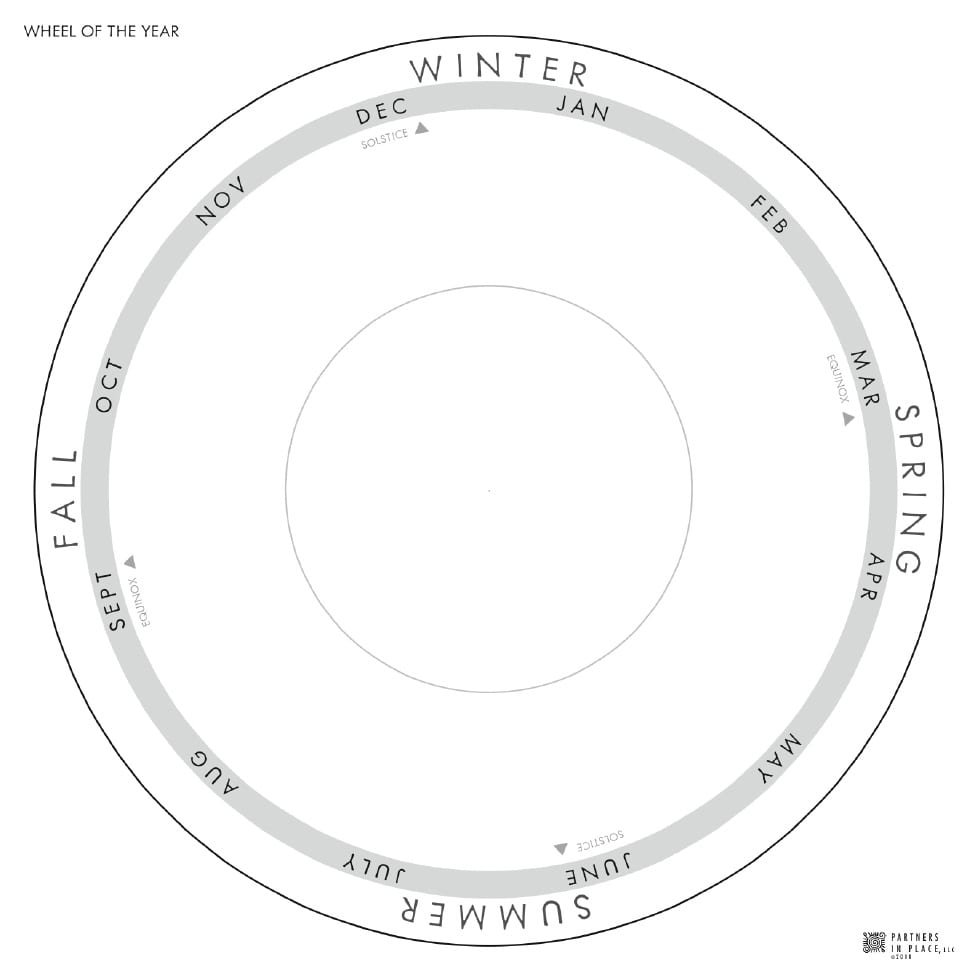
A Phenology Wheel is made up of three rings in a circle, like a target. To become a Wheel-keeper, you select a home place, such as a garden, a “sit spot,” schoolyard, watershed, or landscape that will be represented by a map or image in the center ring, the bull’s eye. Next, you mark units of time – such as the months and seasons of a year, hours of a day, or phases of a lunar month – around the outside ring, like the numbers on the face of a clock. Then, as you make specific observations of what is going on in the lives of plants and animals and the flow of seasons, you record them within the middle ring using words, phrases, images, or a combination.
Here’s How To Get Started
Because the wheel is round, you can begin a Phenology Wheel for Earth observation at any time of year.
Although you can pick among different time scales for the outer ring, let’s begin here with a year of seasons and months.

Courtesy Anne Forbes.
1. Draw a set of nested circles on a large piece of paper. You can do this by tracing around large plates or pizza pans, by using an artist’s compass or by making your own compass out of a pencil, pin, and string. You may also purchase a kit of print Wheels or a set of digital PDF Wheels online.
2. If you are making your own Wheel, write the names of the seasons and months on the outer rings.
3. Select an image for the center to represent the place or theme you have selected and to anchor your practice of observation in time and space.
Maps for the Center: If you choose a map, will it be geographically accurate or symbolic? Will it be traced or cut and pasted from an existing map, or will it be a map of your own creation?
Tip: Use a web-based mapping system such as Google Maps to print a map and use it to trace selected features as a base map for your Wheel.
A Centering Image: If you choose an image other than a map, will you create your own image or use one that you find already in print material? Will you use a photo, make a collage, or choose a found object, like a leaf or feather?
Tip: Children often enjoy a picture of themselves at their “sit spot” or other place they have chosen to track their observations.
4. Establish a Routine: Observe → Investigate and Reflect → Record
OBSERVE: What do I notice in this moment? What is extraordinary about seemingly ordinary things? What surprises me as unexpected or dramatic?
then
INVESTIGATE: What more do I want to know about what I observe? What questions will I seek to answer through my own continued observation? What information will I search for in books or from mentors or websites?
and
REFLECT: What does my observation mean to me? How is it changing me? How does it help me explore my values and beliefs?
then
RECORD: A routine of frequent observation provides the raw material to transform your blank Wheel into a circular journal as you record images, symbols, or words as you observe the passing of the seasons in your home place.
Tip: An interactive diagram of this process can be found under the Observe & Record tab here.
5. Share and Celebrate: Use your Wheel to report or tell stories about what you learn from and value about Earth observation in your home place.
Like a wheel on a cart, time turns around the hub of your home place;
the metaphor is a journey taken through a day, a month, a year,
or a lifetime of curiosity and appreciation.
Of course, you don’t have to keep a journal to explore and appreciate your home place on earth and the home place in your heart. What are the dimensions of your home place in this moment? What marks of time’s passing do you observe? The more playful you are with these questions, the more you may feel a part of your home place and committed to co-creating its well-being with others in your community.

Courtesy The Yahara Watershed Journal.
Welcome home.
Example #1: The Yahara Watershed Wheel
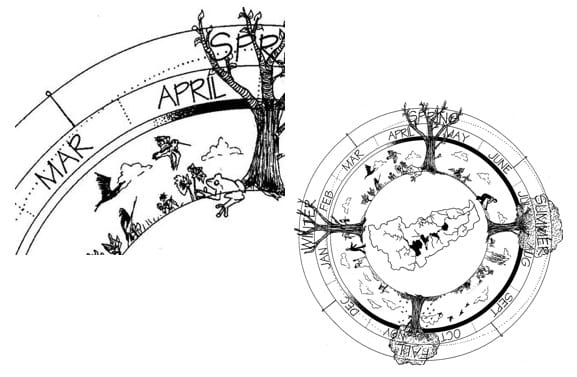
About twelve years ago, a group of like-minded friends gathered by my fireside to reflect upon what it means to live in this place we call home in Dane County, Wisconsin, USA. We chose to think of the Yahara Watershed as our common home place, and the series of seasonal events that occur in a typical year as the time scale to track. We put a map of the watershed in the center of a large Wheel of the Year, with units of time going around the outside rim, much like a clock, but using seasons and months instead of hours. We then went around our own circle, each speaking of the defining moments in the natural world and in the lives of people enjoying it throughout the months of a typical year. The artist among us sketched the images onto the Yahara Watershed Wheel that you see here. The detail in the enlarged image represents the unique happenings in March and April: pasque flowers in bloom, the return of redwing blackbirds and sandhill cranes, woodcock mating dances, first dandelions, and spring peepers in chorus.

Courtesy Anne Forbes.
Example #2: Poems of Place
In reporting on this Wheel filled with seasonal poems by 4th and 5th graders about the large school woods, just outside an elementary school “backdoor” in Cambridge, Wisconsin, teacher Georgia Gomez-Ibanez writes, “Because the woods is so accessible, the children spend quite a lot of time there developing a deep sense of place, including keen observational skills and a heightened imagination, all enhanced by the affection they have gained by years of exploring, learning and stewardship.” This selection of student poems illustrates how Phenology Wheels can be used to enhance language arts as well as science curriculum.
Example #3: Local Biodiversity
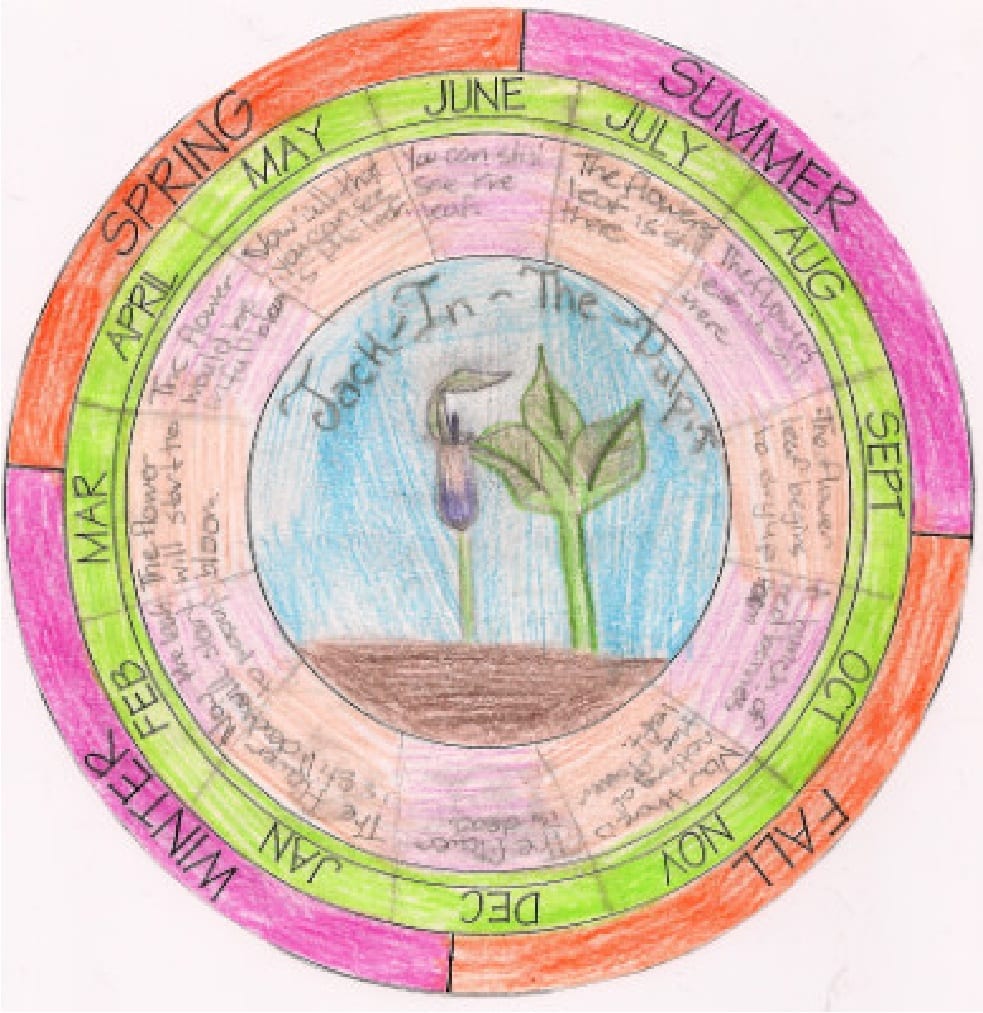
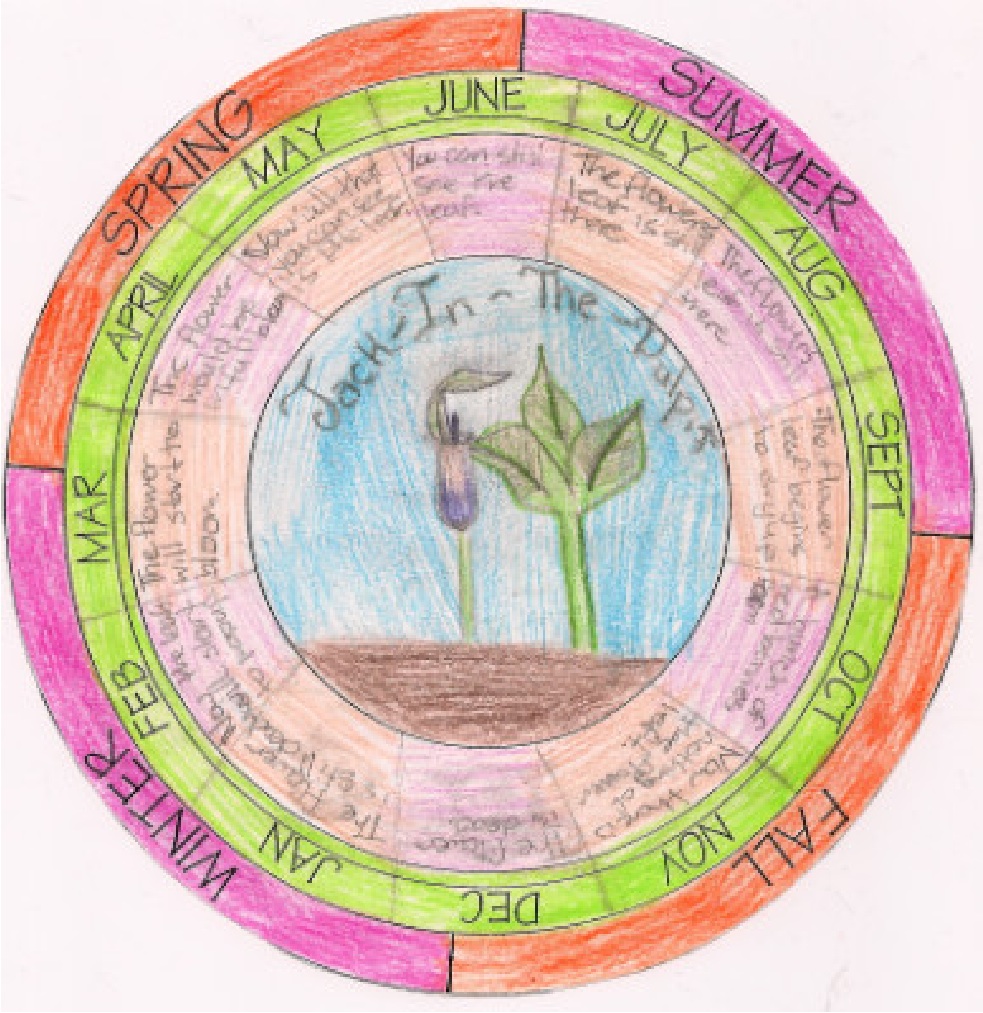
In another example from Cambridge Elementary School in Wisconsin, teacher Georgia Gomez-Ibanez reports that a classroom studied the biodiversity of the area where they live. Each student picked a different animal or plant from their adjacent woods or prairie for the center of an 11-inch Wheel and then did research to tell the full story of the life cycle in words. The example here shows the work of one student who studied the Jack-in-the-Pulpit wildflower.
The next step would be for the students to combine their information for single species onto one large 32-inch Wheel and use it to explore the dynamics of the ecosystem that appear through food webs, habitat use, seed dispersal mechanisms, and so on.
Frequently Asked Questions
Courtesy Anne Forbes.
1. Where do I get more information?
If you are ready to start a Phenology Wheel for yourself, family, classroom or youth program, or any other interest group:
• Visit the Wheels of Time and Place website for instructions, resources, and a gallery of examples.
• Download a curriculum for youth developed in partnership with Georgia Gomez-Ibanez, an elementary school teacher, and Cheryl Bauer-Armstrong, Earth Partnership for Schools, UW-Madison Arboretum.
2. Where do I order pre-made Wheels?
Order the blank Wheel templates as a digital download of PDF files or as a complete toolkit, Wheels of Time and Place: Journals for the Cycles and Seasons of Life. The latter includes a set of print Wheels in 11-inch and 24-inch sizes, a code to download the PDF files, and an instruction booklet – all in a recycled chipboard carrying case.
3. What size should my Wheels be?
Some people prefer 11-inch Wheels because they are compact, portable, and can be easily duplicated in a copy machine on 11 x 17-inch paper. You can trim them down to 11-inch square if you would like.
When people share the 24-inch Wheels, their faces often light up with excitement. This size, or larger, works well if you have a large clip board or a place to keep it posted for frequent use or when people are working on one Wheel in a group.
Of course, if you make your Wheels by hand, you can make them any size you like. If you purchase the PDF files, you can enlarge them up to 32-36 inches at a copy or blueprint shop.
4. What if I’m already a journal-keeper?
Some people who already keep a written journal use the Wheels to review their journals periodically and pull out observations to further explore and put on a Wheel. It’s amazing what patterns and stories can emerge.
5. Can the Wheels be created from databases?
Frank Nelson of the Missouri Department of Conservation has used wheels called Ring Maps, A Useful Way to Visualize Temporal Data to show trends and reveal patterns in a complex set of data.
________________________________
Anne Forbes of Partners in Place, LLC is an ecologist who seeks to integrate her scientific and spiritual ways of knowing. For over 35 years, she worked on biodiversity policy as a natural resource manager and supported environmental and community collaborations as a facilitator and consultant. Her years of spiritual practice in varied traditions, most recently the Bon Buddhist tradition of Tibet, inspire her commitment to engaged action on behalf of present and future generations. She failed her first attempt at retirement and instead created the Wheels of Time and Place: Journals for the Cycles and Seasons of Life.
Contact: anne@partnersinplace.com.
by editor | Oct 23, 2014 | Language Arts
The Power of Storytelling:
Earth Tales and Activities
Show the Way for Living in Balance
by Michael J. Caduto
©2014 All Rights Reserved
From Siberia to the tip of South America, and from Africa to Polynesia, stories have grown from the very Earth upon which they were first told. Through these tales, the natural world speaks to the people who walk upon it and who use it to stay alive. But stories have wings, too, which loft them upon the winds of our imaginations.
Traditional tales contain the wisdom that countless generations have harvested by living close to the land, growing their own food and making the things they needed with their own hands. In order to live, they had to take care of the soil, the water, the plants and the animals. As the stories show, people eventually learned that the harm they caused the world around them would one day come knocking on their own door. The care they showed would be returned in kind with food, clean air and water, and materials with which to fashion tools and other necessities. In this way, stories are a kind of medicine, a way of healing the wounds of life.
In many stories it is clear that traditional cultures believe that all of nature is alive: those things that move, and those that do not. There is a breath of life in a tree, a hawk and the long wind that blows across open places and gently bends blades of grass. A spirit lives in the shadow that grows between the hills as the sun sets, in the rocks of the hills themselves, in the moon that rises into a starry sky, in the sweet smell of a flower and in the joy of a newborn fawn. Over and over in the old tales we read of the common faith in a benevolent, unseen Creator of the wonders that surround us. Like the natural world, stories are sacred and are treated with respect and reverence.
We All Have Native Roots
No matter what culture, or cultures, our ancestors come from, traditional stories can help us trace our roots back to their source. We all have ancestral ties to Native peoples who lived close to Earth. Their wisdom lies deep in our memories. One common thread that runs through the stories is the belief that we are a part of nature, and that the community of people and the natural world depends upon a mutual, respectful relationship. Although we cannot help but change our environment as we live in it and use its resources to keep us alive, we can do everything possible to have a positive impact and nurture the natural world.
Besides entertaining and helping to teach moral lessons, stories help to explain the natural world; they carry on our spiritual beliefs, our artistic traditions and the particular ways we use language. The wisdom of Earth stories is both a link to our past, and a lifeline to the beautiful, healthy Earth we want to leave as a legacy for future generations.
Earth Tales and Activities
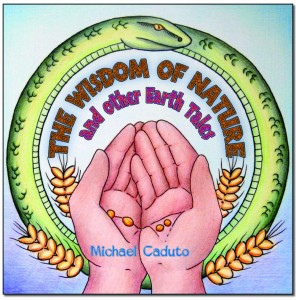
In this section I present “The Wisdom of Nature,” an original retelling of a traditional Swahili story from Kenya, Tanzania and Zanzibar in eastern Africa. The story is adapted from my book Earth Tales from Around the World and it appears on my storytelling CD, The Wisdom of Nature and Other Earth Tales. The accompanying activities are designed for children of ages 5 to 12. As with all stories in Earth Tales, the activities suggested in the back of the book can be created and adapted to suit the home environment of the intended audience. These particular activities are oriented to the plants and animals of North America and are adapted from the book Keepers of the Animals: Native American Stories and Wildlife Activities for Children.

This introduction and story, “The Wisdom of Nature,” are used with permission from Earth Tales from Around the World, ©1997 by Michael J. Caduto (Golden Colorado: Fulcrum Publishing). The story also appears with permission from the storytelling CD: The Wisdom of Nature and Other Earth Tales, ©2014 by Michael J. Caduto (Luna Blu®). The activities, ©1991 by Michael J. Caduto, are adapted with permission from Keepers of the Animals: Native American Stories and Wildlife Activities for Children, by Michael J. Caduto and Joseph Bruchac (Fulcrum Publishing). The illustration by Adelaide Murphy Tyrol is used with permission. Activities may be used only as needed for normal classroom use. Written permission is required from the author to copy this story and introduction in any form from: Michael Caduto, P.O. Box 1052, Norwich, VT 05055, USA. Phone: (802) 649-1815. Copies of these books and information on related books, music and programs can be obtained at the P.E.A.C.E.® website: www.p-e-a-c-e.net
The Wisdom of Nature
Swahili (Tanzania)
©2014 by Michael J. Caduto
All Rights Reserved
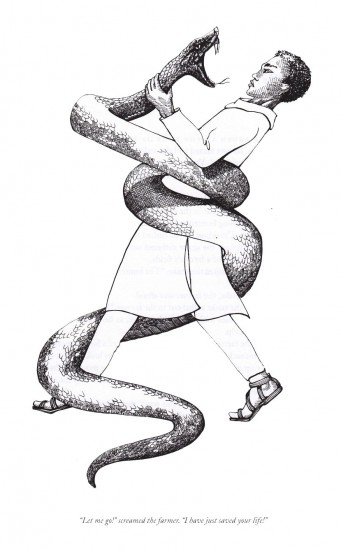 In the thick brush at the edge of the hill country lived a magnificent snake. Its eyes blazed and the scales that covered its skin were as hard and strong as any shield. Venom flowed from its long, curved fangs. In the moment of its hunger, this huge, powerful snake devoured any wild animal it desired.
One day, the snake sat sunning itself in a small clearing. Being close to the ground, the snake sensed a roar in the distance. Its tongue picked up a strong scent. Upwind, some young hunters were burning the brush to drive the game animals into the open. Crackling flames rushed toward the snake
As it searched for refuge, the snake slithered out of the low brush and into the open along the border of a farmer’s fields.
“Please help me hide,” asked the snake. “The hunters are coming. They will kill me.”
When he saw the snake, the farmer was afraid.
“Do not fear me,” the snake called out to the farmer. “I will not harm you.”
The kindhearted farmer took pity on the snake, as he did on all animals that were in need of help.
“Quickly,” said the farmer as he opened the mouth of a large, empty grain bag, “crawl into this sack. The hunters will never think to look for you here.”
As soon as the tip of the snake’s tail disappeared into the mouth of the bag, some hunters approached. They were following the faint trail left by the snake’s belly as it slid along the ground.
“Have you seen a large snake come this way?” they asked the farmer.
“No,” he replied. “I have been working here all morning and have seen no sign of a snake. You must be reading an old trail.”
“Thank you,” said the hunters, and they walked on. When they were a safe distance away, the farmer opened the grain bag and whispered, “Come out, the danger has passed.”
The snake crept out of the sack, threw its coils around the farmer and held him fast.
“Let me go!” screamed the farmer. “I have just saved your life!”
“That is true,” replied the snake. “But I have not eaten for many days. You will make a good meal.”
“Then you will not let me go?” asked the farmer.
“No, I am starving.”
“Before you eat me,” said the farmer, “you could at least repay me for saving your life.”
“That is only fair,” said the snake. “I agree. Now what do you desire?”
“Let us have others decide whether you should eat me.”
“If that is your wish, so be it,” agreed the snake.
The snake followed the farmer to the edge of the field where a coconut palm tree had been planted. The tree listened carefully as each of them told his side of the story.
“Well,” replied the coconut palm, “I know the nature of human beings. They eat my nuts and drink the sweet milk inside. Some even use my leaves to thatch their roofs. Why should I save a human being? I say the snake should have its meal.”
“Let us ask the bee,” said the farmer.
“As you wish,” replied the snake.
“You must be joking!” replied the bee. “Human beings smoke us out of our homes and steal our honey. They never give us thanks. I have no compassion for the farmer.”
“Perhaps the mango tree down by the road will understand my plight,” thought the farmer. “Snake, let us go ask the mango to give us its judgment.”
“Lead on,” replied the snake.
Once it had listened to their stories, the mango tree spoke. “Year after year I stand here as generations of human beings pass by. They cool themselves in the shade of my branches and eat my fruit when they are hungry. Some break off my branches for firewood or to use as the shafts of spears for hunting the wild animals. Not once has a human being thanked me. Farmer, I see no reason why the snake should not eat you.”
“How could this be?” exclaimed the farmer. “Why should my life be such a trifle in the eyes of nature?”
At that moment, the farmer spotted a gazelle grazing along the riverbank. To the gazelle the farmer now pleaded his case.
In response to his story, the gazelle told a tale of its own. “I am often the difference between life and death for the human beings. Without my meat, they would starve and perish. Because I am so generous, people take me for granted. Your life, farmer, belongs to the snake.”
A baboon was listening from where it sat on the branch of a nearby tree.
“Every creature does what it must in order to survive,” said the baboon. That is the way of nature.”
“But what of the snake?” asked the farmer.
“One cannot blame the snake for its hunger,” replied the baboon. “Like you, the snake is part of the balance that exists in the world.”
A snake is meant to eat its prey,
it catches as it can.
Its food will try to get away,
escape’s the way of man.
“What, then, do you have to say about whether or not I should eat the farmer?” asked the snake.
“First, you must show me exactly how it happened,” said the baboon. “That sack does not look big enough to hold a snake as magnificent as yourself.”
The farmer then opened the bag and the snake crawled in.
“Are you able to close bag with the snake inside?” asked the baboon.
“Yes,” replied the farmer as he drew the cord tight and tied it securely.
“Now, farmer, we will see what you have learned,” said the baboon. “Once again, the fate of the snake is in your hands. Now what are you going to do about it, hmmm?”
Activities
Prey, Tell Me
“Every creature does what it must in order to survive,” said the baboon in this story. “That is the way of nature.” Indeed, each plant and animal has specific adaptations, physical (genetic) traits and behaviors that better enable it to survive and reproduce in its particular environment. Among animals, many survival adaptations relate to eating or being eaten.
Activity: Solve some riddles that describe the survival adaptations of some prey animals by guessing the animal’s identity.
Goals: Understand what a survival adaptation is and learn some defenses of certain prey animals.
Level: Ages 5 to 12
Materials: Riddles and kids.
Procedure: Discuss the meaning of interrelationships and give examples of different kinds of animal relationships. Be sure to include examples of animals that have both positive and negative effects on each other. Ask the children to think of their own examples.
Define and discuss the concept of survival adaptation with the children. Have them call out some examples of offensive adaptation of predators and defensive adaptations of prey animals.
Now tell them they are going to hear some riddles which describe some adaptations of animals that are often hunted as prey. With older children, have them come up and take turns reading the riddles. You will need to do the reading for young children. The riddles vary from easy to challenging.
PREY, TELLME (RIDDLES)
- My home is a burrow in the ground. I only come out at night when it is cool and damp and when I am not likely to be seen. Lots of animals, especially early birds, love to eat me, but I can scoot down my burrow quickly if someone tries to grab me, and I am very sensitive to vibrations in the ground. Don’t fish around too long for the answers?
I am a (worm).
- I am a great swimmer from the minute I am born, I float almost as well as a cork. If something comes after me I use my webbed feet and tiny wings to skate quickly away over the water. The predators who spot me and try to attack from below see down when they look up. You may see me eating plants or fish.
I am a (duckling).
- My long ears, keen hearing and sensitive nose help me to detect danger from far off. I can make a fast getaway if spotted. Still, I come out from sunset to sunrise with darkness as my cover. I have a habit of twitching my nose. My tail is short and my feet are lucky.
I am a (rabbit).
- I sing my song when summertime is aging and autumn is on the way. I don’t sing with my voice though. Some people know I wing it. My long antennae help me to sense when danger is around. Still, my kind often become lunch for birds, shrews and even tiny snakes. I might live under a rock or spend my time in a clump of grass.
I am a (cricket).
- You know me well around your garden. My skin is bumpy and bad to taste. I eat ants and flies with a long, sticky tongue. When you pick me up I release the contents of my bladder to startle you into putting me down.
I am a (toad)?
- My skin of scales is a good hint. I am small and quick with a colorful tail. When a predator comes and grabs at the tip, I snap it off like the flick of a whip.
I am a (skink).
Adapt and Survive
Adapting is not simply a matter of following a pre-determined program of adaptations like a robot. Many times, like the human being in this story, the animal that survives is one that can learn from its environment and make choices based on individual situations. For animals, threats can come from both the natural world and from the actions of human beings.
Activity: Play a game of choices to see if you are as adaptable as the coyote—to see if you can adapt to survive in a changing world.
Goals: Understand that change—both natural and human-made—is a normal part of an animal’s existence, and that adapting to change is necessary to survive.
Level: Ages 9 to 12
Materials: Copy or copies of “Coyote’s Choice: Adapt and Survive,” other materials as needed depending upon the format you use for this activity, such as a game for each child to play individually (one copy for each child), or a course that children will walk through while making the decisions (index cards, each with one of the numbered situations set up as separate stations and any props you may want to add to create a more life-like course for the children to experience).
Procedure: Discuss the adaptability of coyotes, how they have expanded their range in recent years and the many changes which are constantly occurring around them to threaten their existence. These changes can be natural, such as floods, fire created by lightning, drought or a food shortage. Change can also be caused by people, for example, clear cutting a forest, damming a river or setting out traps or poisoned bait to kill animals. Coyotes are experts at adapting to change, moving to a new habitat when they need to or sensing danger when it is near and avoiding it, even if it means turning away from food that looks suspicious when they are hungry. They do not always make the right choice, however, and cannot always adapt successfully. Sometimes they survive, sometimes they do not.
Have each child read the following story, making choices along the way as they think a coyote might make. Even if a child makes the wrong survival choice at a certain point in the story, he or she is to continue on to the next station, and so on, until reaching the end of the story. When all of the children are through, have them share their choices, adaptations and experiences. How many of them honestly made all of the right choices and were able to make the necessary changes to survive each time? Which choices made it most difficult to make the right survival decisions? Which choices were the easiest?
Note: This activity can also be set up as a fun series of stations in which the initial situation is described and illustrated and children must choose one course or another by turning over a card or lifting up a flap to reveal the consequences of their decision. Then they can move on to the next station to test their wits there.
 COYOTE’S CHOICE: ADAPT AND SURVIVE
- You are a tiny coyote pup and your mother has gone off to hunt for food. While you wait in the burrow a strange piece of thin wire on the end of a stick is pushed toward you from the door of your den. You see it coming and are afraid of it so you:
a. cower back against the wall of the burrow to escape.
b. attack the wire by biting it.
Answers:
• If you chose (a) you survived.
• If you chose (b) you were snared and taken away by a hunter.
- You are now old enough to do some hunting on your own. There, up ahead, you see a dead animal that looks like it is more than big enough for a whole meal. When you get closer you see some strange tracks in the soil and smell an animal you have never smelled before. You are very hungry, but afraid to go closer to the dead animal. After watching a while and looking for signs of danger you decide to:
a. eat the meat of the animal.
b. turn away and search for another meal.
Answers:
• If you chose (a) the meat was a poisoned trap set by a farmer and you are a goner.
• If you chose (b) you survived.
- It has not rained for a long time, the plants are dying and animals are becoming scarce. You are very weak, yet you feel an urge to travel to look for food. You begin to walk away from your burrow but you find it hard to walk. You decide to
a. push ahead and look for water and food elsewhere even though it means risking using up your last energy.
b. return to the burrow and wait for the rain and food to return.
Answers:
• If you chose (a) you survived.
• If you chose (b) starvation set in and you became too weak to leave your burrow. You did not survive.
- You come to a place where people are living because you know there is usually some food nearby. There is a place up ahead where the smell of food is strong, yet danger is very near and threatening. As night slowly advances with the setting sun, you decide to
a. sneak in and eat as much of the food as you can under the cover of darkness.
b. turn around and seek food elsewhere.
Answers:
• If you chose (a) you were able to eat safely while protected by the darkness. You survived.
• If you chose (b) your last strength was used when searching for food in another spot. You did not survive.
- With your strength restored you travel a short distance seeking shelter—a place to sleep and digest your meal. There is a strange burrow above ground up ahead. It is large and the morning sun shines off the strange smooth skin into your eyes. You climb up into it and try walking through the place that looks like the entrance, but you bump into something you cannot see. Finally you find an opening in the skin on the side and walk in, only to find many strange smells meet your nostrils. You sniff a few times and suddenly feel very tired. You decide to:
a. lie down and sleep here.
b. move on to look for a safer place.
Answers:
• If you chose (a) you slept in an old abandoned car and made it your temporary shelter. You survived.
• If you chose (b) you found a large hollow tree to rest in and slept safely all day. You survived.
- When you wake up the sun is setting and you are hungry again, but not starving like before. You leave your burrow and walk until you come to the edge of the woods. You see a field with some furry animals in it eating the plants, but you are not sure it is safe to enter the field or whether those animals are food or not. As you move closer you notice a freshly-killed rabbit in front of you. There are those strange tracks around it, like the ones you saw near that dead animal with the strange smell some time ago. But this meat smells good as you approach it and your hunger deepens. Then, as you move even closer, you notice something sticking out of the ground near the rabbit. It looks like it has large teeth and is made of the strange skin of that burrow with the smooth shiny skin. You look all around one more time to make sure that none of the dangerous animals who walk on two feet are around, then you
a. pounce on the rabbit.
b. run off into the underbrush, sensing danger.
Answers:
- If you chose (a) you felt a sharp, cold pain climb up your leg from one of your feet. Your foot is in a steel trap and there is no way out.
You did not survive.
- If you chose (b) you survived.
- If you have successfully survived by making all of the right choices so far, you will now raise a new coyote family. On the way back to your burrow you meet a coyote and decide to take her or him as a mate. Soon, the next generation of coyotes is born and you have pups of your own to feed.
Living In Balance: The Circle of Giving and Receiving
In “The Wisdom of Nature” the bee and the mango tree complain that the human beings take what they need but never give thanks. The gazelle says that its meat keeps the human beings alive, but that the human beings take it for granted. Many Native peoples see reciprocity—the Circle of Giving and Receiving—as essential to living in balance with nature.
Activity:(A) Make a list of all the gifts we receive from plants and animals. Practice
using only what is needed and giving thanks when receiving each of these gifts. (B) Create a special gift to return the generosity of the plants and animals.
Goals: Understand how numerous and varied are the gifts we receive from plants and animals. Realize that living in balance involves using only what is needed, not being wasteful and giving thanks to complete the circle of giving and receiving.
Level: Ages 5 to 12
Materials: (A) chalkboard and chalk or felt-tipped markers and newsprint, masking tape. (B) same materials as in (A) plus: pencils, paper, crayons, construction paper, scissors, glue, tape, very large sheet of paper such as brown postal wrapping paper, pictures or photographs of plants and animals as models for the children’s drawings, other materials as needed to complete children’s own, original projects.
Procedure A: Opening the Circle—Receiving. Use the children’s ideas and your own thoughts to make a list of the gifts we receive from plants and animals. Brainstorm a list of plants and animals that help to bring the gifts to us. Have the children go through an entire day by saying “thank you” to a plant or animal, or plants and animals in general, each time one of these gifts is used, eaten, worn, etc. An example is “Thank you honeybee” for honey and beeswax (a common ingredient in lip balm).
Encourage the children to be especially careful to use these gifts wisely—to take only what they need and not be wasteful.
Procedure B: Completing the Circle—Giving Back. Now tell the children how this story of “The Wisdom of Nature” reminds us that the plants and animals give us many wonderful gifts, and that living in balance means, in part, to return the gifts we receive by giving something of ourselves back. Ask the children to call out ways they may do this and write them down for all to see. Save them for use later.
Have each of the children write, in his or her own words, a poem or other form of saying “thank you” to the plants and animals. Children may draw a picture to depict a feeling of gratitude. Very young children may need pictures or photographs of the plants and animals to help them visualize the images for their drawings.
Create, on a large sheet of paper, an outline of a coconut palm, mango or other chosen tree, such as an apple tree. Have each child write or place her or his form of
“thank you” inside this outline. Pictures may be cut out and glued or taped on. The tree could even be entirely filled with pictures or illustrations to form a collage.
Follow through by having the children add other ways of giving thanks to the plants and animals as they think of them.
Michael J. Caduto is the creator and co-author (with Joseph Bruchac) of the best-selling Keepers of the Earth® series of books and resources. He recently released two new storytelling CD’s of stories from around the world: The Rainbow Garden—Tales of Wisdom (ages 5-10) and The Wisdom of Nature and other Earth Tales (ages 11 and up). Michael travels widely as an award-winning author, master storyteller, ecologist, educator, poet and musician. His work draws from the global well of Earth wisdom and he has worked closely with many Native peoples. His most recent books, Catch the Wind, Harness the Sun: 22 Super-Charged Science Projects for Kids and Riparia’s River received the Teacher’s Choice Award and Green Earth Honor Book Award.
by editor | Oct 21, 2014 | Gardening, Farming, Food, & Permaculture, STEM
Integrating STEM and Sustainability Education through Learning Gardens:
A Place-Based Approach to the Next Generation Science Standards
by Sybil S. Kelley and Dilafruz R. Williams; Portland State University
 ur ecological and social problems are deeply interconnected. Climate change, habitat destruction, loss of biodiversity, food insecurity, air and water pollution, along with innumerable other environmental problems, are increasingly related to issues of equity and social justice. Addressing these problems requires a citizenry that is both scientifically and ecologically literate, ensuring that all people are empowered with the understandings, dispositions, and skills to address the challenges of this modern world.
CLEARING readers are likely familiar with another crisis of our times, the idea of “Nature Deficit Disorder” that Richard Louv (2005) so poignantly described in his landmark book, Last Child in the Woods: Saving our Children from Nature Deficit Disorder. Louv and numerous other leaders of the No Child Left Inside initiative have done a remarkable job pointing out the parallel phenomena of increasing numbers of children with ADHD and loss of time spent in nature, particularly unstructured time to explore, engage in imaginative play, and utilize all the senses. Nonetheless, time that children spend in school has become more rigid, siloed by discipline (e.g. 90+ minute literacy blocks), and disconnected from students’ daily lives and lived experiences.
As a society, we place unrealistic demands on educators. Classroom teachers are continually expected to do more with less—less money, less support, less time—with increasing mandates and pressures of accountability, whether from No Child Left Behind or Race to the Top. Informal educators provide a remarkable array of learning experiences, yet many teachers do not have the time or capacity to make use of these opportunities, particularly since in most cases, field trips have to be rigorously defended and justified in context of the school-day curriculum. However, since the early 1990s, the school garden movement has been working to mitigate traditional schooling taking place within the four walls of the classroom by bringing students outdoors on school grounds right where the schools are housed.
The adoption of the Next Generation Science Standards (NGSS) by 26 states has the potential to transform teaching and learning in and out of schools. The focus of the NGSS is on 12 “big ideas” in science (the Disciplinary Core and Component Ideas, NRC, 2012), bringing these together into process oriented learning goals (learning performances) that bridge scientific content with the practices of science and engineering, and crosscutting concepts that span all the disciplines of science (e.g. patterns, cause and effect, and systems and system models). The NGSS raises the bar for science in schools, and will require that much more attention be paid to science starting in elementary school. To help in this process, the NGSS are integrated by design. First, science education has been integrated into STEM education (Science, Technology, Engineering, and Math), elevating the practices and content of engineering design to the level of scientific inquiry. Further, the NGSS provide connections and links to the Common Core State Standards (CCSS), making them much more useful for developing integrated, project-based units of instruction. We believe that school gardens provide a rich milieu to put the NGSS into practice, making science relevant to the lives of students as they engage with their own place in meaningful ways across disciplines.
STEM and Sustainability Education: Sense of Place
As an individually and socially constructed phenomenon, relationship to place is complex and so is the creation and development of meaning, attachment, and identity based on this relationship. To know one’s place is prerequisite to knowing one’s self. According to several scholars, sense of place is recognized as a key component of sustainability and sustainability education. Wendell Berry (1990) tells us that if we do not know where we are, we cannot know who we are. David Orr (1992) explains that people with a sense of place become “inhabitants” who dwell deeply, steeped in connections. Similarly, David Sobel (2004) asserts that people tend to protect what they love and know; therefore the actual places where we live, work, and play, become an explicit part of sustainability initiatives.
Sustainability education takes a holistic, systemic view of the world, is place-based, experiential, and transformative. Effective, high-quality STEM teaching, which should include learning experiences that are relevant and meaningful to students’ lives, are active and interactive, and make use of observation and evidence to develop meaning and understanding (knowledge claims). STEM and sustainability education are complementary and should be brought together in mainstream education.
Not only do we need to weave STEM and sustainability education together, we need to elevate both more prominently in schools. Recent studies have illuminated statistically significant reductions in science instructional time in elementary classrooms (Blank, 2013). These findings are quite troubling considering the need for scientifically and ecologically literate graduates. If we wait until middle and high school to emphasize science, we have already lost a tremendous number of students, most typically students who are already marginalized in mainstream educational (and other) systems. Making use of learning gardens can provide a solution. Teaching and learning in gardens is a way to increase student engagement in learning, and also to support different learning styles, integrate various disciplines, and revitalize schools and neighborhoods.
Using “living soil” as a metaphor for re-envisioning education, Williams and Brown (2012) state,
Gardens present an appropriate life-enriching ecological practice that guides curriculum, teaching, and learning. In an era characterized by educational malaise and apathy and amidst a repetitive discourse of racing to the top, gardens offer an alternative and regenerative model for bringing schools to life that differs significantly from mechanistic techno-scientific reform efforts oriented toward economic globalization. (p. 22)
In other words, school gardens and the living soil within them can provide a place-based context for teachers and students to learn together, alongside other community members, including the non-human members, developing a sense of interconnectedness and understanding of our place in ecological systems.
Williams and Brown (2012) outline seven pedagogical principles that are foundational to garden-based education, and that shift learning from a dry, disconnected model to one that is active and alive. Learning gardens cultivate a sense of place, awaken the senses, and foster wonder and curiosity; further, through practical experience, learners observe rhythm and scale, develop understandings of interconnectedness, and value biocultural diversity. Much of schooling focuses on visual and auditory learning modalities. Learning gardens on the other hand provide multisensory, kinesthetic learning experiences for children (and adults). They provide accessible places to build connections to nature—allowing learners to see, feel, hear, smell, and taste the wonders of nature. In our own teaching and working with teachers in low-income schools in particular, we have found the desperate need for this connection among adults and children alike.
As districts, schools, and individual classroom teachers work to implement the NGSS, innumerable, place-based opportunities exist to address national, state, and local goals within the context of learning gardens. Nonetheless, it will require leadership at many levels to reach the vision of the NGSS and the school garden movement. Principals need to see the value of garden-based education and embrace this type of teaching and learning by supporting and protecting their teachers. As professionals and leaders working directly with students, teachers will need support in developing relevant, place-based lessons that address the NGSS. Teachers must be integral players, bringing their expertise and experiences to the process.
In our summer professional development course entitled, Integrating STEM and Sustainability Education through Learning Gardens, classroom teachers, garden-based educators, and graduate students in the Leadership for Sustainability program work together to implement a place-based curriculum with elementary students in a summer garden program through SUN Schools (Schools Uniting Neighborhoods). In the afternoons, this diverse group of educators has the opportunity to grapple with the content and design of the NGSS, and to work collaboratively to develop integrated, standards-based instructional units that are contextualized in school learning gardens. For the NGSS to become a reality, teachers will need more professional learning experiences that empower them to put their expertise and knowledge of their students (their place) into the design and implementation of well-planned instructional units. NGSS and the Framework for K-12 Science Education (NRC, 2012) from which they were developed provide the structure and scaffolding for building curriculum, but efforts led by teachers and partners from higher education and the local community will provide the flesh and details for implementation.
In the following paragraphs, we will highlight some examples of what the NGSS in learning gardens can look like in practice. The first scenario provides an example of an engaging encounter that could open the door to numerous explorations, while the second is an actual lesson we have used in the summer garden program. Both highlight the rich learning opportunities that emerge and are literally just outside the classroom door.

Figure 1: An unexpected discovery of a Goldenrod Crab Spider feasting on an unsuspecting honey bee yielded immediate fascination and interest among students and teachers alike.
In science, teachers are often encouraged to use the “5E” instructional model (Bybee et al, 2006) that includes “Engage, Explore, Explain, Extend, and Evaluate.” In the garden, all five E’s can be woven together, but “engage” and “explore” are particularly ripe. Last summer, a group of teacher candidates and youth ranging in age from four to twelve years old were thoroughly engaged and excited by this predator-prey discovery. For teachers, such wonders provide an anchor for numerous learning experiences.
For example, a Kindergarten teacher could help her students investigate the needs of different plants and animals in the garden. By gathering age-appropriate data (perhaps a simple table with a name and/or drawing of the organism and what the students observe each organism eating), students can develop an explanation of how different animals eat different (and in some cases the same) things. This would directly address the Kindergarten NGSS related to structures and processes in organisms, specifically the component concept about matter and energy flow in organisms (from NGSS (2013), K-LS1-1. Use observations to describe patterns of what plants and animals (including humans) need to survive). First grade teachers and students could build on foundations laid in kindergarten by focusing on the structure and function of plants and animals, and how an organism’s structures help it survive and grow (1-LS1-1. Use materials to design a solution to a human problem by mimicking how plants and/or animals use their external parts to help them survive, grow, and meet their needs).
As another possible direction, this initial discovery could serve as the platform for introducing the 3rd grade standards related to heredity and biological evolution. By combining hands-on data collection in the garden with internet research, or perhaps inviting a local scientist/arachnologist to visit the class, students could compare the variations among this particular species of spider (e.g. some have red strips, others do not), as well as traits of other spider species. Using their data, they could construct an argument about why some species are more likely to survive in particular habitats over others (3-LS3-2. Use evidence to support the explanation that traits can be influenced by the environment; 3-LS4-2. Use evidence to construct an explanation for how the variations in characteristics among individuals of the same species may provide advantages in surviving, finding mates, and reproducing (NGSS, 2013)).

Figure 2: Students collaborate to gather data about the number and diversity of species they can observe and record in their habitat sampling area.
In each of these possible scenarios, there are also numerous interdisciplinary connections to reading and math expectations in the Common Core State Standards (CCCS) and to real world issues. For example, as third graders learned about the relationships between species and their specific habitats, they could also read a variety of texts describing the flora and fauna, as well as abiotic components, of different ecosystems. They could read and discuss the role of pollinators in ecosystems, and how pollinators are so crucial to our own food sources, particularly those in a specific location—i.e. for this place. As a culminating product, students could create a short video or poster that argues why sustainable agriculture practices are vital to food security and the planet as a whole.
The second example is one that we have experienced first-hand in the summer garden program connected with the Integrating STEM and Sustainability Education through Learning Gardens course—Is Soil Alive?—the driving question behind two days of soil explorations. The first day was spent collecting samples to test for soil composition. As students waited for the layers of sand, silt, and clay from various locations around the school yard to settle in their jars, they explored decomposers in the compost and worm bins, and those found in the garden. As a culminating activity (that could also serve as an assessment), students were given a worksheet that asked them to draw what they had observed above and below ground in the garden. The overarching question, “Is soil alive? Explain your thinking” guided students.
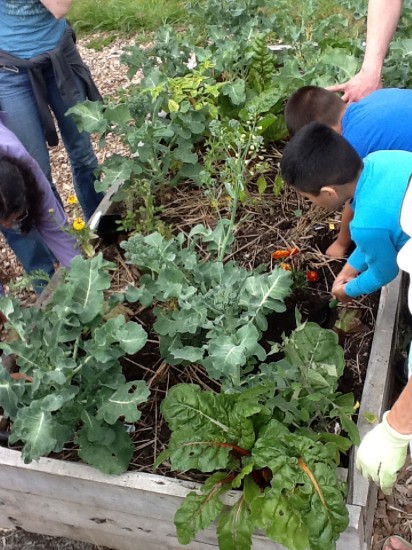
Figure 3: Students and teachers search for critters (aka, decomposers) in the raised garden beds at their school.
This cluster of lessons provides several clear connections to the NGSS, particularly related to “Interdependent Relationships in Ecosystems,” “Cycles of Matter and Energy Transfer in Ecosystems,” and “Biogeology” of Earth’s systems. But equally important, an open-ended question such as “Is the Soil Alive?” helps students and teachers grapple with the nature of science. In this particular example of viewing soil as an ecosystem, students were provided with a concrete example of some relatively abstract, complex ideas. It let them think and learn about systems, interconnections, cycles, and flows, laying a strong foundation for further exploration and learning in upper grades. Students had the opportunity to engage in logical reasoning and discourse, using empirical observations to support their claims. Some of the more complicated explanations of why the mineral portions of soil are non-living while the system as a whole can be considered alive, at the most basic level, were understandable to the elementary-age students. If teachers had given “the right answer” as is traditionally related to properties of living and non-living elements of soil, they would have discouraged students from thinking, imagining, inferring, and looking for evidence. Furthermore, a response that declared soil as not being alive because it is made up of sand, silt, and clay could have denied students a deeper exploration into the microbial ecology of soil and compost.

Figure 4: While observing and recording the decomposers found in the compost bin, a student observed this black soldier fly emerge from its pupa. It is hard to imagine doing a better job of explaining life cycles than an experience such as this can provide
Recommendations/call to action:
School and community learning gardens provide rich, easily-accessible contexts for integrating STEM and sustainability education. Learning experiences that are multisensory, place-based, and interconnected come to life in the garden, making teaching and learning relevant and meaningful to students and teachers alike. The recent adoption of the Next Generation Science Standards, which emphasize application of knowledge, higher-order thinking skills, and demonstration of proficiency through performance, present the educational community with a unique opportunity to make better use of such spaces for teaching and learning. To help move our community closer to this vision, we offer a few suggestions to help in this process:
- Think big, start small—meaningful change takes time. It is important to spend time envisioning and planning in the early stages so that your garden-based aspirations can be turned into reality.
- Whether you are new to outdoor, garden-based education or an experienced practitioner, it is important to set shared expectations and norms with your students. Too many children have not spent a lot of time outside in nature. Furthermore, when they have been outside during school hours, it is often recess, not learning time. It is important to be clear that even though students are outside the classroom, it is still time for learning.
- Related to number two, get outside regularly. As students become more familiar with the garden routines, they will be more comfortable and “on-task.” Consider learning outdoors to be equally essential as learning with technology. Nature time is as important as screen time.
- Share your successes (and challenges)—with colleagues, your principal, parents, and your students.
- Connect with other educators and resources. For instance, the following websites can provide even more links to others interested in learning gardens: Oregon School Garden Summit (http://www.ode.state.or.us/search/page/?id=4202), OSU Extension’s gardening program (http://extension.oregonstate.edu/gardening/), Learning Gardens Laboratory (http://www.pdx.edu/elp/learning-gardens-laboratory) and many other local, regional, and statewide organizations.
- Most of all, have fun! Learning should be a fulfilling lifelong endeavor. That will only happen if it is fun, engaging, and meaningful. Learning gardens are the perfect mileau!
Photo Inspiration:

Figure 5: Learning gardens also provide numerous opportunities for arts integration.
Figure 6: Arts integration and bilingual language development—gardens can provide a cultural entry point for many students from diverse backgrounds.

Figure 7: Collecting daily measurements of temperature and weather conditions helps students develop understandings of hard-to-grasp, abstract concepts. Additionally, they can observe change over time, make predictions, and record and analyze data.

Figure 8: A one-on-one exploration of roots and soil.

Figure 9: Early literacy skills can be developed and enhanced through journaling and data collection. Even the youngest learners can feel successful.
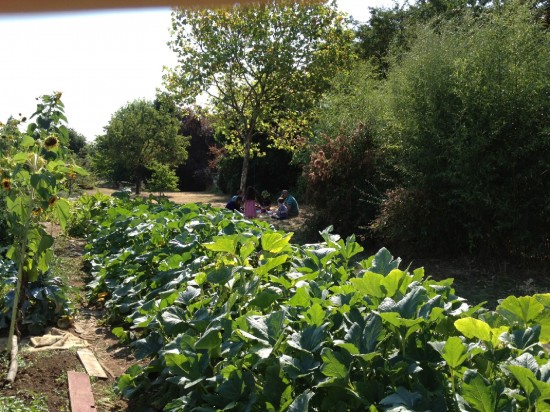
Figure 10: Teacher candidates discuss and reflect on the day’s activities with a small group of students.
References:
Berry, W. (1990). What are People For? Berkeley, CA: Counterpoint.
Blank, R. K. (2013). Science instructional time is declining in elementary schools: What are the implications for student achievement and closing the gap?. Science Education, 97(6), 830-847. DOI:10.1002/sce.21078.
Bybee, R., Taylor, J. A., Gardner, A., Van Scotter, P., Carlson, J., Westbrook, A., Landes, N. (2006). The BSCS 5E instructional model: Origins and effectiveness. Colorado Springs, CO: BSCS.
Louv, R. (2005). Last child in the woods: Saving our children from nature-deficit disorder. North Carolina: Algonquin Book of Chapel Hill.
National Research Council [NRC]. (2012). A framework for K–12 science education: Practices, crosscutting concepts, and core ideas. Washington, DC: National Academies Press.
NGSS Lead States. (2013). Next generation science standards: For states, by states. Washington, DC: The National Academies Press.
Orr, D. W. (1992). Ecological literacy: Education and the transition to a postmodern world. Albany: State University of New York Press.
Sobel, D. (2004). Place-based education: Connecting classrooms & communities. Great Barrington, MA: The Orion Society.
Williams, D. R. & Brown, J. D. (2012). Learning gardens and sustainability education: Bringing life to schools and schools to life. New York, NY: Routledge.
About the authors:
 Sybil S. Kelley, PhD,is Assistant Professor of Science Education and Sustainable Systems at Portland State University in the Leadership for Sustainability Education program. In addition, she teaches the Elementary Science Methods courses in the Graduate Teacher Education Program. Sybil has spent nearly 15 years working in formal and informal educational contexts. Her programming and research focuses on connecting K-12 students and educators in underserved schools and neighborhoods to authentic, project-based learning experiences that contribute to community problem solving. Taking a collaborative approach, Sybil supports teachers and community-based educators in aligning out-of-school learning experiences with state and local academic requirements. Her research focuses on investigating the impacts of these experiences on student engagement, thinking, and learning; and teacher self-efficacy, pedagogical content knowledge, and instructional practices. Prior to her work in education, Sybil worked as an environmental scientist and aquatic toxicologist. Correspondence can be sent to sybilkel@pdx.edu.
 Dilafruz R. Williams is Professor, Leadership for Sustainability Education program, in the Department of Educational Leadership and Policy at Portland State University in Portland, Oregon. She is co-author of Learning Gardens and Sustainability Education: Bringing Life to Schools and Schools to Life (Routledge, 2012), and has published extensively on garden-based learning, service-learning, urban education, and ecological issues. She was elected to the Portland Public Schools Board, 2003-2011. She is co-founder of Learning Gardens Laboratory and Sunnyside Environmental School in Portland. Additional information about her can be obtained at www.dilafruzwilliams.com