It’s hard to imagine a more attention-getting activity for students of all ages than the Soil Your Undies Challenge. The name alone evokes questions, and the process is a memorable way for students to understand the multiple factors impacting soil health, as 21 K-12 educators learned at an Engaging Communities in Agriculture Education workshop in September.
A team from Natural Resources Conservation Service (NRCS) demonstrated the activity, which involves burying new, cotton-based underwear at different sites with varying ecosystem soil conditions. When the underwear is dug up after 60 days, increased microbial activity, an indicator of healthy soil, can be observed. Underwear buried in healthy soil had hardly a shred of material left other than the synthetic elastic waistband.
“This was a fantastic opportunity to see different ways to incorporate agriculture education into different classroom settings,” one educator shared. “[The workshop] provided great networking and resource opportunities.”
The one-day, in-person workshop provided training and resources for educators to integrate agriculture education and career-connected learning into their practice, connect with local community partners and learn about opportunities for students to participate in field-based agricultural learning experiences.
“This was a fantastic opportunity to see different ways to incorporate agriculture education into different classroom settings. “[The workshop] provided great networking and resource opportunities.”
— Workshop Participant
Teachers from twelve school districts were represented between Ferry, Stevens, Pend Oreille, and Spokane Counties. The spread across the grade levels was evenly distributed. Pacific Education Institute’s (PEI) Amy Dawley and Michelle Townshend teamed up with staff from Pend Oreille Conservation District, Stevens Conservation District, and NRCS to co-facilitate the workshop. The workshop was funded by a NRCS grant.
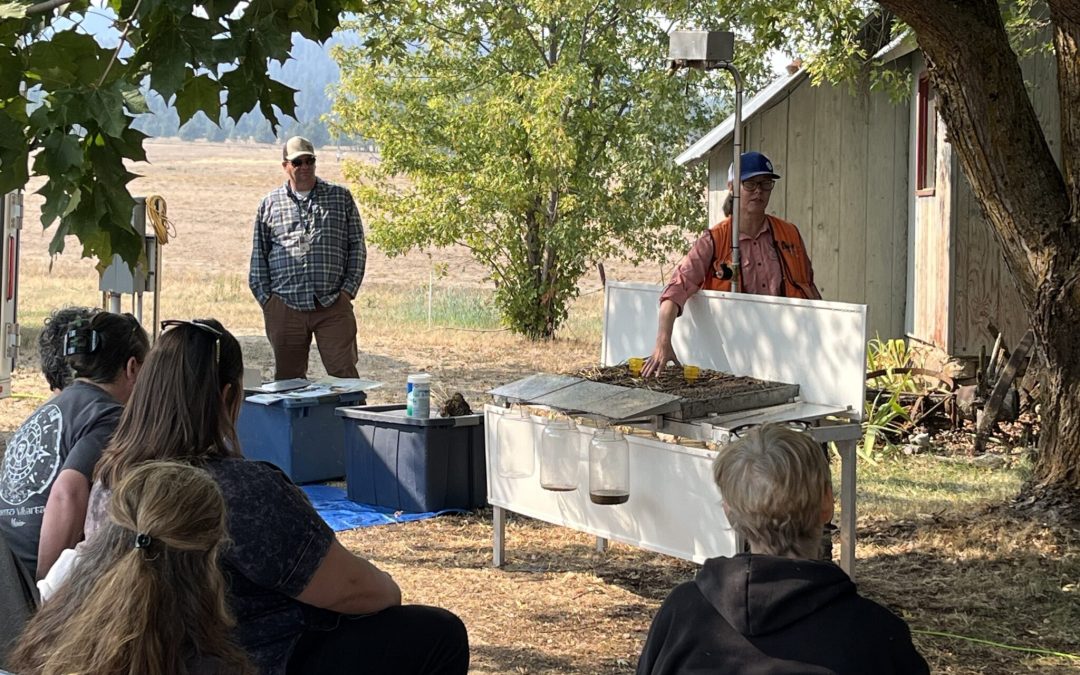
Other highlights included another NRCS demonstration, this time of how no-till, low-till and tilled soil interact with water through a slake test. “The Soil Health Trailer was a big hit,” says Dawley. “It provided a clear visual observation of how intact microbial and fungal soil components, plus living plant roots, create stable soil that does not easily break apart and erode within water. They also demonstrated wind erosion across the surface of a miniature farm setting using a modified leaf blower with variable mph speeds. Again, the importance of wind breaks and established vegetation in preventing soil loss to wind was clearly observable.”
Indigenous Eats from Spokane delivered a catered hot lunch for everyone. “The food was delicious and generous, and it was so appreciated given that the workshop site was quite remote,” says Dawley.
Participants learned about the many factors impacting soil health along with strategies for integrating agriculture and career connected learning into curriculum.
After lunch, the group split into grade-band groups. Grades K-5 educators created soil shakes to determine the soil texture (ratio of sand: silt: clay) and also took home a mini-composting unit. “There is nothing like following a hands-on recipe to put components of a healthy compost system to memory!” Dawley notes.
Grades 6-12 educators went on an Ecosystem Hunt to discover how living (biotic) and non-living (abiotic) components, along with processes (indicating interaction between the components), define the way we depend on ecosystems for our food. They accompanied Stevens County and Pend Oreille Conservation District staff in the afternoon to explore how and why soil samples are collected for lab analysis in agriculture. In addition, they observed water infiltrating soil using infiltration rings as a correlative investigation of soil conditions at Vetter Farm.
Teachers left the event feeling empowered to integrate the resources and activities into their curriculum. “I am confident to take the kids out, but I feel like finishing curriculum always ‘gets in the way’,” one shared. “Now I can make more time for these important field experiences as part of their learning.”
Building a Community: The Value of a Diack Teacher Workshop
Teachers are being asked to do more than ever before. We are inundated with meetings, grading, analyzing data and curriculum development. The idea of taking kids outside to do field-based research can be daunting and filled with bureaucratic hurdles. Given all this, why should we take our precious time to implement this new type of learning?
by Tina Allahverdian
It is a warm summer day at Silver Falls State Park and a group of teachers are conducting a macroinvertebrate study on the abundance and richness of species around the swimming hole. The air is filled with sounds of laughter from children playing, parents conversing on the bank, and the gentle babble of the stream below the dam. The teachers, armed with Dnets, clipboards, and other sampling equipment, move purposefully through the water collecting aquatic species. Being a leader at this unique workshop, I am there to support the teacher’s inquiry project and also help brainstorm ways to bring this type of work back to their classrooms.
The buckets on the bank soon host a variety of species like water beetles, caddisflies, and stonefly nymphs, offering a snapshot of the rich biodiversity in the stream. We teachers sit on the bank, peering into the tubs, magnifying lenses and field guides in hand. We fill out data collection forms and discuss our findings. On this particular summer day, several young children at the park gather to see what we are doing. Their curiosity is piqued by the idea of discovering the hidden inhabitants of the aquatic ecosystem they are swimming in. The teachers and I patiently explain the project to the children and their parents. While some of the crowd goes back to swimming, two little girls stay for over an hour to help identify species. Later, while we pack up a mother stops to thank us for including her daughter in the scientific process. She shares that discovering the magic of the stream with us is her daughter’s idea of a perfect day. This moment is a testament to the power of experiential learning and the unexpected magic that can happen when we take learning into the field.
After the field work is completed, we all gather back at the lodge to create posters and present our results to the rest of the workshop participants. Based on individual interests and grade levels, teachers work in small groups to analyze their data and share their conclusions and questions. There are various topics that groups are curious about — from lichen or moss, to bird behavior and effects of a recent fire on the tree species. Teachers take on the work of scientists so they can get a feel for the experience their students will have in the future.
Teachers often want to backwards plan, knowing the end product their students will experience and learn. But this type of scientific inquiry requires us to let go of control so that students can ask authentic, meaningful questions that are not yet answered. Teachers come to learn that teaching the process of science is often more valuable than teaching the content. They are engaging in the work of true scientists and learning how to be curious, lifelong learners along the way. Being a part of inspiring projects and trips such as these is an experience that teachers, students, and even parent volunteers will remember for years to come. As an upper elementary teacher myself, I often hear about the power of our work when families come back to visit and reminisce about their time in my classroom. I know that this work will impact future generations and their enthusiasm for science learning. Not only that, we are teaching students to do, read and understand the work of a scientist so they can make informed choices in their adult lives.
Every time I help lead this workshop, I witness a transformation among the participants over the course of the three days. On the last day we give a feedback form which is always filled with so much enthusiasm for taking the learning back to the classroom and to colleagues; I often hear this is the best professional development they have experienced in a long time because it is so practical and hands-on. One of my favorite parts about the Diack field science workshops is witnessing the teacher’s excitement for learning about nature that I know will be passed on to students back in the classroom. Twice a year we meet at a beautiful location in Oregon where teachers from many different districts have the opportunity to carry out the mini-inquiry project and plan curriculum that promotes student-driven, field based science inquiry for K-12 students.
Perhaps one of the most significant outcomes of the Diack Ecology Workshop is the formation of a community of educators passionate about outdoor learning. Teachers exchange ideas, share success stories, and collaborate on developing resources for implementing field-based inquiry projects. They share ideas across grade levels to get a sense of where their students are going and have come from. This sense of community not only strengthens the impact of the program but also creates a support network for educators venturing into the world of environmental education. I always leave the workshop inspired by the creativity, collaboration, and joy from teachers. It is one of my favorite parts of the summer and I would encourage anyone who works with students to come join us and experience the magic.
Tina Allahverdian is passionate about connecting students with science in the natural world. When not teaching fifth graders, she can be found reading in a hammock, kayaking through Pacific Northwest waters, or hiking in the mountains. She currently teaches in West Linn, Oregon, and resides in SE Portland with her husband, twin boys, and their dog, Nalu.



 Tina Allahverdian is passionate about connecting students with science in the natural world. When not teaching fifth graders, she can be found reading in a hammock, kayaking through Pacific Northwest waters, or hiking in the mountains. She currently teaches in West Linn, Oregon, and resides in SE Portland with her husband, twin boys, and their dog, Nalu.