
by editor | Mar 20, 2019 | Indigenous Peoples & Traditional Ecological Knowledge
Educating as if Survival Matters
Nancy M Trautmann Michael P Gilmore
BioScience, Volume 68, Issue 5, 1 May 2018, Pages 324–326, https://doi.org/10.1093/biosci/biy026
Published:
22 March 2018
 ver the past 40 years, environmental educators throughout the world have been aiming to motivate and empower students to work toward a sustainable future, but we are far from having achieved this goal. Urgency is evident in the warning issued by more than 15,000 scientists from 184 countries: “to prevent widespread misery and catastrophic biodiversity loss, humanity must practice a more environmentally sustainable alternative to business as usual… Soon it will be too late to shift course away from our failing trajectory, and time is running out. We must recognize, in our day-to-day lives and in our governing institutions, that Earth with all its life is our only home” (Ripple et al. 2017).
In this tumultuous era of ecocatastrophes, we need every child to grow up caring deeply about how to live sustainably on our planet. We need some to become leaders and all to become environmentally minded citizens and informed voters. Going beyond buying greener products and aiming for energy efficiency, we must find ways to balance human well-being, economic prosperity, and environmental quality. These three overlapping goals form the “triple bottom line,” aiming to protect the natural environment while ensuring economic vitality and the health of human communities. This is the basis for sustainable development, defined by the United Nations as “development that meets the needs of the present without compromising the ability of future generations to meet their own needs” (WCED 1987). Strong economies of course are vital, but they cannot endure at the expense of vibrant human societies and a healthy environment.
Within the formal K–12 setting, a primary hurdle in teaching for sustainability is the need to meaningfully address environmental issues within the constraints of established courses and curricular mandates. In the United States, for example, the Next Generation Science Standards designate science learning outcomes for grades K–12 (NGSS 2013). These standards misrepresent sustainability challenges by portraying them as affecting all humans equally, overlooking the substantial environmental justice issues evident within the United States and throughout the world. Another oversight is that these standards portray environmental issues as solvable through the application of science and technology, neglecting the potential roles of other sources of knowledge (Feinstein and Kirchgasler 2015).
One might argue that K–12 students are too young to tackle looming environmental issues. However, they are proving up to the challenge, such as through project-based learning in which they explore issues and pose potential solutions. This may involve designing and conducting scientific investigations, with the possibility of participating in citizen science. Case-study research into teen involvement in community-based citizen science both in and out of school settings revealed that the participants developed various degrees of environmental science agency. Reaching beyond understanding of environmental science and inquiry practices, this term’s definition also includes confidence in one’s ability to take positive stewardship actions (Ballard et al. 2017). The study concluded that the development of environmental science agency depended on involving teens in projects that included these three factors: investigating complex social–ecological systems with human dimensions, ensuring rigorous data collection, and disseminating scientific findings to authentic external audiences. Educators interested in undertaking such endeavors can make use of free resources, including an ever-growing compendium of lesson plans for use with citizen-science projects (SciStarter 2018) and a downloadable curriculum that leads students through the processes of designing and conducting their own investigations, especially those inspired by outdoor observations and participation in citizen science (Fee 2015).
We need to provide opportunities for students to investigate environmental issues, collect and analyze data, and understand the role of science in making informed decisions. But sustainability challenges will not be resolved through scientific approaches alone. Students also need opportunities to connect deeply with people from drastically different cultures and think deeply about their own lifestyles, goals, and assumptions. As faculty members of the Educator Academy in the Amazon Rainforest, we have had the privilege of accompanying groups of US teachers through 10-day expeditions in the Peruvian Amazon. Last summer, we asked Sebastián Ríos Ochoa, leader of a small indigenous group living deep in the rainforest, for his view of sustainability. Sebastián responded that he and his community are one with the forest—it is their mother, providing life and wholeness. Reflecting on the changes occurring at an accelerating rate even in remote rainforest communities, Sebastián went on to state that his greatest wish is for his descendants to forever have the opportunity to continue living at one with their natural surroundings (Sebastián Ríos Ochoa, Maijuna Community Leader, Sucusari, Peru, personal communication, 18 July 2017). After decades of struggle during which their rainforest resources were devastated by outside loggers and hunters (Gilmore 2010), this indigenous group has regained control over their ancestral lands and the power to enact community-based conservation practices. Their efforts provide compelling examples of how people (no matter how few in number and how marginalized) can effect positive change.
In collaboration with leaders of Sebastián’s remote Peruvian community and a nongovernmental organization with a long history of working in the area, US educators are creating educational resources designed to instill this same sense of responsibility in children growing up without such direct connections to nature. Rather than developing a sense of entitlement to ecologically unsustainable ways of life, we need children to build close relationships with the natural world, empathy for people with different ways of life, and a sense of responsibility to build a better tomorrow. Although the Amazon rainforest is a common topic in K–12 and undergraduate curricula, typically it is addressed through textbook readings. Instead, we are working to engage students in grappling with complex real-world issues related to resource use, human rights, and conservation needs. This is accomplished through exploration of questions such as the following: (a) How do indigenous cultures view, interact with, and perceive their role in the natural world, and what can we learn from them? (b) How do our lives influence the sustainability of the rainforest and the livelihoods of the people who live there? (c) Why is the Amazon important to us, no matter where we live? (d) How does this relate to the triple-bottom-line goal of balancing social well-being, economic prosperity, and environmental protection?
Investigating the Amazon’s impacts on global weather patterns, water cycling, carbon sequestration, and biodiversity leads students to see that the triple bottom line transcends cultures and speaks to our global need for a sustainable future for humans and the environment throughout the world. Tracing the origin of popular products such as cocoa and palm oil, they investigate ways to participate in conservation initiatives aiming for ecological sustainability both at home and in the Amazon.
Another way to address global issues is to have students calculate the ecological footprint attributable to their lifestyles, leading into consideration of humankind vastly overshooting Earth’s ability to regenerate the resources and services on which our lives depend. In 2017, August 2 was determined to be the date on which humanity had overshot Earth’s regenerative capacity for the year because of unsustainable levels of fishing, deforestation, and carbon dioxide emissions (Earth Overshoot Day 2017). The fact that this occurs earlier each year is a stark reminder of our ever-diminishing ability to sustain current lifestyles. And as is continually illustrated in news of climate disasters, human societies with small ecological footprints can be tragically vulnerable to such calamities (e.g., Kristof 2018).
Engaged in such activities, students in affluent settings may end up deriving solutions that shake the very tenet of the neoliberal capitalistic societies in which they live. To what extent should students be encouraged to challenge the injustices and entitlements on which world economies currently are based, such as by seeking ways to transform the incentive structures under which business and government decisions currently are made? Should they be asked to envision ways of overturning the unsustainable ways in which modern societies deplete resources, emit carbon dioxide, and destroy the habitats needed to support diverse forms of life on Earth?
Anyone who gives serious consideration to the environmental degradation and social-injustice issues in today’s world faces the risk of sinking into depression at the thought of a hopeless future. What can we possibly accomplish that will not simply be too little, too late? Reflecting on this inherent tension, Jon Foley (2016) stated, “If you’re awake and alive in the twenty-first century, with even an ounce of empathy, your heart and mind are going to be torn asunder. I’m sorry about that, but it’s unavoidable — unless you simply shut down and turn your back on the world. For me, the only solution is found in the space between awe and anguish, and between joy and despair. There, in the tension between two worlds, lies the place we just might find ourselves and our life’s work.”
Education for sustainability must build on this creative tension, capturing students’ attention while inspiring them to become forces for positive change.
Acknowledgments
Collaboration with the Maijuna is made possible through work of the OnePlanet nonprofit organization (https://www.oneplanet-ngo.org) and Amazon Rainforest Workshops (http://amazonworkshops.com).
Funding statement
Nancy Trautmann was supported through a fellowship with the Rachel Carson Center for Environment and Society in Munich, Germany, to develop curricular resources that highlight the Maijuna to inspire U.S. youth to care about conservation issues at home and abroad.
References cited
Ballard HL, Dixon CGH, Harris EM. 2017.
Youth-focused citizen science: Examining the role of environmental science learning and agency for conservation. Biological Conservation 208: 65–75.
Earth Overshoot Day. 2017. Earth Overshoot Day 2017 fell on August 2. Earth Overshoot Day. (1 December 2017; www.overshootday.org)
FeeJM. 2015. BirdSleuth: Investigating Evidence. Cornell Lab of Ornithology . (15 January 2018; http://www.birdsleuth.org/investigation/)
FeinsteinNW, KirchgaslerKL. 2015.
Sustainability in science education? How the Next Generation Science Standards approach sustainability, and why it matters. Science Education 99: 121–144.
Foley J.2016. The space between two worlds. Macroscope . (28 October 2016; https://themacroscope.org/the-space-between-two-worlds-bc75ecc8af57)
Gilmore MP. 2010. The Maijuna: Past, present, and future . 226–233 in Gilmore MP, Vriesendorp C,Alverson WS, del CampoÁ, von MayR, WongCL, OchoaSR, eds. Perú: Maijuna. The Field Museum.
KristofN.2018. Swallowed by the sea. New York Times. (23 January 2018 ; www.nytimes.com/2018/01/19/opinion/sunday/climate-change-bangladesh.html)
[NGSS] Next Generation Science Standards. 2013. Next Generation Science Standards: For States, By States. NGSS. (10 October 2017; www.nextgenscience.org)
Ripple WJ et al. 2017. World scientists’ warning to humanity: A second notice. BioScience
67: 1026–1028.
SciStarter. 2018. SciStarter for Educators. SciStarter . (12 February 2018; https://scistarter.com/educators)
[WCED] World Commission on Environment and Development. 1987. Our Common Future . Oxford University Press.
© The Author(s) 2018. Published by Oxford University Press on behalf of the American Institute of Biological Sciences.
This is an Open Access article distributed under the terms of the Creative Commons Attribution Non-Commercial License (http://creativecommons.org/licenses/by-nc/4.0/), which permits non-commercial re-use, distribution, and reproduction in any medium, provided the original work is properly cited. For commercial re-use, please contact journals.permissions@oup.com
by editor | Mar 20, 2019 | Climate Change & Energy
A Chance to Make a Difference: Tackling Climate Change in a Middle School Classroom
by Angela Duke
Northwest Expedition Academy
Hayden, Idaho
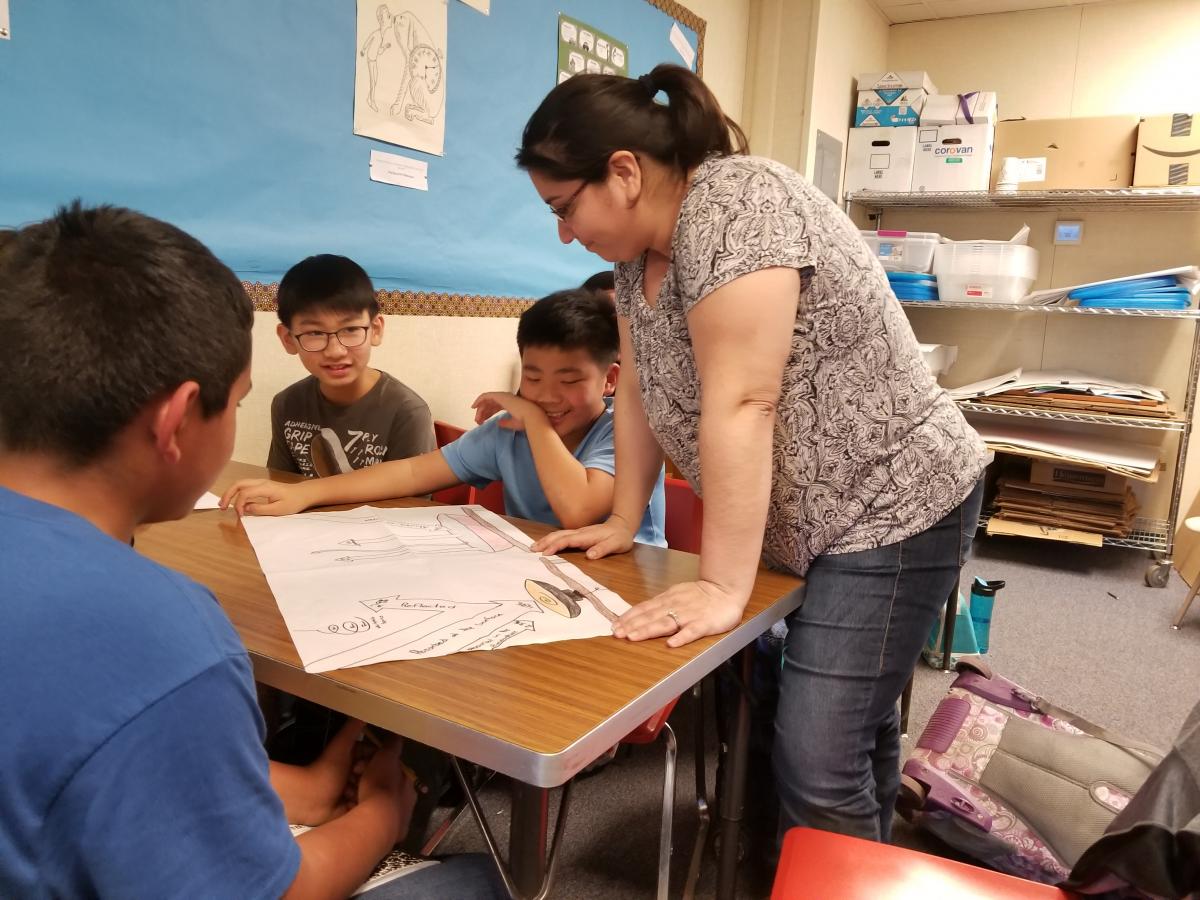
 n the days of selfies and social media mania, it is often a difficult job getting middle schoolers to look up instead of down. When I first introduced the topic of climate change to my students, the reactions were mixed. But most importantly, several heads looked up.
Climate change in the classroom has gained great momentum and for good reason. What more real of a problem than the state of our planet? And what better a subject to let our young people tackle? The environment of the future will be theirs to live in after all. How powerful is it to empower students to solve problems that may have always seemed out of reach or “too big?” Facilitating science-based research on real world problems empowers students not only through the skills they acquire from this type of work but from the subject knowledge gained. Climate change curriculum in the classroom also allows students to see how much of a difference they can make not only on their school campus but in their larger community as well. That makes the work important. Investigating climate change, understanding human activities that contribute to climate change and formulating strategies to slow climate change down also cultivates environmental-literacy.
 At first, I was intimidated. Climate change is such a huge topic with so many different avenues and tangents to get lost in. Then I happened upon Green Ninja – the climate-action superhero. This discovery immediately took me back to my own childhood, watching episodes of Captain Planet, an environmental superhero in his own time. I was instantly intrigued. Green Ninja (www.greenninja.org) is a middle school curriculum that focuses on helping students design a more sustainable world. Each grade level (grade six through eight) consists of six units. Each unit is centered around a series of phenomena and central storyline that seamlessly blends topics together in ways that make sense. The units use elements of project-based learning to bring the content to students in engaging and entertaining ways. For example, embedded in the curriculum is access to animation and live-action videos that introduce and reinforce topics of study. My students also enjoyed playing the environmentally-themed video game which is used to hook students and get them to interact with a serious topic, the effects of human-released carbon ithen our atmosphere, in a low-stress setting. And all the while they are learning. Everybody loves a hero, as the saying goes, and Green Ninja is no exception. Green Ninja gives students access to points of change in a way that is not overwhelming. His appearance is familiar and friendly, which allows students to focus on what is being said and the main lesson to be learned from each video.
When it came to prior knowledge, my students all knew the “what” of climate change: what to do, what not to do, what was better and what was worse. The three “Rs” of “reduce, reuse, and recycle” came up a lot. What stopped them in their tracks is when I asked, “Why should we take action? Why should we reduce, recycle, and reuse? Why do people think solar is better? Why do people think it’s better to buy a hybrid or full electric vehicle?” There were lots of shoulder shrugs. Then came the answer I’m sure we’ve all heard, “because they said it was better.” The all-encompassing “they.” “They” are usually the source of most misconceptions. The majority of my students’ misconceptions revolved around the difference between weather and climate. I knew there was a whole unit in Green Ninja on that topic so when we got there, we dug in. I made sure students had time to access prior knowledge and allowed them time to journal I before each subtopic. I also frequently built in time for them to look back through and reflect on any changes in their thinking that happened. I wanted their understanding and interpretation to be natural and their own discovery.
If I had to choose one series of lessons that I believe made the strongest impact on my students, it would have to be those surrounding our carbon footprint. There are several websites, such as Green Ninja, that give free access to videos that can be used as a starting point to a unit or subtopic. In one instance, I used the Green Ninja video entitled, “Footprint Renovation.” You can see it here: greenninja.org/Green_Ninja_Show/31. In this video, an average homeowner awakens to find that his feet are swelling in size. The viewer is shown several areas in the house that could use some eco-friendly renovation. For example, the window is open and the heat is on. All of the homeowner’s electronics have been left on. There is no recycling or compost bin and the garbage is overflowing. Our superhero, Green Ninja, arrives to save the day (well, in this case, the night) and there is a direct visual correlation between the renovations being made and the decrease of swelling in the homeowner’s feet. I used this as an entry event to a new unit and followed the video with partner talk around a simple open-ended question, “What was that all about?” I remember the room bursting into conversation. Each table of students talking about what they saw, what they liked and what it could possibly mean. I had them hooked.
 Later on, in that same unit, my students collected energy-use data from their own homes over one four-week period. Then they designed an energy reduction plan for their household. After they worked with their family to implement the plan, they collected data again over another four-week collection period to measure their reduction in energy use. But I didn’t want to stop there. I wanted my students to continue climbing the environmental literacy ladder and move from awareness to knowledge to attitude to skills to collective action. I combined portions from a few different lessons from the TeachEngineering website (https://www.teachengineering.org/) to put together a research assignment where students collaboratively collected current data on factors that influence our carbon footprint, such as transportation choices, appliance choices, and food choices. I wanted to grow students’ environmental literacy and know it starts on an individual level, so I asked each student to decide on a factor that was of the most interest to them. Students were then given time to research this factor and gather as much data as they could. While they conducted their research, I used this time as a benchmark of learning and formative assessment and checked in with them, “Can you explain why you chose the factor you did? Do you understand the assignment? Do you know where to search for the data you need?”
Once our research block was over, I asked them to put themselves together into groups of four with those with the same factor. Another component of environmental literacy is to make educated decisions as a group. So here, students worked collaboratively to synthesize their individual research into one combined and complete presentation. This presentation was their first graded assessment.
 I could have stopped there. But another important component of environmental literacy is to share knowledge with others. To satisfy this, each group was asked to present their new knowledge and findings to two different audiences. Their first audience were third graders who were also learning about making good environmental choices. I used these presentations as a benchmark, and formative assessment, of their learning. Groups had to know their content well since, because of the audience’s age, my students could not just read lines of data or pages of facts. Some groups made posters and others brought in props. Still other groups wrote fictional stories with the new information embedded.
The students’ second audience was adults. Their presentation to adults had to not only contain research data and facts but also real, logical, feasible solutions to lowering carbon footprints. They were given choice as to how they would present; posters, Google slideshows, speeches with artifacts or even Powtoons (a platform to make your own digital video or presentation). This presentation was their second and final graded assessment. To ensure students knew what to expect and what they’d be graded on, I borrowed from rubrics from Buck Institute for Education (bie.org). They specialize in project-based learning. The rubrics can be daunting if you’ve never used them before but it’s easy enough to adapt them to your students and your projects.
Tackling climate change in the classroom was new to me. It was not easy. But one of my biggest tips to other educators is to remember it’s okay to try something new and not know it one hundred percent. Just as we give our students time to improve on their skills, we also need to give ourselves time to improve our skills. Sometimes that means jumping in with both feet and taking on problems as they come. Not everything is going to go right, but that’s O.K. What a learning experience it will be!
At the end of the year, we reflected on what we had accomplished. I had my students reflect individually in their science notebooks about their contributions to the project and how they felt it went overall. With their project groups, they reflected on their performance as a team, how it went and improvements they would make next time. Finally, as a whole class, we debriefed the entire experience and what was enjoyable and what was not.
Did I feel my students had an engaging experience? Absolutely! Heck, I had an engaging experience! Did my students feel they had an engaging experience? Definitely. In the end, out of the ninety students I taught that year, about twenty students demonstrated they were committed to continuing to take action to lower their carbon footprints. And while I would be lying if I didn’t say I hoped to get through to many more, I remembered to practice what I preach and take the advice I often give students, “If we each do something small, together we can do something big.” So this year it was twenty students, but next time around it might be thirty. Knowledge is contagious. Even a small number of students changing their actions and leading by example still equals a big win for the planet!
Resources (alphabetized) mentioned in the article:
Buck Institute for Education (www.bie.org): A nonprofit and leader in project-based learning. Several free resources that include collaborative work rubrics and project-planning tools can be found on their website. They also offer professional development for teachers.
Cool Climate Network, U.C. Berkeley (coolclimate.berkeley.edu/calculator): There is a carbon footprint calculator here. You can also google carbon footprint calculator and find several options. Some are more student-friendly than others.
Green Ninja (www.greenninja.org): NGSS middle school science provider and creator of many great, free videos. With Green Ninja, each unit of instruction includes phenomena, hands-on activities and projects that allow students to use science and engineering to create their own environmental solutions.
PowToon (www.powtoon.com): A digital animated presentation tool that can be used by students to create Public Service Announcements, 100-word presentations, animated cartoons and educational presentations. Great for teachers to use to flip instruction too.
National Environmental Education Foundation (NEEF): References to environmental literacy based on NEEF’s “Environmental Literacy Report 2015”: www.neefusa.org/resource/environmental-literacy-report-2015
Teaching Engineering (www.teachingengineering.org): Great collections of supplementary lessons focused on how to use engineering in the classroom.
A bout the author: Angela Duke is a fifth-grade teacher at Northwest Expedition Academy in Hayden, Idaho. She previously taught sixth grade Language Arts and Science for seven years in San Jose, California. She enjoys participating in as many outdoor activities as she can with her husband and three children. She is passionate about project-based learning and strives to give her students as many hands-on experiences as possible. Her goal every year is to develop her class’ growth mindset and take the away stigma of science being “too hard”. She enjoys developing new fun and engaging curriculum and sharing her experiences with others.
 More about Green Ninja: The goal of Green Ninja is to create environmental solutions through education. The project grew out of an NSF grant funding academic research at San Jose State University that identified key elements to support student engagement and success in science.
Green Ninja is now using this knowledge to create materials that help schools improve how they teach science, while also inspiring student agency around environmental topics. Their middle school curriculum is aligned with the Next Generation Science Standards and builds on Green Ninja videos to help inspire student engagement and success. If you are interested in learning more, go to www.greenninja.org or email info@greenninja.org.
by editor | Feb 19, 2019 | IslandWood, Learning Theory
Immersive Storytelling: A Reminder to Read to Your Students Outside
By Hannah Levy
Sitting amongst towering cedars as the sun treated us to the last bits of golden hour, our final field study day was coming to a close. We had a hard week, for many of my students, this was their first encounter with nature and first time away from home. The group had been struggling to work cohesively and accessing their focused attention had proved incredibly difficult. I wanted so dearly for my students to experience a moment of wonder. To capture a sense of magic and connection to our surroundings, if only fleeting. I had planned to read them a book in a nearby treehouse, but looking around realized I had no better classroom at that moment than the forest floor on which we sat.
“This is the ancient forest. This is the three-hundred-year-old tree, that grows in the ancient forest…” I read softly. Immediately, one of the students looking back and forth from the picture in the book to the tree before them blurts out, “Is that the 300-year-old-tree?” As we make our way through the story, we continue making connections. One student sees the gnarled roots jutting out before them, and asks “Are these roots?” Another recognizes the red cap of the Pileated Woodpecker that graces the page, “That’s the woodpecker I saw!” A Barred Owl winds its way into the story, just like the one we saw together on our first day in the field. A resounding “whoaaa” and “there’s our owl” makes its rounds. And finally, the most captivated question of all as we end the story,“…is this the ancient forest?”
As an emerging educator, moments like these still feel like unprecedented breakthroughs. I said goodbye to my students that day and reflected on the simple and poignant impact of our storytelling session. All this time, I had been pouring over how to craft lesson plans that inspired authentic connection and here, right under my nose, was one of the simplest and most powerful tools of all: immersive storytelling. In just a few short minutes of read aloud time we had accessed our collective curiosity, practiced information recall, and made connections about an ecological system. In outdoor education, where students are often thrust into an entirely new context, the familiar structure of classroom storytelling time had proved incredibly effective.
Today, a Google search for “immersive storytelling” will return results about the latest VR headset or educational video game. While these resources provide essential access for many students, it is critical we not forget the power of a nearby park, backyard, front porch, or garden bed. In my own lesson planning, I consider immersive stories to be books that reflect the setting, observations, and lived experiences of my students. There is nothing quite like the feeling of being absorbed by a book, as if the world around you has melted away and only you and its characters exist in that moment. This is the intention of incorporating immersive stories into outdoor education, to rouse a sensitive connection to our place, our learning, and our peers.
Here are eight easy strategies to craft an immersive storytelling experience with your own students in an outdoor setting (many of these tips can easily be adapted for classroom learning):
- Story selection
Select your stories based on real-life encounters, using primacy of experience to your advantage. Earlier in the week, I had planned to read students a story written from the perspective of a tree. However, after seeing the owl, I decided to select a book that I knew would offer connections to our week. Consider keeping a list of “immersive friendly” stories that reflect the settings in which you teach and the experiences your students may have at your outdoor education program.
- Preview the book
Preview the book on your own ahead of time by reading aloud to yourself. This will help you deliver the story more confidently later on and better enable you to use your voice to cue student attention if you know which plot elements are coming. Previewing also ensures the plotline does not contain any content that might be triggering to students with known trauma.
- Scaffold student observations
Build up the magic by weaving time for students to notice their surroundings throughout the day, share their wonders, and make claims. Prompt students with questions that you know are later answered in the story. When I plan to read students The Ancient Forest I subtly introduce observations of tree snags with holes from the Pileated Woodpecker, visit with a taxidermy Barred Owl (if we don’t encounter one in real life), and invite students to search for macroinvertebrates in the soil. All of these elements later appear in the story and by scaffolding our week with interactions with real elements from the story I intentionally build a more immersive experience for all students.
- Location, location, location
Scope out your location. Meet the needs of your group by scouting a few locations ahead of time. Is the space accessible to all students? Do you need to make any accommodations to ensure everyone is able to engage? If feasible, always allow for free explore time at your location as a strategy to both incite curiosity and ease any fears or unfamiliarities your students may have with the space.
- Meeting student needs
Think about context, how have you built up the moment? Are students aware that they will be having quiet listening time? Have they had time to advocate or and meet any needs they might have? If snack, water, or bathroom breaks are even remotely on the horizon consider taking them before you begin in order to mitigate distractions and discomfort. Immersive storying telling is highly dependent on everyone being included and feeling engaged. Design your session to meet any needed accommodations for english language learners or students with accessibility needs.
- Use grounding techniques as you begin
Grounding activities prompt reorientation to a present moment, often using sensory awareness strategies to cope with overwhelming feelings, anxiety, or, in the case with many outdoor education students, nervousness in a new place with different educators. Awareness of our sensory experiences are also an avenue for deeper connections with our surrounding environment. There are a few easy grounding prompts as you can use as you prepare to read: practicing mindful breath, feeling the temperature and breeze on our face, running dirt through our fingers, or listening and counting the number of sounds. Allow ample time for students to downcycle and re-regulate their focus. Adapt your grounding prompts to fit the sensory abilities of your students.
- Pacing is your friend
While the number of seconds that pass may be just the same, novel experiences seemingly expand our perception of time. Use this to your advantage with students. If possible, pick a book they have not yet encountered. Go slow, do not rush as you read. Set a pace that allows for students to engage in their observational skills as they listen. Model a sensory moment for them, for example, with my students we looked up into the trees, put our ears to the ground to listen for bugs, and felt the roots that surrounded our feet.
- Welcome questions and collaboration
Welcome questions from your students. Part of the immersive storytelling experience is to allow students to make. Field questions as you read without delving too deep into tangents. Use the characters and plotline of the story as opportunity for students to make science and real-life connections. If your group is comfortable reading aloud, consider using a pass and read style of read aloud to engage students further.
References:
Booth Church, Ellen. “Teaching Techniques: Reading Aloud Artfully!” Scholastic Teachers, Scholastic, 2018, www.scholastic.com/teachers/articles/teaching-content/teaching-techniques-reading-aloud-artfully/.
“Grounding Techniques.” Prince Edward Island Rape and Sexual Assault Center, PEIRSAC, 2018, www.peirsac.org/peirsacui/er/educational_resources10.pdf.
Lindamood, Wesley. “Take Our Playbook: NPR’s Guide to Building Immersive Storytelling Projects.” NPR Training, National Public Radio, 25 June 2018, training.npr.org/digital/take-our-playbook-nprs-guide-to-building-immersive-storytelling-projects/.
Paul, Pamela, and Maria Russo. “How to Raise a Reader.” The New York Times Books, The NY Times, www.nytimes.com/guides/books/how-to-raise-a-reader.
Reed-Jones, Carol. The Tree in the Ancient Forest. DAWN Publications, 1995.
What Is Sensory Awareness. Sensory Awareness Foundation, 2018, sensoryawareness.org/about/.
###
Hannah Levy is a graduate student at the University of Washington, completing her Certificate in Education for Environment and Community at Islandwood.
by editor | Feb 7, 2019 | Climate Change & Energy, Schoolyard Classroom
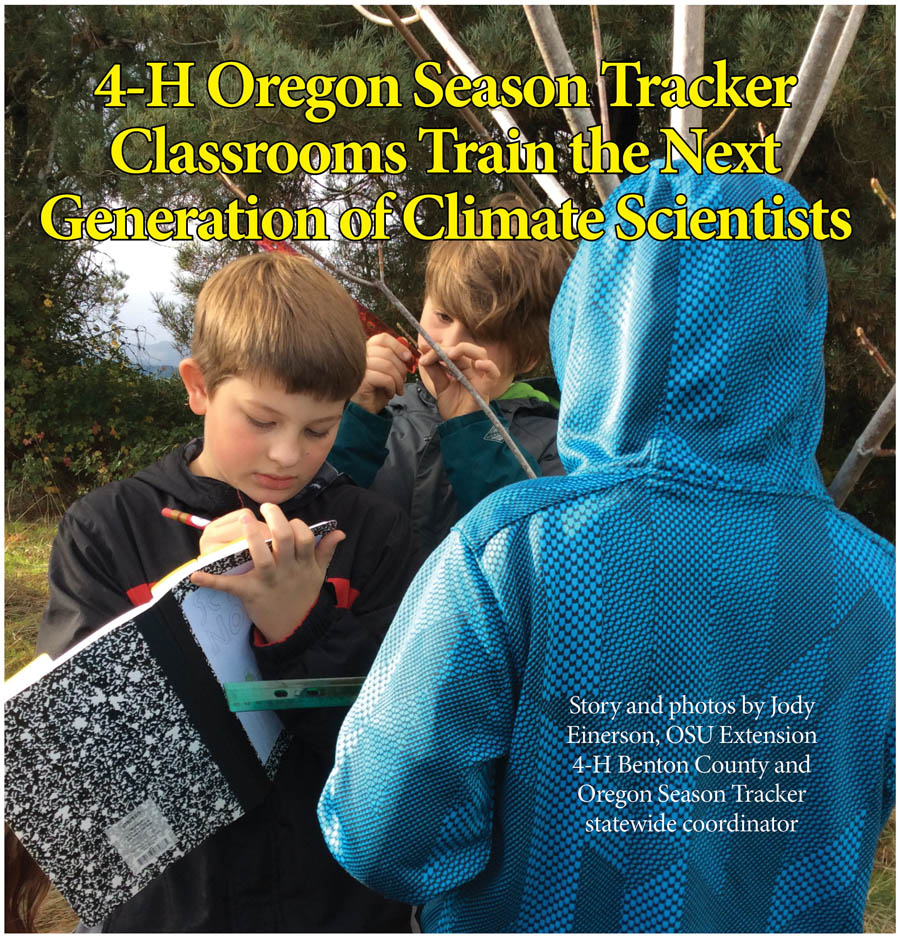
On a sunny fall day in Oregon students are outdoors learning about the new citizen science observation site in their schoolyard. With a mix of 4th and 5th grade exuberance and the seriousness of adults they are taking on the mission of gathering basic data for a section of their school yard scientific study and research area. These students are part of the Oregon Season Tracker 4-H classroom program that is regularly getting them outdoors for real world science. As the teacher explains, this is the first of many data gathering sessions as part of their yearlong commitment to the program. This real world data will support researchers to gain a better understanding of climate change across Oregon.
 regon Season Tracker (OST) 4-H classrooms are a companion to the Oregon State University Extension Oregon Season Tracker adult citizen science program http://oregonseasontracker.forestry.oregonstate.edu/ . In the adult program, volunteers are gathering and reporting their observations of precipitation and plant seasonal changes in a statewide effort. Started in 2013 and targeting adults, it quickly became evident to everyone involved that the program had clear applications to outdoor hands-on “experiential” science learning for students.
The foundation of the OST program is based on a partnership between OSU Extension and HJ Andrews Experimental Forest located in Blue River, near the midpoint of the Cascade Mountain range https://andrewsforest.oregonstate.edu/ . The Andrews is a leading center for long term research, and a member of the National Science Foundation’s Long-Term Ecological Research (LTER) Program. The 16,000 acre research forest in the McKenzie river watershed in the Cascade Mountains was established in 1948, with paired watershed studies and several long-term monitoring programs initiated soon after. Today, it is jointly managed by the US Forest Service and OSU for research into forest and stream ecosystems, and the interactions among ecological dynamics, physical processes, and forest governance.
Part of the success of the Oregon Season Tracker program is that we have also collaborated with national programs, Community Collaborative Rain Hail and Snow Network (CoCoRaHS) https://www.cocorahs.org/ and National Phenology Network (NPN) Nature’s Notebook https://www.usanpn.org/natures_notebook, as well as our local partner. A key role of our national partners is their ability to collect, manage and store the data, making it available both to professional and citizen scientists. This national connection makes sure the data is available long-term and easily accessible locally as well as nationally and beyond. Both of our national partners have easy to use web based visualization tools that allow volunteers and students to easily look at and interpret data. In the classroom this means not only are students helping ongoing professional research, they can also investigate or research their own science questions using the data of others. Partnering with these national database sites also allows OST to stretch our resources further, spending our time and energy supporting the volunteers and classrooms in our program.

Zero is important data when reading the rain gauge!
Back at the school, it is 8:30 am and a student team is checking and recording the level of precipitation for the last 24 hours. The rain gauge station is set up outside the school entrance and is clearly marked with a sign explaining what the students are doing. Parents and visitors can clearly see they are part of the Oregon Season Tracker 4-H program collecting precipitation and plant phenology data as citizen scientists. The sign calls attention to their efforts and gives the students a sense of pride in what they are doing.
Students use a program approved manual rain gauge that is standardized nationally. They become comfortable reading the gauge marked out in hundreds of an inch and how to conform to set data protocols. They learn not to round measurements for accuracy, to read using the bottom of the meniscus, and how to deal with an overflow event. All skills that have math applications for what they are doing. Depending on the grade of the students these skills are new or a refresher of what they already know, but important none the less.
Students learned the rain gauge skills at the beginning of the year in outdoor relay races using Super Soakers to simulate rainfall in their gauge. Teams vie to see who can get the most “rainfall” into their gauge. The casual observer might mistake this activity for recess, but they are having fun learning the needed math skills. By learning to read the manual gauge to .01 of an inch they are following the protocols set out by our national partner CoCoRaHS.
The daily precipitation observations are establishing a piece of the scientific process. As part of the team approach, the observations readings are verified before dumping out the day’s accumulation. Students begin to get a feel for what an inch of precipitation looks like, both as it falls from the sky and what it looks like in the gauge. The data collected is then passed on to another student team that hovers over the classroom computer, entering it in the national CoCoRaHS website. Data entered by 9:00 am is shared on an interactive map, for any visitor to the website to view.
The data submitted to the CoCoRaHS website is accessed and used by meteorologists, hydrologists, water managers, and researchers. It is also captured daily by the PRISM Climate Group, one of our local OSU partners. PRISM gathers climate observations from a wide range of monitoring networks (including CoCoRaHS), to develop short and long term weather models that are in turn used by still more groups and agencies reporting on and studying weather and climate. This is an important thing for all our adult and student observers to realize: their data is real, it is important, and it gets used.
So for those students that are worried that their data will just get lost in the mountains of reports submitted every day, I’d like to share this experience. This past year, I worked with a teacher that received an urgent email from the National Weather Service within a short time after the Monday morning rainfall report was entered in the database. The Weather Service continuously monitors for extreme weather, and were checking on the accuracy of the morning report of over 2 inches of rain. Quick sleuthing found the students had made an error in submitting their data. Instead of making a multiday report for the weekend they had made a single day report. This was an eye opening experience for the students, not only to realize their data is being used but also that scientists are depending on them to be accurate.
Monitoring a rain gauge is an easy lesson to expand or extend into other topics. Students can be challenged to look for weather patterns by comparing their own station with others across your county, state, and even the nation. Alternatively, by graphing daily data or comparing the rainfall data against topographic maps. These types of observations can challenge students to see patterns and make connections. This leads to investigating essential questions such as: how do these weather and climate patterns play out across the state and how does this effect what and who lives in these locations?
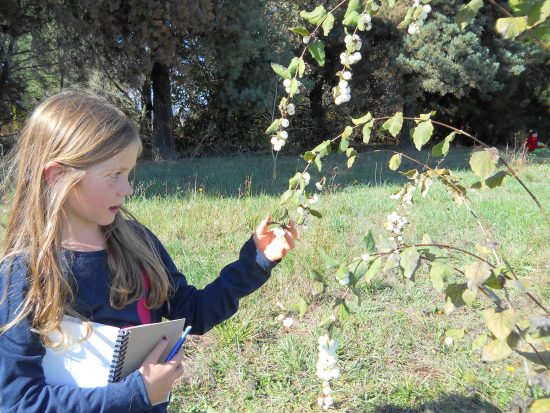
Observing fruiting on a common snowberry shrub.
OST students are also tracking plant phenology or growth phases over the year. They will be reporting on leaf out, flowering, fruiting, and leaf drop. By pairing these plant change observations with the precipitation readings, researchers have a powerful tool in the study of climate and the role it plays in plant responses. The OST program has identified eight priority native plant species that we encourage using if possible. These priority plants 1) mirror plants studied at the Andrews Forest, 2) have a large footprint across the state, and 3) are easy to identify. By targeting this small group of priority plants, we add density to the data collected making it more useful for our research partners. Our research partners at the Andrew’s Forest have many long-term studies looking at phenology and climate. They not only look at plant phenology but intensively study the ecosystem connections with watersheds, insects and birds. OST phenology data collected by students and volunteers allow the researchers to apply their findings and connections on a larger statewide scale.
Back at school, we now shadow a High School class. Students in an Urban Farm manage and work in a small farm on the school grounds, growing market vegetables and managing a small flock of egg laying hens. As part of their Urban Farm, they have planted a native pollinator buffer strip surrounding their large market garden. In this pollinator garden, they have planted vine maple, snowberry and Pacific ninebark, several of the OST priority plants, which they are observing weekly. They started their strip by studying the needs of the plants looking at soils, sunlight, and water needs. They then matched appropriate plants with their site, found a source and planted their buffer strip. Adding native plants to their buffer helps to attract and sustain the native pollinators in their garden. These students carry a field journal out to the garden and collect phenology data weekly as one of the garden jobs.
 Just like precipitation data, observing and reporting on plant phenology has a set of protocols that need to be followed to standardize the data, and ensure accuracy. OST and Nature’s Notebook (our national partner with the National Phenology Network) are looking for the timing of some distinct phenophases or plant lifecycle stages. The students concentrate on looking for leaf bud break, emerging leaves, flowers and buds, fruiting or seeds, and leaf drop. Nature’s Notebook has defined criteria for reporting each one of these stages.
We have found students as young as 3rd graders can be accurate and serious phenology scientists with a progression of training and understanding. It all starts with being a good observer, one of those important science skills. We have found one of the best tools to teach observation is to consistently use a field journal (e.g., field notebook, science journal, nature journal) when working outdoors. A field journal is a tool that helps to focus students and keep them on track, and to differentiate their outdoor learning time from free time or recess. A simple composition book works well, is inexpensive, and is sturdy enough to last through the seasons.
Start with a consistent expectation of what a field journal entry will include and help students to set this up before they go out in the field. Page prompts will help younger students focus on the task. At a minimum, all field journal entries should include the date, time, weather, and location. Depending on the focus of the day, have students include sketches, labels, and notes on colors. Have students include at least one “I wonder” question they would like to investigate and learn more about. Use the field journals as a tool to help students focus in on the plant they are observing for OST, but also encourage them to observe everything around them. This broader look is what leads students to make those ecological connections that just may spark their interest in science and lead to a lifelong study.

Phenology photo cards help with recording data.
As students get comfortable using a field journal we introduce phenology. Phenology is the study of nature’s seasonal changes, and a scientist who studies phenology is looking at the timing of those seasonal changes and the relationship to climate. Although OST focuses on plant phenology, the observational skills can apply to wildlife and insects, for example reproduction and migration. Phenology is an easy observable phenomena that can lead your science study and help meet Next Generation Science Standards http://www.nextgenscience.org/resources/phenomena .
We use a fun activity to introduce phenology and help students focus on what is happening outdoors in the natural world. Start by having students brainstorm in their field journal a list of all the things they can remember occurring outside during their birthday month. They can use plant cues, animal migrations, weather and light. For example,, “the earliest bud break has already happened, daffodils are blooming, the daylight hours become equal to the night hours, and the early bird migrants have arrived” (March). Once they have their list, pair them up with someone who does not already know their birthday. Then have them trade clues to see if they can guess each other’s birthday month. For younger students you may decide to help them with a class brainstorm and write the different nature clues on the board under headings for each month.
Once the student have a good understanding of the concept of phenology we go outside to start observing. OST has developed some handy plant phase field cards that have pictures and definitions for students to refer to and compare as we learn the phenophases in the field. Nature’s Notebook has printable data sheets that students can take out in the field to record their data. We have found that by copying these data sheets at the reduced size of 87%, they fit into the composition book field journal and can be glued in to create a long term record of data at the site.

Using technology to create an informational video.
Technology also plays a key role when doing citizen science with your students. Both Nature’s Notebook and CoCoRaHS have developed easy to use free apps. The versions work with both Apple and Android devices, so you could use them on phones and tablets as well as entering data online with classroom computers. We take it one-step further and use the tablets to document the student learning. Each student team works on creating an informational video of the project over the school year. We give them the option of creating a video to train other students or make a video to communicate their work back to our partner researchers at the Andrews Forest. This video becomes an assessment tool for teachers and is something that the students enjoy. We limit the videos to no more than a three minutes, which means they need to plan it out well. They spend some of the slower winter months creating a storyboard, writing scripts, filming and editing. A 5th grade teacher at Muddy Creek School said, “The iPads engaged my most distractible students. Also, everyone was vested in this project because of the fun the iPads bring to the table. Basically, iPads were a great motivation to learn the science.” For Apple products, you can download a free version of iMovie for creating and editing your final product. There are also free editing apps that can be used on Android devices. Here is one of our early attempts using a movie trailer format https://www.youtube.com/watch?v=1KdNPZp-1Fs
In exchange, “Researcher Mark” (Schulze) from the Andrews Forest is in a video we created for the students. Walking through the HJ Andrews Experimental Forest we visit one of the many phenology plots at the forest. Mark explains how the phenology plots are scattered across a gradient of elevations at the Andrews. This allows them to look at plant responses to weather and climate as well as delving much deeper, making connections to insects, birds, soils, drought and much, much more. Mark explains that he is gathering data on some of the very same species as the students, and looking for the same phenophases. He takes them on tour of one of the many meteorological stations at the Andrews to see the many different climate instrumentation and variables that they are studying. In the end, Mark shares how valuable their citizen science data is to the future study of climate.
So, what does the Andrews research community hope to get out of collaborating with OST citizen scientists? With the wealth of information they are amassing, they are also interested in seeing if the trends and patterns they are documenting on the Andrews hold true across the varied landscape of Oregon. There is no stream of funding that could finance this kind of massive scientific study except through tapping into the interest and help of volunteer citizen scientist including teachers and classrooms across Oregon. In this circular process of interactions between researchers and volunteers we hope to extend the conversations about climate science, and document the landscape level changes for the future.
It is easy to see how the students benefit, both by applying “real science” outdoors on a regular basis, and their career exploration as scientists. Teacher’s surveys report taking their students outdoors to work on science an additional 8 – 12 times per year because of this program. One Middle School science teacher says, “A great opportunity to get students collecting ‘real’ or authentic data. Given that the work is from a national source it also helped students take ownership of their project and feel its importance.” Students also learn and practice many of the NGSS standards and science practices working on and experiencing real world problems, not just reading about it in a text book.
Climate change is a real and sometimes overwhelming problem for many students, leaving them with a sense of helplessness. What impresses me the most with the students in the program is that they come away with a mindset of how they can have a positive impact in the field of climate science. When asked what they liked best about this program student surveys stressed that positive connection, “Helping scientists felt good.” “That I can make a difference.” “By helping researcher Mark, it was not just for fun it was real.” A good step in building the ecological thinkers and problem solvers we need for our future.
Jody Einerson is the OSU Extension 4-H Benton County and Oregon Season Tracker statewide coordinator.

by editor | Jan 24, 2019 | Indigenous Peoples & Traditional Ecological Knowledge, Place-based Education

Canoes and other forms of human powered watercraft have been utilized by human beings all around the world since time immemorial. For this reason, the study of canoes can serve as a gateway to analyze, compare and learn from the world’s cultures and the unique histories therein.
However, our education systems struggle to connect with students’ lived experiences in ways that honor their home culture and engage in ways that are greater than the sum of their parts. Decontextualized educational experiences have shown to be problematic within the formal education system. Moreover, in our current climate of high stakes testing and curriculum reforms that fail to account for the diversity within contexts of education, students are left listless towards schooling that ineffectively attaches to anything meaningful in their lives. Each community and regional context affords seemingly endless opportunities for connecting curriculum to on the ground issues that are meaningful and relevant to students’ lives.
In this article, we are going to tell the story of how a David Thompson-style canoe served as the curricular centerpiece for a 4th grade learning expedition that explored the confluence of cultures throughout Idaho’s history.
 alouse Prairie Charter School (PPCS) is a public, K-8 school located in the community of Moscow, Idaho. Moscow has approximately 25,000 residents and is the home of the University of Idaho. Within Moscow there are multiple K-8 schools including two public charter schools. PPCS being one, has approximately 120 students in grades K-8. PPCS espouses the Expeditionary Learning (EL) model, which will be discussed below. PPCS students experience two learning expeditions each year in grades K-5 and three per year in grades 6-8. Some examples of expedition topics are: historic buildings in the community, how plants grow and their many uses, regional water conservation, geology of the region, human rights with immigration, the Israeli-Palestinian conflict, the sixth mass extinction, and the giant Palouse earthworm, to name just a few.
The EL approach has its roots in Outward Bound and began in 1992 (Cousins, 2000). EL can be traced back to Kurt Hahn and some of his progressive boarding school curriculum that led to the forming of Outward Bound as early as 1933. The EL model is based on ten design principles that guide the development and implementation of learning expeditions. The ten principles emphasize self-knowledge, caring and collaborating with others, active engagement in the natural world, and active learning based on the whole person (Expeditionary Learning, 2011). Teachers within EL schools work to develop learning expeditions that integrate educational standards across disciplines and leverage resources within the local and regional communities to enhance the student experience by showing that there is a rhyme and reason to the educational activities that students are engaged in.
 The 4th grade class at PPCS embarked on the Confluence of Cultures learning expedition in the spring of 2017. In the state of Idaho, 4th grade social studies standards focus on westward exploration and expansion and Idaho tribes. In an effort to bring the historical content alive, a serendipitous connection was made within the local community of Moscow between the 4th grade teacher and graduate students who had extensive experience in boat building and river navigation. The idea of building a canoe with the 4th grade students at PPCS quickly took on a life of its own. A David Thompson style cedar plank canoe was deemed appropriate for this learning expedition as it integrates the cultural influences of European and Indigenous peoples throughout the history of Western North America. In 1811, David Thompson, an English-born explorer and geographer, led the first expedition to navigate the Columbia River from its headwaters to the Pacific Ocean. Thompson also created a series of maps that provided the most complete record of western North America into the nineteenth century. Through his explorations, Thompson interacted closely with many Native American peoples and built seven cedar plank canoes that incorporated both European and Indigenous techniques. The David Thompson style canoe was not only appropriate for this project given the historical geographies in which the canoe was built and used, but also a feasible option for available financial resources and the time required by the canoe-building guides to complete the project.
The community of Moscow, Idaho is located on historic Nez Perce tribal lands and is situated between two reservations, the Coeur d’Alene and the Nez Perce. Additionally, Moscow is within close proximity to the Clearwater and Snake rivers, two major waterways that have historical significance for navigation, fishing, and inhabitation. Moscow is located in the Inland Northwest, and the many rivers of the region connect people, culture and historical events as they flow together and make their way to the Pacific Ocean. People and cultures coming together to influence each other, just as our rivers do, has played a significant role in the history of Idaho and the Inland Northwest region. Furthermore, there is a revival of canoe culture in Idaho and the Inland Northwest, resulting in canoes from different cultures coming together. It is with this in mind that the Confluence of Cultures learning expedition sought to build on local resources to create meaningful learning for the 4th grade students.
The Curriculum
The building of the David Thompson style cedar plank canoe served as the thread that wove the entire learning expedition together. Rigorous history, social studies, and literacy work in the classroom was balanced with hands-on woodworking throughout the semester. Individually, each student hand-carved their own paddle and collaboratively as a team/crew, the students built a 21 foot cedar canoe. Here we explain the main elements of the classroom curriculum, as well as corresponding canoe specific activities. The curriculum for the learning expedition spread across the spring semester and included a short kick-off unit followed by three discrete month-long case studies.
Kick-off unit. In the kick-off unit, 4th grade students began learning about the historic and current mixing of cultures in Idaho, and beyond, and how this process has shaped who we are. Students started this journey by reading about interactions between Columbus and the Arawak people and critically analyzing who really “discovered” America. Then student groups were assigned one of five federally recognized tribes in Idaho and created posters to present general information about their tribe, including the types of canoes they made and used, as well as maps highlighting both historical territories and current reservation boundaries.
During the kick-off unit, along with being introduced to historical canoe styles, students were presented with a variety of activities to learn about woodworking. For example, students learned about the various tools that would be used to build the canoe and paddles. Safe use of tools and proper technique were emphasized up front. Students were also able to practice using the tools with expert supervision to ensure proper technique.
 Case study #1. In the first case study, students studied the history of westward exploration and expansion in the United States, and began to understand both positive and negative impacts of the confluence of cultures in our history. Students learned about the canoe supported expeditions of Lewis & Clark Corps of Discovery, David Thompson, and subsequent westward expansion (i.e. colonization), with particular focus on the impacts on Indigenous peoples. They read and examined stories about the Nez Perce War, the Navajo Long Walk, and the Cherokee Trail of Tears.
During the first case study, students began carving their individual paddles and also helped with canoe building tasks where applicable. For the former, students outlined the shape of the paddle based on body length measurements to ensure that their paddles would fit them perfectly. Once the shape was set, an adult used a jigsaw to cut the cedar board. From there, students began using hand planes and other woodworking tools to refine the shape of the paddle. This task would carry through both case study #1 and #2.
Case study #2. In the second case study, students discovered the power of storytelling to understand culture. They explored the meaning of “culture” by defining their own personal values, making an artistic poster to express how our design principles help us shape our school culture at PPCS, and learning about Indigenous cultures directly from experts, including Shoshone-Bannock, Oglala Lakota, San Carlos Apache, and Nez Perce tribal members. Next, students studied the structure and elements of written and told stories. They analyzed picture books to identify the structure of a story and elements of culture, learned the elements of oral storytelling from an expert storyteller, evaluated videos of Indigenous storytellers using these elements, then practiced using these elements to tell the class a myth from an Idaho tribe.
 As students shaped and sanded paddles, there were numerous opportunities to work on building the canoe. For example, students measured the keel board and secured it to the gunwales using a clamp that supports bending to create the shape of the canoe. Students also laid out the ribs and measured with their hands where the ribs needed to be bent. Then they labeled the ribs to denote where the ribs would go on the canoe. Once the ribs were bent, the students helped by pouring hot water on the ribs as they were being positioned and secured which provided the full shape of the canoe. Once ribs were in place, students sawed the ribs extending beyond the gunwales flush and also sanded sharp edges throughout the process. Students participated in ways that were within their abilities throughout the project. This was oftentimes a sliding scale with some students taking more initiative than others, or showing more aptitude for woodworking. Every student was vested in the canoe building process.
Case study #3. For the third case study, each student interviewed family members about their family values and culture, and wrote stories with their “family motto” as the theme. Students used a high-quality criteria checklist together with peer and teacher feedback for multiple drafts and revisions. Then they practiced telling their stories using the elements of storytelling they had previously studied, and prepared to tell their stories around the campfire at their Celebration of Learning. Throughout the expedition, students identified words of wisdom that they would want to strive to live by and recorded them in their handmade journals. By integrating what they learned throughout the three case studies, each student wrote a nugget of wisdom that expressed a genuine and valuable lesson that they learned from experts (people and texts) about the confluence of cultures.
With the canoe almost to completion, students began preparing for the water. Students created potential names for their canoe and voted to name the canoe Burning Wisdom. Then students, their family members, and community members engaged in the canoe-building process participated in a naming ceremony where Burning Wisdom was officially given her name and wished well on all future river journeys. Next, student’s artistically wood burned their unique nugget of wisdom into the gunwale and thwarts of the canoe so that their message of understanding and hope about the confluence of cultures can be read by all who paddle in Burning Wisdom. Students then oiled the canoe and paddles and learned about water safety in preparation for the Celebration of Learning and the maiden voyage of Burning Wisdom. At the final Celebration of Learning, students paddled their hand-crafted canoe on the Snake River, together with members of their own families and traditional canoe families who brought their own dugout canoes from throughout the region.
The Work of Canoe Building
Canoes as a vessel of education allows students to draw connections between their local waterways and the cultures traditionally travelling and utilizing those waterways. Because all canoes are different and are designed in tandem with the region’s environment, the act of building a canoe with students and community members can provide an authentic gateway into deep learning. Grounded in place-based educational theory, using the canoe as a vessel for education is readily adaptable to any region’s waterways and traditional watercrafts. Below we discuss three key elements that should be considered when creating a canoe building educational experience with youth.
Collaborate with a local master canoe builder. If you are not familiar with canoe building it is critical to connect and collaborate with a master canoe builder who is familiar with the geographically relevant canoe style. It is important to connect with those who are interested in teaching their craft and working with youth, and who are willing to adjust their canoe building routines with the teachers desired scheduling. Ideally, the canoe builder would be in charge of sourcing all materials and tools; however, the teacher may be required to purchase supplemental tool/materials as needed. If you do not know a local canoe builders, here are several methods to aid in the finding of a canoe builder:
- Google search – A simple internet search using keywords such as “traditional canoes of the Pacific Northwest” or search for a “traditional canoe builder” in your town.
- Native American Tribes – Traditional canoes are built by tribal members across the Northwest and these canoe builders are knowledge keepers for both their people and the regions in which they live.
- Wooden Canoe Heritage Association (WCHA) – The WCHA serves as a gathering place for canoe builders across the country. With online forums and social media, a local canoe builder is just a click away: www.WCHA.org.
Decide on the canoe building location. Where the canoe building takes place matters. An ideal space would be outdoors in a location on the school premises. However, some canoes are suitable for indoors, provided that the canoe builder approves of the location. Additionally, for some traditional canoes a fire is a vital canoe building tool for bending wood or soaking (in warm water) raw materials. If a fire is not possible, propane burners can be used to supplement a heat source. If outdoors, a covered, dry area will ensure the students’ comfort while they build their canoe. And finally, it is critical that the space be open and large enough to accommodate parents and community members who come to observe or help build the canoe. An ideal space would be big enough for many people to gather, and have the option of serving food, having a fire, and creating a community bond.
 Connect canoe building to curriculum. The degree that the canoe building project is integrated into the curriculum is left to the teacher’s discretion. However, from our experience we believe that careful integration can make this project very powerful while meeting state requirements for multiple subjects and skills. Additionally, the teacher must communicate with the canoe builder to ensure compatibility with classes and building schedules. We recommend that the students visit the canoe site at least three times a week. This ensures the student’s engagement with each step of the process and provides enough hands-on education for the students to learn actual wood working skills. So as to not completely burden the students and teacher, the canoe builder will typically continue working on the canoe throughout the days when no students are scheduled to visit.
One of the most rewarding aspects of using the canoe as an educational vessel is discovering and uncovering the myriad of ways to integrate canoe building with the curriculum and educational standards that must be met. While this requires some degree of creativity, simple lesson plans can be created to explore principles of mathematics, for example, using scale model canoes using ratios, speed, displacement and hydrodynamics or even determining the mass of a dugout canoe (compared to the log before it was carved). Additionally, environmental science standards can be met through the exploration of the species of trees and plants required to build a canoe, which opens up opportunity to explore forest ecology, invasive species, and other relevant topics. And as illustrated by the Confluence of Cultures curriculum model described above, canoe building provides a unique and culturally relevant opportunity to explore history and different cultures’ uses of canoes on their local waterways.
When possible, we advise that the canoe builder facilitate and provide a paddle carving module to the canoe building project. While some steps in canoe building are quite technical and tedious, we have demonstrated students from the 4th grade and up are capable with carving their own canoe paddle in three to four weeks. The opportunity for students to carve their own paddles allows for an individual sense of accomplishment while the canoe is a collaborative group project.
Organize a trip to paddle the canoe. Finally, canoes are built to be paddled. It is critical to plan a culminating maiden voyage where the youth launch and paddle the canoe that they built. This should take place at a local waterway that the students learned about during the course of the year. The paddle event can occur in the course of an afternoon, or more ideally, with a full day or overnight experience. For the paddling component, we recommend that you can coordinate with a local watersports organization or outdoor recreation program who can provide life jackets and expertise in water safety protocols. These culminating voyages are a ceremony to honor the canoe but also the students and community members who participated in the project.
Secure funding. Projects like this require funds. Often times in-kind resources can get a project down the path quite a ways. Depending on the level of resources needed that cannot be procured through local volunteers, plan to budget between $2,000 and $10,000 to adequately cover costs. We have found local education funds are of reasonable magnitude to support an effort such as this. For example, we recently were awarded approximately $10,000 for the upcoming academic year to build another David Thompson style canoe with PPCS 4th graders and collaborate with a regional tribal school building a traditional dugout canoe.
Lessons Learned
Throughout the building of the canoe as a narrative thread of the Confluence of Cultures learning expedition, many lessons were learned that may prove helpful for readers interested in doing a similar project within their context. We will share lessons learned from the perspective of the teacher and lead author, Ms. Hill.

- Standards-based education can be hands-on, meaningful and authentic! If it can be, then it should be. If research and practice show that it works to achieve educational goals, then when it is possible in the context, then that should be the goal. In this particular learning expedition, I was able to hit all of the required social studies and English Language Arts (reading, writing, speaking, and listening) standards in the classroom, AND we had time to build a canoe. So my main message is that it can be done. Teachers and administrators, I encourage you to be brave. I truly believe that you can make it work with the right types of support and resources in place.
- Spending the time on these types of hands-on projects makes the classroom work so much more meaningful. It is very clear that these kids will remember this experience for the rest of their lives, and it was all connected to the social studies content and literacy skills that they would be learning in fourth grade with or without this type of project.
- Parents and other family members became so incredibly involved in the project and engaged in the classroom learning through this project. They were deeply inspired to see their children accomplish such huge tasks such as safely using woodworking tools, hand-carving their own paddles specially fit to their own body measurements, and working together as a crew family to build a canoe that they could paddle in together. For some children and families, this was their first canoe trip.
- Students and families were incredibly inspired by the opportunities to authentically and genuinely interact with Indigenous peoples through this project and the paddle/camping trip.
- Local and regional Indigenous peoples were very willing and honored to work with us on this project, on both the social studies content and canoe-building pieces. These connections made the project authentic and meaningful. The genuine support of local tribal members was apparent in receiving invitations for future paddling opportunities and with funding for a future project to work closely with the 4th grade class in Lapwai, Idaho.
- A key element for success of a project like this is that the teacher has a very close working relationship with a local nonprofit or other group or individual to do this type of project (i.e., Voyages of Rediscovery, and local Indigenous partners). Our EL model of education at PPCS embraces this type of outreach and collaboration very well, and I would encourage other teachers in any other school system or teaching model to think about how to do this within their own contexts.
Conclusion
The canoe building component proved to be an invaluable addition to the learning expedition for the PPCS 4th graders. Students were able to associate the content of the curriculum to a meaningful and tangible context represented by the David Thompson style canoe. The canoe brought people together that otherwise wouldn’t have had a reason to work together, which led to powerful learning opportunities. By opening the school doors to the possibilities of building a canoe, we found that the risk was rewarded in outcomes much greater than we had anticipated. The effort was completely worth it.
References
Cousins, E. (Ed.). (2000). Roots: From outward bound to expeditionary learning. Dubuque, IA: Union-Hoermann Press.
Expeditionary Learning (2011). Expeditionary learning core practices: A vision for improving schools. New York, NY:
Authors
 Renée Hill is the fourth-grade teacher at Palouse Prairie Charter School (PPCS) in Moscow, Idaho. Using the Expeditionary Learning (EL) model, she has engaged her students in inquiry-based projects including building a David Thompson style canoe as a symbol of the confluence of cultures throughout Idaho’s history.
Dr. Brant G. Miller is a science educator at the University of Idaho. He teaches science methods and technology integration and does research on Adventure Learning.
Adam Wicks-Arshack is a PhD student in the Water Resources Department at the University of Idaho. Adam has facilitated educational expeditions and canoe building projects throughout the Pacific Northwest.
