
by editor | Jul 19, 2018 | Outstanding Programs in EE
E2E Grant Project Report
Evaluate EE Programs for Systemic Change in Your Community
How to improve the effectiveness of teacher professional development in environmental education
By Cathy Rezabeck, Marilyn Sigman and Beverly Parsons
 illingham, Alaska is a rural community in western Alaska with about 2,400 residents, including a substantial population of Yup’ik Eskimos. It has its own school district with an elementary, middle and secondary school. The only way to get there is by plane or boat – there is no road from anywhere! Anchorage is a one-hour jet ride away. You might think it unlikely that you can compare this scenario to your own, but stay tuned. Key to our success in determining the impact of our environmental education project was our use of a Framework for Systems-Oriented Evaluation.
The Alaska Natural Resource and Outdoor Education Association (ANROE) is Alaska’s NAAEE affiliate (www.anroe.net). In 2014 the Environmental Education Office of the EPA awarded a grant “Collective Impact: Advancing Environmental Literacy through Shared Value Creation, Innovation and Collaboration” to four Pacific Northwest states (Alaska, Idaho, Washington and Oregon – EPA’s Region 10). The goal of this Educator to Educator Initiative (E2E) was to develop, disseminate, and evaluate a replicable model for implementing state environmental literacy plans in the Pacific Northwest.
The project team for each state chose a “problem of practice” to focus their grant activities. The Alaska team, with Cathy Rezabeck as ANROE’s Project Coordinator, chose to address how to improve the long-term impact and outcomes of professional development in K-12 environmental education. Our intention was to gain insight into how to improve the effectiveness of professional development in environmental education and the methods by which effectiveness was evaluated. The typical professional development formats consisted of a brief session during a teacher in-service, a two-day, one credit workshop, or a 4-5 day two-credit course. All three were essentially “one shot” learning opportunities for teachers with some limited follow-up requirements to report on how they applied what they had learned in their classroom in a brief reflection on change in practice.
We chose to pilot a new model developed by Alaska Sea Grant (ASG) with the goals of accomplishing and documenting sustained changes in teaching practice schoolwide with emphasis on thematic environmental education instruction focused on local environments and outdoor learning on field trips. Our “problem of practice” was relevant to two goals of the Alaska Natural Resource and Environmental Literacy Plan : Goal 4: “Enhance professional development for educators, administrators, and community members in natural resource and environmental literacy,” and Goal 5: “Support the development of Alaska school facilities, grounds and local natural areas that provide accessible learning opportunities and serve as community models for healthy living and sustainability.”
 ASG wanted to re-invigorate their Sea Week program (re-named as Alaska Seas and Watersheds) in the Dillingham School District and in other Alaska communities where it had been an annual tradition from 1980s into the early 2000s. They developed a new model for professional development designed to increase the use of Alaska Seas and Watersheds (ASW) curriculum materials (alaskaseagrant.org/teachers) and, thus, STEM teaching and environmental literacy about local marine and aquatic environments. The model involved an on-site, professional development workshop provided by Marilyn Sigman, ASG’s Marine Education Specialist, followed by the opportunity for an extended for-credit practicum that could be fulfilled by providing leadership in schoolwide instructional or curriculum change and a field trip program. ASG also provided the Dillingham School District with a $10,000, three-year grant to jump-start their environmental education program.
As part of the grant funds provided by EPA, Marilyn Sigman and Cathy Rezabeck were able to work with Beverly Parsons as an outside evaluator to identify our metrics and methods of evaluating systemic, i.e., sustainable, change.
We identified seven elements which we felt were key to our success, but all were “driven” by the Framework for Systems – Oriented Evaluation developed by Beverly Parsons. ANROE articulated the system of interest and the framework for evaluating change. In our application of the systems framework to our project, we began by identifying the specific levels within the system where change would have significant impacts on the entire system. We selected the following levels which can be viewed on the vertical axis of Figure 1: the individual teacher level (K-8 teachers, specifically, because the ASW curriculum is elementary and middle school-focused), two school administrator levels –the principals of the elementary and middle schools and the District superintendent, and the community level (specifically, local community partners). For each level, we then articulated (on the horizontal axis in Figure 1) the current status of the component of the system we desired to change, the interventions we intended to implement, the tangible or quantifiable “tipping points” we could identify that would indicate significant change, and the desired long-term end-state for the component. We designed and administered pre and post surveys to the teachers involved and used that data to inform this chart. Figure 1 summarizes how this framework was applied to our project and also shows our assessment of whether the intervention (Evaluation column) met the identified tipping points. For a more detailed discussion of the components and results of the evaluation along with our recommendations and conclusions, “Case Study: Increasing Environmental Literacy through Professional Development in Alaska” is available for download here.

The case study demonstrates that using the framework illustrated in Figure 1 can provide the means for professional development providers to evaluate their impacts not only on individual teachers, but also at other levels of the K-12 education system, including school districts, and communities, both of which support the sustained use and benefits of professional development. This systems-based evaluation approach could be used to gauge success in the implementation of effective teaching strategies in environmental education, on the use of specific environmental education resources, and on emphasis placed on environmental education in school and school district curriculum frameworks.
On the statewide level, this approach could provide the means to analyze and evaluate statewide progress on the goals and objectives of the Alaska Natural Resources and Environmental Literacy Plan. In addition, we concluded that providing even relatively modest financial support to schools and instructional resources that were locally relevant removed two important barriers to increasing instructional time spent on environmental education.
We acknowledge that the evaluation process described can be time-intensive and requires considerable professional expertise, but it provides a much more insightful and adaptive approach to professional development and the systemic improvement of environmental literacy instruction than the previous model of stand-alone professional development workshops and courses.
This systems-oriented evaluation approach could also provide the means to evaluate the impacts of other types of environmental education interventions to accomplish systemic change in the K-12 system, an area of environmental education that has not been well developed with evidence-based studies. Finally, because this approach is closely aligned with “logic models” required by a number of federal agencies, it is also useful as an evaluation framework for grant proposals and the documentation of societal impacts from federal, state and private investments in environmental education programs.
Give it a try! Make a chart of your own when you plan your next professional development or other environmental education program. We think you will discover a new way to view your efforts –and make systemic change happen.
 Cathy Rezabeck is ANROE’s Project Coordinator. She recently retired from her U.S. Fish and Wildlife Service position as statewide Outreach Coordinator after 26 years.
 Marilyn Sigman is Alaska Sea Grant’s Marine Education Specialist and an Associate Professor of Marine Education in the University of Alaska Fairbanks College of Fisheries and Ocean Sciences. She is the current Chair of ANROE’s Board of Directors.
 Beverly Parsons is President and Executive Director of InSites, a Colorado-based nonprofit organization that provides inquiry-based evaluation, planning, and research to support learning, growth, and change in formal and informal social systems.

by editor | Jul 18, 2018 | Marine/Aquatic Education

This aquarium guest is filled with excitement to have the opportunity to navigate this underwater robot for the first time.
Engaging Students in Underwater Technology and ROVs
by Jessica Lotz
Education and Outreach Coordinator
The Marine Science and Technology Center
Highline College
 ften times it’s hard for us air breathers to really appreciate the depth and immensity of our ocean when we are standing at its surface. The deepest canyons and trenches are so massive that they are able fit Mt. Everest inside, leaving miles of ocean above its peak to spare. What is even more shocking is that only about 5% of the ocean has been explored. With more miles of the surface of Mars mapped than in our own planet’s ocean, scientists are diving into new technology to help us better understand the deep. The boom in underwater technology has enabled us to understand more about the ocean than ever before by exploring the depths, collecting data, and accomplishing tasks that would limit a human in the past. The ocean connects every ecosystem on the planet; understanding and exploring it is more than a matter of curiosity, it is critical!
Ocean literacy is vital for maintaining healthy ecosystems, resources, and planning for our planet’s future. Teaching students and the community about these advances in underwater technology is crucial because it empowers them to discover, monitor, and preserve marine habitat. We hope to show other organizations how teaching an ocean exploration curriculum, which uses ROV (Remotely Operated Vehicle) technology, to a wide variety of learners can be an effective tool to increase ocean literacy.
Tucked away on beautiful Redondo Beach in the central Puget Sound, the Marine Science and Technology Center (MaST) is the marine biology and aquarium facility of Highline College. Dedicated to expanding knowledge about the Puget Sound, a central mission of the MaST Center is fostering a culture of marine stewardship by engaging the community through interactive learning, personal relations, and exploration. In order to accomplish this mission, our education team has developed program curriculum designed around ROVs and underwater technology. The result? – Students ranging from 3rd grade to college, summer campers and aquarium guests have hands-on experiences either building or utilizing the video capabilities of underwater robots.

Aquabotix Hydroview Remotely Operated Vehicle used at the MaST Center by volunteers and aquarium guests.
The planning of this curriculum was highly influenced by Marine Advanced Technology Education (MATE) organization. Their website is full of resources including curriculum about ROV basics and assemblage. They even have materials such as pre-assembled kits including motors and control boxes all available for purchase through their website marinetech.org. Another organization that offers similar materials is SeaPerch, which you can visit at seaperch.org. Both of these sites offer competitive rates under $200 per kit, including instruction materials. We have found that 3-4 students per kit seems to work best when designing frames and driving the vehicles, so plan for that while budgeting. Once you decide which company offers materials that match your program goals, you can outfit your classroom with a long-lasting and incredible resource to learn. At the MaST Center, we are fortunate enough to test the vehicles in the Puget Sound; but a close proximity to the ocean is not necessary. Your students will still gain valuable learning experience even simply testing their ROVs in a blowup pool. This programming is very flexible and is a valuable resource for teachers wishing to engage their students with topics involving ocean exploration, underwater technology, and engineering.
After designing and building his very own ROV, this 8th grade boy lowers the vehicle into the Puget Sound in hopes of retrieving a geological sample from the bottom of the seafloor.
At our facility, all of the curriculum is linked to Next Generation Science Standards and Ocean Literacy Principals, making it simple to integrate into teachers’ planned coursework. Students learning this material not only learn about ocean exploration, monitoring, and uses of underwater technology; they also gain experience becoming familiar with force diagrams, engineering methods, and problem solving skills. We aim to educate the public about underwater technology through facets other than coursework. One portion of our program that always seems to intrigue learners includes showing them the live footage from ROVs actively exploring the ocean. They are able to connect what they are learning to current, exciting expeditions beneath the surface. Any teacher can do this easily by visiting the live streams of the NOAA Okeanos Explorer or the Nautilus Live ROVs online. I’ve included the websites for these live streams here:
Okeanos Explorer: https://oceanexplorer.noaa.gov/livestreams/welcome.html
Nautilus Live: https://www.nautiluslive.org/

These 5th grade Underwater Robotics team members put the final touches on the ROV which won 1st place at the Marine Advanced Technology Education (MATE) ROV competition.
Your students will surely gain plenty of valuable knowledge about underwater technology and ROVs by building and testing the frames, but there is always room to expand upon this type of program. At the MaST Center we took the programming a few steps further by doing some of the following activities. During the Summer of 2018, we will spotlight ROVs and underwater technology during our Sound Science Summer Camp. The theme of the camp will be “Science Beyond the Surface”. This theme will create an interconnection between ROVs not only through daily activities, but throughout the week in its entirety.
Another way in which we teach ROV education is through robotics clubs! Students of this generation are growing up in an era of rapid technological advance. This creates an opportunity to fuel these students’ fascination and impressive knowledge of technology into ocean research. We work with 5th grade students from Geiger Montessori Elementary School in Tacoma, WA to do just that. The club has been designing, engineering, and testing ROVs in preparation for the 2018 Marine Advanced Technology Education (MATE) ROV competition. Through the club, these young students have dove even deeper into the makings of these underwater robots, and even learned to wire the electronics and motors themselves. In addition to these engineering feats, they gained further experience by preparing technical reports, poster displays, and engineering presentations which were delivered to professionals working in the field. All of these skills will be useful as they prepare for technical careers in the future. We are proud to say that the team won 1st place in their class at the 2018 Marine Advanced Technology (MATE) ROV competition in May! I feel certain that this club has inspired many of the youngsters to stay involved in underwater robotics and the sciences in general.
After putting in many long hours, gaining a victory, and sharing their insights with their elementary school; the club was able to explore a WWII plane wreck in Lake Washington 150 feet below the surface using an advanced ROV. The youngsters were able to drive the underwater vehicle and record video of the sunken plane. This experience was not only exciting, but also educational because the students were able to apply the knowledge that they’ve gained, and apply it to a real life scenario. This was an opportunity of a lifetime.
We interact and educate the public about ROV technology in a number of ways including presenting aquarium volunteers and visitors with the opportunity to build ROV frames and test them off our dock. They may also explore the underwater habitats of Redondo Beach, WA with our $10,000 Aquabotix ROV, equipped with video streaming capabilities.
Our program impacts students and the community in a way that goes beyond the classroom. As I mentioned previously, teaching about underwater technology and ROVs is a very flexible and dynamic opportunity. It can be as simple as allowing the public to drive the vehicles, to the intricacy of a dedicated club wiring the entire system. It’s up to you to choose which option works best for your site’s desires and capabilities.
Moving forward, I ask you to join me. Help me inspire the next generation to explore the last unknown frontier! Imagine the possibility of discoveries, solutions, and history we may find in the ocean. Using the latest underwater technology, unveiling the oceans and turning a mystery into reality is right at our fingertips. As educators, we just need to dive right in.
Jessica Lotz is the Education and Outreach Coordinator at the Marine Science and Technology Center (MaST) Aquarium, a program of Highline College in Des Moines, Washington.

by editor | Jun 20, 2018 | Learning Theory
What is the Place of Science in Art and English Education?
by Jim Martin
CLEARING Special Contributor
School districts have, over the past four decades, reduced their arts offerings in order to meet increased demands for time devoted to science, mathematics, social studies, and English language arts. As a consequence, time devoted to the Arts has diminished to the point that people and organizations in the community have volunteered to deliver arts-centered projects and programs in the schools. I’m one of those; I have been volunteering in the Poets in the Schools program where I live in Clark County, WA. with a second grade teacher for two years.
After my first year in the poetry program, I experienced first-hand how the support teachers receive from the state hasn’t improved over the years since I left the classroom, while the demands the state places on them has increased. While I won’t be able to resolve the issue by myself, I can use what I know and understand about science, the arts, and teaching to suggest some things that might integrate the Arts in today’s schools.
What does writing poetry have to do with art in schools, and teaching science?
One project I volunteered in last year was a poetry project designed and delivered by Ms. Jenny Mowery, the Hough Elementary School librarian. Ms. Mowery’s poetry project is delivered to all K-5 classes, one period at a time, and involves teaching a poetry genre like haiku or limerick to a class, then having them use that genre to write a poem about a person or historical era they had studied in her library. When the poems are ready to deliver, students find an image of a person they read about when they researched their topic, and transfer that image to an app, Chatterpix, which can be manipulated to have the image speak the poem. When they are satisfied with their app, they all sit on a carpet in front of the screen, and individual students present their Chatterpix poems for all to see and hear. No matter how students felt about writing poetry at the beginning of the project, they would become enthusiastic as they made progress writing their poem.
What does this have to do with science and art? Well, I was very impressed with the way Ms. Mowery presented this project to kindergartners. Most weren’t ready, at the time of year they did the project, to write a poem. So, she had them decide what they would write about, then write a four-line, one word per line, poem on that. This worked very well, and I decided to think about how it could be amplified to reach more than one grade level, and even to develop into an interdisciplinary vehicle for other learnings.
I really liked this, and saw immediately that the kindergartners could draw a picture representing the concept or feeling each one-word line elicited, then put the pictures and words together in a way that made sense. What about older students? Could they do the same thing, but with more and more words, the older they were? This, I thought, had possibilities.
So, how would this look? Here’s how a simple school garden project might take shape. Let’s say we’re working with 7th graders in a middle school science class. And, we’ll have to pretend that there is a 7th grade English teacher who is interested in doing a collaboration with us. (It’s not easy for teachers in the US to do collaborative projects because they have many time demands, and very little free time. In many OECD countries, teachers are in the classroom for about half the day, and do classroom preparation, parental communication, and collaborative planning during the other part of the day.)
What is a possible place for science in Art and English?
My plan for this 7th grade science class is to develop a school garden plan from details we discover about soil presence and quality on the school grounds. After we know more about the school’s soils, we will choose an area and build a plan for our garden. Hopefully, our principal will approve our plan, and we can go to work. (Yes, the principal does already know about this!) The idea here is to provide students with an opportunity to meet a standard which expects them to engage effectively in a range of collaborative discussions (one-on-one, in groups, and teacher-led) with diverse partners on grade-level topics, texts, and issues, building on others’ ideas and expressing their own clearly. Eventually, the class locates a spot, receives approval for their garden plan (The principal gave her okay after students presented their plan), and planting begins. And so, where is the English teacher?
She might be expected to be involved in writing the proposal to the principal, but she wasn’t. From the start, she had them write notes about what they did each day. Then, every Wednesday, they spent part of the English period using their notes to develop a story about some aspect of the garden. They were encouraged to write about the part of the project that was most interesting to them. Some wrote about who lives in the garden’s soil; what they found there, dangers they had to avoid, how they helped the plants we see above the soil. Others wrote about insects they found; their adventures, their hard work pollinating so many flowers, etc. As the work, and the notes progressed, the English teacher asked the students to begin morphing their stories into tales. This writing project continued after the garden project had evolved into routine maintenance, harvest, and observations. At this time, we had done lots of good science based on the garden, and would continue that.
 This is a regular feature by CLEARING “master teacher” Jim Martin that explores how environmental educators can help classroom teachers get away from the pressure to teach to the standardized tests, and how teachers can gain the confidence to go into the world outside of their classrooms for a substantial piece of their curricula. See the other installments here, or search Categories for “Jim Martin.”
by editor | Mar 19, 2018 | Outdoor education and Outdoor School, STEM

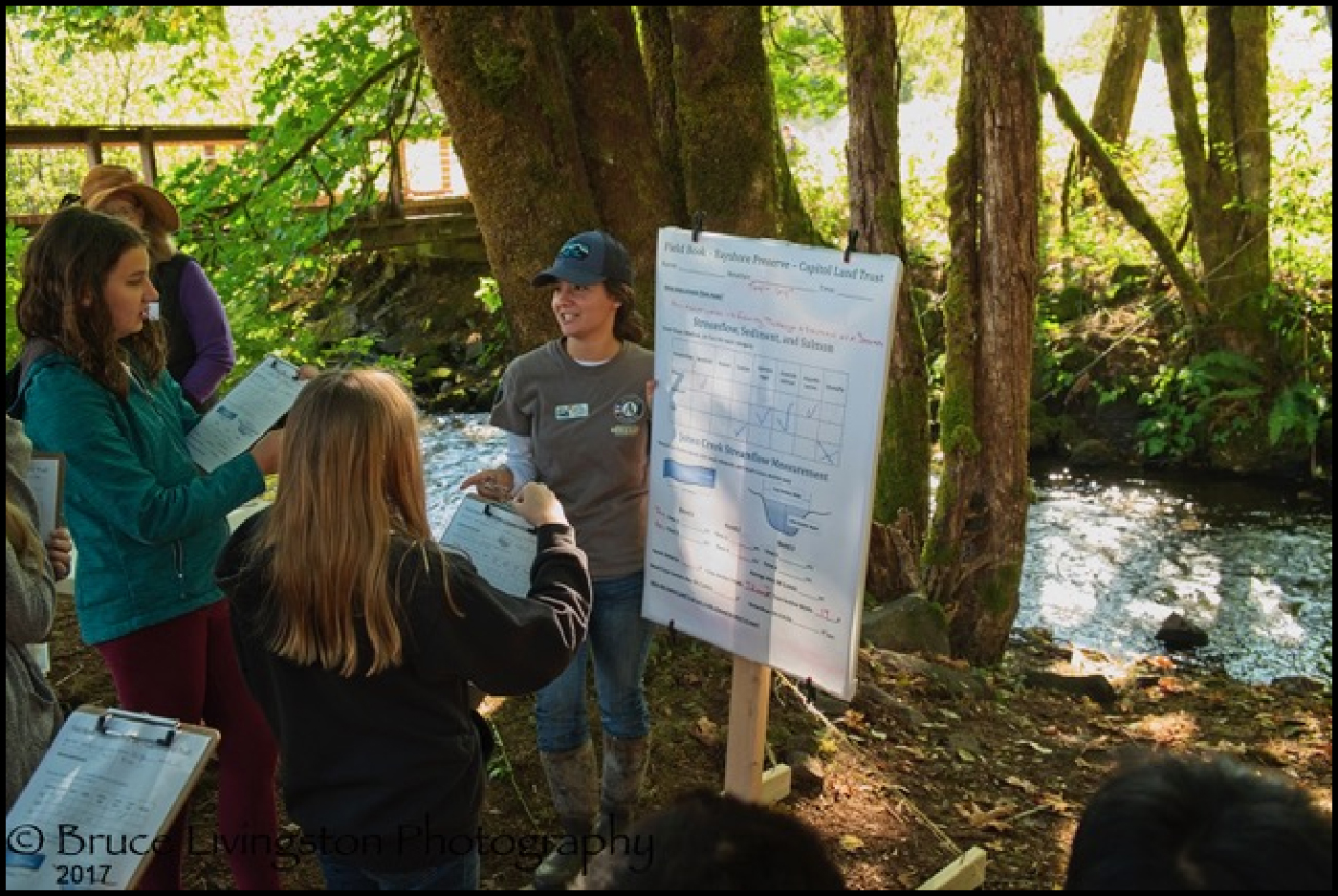
Mary Birchem, Restoration Coordinator with Capitol Land Trust, guides students through a discussion of streamflow next to Johns Creek on the Bayshore Preserve. Photo by Bruce Livingston.
Outdoor Learning in Shelton: A Surge of Hope
by Eleanor Steinhagen
Bayshore Preserve – Shelton, WA
 wo 7th graders have just tossed their pears into Johns Creek and are jogging downstream to see which one will cross the finish line first. Maneuvering around a large maple tree and jagged rocks on the stream’s bank, a handful of their classmates jog with them, including two “timers” who hold stopwatches in front of their chests, ready to hit the stop button when their designated pear reaches the finish line. The pears bob up and down for a moment, then drift into the creek’s swiftly flowing current and float eastward toward Oakland Bay.
The rest of the students are already standing at the finish line, peering upstream and cheering on their desired winner as they hunch forward and hide their hands in their sleeves to protect them from the frigid October morning air. It’s a sunny morning, but the temperature hovers in the high 30s and is slow to rise in the shade by the creek. As the winning pear crosses the finish line 25 seconds after the start of the race, several kids break into a loud cheer, while others throw their hands in the air, or turn away and yell, “Aw, man!” in disappointment.
The race was one of three that this group of 13 students conducted as a means of collecting the data they needed to measure streamflow in the creek at Bayshore Preserve, a 74-acre former golf course three miles northwest of Shelton, Washington, conserved by Capitol Land Trust in 2014. Before the race, the students learned about side channels and discussed how they impact flow; measured the distance from the race’s starting line to the finish line, or the “reach”; discussed key concepts they are learning in class, such as “ecosystem” and “biodiversity”; and, standing mere feet from the creek’s sand, cobble and stoneflies, they learned about the variety of sediments and creatures in northwest streams and where each can be found according to streamflow. Throughout the lesson, they used field journals to take notes and record data, including the depth and width of the section of the creek they were studying—information they would use to perform calculations in math class later that week.
The students’ work at Johns Creek is the culmination of three years of effort made by several groups to design and implement high impact field experiences for every student in the Shelton School District. The program started with a conversation at a community stakeholder meeting in 2014 between Margaret Tudor, then-Executive Director of Pacific Education Institute (PEI), Wendy Boles, Shelton School District Science Curriculum Leader and Science Teacher at Olympic Middle School, and Amanda Reed, Executive Director of Capitol Land Trust. Since the fall of 2015, Capitol Land Trust has been facilitating these field investigations for every 7th grader in the Shelton School District—serving around 300 students per year—using PEI’s trademark FieldSTEM model as a foundation for the work. In addition to Capitol Land Trust, Shelton School District and PEI, a handful of dedicated volunteers and other community stakeholders, such as the Squaxin Island Tribe, Mason County Conservation District, Green Diamond Resources and Taylor Shellfish, have stepped forward to support the program.

A student draws an example of a freshwater macroinvertebrate for his classmates to add to their field journals. Opportunities for students to share their work and learn from one another are built into the field investigation curriculum. Photo by Bruce Livingston.
This type of outdoor hands-on STEM learning appeals to many learner types and helps students overcome barriers to learning often found inside the classroom. During this first field investigation day, a group of students was asked why they liked learning science outside. Rian, a student at Olympic Middle School who used to go clamming near Bayshore with his mom and grandparents, said, ”I know some kids, they’re better with a complete visual. Not like a visual coming from a book, or written on a whiteboard.” Another student, Madison, said, “It’s good to be outside because you get physical education and you get to look at a lot of stuff,” she said. “I like coming out here to do hands-on learning and have fun with my friends.”
Capitol Land Trust in particular has done a lot of work to realize the initial vision of using Bayshore as a place to provide Shelton School District students with these learning opportunities. Daron Williams, Community Conservation Manager, and Mary Birchem, AmeriCorps Restoration Coordinator, are the land trust’s “boots on the ground,” making the improvements needed each year to transform the program from an average field trip to a PEI-style high impact field experience. Of his drive to help make these experiences happen for students, Daron said:
Doing FieldSTEM—where [students] can get the knowledge they need in a way that actually works for them—can help connect them with the land they live on. Shelton is an economically impoverished area. And a lot of families are struggling… As a small organization, we bring a capacity that the schools don’t have on their own. And that can make a difference in the students’ lives. Doing these project-based lessons, we could actually be helping students get through school that maybe wouldn’t have, and get them excited about science. This is a way to show them how science is connected to the real world.
To this end, Daron and Mary have worked tirelessly to increase student engagement and develop the program curriculum. When the program started in 2015, Daron collaborated with teachers to correlate what Bayshore offers and what is taught in the field to what students are learning in the classroom, ensuring that the lessons are aligned with state and national learning standards. In the summer of 2017, a year into her AmeriCorps service with Capitol Land Trust, Mary began recruiting additional volunteer teachers, and then designed and implemented a program to train them. Together, they have worked to adjust the schedule and coordinate the logistics of the field experience with district teachers. And on field experience days, both Mary and Daron work alongside the volunteer teachers to help them guide students through the FieldSTEM tasks.
This year especially, their effort shows. Viola Moran, student teacher at Olympic Middle School, shared her observation of Fiona (her name has been changed to protect her privacy) during the field investigation at Bayshore. A high-needs student in one of the district middle schools, Fiona doesn’t like to be the center of attention. As a rule, she doesn’t participate in activities or raise her hand in class. The commotion that comes with being in large groups of people makes her feel so uncomfortable that she waits in the bathroom until the hallways clear out during breaks before going to class. And when she gets there, she doesn’t want to sit with the other students.
When the Bayshore field investigation day was announced, Fiona said, “I’m not going. I’ll be sick that day.” But in spite of her reluctance, she got her permission slip in and ended up attending. And in the course of the afternoon, she became so engaged in the fieldwork that she and her classmates were doing that she volunteered to throw one of the pears during the fruit race. She also offered to draw an example of a macroinvertebrate on the board for the class—a profound shift from what Viola had observed in the classroom.
Throughout the first field investigation day, as well as the week following, Wendy, Viola, Mary, Daron and several of the volunteer teachers remarked that student engagement is at an all-time high this year. With the inevitable exceptions of “kids being kids,” the students listened attentively, asked questions, volunteered for a variety of tasks and diligently took notes and recorded their data. Viola and Wendy also observed that the students handled the creatures more gently this year than in the past. At the “Tidal Life” station, for example, on the first day of the field investigation, a group of students were so concerned about a hermit crab that had shed its shell in the molting process that they spent 10 minutes trying to persuade the crab to crawl into a shell they had found on the shore while offering various words of encouragement: “You want your shell!” and “Come on, man, you need a home!”

Students examine macroinvertebrates at the saltwater station. For many of them, this is the first time they’ve come into contact with the creatures that live in their surrounding area. Photo by Bruce Livingston.
Viola expounded on the above by adding:
Even though this is their community, there’s a good portion of [the students] that have never actually been around the creatures out there. And so, seeing the hermit crabs and the different specimens that they got to handle—they were just fascinated by that… And as they grow up, it’s right there. It’s a part of their environment.
What’s more, the impact of the field experience was evident in the classroom after the students went to Bayshore. “When we are going over ‘producer, consumer and decomposer,’” Viola said, “they are relating back to the information they got at Bayshore.”
Susie Vanderburg, retired elementary school teacher, former Thurston County Stream Team Coordinator and former Education Director for Olympia’s LOTT WET Science Center, agrees with Viola. “A lot of kids today are not getting exposed to the outdoors, not having experiences outside. They’re not given opportunities to love the land and be fascinated.” While her work as a volunteer is a big commitment, Susie does it because she believes that giving kids the opportunity to learn science outside, in the field, simultaneously gives them the opportunity to become stewards of the land they live on. “In environmental education we always say, once you get to know something, like a wetland or a prairie, then you begin to care about it. It’s personal. And if you care about it, then you’re willing to do something to protect it. If you never get outside and get to know the outdoors, you’re never going to care about it, you’re not going to protect it.”
While young people’s lack of exposure to the natural world poses a challenge, Wendy Boles, who is in her 15th year as a science teacher and is another major force behind implementing these powerful experiences for students, has begun to feel a surge of hope with a discovery she’s made in her classroom in recent years. It used to be that students entered her 7th grade class without any knowledge about (and very little interest in) the problems caused by issues such as overpopulation, resource depletion and pollution. In the past few years, however, Wendy has noticed in her students an increased awareness of and concern about climate change and environmental issues. She sees field investigations as an opportunity to help kids make the connection between these issues and how they impact their community. She hopes that by having real-world science learning experiences, her students will discover what they love to do, learn about science-related careers in their communities and be empowered to pursue them if that’s their dream.
Along with the work she does to help integrate the field investigation tasks with the district’s science curriculum, Wendy helps train volunteers and coordinate schedules with Capitol Land Trust, district teachers and the English language support staff that the district provides. “It is a lot of work. I mean a lot of work,” she said of the field investigation days. But all of that becomes worth it when she witnesses the new awareness among her students and their desire to safeguard the environment. “The kids are starting to go, Wow, we have to start caring about the environment. That to me is the biggest thing because if we aren’t taking measures to be good stewards, we are going to be in trouble. That’s my concern. Making sure that our planet can continue to support us in a way that we’re used to.”
At Bayshore, several individuals and community partners have come together to seize this opportunity by providing Wendy’s students, and every 6th and 7th grade student in the Shelton School District, with real-world, project-based, career-connected science education. The hope is that this education will enable them to lead richer and more meaningful lives, and that they, in turn, will draw from their time exploring and learning science out in their community to generate change where they can. Yes, it is a lot of work. Everyone involved agrees with Wendy on that. But they do it because they believe that the return will be well worth the effort.
Eleanor Steinhagen is the Communications Coordinator for Pacific Education Institute in Olympia, Washington.


by editor | Mar 19, 2018 | IslandWood, Learning Theory
The Compassionate Educator:
Empathy and Environmental Education
Tom Stonehocker
 common challenge in environmental education is working with students who feel disconnected from their environment. This disconnection not only impedes a student’s ability to understand how natural systems function, it also affects how they value the natural world. This is caused not necessarily from lack of education, but the lack of focus on types of learning that build social-emotional skills in students.
Environmental work is inherently about responding to the needs of a changing planet. Environmental education must also continually focus on responding to the needs of our students so that they can grow to do the same for others. The study of nature is the study of relationships, and we would be wise to include ourselves in that definition, and perhaps even more importantly, those around us.
Author and educator Joseph Cornell shares that, “Our enjoyment and appreciation of life depends on our ability to sense feelings of other creatures, escaping our self-definitions to taste the joy of self-forgetful empathy with others” (Cornell, 1998, p.33). If young people are not well practiced in putting themselves into perspectives outside of their normal selves, how can they be expected to understand and care for the natural world?
Through my own reflections and experience as a field instructor at Islandwood, “a school in the woods”, located in Washington state, I have witnessed the value of being able to take on other perspectives. By adopting new points of view, we are better able to make informed and meaningful connections with ourselves, with others, and with our environment. As educators, the opportunites we provide our students largely do not come from the knowledge we can impart, rather our ability to engage students in experiences that speak to where they are coming from in life. To teach in this way, we must be willing to step out of our own experience from time to time and into the experiences of others in our community. Fortunately, with practice and thoughtful action, empathy can be used to increase the impact of our teaching.
Beyond Egocentrism
In Coyote’s Guide to Connecting with Nature, the authors describe a progression toward empathy that begins as students learn to recognize and express their own needs. “Over time and with your encouragement, they will go beyond asserting their needs into taking responsibility for them and being proactive about them” (Young, Haas, and McGown, 2010, p. 268). This growing sense of responsibility might be observed in simple acts, like noticing a student plan ahead by bringing warm and dry clothing. It might be a student who articulates that they are uncomfortable with a certain aspect of an activity and opens a conversation to plan an alternative.
Young, et al. go on to describe how this behavior often expands into a greater awareness of others and tending to their needs as well (2010). I have witnessed this progression in my students as I see them begin to speak up for each other. Students also feel more comfortable affirming the positive attributes that their peers bring to the group, and begin to feel a sense of comradery and pride with group identity.
“This same tending sensibility will also show itself as care for the natural world -and especially one’s own native romping grounds” (Young, et al., 2010, p. 268). In watching how self-care can grow into caring for others, it’s easy to imagine this expanding beyond just people and encompassing the environment as well. Developing a sense of place begins when a person starts to have deeper familiarity with their surroundings, and ultimately begins to feel at home where they are. Feeling a sense belonging is a true testament to the number and quality of the relationships built.
Helping Students to Cultivate Empathy
An important way to help a group of students begin to see from perspectives other than their own is by helping each individual realize the interconnectedness present within a community. One way to encourage this sense of interpersonal connection is by engaging them in team-building challenges. Of course there are millions of activities that achieve this—I’ve seen wonders happen when I challenge group of ten students to transport themselves 25 feet across an expanse of “shark-infested hot lava” using only four foam seat-pads as stepping stones. They become invested in a successful outcome for the group and along the way, they discover the role that each person plays and how they can more carefully and effectively communicate with one another.
These types of play-based collaborations have helped groups of students with intense trust and interpersonal challenges to become significantly more community-minded and thoughtful of each other’s needs. Sometimes, we must recognize that there is more work than can be achieved in our time together with students, but we must not let that stop us from trying.
One of my favorite activities to facilitate with students to dive even deeper into empathy is to engage them in storytelling from the perspective of a non-human element of the natural world. Students get to create their own narrative, which could be a short story, poem, or comic about any living or nonliving component found in our place.
One memorable story came from a student who, after having trouble coming up with ideas for his story, eventually wrote a beautiful piece about a plant he had learned about earlier in the day, the Evergreen Huckleberry:
One time there was [an] Evergreen Huckleberry. People and animals came every second to take the berry. A bird comes and make a house out of you, but the evergreen huckleberry can’t do nothing. So every time it grows [berries], people or animals take it. The tree was mad…because they were eating its berry. It [wanted] revenge and a 10-year-old kid came and said, ‘Stop, we were not hurting you, we were only [taking] berries because it taste good and we take out the seeds and grow another tree. No big deal.’”
Another student wrote from the perspective of a Salal plant that lives through the challenges of each season and ultimately feels unwanted by the other members of the forest community. She wrote,
“A small blueberry tree [looked] at me and said, ‘Salal you are great just like you are. You don’t need to be bigger and we need you. We need you, like you have very [delicious] and sweet [berries] and animals need you. Look, the [deer] needs you for your [berries].’ Salal said ‘Cool, I’m special.’”
In both of these stories, students are demonstrating their understanding of ecological relationships but also have some compelling themes of personal struggle. Both stories have moments when the main character is feeling underappreciated until another member of the community shows them they are valued. People of all ages struggle with self-confidence or feeling like an outsider. These stories illustrate how students can identify threads of connection across boundaries. This helps them develop new interpretations of environmental relationships andf also interpersonal relationships.
Another strength of perspective storytelling is that it helps students to view the natural world through a creative lens, and allows them to do so on their own terms and in their preferred medium. The perspective storytelling activity I shared with my students involved writing, but perspective storytelling can be done with singing, rapping, dancing, acting, or any other interpretation. By giving them flexibility in how they complete the activity, students will be more successful in reaching the goals of connecting with place and practicing empathy.
Showing Students We Care
Environmental and outdoor education inherently provides experiences that are new and often uncomfortable for students. Some students have spent very little time outdoors, some are away from their families for the first time, and some are working with people they don’t know very well. It is a vulnerable time for many, and often students’ interpersonal and intrapersonal challenges are placed secondary to content. The best way we can teach empathy is by practicing it ourselves.
I frequently encounter students with anxiety from being away from home. It is incredibly difficult for a student to experience the wonders of nature when they are in tears and sick to their stomach from being anxious. I approach these students by thinking about where I was at 10 years old. I remember being at outdoor school being unable to sleep, staying up at night crying, and feeling so alone in my discomfort. By stepping into the shoes of my 10-year-old self, I am better able to help students feel like they are being heard and help them persist through their challenges. I acknowledge the difficulty and pain, but remind them of the ways in which I’ve watched them succeed during our time together.
Being empathetic toward students also helps us as educators be more responsive to diverse groups of students. Something as seemingly straightforward as writing in a nature journal may cause great stress for an English Language Learner or a student with different learning abilities. It’s important for us to assess how we are connecting with our students, because it ultimately affects how they will be able to connect with the natural world
Many educators feel constrained when their curricula is focused on meeting state and national achievement standards. Some may not realize that NGSS (Next Generation Science Standards) was designed to improve the equity of science education and serve diverse populations and learners (Quinn, 2015). At its core, NGSS help students explore concepts that are applicable across many different scales and subjects.
It is precisely this adaptability to a broad range of learners that demonstrates how integral empathy is in science teaching. An important tenet of NGSS is to create an environment where students feel at home and are “welcomed as full members, and invited to share their ideas and participate fully” (Quinn, 2015, p. 16). Reaching this place of comfort will happen after learning to be appropriately responsive to the needs of the students. Getting there could be as simple as providing opportunities for movement within lessons, inviting them to incorporate personal or family stories as part of the activity, or by keeping the focus on experience rather than outcome.
Making content more relevant to student lives can help concepts feel less abstract and more tangible. Kathy Liu Sun (2017) suggests incorporating guests to share their perspective and speak from experience. Hearing from voices that students can identify with helps add personal meaning and relevance. When learning is rooted in the experiences of real people and real places, students will recognize the authenticity and be more able to make connections back to themselves, their families, and their communities.
Being There
In her 2012 novel, Wonder, R.J. Palacio writes, “It’s not enough to be friendly. You have to be a friend” (p. 312). I interpret this to mean that we can treat others with kindness, but it means little if we are not working towards creating a meaningful relationship. In environmental education, we must prioritize relationship-building if we are to truly show that we care for future generations and the planet. By being present and attentive to student needs, we can help them cultivate a rich and meaningful connection to nature. By helping create these relationships, we are helping to create a future where people are fully invested in and advocate for the wellbeing of their natural and human communities.
Tom Stonehocker is a naturalist, graduate student, and field instructor who works with 4th & 5th-grade students at Islandwood, an outdoor school on Bainbridge Island, Washington.
References:
Cornell, Joseph. (1998) Sharing Nature With Children. Nevada City, CA: DAWN Publications
Palacio, R. J. (2012). Wonder. New York: Knopf
Quinn, Helen. (2015) Science and Engineering Practices for Equity. In NGSS for All (pp.7-18). Arlington, VA: NSTA
Sun, Kathy Liu. (2017) The Importance of Cultivating Empathy in STEM Education. In Science Scope. April/May. Pp. 6-8.
Young, J., Haas, E., and McGown, E. (2010) Coyote’s Guide to Connecting with Nature. Shelton, WA: OWLink Media.

