
by editor | Mar 17, 2016 | Equity and Inclusion
Urban Schools and Environment Education
by Alison Swain
IslandWood Graduate Student/ Field Instructor
 his past fall, an IslandWood instructor gave me the
advice that a teacher can only take her students from the
place they are coming from. Through weeks of teaching environmental education to students from public and private elementary schools across the Seattle area and Washington peninsula, I thought little about this statement. Instead, I focused on the prescribed curriculum. Perhaps I did more team building with one group and in-depth water quality with another; but ultimately, the curriculum and content was on par for each group. This past week, teaching seven students from an under-resurced, urban elementary school, environmental education as I had practiced it stopped dead in its tracks. Or so I thought.
After receiving the Friday morning briefing establishing the elementary school’s lack of organization, structure for students, and underserved background, I acquiesced that I may not hit “Nature’s ABC’s” the first day. I did not anticipate one student planting himself outside the Gear Room, head buried in his knees, refusing to move or even voice his concerns for a half an hour. I did not anticipate the ingrained reaction of five of my seven students to shut down (no movement, no verbal communication, no eye contact) when they experienced emotional, physical, or personal discomfort. I did not anticipate the silence of a solo hike to be a poignant teachable moment or the game of camouflage to be a revolutionary way to experience nature. I certainly did not anticipate the impact of a single salamander.
At the end of a week characterized by the challenge of melding my teaching to situations previously unanticipated, I was left with several questions for reflection. The first: “Is the game of camouflage environmental education?” In terms of meeting my students where they were coming from, the answer is most certainly, yes. Seeing all seven of my students run without hesitation into the woods, which were previously full of bugs, discomfort, dirt, and fear, to hide became my most effective means of encouraging my students to get into the nature. When I tried to relate the game to animal adaptations, a student immediately chimed in, “Like what?” As we discussed and they discovered and named several adaptations of local animals, I knew I had them engaged and thinking about the natural world.
 At one point in the week, I thought to myself, “It is a good thing that community is part of our mission statement because I do not know how much my students are learning about the environment.” Reconsidering the definition of environment and the successful movements that are changing the ways Americans and industries use resources, I realized that creating community is a necessary component of environmental education. The interconnectedness of the community of our team and the natural world became clear when we stumbled upon a salamander while hiking along the side of the Marsh. Some of my students stared, surprised and awed by the creature. Others pushed and reached to pick it up. The reachers and pushers calmed as we quietly observed the salamander’s behaviors and discussed its habitat. Finally, we talked about whether we should pick up the salamander. My students came to a group consensus that we should not. It was my turn to stand by, awed by the deep sense of care and blooming connection to the natural world as my students watched, unmoving, the salamander slowly lope off the trail to find cover. The last boy to pass the spot where the salamander had hidden delicately poured water from his water bottle near the spot, so that, as he told me, the salamander could find water to keep his skin moist. Our team’s salamander moment is just one example of the profound power of a community committed to caring for each other and the environment.
As the week continued, I encouraged each of my students to look outside of herself and take into account the greater whole by teaching my students through natural consequences about the choices they have and how those choices affect the entire group. At different times that greater whole was the salamander at the Marsh, ecosystems we studied, and our team. Empowering my students with the idea that they had choices and asking them to use these choices throughout the week taught them an extremely important element of environmental education: each person possesses the power to choose his path and that path effects the natural world and human communities.
For the final activity of our week together, I revisited a blindfold walk as a lead-in to a short solo hike. At the end of the solo hike, students were to write a letter to themselves recounting what they had felt, learned, and loved about their week at IslandWood. As each student walked down the path silently stopping at each solo hike card to consider the statement or question, I knew that these students had connected to the environment around them. Simply by being comfortable walking alone on the trail, they had absorbed many of the lessons of the week. At the end of the solo hike, as students went off-trail to find their own space to write their letter, I witnessed yet another success. These students had attained a level of comfort with their natural surroundings. At the beginning of the week, my students were afraid, uncomfortable and seemingly out of their element. Today, they had learned that moving silently was often rewarded by an awe-inspiring moment of witnessing an animal in its environment. On the final day, this moment entailed observations of a pileated woodpecker at work on a snag and for over half my group, a mention of the salamander as something they will always remember.
As for myself, I was finally forced to consider the advice others had given me. I learned to meet my students where they were coming from and find a balance, an understanding, where we all could engage in our environment for the week.
Allison Swain is a field instructor and graduate student living and teaching environmental education at IslandWood’s campus on Bainbridge Island, Washington.

by editor | Feb 24, 2016 | Outdoor education and Outdoor School, Outstanding Programs in EE
Wolverines, Wonder and Wilderness
Why the Wolverine Matters to a Kid Who Has Never Seen a Raccoon

by Megan McGinty
IT IS APRIL AND I AM SITTING UNCOMFORTABLY on the cobbles of a gravel bar on the Skagit River in the North Cascades National Park with a group of local fifth graders, talking about the special rocks we just found. Ranger Paula arrives and greets us, asking the kids about their day and if they’ve seen any wildlife on their hike this afternoon. Excited, they all talk at once, clamoring to describe the chipmunk that ran across the trail and the robin they tried to take pictures of as it flew into the canopy. Paula begins to talk about the wildlife research being conducted in the park by scientists and asks the children “What animal would you most like to see while you are here?”
“Wolf!”
“Rabbit.”
“Mountain goat.”
“Raccoon.”
“Wolverine.”
At this last, my answer, the kids all turn and stare at me quizzically. Paula laughs and explains to the kids what a wolverine is and that they require a large amount of wilderness for their habitat. “How do you know they exist?” one asks. “Good question.” replies Paula.
For many of the kids, these two nights in a paved campground, using a bathroom with flush toilets and running water, eating out of a group kitchen with a gas stove and a refrigerator (albeit at picnic tables under a roof with only two walls), will be the most rugged outdoor recreation experience they ever have. For nearly all of them, the most pressing environmental issues they will come to terms with will be economic, as the area’s historically resource extraction-based industries dwindle. There is less land, less water, fewer trees and not enough fish available for these kids to follow in the footsteps of their parents and grandparents. Some of the students are already coping with the effects of illnesses caused by exposure to pesticides, industrial pollutants, lead in their drinking water and a myriad of other difficulties resulting from low-income residency. Given the realities of daily existence for some of these students, the fact that they are living within two hourís drive of one of largest areas of wildernesses within the contiguous United States is of little importance to them. Or is it?
 Wilderness has long held a role in Judeo-Christian culture; its effects are still felt each year as millions of devout practitioners observe Lent. A significant portion of modern American culture still grapples with the issues raised by wilderness, from literary classics such as”The Call of the Wild” to the hit TV show “Survivor”. Many aborigine cultures used wildlands as the foundational setting for rites of passage and seeking insight. As we began to define ourselves as human and civilized, we also needed to label that which we were distinguishing ourselves from. It seems that as soon as man began to exist, so did wilderness.
Environmental education first came about as a movement when conservationists and educators recognized the effects of an increasing disconnect between society and the natural world. The need to rekindle that connection inspired efforts to get kids out into the woods, to take them out into the wild, because that’s where “real” nature was. It was assumed that a big part of the reason for the growing alienation from nature was due to the fact that there was no nature worthy of inspiring a connection in the cities and suburbs we live in. As school budgets tightened, the likelihood of such field trips and opportunities became scarce. At the same time, many thinkers began exploring the connections made to the natural world during childhood and realized that for many kids, it happened in the more common places such as vacant lots or backyards, places that they were allowed to have daily contact with. Educators began to wonder if the connections being made had less to do with the “wow” factor than with intimacy and immediate relevance.
Recent trends in environmental education have rendered the phrase ìplace-based-educationî a hot term, and rightly so. More curricula are available that allow the local schoolyard or drainage ditch to be a laboratory for ecological study. Innovative teachers have devised lessons that allow even the most urban settings to serve as the source for environmental theory. Students living in heavily-impacted areas are now more likely to be exposed the concepts behind environmental justice than to a canned curriculum about the Brazilian rainforest. By bringing a concrete (literally) relevance to the students’ daily lives, environmental education is being brought closer into the fold as a valid academic discipline.
The problem is this: wonder thrives on apparent irrelevance. I think of my friend Diego, born in the Dominican Republic and raised in the South Bronx. When he was fifteen, he went to a wilderness program in the Appalachians for students from the South Bronx High School who spoke English as a second language.
Incredibly out of place in an alien land and culture, he fell in love with climbing and returned to the program as an intern and later as a staff member. He now spends his free time in alpine wildernesses and climbs in some of the most remote parts of North America.
In this more recent vein of locally-focused programs, many kids are not introduced to the large chunks of land and water that are todayís wildernesses. This is often done with the assumption that this is best for them. Every educator is charged with the task of assigning importance to some lessons over others. The best educators begin with assessing what their students already know and where they are coming from.
There are many students with a wide range of experiences, so a sort of middle ground is aimed for, that is, the lessons are designed for the greatest commonalities among the students and the experiences they are most likely to already have. To be sure, Diego is an anomaly, but he is also an example of a student that flourished by getting a chance to see the wide world beyond his backyard.
It can easily be argued that a wilderness area isn’t needed to teach a group of fifth graders what watershed they live in or where their food comes from. A significant number of environmental education programs never reach a point where wilderness issues become pertinent and of those that do, there is rarely room in the curriculum for the issue. However, an educational program that is not prepared to address the question of wilderness is limited in its ability to handle the larger philosophical questions that environmental education tends to beg. (Should we preserve lands? Which ones? Why? What is ‘preservation’?, etc.) Even though the instructors often have to work with constraints such as lesson time, program length, or student background, they need a solid fundamental philosophy from which to base their lessons in order to effectively grapple with the more abstract aspects, the “big questions” of environmental education.
As we make lessons more real and connect them more intimately to students’ daily lives, we must not forget the importance of the great unknown. Appealing to the sense of wonder, to the promise of discovery, is of essential importance when convincing future generations to become active conservationists. When we introduce schoolchildren to the mysteries of their backyards, we cannot answer every question, nor should we try to. If they receive the message that all the answers have been found, that everything is under control and fully explained, there will be no reason for them to continue discovering and questioning.
By presenting the backyard as what it is, a test case, a fraction, a tightly bound series of parameters that can only serve as the roughest of sketches for the great ecological mysteries of the wildlands, we are giving them the most honest of lessons. No longer are they schoolchildren on an outing following a curriculum designed to lead them towards a predetermined outcome. They have been initiated as citizens of the planet who will play a role in shaping its future. How these kids will feel about their role in the environment can be decided by whether or not they know or don’t know that there are places on the planet where human impact is not yet a primary shaping factor.
Environmental issues cannot be conveniently contained with the boundaries of a city, state or even a country. Instead, they ignore the abstract divisions we have attempted to draw and reinforce the interdependence of ecosystems on both big and small levels. We need clean air, clean water and healthy soil, and preserving the areas that are still reservoirs of these things is as important as cleaning up the areas that are dangerously contaminated. Letting kids think that recycling and picking up litter will be sufficient to address the current and pending environmental issues is not far from lying to them.
The value of something beyond that which we know and see in our daily lives is of absolute importance when trying to convince people to work towards a goal that does not have immediate or tangible results. Kids need to be encouraged and to believe their efforts will have results, but we should not deceive them about the magnitude or pace of environmental progress. They will need inspiration for the work that lies ahead, be it in the form of a magnificent photo in National Geographic, a video of an amazing rainforest or tales of strange and fantastic creatures that live in remote wildlands.
When I was young, before I could read very well, one of my favorite books was a Dr. Seuss volume titled “McElligot’s Pool”. The story is simple: a farmer is teasing a boy named Marco who is fishing in McElligot’s Pool, a small pool in the middle of a cow pasture that people throw junk into. He thinks Marco will catch nothing but an old shoe. Marco concedes that the farmer may be right, but wonders if the pool could be connected to an underground river that flows to the sea. He imagines the progression of the secret river that connects the puddle to the great sea and the increasingly more bizzare creatures that live there. As a kid, I was absolutely captivated by the idea that the mundane things in my backyard could be connected to bigger, more exotic things that lay far beyond. Suddenly, pretending to be exploring the Amazon while catching and identifying spiders in the vacant lot next to my friend’s house did not seem quite so farfetched. In fact, it made the spider-hunting seem less like playing and more like training for someday exploring the great unknowns that still remain in the wildlands.
Megan McGinty lives in Bellingham, WA and is an Environmental Educator with North Cascades Institute. Photo by Benjamin Drummond.

by editor | Feb 23, 2016 | Gardening, Farming, Food, & Permaculture

Care for Self, Care for Others, Care for the Land:
How Springwater Environmental Sciences School Uses Their Permaculture Garden as a Microcosm for the Environment.
Kaci Rae Christopher
 t first, starting a school garden that combined permaculture and science seemed like a puzzle. How could I teach garden science classes while simultaneously producing large amounts of food and building a permaculture model for the garden? How could I produce the short-term yields the school craved (food) and the long-term yields (permaculture)? Furthermore, the science that I grew up learning did not fit in to my idea of permaculture practices. They seemed inherently different. How could a process which looks to dissect and separate each small particle support a process which looks at the holistic and interconnected aspects of life?
In August of 2012, I was placed as the School Garden Coordinator and AmeriCorps volunteer at Springwater Environmental Sciences School, through Confluence Environmental Center in Portland. The school garden was a large, grant-built space left fallow without a community leader to organize the tangle of weeds and ideas. But step by step, the garden has been slowly growing and building momentum ever since. And through an aggressive fundraising process, the school has been able to support the School Garden Coordinator (SGC) position with full-time employment.
Springwater Environmental Sciences School is a public charter school for grades K-8th, within the Oregon City School District. Approximately 200 students have the opportunity to learn stewardship, positive land ethic, community involvement, and all their studies through the lens of science.
As the Garden Coordinator, I was tasked with establishing a permaculture garden on the schoolyard that would enhance student scientific learning. It was to be both a laboratory space for the students and produce food for the school. Additionally, I would be teaching garden classes and developing an integrated garden curriculum that would support and supplement student scientific learning.
It took me a while to connect the dots, but eventually I was led to a simple conclusion. There is a seamless connection with science and permaculture. And school gardens are the best to develop it. If we view the garden as an ecosystem and teach the students about it through sciences, they will begin to view the garden through a permaculture perspective. Food, nutrition, and gardening skills extend naturally, without the need for stressing about production.
 Working with Nature
Upon arriving at Springwater, I had no established garden, but needed to teach garden classes. The first thing I did, which made my life easier, was work with what was already there—a technique that is essential to the tenets of permaculture. I went to each teacher and asked them to give me their unit themes for the next two years. Because many of the grades are mixed, most staff teach in a two-year rotation of classes in order to provide a holistic and engaging education for the students. I took these themes and the overarching science standards and began to build a small amount of activities that related to each theme. Over the years, I have been able to grow off of this small beginning and find larger connections between student studies and gardening activities.
Now, when the 5th-6th graders study the climatology unit, they simultaneously explore how we capture water in the garden, how permaculture mulching practices conserve water, and how rain gardens can solve so many local water issues. Additionally, they also learn practical garden skills by researching and planting water or drought resistant plants and making changes to the garden space with water in mind, such as designing or altering the water catchment systems.
I started with a small amount of classes and a couple of activities for each trimester. This has grown to 30 garden classes for each grade every year. But we started small, but dreamt big!
The Permaculture Perspective
The second thing I did was take a step back and look at the long-term goals of the school garden program. I had to keep in mind how to establish the sustainability of the garden, as well as the sustainability of the integrated garden activities in the classes. The activities could be relevant to student studies, but could they teach the students how to grow food or about permaculture and science in a holistic way from Kindergarten to 8th grade?
Fortunately, there had already been work done there too. The staff had come together the year before I arrived and laid out a set of goals and commitments for each class. Every grade was committed to a set of yields that would contribute to the sustainability of the school garden (planting a certain number of seeds, mulching, caring for worm bins, composting). Additionally, each class adopted a theme for the year that would focus their studies, so that as the students moved up in the grades they would get closer to becoming mini “Master Gardeners.”
As the coordinator, these commitments were foundational pieces that helped me focus my work. It also allowed me to feel supported by the school community and not have to work from scratch. I knew going into the year that K-1st wanted to learn about seeds and pollinators and were committed to planting 20 seeds per child. Additionally, they would be studying the senses in the fall, phenology in the winter, and insects in the spring. With this information, all I had to do was connect the dots and get creative with my activities.
In garden class, as a supplement to these science units, all students would use their senses to explore the garden and identify plants, dissect and plant seeds in the winter, and study pollinating insects in the spring. I did this matching and reflecting practice with all the classes, starting small with class projects and working towards bigger projects every year.
 The Garden Ecosystem
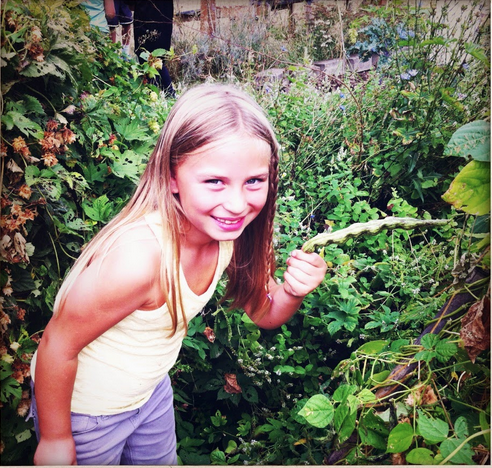
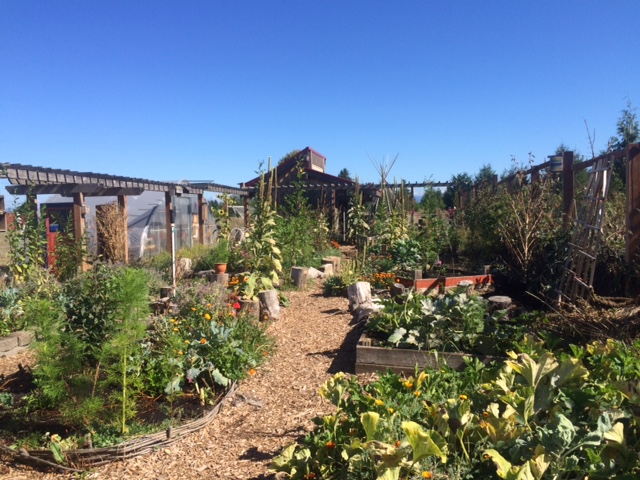
The last thing I practiced was letting go of any notion of what a garden should look like and evaluating the intentions of garden spaces. Did all the plants have to be perfectly spaced out? Why did we need to pick all the weeds in a garden bed? What would happen if we planted certain plants next to each other? Instead, we focused on the garden as an ecosystem. Whether filled with native or non-native species, humans play a role in them and interact with a whole system of insects, plants, and microbes. A garden is the perfect ecosystem model for place-based learning.
But it requires practice in letting go. If you have a bed of carrots in your school garden, harvest them! Enjoy and celebrate. But leave a few carrots in the ground. Watch how the plants produce seeds. What insects flock to the flowers? What feeds on those insects? What does the carrot lifecycle look like? Reevaluate your intentions, let go of your expectations, and nature will show you the garden ecosystem. When we let the weeds go one winter, we discovered that sheep’s sorrel grows abundantly in the garden, and that the students love it! If we are going to have weeds anyway, why not have tasty ones?
Or just look at the slugs. All insects are protected in the Springwater Garden and slugs are a respected part of our garden ecosystem. They allow the students to wrestle with preconceived notions of “good” and “bad” in the environment. When a student expresses disgust or stress that a slug is eating their lettuce, we have a conversation about the role of slugs in the garden, rather than remove it right away from the leaf. We watch the way the slug eats and how it needs moisture to move. We brainstorm what types of predators would eat a slug and how we could build a habitat for such a creature. We watch the slugs a little more and then leave it to its snack.
Through their garden science classes, the students were able to come to similar conclusions. They would look at all the details in the garden and piece together the ecosystem themselves, coming to care about it as a whole. For example, the 2nd/3rd graders learn about the living and non-living elements of soil through intensive scientific exploration for two trimesters. They perform insect surveys, keep track of the bug life stages they encounter, and brainstorm ways to increase habitat for different species. Through hands-on scientific exploration, the students discover that all the parts of the soil ecosystem are valuable to its stability and they learn stewardship skills and practices that can promote healthier ecosystems.
By the end of the school year, their knowledge and interaction with these important elements and living things brings about a level of stewardship and care that they wouldn’t have known otherwise. Through science and active exploration, the students come to their own permaculture conclusions without my direct instruction. The students value the garden ecosystem and become environmentalists in their own way.
With guidance from all of these lessons, our Garden Program has found a balance in maintaining all the goals we had with the space. The students learn about the garden and permaculture practices through a scientific lens. Their learning, creative problem solving, and discovery brings out the inner environmentalist. All I do is facilitate the opportunity to learn these traits in the garden. Food is grown and produced by the students as an extension of their studies. We don’t stress how many pounds of kale we’re producing or if they’re properly spaced apart, but we still manage to feed the students organic food all year long.
 A Thriving Garden
The first year ended with half of the garden planted with edibles. The students had been able to eat an early harvest of lettuce, radishes, beets, and berries, but the rest of the plants were still too small. Half of the school had been involved in the garden development so far and my co-teacher and I had a year’s supply of garden activities for K-4th grade students. Half of our goals were accomplished, but I was pleased with every inch that we had achieved.
That second school year, I began teaching an extra gardening class for those students who considered themselves enthusiasts and who wanted to become “Garden Leaders.” They were able to save-seeds, plant winter foods, and begin developing the last stage of the garden. Additionally, I began teaching gardening class from K-8th grade students, inspiring me to energetic and sometimes frenetic curriculum development and research in order to teach these new classes.
In that second year, we finished laying down the foundational garden space, developed more garden beds, and put in an orchard area. In the third year, the garden classes matured into what they are now: weekly focused garden science and exploration for each class, as well as taste-testing and nutrition education throughout the week.
Classes use the garden in their weekly homeroom field exploration to study genetics, plant biology, water movement and cycles, mammals, and phenology. The garden has truly become a living classroom and special retreat at Springwater. The students discover a new land ethic in their garden classes and practice creative problem-solving and responsibility for their actions.
Care for Self, Care for Others, Care for The Land
The tenets of permaculture as established by David Holgrem and Toby Hemenway fit well into the three character traits encouraged at Springwater: care for self, care for others, care for community and land.
These three phrases are now the inspiration and motto for the unique culture at Springwater. Permaculture tenets provide a great framework for building scientific learning in the garden program. For example, the tenets “Diversity is Stability,” the “Edge Effect,” and “Working with Nature,” focus the students on ways to treat the garden, its living inhabitants, and plants themselves.
When the 2nd-3rd graders study soil ecosystems, they learn that soil and garden health and stability is directly impacted by the diversity of creatures living there. When 4th-6th graders explore the complexities of composting systems, they know that “Energy Cycling” can solve problems at school and in the larger community. By using permaculture as the lens to explore scientific lessons in the garden, Springwater students are encouraged to be innovative social and environmental minded citizens.
These three tenets help students, and staff, focus on how students treat each other, how they make good choices during the day, and how they play and study on the school grounds. The expectations are flexible to the children’s development and change meaning throughout their studies in the year. They are also helpful tools to focus the students and give further empathetic meaning to the day’s lessons.
The Springwater Garden has flourished with the guidance and gaze of environmental education practices. The space has known no other gardening plan. It was always a dream of the school to have a garden on campus as the heart of the school community and an extension of the school’s place-based initiative.
At Springwater, we have been able to intentionally focus the garden education program from the perspective of environmental education, because of the simple fact that permaculture and science goes hand-in-hand. They are inseparable to the educational experience of our students. Here, nutrition, taste-testing, and practical garden knowledge are included in scientific exploration and study. Here, the garden is a special, wild, place on campus that supports a culture of thoughtful, self-aware, and concerned young citizens.

by editor | Feb 22, 2016 | Learning Standards
Active Learning:
Is this something our pre-service education equips us for?
 ’m interested in the Resource section on the New Generation Science Standards (NGSS) web site (http://www.nextgenscience.org/resources). At the very end of the materials, there is a link to the Vision Framework table (http://www.nextgenscience.org/sites/ngss/files/15-041_Achieve_ScienceChartNewVision.pdf) which indicates where science education has been, and where it is expected to go: From teacher-centered/didactic to student-centered/constructivist, along with an emphasis on active learning. My experience and perennial hopes tell me that this is what should happen. In the long run, it will produce a better-educated electorate.
 One thing I don’t see is how this change will be effected. There is little evidence of funding to facilitate this movement from teacher-centered to student-centered deliveries, especially when so many science teachers haven’t made the move. And for good reason: a large fraction of teachers don’t have the college-level preparation this change entails. And, historically, this has been the case since I started tracking it in the early 1970s. There is some talk of states taking up this responsibility, but not many states seem willing to spend more on education. As in most education initiatives, it will be up to the teachers to bring themselves up to speed.
That said, my hope is to be able to take a science activity and walk it up the NGSS from K-12. This started with a simple food web, which we’ll continue to use with questions it raises to stray into other areas of the Life Sciences standards. I’ll try to use examples which can be applied at any grade level. I have no certainty that I can do that, but I’ll try. Several possibilities for assisting teachers to make the transition to effective use of the NGSS in their classrooms are briefly described in the NGSS Resources section, such as the effort the Delaware and Rhode Island (http://www.nextgenscience.org/sites/ngss/files/DE-RI%20Collaborating%20for%20NGSS%20Alignment%20June%202015.pdf) collaborative effort to build effective ways to deliver the NGSS. Most efforts are still in the works, or pending work. The Delaware and Rhode Island effort’s final statement is instructive: “This work takes time: Participants’ knowledge of the NGSS, the rubric, and what makes for good feedback and suggestions for improvement grew over time, especially through the process of sharing their work with other members of their state team and across state teams.” Progress, but definitely not a final product.
 Many Classroom Sample Task plans described in the NGSS Resources section are “coming soon.” In one which is here now, Where Did the Water Go?: Watershed Study – Middle School Sample Classroom Task, the Introduction to the sample task describes what could become a student-centered activity, but the description of how to teach the lessons is largely teacher-centered. Overall, it doesn’t represent a student-directed inquiry, and provides little effective advice for teachers who are employing active learning for the first time. I suspect it will be up to individual teachers to reorganize the NGSS Resources offerings to make them student-centered inquiries. I’m concerned about this because teachers are under the gun to deliver on the NGSS, but are receiving precious little assistance to do so. And so we must train ourselves.
Let’s look at the wording in K-LS-1. Its performance expectation reads, “Use observations to describe patterns of what plants and animals (including humans) need to survive.” This is further clarified: “Clarification Statement: Examples of patterns could include that animals need to take in food but plants do not; the different kinds of food needed by different types of animals; the requirement of plants to have light; and, that all living things need water.” Then, elements from the Framework for K-12 Science Education are listed: “Analyzing and Interpreting Data – Analyzing data in K–2 builds on prior experiences and progresses to collecting, recording, and sharing observations. Use observations (firsthand or from media) to describe patterns in the natural world in order to answer scientific questions. Connections to Nature of Science: Scientific Knowledge is Based on Empirical Evidence – Scientists look for patterns and order when making observations about the world. LS1.C: Organization for Matter and Energy Flow in Organisms: All animals need food in order to live and grow. They obtain their food from plants or from other animals. Plants need water and light to live and grow. Patterns: Patterns in the natural and human designed world can be observed and used as evidence.” Lots of jargon, but it does contain useful information. We can draw on these elements to integrate what we observe in the real world with the semantic world of the NGSS. If we succeed, our students will be learning for conceptual understanding rather than to connect particular standardized test question stems with memorized, but not conceptualized, facts. We need to be able to do this.
We started to use a food chain to begin to address this standard. If we were to use the delivery modalities described in the first row of the Vision of the Framework table at the end of the NGSS Resources web page we would have two choices. One is teacher-centered, “Rote memorization of facts and terminology.” The other is student-centered, “Facts and terminology learned as needed while developing explanations and designing solutions supported by evidence-based arguments and reasoning.” That’s a rather densely concept-populated sentence; a sentence with a top-heavy concept load. (Concept Load is one of the things we all need to be careful about when we’re speaking or writing. It’s certainly a common problem for me.) In spite of that, it does open the door to teachers who allow their students to develop their own questions from time-to-time, and to develop investigations to answer them, collect and analyze data, interpret their findings, and communicate them. (You’ll notice my problem with concept load in that sentence.) In the process, students’ own questions and investigations force them into the books and the web to find needed information. Because they’re not going after it to answer a test question, it will be stored in conceptual memory, where it can be brought out to use when needed. That kind of work fits what the NGSS states it wants students to do. That opens the door to real, competent learning. We need that.
Your best way to master this new way of teaching is to take one piece and work on a way to deliver it via active learning. We’ll give that a first shot here. If we were to deliver the personal food chain activity described in the previous blog with a teacher-centered activity, we would provide students with the names of the plants, and where to place them on paper. Then we’d have the students write their own names above the plants and animals they ate, and draw arrows from each plant or animal to the student’s name. (We might ask them to write the animal names above the plant names and below their own names.) We’d then tell them they’d constructed a food chain, and begin to explain the arrows’ meaning. Whatever else we wanted them to know would be delivered in a similar way. Very little conceptual understandings would connect all of this information in a meaningful way or pattern.
“Pattern” is the operative word here. When we discover patterns, our brain’s Seeking system is activated, and the prefrontal cortex organizes itself to place all of these learnings within a connected conceptual schematum, which draws on information stored in various parts of the brain. The conceptual memory then ‘makes sense.’ Contrast this with memories created during teacher-centered activities, where memories are stored, but with precious few connections; little chance of developing into conceptual memories.
Now, to the right side of the Vision of the Framework table. Each of us teaches differently. I’ll describe this constructivist, active learning activity as I might do it. Think about it in your own way. That’s important. The differences may raise useful questions. Here we go. First, I assigned the homework task, “Tomorrow, write down all of the things you eat for breakfast. We’ll use this to look at one of the ways you’re connected to the world.” This will raise questions in some students’ minds. When a few of those articulate their questions, I’ll phrase in some way my standard response, “What do you think?” If the discussion seems fruitful, we’ll just see where it goes. If not, we’ll continue with what follows.
When they come in with their information the following day, I’ll ask them to work in partnerships to figure out a way to picture a relationship between the things they eat and themselves. After, we’ll report back what we find, discuss what we see and think, and then each group will build a picture to illustrate how they understand the relationship between the organisms they eat and themselves based on what they’ve taken away from the reporting session. That is as long as a fruitful discussion the day before didn’t lead to a better way to do this. Note: I’m talking about kindergarten or, K-1, since that is the level the standard quoted above is directed toward. But this activity does work at all levels with a little tweaking. The idea here is to prepare students’ minds for the learning about food webs that they will embark upon; and, to begin working on the NGSS LS1-1 standard.
We’ll post their pictures, then if I think it’s helpful, I’ll show them the way I did mine. Hopefully, I won’t have to. Since these are young children, I’ll simply say this is the way I thought of to do it. Then I’ll ask if their pictures provide any information about what plants and animals need to survive. This conversation can go many ways. My job will be to see that we learn that we all, even plants, need to eat. (Note: The NGSS K-LS-2 states that plants don’t need to take in food. I disagree with this assertion. Plants take in nutrients from the soil; that’s one of the reasons we compost and fertilize. Plant roots aren’t there just to absorb water and stabilize the plant. Roots work on their own and with microbes and fungi to bring nutrients in the soil into their own bodies. That’s taking in food, which the NGSS standard says plants do not. Oh, well.)
It is more difficult to write a set of standard directions for an activity delivered via active learning than via teacher-centered learning. Active learning allows so much room for minds to explore that it seems to have no direct path to the end. It actually doesn’t work that way, but you have to engage it yourself to discover that. There are little or no standard terminology or conceptual referents that we can use to describe active learning as there are for teacher-centered learning. Perhaps because it’s a relatively new function for most educators. Not for our brain. It learns best when it is seeking a pattern and/or answer to an interesting question. Helped us survive the Pleistocene. Somewhere along the way, school lost the capacity to use this powerful tool. We’re beginning to rediscover it.
In the next blog, we’ll look at the food chains the class produced, then see how we can use them to connect to other curricular areas.
 This is a regular feature by CLEARING “master teacher” Jim Martin that explores how environmental educators can help classroom teachers get away from the pressure to teach to the standardized tests, and how teachers can gain the confidence to go into the world outside of their classrooms for a substantial piece of their curricula. See the other installments here, or search Categories for “Jim Martin.”

by editor | Feb 22, 2016 | Outdoor education and Outdoor School
From Chattermarks
The Transformative Power of Wilderness Education
A graduate student finds an understanding of the effect of wilderness on the development of young people’s sense of self-worth
by Rory Crowley
 n July 7th, 2001 I lie huddled in my sleeping bag, shivering as I survey the cloud of water vapor that floats above my head. It’s 2:00 am and sleep is distant; I realize that I am unprepared for my first solo backpack. I’ve brought a waif of a summer sleeping bag into the high-country, and as snow covers my lonely two-man tent and the ground steals away the heat, I shiver. The Nalgene bottle under my knees is cold; I pull it out, undo the top and gulp the cool water. I open the tent door and pour the rest of the water into my camp stove. I am boiling water for the fourth time tonight; I watch the blue flame in anticipation. I need a warm water bottle under my knees to keep the night bearable.
“What am I doing here?” I say to myself, echoing what I’ve been thinking all night. I have come to Cathedral Provincial Park to test myself but I have also come in search of wildness, to find something that a city cannot supply. I just don’t know what I seek.
The simplicity of wilderness travel attracted me to strap on the hiking boots for that solo and embark on a career in environmental education. Carrying everything I need to survive a week, and leaving behind the overabundance of technology and distraction. Wilderness travel requires simplicity because of the load limits of the human body. Furthermore, wilderness travel resigns the distractions of the modern world to the subconscious. Gary Snyder eloquently warns people who seek the wild that
“Wilderness can be a ferocious teacher, rapidly stripping down the inexperienced or the careless. It is easy to make a mistake that will bring one to an extremity. Practically speaking, appropriate boldness, good humor, gratitude, unstinting work and play, and lots of walking brings us close to the actually existing world and its wholeness.” (Snyder 1990, 23).
During my first solo I was searching for my self-definition as an adult. Self-definition — ”defining, or interpreting ourselves to others, so that people in our social environment have a clearer understanding of who we are”— is a constant evaluation to see if our actions reflect our values (Williams et al. 1989, 170). I wanted to exhibit the “Mountain Man” persona as a symbol of my personal values. But there is also a cultural aspect; this self-image is desirable because the natural wonders of the wilderness are symbols spiritually and aesthetically unique to my Euro American culture. I came to Cathedral Provincial Park with a very anthropogenic goal. Unfortunately, like me at twenty-one, many “weekend warriors” do not go beyond the personal benefits of wilderness — views, peaks, the workout — disregarding their interconnections to the natural world. Learning is facilitated in wilderness when “the learning is necessary to solve basic problems of comfort and even survival” (Miles, 1987, 7). However, wilderness education needs to be sure to go “beyond the simple act of holding classes in the great outdoors” and embrace the experience and personal growth possibilities (Grumbine, 1999, 125).
www.evergreenescapes.com
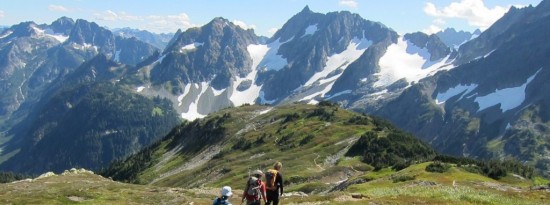
Much of my summer (2004) was spent in the backcountry in North Cascades National Park. I was at the halfway point of a graduate program jointly administered by Huxley College of the Environment at Western Washington University and North Cascades Institute. The Master’s of environmental education is centered on place-based education, leadership and non-profit administration gave me the opportunity to teach in the backcountry while fulfilling course requirements.
During a 6-night canoe camp, my co-leader and I took a group of participants, aged 14-16, up a difficult hike to the top of Desolation Peak and a fire lookout. Rob, the oldest and most experienced participant who had attended two previous camps, set out to try and summit Desolation, a peak that his earlier instructors had never attempted with their groups. After ten minutes of strenuous hiking Rob sat down for a drink of water. Gasping he said, “I am never hiking that fast again, it sucked.” At this point I thought to myself, “okay, I guess we won’t make it to the top, but we’ll make a day hike out of it.” I was wrong. As the group quickly started leaving Rob behind, I sent Rob’s best friend in the camp, Stan, back to hike with him. Stan talked Rob all the way to the top, reaching the lookout just thirty minutes after the rest of the group. The weary hikers were greeted by a fire raging in the distance, the lookout making her daily observations, a helicopter flying through the smoke, and the ghost of past lookouts.
 About a month after the trip I received an e-mail from Rob’s father. Rob was doing really great in alternative school this year, especially in English class. Our lessons during the hike had centered on Jack Kerouac, who spent the summer of 1956 as Desolations Peak’s fire lookout. Our lessons, combined with the accomplishment of reaching the summit had convinced Rob to read both Desolation Angels and Dharma Bums. Most importantly, he had started writing. Although Rob said he hated hiking at the time, I am happy to hear that after some reflection he has incorporated some positives from the day into his daily life.
Rob was receptive to coming to the wilderness and striving towards self-improvement. His actions exemplified this commitment. The wilderness of Ross Lake differs from Rob’s daily hectic life in urban America. Contrast and attunement during time in the wilderness humbled and empowered Rob.
With increased visitation to wilderness areas as population grows, stress on our protected areas increases. As a result, programs that do not depend on the pristine wilderness should take place elsewhere. But if the program depends on the healing and restorative powers of wilderness the activity will be inferior elsewhere. In my opinion, Rob likely would not have received the same personal benefits if the canoe camp was on a local lake and the hike was on a less significant peak near his home.
During the summer of 2004 I also began to explore what it means to be a mentor and a facilitator. I tried to make the experiences I led as valuable as possible, exposing youth to wilderness’s restorative capabilities, while modeling positive behavior in the backcountry. Although a recent resident of the North Cascades, I have further sought to exhibit the qualities Barry Lopez suggests in his essay “American Geographies,”
It resides with men and women more or less sworn to a place, who abide there, who have a feel for the soil and history, for the turn of the leaves and night sounds. Often they are glad to take the outlanders in tow… they are nearly flawless in the respect for these places they love. Their knowledge is intimate rather than encyclopedic, human but not necessarily scholarly, it rings with concrete detail of experience. (Lopez, 1998, 132-133).
It was in this vein that I set out on successive hikes up Sourdough Mountain with participants from the Washington Conservation Corps.
“What are you doing Cait?” I yelled as I looked back to see Cait walking backwards down the trail. Cait, a member of the Washington Conservation Corps, was close to finishing a long day-hike to Sourdough Mountain lookout which included a talk with Northwest poet and fire lookout Tim McNulty.
“It feels like needles are poking into my toes! Like a thousand needles!” she shouted over her shoulder as she limped down the trail to catch up with the waiting group. “My stupid boots are cutting into my toes. Walking backwards makes it feel better.”
“What’s wrong? Do you want me to check for blisters?” I probed. We were still at least an hour from the trailhead.
“No, let’s just get down,” she said, tears swelling in her red eyes. “How long until we get down?”
“Ah… thirty-forty minutes…if you walk facing forward” I fibbed. We continued down the trail from Sourdough, one of the steepest and hardest hikes in North Cascades National Park, but also one of the most rewarding. From the fire lookout you can see six different river drainages; Ross, Ruby, Thunder, Stetattle, Big Beaver and the lower Skagit. We had an amazing day in the high country: blue skies, mountain flowers, views, poetry and writing advice. An hour and a half later we reached the vehicles and Cait immediately stripped off her dust-covered boots. Her toes were red, raw and inflamed but with no noticeable blisters. Her boots must really be terrible. Now in sandals, Cait soothed her toes in the cool river before we got into the trucks to go back to camp. Her feet will be fine tomorrow.
Back at camp I noticed that Cait was not at dinner. After climbing over 5,000 feet in five miles I expected everyone to be devouring their food. I tracked her down walking back from a payphone, her eyes red and swollen. She had phoned her boyfriend because she could not wait to tell her partner about her amazing day; so amazing she could not wait another minute to share it with him. As an aspiring writer, Cait met one of her idols and it has had a profound impact on her. It was at that point that I realized I had facilitated a day that Cait would remember for a long time. Cait’s amazing day can be summarized as experiential wilderness education.
Cait saw the hike up Sourdough was a once in a lifetime opportunity. Author Tim McNulty was in the lookout crafting his work. While at the lookout she observed his everyday tasks of a lookout. Cait understood the purpose of a writer spending time in seclusion and wilderness. Tim gave her advice of different techniques to make her writing better.
Since our hike Cait has had the opportunity to independently write and apply what she had learned. In a chance meeting she indicated her writing had never been better and that the advise from Sourdough was very helpful.
Cait and Rob exemplify the amazing metaphoric benefits to wilderness education. They have been able to apply the positives from the wilderness to their everyday lives. My time as wilderness educator has also been metaphoric for me as a leader. I knew wilderness could impact someone in a positive way, but I needed to actually witness a transformative experience to fully believe in the benefits of wilderness education.
Learning and teaching during my time working with North Cascades Institute causes me to reflect on my time huddled in my cold sleeping bag in the Wilderness of Cathedral Provincial Park. I was grasping for a connection to nature. The myth of the “Mountain Man” brought me to the wilderness, but the effect has been something deeper. For me wilderness has become a metaphor of a deeper connection to the land, a source of inspiration and, most importantly, a positive influence on me as a member of society, a citizen and a resident of the earth.
References
Grumbine, E.R., “Going to Basho’s Pine” ISLE, 6(2), 1990.
Krumpe, E.E., “Managing Wilderness for Education and Development.” Preparing to Manage Wilderness in the 21st Century, U.S. Forest Service, 1990.
Lopez, B.H., “The American Geographies” Barry Lopez: About This Life, Toronto: Random House, 1998.
Miles, J.C., “Wilderness as a Learning Place.” The Journal of Environmental Education, 18(2), 1986-1987.
Miles, J.C., “Wilderness as Healing Place.” The Journal of Experiential Education, 10(3), 1987.
Snyder, G., “The Etiquette of Freedom.” The Practice of the Wild, San Francisco: North point Press, 1990
Spray, R.H. & Weingert, P.D., “The Wilderness Environment: Training Wilderness Managers.” Wilderness Benchmark 1988, U,S, Forest Service, 1989.
Williams, D.R. et. al., “The Role of Wilderness in Human Development.” Wilderness Benchmark 1988, U.S. Forest Service, 1989.
Rory Crowley was a Graduate Student with Huxley College of the Environment at Western Washington University and the North Cascades Institute. Funding was provided by the Skagit Environment Endowment Fund who support conservation, stewardship and education in an around the Washington and British Columbia’s Skagit Watershed.

 At one point in the week, I thought to myself, “It is a good thing that community is part of our mission statement because I do not know how much my students are learning about the environment.” Reconsidering the definition of environment and the successful movements that are changing the ways Americans and industries use resources, I realized that creating community is a necessary component of environmental education. The interconnectedness of the community of our team and the natural world became clear when we stumbled upon a salamander while hiking along the side of the Marsh. Some of my students stared, surprised and awed by the creature. Others pushed and reached to pick it up. The reachers and pushers calmed as we quietly observed the salamander’s behaviors and discussed its habitat. Finally, we talked about whether we should pick up the salamander. My students came to a group consensus that we should not. It was my turn to stand by, awed by the deep sense of care and blooming connection to the natural world as my students watched, unmoving, the salamander slowly lope off the trail to find cover. The last boy to pass the spot where the salamander had hidden delicately poured water from his water bottle near the spot, so that, as he told me, the salamander could find water to keep his skin moist. Our team’s salamander moment is just one example of the profound power of a community committed to caring for each other and the environment.


