by editor | May 4, 2010 | Conservation & Sustainability
by Kenny Ausubel
For all the chatter about the Age of Information, we really seem to be entering the Age of Biology. We didn’t invent nature. Nature invented us. Nature bats last, as the saying goes and, more importantly, it’s her playing field. We would do well to learn at least some of the ground rules.
The great ecological play takes place in a food web that makes no waste, powered by a solar economy that neither mines the past nor mortgages the future. Some of its guiding principles are diversity, kinship, symbiosis, reciprocity and community. It’s alive. It’s intelligent. It’s connected. It’s all relatives. (more…)
by editor | May 4, 2010 | K-12 Activities
Warren Marchioni, Frances Vandervoort, Frank Hinerman, Ann Stocker, and Judy Kemlitz – 1991 Woodrow Wilson Biology Institute
Classroom Ideas
* Try to germinate tropical plant seeds in the classroom and have students determine the best conditions for plant growth (high humidity and warm temperatures.) Either order seeds (see Resources) or have students save seeds from tropical fruits they eat.
* Visit a local botanical garden or conservatory so students can see the variety of tropical plants in the world.
* Many large zoos have tropical rainforest exhibits. Before you take your class to the zoo, find out what materials are available from the zoo’s education department. Use them to prepare your students for a meaningful visit.
* Examine a variety of tropical fruits and seeds and have students determine the seeds’ means of dispersal. (Students will find a variety of dispersal methods, reflecting the variety of the rainforest’s flora and fauna.) (more…)
by editor | May 4, 2010 | Place-based Education
 By Greg Fizzell, Tiffany Cooper, and Aly Bean
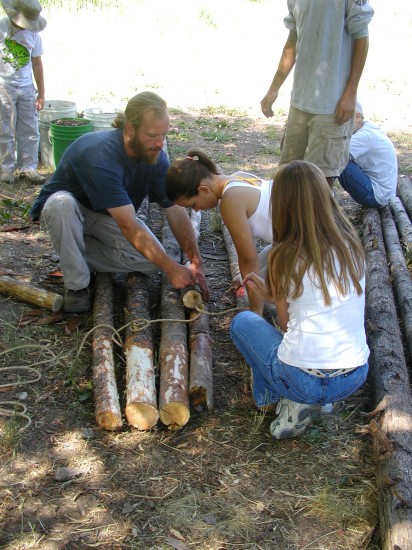
The education program at the Palouse-Clearwater Environmental Institute (PCEI) gives local school groups and community members an opportunity to learn about the natural world while participating in community service. PCEI programs are unique in nature because of their ability to connect state-of-the-art watershed restoration projects with community education. Through a multitude of programs from pond and stream ecology to the Complete Kinder Series, PCEI serves over 1,500 K-university students, teachers, and citizens annually. (more…)

by editor | Apr 14, 2010 | Interviews with Educators & Leaders, Outdoor education and Outdoor School

This interview is the first in a series that will be a regular feature in Clearing. Check back each month for a new interview with a leading environmental educator in the Pacific Northwest.
Saul Weisberg is executive director and co-founder of North Cascades Institute. He is an ecologist, naturalist and writer who has explored the mountains and rivers of the Pacific Northwest for more than 30 years. Saul worked throughout the Northwest as a field biologist, fire lookout, commercial fisherman and National Park Service climbing ranger before starting the Institute in 1986. He authored From the Mountains to the Sea, North Cascades: The Story behind the Scenery, Teaching for Wilderness, and Living with Mountains. Saul serves on the board of directors of the Association of Nature Center Administrators, the Natural History Network, and the Environmental Education Association of Washington. He is adjunct faculty at Huxley College of the Environment at Western Washington University. Saul lives near the shores of the Salish Sea in Bellingham, Washington with his wife and daughters.
Clearing talked to Saul on April 12, 2010:
You were the co-founder of the North Cascades Institute in 1986 and have been its executive director ever since. What changes have you seen in the field of environmental education over the years? (more…)

by editor | Apr 4, 2010 | Forest Education

by Jeremy Solin
Standing next to a monstrous 300-year old Sitka spruce near Clark’s Point of View on the Oregon coast, I try to imagine what the forests in this area were like when Captain Clark and crew passed through here in 1806. Many of us have romantic notions of the halcyon days of the “sea of old growth forests” that existed before European settlement in the Pacific Northwest. I image hemlocks so tall and straight that I can’t see the tops. Sitka spruce so large you could drive a car through them if you could possibly navigate the maze of large downed logs, rotting and returning their nutrients to the soil and providing seedbeds for other spruce and hemlock.
This picture is, in many places, as errant as Clark’s exultation, “Ocian in View! O! the Joy” at seeing the Columbia’s estuary — not the Pacific. A little math will demonstrate why. If this tree, among the largest in the area, is 300 years old, that means that it was only 100 years old during the time of Clark’s hike over Tillamook Head. A 100-year old spruce can be a large tree, but it is far from indicative of old growth. Sure, there were extensive areas of old growth forests that Lewis & Clark saw and passed through, but the “sea of old growth” is as much a romantic fairy tale as “Goldie Locks and the Three Bears.”
Ecola State Park Forest History
These forests and other forests throughout the Pacific Northwest, North America and the world, have always changed, have always been dynamic. The coastal forest of Ecola State Park near Cannon Beach, Oregon provides a good example of the forces that shape forests and the extent of old-growth forests at the time of Lewis & Clark.
Forests of one type or another have existed here for millennia. In a recent study at Ecola State Park, Dr. James Agee found evidence of forests that grew here 45,000 years ago (and possibly between 73,000 and 123,000 years ago) in which the trees were destroyed by inundation or massive debris flows. Between 17,000 and 10,500 years ago forests of varying species existed as the climate warmed and the glaciers retreated. The Sitka spruce and western hemlock forests have existed in the part of the Oregon coast (and much of the Oregon and Washington coast) since the end of the last ice age, about 10,500 years ago.
Since then, the composition of the forest has remained relatively constant, but numerous events have changed the species and age of trees present at a local and regional level. Periods of warm, dry weather between 10,500 and 7,000 years ago encouraged low severity fires that kept the forest more open and favored trees that prefer full sunlight. From 7,000 to 4,000 years ago, a cooler, moister climate (similar to today’s) decreased fire frequency. However, when fires burned, they were very intense and consumed large areas of forest.
The most recent major disturbance in this area occurred approximately 100 years before Capt. Clark stood on the current day Tillamook Head. Through a variety of evidence (including Japanese oral history), it is believed that a very large earthquake struck the Oregon and Washington coast in 1700. The quake likely leveled large areas of forest, possibly including those at Ecola, setting the stage for a massive wildfire the following summer. This story is contained in beach deposits at Indian beach and charcoaled remains in the forest. Results of ongoing disturbance are still visible in the park. From the upturned roots and snapped off trunks of windblown trees to the stumps of a trees cleared from trails, we know that “change is the constant companion of the forest of Ecola State Park. They are forests of change now; they were forests of change during the time of Lewis & Clark; and they were forests of change millennia before Lewis & Clark.” (Agee 2000).
Forests Today
When Lewis & Clark visited the Pacific Northwest, approximately 40 — 70% of the total forest area was old-growth. On going disturbances from wind, lightning ignited fire, extensive human (Native American) burning, volcanoes and earthquakes ensured that there was always some young forest. Today these same disturbances continue with the addition of more human caused events such as clearing land for residential, urban and agriculture and logging. These account for the manor differences that Lewis & Clark would notice in our forests. Some of the areas once “thickly timbered with Pine Spruce Cotton and a kind of maple” have been converted to houses, streets, malls and fields while the amount of old-growth forests now makes up about 10% of the forestland.
Lessons from the forests Lewis & Clark encountered
We now know that forests develop in a particular manner and that disturbance is an important, if unpredictable, part of this process. Forests are dynamic. Understanding past forest conditions and the processes that shaped those forests will help us make decisions about the forests of the future.
We can’t go back — nature is too dynamic (Where would we go back to anyway? The forests of 1900 were different from those of 1806, which were different from those of 1492, …). However, we are moving ahead and the choices we make today will influence the forests for the next 200 years or longer. This quote from Wells and Anzinger (p. 194, 2001) summarizes this idea nicely:
An understanding of the dynamic nature suggests that forests are neither completely malleable nor completely beyond our beneficial influence. Understanding dynamic nature encourages us to take our stewardship seriously, managing actively, but in the fullest possible awareness of the land’s history and likely consequences of our action.
As such, I hope you begin your own “voyage of discovery” whether it is in an old-growth coastal forest, a second-growth Ponderosa pine forest or the urban forest of your school or backyard. The more we understand about the processes that shaped the forests encountered by Lewis & Clark and influence our forests today the better prepared we will be to make the decisions about tomorrow’s forests.
References
Agee, J. 2000. “Historic Forest Disturbance at Ecola State Park, Oregon: Opportunities for Interpreting Forest Ecology and Conditions at the Time of Lewis and Clark.” Oregon Forest Resources Institute, Portland, OR.
Wells, G. and D. Anzinger. 2001. Lewis and Clark Meet Oregon’s Forests: Lessons from Dynamic Nature. Oregon Forest Resources Institute, Portland, OR.


