Special Issue: Understanding Green Schoolyards
Picture a noisy elementary classroom, with bustling kids cleaning up from a morning of schoolwork. Then see the doors swing open and they head outside for some fresh air and play. Some students make a straight line right to their favorite equipment, like the swings. Some head for sports, like basketball or soccer. Still others may skip over to the play structure, start a game of tag or simply race around the equipment.
Does your vision stop there? Some, probably more than you think, need quiet space and decompression time, alone or with friends. Maybe they walk a loop path while chatting about a new pet, or maybe they give voice to their nervousness about an upcoming test. Given the chance, some would stroll over to a table under a tree, carrying a good book or some art supplies. If their school’s leadership is forward-thinking, some kids will head for a nature play area, where you may see them avoid the “lava” while traversing from log to boulder to log. Still others might roam the whole of the area, collecting leaves, twigs, flowers, and cones to craft something at the outdoor building tables.
If you have envisioned all of this, then in your mind’s eye you’ve built a Green Schoolyard. You might also hear terms such as Community Schoolyards and Living Schoolyards, as the concepts are similar – connect kids to nature in their neighborhoods.
“School” is about more than the indoor, classroom environment. A school’s entire campus creates an integrated experience for students, staff, and neighbors, both in terms of
activity and perception.
Green Schoolyards complement academic achievement. There is a significant body of research connecting children’s performance in school and the role that their environment plays. Views of nature, especially trees, from school windows, improve test scores for middle school students. 1
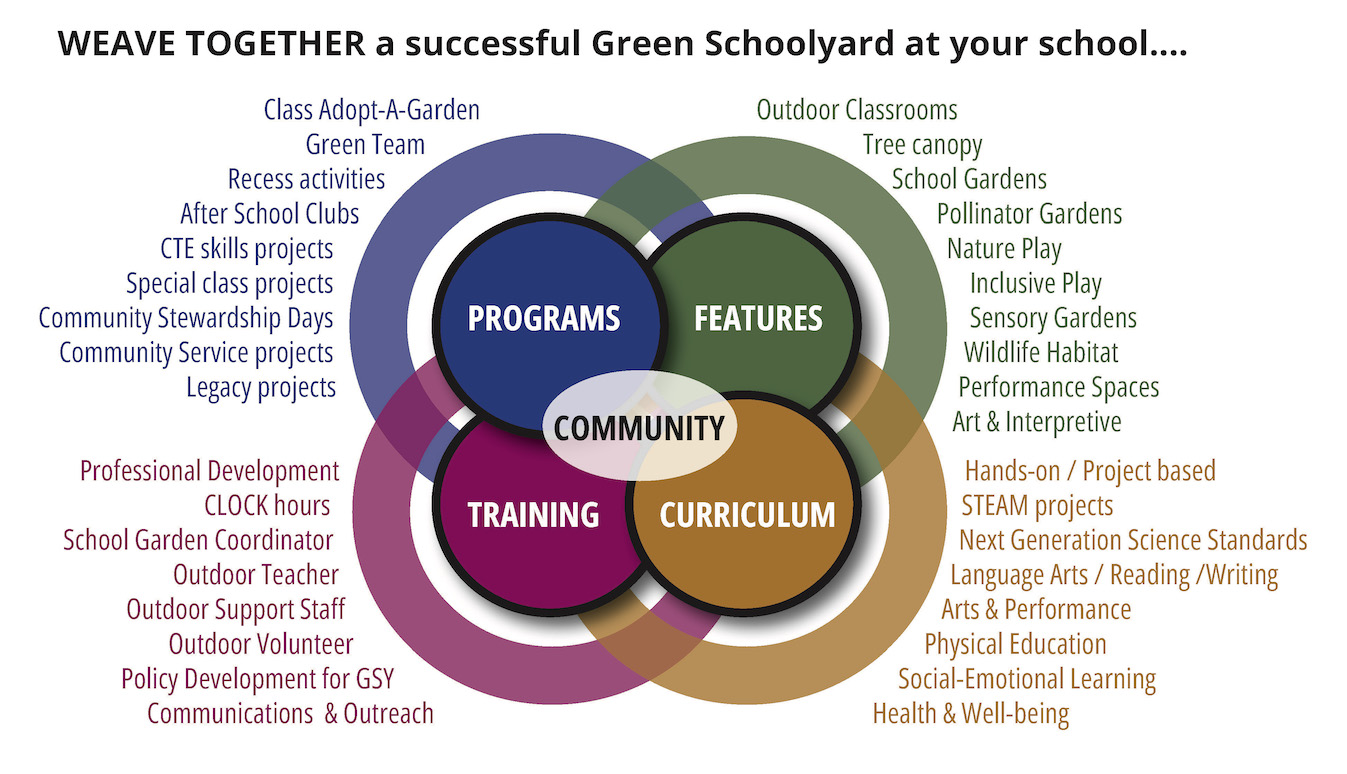
Green Schoolyards vary widely, but at their heart they offer natural elements that contribute to a diverse, safe, and welcoming setting for students and staff. (And, again, neighbors. Green Schoolyards enhance neighborhoods.) They may comprise any number of features, but you’ll mainly find that they promote hands-on learning, social-emotional connectivity, and a harnessing of the calming power of nature. Goodness knows, we need to reduce stress and anxiety while fostering confidence and creativity. Green Schoolyards tip that balance toward healthy development.
To learn more about bringing Green Schoolyard thinking to your campus, please keep reading. The contributing authors will showcase examples of projects, features, programs and ideas to transform any school. —JTK