
Living Soil and Composting: Life’s Lessons in Learning Gardens
by Dilafruz Williams and Jonathan Brown, Portland State University
After we spread the chicken poop, we covered it with hay… the poop was the fertilizer and the hay was the stuff that kept the plants warm. After school I checked the garden. Empty. Nobody. I climbed the fence to check the radishes [I had planted.] I dug around the radishes. They seemed dead. I grabbed a magnifying glass and looked closely at the leaves. Aphids were chewing on the leaves, like ants or other bugs. I went home worried.
Next day [I went to check the garden.] Something red flashed in my eye. I panicked. “Yhaaaa!” I screamed with terror. I looked down expecting to see some poisonous bug. It was a pair of ladybugs, maybe mating. The answer to the radish problem right in front of my face!
-3rd grade student journal (from Clarke, 2010)
This journal entry conveys an eight year old student’s understanding of the web of life: how to use natural fertilizer, ways to warm the soil to create favorable conditions for plant growth, and the role of beneficial insects in a school garden.
Beyond distant field trips, learning gardens provide a locally relevant context for such multi-faceted environmental discovery right on the school grounds where learning is housed; they bring children into contact with a vast biological and cultural web of relations embodied in the living soil of compost.
We celebrate learning gardens as sites for integrated learning that can help students develop an intimate connection with land, insects, plants, and soil through awakening their curiosity, wonder, and critical thinking skills. Life is about more than head and gut; our fingernails, skins, palates, nostrils, and tongues are also important in nurturing deep and long lasting bonds of environmental kinship. In this essay we highlight compost-making as a practical school garden activity that builds living soil and serves as a metaphorical guide for learning about life.
 Where is the Learning in Learning Gardens?
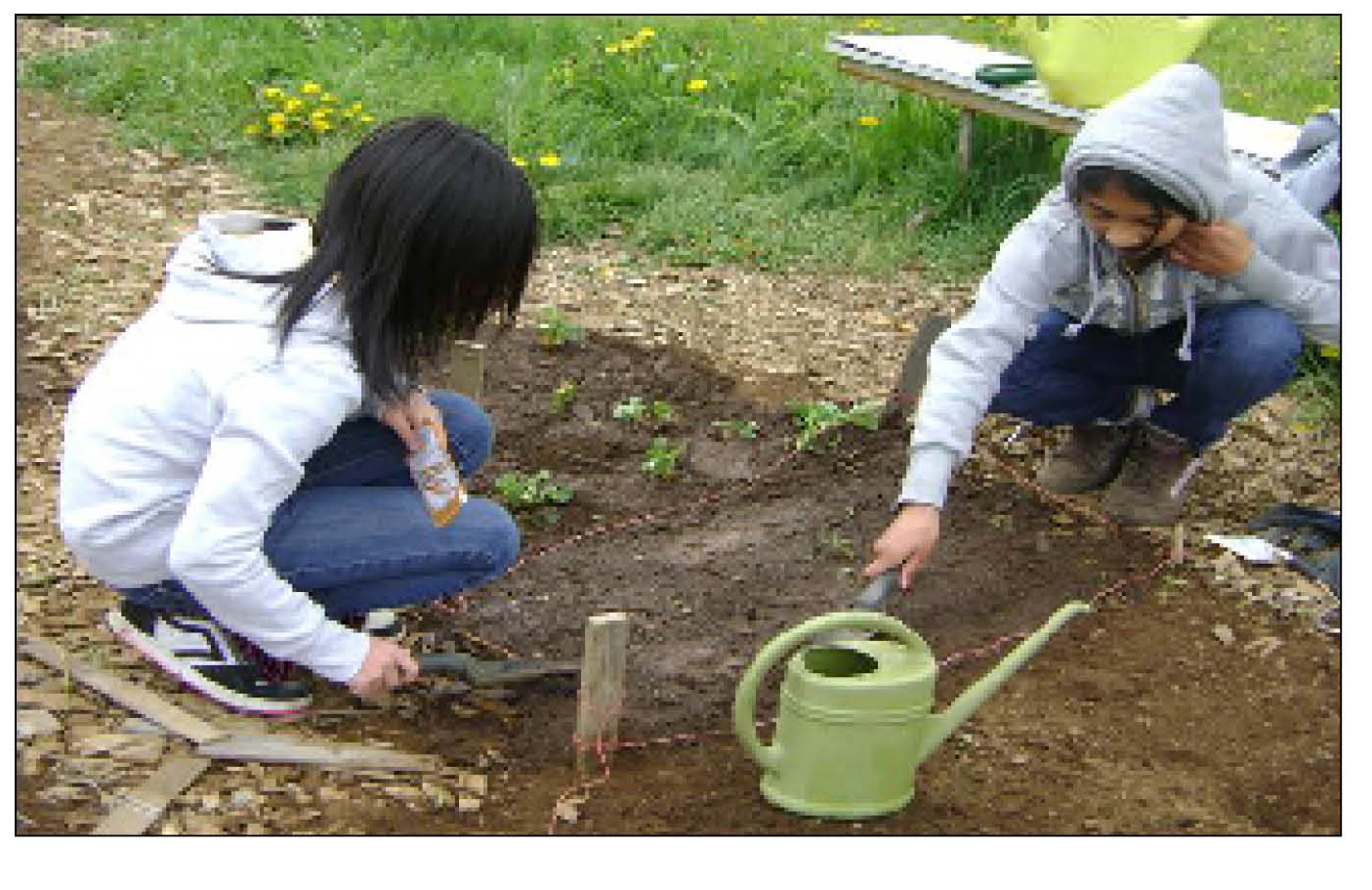
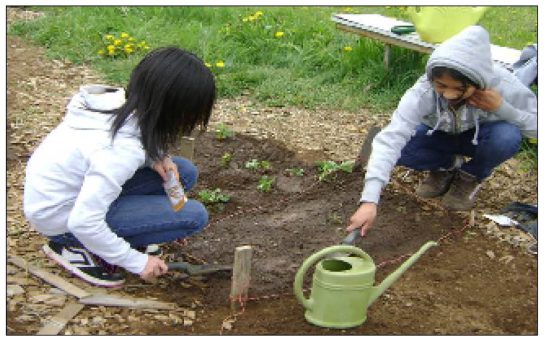
On March 20, 2009, First Lady Michelle Obama joined children from a local public school to break ground on the South Lawn of the White House, establishing an organic vegetable garden with special attention to health and nutrition. In doing so, she has validated the recent surge in the school gardening movement.
Simultaneously, garden-based learning is being supported by state and local curricular efforts to align standards and to provide design support.1
An avenue of environmental education, school gardens are unique as they are located directly on school grounds. This makes for dynamic learning as “the environment” can less easily be separated from daily human activity. Walking through gardens on the way to and from school encourages students to develop a sense of ownership, to connect with the natural world, and to observe subtle seasonal changes, as the opening journal excerpt demonstrates.
Both of us have been involved in the design and development of gardens on school sites and have partnered with teachers, and students of varying ages, to support their learning. Garden-based learning is considered an instructional strategy that utilizes a garden as an instructional resource, a teaching tool that encompasses programs, activities and projects in which the garden is the foundation for integrated learning, in and across disciplines, through active, engaging real-world experiences. In some settings it is the educational curriculum and in others it supports or enriches the curriculum (Desmond et al., 2002, p.7).
The resurgence of school gardens and garden-based learning across the country in school districts large and small appears to have multiple purposes and outcomes: aesthetics, growing food, developing healthy eating habits, rain-water harvesting, interdisciplinary learning, social development, multisensory learning, play, academic learning (particularly science), instilling morals, intergenerational learning, healthy habits, and physical activity (Williams & Dixon, forthcoming). Multicultural gardens have been successfully used as context for teaching about regional cultural history (Kiefer & Kemple, 1998) as well as English as a second language (Cutter-Mackenzie, 2009). Potential application of gardens in education is seemingly endless. This interest in integrated real-world learning has made the school garden an instructional resource and tool as viable as a classroom. As a result, school gardens are often viewed as “outdoor classrooms” (Dyment, 2005). For Parajuli and Williams (2005), the following four-fold framework highlights the role of interconnectedness in learning gardens pedagogy:
- To promote multicultural learning representing multiple agricultural and culinary traditions of the parent community.
- To foster multidisciplinary learning, connecting math, science, social sciences, languages, arts and aesthetics.
- To cultivate intergenerational learning between young adults and their parents, grandparents and other relatives.
- To nurture multisensory learning by involving not only our heads but hands, hearts, skins, tongues, intestines, and palates.
Thus, school grounds can become community hubs that integrate learning across disciplines, generations, and cultures, and get students to think in terms of patterns and connections (Williams, 2008). From our experiences, we offer an illustration of compost-making where students learn about life’s lessons in the learning gardens.
 Composting for Living Soil
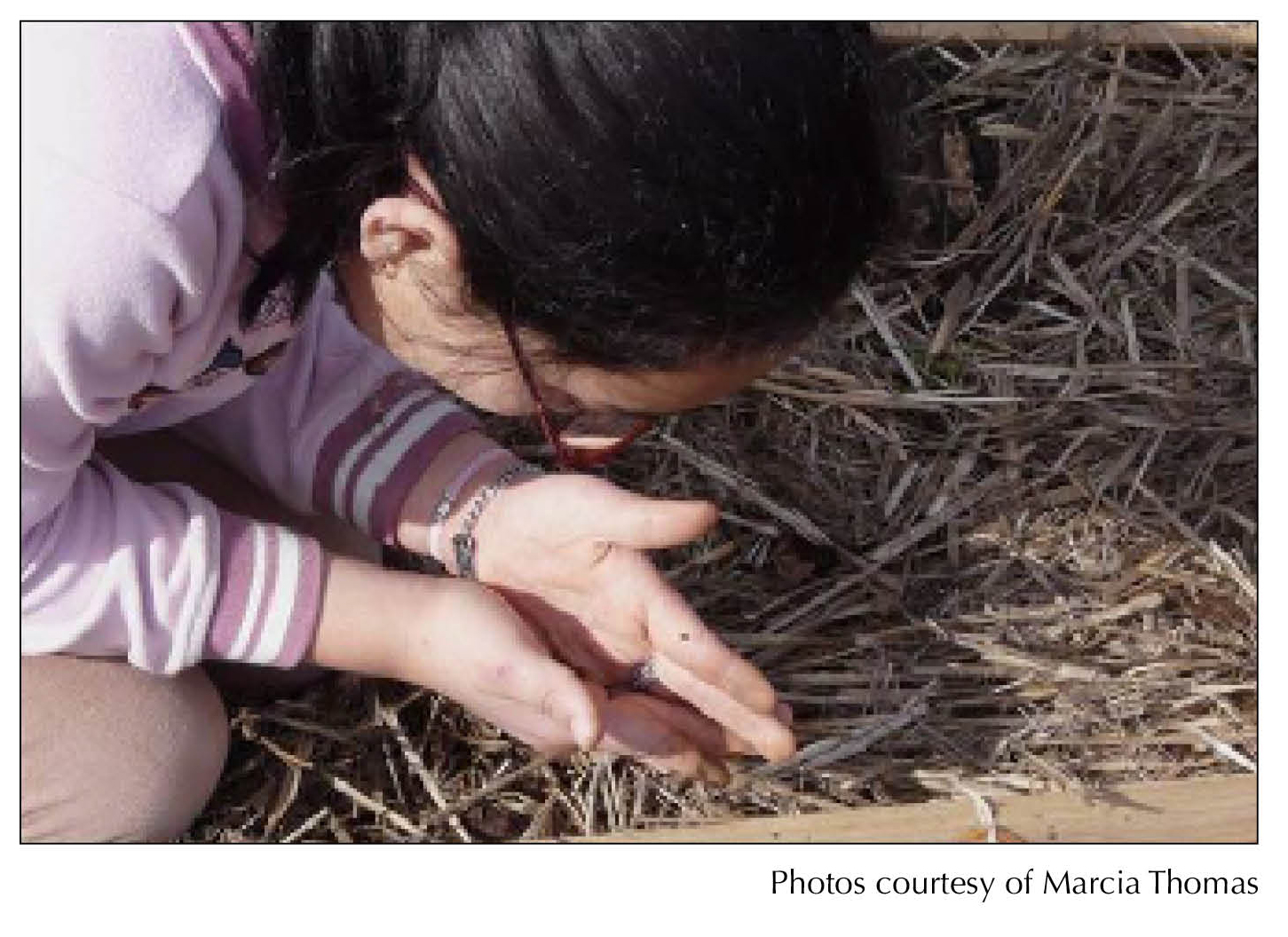
While food is the most palatable product of gardens, compost is the most desirable. Since long neglected soil on school grounds is often nutrient deficient or polluted, active composting makes a contribution to living soil which sustains related human and biotic communities.
Unfortunately, the gardening season is out of sync with the academic school calendar; just as students are arriving for classes, the rich abundance of the summer fades to withering stalks and muddy fields. While this can be an obstacle for educators seeking to integrate gardens into their practice, it presents an opportunity for compost-making, which sets in motion a long-term investment in living soil.
Imagine a fall day in the garden, where 20 6th grade students are busily harvesting ripe produce in small groups led by teachers and community volunteers. There are a number of work stations, including picking pumpkins, mulching fruit trees, and building a fall compost heap. Not many students are drawn to the compost heap, perhaps because it is “dirty”, but eventually two students—Santiago and Katie—agree reluctantly to help Rick, a community volunteer, gather different types of biomass for the pile. The trio retrieves a wheelbarrow and begins to gather fall leaves from the small orchard.
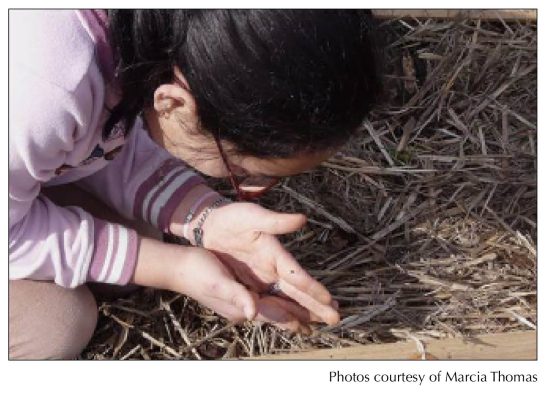
Katie notices that underneath the moist leaves there are many organisms such as millipedes and sow bugs. At first, she is nervous to touch them, but soon overcomes her fear. Rick explains that moist leaves are a natural habitat for decomposers, and that the compost heap that they are building is an ideal home for these organisms to flourish. Santiago gets excited managing to steady the wheelbarrow when it is filled with donated rabbit manure. Though he is first disgusted by the mixture of straw and manure, he soon finds pride in being strong enough in body and spirit to fill and pilot the wheelbarrow.
Back at the compost heap, Katie and Santiago work together to cautiously combine their gathered biomass in a careful formula presented by Rick. Other students notice their project and inquire about what they are doing. Katie explains that the decomposers are just like humans, they need food, water, and air to live. Santiago shows his friends how to add layers of leaves covered with layers of manure. Soon many students are gathered around the growing compost heap, helping to water it and keep it within the bounds of the wooden bin.
Some students are brave enough to reach a gloved hand into a nearby compost heap that is more established; they notice it is hot. Removing their gloves, they remark with surprise that the compost does not smell and that they cannot recognize any leaves or straw in the maturing heap. They wonder aloud how long it would take to transform the rough pile of leaves, sticks, and straw into one that looks, feels, and smells “just like dirt.” The garden period ends and the students and their teacher return to the school building for the rest of their day. But the lesson does not end there. At snack time, Carlos, a particularly observant student, announces to the class that their apple cores can be added to the compost heap; the class community finds a way to collect the cores. Compost now enters classroom walls as students and teacher reconnect with the core of life: living soil. Decomposition becomes as relevant as Composition.
The preceding story is no fantasy, but an account of our actual experience with children building compost in school learning gardens. There is a wide array of curricular material describing teaching various forms of composting in greater detail.2 Below, we present a lesson sketch (adapted from Parajuli et al, 2008):
Lesson: “Living Compost: What is it and how do we make more?”
Description: This lesson introduces students to compost and the biological processes behind it. Students make a simple compost pile and watch as it changes over the next few months. They also closely examine the critters that make compost their home.
Lesson Outline:
10 min. – Introduction
90 min. – Small groups work in three 30-minute rotating stations:
Station One: Critters in the Compost
Station Two: Making a Compost Pile
Station Three: Early Winter Harvesting and Bed Preparation
10 min. – Reflection & Clean Up
Educational Goals /Skills:
1. Learn what compost is and its role in the garden
2. Learn how to identify common compost and soil organisms to appreciate them
Activity Station: Making a Compost Pile:
1. Introduce the cycle of life and the concept of decomposition. Explain that by building a compost pile, we build a home for decomposers.
2. Ask if anyone can describe what a decomposer is or what it does.
3. Introduce the “FBI”: fungus, bacteria, and insects. These are decomposers that will break down the compost pile.
4. Have participants give examples of biodegradable materials that they might throw away at home or at school (banana peel, dried leaves).
5. Ask participants to describe possible reasons to compost.
6. Introduce the “BIG FOUR”: browns (e.g. leaves, straw), greens (e.g. grass clippings, food waste), air, and water.
7. Explain procedures: (1) chop materials to 6 inches or less; (2) mix browns and greens; (3) maintain moisture equal to a wrung-out sponge.
8. Have the group collect brown and green materials in separate piles.
9. Assign students various tasks such as chopping, layering browns and greens, mixing, and watering the pile.
10. Once the pile is built, review basics of composting and why it is important.
Compost-making teaches many lessons such as: change over time, cycles, decomposition, life from death, the role of microorganisms in sustaining life, and food webs. The traditional meaning of the term “harvest” is turned on its head as students first harvest food waste and garden debris with which to build a compost pile, then months later harvest rich soil and earthworms from the bottom of the compost bin. This puzzles students and draws them into the cycles of life: “bugs” become invertebrate partners in helping to break down biomass into a form usable by plants; and compost serves as an intergenerational gift to future students and the school grounds themselves. Plus, they grow seeds in this compost-turned-soil: the miracle of life presents further bounties. Students learn one positive model of environmental regeneration. Via composting, life’s lessons simultaneously surface and find roots in the learning gardens.
As food producing sites often marginal in relation to school buildings and other concrete educational infrastructure, school gardens are islands of biological activity within a sanitized and homogenized school environment. This contrast itself can stimulate critical questioning about the broader community context of learning in relation to life, as a 7th grade student reflects:
It is strange that people can take pride in large lawns and waste their land with simply growing and cutting grass. If we plant gardens instead, and can also grow food, we can bring wildlife and at the same time eat healthy fresh food. I am worried that bees are dying in our region; how will our flowers get pollinated? How will we have fruits? (from Williams 2008)
Thoughtful and critical questions are a key component of the cognitive process: when students are questioning, they are making meaning and seeking to connect new stimuli to familiar concepts. The living soil of school gardens awakens endless learning.
Conclusion
The current educational environment is driven by fact-based curriculum, standardization, and multiple-choice test-taking, all of which stifle children’s curiosity and imagination. Learning gardens provide ample opportunities for students to encounter the unfamiliar; questions, not answers, become the driving motivators for learning. Struck by peculiarity in the gardens, a wondering “beginner’s” mind stimulates an experience of awe and sets in motion a search for answers, as curiosity, wonder, and critical thinking come naturally to children. The living soil of school gardens engages the learning of life’s lessons.
Dilafruz R. Williams is Professor, Leadership for Sustainability Education at Portland State University. She is co-founder of the Sunnyside Environmental School and the Learning Gardens Laboratory in Portland. See www.dilafruzwilliams.com
Jonathan D. Brown is Adjunct Faculty, Leadership for Sustainability Education at Portland State University. He served as instructor at the Learning Gardens Laboratory and co-founded a campus community garden at Simon’s Rock College of Bard, Massachusetts. Contact: Jon Brown at jumpinjonbrown@gmail.com.
PHOTOS: Courtesy Marcia Thomas
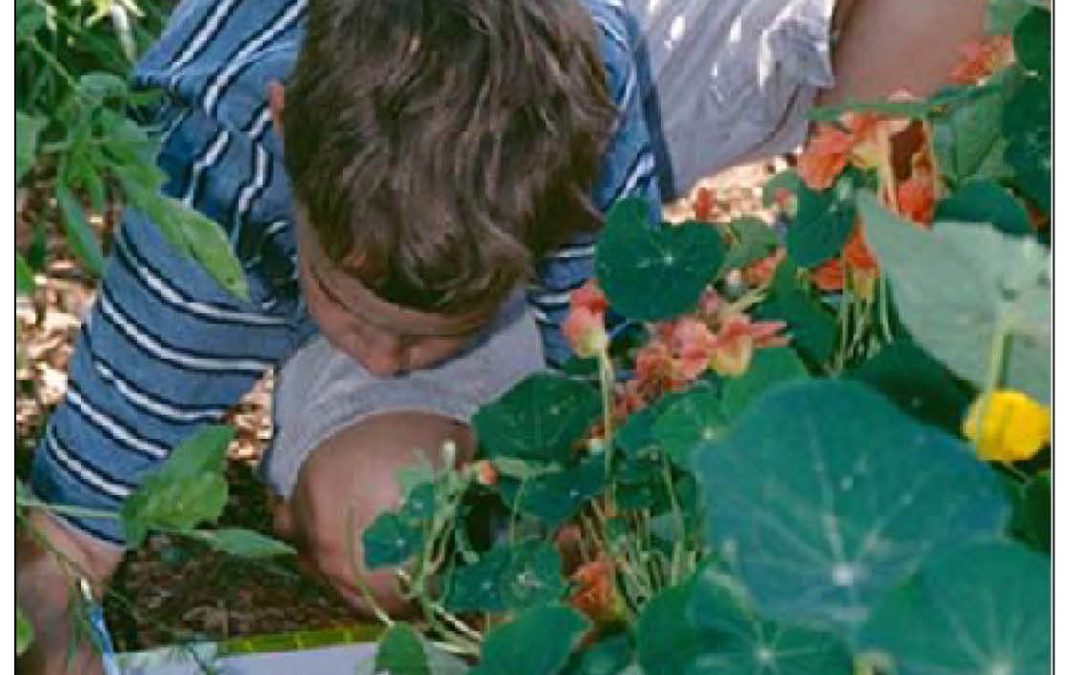
Title: The touch of life
References
Clarke, D. C. (2010). Ethnobotany: A year of schoolyard learning: curriculum review. Unpublished master’s research project. Portland State University, Oregon.
Cutter-Mackenzie, A. (2009). Multicultural school gardens: creating engaging garden spaces in learning about language, culture, and environment. Canadian Journal of Environmental Education, 14, 122-135.
Desmond, et al. (2002). Revisiting garden-based education in basic education. International Institute for Educational Planning, UNESCO, Paris, France.
Dyment, J. (2005). Green school grounds as sites for outdoor learning: barriers and opportunities. International Research in Geographical and Environmental Education, 14 (1), 28-45.
Kiefer, J., & Kemple, M. (1998). Digging deeper: integrating youth gardens into schools & communities. Vermont: Food Works.
Parajuli, P., Dardis, G., Williams, D. R. & Hahn, T. . (2008). Curriculum Development and Teacher Preparation in and for the Learning Gardens. A Report to Oregon Community Foundation, Oregon.
Williams, D. R. (2008). Sustainability Education’s gift: learning patterns and relationships. International Journal of Education for Sustainable Development, 2(1), 45-50.
Williams, D. R. & Dixon, S. P. (forthcoming). Garden-based learning: synthesis of research. A report to the Spencer Foundation.
Notes
(Endnotes)
1 For garden-based learning, see Collective Roots: http://www.collectiveroots.org/garden_based_learning; For development and design of garden curriculum, see Gardens for Learning: http://www.csgn.org/page.php?id=36
2 For comprehensive introduction to school composting, see: School Composting: http://www.ct.gov/dep/lib/dep/compost/compost_pdf/schmanual.pdf
11. 12. 13. 14. 15. 16. 17. 18. 19. 20.
Trackbacks/Pingbacks