
Field-based Inquiry: Developing Comprehension and Memory
Preparing teachers to introduce their students to field-based research in local or regional environments means that these teachers have an inherent need to actually be able to do the kinds of work they plan for their students to engage. Something to think about.
by Jim Martin
It’s a bright, sunshiny day on Oregon’s Salmon River, not far from where it passes by Welches, a small Oregon village. Just downstream, a school bus is disgorging a happy class, who are running down to the river’s edge. Arrived, the students traipse down the path to the river; happy, lugging gear; knapsacks hopping back and forth around their shoulders. Happy class; happy day! They are here to investigate the health of this stream in this particular place; and so, array themselves along the river’s bank; organize into five groups of four; find and arrange their gear, and start to work. Each group has chosen one of five aspects of the stream: Temperature and dissolved oxygen; turbidity; aquatic plant species; sediment grain size; and a transect from river’s edge 100 meters onto the shore to identify plant species. The odd thing about this is that this is their first field trip this year. And the teacher is standing, quiet, further up the stream bank, a slow smile on her face. What is she thinking? What does she know?
Have you ever wondered how natural areas develop and express a coherent view of a place which is as it should be?
Have you ever attempted to explore that thought; conducted an inquiry of your own into what is there, and how it works?
One more question: Have you ever stood looking over an urban or suburban area, and wondered if it actually works for your benefit?
 What is Field-Based Research?

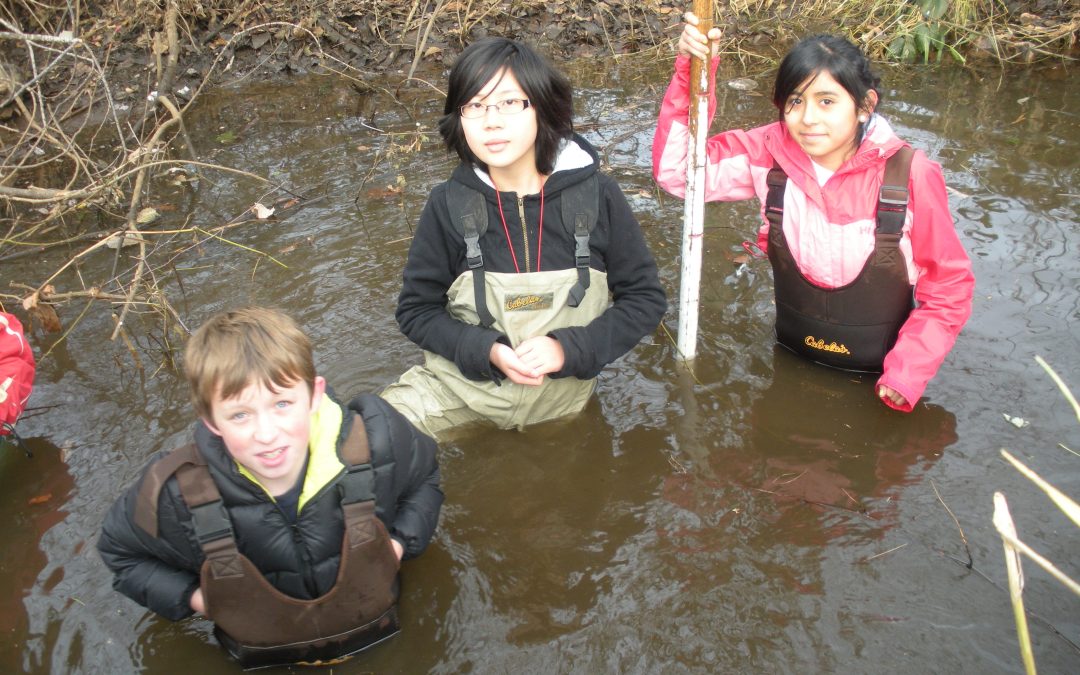
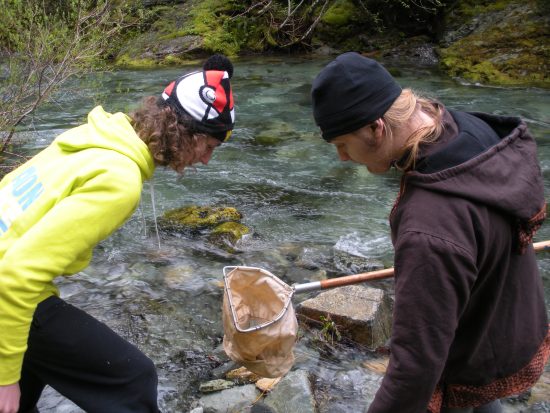
Field-based research with students is a relatively recent phenomenon which immerses the brains and bodies of teachers and students in a milieu of conceptual interactions with concrete elements of a natural area which ultimately converge to produce people who comprehend, interact with, and appreciate, the species and ecosystems they visit, or live within. How does it do this?
Good question. Try to envision how this would operate in a school classroom, without googling or searching for information to respond to that question. How many of us left our last school, college, or university, with not only a clear understanding of the species in the ecosystem we inhabit; but, the experience of sitting on a river bank, holding a temperature probe, ready to measure the temperature of the water next to the shore. Knowing why you’re doing this.
This might seem unattainable; but, a few hours in a natural area, with a well-prepared teacher, and some classroom prep in how to use most instruments; and, in the species who live there, can do it. And, using this active learning approach to education uses our brain in the way itevolved to do just that: Look about. See. Think!
This method of teaching new material involves active learning, in which students, after a brief introduction to the topic under study, engage in self-directed discussions, development of questions which need answers, active planning for activities directed by those questions, development of group roles and ways to work together effectively; and, finally, self and group assessment. When we take students, and teachers, into a natural area to engage in research into an ecosystem and its inhabitants, we open a door to this very human, and very effective way that our brain and body are organized to work together to discover, learn about, and comprehend, the components of this place: Who they are, what they do, and how they do this in cooperation with all the pieces of this particular place. Understandings that humans developed thousands of years ago; and which are slowly being re-learned by today’s humans.
Before the class’s field trip to the natural area, they spent three classes engaging as much of the field work as they could without being on that river bank in order to learn the observational skills they would need on site. On one of those days, they made their observations on a creek which flowed through the west edge of the school grounds. By their third day in the creek and lab, all of the students had introduced themselves to each of the sets of equipment, books, etc., and now will focus on one set, describe where they will be on that streambank, and how they would organize themselves and their gear to do a good job while they are on site. During all this work, as they observed in the creek and in the lab, practicing their skills, each student, and each group, discovered they were growing; working together, figuring things out, learning about their own capacities in this new world they had engaged.
 Then, the Temperature and Dissolved Oxygen group gathered together the five temperature and dissolved oxygen samples they had collected on the creek behind the school the day before, each from a different part of the creek. They brought each sample, one at a time, to their lab table, unscrewed the lid of each container, carefully let the probe into the container, and recorded the data presented: Temperature, or Dissolved Oxygen. They did this for each of their five samples, then used a graph to plot their data. The data, as plotted, is shown in the figure here. Their job at this point became how to explain the shape of their curve. They had made careful descriptions of the five stations when they made their water collections in the creek on their school grounds, and noted that there was a small fallen tree near Station 3, which disturbed plants, animals, and the bottom at that site. They decided that the slow rise at Station 4 simply indicated a recovery process might be in place; and, they would measure dissolved oxygen at Station 4 when they next visited the creek.
Currently, the U.S. is way behind in slowing climate change. Today’s students need all the assistance they can find in order to understand this fact, and its consequences for them in their lives.
Field-based science inquiry has proven itself over the past few decades to generate understandings which lead people to do their part in alleviating global warming’s effects. As noted in numerous articles found in CLEARING, and performed by teachers who have worked with organizations like the Diack Ecology Education Project1 to build their skills and understandings. We need to be prepared to increase the comprehension and dedication of a much larger segment of students in school today.
We, and our Primate ancestors, learned this way of looking at our world by interacting with it. As Archie Diack2, the founder of the Diack Ecology Education Program, said, more than once, “When we get our hands dirty, we begin to learn about the environment we live in.” When we hold a temperature probe in place in a stream, read the reported temperature, and set the probe down in order to pull out a pen to record it in a notebook, we are physically engaging thoughts and actions in the “Real World”—that physical place outside our body or classroom. Those actions produce a key to unlock the place in our brain which supports critical thinking, and long-term memory; the prefrontal cortex, or PFC. It all starts when we “place our hands on . . .” . That simple act sets our critical thinking processes in motion.
When we engage our mind in critical thinking, the PFC sets up a free place for this work and its storage, and a group of neural addresses which point to relevant information on this thing you want to know about. It does this, not to tell us what to think; but, to provide access to information, to suggest steps to take in order to accomplish your thinking, and memories from your current work that you’ll want later. In effect, the PFC helps you to set up what amounts to an office in your brain, and a strategic plan to learn this place you are working and thinking within. This same phenomenon can work in classrooms also, but is rarely employed.
Now, back to action! We left the teacher, a slow smile forming, and her students, organizing their work. Let’s get back to them. They are engaged in a sampling of a teacher-organized, student-centered, project to help students to comprehend the place of natural ecosystems in our worlds, and their place within them.
 Back on the stream bank, the student groups have decided just where their particular station would work best; and, have begun to discuss how to set them up. As a class, they, not their teacher, are deciding just where each group’s station would work best. We’ll follow the Water Temperature and Dissolved Oxygen team, who are setting up a 30-meter reach along the river bank, adjacent to where a set of rocks in the stream near the shore, a growth of rushes and grasses in the water, and a strand of sand beyond the beach, will provide a variety of microhabitats which might affect the temperature and dissolved oxygen in the water in the stream along their reach. Before they started this field trip, in the classroom, they researched, thought, and finally decided to relate temperature and dissolved oxygen to the health of the stream itself, and for the organisms living there. So, this decision will focus the work that they do.
They decided to form two subgroups, one to do the temperature work, the other to do the dissolved oxygen work. The make up of each subgroup was decided by each student declaring what he or she preferred to do, then accommodating where possible. Then, they went to work. During the time they made and recorded their observations, they made minor decisions among each subgroup when a small tweak needed to be made in their work. And, so, they carefully measured and mapped their sampling stations in their notebooks, naming them by their polar coordinates. (Something they dreamed up!!) They also described their sites, and detailed the reasons for placing things where they are.
All this time, the teacher was moving up and down the class’ reach, responding to questions and encouraging their good work and thinking. When time was up, students gathered their materials, and moved back to the covered area on the shore, with the tables and benches they would need when they set things down; and, prepared a preliminary report on their work, findings, and interpretations. Each of the five groups decided on their part of the report. They agreed to calibrate the report when they were back in school.
 Each of the five classroom groups decided on their part of the report. They agreed to calibrate the report when they were back in school. Throughout their work, members of each group began to clarify relationships, the nature and specifics of the work, the meaning of what they were doing, and their own individual development into an effective member of their group. Students discovered that they are a powerful arrangement of people, ideas, and materials which can work together to accomplish worthwhile things. They learned that they could pull two or more pairs together as needed to build effective work groups. Plus, they learned that, when we begin to discover our own capacity while we are working, we discover that we are becoming people. This work, and events, may look or be different for each class, but together are usually equally effective.
The main reason these students were able to accomplish so much within a 4-hour field work period lies in the way their teacher organized her delivery. She has used active learning delivery techniques for three years now, and is very comfortable with them. One of the things she did was on Day One of the school year, arrange to have her students organize themselves into pairs. She did this by giving each student a Partner Calendar, a mostly blank sheet with spaces for writing “Time”, “Partner”, down the sheet until they had done ten spaces, with times beginning about 8:00 AM, until ending at 5:00 PM. Then, she asked the students to go around and introduce themselves to one another; and, while they were doing this, ask for, and fill out, a Calendar “Date”. As the class did this, she walked around and noticed who was totally involved in the activity, and who was either perplexed, or seemed bored. She talked to each of them individually, asking them how they thought this might work to organize effective work groups. This was one of the steps she used to build strong, effective groups. Students, many of whom had never met, began to know one another. This seemed to work each of the three years she had done it; and, that seemed to be true this day also.
When all the work of signing up seemed to be done, she asked the class to get together with their 2:00 Dates, and then brought these pairs out into the lab to take first steps for some work they would do. She asked each pair, a dyad, to get together with another pair to form a tetrad, a group of four. Each tetrad selected and went to a particular table. When they were at their tables, the teacher let the partners know that, in about three weeks, they would be going out to a river near the Columbia Gorge, between Washington and Oregon. Meanwhile, each week, they would spend one day in the lab, preparing to use the equipment they’d need to examine the river.
What did the teacher know? She knew from her teacher education preparation, and from two workshops she had attended three years before, that teacher lectures and assigned homework did not produce students who were involved and invested in their learnings. So, she attended a workshop focused on active learning, and a light flashed in her mind; she suddenly “got it!” Organize the teaching environment, now matter where it is, and organize what the students do so that it will raise questions in their minds. She knows now that they will heartily engage those questions; and, in doing so, will learn more than she could teach them using didactic methods. She had discovered learning as our brain is organized to do just that.
1 A program (https://www.diackecology.org/) which provides training for teachers, funds for equipment to use in natural areas, and basic funding for transportation to study sites.
2. Archie Diack, the founder of the Diack Ecology Education Program. The family of Arch W. Diack established the Diack Ecology Education Program to encourage teachers to involve students in student field-based research and ecology. The Diack program seeks to inspire a combination of experiential education and authentic science in order to spark interest in a scientific understanding of the complex ecosystems of the natural world.
 Jim Martin is a retired but still very active science educator who has written a remarkable series on finding science lessons in your community for CLEARING. You can find them at www.clearingmagazine.org.Student