
A linguistic “ecosystem”: Word study methods for outdoor education
by Sam Rubin
samrubin19@gmail.com
Once the students had settled on the benches of the Pond Shelter on IslandWood’s campus, I unfolded my large butcher paper with the word “macroinvertebrate” written in large letters.
“What does that say, macrinovirbatalalalate?”
“Microscope?”
“Macaroni and cheese!”
A chorus of giggles emerged as students wondered if we were going to study macaroni and cheese. I gave them space to explore this idea, excited about their joy as we began to engage in word study.
~~~
In my experience teaching in elementary school settings, a significant barrier in science sensemaking and understanding is the perception and reality of complicated scientific language. A student might see the word “macroinvertebrate” and receive an explanation of what it means, but the length and perceived complexity of the word blocks recall and connection to other words. Thus, a student might not see themselves as a scientist because they feel they lack the understanding and language to form that identity. While scientific words are lengthy and morphologically intricate, this structure makes them ripe for linguistic study.
I have always loved words, a love that was solidified as I began my studies of linguistics in college. After graduation, I found a job teaching kindergarten at an elementary school in the San Francisco Bay Area. To my pleasant surprise, the literacy curriculum at this school was grounded in linguistics, with kindergarteners learning words such as “grapheme” and “phoneme,” and engaging in a daily, interdisciplinary practice of morphological and etymological inquiry. This instructional method is deemed “Structured Word Investigation,” or SWI, based in research on effective morphological instruction (Bowers and Kirby, 2010). When I began my graduate studies teaching intersectional environmental education at IslandWood, I noticed myself engaging in SWI practices for sensemaking in this new context. I wondered if the same word study practices I employed in the classroom could be applied to outdoor, field-based science education.
 SWI blurs the boundaries between science and literacy in novel ways. The scientific approach of noticing, wondering, and analyzing word data in literacy instruction challenges the notion of science as a discrete and exclusive endeavor, while using literacy practices in science construct deeper understanding. Additionally, the study of words creates space for multilingual learners to share their expertise. Perhaps a Spanish-speaking student knows a Spanish word with a Latin base that illuminates the meaning of a challenging morpheme, or two Lushootseed words for different more-than-humans illustrate a connection that clarifies a Western science conception.
In this article, I will share two SWI word studies I reasoned through with a wonderful group of students. Since every word study is different, I choose to share these as two vignettes rather than a context-lacking list of tips. I do hope that outdoor educators can use this article as both motivation and a toolbox, so techniques and curricular questions are inevitably included in these vignettes. At the end of this article are various resources to help you get started!
Day 1: “ecosystem”
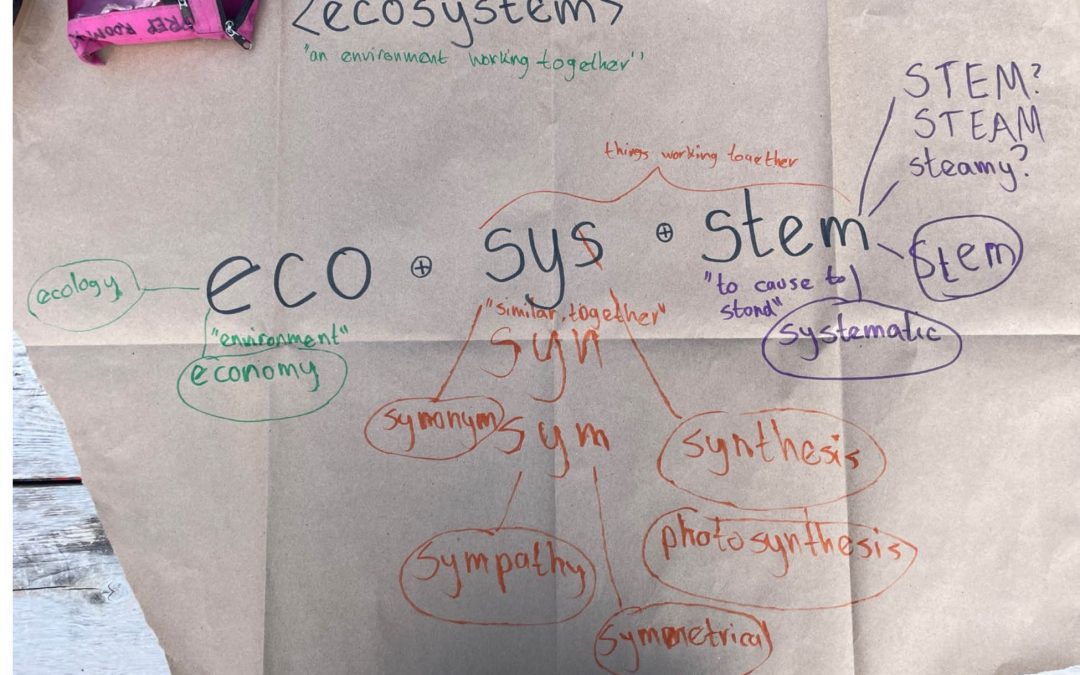
When I meet a new group of students, I often ask them,“What is an ecosystem?” I usually do this by taking students to some of the different ecosystems IslandWood has on its campus, examining biotic and abiotic factors, and perhaps asking students to find similarities between themselves and the ecosystems they explored, to build a stronger connection to land. In planning for my week of word study, I looked up the etymology of <ecosystem> on etymonline.com (a SWI teacher’s favorite resource), finding that the base <stem> in <ecosystem> comes from the Greek word histanai, meaning “cause to stand.” From previous word studies, I know that the prefix <sy-> is an reduced form of the prefix <syn-> (sometimes appearing as <syl-> and <sym->), meaning “with, together.” To scaffold this word study for my students, I wrote the word sum “eco + sy + stem” on a large piece of butcher paper, folded it, and placed it in my backpack.
At the end our first field day, after some free explore time in a forest ecosystem, the time felt right for a word investigation. Sitting on the ground, logs, and stumps, students examined the butcher paper and awaited instruction.
My first question, as in any good scientific investigation, was, “What do you notice?”
Students shared that they knew about the prefix “eco-“, defining it as “environment.” Another student said a <system> is when “things work together.” A visibly excited student exclaimed, “So an <ecosystem> is when the environment works together!”
I was already thrilled about the direction of this word study, and wanted to go further. I asked students what they wondered about the word, and a student asked if it was connected to “STEM.” We talked about what the acronym stood for, and even though it wasn’t necessarily connected in meaning to the base “stem”, I still wrote it down, because it was a part of student sensemaking. Another student wondered if it was connected to the stem of a flower. I asked students what a flower stem does.
“Brings water and nutrients to the flower!”
“Protects the flower!”
“Makes it stand up!”
I couldn’t have said it better myself! The group decided that the definition of the base <stem> was “stand up,” and I wrote it down.
At this point, we had two out of three morphemes figured out, and it was time to tackle the pesky “sy-” prefix. After some think time, a particularly scientific student yelled out “photosynthesis!” Not usually the first word I see in this word study, I was more than happy to write it down and indicate further connections to science. Another student added “synthesis” to our list. The chaperone, a math teacher, asked students what it means when a shape can be split into two mirror-image parts, and like a lightbulb turning on, half the students cried “symmetrical!” Thinking about other words they learned in school, one student shared the word “synonym” and another “sympathy”. We had a good list of words going, so we moved on to thinking about commonalities between words.
“All these words mean something about being similar, or together!”
“Oh! So an ecosystem is when the environment stands up together!”
“Yeah, but maybe ‘stands up’ in this word means something like supporting or working together.”
I took this opportunity to ask my favorite question: “So, how are we an ecosystem?”
Quiet. Then, a brave voice.
“Well, we all work together, and support each other to help each other stand.”
“Yeah! And we all stand up for each other!”
What began as a vague, science-y nature word suddenly became a meaningful, connected, and motivating idea. Through every student observation, question, and synthesis, we were building a deeper understanding of both language and science, grounded in our outdoor context.

Figure 1: Recorded evidence of our investigation. I crossed out the accidental extra “s”, and made a show of adjusting my understanding after a mistake! Photo by Sam Rubin.
Day 2: “macroinvertebrate”
Once the students had settled on the benches the Pond Shelter on IslandWood’s campus, I unfolded my large butcher paper, with the word <macroinvertebrate> written in large letters. We were about to investigate various freshwater macroinvertebrates to assess the pollution level of the pond.
“What does that say, macrinovirbatalalalate?”
“Microscope?”
“Macaroni and cheese!”
A chorus of giggles emerged as students wondered if we were going to study macaroni and cheese. Sensing the challenge in a large group discussion, while also hoping for students to apply some of their knowledge from our “ecosystem” investigation, I prompted them to work with a small group and write down some ideas in their journals. I asked them to write down what they noticed, what they wondered, and perhaps hypothesize a word sum (since I hadn’t split the word into morphemes this time).
After some writing and pair-share, a student pointed out that they recognized the prefix “macro-” as the opposite of “micro->, like in “microscope”, and another student clarified that “macro-” means “big.” Another student noticed <invert>, having seen the word “inverted” before. Another student noticed the prefix “in-“, and thus we are left with the base “vert”. All these ideas (along with “macaroni and cheese”) were written on the butcher paper, so students (and I!) could track the discussion.
At this point, we are left with the base “vert”. While not a word itself, like the base “stem” in “ecosystem”, “vert” might appear in many words an elementary school student might see. We call this a bound base, since it must be bound to a prefix, suffix, or other base to make a recognizable English word.
I had done some research about “vert” using Neil Ramsden’s Word Searcher, a helpful tool for finding words with similar structures to a base of interest. It is important to remember, though, that a word may share the same structure as the base, but have a different meaning, such as “overtake”, a compound word combing “over” and “take”. It is vital to always check for both when planning a word study.
In uncovering the meaning of “vert”, I prompted the students with some ideas. Perhaps in math they learned about “vertical” axes or a shape’s “vertex”, in social studies read about religious “converts”, or in SEL class thought about whether they were more “extroverted” or “introverted”. As they uncovered these words, a student had an idea that these words had to do with “angles” or “turning.” Their idea aligned with the Latin root vertere meaning “to turn.” Suddenly, the word “vertebrate” that one student has also pointed out made more sense, as the place where someone’s body “turns.”
Now, as the group looked at the word <macroinvertebrate> they notice denotations of “large,” “not,” and “turn” within the word, along with a connection to backbones, and the larger, unfamiliar word becomes a conglomerate of small, familiar morphemes. One student hypothesized that the definition of a macroinvertebrate could be “a large creature that can’t move in a certain way because it doesn’t have a backbone,” followed by many nods of assent from their peers.

Figure 2: Recorded evidence of our “macroinvertebrate” investigation. Photo by Sam Rubin.
When we were exploring the macroinvertebrates at the pond after our word study, I experienced a much richer pool of observations around the ways these creatures were moving and turning, what protections they had, and their relative size. Our word study both gave students tools to be more active readers while also engaging their scientific minds.
—
“What were those little bugs we saw at the pond called again?” A student wondered as we were walking to their lodge, preparing for departure.
“OH! Umm, I think it started with an ‘m’, like m…a…c…r…o…” her friend responded.
“MACROINVERTEBRATES!” they yelled in unison.
I smiled, observing this too-good-to-be-true assessment of their new linguistic knowledge. Not only did they recall the name and meaning of this large word, but also were able to begin to spell it out! I knew that engaging in frequent word study in the classroom was an effective literacy tool, and now could see evidence of just two days of scientific, contextual word investigation.
I challenge educators, especially outdoor educations to really spend time with the word-related questions students ask. The only tools you really need to facilitate these are curiosity and a proclivity towards saying “yes, and…” (traits of any effective outdoor educator). It is okay to get things wrong–I often will return to a previous day’s word study clarifying a mistake I later realized I had made, which only contributes to the student’s learning and development of trusting relationships. If you have a word in mind, do some research on Etymonline, but don’t expect all the answers there! The most exciting learning occurs from engaging in scientific word study with students themselves.
Resources
- com: A master of SWI and word study, Rebecca Loveless shares more background and implementation of SWI curriculum.
- Words in the Wild: A literacy- and exploration-based outdoor education center that provides ideas of scientific, contextual word study.
- Etymonline: An “online etymological dictionary” helpful for word study research.
- Neil Ramsden’s Word Searcher: A tool for finding words that share prefixes, suffixes, and bases.
References
Bowers, P. N., & Kirby, J. R. (2010). Effects of morphological instruction on vocabulary acquisition. Reading and Writing, 23(5), 515–537. https://doi.org/10.1007/s11145-009-9172-z
Credits
Sam Rubin is a field instructor and graduate student at IslandWood’s Graduate Program in Education for Environment and Community in partnership with the University of Washington.