
Teaching Biodiversity Through Local Landscapes:
Salmon, Storying, and Place-Based Learning
Authors:
Poh Tan PhD (UBC, Exp. Medicine), PhD (SFU, Education)
Scientist, Researcher, Educator, Author, Entrepreneur
Non-Regular Faculty, Research Associate, Institute for Environmental Learning; Founder and CEO, STEMedge Academy
Jennifer Wong
3rd Year Student, Visual Arts, Emily Carr University of Art + Design; Certificate of Visual Arts, Vancouver Island School of Art
Sarah Martin
Undergraduate Year Student, Emily Carr University of Art + Design
Lennox Johnston-Yu
4th Year Undergraduate Student, New Media and Sound Art Major, Social Practices and Community Engagement Minor, Emily Carr University of Art + Design
Abstract
In the Cascadia bioregion, biodiversity education is inseparable from watersheds, seasonal cycles, and Indigenous place relations. This article offers a place based case study from my classroom in Vancouver on the unceded lands of the Musqueam, Squamish, and Tsleil Waututh Nations. Grounded in Vision III scientific literacy and guided by seascape epistemology and the Pedagogy of Aloha, the work centres an interdisciplinary student artwork, Salmon Remember, Salmon Return, Salmon Run. The project braided ecological science (salmon as ecosystem connectors and nutrient vectors), urban watershed history (buried streams and grey infrastructure), and arts-based storying as a method of learning. Findings are presented as a practice narrative with transferable teaching moves for environmental educators across the Pacific Northwest and Cascadia, including a “Teaching Biodiversity through Local Landscapes” sequence adaptable to outdoor classrooms, garden projects, and community rooted learning.
Roots begin under our feet: a watershed you cannot always see
 The place now called Vancouver sits on the ancestral and unceded lands of the xwməθkwəy̓əm (Musqueam), Sḵwx̱wú7mesh (Squamish), and səlilwətaI (Tsleil Waututh) Nations. Only about 150 years ago, this region was a dense rainforest stitched together by streams, creeks, and tidal flats. At the heart of this waterscape was Snauq (False Creek), a place of congregation whose later industrialization and urban expansion filled wetlands and channelled living waters into buried conduits. Today, more than 117 streams in Vancouver are considered “lost,” and many remaining waterways are threatened by further erosion and development (Martin, Wong, & Johnston-Yu, 2025).
To respond to this history of enclosure, environmental and sustainability education in Cascadia must do more than teach about ecosystems; it must invite learners into an ethical relationship with place. Place based education has long been framed as both pedagogical and political, shaped by the twin responsibilities of decolonization and reinhabitation (Gruenewald, 2003; Greenwood, 2008). In practice, that means learners do not only “learn outside.” They learn with and through place as teacher, attending to what a watershed remembers, what it sustains, and what it has been forced to carry.
This is also why “sense of place” matters as a learning outcome, not just a feeling. Sense of place can be taught, observed, and assessed through changes in meaning, attachment, and responsibility, especially when learning is situated in local landscapes with layered ecological and cultural histories (Kudryavtsev et al., 2012; Semken & Freeman, 2008).
Vancouver’s buried waterways are not only a local curiosity. Across the Pacific Northwest, urbanization has repeatedly produced degraded stream conditions that show up in consistent patterns of hydrologic alteration, habitat simplification, and biological impairment, often described as the “urban stream syndrome” (Walsh et al., 2005). Buried and culverted stream segments can create abrupt transitions in habitat and biodiversity, fragmenting ecological connectivity in ways that are difficult for learners to perceive without guided inquiry (Hintz et al., 2022).
In my teaching, this place based shift is carried by a seascape epistemology, a fluid way of knowing that refuses hard boundaries between mind and heart, self and watershed, classroom and community (Tan, 2024). It is also guided by the Pedagogy of Aloha, a Hawaiian epistemology grounded in stewardship and Aloha ʻāina (love for the land), where teaching is a lived practice of care and reciprocity rather than the delivery of content (Kahakalau, 2022, Tan & Wangsadyjahja, 2026). In Spring, when “roots and renewal” are more than metaphors, my students Jennifer, Lennox, and Sarah and I turned to salmon and streams as teachers.
Salmon are not only a species; they are connective tissue across Cascadia. Pacific salmon link ocean, river, forest, and community through nutrient transfer, food web dynamics, and habitat engineering (Gende et al., 2002; Naiman et al., 2002; Schindler et al., 2003; Walsh et al., 2020). Salmon derived nutrients can extend beyond the stream into riparian forests, influencing growth and productivity and reinforcing the idea that “biodiversity” is always cross boundary and relational (Helfield & Naiman, 2001).
For Cascadia educators, salmon can hold multiple curricular threads at once. As a biodiversity story, salmon make interdependence visible by linking aquatic insects, riparian plants, birds, mammals, estuaries, and ocean food webs through movement, nutrients, and relational webs of life (Gende et al., 2002; Naiman et al., 2002). As a place story, salmon runs are always local and particular, shaped by specific streams, estuaries, and histories, yet they also carry a shared bioregional identity across the Pacific Northwest coast (Schindler et al., 2003). As a seasonal story, salmon make cyclical time teachable through return, spawning, emergence, out migration, and the quiet work of regeneration that unfolds beyond a single lesson or unit. When students learn salmon only as content, salmon becomes a diagram. When students learn salmon as a living relation within a watershed story, biodiversity becomes felt, not only known.
From Vision I and II to Vision III:
Scientific literacy as relationship
A recurring tension in environmental education is the gap between knowing and doing, between scientific information and lived responsibility. Vision III scientific literacy offers one way through that gap by insisting that science learning is always contextual, cultural, and ethical, and that it must grapple with power, place, and pluralism (Roberts, 2007; Sjöström, 2024). In a Vision III stance, multiple sciences are recognized, including Indigenous sciences, and Eurocentric science is treated as one powerful way of knowing rather than the only authority.
This matters in Cascadia because the ecological crises we teach, salmon declines, habitat fragmentation, contaminated waters, are not only scientific problems. They are relational problems, governance problems, and story problems. Which histories become invisible. Which place names are forgotten. Which futures feel possible.
A decolonizing science education agenda in Canada has also emphasized the need for sustained collaboration and structural change, not one off “inclusion,” when Indigenous knowledge is engaged in science learning (Aikenhead & Elliott, 2010). Vision III helps name what many educators already sense: if learners are to participate in renewal, they need more than information. They need relationship, humility, and accountability.
Seascape epistemology and the Pedagogy of Aloha:
How we teach toward renewal
Seascape epistemology, as I describe it, is learning that moves like water: non linear, relational, and boundary refusing (Tan, 2024). Practically, it means I design learning experiences that let students cross borders between classroom and shoreline, data and story, analysis and artmaking, cognition and care.
The Pedagogy of Aloha (Kahakalau, 2022) helps name the ethic underneath those designs. It frames teaching as stewardship driven by Aloha ʻāina, centring reciprocity, responsibility, and love for the land as legitimate sources of knowledge and action (Tan & Wangsadyjahja, 2026). In a Cascadia context, this stance aligns well with place based education’s insistence that the local is not neutral. Place is contested, storied, and shaped by ongoing responsibilities (Gruenewald, 2003; Greenwood, 2008).
The classroom story:
Jennifer, Lennox, and Sarah as co learners of place
Jennifer, Lennox, and Sarah entered my classroom as artists and designers learning environmental ethics through a local lens, each bringing a distinct practice that shaped how we approached salmon and streams as teachers. Lennox is a New Media and Sound Art major whose work revolves around music, live performance, and the craft of audio mixing and mastering, often learning through iterative experimentation and self directed technical study. Sarah is a third year Visual Arts major who moves between mediums, with a particular love for charcoal and gouache, and a draw toward abstraction, pattern, and playful visual “messiness” that holds emotion without needing to explain it. Jenn is also a third year Visual Arts major who works primarily in representational drawing and painting, but came into this term intentionally trying to move away from toxic materials and extractive habits of studio making. Alongside this class, she was taking Prax Field School and actively exploring foraged materials and lower impact approaches to art practice as a way to better connect with local ecology and depict environmental concern with greater care.
Before the students began working with Snauq (False Creek) as a focal site, we visited Guichon Creek on the BCIT Burnaby campus as a field encounter with an urban watershed that has been both buried and brought back into view. Guichon Creek is a quiet ribbon of water threaded through buildings and walkways, but it carries a layered story of enclosure and repair. Once salmon bearing, it was gradually culverted and altered through twentieth century industrial and campus development, pushed underground, and made functionally invisible. Since the 1970s, students, faculty, and community members have returned to the creek with sustained care, restoring riparian plantings and habitat complexity, and undertaking ongoing daylighting work to uncover hidden sections. Walking alongside it, we witnessed restoration as a long practice rather than a single intervention, and we were reminded that ecological healing in urban places is possible when communities commit to it over time.
The Guichon Creek walk also served as a rehearsal for how we would learn throughout the term. We began with a silent observation stretch to tune our attention to water sounds, riparian textures, and the friction between built form and living flow. Students then interpreted the creek through ethical lenses including anthropocentrism, ecocentrism, Indigenous relational ethics, and environmental justice, and responded with sketches and sound captures. These field practices carried directly into the students’ later research and making. Lennox’s sound work treated the watershed as an acoustic archive, while Sarah and Jenn developed visual and material responses that held both disturbance and renewal. The creek became an early proof that what is buried can return, and it helped anchor our later inquiry into Vancouver’s lost streams and the civic imagination of daylighting (Khirfan et al., 2020; Neale & Moffett, 2016; Wantzen et al., 2022).
In their final project, they traced two linked case studies: the disappearance of streams in the lower Fraser River watershed and the cascading loss of salmon habitat connected to that transformation (Martin et al., 2025). They situated their inquiry in Snauq (False Creek), where industrial expansion and infrastructure development reworked the waterscape. Importantly, their language was not only ecological. It was effective and ethical. They linked hidden waters to eco anxiety, grief, and the heaviness of living amid layered ecological loss.This is also where “sense of place” becomes visible in student work. As meanings and attachments shift, learners move from detached description toward situated care, which research suggests can support pro environmental responsibility and engagement (Kudryavtsev et al., 2012; Semken & Freeman, 2008).
The students also paid attention to an emerging practice of renewal: stream daylighting, the re-emergence of buried waterways to the surface. Guichon Creek offered the students a nearby, imperfect, and hopeful example of how daylighting unfolds over decades rather than weeks. Daylighting is increasingly discussed as a nature based solution with ecological, social, and design dimensions, though review work notes uneven coverage and ongoing gaps in how the practice is studied and framed (Khirfan et al., 2020). Daylighting is also a global restoration approach with widely varying barriers and benefits depending on local infrastructure, governance, and community relationships to water (Wantzen et al., 2022). Empirically, daylighting can lead to rapid ecological changes in stream communities, including shifts in invertebrate assemblages, even as full restoration remains constrained by broader urban conditions (Neale & Moffett, 2016). In their reading of Vancouver, daylighting was not only ecological restoration. It was civic imagination: water returning to the surface, and public attention returning with it.
Salmon Remember, Salmon Return, Salmon Run:
Youth art as biodiversity pedagogy
To move from research into felt understanding, the students created an interdisciplinary artwork: Salmon Remember, Salmon Return, Salmon Run (Martin et al., 2025). A short film created and produced by the students documents the project’s soundscape and narrative arc (Figure 1) combined sound, visual, and performative elements to invite audiences to hear, see, and feel waterways and salmon presence. Click on the image to play the video or go to: https://www.youtube.com/watch?v=ZTAyL0hVQ9g
Their intention was explicitly pedagogical: disrupt passive spectatorship and cultivate attentiveness, an embodied noticing of what flows under the city. The form of the work emerged from their practices. Lennox’s sound training led the group to treat the watershed as an acoustic archive, building a soundscape that could hold both grief and return, and using careful mixing choices to make “what is buried” audible. Sarah’s visual practice contributed to the project’s textural and patterned sensibility, using abstraction to suggest interdependence and movement rather than illustrating nature as a static scene. Jenn’s commitment to material responsibility helped the group question the environmental footprint of artmaking itself, and to consider how foraged or low impact materials can function as a method of relationship rather than a decorative “eco” aesthetic. Together, these approaches made storying feel less like a representation of ecological ideas and more like an ethical practice of attention.
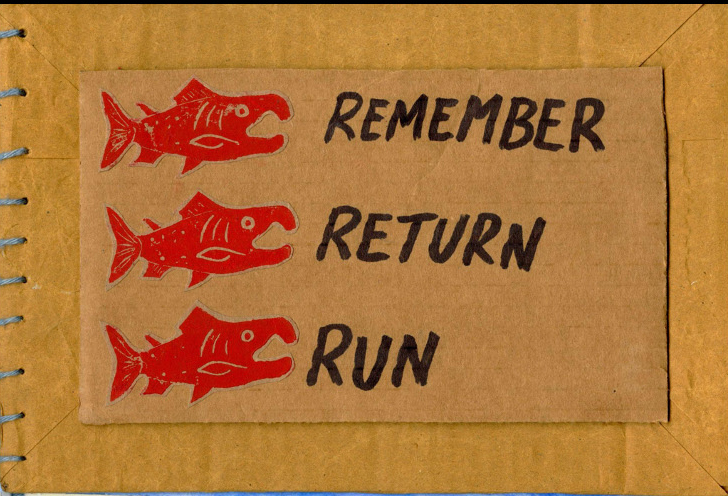
Alongside the film, the students also created a hand-crafted artist book that appears in the video as a tactile narrative thread. The book traces the salmon journey through return, interruption, and renewal, using page turns as a pacing device that mirrors movement through a watershed. Figure 2 is a scan of the pages of the book. In class, the book mattered as much as the screen. It gave students a handheld way to rehearse story structure, life cycle, and place relation while staying grounded in material care.
In environmental education, art is often treated as enrichment. In this project, art was a method. Arts based pedagogies can deepen environmental learning by making room for ambiguity, emotion, multiple perspectives, and forms of knowing that exceed conventional academic reporting (Davis, 2018; Niederhauser et al., 2024). Place based art education specifically has been theorized as a route to ecological literacy because it integrates community centred place learning with affective, sensory, and imaginative practice (Inwood, 2008).
This aligns with Indigenous scholarship on story as lived practice. Cajete (1994) reminds us that stories have long been enacted through song, dance, ritual, and art, and that they carry truths that are lived and remembered. In a Vision III frame, such modes are not “extra.” They are legitimate evidence of learning because they show how knowledge is being metabolized into relationship, responsibility, and action.
Renewal as re-storying: shifting the human nature relationship
One of the most powerful learning shifts in this work was movement from “environmental problem” to “relationship in need of repair.” In Cascadia, where ecological change is rapid and grief is real, renewal cannot be reduced to optimism. Renewal becomes a braided practice: ecology plus history plus ethics plus story. Here, decolonial responsibility is not symbolic. Place based pedagogy asks learners to notice how land has been renamed, reorganized, and governed, and how those changes continue to shape ecological outcomes (Gruenewald, 2003; Greenwood, 2008). A Vision III stance deepens that by insisting that Indigenous systems of knowing, law, and governance are not add ons. They are foundational.
This is evident in salmon restoration in particular. Studies in the Pacific Northwest have written of the established Northwest Coast Indigenous institutions and frameworks of governance that facilitated sustainability and resistance in salmon runs (Trosper, 2002). More contemporary treatments of salmon restoration treat Indigenous modes of governance and the ongoing resilience of the ecosystems and cultures they stress in contemporary salmon fisheries (Atlas et al., 2021). The literature on pluralism in First Nations salmon restoration research emphasizes that ‘braided’ approaches involve considerations that stretch from ‘integrating’ information in some way. They involve considerations of the production, value, and use of information in the whole process of governance (Bingham et al., 2021). In the province of British Columbia in particular, cross-cultural restoration efforts in Okanagan sockeye salmon have been isolated in restoration storylines that involve relationship, learning, and responsibility in a process (Correia et al., 2024). These, in sum, establish a start in situating what students felt in their research: salmon restoration is always, in every way, a process that’s not strictly ‘biological’.
Teaching Biodiversity through Local Landscapes: a transferable sequence
Below is a classroom tested sequence you can adapt anywhere in Cascadia, from coastal estuaries to inland creeks, school gardens to urban parks. The goal is to teach biodiversity through local landscapes while holding space for Indigenous place relations and seasonal cycles. The sequence is structured as a field walk that blends observation, ethics, and creative response, modeled after our Guichon Creek visit, a partially buried and partially daylighted urban stream on the British Columbia Institute of Technology at the Burnaby campus that offered students a living example of restoration as long term community practice (Khirfan et al., 2020; Neale & Moffett, 2016; Wantzen et al., 2022).
1. Begin with a place name pause
Invite learners to locate themselves in relation to watershed, Indigenous territory, and a specific more than human relative they might encounter on site (salmon, cedar, heron, salmonberry, water strider). You can do this as a short spoken acknowledgment, a map check, or a simple prompt written in notebooks. This opens learning with belonging and accountability, and frames place as teacher rather than backdrop (Gruenewald, 2003; Greenwood, 2008).
Practical prompt:
- “Where does this water come from, and where is it trying to go?”
- “What is one more than human presence you notice immediately?”
2. Guided observation walk
Begin with a short stretch of silence. Ask learners to move slowly and attend to details: the sound of water, riparian plants, insects at the surface, bird calls, the feel of shade, and the visible friction between built form and living flow. This is not a warm up. It is field based data collection, and it supports a sense of place as an observable learning outcome (Kudryavtsev et al., 2012; Semken & Freeman, 2008).
Practical prompt:
- “Write five words that describe what the creek is doing right now.”
- “What feels alive here? What feels constrained or interrupted?”
3. Map the visible and the buried
Ask learners to identify water pathway clues: culverts, storm drains, channelized edges, fenced banks, sudden disappearances of flow under pavement, or changes in sediment and vegetation. This step makes hidden hydrology legible and supports discussions of how urbanization creates consistent patterns of stream degradation (Walsh et al., 2005). It also connects to research showing that buried or culverted stream segments can create abrupt transitions in habitat and biodiversity and fragment ecological connectivity (Hintz et al., 2022).
Practical prompt:
- “Where does the creek disappear, narrow, speed up, or get quieter?
- “What does the built environment ask the water to do?”
4. Ethical lens reflection
Pause and assign each group one ethical perspective such as anthropocentrism, ecocentrism, Indigenous relational ethics, or environmental justice. Ask students to interpret the creek in front of them through that lens. This step makes values explicit and positions environmental education as cultural and ethical learning rather than only scientific description, aligning with place based pedagogy and Vision III commitments to pluralism and responsibility (Aikenhead & Elliott, 2010; Gruenewald, 2003; Greenwood, 2008).
Practical prompt:
- “What does this ethical lens prioritize or protect here?”
- “What does it critique about how this waterway has been treated?”
- “Who benefits, and who bears the burden of this design?”
5. Creative sketch or sound capture
Invite learners to respond with one creative act that records attention. They can sketch a plant, a ripple, the meeting point of trail and creek, or they can record a short sound sample capturing rushing water, birds, insects, or the contrast between human and more than human sounds. This is not about producing polished art. It is about noticing and translating relationship into a form that can be shared. Arts based pedagogies support environmental learning by making room for emotion, ambiguity, and multiple perspectives (Davis, 2018; Niederhauser et al., 2024), and place based art education offers a grounded rationale for connecting creativity to ecological literacy (Inwood, 2008).
Practical prompt:
- “Choose one sound or one visual detail that symbolizes resilience, change, or healing.”
- “Record or sketch it, then write two sentences about why you chose it.”
6. Post visit reflection
Back in the classroom, ask students to write a short reflection that braids observation, ethics, and creative response. This can be done in 200 to 300 words, posted to a class forum, or used as a seed text for larger projects.
Reflection prompt:
- “What does this creek teach us about healing in the more-than-human world? Include one detail you noticed, one ethical perspective your group discussed, and something from your sketch or sound recording.”
These field practices were the groundwork for Salmon Remember, Salmon Return, Salmon Run, where observation, ethical dialogue, and creative capture were braided into a public facing artwork and short film that invited wider audiences to listen for what the city has buried and to imagine what might return (Figure 1).
Why this matters across Cascadia
Cascadia’s environmental education community is diverse: coastal and inland, urban and rural, Indigenous and settler, K to 12 and post secondary, classroom based and land based. What unites us is that our ecological stories are not abstract. Salmon, forests, rain, fire seasons, shorelines, and rivers are lived realities. Bioregional framing reminds us that curriculum can be rooted in “life places,” where learning supports the capacity to live well with the systems that sustain us (MacGregor, 2005).
This is also where biocultural diversity becomes more than metaphor. Biocultural approaches to sustainability emphasize the intertwined nature of biological and cultural diversity and the need to engage plural relationships with nature in sustainability work (Hanspach et al., 2020). Biocultural approaches have also been used to define locally grounded indicators of well being and success, resisting narrow external metrics that can miss what communities value (McCarter et al., 2018). Recent synthesis work continues to highlight conceptual and empirical gaps, especially around intangible components such as values, worldviews, and traditional knowledge (Otamendi-Urroz et al., 2025).
When students like Jennifer, Lennox, and Sarah create art that makes relationships felt, when a buried stream becomes audible again, when salmon becomes more than a diagram, we see what Roots and Renewal can look like in practice: place based education in action, Indigenous aligned ways of learning through story, and youth creativity that refuses despair.
Conclusion: renewal is a teaching stance
In a region where ecological change is accelerating, environmental educators are not only delivering curriculum. We are cultivating ways of being in relationship with place. Vision III scientific literacy offers a framework for that cultivation by legitimizing multiple sciences and centering context, culture, and ethics (Roberts, 2007; Sjöström, 2024). Seascape epistemology and the Pedagogy of Aloha offer an embodied pedagogy that reconnects mind and heart, knowledge and kuleana, learning and love for the land (Tan, 2024; Tan & Wangsadyjahja, 2026).
Spring is not only a season. It is a reminder: what is buried can return, what is fractured can be storied, and what is taught can become lived. Sometimes renewal begins with students making salmon audible again.
References
Aikenhead, G. S., & Elliott, D. (2010). An emerging decolonizing science education in Canada. Canadian Journal of Science, Mathematics and Technology Education, 10(4), 321–338. https://doi.org/10.1080/14926156.2010.524967
Atlas, W. I., et al. (2021). Indigenous systems of management for culturally and ecologically resilient Pacific salmon (Oncorhynchus spp.) fisheries. BioScience, 71(2), 186–204. https://doi.org/10.1093/biosci/biaa139
Bang, M., & Medin, D. (2010). Cultural processes in science education: Supporting the navigation of multiple epistemologies. Science Education, 94(6), 1008–1026.
Bartlett, C., Marshall, M., & Marshall, A. (2012). Two-Eyed Seeing and other lessons learned within a co learning journey of bringing together Indigenous and mainstream knowledges and ways of knowing. Australian Journal of Environmental Education, 28(2), 1–16. https://doi.org/10.1017/aee.2012.8
Bingham, J. A., Milne, S., Murray, G., & Dorward, T. (2021). Knowledge pluralism in First Nations’ salmon management. Frontiers in Marine Science, 8, 671112. https://doi.org/10.3389/fmars.2021.671112
Cajete, G. (1994). Look to the mountain: An ecology of Indigenous education. Kivaki Press.
Correia, M., et al. (2024). Bringing the salmon home: Cross cultural collaboration restoring Okanagan sockeye. Ecology and Society, 29(1), Art. 15.
Davis, S. (2018). The Engagement Tree: Arts based pedagogies for environmental learning. International Journal of Education & the Arts, 19(8). https://doi.org/10.18113/P8ijea1908
Gende, S. M., Edwards, R. T., Willson, M. F., & Wipfli, M. S. (2002). Pacific salmon in aquatic and terrestrial ecosystems. BioScience, 52(10), 917–928. https://doi.org/10.1641/0006-3568(2002)052[0917:PSIAAT]2.0.CO;2
Greenwood, D. A. (2008). A critical pedagogy of place: From gridlock to parallax. Environmental Education Research, 14(3), 336–348. https://doi.org/10.1080/13504620802190743
Gruenewald, D. A. (2003). The best of both worlds: A critical pedagogy of place. Educational Researcher, 32(4), 3–12. https://doi.org/10.3102/0013189X032004003
Hanspach, J., et al. (2020). Biocultural approaches to sustainability: A systematic review of the scientific literature. People and Nature, 2(3), 643–659. https://doi.org/10.1002/pan3.10120
Helfield, J. M., & Naiman, R. J. (2001). Effects of salmon derived nitrogen on riparian forest growth and implications for stream productivity. Ecology, 82(9), 2403–2409. https://doi.org/10.1890/0012-9658(2001)082[2403:EOSDNO]2.0.CO;2
Hintz, C. L., Booth, M. T., Newcomer-Johnson, T. A., et al. (2022). Urban buried streams: Abrupt transitions in habitat and biodiversity. Science of the Total Environment, 819, 153050. https://doi.org/10.1016/j.scitotenv.2022.153050
Inwood, H. J. (2008). At the crossroads: Situating place based art education. Canadian Journal of Environmental Education, 13(1), 29–41.
Kahakalau, K. (2022). Pedagogy of aloha. In Encyclopedia of Teacher Education (pp. 1232-1238). Singapore: Springer Nature Singapore.
Khirfan, L., Peck, M. L., & Mohtat, N. (2020). Digging for the truth: A combined method to analyze the literature on stream daylighting. Sustainable Cities and Society, 59, 102225. https://doi.org/10.1016/j.scs.2020.102225
Kudryavtsev, A., Stedman, R. C., & Krasny, M. E. (2012). Sense of place in environmental education. Environmental Education Research, 18(2), 229–250. https://doi.org/10.1080/13504622.2011.609615
MacGregor, J. T. (2005). Curriculum for the bioregion: Learning to live sustainably in our life places. Applied Environmental Education and Communication, 4(3), 239–243. https://doi.org/10.1080/15330150591004689
Martin, S., Wong, J., & Johnston-Yu, L. (2025). Impacts of the man made: Unearthing the lost streams and salmon habitats of Snauq (Unpublished course paper, HUMN 307, Emily Carr University of Art + Design).
Martin, S., Wong, J., & Johnston-Yu, L. (2025). Salmon Remember, Salmon Return, Salmon Run [Video]. YouTube. https://www.youtube.com/watch?v=ZTAyL0hVQ9g
McCarter, J., et al. (2018). Biocultural approaches to developing well being indicators in Solomon Islands. Ecological Economics, 154, 133–143.
Naiman, R. J., Bilby, R. E., Schindler, D. E., & Helfield, J. M. (2002). Pacific salmon, nutrients, and the dynamics of freshwater and riparian ecosystems. Ecosystems, 5, 399–417. https://doi.org/10.1007/s10021-001-0083-3
Neale, M. W., & Moffett, E. R. (2016). Re-engineering buried urban streams: Daylighting results in rapid changes in stream invertebrate communities. Ecological Engineering, 87, 175–184.
Niederhauser, J., Vez, C., Jörg, A., Bertschy, F., Künzli David, C., & Pfründer, G. (2024). The power of artistic practices in ESD. Environmental Education Research, 30(4), 580–590. https://doi.org/10.1080/13504622.2023.2227362
Otamendi-Urroz, I., Quintas-Soriano, C., Hanspach, J., et al. (2025). Exploring biocultural diversity: A systematic analysis and refined classification to inform decisions on conservation and sustainability. AMBIO. https://doi.org/10.1007/s13280-025-02168-y
Roberts, D. A. (2007). Scientific literacy and science education: The current state of the field. (Foundational Vision I and II framing).
Schindler, D. E., Scheuerell, M. D., Moore, J. W., Gende, S. M., Francis, T. B., & Palen, W. J. (2003). Pacific salmon and the ecology of coastal ecosystems. Frontiers in Ecology and the Environment, 1(1), 31–37. https://doi.org/10.1890/1540-9295(2003)001[0031:PSATEO]2.0.CO;2
Semken, S., & Freeman, C. B. (2008). Sense of place in the practice and assessment of place based science teaching. Science Education, 92(6), 1042–1057. https://doi.org/10.1002/sce.20279
Sjöström, J. (2024). Vision III of scientific literacy and science education. Studies in Science Education.
Tan, P. (2024). Extending scientific literacy through Indigenous Hawaiian epistemology: Navigating scientific seas with hula (Doctoral dissertation, Simon Fraser University).
Tan, P. (2016). Science education: Defining the scientifically literate person. SFU Educational Review.
Tan, P., & Wangsadjaja, A. (2026). Hula and Aloha ‘āina: A matriarchal teaching approach. In J. Carson, J. Hawkes, and P. Philips (Eds.), Maternal Ecologies: Feminist Practices of Motherhood, Land, and Creativity ( pp. 164–178). Demeter Press.
Trosper, R. L. (2002). Northwest Coast Indigenous institutions that supported resilience and sustainability of salmon runs. Ecological Economics, 41(2), 329–344.
Walsh, C. J., Roy, A. H., Feminella, J. W., Cottingham, P. D., Groffman, P. M., & Morgan, R. P. (2005). The urban stream syndrome: Current knowledge and the search for a cure. Journal of the North American Benthological Society, 24(3), 706–723. https://doi.org/10.1899/04-028.1
Walsh, J. C., Pendray, J. E., Godwin, S. C., et al. (2020). Relationships between Pacific salmon and aquatic and terrestrial ecosystems: Implications for ecosystem based management. Ecology, 101(9), e03060. https://doi.org/10.1002/ecy.3060
Wantzen, K. M., et al. (2022). Back to the surface: Daylighting urban streams in a global North South comparison. Frontiers in Ecology and Evolution, 10, 838794.