
Photo courtesy of IslandWood
Inspiring Mindfulness in Students
by Stella Terry
Graduate student at IslandWood
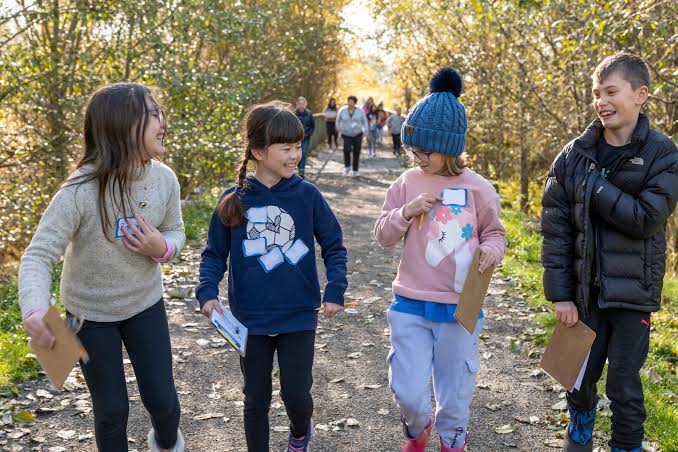
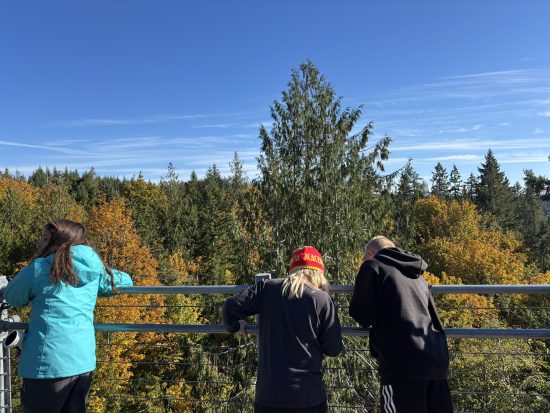
Right before I opened the gate to the canopy tower I asked my group of eager 5th graders if any of them had done box breathing. I said: “Let’s try a breathing exercise to help us become calmer.” We then began by breathing in for four counts, holding at the top of our breath four, exhaling for four, and holding again at the bottom of our breath for four. We repeated this process four more times, drawing the shape of a box with a finger in the air with each inhale and exhale. After our exercise, I saw that most of the students appeared visually quieter, less squirmy, and ready to do something that is brave. I then pushed the gate open, and with a bit more peace, we walked up into the forest canopy. Box breathing, while a simple exercise that takes less than five minutes to introduce and do, is one of many effective ways of inspiring and encouraging students to engage in mindfulness.
What is Mindfulness?
There is a popular belief that mindfulness means sitting alone and thinking about nothing–a destination only achieved through years of quietness and solitude in a remote location. However, this limited understanding of mindfulness is not a full picture, nor does it invite adults and children to learn or practice it. Thich Nhat Hanh (1926-2022), a Buddhist monk, philosopher, and teacher, writes about the ways that mindfulness and meditation can be an everyday, accessible practice that affirms and connects us to our spiritual, emotional, and physical being. He writes, “Meditation is to be aware of what is going on: in your body, in your feelings, in your mind, and in the world” (Hanh, 2020, p.105). In Hanh’s understanding, mindfulness and meditation are processes of awareness, both internally and externally. It is this awareness, although seemingly simple, that can positively affect the way that students feel emotionally and physically in their body and in a new environment.
As an environmental educator at Islandwood, I incorporate mindfulness in daily, simple ways throughout the students’ four-day field study. In my experience, teaching mindfulness is a much needed practice that has established benefits. One scientific study documented the effectiveness of brief mindful breathing exercises, including box breathing. The research concluded that mindful breathing significantly reduced negative affect and anxiety in the brain, respiration, and heart rate (Balban, et al, 2023). Through breathwork and structured mindful exercises, students can learn simple yet incredibly effective strategies of calmness and grounding that encourage them to be present with their emotions and space. I believe that these practices of attuning to emotions and being is even more important considering the pervasiveness of social media, internet, and busyness of students’ lives. For the students that I teach, I find that their schooling and social lives rarely incorporate the time and space to breathe, reflect, and simply be, despite its shown emotional and physical benefits during such a crucial time in their development.
Mindful Applications in Teaching
As an educator, I apply mindfulness as a primer to challenging activities (such as going up a tall canopy tower) or as a transition into a new activity when energy becomes very high. Considering mindfulness as an accessible way of grounding students in their bodies and with their environment, I propose two teaching strategies that incorporate mindful moments with students. It is my hope that these exercises can be used in various moments, in almost any location, and with ease. In my teaching practice, these strategies are incorporated into most activities or as a break.
Box Breathing:
Breathe in for 4 seconds, hold at the top for 4, exhale for 4, hold at the bottom for 4. Repeat. You can draw the shape of a box in the air as you breathe to demonstrate. I normally repeat a full breath at least four times. I find that four breaths is a good minimum, especially to take note of the physical and emotional change that students experience with a few simple breaths.
Box breathing can be done anywhere, and with multiple accessibility needs! It can be especially useful before doing an activity that may be difficult or scary for some students (e.g. walking up the canopy tower or suspension bridge). It can also be done to regroup after a high energy activity as a way of regaining focus.
Mindful Exercise by Patrick Cook Degan (adapted by Ray Cramer):
All of us are reliant upon the sun for energy, the earth for food, trees for air, and water for drinking. But, it is easy to take the water, air and plants around us for granted. The practice of mindfulness takes us off autopilot, allows us to pause, experience the present moment and give gratitude for all the elements of the natural world that support our daily lives.
Stepping out of their classrooms or houses to practice mindfulness allows our students to connect, appreciate and develop a relationship with the natural world.
Engaging the 5 Senses
First, we are going to go outside and sit down on the ground, on a rock or log, or whatever works for you. Spread out in order to feel like you have your own space, but keep within easy earshot.
Part 1
Close your eyes and take a few deep breaths. If it will reduce strain for you, put on a blindfold. Put your attention on the sounds around you — seeing if you can focus on the calls and movements of birds or any other natural sounds within earshot. Your attention sounds every minute or two. When the timing feels right, move on to the next part.
Part 2
Next, feel the sun on your skin — your face, hands, arms or any place exposed to the sun. Keep your attention on all the parts of your body where you can feel the sun, feeling the energy for all the life and power on earth.
Part 3
Feel the air moving across your skin. (After doing this for a minute or two): concentrate on a specific part of your body where you can feel the wind — it could be the tip of your nose, your hands or the back of your neck. Keep your attention in this specific place until we move on to the next part.
Part 4
Feel your body sitting on the earth. See if you can keep your attention focused on any part of the body that is touching the earth — it could be your feet or the whole lower half of your body (if you are sitting on the ground). Really connect with the earth and feel the earth supporting you.
Part 5
Next, connect with your breath. Try to focus on your breath for 1-2 minutes, paying close attention to each inhalation and exhalation. Keep your focus on each breath while thinking of how the air passing in and out of your lungs comes from the plants.
Part 6
We are going to end with a gratitude practice. Envision your favorite place or thing from the natural world. It could be a park, an animal or a tree — whatever comes to your mind.
Once you have something in mind (it will take a moment or two), send thoughts of gratitude to this place or element of the natural world. Fully appreciate this place or creature. Think how special it is to have this part of the natural world in your life.
Gently open your eyes. We have some time now to discuss what we just experienced together.
- Does anyone feel more like part of the Earth?
- Which one of the elements did you connect with the best?
- What did this feel like?
- What plans do folks have to celebrate Earth Day in some way this week?
Tips for Teaching this Exercise
1 Use your intuition to figure out how long to spend on each part. The whole exercise can last between 10 and 25 minutes depending on your students. You can also break up the exercise and have a discussion in between the different parts.
2 You want your tone to be gentle and inviting.
3 Before teaching this, it is good if you have a time before the school day or before teaching this lesson to go outside and practice the exercise yourself
 Stella Terry is a Masters in Education student at the University of Washington and graduate student instructor at Islandwood on Bainbridge Island, Washington.
References
Balban, M. Y., Neri, E., Kogon, M. M., Weed, L., Nouriani, B., Jo, B., Holl, G., Zeitzer, J. M., Spiegel, D., & Huberman, A. D. (2023). Brief structured respiration practices enhance mood and reduce physiological arousal. Cell reports. Medicine, 4(1), 100895.
https://doi.org/10.1016/j.xcrm.2022.100895
Nhat, H. T. (2020). Being peace. Parallax Press.
https://www.overdrive.com/search?q=EDE06BC0-63DC-4D98-9FB9-38A1AD5C1D3D