by editor | Jun 12, 2009 | Gardening, Farming, Food, & Permaculture
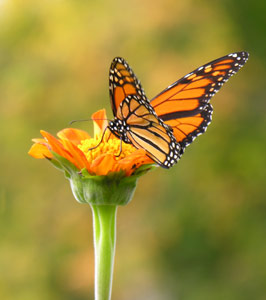
 Many people think only of allergies when they hear the word pollen. But pollination — the transfer of pollen grains to fertilize the seed-producing ovaries of flowers — is an essential part of a healthy ecosystem. Pollinators play a significant role in the production of over 150 food crops in the United States — among them apples, alfalfa, almonds, blueberries, cranberries, kiwis, melons, pears, plums, and squash.
Bees, both managed honey bees and native bees, are the primary pollinators. However, more than 100,000 invertebrate species, including bees, moths, butterflies, beetles, and flies, serve as pollinators — as well as 1,035 species of vertebrates, including birds, mammals, and reptiles. In the United States, the annual benefit of managed honey bees to consumers is estimated at $14.6 billion. The services provided by native pollinators further contribute to the productivity of crops as well as to the survival and reproduction of many native plants.
However, long-term population trends for some North American pollinators are “demonstrably downward,” says a new report from the National Research Council1.
Observable decreases in wild populations of bees, butterflies, and moths are of great concern to producers of fruits, vegetables, nuts, alfalfa, and flowers. These crops depend on wild and domestic pollinators. Growers in California, Florida, Arizona, Utah, Washington, and Hawaii are especially concerned. More important is the disturbing notion of an imbalance in the natural ecosystem and biodiversity on which all food production depends. Habitat loss for pollinators by human activity poses an immediate and frequently irreversible threat. Other factors responsible for population decreases include invasive plant species, broad-spectrum pesticide use, disease, and weather.
For the most part, the general public is unaware of the decrease in pollinator populations and the implications this has for agricultural production. The Nature’s Partners: Pollinators, Plants, and You curriculum is designed to educate young people about
- pollinators and the important role they play in providing many of the foods we eat and the plant fiber used in our clothing and household goods, and
- ways they can help pollinators survive and flourish by protecting and creating pollinator-friendly habitat.
The Nature’s Partners curriculum is just one step toward increasing the public’s awareness and sense of responsibility that are essential to a successful conservation program for pollinators.
Go to curriculum
by editor | Jun 9, 2009 | Conservation & Sustainability
by Rex Ettlin
Education Program Coordinator
Oregon Zoo
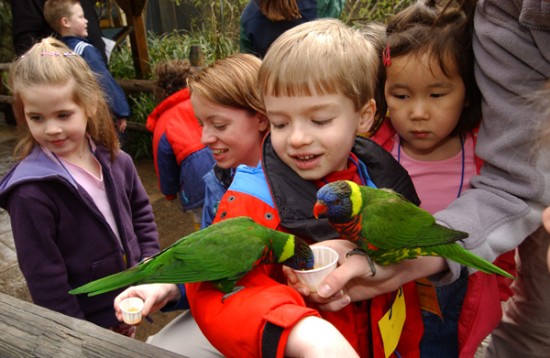
First I have to tip my hat in apology to aquariums, wildlife parks and educational farms. Since I work in a zoo that’s what I can talk about. But the idea of a zoo as an effective educational tool applies equally well to all non-formal educational settings, such as art museums, science museums, nature parks or natural areas. Teachers who have access to any of these should definitely include them in their toolbox.
A zoo’s paramount purpose is to promote wildlife conservation. A zoo exists to educate. Research happens, recreation happens, but above all is the intent to educate. The educational potential is at its greatest with a professional educator designing a learning activity to use at the zoo. The zoo is a great tool and it’s at its best when a real artisan is using it, a classroom teacher who has designed focused activities connected to a long-term curriculum.
(more…)
by editor | Jun 8, 2009 | K-12 Classroom Resources
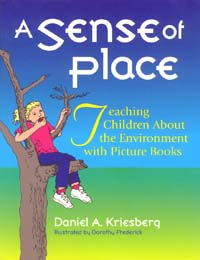
 Teaching Children about the Environment with Picture Books
By
Daniel A. Kriesberg
Illustrated by
Dorothy Frederick
Reviewed by
Dr. Suzanne Spradling
A Sense of Place is a valuable classroom resource and curricular supplement. This book is designed to help integrate children’s literature and hand-on activities to increase students’ awareness of their connections to the earth. The activities and literature suggestions fit readily into existing curricula in the core content areas. The author describes how place-based environmental education can be used to meet state and national education standards. The topics addressed in the book develop students’ geographical and scientific observation skills and provide opportunities for them to learn about their area’s ecology and history. The chapters also include a variety of environmental education activities, language arts projects, and activities that integrate math and art.
(more…)

by editor | Jun 2, 2009 | Learning Theory

By Paul Hawken
From a commencement speech given at the University of Portland, May 3, 2009.
When I was invited to give this speech, I was asked if I could give a simple short talk that was “direct, naked, taut, honest, passionate, lean, shivering, startling, and graceful.” No pressure there. Let’s begin with the startling part. Class of 2009: you are going to have to figure out what it means to be a human being on earth at a time when every living system is declining, and the rate of decline is accelerating. Kind of a mind-boggling situation… but not one peer-reviewed paper published in the last thirty years can refute that statement. Basically, civilization needs a new operating system, you are the programmers, and we need it within a few decades.
(more…)
by editor | May 20, 2009 | Forest Education, Outdoor education and Outdoor School, Place-based Education
 by Victoria Lewis
Spawned out chinook salmon, brown , spotted and beak-nosed lie dead in the shallow water near the banks of the Salmon River in the Wildwood Recreation Area at the foot of Mount Hood.
The smell of rotting fish is sharp and pervasive, but Jill Semlick’s Pauling Academy ecology students ignore the odor. They are busy yanking off their shoes and snapping the clips of their chest waders. The bridge upstream is under construction and the high school students must ford the cold, fast-moving river to reach their research sites on the other side. (more…)
