by editor | May 20, 2009 | Outdoor education and Outdoor School
Knowing One Big Thing: The Role of the Nature Center in the Next Millennium
By Mike Weilbacher
From The Best of Clearing, Volume V
It’s a very rainy day in the middle of Aesop’s fables, and Hedgehog is stuck outside without a dry place to hide. He finds a den, but Fox already occupies it. After much begging and whining, Hedgehog squeezes in alongside Fox, raises her prickles, and a needled Fox quickly vacates his dry den to the now contented Hedgehog.
A fox knows many things, concludes Aesop, but the hedgehog knows One Big Thing: how to use prickers.
Which brings us to fuzzy little beasts called nature centers, a.k.a. environmental education centers. I carry an exquisite love-hate relationship with these beasts. As a freshly-scrubbed, greener-than-a-tree-frog college graduate, I was offered the irresistible opportunity of not only directing a small nature center tucked into the middle of central New Jersey, but directing it when its nature center building had just been erected! Imagine my luck, walking into a vacant building as my first full-time job and inventing a nature center.
In the years since, I’ve had the pleasure of working at and visiting quite a few centers, and I know that my corner of the eastern seaboard is blessed with an abundance of centers. By contrast, when I recently spoke at Montana’s environmental education conference, I was stunned to learn that Big Sky country was only that year building its FIRST nature center. I hope the concept takes root in the West the way it’s proliferated in the East.
But I worry about nature centers. Always underfunded, many centers suffer from severe physical plan maintenance concerns, are almost perpetually understaffed, the staff almost always crammed in too-small spaces not originally designed as offices, stuff stored in every nook and cranny of the too-small building. The exhibitry is often tired, the touch table full of objects that should have been removed months ago, the touchy-feely boxes mostly empty, and the few live animals mostly immobile in cramped aquaria. Light bulbs are often shot, terrarium text is missing letters, the information presented anachronistic, irrelevant — scientific name, adult length, average lifespan. Horribly, and frankly, unforgivably, nature center are easily 100 years behind the state-of-the-art science exhibitry techniques practiced by their big-city peers in science centers and museums.
And yet, for all that, never has the mission of the nature center been as vital as it is today. No, “vital” is not the right word. Imperative. Critical. Necessary. In a perfect world, every single student in every single elementary school would have regular, ongoing access to a nature center, its staff, and its programs. Because in this hugely imperfect world we inhabit, something horrible is happening.
We live during perhaps the largest extinction event in natural history. Certainly, we are fueling the largest Holocaust since the Great Extinction wiped out dinosaurs, marine reptiles, ammonites, and more during the end of the Cretaceous Period. Evolutionary forces cannot keep pace with the changes we have wrought on the landscape, and pieces of the plane’s jigsaw puzzle are mysteriously vanishing daily. The web of life is unraveling: frogs dropping out of pristine ecosystems, large mammals in decline in many locations, coral reefs being dissembled and sold to collectors, white-tailed deer removing wildflower populations from Pennsylvania sanctuaries, the Amazon again set ablaze to produce more of those damn cows.
While there are many notable conservation success stories — peregrine and pelican, alligator and eagle — there are innumerable losses (one estimate is between 70 and 100 species daily).
The unfolding story of the extinction of life — the sinking of the global ark, if you will — is perhaps only one large mammal away from receiving the full world’s attention. When the last mountain gorilla or black rhino, two highly endangered creatures in politically unstable parts of the world, disappears, the headlines will begin, and that unfortunate mammal will jump-start a conversation we should have been having for decades. Here’s a prediction: in the next millennium, global warming and extinction will emerge as the environmental Scylla and Charybdis through which the world must navigate to survive, and the entire environmental movement will rally behind the great struggle of keeping the burning ark afloat.
In that context, then, the nature center will play an increasingly important role in the extinction story. Today, the zoo has claimed for itself — partly through creative public relations seeking to preempt the animal rights movement — the title of the ark, for zoos maintain professional staff working daily on preserving and building breeding populations of animals like gorilla and lemurs, pandas and vultures.
But the nature center movement must organize itself to become recognized and treasured for the One Big Thing it does that a zoo does not it preserves a precious piece of habitat, serves as an island of green in a sea of McAsphalt. That first nature center I worked at in central Jersey was surrounded on three sides by development, the fourth by a four-lane, concrete-barrier highway. To a migrating songbird, that park’s emerald canopy was a welcome neon sign; to resident birds, one of the few habitats left. As the suburbanization of America transforms everywhere into Nowhere so that Denver, Miami and Albuquerque all look just like, well, Jersey, as beige stucco townhouses advance like slime mold across the width and breadth of America, the preservation of a hunk of diversity embedded in a sliver of habitat will emerge as perhaps the largest contribution of nature centers to environmental quality.
Which rises an intriguing question: are nature centers and their staff up to this challenge?
Here’s the result of years of mulling. First, nature centers have spent too many years wrestling with the meaning of the phrase “nature center.” As nature study begat environmental education, so did naturalists evolve into environmental educators and nature centers transmogrified into EE centers. The reasons are many, and not necessarily a mistake. With the emerging mass awareness of environmental degradation in the late 1960s, our profession wished to be on the front line of environmental interpretation, and teach about energy use, lifestyles, pollution, consumption, conservation, resources, etc. As a college student in the early 70s, I rebelled against the teachings of my professor, one of the foremost American naturalists of this — or any — time. I, too, had bigger fish to fry that knowing which woodland bird sings “drink your tea.” Drink your own tea, thank you very much, I have a world to save. Nature centers gave themselves a face-lift, a work-over, and began re-naming themselves as environmental education centers, biting off a larger mission, interpreting in parallel both the wonders of nature and the destruction of the environment.
Trouble is, this large mission forces environmental educators to be so many Foxes, trying too hard to know too many things: when does the ozone hole open? Why do we recycle glass when sand is so plentiful? What’s the role of water vapor in global warming? Paper or plastic? Disposable or cloth? And the center’s exhibits begin to reflect this scattered mission, becoming a hodge-podge of disjointed displays that, in concert, present no unified vision of what an environmental education center is.
Worse, the public has never rallied behind a banner called “environmental education,” and the phrase still carries little or no resonance with mass America.
So allow me to suggest a smarter strategy: centers must, like corporate America, downsize and streamline. It strikes me that, with acres of land in which to teach and interpret, the role of the nature center and its staff is to know One Big Thing: the community of plants and animals that inhabits the special piece of the planet in which the nature center resides.
Yes, someone must teach about ozone holes and Amazonian fires, and there must be environmental organizations dedicated to getting good lifestyle information to large numbers of overconsumers. But it’s been suggested in this space before that perhaps the ultimate solution to our environmental ills is to install nature study as the beginning of any environmental education curriculum, and graduate a nation of naturalists. If we are to realize that vision, then communities need Master Naturalists capable of teaching this information, people who inhabit one place for a very long time and get to know that place so well, they know which wildflowers bloom in which location in what numbers, which frogs croak in which wetlands in what order, which migrating songbirds return in which succession — and scream loudly if those wildflowers or frogs or birds disappear.
This is a very high calling, and very necessary work.
The naturalists that inhabit nature centers must then master three skills: knowledge of nature, the ability to communicate that knowledge, and conservation biology. Naturalists must begin to learn which tools they can employ to manage their green oases correctly to keep their ecosystem’s fabric from further tearing.
If the nature center focuses on this mission, other problems centers face might resolve themselves. It becomes clearer, for example, what skills one is looking for in staff to hire. It gives the center a context for successfully appealing to the corporate and foundation community for higher levels of funding (after all, it’s not just nature study, it’s species preservation). And it gives the center One Big Thing to tell the public, over and over: we are the people who preserve the plants and animals that are your natural neighbors. For once, the public might finally get it. And support it.
So if you’re a nature center staff, feeling foxy and scatterbrained, here’s a strong recommendation: follow Hedgehog. Dig yourself deeply into your center’s burrow, learn One Big Thing, teach it masterfully, and teach it so well that it rallies the world behind solving the single most intractable dilemma of our time: how Homo sapiens will ever learn to share a sinking ark with any other species but himself.
[/password]
Mike Weilbacher is the executive director of the Lower Merion Conservancy, and is, he confesses, required to teach Too Many Things.
by editor | Apr 26, 2009 | Place-based Education
By Kristina K. Sullivan
“Knowledge of the nearest things should be acquired first, then that of those farther and farther off.” — Comenius, 17th C. educator (Dubel and Sobel, 2008)
On the day of my twenty first birthday, I arrived in the small Appalachian town of Whitesburg, Kentucky (population 2,000) on a university field study. Though not yet a credentialed teacher, I was assigned the position of reading specialist for a small group of unmotivated yet adequately intelligent 5th-7th grade students at Cowan School, about five miles off the main highway.
It took very little time to discover that the traditional methods of schooling were not going to work, the problem exacerbated by my status as a California “outsider”. At that idealistic age despair was not a consideration; I had no choice but to embrace our differences. Rather than following a rote lesson plan, it seemed more promising to ask them questions about themselves.
(more…)

by editor | Apr 21, 2009 | K-12 Classroom Resources, Place-based Education

By Shamu Fenyvesi Sadeh
Portland State University, Center for Learning and Teaching West (NSF)
If students were asked to define “environment” and “community” what would they come up with? What would it look like if students designed their own methods for investigating community environmental issues? What would it mean if the teacher encouraged students to make connections between what they know about their neighborhood and scientific concepts such as diesel particulate pollution and carcinogens?
These are the central questions guiding a collaborative research and teaching project between an eighth-grade science teacher in a Northeast Portland middle school and myself, a long-time environmental educator turned doctoral student.
Our goal is to empower students to make connections between personal knowledge and environmental learning in ways that promote participation and learning in science class. To be responsive to the students’ interests and to facilitate our own continual learning, we use the model of action research – a spiral process of planning, implementation, evaluation and re-planning. The general approach of our plan-as-we-go curriculum is to get students involved in learning about and acting on community environmental issues of their choosing.
ALERT: You need to be a CLEARING subscriber to read the rest of this article.
(enter password then hit return button on your keyboard for best results)
[password]
Community-based or place-based programs share our emphasis on the local context but few programs that we have read or heard about turn power in the classroom over to the students. In my first years of teaching environmental education I spent a lot of energy trying to get the students to understand and adopt my (enlightened) environmental perspective and absorb my (considerable) scientific expertise. Historically much of the environmental education curriculum and research does the same: it focuses on either 1) carefully planned and tested activities designed to encourage the adoption of environmentally friendly behaviors that are pre-determined by the teachers and researchers, or 2) packaged units on environmental knowledge designed to be easily fed to the cooperative (but passive) student.
It was working with Native American, poor European American and African American students that helped me to shift towards student-centered learning. Approaching urban and minority students with my standard nature-as-wilderness bag of tricks was simply not working. Slowly, I began to do more listening than talking and to adapt my teaching to the particular needs and interests of the students and their communities. Now I know that to make environmental and scientific fields more diverse and to teach effectively to underserved populations I have to drop my agenda and listen to theirs. Particularly for populations such as urban, low-income African American and Latino students, who historically have not had a voice in scientific and environmental fields, honoring student knowledge and empowering student decision-making in the curriculum is crucial.
The Community Environmental Health Project at Columbia Middle School
In our work with low-income African American, Latino, Asian and European American middle school students, the collaborating teacher and I have worked hard to put the students’ perspectives at the center of the classroom. For example, when we began this fall by asking students about environmental issues in their community we got a lot of confused looks and blank stares. We decided we needed to take a few steps back and have the students define the concepts we were using. We decided to start using the words like “neighborhood”, “community” and “health”, rather than just “environment”, because we found that those words made sense to the students.
The discussion on “What is Community to You” was one of several that delved into students’ intense curiosity about race and poverty. Why is it as one student, Devon, observed “On this block we got Mexicans, on this block white, on this block white.” Why is the majority of industry located in minority neighborhoods? These were some of the liveliest conversations we have had in class this year. Few off-the-shelf environmental education curricula, even community-based programs, address race or class. Yet we found that culture, race and class are central to the students’ experience of community issues and are, of course, central elements in the field of environmental justice.
As a way of generating excitement on an issue close to the student’s experience, we read an article on the building that housed our school just four years ago. Many students in the class had older brothers and sisters, cousins or even parents who had attended school in the old building. The article describes how the building was contaminated with high levels of radon and toxic mold for many years. However, most shocking were three facts in the article: 1) radon exposure causes severe headaches and a lowering of cognitive abilities, 2) students at this school had the lowest test scores and among the lowest attendance rates in the entire state, and 3) some school officials knew for many years about the radon contamination and did nothing, despite repeated complaints by students, parents and teachers.
Many of the students were shocked and some, angry. One student, Sara, wrote in response to the article “If they knew about it for so long, how come they didn’t tell nobody or do anything?” The article showed students that there are important environmental issues affecting their community, introduced the concept of environmental justice, and in the words of the teacher, “got them riled up!”
After helping students to find their homes on city maps, we decided to engage in some neighborhood investigations at a scale that makes sense to the students: three block surrounding their house, apartment or trailer. From their observations, and from surveys the students designed and conducted in their neighborhoods, we generated a list of community issues. Homelessness, violence and graffiti were frequently raised together with more traditional environmental justice issues such as air pollution and asthma. Each class of students voted on an issue to investigate further and to take action on. Three classes chose air pollution and asthma and one class chose homelessness. Although homelessness and graffiti do not appear in scientific accounts of environmental problems, nor are they topics usually studied in science class, we decided to include them on the “community issues ballot” because they reflect student and community interest. If we want a science and environmental education that reflects the full diversity of our society, than we must expand the boundaries of “science” and “the environment.”
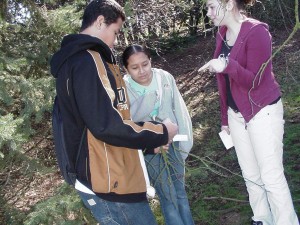 Other activities we have done as part of the community environmental health project include: writing a scientific autobiography, conducting community surveys, dialoguing with guest speakers, taking field trips, watching a video on pollution issues in a San Francisco neighborhood made by middle school students, conducting a lichen (as air quality indicators) survey, and making presentations to 6th and 2nd graders.
Challenges
Accomodating the time demands of this way of teaching and learning is not easy. Since the students design their own assignments and choose projects to work on, the teacher and I cannot plan the curriculum in advance. Additionally, our community investigations involve lots of reading and group work that demand lots of class time and need to be balanced with other 8th grade science units. Moving from teaching as telling to teaching as finding out requires a huge shift in thinking that posed a challenge to both the teacher and myself. This shift involves letting go of control and expertise and leaving room for mistakes and uncertainty. From my experience in environmental and science education, it is the path that all of us, whether college professors, nature center naturalists, or middle school teachers need to take.
A Little of What Have We Learned
Although we are still deep in data analysis, evaluation and reflection, a few patterns and lessons have emerged from the last year.
The Community Environmental Health Project is seen by some students as exciting and “real” compared to the usual school work of “sit and listen”, “facts” and “books”.
Many students who were typically unmotivated by science class emerged as energetic and vocal participants in the community environmental health project.
Many students were able to make personal connections to science through observations they made in their daily lives, conversations with neighbors and family, concerns about justice, and feelings of compassion for those suffering from asthma, cancer, lead poisoning, or homelessness.
Students showed understanding of concepts such as: the health effects of environmental toxins, using lichen as air quality indicators, environmental justice, mapping, community activist resources, and the effects of personal choices on environmental health.
Students’ comments and participation in extracurricular activities related to the project (producing a youth radio show for local community radio) demonstrate the empowerment many students feel being part of the project.
When a normally shy student proclaims “I want to know what it is like to be a homeless person,” and another confides to me that she likes studying air pollution because “my friend has asthma and I can cure her,” and a third tells me “So now that I see these things around me, all this air pollution, I know what to name it cause before I didn’t really pay attention to it,” we feel good about the work we have done.
(Names of the school and students have been changed)
[/password]