
by editor | Jan 11, 2009 | K-12 Classroom Resources
 A Guide to Ecological Learning Experiences for Upper Elementary/Middle Grades
Reviewed by Fletcher Brown
Author Kathleen Hogan
Publisher: Kendal/Hunt Publishing Company
Pgs: 392
Over the last two decades the educational reform movement has been pitching a variety of methodologies to get educators to be more student-centered and inquiry minded. Curriculum and textbooks have been slowly adapting, most often offering supplements to existing materials that incorporate these methods and approaches. Eco-Inquiry: A Guide to Ecological Learning Experiences for Upper Elementary/Middle Grades is one of the few guides that truly incorporates these reform measures beautifully embedding inquiry teaching strategies and alternative assessment measures into the activities.
(more…)
by editor | Dec 17, 2008 | K-12 Activities
“The frog does not drink up the pond in which it lives” – Indian Proverb
Science – How do Plants Help Soil?
Take two large baking pans (about 12 x 6 in.). Place bare soil in one pan and line the other with grass sod. Place the pans at a 20 – 25 degree slant in front of the class. Have a hand-held hair dryer and a watering can or spray bottle ready. First take the hair dryer and blow air from the hair dryer on the dry soil and then on the soil with grass. Discuss the reasons for what is happening. Using the same pans, pour/spray water on the soil and grass. Have students look for differences in the two pans. Ask what would happen if it rained hard all day on the two pans. again, discuss the reasons for what is happening. Do other types of plants help soil? Is it important to have plants growing on soil.
Have the class walk around the school grounds looking for evidence of erosion and plant soil relationships. What happens outside in areas where there is dirt with no plants growing on it? Where does the dirt go when it is carried away by wind and water? LIFE
Mathematics (& Science) – Sun Heat and Drink
You need several, clean, empty pop cans, 5-6 kitchen thermometers, some aluminum foil and a few different colored acrylic paints. Paint the cans a variety of colors (black, white, red, green . . .). Leave one unpainted and cover another with aluminum foil. Fill the cans with equal amounts of cold water and set in full sun, either in a window, or in a sheltered place outside. Take the temperature of water and record on a chart as a class, or individually. (more…)
by editor | Nov 16, 2008 | Outstanding Programs in EE
by Sharon Morse
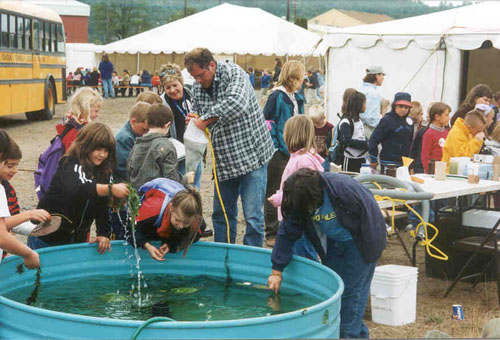
It doesn’t look like much. A big dirt parking lot filled with boat trailers. Then the magic starts.
This is the tenth year for Tsalila (sa-Lee-la), the celebration of salmon and the Umpqua River in southern Oregon. Over 60,000 people have participated in this hands-on learning experience. Thinking about doing a large educational event in your area? Here’s how we have grown Tsalila.
(more…)

by editor | Oct 22, 2008 | K-12 Classroom Resources
 Edited by Michael K. Stone and Zenobia Barlow (2005; Sierra Club Books)
Review by Jaimie P. Cloud
This spectacular collection of essays by Fritjof Capra, Wendell Berry, Alice Waters, David Orr and Donella Meadows, to name just a few, is woven together with stories of the editors’ own journeys, over time, educating for sustainability. The book is organized into a system of four interdependent parts: Vision, Tradition/Place, Relationship, and Action. The reader can experience the book sequentially or can enter at any point and travel back and forth between the parts and between each essay and story. No matter where you enter, the book hangs together as a unified whole.
The editors have skillfully selected the authors and their essays to convey the essence of each of the four parts of book and have simultaneously used the essays to communicate the learning process in which they themselves have been engaged. Here’s just one of many examples:
“As we immersed ourselves in the life of communities and ecosystems, important strategies began to emerge. Through our collaboration with STRAW (Students and Teachers Restoring a Watershed) we became aware of a nationwide phenomenon: family farms on the urban edge were going out of business for want of a market. We also knew that city kids around the San Francisco Bay were going to school hungry. On a map of regional problems, we highlight urban fringe farms at risk, malnutrition, solid waste generated by students throwing away their lunches, underachievement, and vandalism. See these all together on the map, we recognized them not as isolated problems, but parts of one overarching problem of disconnection: of rural communities from urban life, of food from people’s understanding of its origins, of health from the environment — and of problems from the patterns that perpetuate them.”
Both living systems and learning develop over time, and witnessing the congruence between the two is stunning. This book is classic and timeless.
Ecological Literacy is required reading for anyone who wants to understand what we mean when we say, “Education for Sustainability.” The core content and the habits of mind that characterize Education for Sustainability are seamlessly and elegantly communicated by many of our most revered champions in the way that only learner-centered experiential educators can do.
Jaimie P. Cloud (jaimie@sustainabilityed.org) is president of the Cloud Institute for Sustainability Education in New York City. This review originally appeared in The Communicator, the newsletter of the North American Association for Environmental Education (NAAEE).

by editor | Oct 22, 2008 | Outstanding Programs in EE, Place-based Education
Students Use Real World Data to Make ‘Green Maps’ of their Community
by Todd Burley
Homewaters Project, Seattle
“Green Mapping connected Cleveland’s students to their community by opening up their eyes to the environmental benefits and detriments around them. It gave the students a sense of ownership, pride, and responsibility. The culminating presentation at City Hall was the icing on the cake–students were able to share their voice with students from other schools and show what they found from their research.”
Amy Baeder, 10th Grade Teacher, Cleveland High School
How can we bring the titanic issues of community health – both environmental and social – down to a level that can be taught in the classroom? How can we make pollution immediate, income disparity tangible, and historical landscape changes apparent to the average tenth grade student? And how can we show the connections among all these issues including the students themselves?
Ten years ago, the seed of an answer to these questions germinated in New York’s Green Map System. This nonprofit organization facilitates the creation of ‘green maps’ around the world that make visual the sustainable features – and problems – in a local community. Green maps are locally created, but use an international set of icons as a shared language.
(more…)
