by editor | Apr 10, 2009 | Indigenous Peoples & Traditional Ecological Knowledge, K-12 Classroom Resources, Place-based Education, Service learning
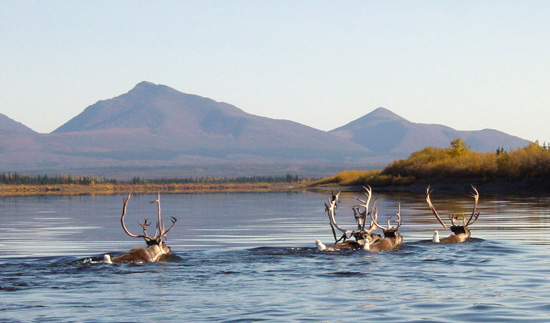
Connecting Kids and Caribou
by Sue Steinacher, Alaska Dept. of Fish and Game
Teenagers can be a tough audience to impress. The students from northwestern Alaska let it be known they’d seen plenty of caribou, and had been riding in boats and camping all their lives. So coming to a place called Onion Portage, downriver from Ambler on the Kobuk River, didn’t seem like such a big deal — even to help with an Alaska Department of Fish and Game caribou collaring project.
But that all changed once they got their hands on a live caribou.
(more…)

by editor | Apr 2, 2009 | K-12 Classroom Resources

ISBN: 0-8403-9584-1
Copyright: 1994
Number of Pages: 400
Binding: Soft Cover
Author: Kathleen Hogan
Publisher: Kendal/Hunt Publishing Co.
Reviewed by Fletcher Brown
Over the last two decades the educational reform movement has been pitching a variety of methodologies to get educators to be more student-centered and inquiry minded. Curriculum and textbooks have been slowly adapting, most often offering supplements to existing materials that incorporate these methods and approaches. Eco-Inquiry: A Guide to Ecological Learning Experiences for Upper Elementary/Middle Grades is one of the few guides that truly incorporates these reform measures beautifully embedding inquiry teaching strategies and alternative assessment measures into the activities.
Eco-Inquiry in composed of three ecology modules for upper elementary or middle grades. The modules last from four to seven weeks and examine food webs, decomposition, and nutrient cycling. Important features in this guide include:
• Each module organizes students’ inquiries around a real-world problem or challenge.
• Students form research teams that do peer reviews, share ideas and findings.
• The focus of the activities are on the local schoolyard or neighborhood environment.
• Both the staff and students use a variety of alternative assessment measures.
• Units address student misconceptions about ecology through learning concepts using a learning cycle approach.
• The guide includes extensive background information for teachers about schoolyard habitats and the flora and fauna found in them.
Upon opening the book you will immediately identify that this is not like most other curriculum guides. The introduction sets the stage for things to come making sure the teachers understand that their role is one of a collaborator who will be involved in a classroom that they call a ìcollaboratoryî. To create this colaboratory learning environment they structure each module around an inquiry approach to learning. Each module has four sections; activating ideas, investigations, processing understanding, and applying/assessing. Embedded in these four sections lie seven to ten lessons which have embedded in them four central learning processes; building a framework, developing knowledge, inquiring, and applying.
Central to the guide is the current of building a community of inquiry minds. This is accomplished in the curriculum through the use of student writing that they hope will promote interaction and reflection. Most of the writing is accomplished through journaling, which is a major part of what students do on a daily basis while being involved in the modules. A variety of different types of journaling formats are used including reflections, quick writes, learning logs, and persuasive writing to name a few. One particularly interesting journal format that they implement which models current communication patterns in the science world is the use of what they term ìC-mailî. Here students are able to send notes to friends using set formats to quickly communicate ideas and thoughts. Be it C-mail or other journaling formats students are expected to be writing on a daily bases aimed at sharing their thoughts, ideas, and impressions about what they learn and observe.
There are two additional pieces to the guide that make it shine among other ecology curriculum guides. The first are the activities they have selected for the students to use. Each module has a variety of hands-on and minds-on activities that are based on studentsí misconceptions in ecology. A good example of this is a unit entitled, A Challenge to GROW. Here students begin by examining prior ideas about what plants need to grow. This is followed by students observing soil samples, talking about where soil nutrients come from, they receive a letter from a company that wants to know if dead plants can be used as fertilizer and end with the development of research questions that lead extended study projects. The modules are clearly multi-faceted keeping students engaged and busy. While they have given structure to the activities to help guide students and teachers, there is also flexibility for students to go their own direction with investigations.
The second area that is done exceptionally well is assessment. Throughout the guide students are asked to reflect on their learning and relate what they learn to the real world. The main vehicle for studentsí summative assessment is the portfolio. Here students select samples of their work after each module and turn in an end of the year final portfolio project that is formally graded. Individual assignments, whether they are part of the portfolio or not, are assessed using a set of proficiency standards.
Indicators used in the proficiency standards include; novice, proficient, proficient +, and advanced. Be it a journal product, concept map, or experimental write-up, one of the proficiency standards are applied to student work. For the teacher guidance and examples are given so first time user of alternative assessment measures feels more comfortable and confident in using them. Whether it is journaling, concept mapping or portfolios the assessment is an integral part of the modules. By choosing to do the modules you will have to use the assessment measures. They cannot be easily separated.
One thing that Eco-Inquiry is not is a complete curriculum for all content included in middle and high school ecology classes. The authors have chosen to take a few main ideas and go in-depth in these areas. If you are looking to cover all the major concepts in ecology using this guide you will not succeed. What this curriculum guide does is develop in-depth learning, communication skills, and inquiry learning skills through the science topics of food webs, cycles and decomposition. If you do not already have this guide on your bookshelf you should add it now. If for nothing what this guide provides is an outstanding example of how to embed science education reform methods effectively into your teaching of ecology.
Fletcher Brown is on the faculty of the education department at the University of Montana in Missoula, Montana.
by editor | Mar 15, 2009 | K-12 Classroom Resources
by Louis A. Iozzi, Professor/Director
Center for Science and Environmental Education
Cook College, Rutgers University
As I look at the world of K-12 education, I see far too many challenges to cover in this short presentation. Some have been with us for a very long time, while some are more recent, and few relate only to environmental education. My list of challenges is extensive, but because of time and space constraints I will discuss only a few of them of them here.
EDUCATION REFORM
During the past twenty years concern has grown across the country regarding the quality and relevance of education to the needs of society and the demands of a changing economy and world order. Reform efforts of varying types and degrees are evident in every state. Components of the reform movement include: constructivist thinking and conceptual understanding, cooperative learning strategies, interdisciplinary approaches, problem-solving and higher-order thinking skills and processes, the use of authentic assessment, and recognition of the value of multicultural education. In my judgment, these have been, for the most part, positive steps in the right direction.
But… the BIG national movements, initially imposed by state legislators and then seized upon by the education community itself, are for standards and statewide testing.
What does this mean for education in general, and specifically for EE? The activities of the past few years can be described as “frenzied” as state education agencies have been, with the help of teacher organizations, busy generating lengthy lists of what children
should know in the various disciplines and developing tests to determine how much of it they actually do know. Meanwhile, school districts have been scurrying to articulate their curricula with the new standards and statewide testing schedules. A lot of time, and
many education dollars, have gone into this movement, in the hope of demonstrating the effectiveness of the education we are providing for children.
I personally characterize this effort with the proverbial tale of the emperor’s new clothes; we keep trying to justify, via paper and pencil tests, that we really are educating our youth. I’ll have more to say about this later.
In any case, I see two challenges here. The first is that few of these statewide standards include EE, and fewer still have included EE in the tests– assuming that the tests are valid in the first place. But if EE is valuable it should, like other educational programs, be treated the same way. EE standards, and questions dealing with EE, should be– must be– included in the standards and testing programs across the nation.
Educators will also be challenged to teach children for “meaning and understanding”, and not simply coach them to pass the test. Many of the statewide tests are, in my judgment, generating a lot of needless anxiety on the part of children, their teachers, school administrators, and parents– for political, rather than sound educational, reasons. Thus, I see getting past teaching “to pass the test” as the second major challenge.
If historical patterns hold true, the pendulum will in a few years swing the other way and the push for standards will probably go away, to be replaced by some other scheme. What comes next? I believe that we will once again strive to put real meaning back into our educational processes. Perhaps this is only wishful thinking. But as my colleague and good friend Frank Gallagher likes to say, “It’s good to be able to read, it’s better to understand what you have read, but it’s best to know where the paper came from that made the page you have just read.”
ASSESSMENT OF LEARNING
We simply have to find better ways of determining if and when learning has taken place. We have made significant progress in assessing learning; authentic assessment has the potential for quite accurately measuring learning outcomes in very meaningful ways.
So the methodology for more meaningful and accurate assessment is already here, and to rely on simple paper-and-pencil tests is, in my judgment, pure folly. One challenge for K-12 educators is to supplement the older and more established methods of assessment with some of the newer techniques and strategies. The new Project Learning Tree has made significant progress in this area, but there remains a long way to go. The techniques are there, but (once again) we must strive to break our old habits.
A MATTER OF RESPECT
Another big challenge is to legitimize EE for K-12 education. Despite years of effort on the part of well-meaning environmental educators, despite all the research evidence regarding global deterioration, despite all the warnings, we have not been able to make EE a basic and important part of the curricula of our schools. To paraphrase Rodney Dangerfield, “EE just doesn’t get any respect.” We are still too often viewed as a bunch of “tree huggers” and our field is relegated to after-school activity status, or a club activity, or an elective course in high schools. We need to find ways to make EE an integral part of the K-12 curriculum, to be infused into every subject area K-12, and to be accepted as a legitimate area of inquiry, along with science, social studies, English, math, etc. I have been in this business for more than thirty years, and unfortunately am not particularly optimistic about this becoming a reality.
WHOSE JOB IS IT?
The interdisciplinary nature of EE presents a “damned if you do, damned if you don’t” quandary. First of all, American education does not lend itself very well to interdisciplinary studies because everything in our schools is neatly compartmentalized.
At the high school level that’s very obvious; we have separate classes for math, English, science– no, correction: we even have separate classes for each of the sciences like biology, chemistry, physics, geology, and even more separate classes for the special classes, like ecology, ornithology, physical chemistry, organic chemistry, etc. Even at the elementary school, in self-contained classrooms, the day is compartmentalized according to academic subjects. American education seems to like to take the world apart; EE likes to put the world back together. In most schools where it is believed that EE is truly interdisciplinary, the position is taken that all teachers should teach EE, no matter what subject they are assigned to teach. That sounds good. But in reality, when something is everybody’s job it turns out to be nobody’s job.
For EE to be successful at the elementary level, not only is teacher preparation crucial, but EE concepts, activities, etc., must be built into the curriculum itself. This is not a new idea; John Dewey in 1914 proposed a core curriculum that focused on the environment. In Dewey’s curriculum, reading was taught using books with environmental themes, science looked much like what we now call EE, math was taught using environmental problems, etc.
At the secondary level, REAL team teaching needs to be practiced. By real team teaching, I mean that various subject matter specialists need to be in the classroom together, each adding his/her perspective to the exploration of the environmental topic under discussion. This does NOT mean that the science teacher presents his point today, the social studies teacher tomorrow, etc. Rather, all are in the same classroom interacting with each other and with the students at the same time.
The EE curriculum must, moreover, be carefully designed and made available to all teachers so that each will know what the others are teaching at each grade level. It should be sequential, with each succeeding year’s EE concepts and experiences building on the previous year’s work, much like the “spiral curriculum” recommended by Jerome Bruner many years ago.
While the excellent national programs such as Project Learning Tree, Project WILD, Project WET, etc., are extremely valuable and important to our schools, they do not in themselves constitute a curriculum. They are activity guides that certainly can be used as parts of a well-designed curriculum.
However, they are not in and of themselves a curriculum as I would define the term.
CONCLUSION
The concerns discussed above are by no means an exhaustive set of challenges facing EE in the K-12 sector, nor does my discussion do full justice to any of them; this is a short presentation, not a full course, and not the dialog that must be part of serious attempts at resolution. Though not presented here, additional concerns that are very much on my mind include: teacher recruitment and education, curriculum, competition from technology, overcoming the opposition, developing partnerships, and urbanization.
There are many others, but these appear to me to be among the more prominent, some of the more difficult with which to deal.
The challenges are there, and it is our task, individually and organizationally, to meet them head on, to resolve them as best we can, and to move on from there. We will achieve more if we confront them together, as professionals working cooperatively in a professional organization.

by editor | Feb 19, 2009 | Outdoor education and Outdoor School, Schoolyard Classroom

by Lyanda Haupt
Seattle Audubon Society
Birds are everywhere. Their lives hold myriad ecological lessons, some obvious, some subtle. No matter where we live, or where we teach, there are birds to be found. They may not be wondrous, rare, or exotic. They may be an uninspired mix of starlings and pigeons. But they ARE birds, living definitively avian lives, and as such, they are the perfect subjects for schoolyard studies of bird behavior, flight, social habits, feeding preferences, and much more.
We’ve all seen hot-shot birders, calling out the name of every bird that flies by. It’s easy for teachers to feel intimidated, and believe that since they don’t have that level of competence, or perhaps don’t know the names of any birds at all, that they are not qualified to teach students about birds. The truth is, all you need is a schoolyard with a pigeon or a crow in it, to begin studying birds with some depth. The secrets of birds lie not in their names, but in their lives. Observation is the best, and most direct pathway to learning about our avian neighbors. Explore birds holistically, and learn their names as you go.
The study of birds can complement any environmentally minded program. Avian observation increases understanding of adaptations, species, biodiversity, and food webs. Schoolyard observations can lend depth to concepts such as native versus non-native species, and biodiversity. Watching birds can even complement studies in paleontology, since many prominent geologists now believe that birds are living dinosaurs! With guidance, students can gain competence in data collection and field identification. Perhaps the most enriching aspect of schoolyard birding is that it increases students’ awareness of the natural world as it surrounds them day to day. When they journey to a natural place, they will be awakened to the presence of birds, and ready to see more.
Birdwatching with Kids
The most important thing on a bird walk with young people is to have an enjoyable time that increases their interest in birds and the natural world. You don’t have to be seriously and silently slinking around, stalking birds every second. It’s probably best to go on a bird watching walk – a fun hike punctuated by times that everyone stops to look for birds.
Being in the outdoors, working with binoculars, field guides, and searching for birds is a lot to do. You don’t have to overload the time with planned activities. Here are some simple suggestions that can be incorporated into your walk. These are foundational ideas that can form the basis of a bird walk for any age group or experience level.
Enter a Place Quietly. Groups of people have to be particularly aware of the noise they make. Try to plan your bird walk before a recess, or well after one, so the birds have time to recover from frolicking youth. The less talking on a bird trip the better. If you enter a place quietly and respectfully, the birds will grace you with rare glimpses into their lives.
Starting Off. Sometimes a group of students will be pretty hyped up at the beginning. Try to start with an activity that gets students quieted down and focused on their surroundings. With eyes closed, have students listen for birds around them. Give them some time – four or five full minutes. Have them open their eyes, and still sitting in one place, quietly notice any signs of birdlife around them, without trying to identify or analyze any of it.
Experiment with Birding Methods. What works best? Some birders walk around and just see what they see. Some birders see a bird from afar, and then quietly sneak up on it until they have a good view. Some birders sit quietly in one place that looks promising and wait for the birds to come near. Have students experiment with these methods, and see what they think works best. Do some birding strategies work better for some species of birds than others?
Use Real Names. Young people are ABLE and WILLING to learn the real names for birds, other animals, and plants. Look at how well some five year olds can rattle off the long scientific names for dinosaurs! Use complete real names for the species of birds that you know, and encourage students to do the same. If the name of a species is difficult, repeat it together several times.
“Pishing.” This is a secret technique that birders use to get birds to come out of the bushes and show themselves. Make a sort of spitty pishing sound – “PISHHH-PISHHH-PISHHH.” Many birds are curious about this sound, and will come out to investigate. If you sit very still and don’t talk (other than to PISH) some birds may come startlingly close. Very fun!
Field Notes. Keeping a field notebook is probably the best thing anyone can do to learn to appreciate birds in the field. It’s a place to record individual observations, sketches, strange things that birds do, new species, and literally anything that occurs during the day that may help a student to remember a bird walk, and the birdlife experienced. It’s a place to ask questions and seek answers from the birds themselves. By putting pencil to paper in the field notebook, observations become crystallized, and experience becomes focused. Field Notes can include a record of the day – weather, time, other observers, etc., a list of species seen and their behaviors, vocalizations, habitats, sketches and descriptions, anything that makes the experience memorable.
Expect UFOs. Even expert birders encounter unidentifiable flying bird-objects. Let the kids know that not all birds can be identified by everyone, and that’s O.K. It’s part of the mystery that keeps bird watching fun.
A Note About Attracting Birds to School Grounds.
There are many great resources that can assist you in choosing native plants and feeders to create an avian sanctuary on school grounds. With work, you can attract new species to an urban area. Just make sure to use feeders specific to the kinds of birds you want to attract, and take steps to minimize use by non-natives. Don’t let worries over the long-term existence of your feeding station stop you. Contrary to popular belief, it IS okay to feed birds for awhile, and then to stop. Birds use feeders because it’s easy, not because they have to. When your feeders are removed, the birds will go back to natural sources for food.
Birds are everywhere! One great thing about watching birds is that you can pretty much always find one. Crows, pigeons, and starlings are all good examples of “birdness” that are readily available. They are walking around vocalizing and exhibiting interesting behaviors all day long. Even if you can’t swing a major field trip or uncover an exciting avian rarity, you can take advantage of the birdlife that’s around you everyday, and engage birds as a powerful educational tool.
Resources at the Seattle Audubon Society
Seattle Audubon offers an educational kit called “Birds in the Field.” Ten field bags contain binoculars, field guides, bird calls, and field notebooks for each student to keep. A leader’s pack contains all of the above, plus flash cards and the booklet “Sharing Birds With Students,” to help you get started with field guides, binoculars, identification, taking walks and field trips, using field notes, etc.
We also have two other kits to complement bird studies. “Symphony of the Birds” is an audio-visual introduction to avian vocalizations. “Feathers, Fossils, Flight” is a hands-on introduction to the adaptations that birds have for flight. It includes a reproduction of the first fossil bird Archaeopteryx, as well as many wings, bones, feathers, and more”
Kits are available to rent for one week at a time, or a Seattle Audubon naturalist can visit your site to present a program. Contact Lyanda Haupt, Seattle Audubon Education Coordinator at (206)523-0722, lyandah@seattleaudubon.org
Schoolyard Birds
Here is a short introduction to the species that you are likely to encounter in an urban or suburban schoolyard. With a little practice and observation, the various species can come alive in their uniqueness. Many of the common schoolyard birds are non-native birds that thrive in disturbed habitats. While it may make them less interesting ecologically, many of these birds exhibit fascinating behaviors, and are quite intelligent. They are still great tools for learning about birds in general.
Eurasian Starling Many people call starlings “blackbirds,” because they are about the size of a blackbird, and they are certainly black. Actually, they are not closely related. The starling can be separated from the locally common Red-winged blackbird by its yellow bill, and spangled plumage. In the summer, the starling looks like it is covered with iridescent jewels, as bright flecks of gold mingle with its black feathers. People are often mistakenly convinced that a bird they have seen up close could not possibly be a starling, because their bird was so pretty! Winter starlings are more drab, and the first-year birds are all brown, with a black beak and legs.
Starlings were introduced to the U.S. in the late 1800’s, and have proved to be an ecological disaster. They compete with native birds for nest sites and food, and are implicated in the decline of many sensitive native species. Even so, starlings are extremely intelligent and interesting. They are one of the best bird mimics in the country, imitating the calls of gulls, killdeer, cats, honking horns, and whatever else strikes their fancy. Listen for their long, fanciful whistles, and complex vocalizations. Starlings can learn to talk as well as mynah birds and parrots.
Rock Dove Calling the pigeon by its “real” common name, the Rock Dove, makes it sound a little more interesting. Like the starling, the Rock Dove is not native to our area. Rock Doves were introduced from their native homes in Europe, North Africa, and India. Most of the birds that we see in the schoolyard are passerines, or perching birds. The Rock Dove is not – its feet are adapted for roosting, rather than grasping tightly onto branches. Pigeons are unique in that both males and females produce a milk-like substance in their digestive system to feed their young. The baby doves plunge their bills down the parents’ throat and suck out the milk. The typical gray and purple pigeon resembles the extinct Passenger Pigeon. The numerous hybrids among city pigeons produce some intriguing color combinations – genetics in action!
House Sparrow Yup. Another introduced bird. And this one isn’t even properly named! Taxonomically, the House Sparrow is not a sparrow at all, but an Old World Finch. Find it at the very end of your field guide, rather than in the sparrow section. These are the small, brown birds that jump around under your feet at outdoor cafes, awaiting the crumbs of your bagel. They also chirp about the shrubbery of schoolyards, and nest noisily beneath the eves. The males have a gray cap and black throat. Females are a drab gray-brown, with a light brown eye stripe. House Sparrows have a beak made for seed-eating. Watch them forage on the ground for bits of plant material.
American Crow The amazing black bird with the raucous “CAW CAW CAW!” The crow is one of the most intelligent birds out there. They are known to use tools, problem-solve, mourn the loss of family members, and PLAY. Crows are scavengers that will eat just about anything, but they prefer meat. Even though they are so large, crows are passerines, or “songbirds,” just like robins and chickadees.
Steller’s Jay The Steller’s Jay is in the crow family – closely related to the larger American Crow. If you have trees around your schoolyard, you may attract this brilliant blue bird with the unwieldy black crest. Like crows, Steller’s Jays are quite intelligent, and will think up all kinds of mischievous way to win more food than all the other birds. They will even sit at feeders and imitate the call of a Red-tailed Hawk to scare smaller birds away. Jays can cause problems for other birds, attacking and eating their eggs and nestlings.
Black-capped Chickadee This is another bird that requires some cover – at least small trees or shrubs. These tiny gray and white birds with black masks are a birdwatcher’s treasure. They are common, but constantly delightful, gleaning insects, caterpillars, and seeds from the branches. The chickadee repeats its own name in its call – a nasal “chickadee-dee-dee.”

by editor | Feb 11, 2009 | Conservation & Sustainability
Global Issues – Global Opportunities: Population, Poverty, Consumption, Conflict, and the Environment
by Gilda Wheeler
Abstract: This article discusses the important role of educators in helping students understand, connect to, and act on critical global issues facing us today and in the future. Global issues impact social, environmental, economic, health, and security concerns. Global issues are interconnected and hold the potential for far-reaching impacts on large numbers of people. What is important to remember as we explore global issues is that while they may be daunting, because of their interconnectedness they can provide us with opportunities to help create a sustainable world. By approaching global issues from a systems perspective we can help students create a world that represents their highest aspirations. It is up to each of us individually and as a community to make the choices and take the actions to create a future we want for ourselves and for future generations.
Introduction
The idea of issues that are truly global in scale is new to us. It emerged late in the 20th century, perhaps when humans first saw images of the Earth from space – a small blue-green planet devoid of boundaries and arbitrary political divisions. Regardless of their novelty, global issues are so important that they may literally determine the future of the human species. Global issues impact virtually all social, environmental, economic, health, and security concerns. And those concerns are, in themselves, global issues. Perhaps one of the most important roles that educators have today is helping our students understand global issues, see the connections to their own lives, and empower them to create a sustainable world.
Defining Global Issues
Since the study of global issues is relatively new there is not agreement as to how one defines a global issue. For the purpose of this presentation we will define global issues as follows. Global issues are those that have, or hold the potential for, far-reaching impacts on large numbers of people. Global issues are trans-national, or trans-boundary, in that they are beyond the capability of any one nation to resolve. Global issues are persistent or long acting in that they may take years, decades, or even generations to be fully felt, and may require similar time frames to be resolved. Finally, global issues are interconnected, which means that a change in one – whether for better or worse – exerts pressure for change in others.
Population
World population exceeded six billion in 1999 – doubling from three billion in 1960 – and is currently increasing by 80 to 85 million people each year. Depending upon the choices we make over the next few decades, demographers at the United Nations project world population in 2050 could be anywhere 7.3 billion to 10.7 billion. A number of factors drive this growth. At the most basic level, it is because far more people are born each year than die. Advances in nutrition and health care have increased survival rates and longevity for much of the world, and shifted the balance between births and deaths. Another is population “momentum”. Even though fertility rates have come down worldwide, there are many more people of childbearing age today than ever before. Roughly half the world’s population is under age 25, so as those three billion people start families over the next few decades, world population will likely increase by several billion. Another reason for continued high levels of population growth is that fertility rates remain relatively high in some populous regions like Africa and South Central Asia. Decisions about family size are often based on economic factors, and in poorer societies, having numerous children may be an important asset. They provide support and security in parents’ old age, help raise food, haul water, care for younger siblings, and gather fuel wood. Children may also work for wages outside the home, be indentured, or even sold to help support the family.
Consumption & Environment
One approach scientists are increasingly using to explore the issue of the Earth’s carrying capacity (the number of people the Earth can support over time) is through the concept of “ecological footprint” pioneered by Mathis Wackernagel and William Reese. The footprint model calculates the area of the Earth’s productive surface (land and sea) necessary to support a particular lifestyle or level of consumption. Through the ecological footprint lens we see that a person’s lifestyle has as much (or even more) of an impact on the planet than the mere numbers of people on the planet. By mapping the items of everyday items such as food, clothing and transportation, through Facing the Future’s activity Watch Where You Step, students begin to see what makes up their ecological footprint, and more importantly what they can do personally and what we can do collectively to reduce the total human footprint on the Earth.
Poverty, Scarcity, Impacts, and Sustainability
As we enter the 21st century, the gap between the world’s rich and poor is widening, both within and among countries. The United Nations identifies 2.8 billion people surviving on less than two dollars a day. Overall, the richest 20 percent of the world’s people control 86 percent of global income, while the poorest 20 percent control barely one percent.
The impacts of poverty, over consumption, and resource scarcity are varied. They include environmental destruction – richer nations and individuals can afford to over-consume resources, while poorer nations and individuals are often forced to over-exploit the environment just to survive. They include migration – people are forced to move in search of adequate resources. And they include conflict – wealthier nations and individuals fight to keep what they have, while those suffering a lack of resources fight to obtain them.
The solution this cycle of resource scarcity and poverty is to develop sustainable practices. We can help students understand the complexity and interconnectedness of scarcity and poverty through Facing the Future’s classroom simulation activity Fishing for the Future” in which students “fish” over several seasons. This activity also helps students understand the concept of sustainability as they over-fish their oceans and realize that they can “survive” and the resource base can be maintained by establishing sustainable fishing practices.
Linking Global Issues to Action
The good news is that we have the knowledge and tools today to help create a sustainable world. There are both personal and structural solutions that we can help our students identify and act on. On the personal level these include among many other things reducing our consumption, recycling, supporting sustainably developed products and food, considering our own family size, and engaging in the political process. On the structural level, as a nation we can help provide reproductive and community health care so people can make choices about their family size and be assured that they and their children will survive and be productive members of society. We can help alleviate poverty so people can support their families and aren’t forced to make decisions of “rational desperation” that may not be good for the environment. And finally we can develop new ways of measuring progress that take into account environmental and social impacts along with more traditional economic indicators.
We can help our students identify these solutions and begin the process of changing the way we think and act by using the lens of a system thinking process that recognizes the interconnectedness of all people and of all global problems. This perspective offers us a starting point; the only principle we can then follow is one of sustainability. The only “answer” is one that doesn’t create new problems but rather searches for underlying causes and their links across the spectrum of issues and finally rests on common ground.
We have the tools at our disposal to create a world that represents our highest aspirations. It’s up to each of us individually and as a community to make the choices and take the actions to create a future we want for ourselves and for future generations. To learn more about actions that educators and their students can do to make a positive impact in local communities and in the world, visit Facing the Future’s websites at www.facingthefuture.org.
References:
Facing the Future: People and the Planet. Curriculum Guide: Classroom Activities for Teaching about Global Issues and Solutions 2002
Facing the Future: People and the Planet. Facing the Future: Population, Poverty, Consumption and the Environment 2001
Population Reference Bureau website www.prb.org
Redefining Progress website, www.rprogress.org
United Nations Development Program website, www.undp.org
United Nations Food and Agriculture Organization website www.fao.org
Gilda Wheeler is currently the Program Supervisor for Environmental and Sustainability Education at the Washington State Office of the Superintendent of Public instruction (OSPI). She is responsible for supporting districts, schools, teachers, and students in implementing legislatively mandated environmental and sustainability education in Washington state. This includes the development of integrated standards and assessment and professional development for classroom teachers and non-formal educators. Gilda also serves on a number of state and national boards and committees including co-chair of the E3 Washington K12/Teacher Education Sector steering committee, national K-12 Sector of the U.S. Partnership for Education for Sustainable Development and the Council of Chief State School Officers EdSteps Global Competency work group.
