by editor | Aug 26, 2025 | Arts and Humanities, At-risk Youth, Environmental Literacy, Language Arts
By Emilie Lygren
I am a poet and outdoor science educator.” This is what I say when asked what I do for work. For me, poetry and outdoor science are complementary ways of looking at the world. They’re both rooted in common attitudes of attention, curiosity, and humility. They both require being present with the world in a deep way. And both fields of study can support learners, educators, and communities to develop environmental literacy and a sense of place.
My own relationship with poetry and outdoor learning started early. While growing up in the Monterey area in California, I loved spending time outside. I liked to study nearby trees, plants, animals, and bodies of water, and I often composed poems in my mind based on what I saw. Paying close attention to my surroundings helped me feel grounded and connected to place. Learning through my own observations made me curious to know more. In part, these interests emerged from having access to outdoor spaces and parents who encouraged me to express myself creatively. I was also fortunate to learn through an ecosystem of experiences in nature and generous individuals and groups I’d known.
I had a fantastic sixth-grade science teacher who invited students to engage in curious, careful investigation of the mysteries of the world. At the beginning of a class period, he’d hand out binoculars and field guides, then say, “Go out and find out what birds we have on campus. Come back in an hour and tell me what you saw.” Throughout the school year, our class mapped which plants grew around the schoolyard, collected and sketched insects, searched for fence lizards, and discussed how the school’s water use impacted nearby animal and human communities. By the end of the year, I’d gained a set of tools and mindsets for nature study that continues to sustain me to this day; environmental education made a difference in how I perceived myself as a learner and as a community member.
But not everyone has the access to the outdoor spaces and environmental learning opportunities that I did. In fact, access to green space and educational opportunities is often stratified by race and class. Many organizations in California and beyond are working to address these disparities and expand access and inclusion in the outdoors, including affinity-based organizations like Latino Outdoors and Outdoor Afro, education and advocacy organizations like Justice Outside, networking and community-building organizations like Ten Strands, and many more. Policy efforts such as “A Blueprint for Environmental Literacy” lay out a vision and strategies for “educating every California student in, about, and for the environment.” And there are hundreds of providers across the state that offer outdoor learning experiences. The work of all of these organizations is important and necessary to support environmental literacy.

I have spent most of my time in the outdoor education world working with the BEETLES Project, based at the Lawrence Hall of Science at UC Berkeley. Since its beginning in 2011, BEETLES has focused specifically on shifting the culture of outdoor teaching toward learner-centered pedagogy, encouraging instructors to be curious about students’ ideas, to represent science as a way of thinking rather than a list of facts, to help learners develop transferable thinking tools, and to focus on common and accessible parts of nature. BEETLES professional learning sessions, like “Making Observations,” offer learner- and nature-centered practices, paired with research and theory behind why they are effective. BEETLES student activities, like “Discovery Swap,” offer practical, learner-centered resources for instructors to use. Supporting resources, such as “Engaging and Managing Students in Outdoor Science” and “BEETLES Guide for Outdoor Science Program and Organization Leaders,” offer general support for instructors and organizations.
Prior to working for the BEETLES Project, I was an instructor at residential outdoor education schools, where I spent every day outside with students. My goal was to offer learners a range of different ways for being outdoors, from direct observation and close study of organisms to discussions of environmental issues to nature journaling to exuberant play. I also called on my love of poetry and facilitated writing exercises with students. I found that learner-centered, observation-based teaching practices and nature journaling in particular fed easily into poetry. My poetry eye quickly noticed that lists of observations, questions, and connections that students said out loud often sounded a lot like poetry––which is teeming with observations, questions, and connections. It wasn’t hard to encourage budding young writers to transform their scrawled notes, memories, and firsthand observations into poems, which they were often eager to share.
Ada Limón, the national poet laureate, says, “Poetry offers us a way to be closer to who you are.” In my experience, poetry also offers us a way to be closer to where we are through the process of careful observation, as in Brooke Maren Yokell’s poem:
My Backyard in the Spring
Brooke Maren Yokell, third grade
I sit in the backyard for
hours looking up and noticing the
clouds swiftly drift by
When I’m there I hear the bees
buzzing, the birds chirping
and wind gently blowing the trees.
I let the low wind hit my face
with warm spring air.
I let the warm air flood through
my body.
I sink into the
hot grass trying
to figure out
the shapes of
the clouds. The
wind gently pushes the
trees toward us.
Writing and sharing poetry in the context of environmental learning supports learner-centered teaching, making room for students to share their perspectives and experiences, as in Lena Nguyen’s poem:
My Old Old Old neighborhood
Lena Nguyen, third grade
My old old old neighborhood
where I used to live
was a home to me.
It had everything I needed.
Playground behind my house.
And every time I was sad
it would calm me with
sweet hushing rain.
When I was not scared
it would scare me with thunder.
If I was bored it would let
the sun out and welcome me to play.
Every year it would celebrate
with different decorated trucks
depending on the year.
My old old old neighborhood
used to cheer me up all the time.
Writing poetry is also a way to reflect on responsibility, making sound choices, and reflecting how actions may impact communities, places, and people––as in Ada Limón’s “A New National Anthem.” Writing poetry offers a way to slow down, notice, and adorn the ordinary with attention, as the luminous poet Naomi Shihab Nye describes in “Valentine for Ernest Mann.” And, writing poetry can be a way to name and cherish meaningful memories of places, people, and communities, as in my own poem about elders teaching children how to plant seeds.
On the following page are two poetry exercises that integrate poetry into environmental and outdoor programming (suggested for students age seven and older). Use them with groups of students, or respond to them as writing prompts yourself!
Throughout my career in environmental and outdoor science education, reading, writing, and teaching about poetry has helped me to stay connected to purpose and place. I have returned to poetry again and again and been sustained by the joy and perspective I’ve found there. I hope this article offers ideas for calling on poetry as a means to support environmental learning with your students and communities.
Resources for Further Study of Poetry and Science, and Learner-Centered Instruction
Poets for Science, an exhibit curated by Jane Hirschfield
Voices of Nature Series in Poetry of Resilience, a series of interviews with poets who write about nature, facilitated by James Crews and Danusha Laméris
Ada Limón interview “To Be Made Whole,” from On Being with Krista Tippet
Naomi Shihab Nye interview “Pay Attention. Be Kind. Live Large,” on No Small Endeavor
“I Notice, I Wonder, It Reminds Me Of,” a BEETLES activity that can be used to support science learning or poetry
“Offering I Notice, I Wonder, It Reminds Me Of as a Tool for Social Emotional Learning,” from the BEETLES Project blog
Poems with themes of outdoors, place, and observation (a few of many!)
“Everything Comes Next,” by Naomi Shihab Nye
“Sparrow Envy,” by J. Drew Lanham
“What We Were Born For,” by Emilie Lygren
Emilie Lygren’s story was originally published by Ten Strands, a California–based nonprofit working to strengthen the partnerships and strategies that will bring climate and environmental literacy to all of California’s TK–12 students.

by editor | Aug 26, 2025 | Environmental Literacy, Equity and Inclusion, Indigenous Peoples & Traditional Ecological Knowledge, Tribes & Traditional Ecological Knowledge
Indigenous Perspectives
and Environmental Education:
Connecting Youth with Plants, Places,
and Cultural Traditions
INTRODUCTION
These are exciting times in our region. We are fortunate to live at the confluence of two currents: the growing integration of Indigenous perspectives in both formal and informal education, and a surge of cultural revitalization in Indigenous communities. In the state of Washington, the 2015 passage of Senate Bill 5433 requires public K-12 schools to teach Indigenous history, culture and sovereignty in collaboration with the tribes nearest their schools. Educators have a rich variety of curricular materials to draw upon, beginning with the Since Time Immemorial curriculum. In the state of Oregon, the 2017 passage of Senate Bill 13 Tribal History/Shared History has led to similar developments in curriculum creation and collaboration between schools and tribes. Simultaneously, Indigenous communities around the region are experiencing a dramatic and wide-ranging cultural resurgence, including language revitalization and the revival of traditional pre-colonial practices. This fertile convergence offers a wealth of new opportunities to both Indigenous and non-Indigenous educators and their students. This special edition’s essays, including contributions by both Indigenous and non-Indigenous practitioners, introduce you to these currents and opportunities by focusing on Indigenous relationships with the more-than-human world, and particularly our ties to our plant relatives. We hope that these essays will inspire and guide you as you explore ways to enhance your teaching by accurately and respectfully integrating Indigenous experience and knowledge.
—Rob Efird and Laura Lynn
Co-editors

by editor | Aug 26, 2025 | Environmental Literacy
Activating Schoolyards through Garden Enrichment
by Bekah Marten, WSU Clark County Extension
School Garden Coordinator
In my current role as a School Garden Coordinator in SW Washington state, I have been able to work alongside school staff to help develop garden programming at area elementary schools. Often the schools that I have partnered with are excited about establishing a school garden, but they struggle with how to incorporate the garden spaces into the daily rhythm of their classes or do not feel confident in knowing how to plan, plant and manage a garden. Creating garden enrichment programs in these schools has been a successful way to activate their outdoor learning spaces as well as overcome some of the barriers staff expressed.
Garden enrichment programs can be incorporated into the school day without taking time from classroom learning. They can be led by staff or by parent or community volunteers. These types of programs allow students to explore their schoolyard in a different way. Lastly, garden enrichment affords students an opportunity to share something about themselves as well as gain natural world experiences in a non-academic setting.
One example of this would be to host an open garden time during a school’s lunch recess. A recess garden program can scale based on your number of adult staff or volunteers and what your goals are for the program. It can meet once a week, every other week, or monthly. This is a low-cost program that can be run regardless of whether your school has a set garden space or growing area and would be open to all students in the school.
When designing a recess garden time, choose a theme for that week’s session. In the fall you may want to explore leaves, spiders, or squash. In the spring months, insects, birds, vegetables, flowers or weather are all great options. Once your theme is picked, choose activities or stations that will be accessible to both the youngest primary grades as well as hold the attention of older grade school kids. For example, providing found natural objects (leaves, twigs, cones, small stones, etc) and allowing kids to make temporary art with them is an accessible project for the youngest students while still allowing for older children to create more intricate art pieces.
I have found that setting up three stations helps to manage the flow of students through the garden area. In choosing station activities, I like to have one that is a hands on and exploratory, a creative station, and a “Did you know” type station where student’s can learn something about the given weekly theme. This allows for all learning styles and interest levels to be accommodated. The “Did you know” stations are a great opportunity for students who have prior gardening experiences or knowledge about the natural world to share those stories or information with the station adult and their peers. Staff have noticed that students who are often more reserved in class open up when they can share their personal stories or things they know in the garden.
Enrichment programs like this are a great experience for all involved. Many of the schools where I work have a student population that does not have immediate access to an outdoor space to explore. Their schoolyard and the loose structure of a recess garden program allows for that freedom of exploration, creativity and learning in an outdoor setting. This fall, one student shared his excitement with me about learning how to prepare a garden bed for winter. When I asked what was most exciting about it, he said that his grandmother really wanted to learn how to garden, and now he will be able to teach her. Even many of the parent volunteers share that they walk away having learned or discovered something new about the natural world around them.
Rebekah Marten is the School Garden Coordinator with the Clark County Master Gardener Program. Our program offers a variety of ways to support local schools. We work directly with teachers and classes in the garden with activities and lessons that teach about soil, plants, and insects.

by editor | Aug 26, 2025 | Outdoor education and Outdoor School, Place-based Education, Schoolyard Classroom
by Jane Tesner Kleiner
We know that for kids of all ages, play equals learning. And play comes in many forms, such as team sports, partner games and individual kids creating their own play. Play can also be active, passive or quiet. Learning also comes in many forms, such as visual, auditory, kinesthetic, and reading/writing. Kids love to explore, discover, question and dive into the world around them.
Many school campuses put the majority of focus on the building and what is happening inside and miss the opportunities to enhance the entire campus for learning, play and wellness.
What is there to gain by using the whole campus? A whole lot!
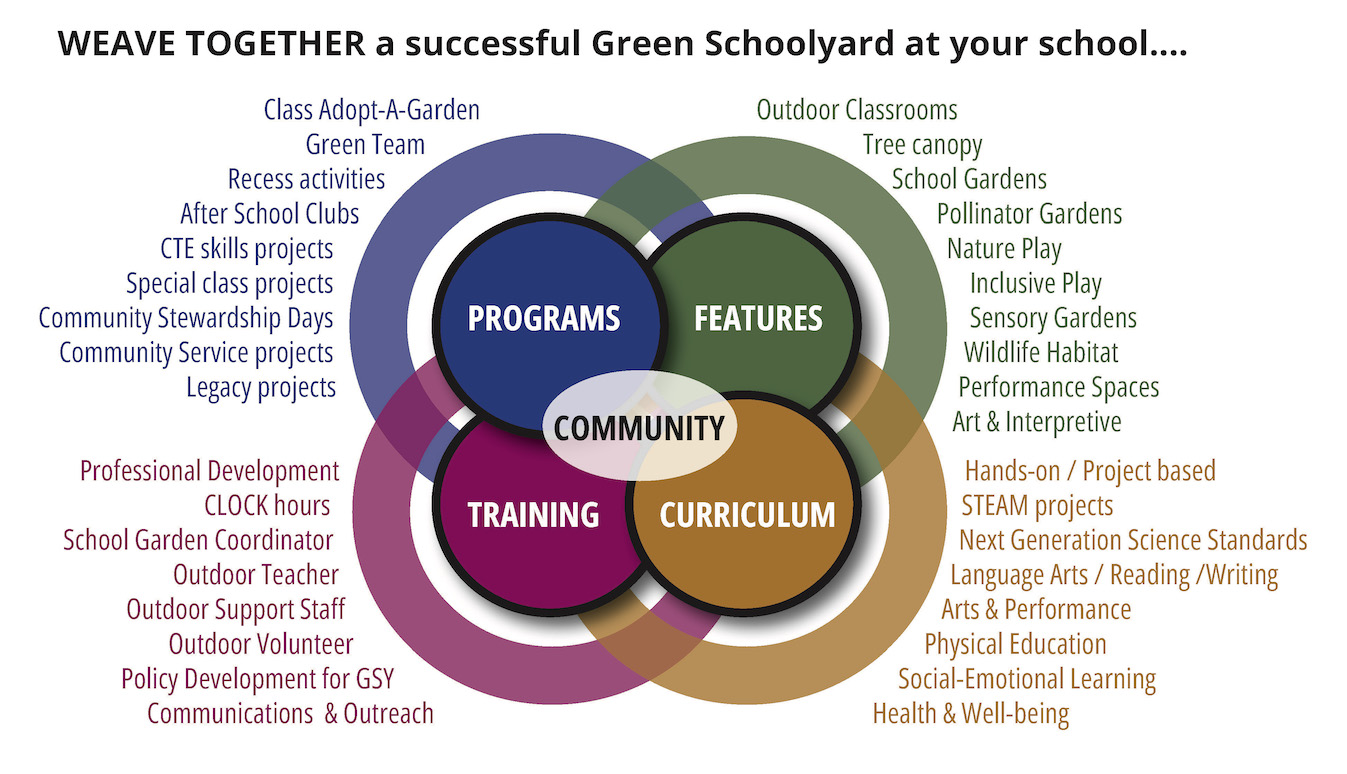
A Green Schoolyard looks at the entire property, from fence to fence, at the potential that could be across the whole property if money, time and energy were available. A majority of schools in our communities have landscape that is required by code, such as street or parking lot trees. But the majority of where people spend their time, is absent of nature and places to engage beyond active play and sports fields. When we consider adding nature and diverse features for all types of users and activities, we see a much greener campus.
As many of the articles, books and web pages in the Resource section will tell you, Green Schoolyards provide numerous benefits. There is also a role for every member of the school community to contribute to the on-going success of Green Schoolyard campuses. There can be a fine balance between meeting safety and security with diversifying features so that all can safely enjoy outdoors as well as feel welcome to enter and explore.
Here are just a few examples of benefits:
From the Children & Nature Network – Not only do Green Schoolyards promote learning through improved academic performance, increased attention span, and provide opportunities for diverse play, but also improving community cohesiveness, create activities for family engagement, improve health and wellness and enhance the environmental habitats.
Many research studies have indicated that:
- View of trees and natural settings outside of classroom windows can calm and reduce stress of students (and I can imagine staff, too)
- Diverse play features promote opportunities to increase social-emotional learning through working and playing with other students
- Working in gardens provides equitable access to nature for all students, regardless of age, academic capabilities or learning styles and provides mental health benefits
- Adding gardens and habitat features helps students feel ownership of their campus and can reflect the neighborhood needs for both in-school lessons and after school and breaks.
Other benefits that support implementing Green Schoolyard projects include:
- School districts tend to be significant land owners, providing opportunity to increase natural areas throughout urban and suburban communities.
- Projects can benefit mutual community goals, such as tree plantings and pollinator gardens to meet Climate Action Planning & Resiliency efforts, Urban Tree Canopy projects to reduce heat island effects, creating more public access to parks and green spaces with joint use agreements, etc.
- For middle and high schools, Career Education Technology (CTE) projects and programs can create on-site field stations and learning labs for horticulture, environmental science and natural resources. Green Schoolyards create equitable access for all students within walking distance of the building and provide an opportunity to have professional partners to support career-ready learning on-site.
- Stewardship and community service projects help nurture and care for the new spaces, features and plantings.
Accessible pathways provide equitable access to fitness on campuses, as well as walking loops for “walks and talks” or de-escalation walks.
- Green Schoolyards provide daily, weekly, monthly access to nature to familiarize students to nature, which is especially important for students who have little contact with nature. Learning about what to see, explore and understand at school will help build for successful trips away from campus, including Outdoor School trips are remote learning centers.
Campus improvements lend themselves to engaging community partnerships including donations of materials, expertise and activities.
The list of benefits vary, of course, by school, district and community. But each school has the opportunity to look at what their needs are for building success of students, staff and the community and finding projects that bring people and nature together.


by editor | Aug 26, 2025 | Gardening, Farming, Food, & Permaculture, Outdoor education and Outdoor School, Place-based Education, Schoolyard Classroom
Special Issue: Understanding Green Schoolyards
Picture a noisy elementary classroom, with bustling kids cleaning up from a morning of schoolwork. Then see the doors swing open and they head outside for some fresh air and play. Some students make a straight line right to their favorite equipment, like the swings. Some head for sports, like basketball or soccer. Still others may skip over to the play structure, start a game of tag or simply race around the equipment.
Does your vision stop there? Some, probably more than you think, need quiet space and decompression time, alone or with friends. Maybe they walk a loop path while chatting about a new pet, or maybe they give voice to their nervousness about an upcoming test. Given the chance, some would stroll over to a table under a tree, carrying a good book or some art supplies. If their school’s leadership is forward-thinking, some kids will head for a nature play area, where you may see them avoid the “lava” while traversing from log to boulder to log. Still others might roam the whole of the area, collecting leaves, twigs, flowers, and cones to craft something at the outdoor building tables.
If you have envisioned all of this, then in your mind’s eye you’ve built a Green Schoolyard. You might also hear terms such as Community Schoolyards and Living Schoolyards, as the concepts are similar – connect kids to nature in their neighborhoods.
“School” is about more than the indoor, classroom environment. A school’s entire campus creates an integrated experience for students, staff, and neighbors, both in terms of
activity and perception.
Green Schoolyards complement academic achievement. There is a significant body of research connecting children’s performance in school and the role that their environment plays. Views of nature, especially trees, from school windows, improve test scores for middle school students. 1
Green Schoolyards vary widely, but at their heart they offer natural elements that contribute to a diverse, safe, and welcoming setting for students and staff. (And, again, neighbors. Green Schoolyards enhance neighborhoods.) They may comprise any number of features, but you’ll mainly find that they promote hands-on learning, social-emotional connectivity, and a harnessing of the calming power of nature. Goodness knows, we need to reduce stress and anxiety while fostering confidence and creativity. Green Schoolyards tip that balance toward healthy development.
To learn more about bringing Green Schoolyard thinking to your campus, please keep reading. The contributing authors will showcase examples of projects, features, programs and ideas to transform any school. —JTK