
by editor | Feb 23, 2021 | Critical Thinking, Equity and Inclusion, Questioning strategies
Aldo Leopold famously wrote,”One of the penalties of an ecological education is that one lives alone in a world of wounds.” As environmental educators, we must ask ourselves what we are giving our students that equips them to deal with this harsh reality.
by Nick Engelfried (2017)
It hurts to love nature in the twenty-first century. Climate change, species extinctions, toxic forms of resource extraction like fracking, all will inevitably be encountered by our students in headlines and the evening news. Again and again, they will be confronted with news of harm being done to the world they have grown to love. What tools can we give students to defend themselves against despair and cynicism?
The solution, I believe, is for students to see environmental issues not as a serious of hopeless problems, but as a set of challenges with solutions they can take action to implement. By “taking action,” I don’t mean changing light bulbs, turning off the faucet, or reducing one’s meat consumption.
Making environmentally friendly lifestyle choices may provide a temporary sense of relief for some students. However, those who think critically about it will quickly realize that much larger forces than their individual footprints are at play in creating the climate crisis.
If we want to help students thrive in Leopold’s “world of wounds,” we must guide them far beyond the realm of personal consumption choices. We must help them see opportunities for collective, not just individual action. This is especially important for students of high school age and up, who are both developmentally ready to think about social change and increasingly likely to be exposed to environmental news as their awareness of the world around them expands.
I recently had the opportunity to experiment with teaching students about collective action and climate change, while co-leading a group of high school juniors and seniors on a 12-day backpacking trip for the North Cascades Institute (NCI) Youth Leadership Adventures program. NCI is a nonprofit that has been helping people connect with nature in and around the majestic mountains of North Cascades National Park for over three decades. NCI’s Youth Leadership Adventures program gets high school students out into the backcountry to learn about natural history, sustainability, and leadership.
In the lessons my two co-instructors and I taught while leading our students through North Cascades National Park, we made a point of emphasizing climate change solutions that involve collective organizing. The successes and challenges we encountered may, I hope, be useful to educators in similar positions who wish to help their students become effective agents of environmental change.
On the third day of the trip, one of my co-instructor colleagues led a lesson which introduced concepts like how the greenhouse effect works. We felt it was important to give students this grounding in basic climate science as a way to set the stage for future lessons.
Two days later, we introduced students to some specific impacts of climate change on people around the world. Another of my fellow instructors led a “Climate Change Mixer” activity taken from Bill Bigelow and Tim Swinehart’s excellent book, A People’s Curriculum for the Earth. Students participated in a role play in which they took on the roles of real people whose lives are affected by climate change or energy extraction. Afterwards, several students expressed surprise at the severity of climate change impacts on people like members of the Gwich’in nation in the Arctic, whose way of life is threatened by melting ice and the die-off of caribou.
Having acquainted students with the science of climate change and some of its effects, we were ready to talk about action. The day after the mixer activity, I led a lesson on social change designed to get students thinking about how they could have a positive influence on climate issues. I opened the lesson by introducing a concept none of the students had heard of before: theory of change.
A person’s theory of change is their mental conceptualization of how change occurs in society. If you believe the solution to environmental problems is for each of us, one by one, to decide to change our lightbulbs and reduce our meat intake, that’s your theory of change. This is also the theory promoted by many mainstream environmental education materials, which emphasize individual lifestyle changes above all else.
Another, equally problematic theory of change most high schoolers have encountered is that major societal changes are mostly triggered by charismatic individuals and “super-people,” who inspire the masses with exceptional acts of daring or wisdom. The way history is taught at the elementary and high school levels tends to reinforce this theory. Traditional historical narratives focus on charismatic leaders—the George Washingtons, Abraham Lincolns, and Martin Luther Kings—to the virtual exclusion of thousands of other ordinary people who contributed to making change happen.
To get students thinking critically about developing their own theory of change, I had us analyze one of the most famous accounts of personal bravery from US history: the Rosa Parks story. I asked a student volunteer to recount the story the way they’d learned it in school. The traditional narrative goes something like this: Rosa Parks, a seamstress in Montgomery, Alabama, decided one day that she would not put up with racist segregation laws any longer. She refused to give up her seat on a bus to a white man, and this act of personal bravery inspired the city-wide Montgomery Bus Boycott. This in turn gave rise to the Civil Rights Movement.
I next introduced some additional facts usually left out of the Rosa Parks story (these particular bits of background information were drawn from Paul Schmitz’s article for Huffington Post, “How Change Happens: The Real Story of Mrs. Rosa Parks and the Montgomery Bus Boycott”). They include:
• Rosa Parks had a long history of challenging segregation. In 1943, she was elected Secretary of the local NAACP chapter.
• Prior to her arrest, Parks had received training in nonviolent civil disobedience practices at the Highlander Folk School.
• When Parks was arrested in 1955, Alabama NAACP President E. D. Nixon was already searching for a good plaintiff to challenge segregation laws.
• Organizing the Montgomery Bus Boycott was a major undertaking involving many people. Jo Ann Robinson, a local leader in the Women’s Political Council, spearheaded an effort to print and post 15,000 fliers supporting the boycott.
None of these details diminishes the significance of Rosa Parks or the heroic nature of her actions. However, the picture they paint is quite different from the traditional Rosa Parks story. Rather than an act of individual bravery spontaneously triggering change, this more accurate narrative becomes one about a community of people coming together to challenge an unjust system.
It was now time to get students thinking about social change in an age of climate crisis. To do this, I introduced a role play centered around a current issue in Washington State: the controversy over a proposed new oil export terminal on the Columbia River in Vancouver, WA.
I first gave students some context. Tesoro-Savage, an oil infrastructure company, is seeking permits from the State of Washington to build the country’s largest oil export facility at the Port of Vancouver. If built, the terminal would further the world’s reliance on fossil fuels, and would be serviced by four oil trains per day passing through many towns and cities in the Columbia River Gorge. A train derailment in any of these communities could cause a disaster involving a massive explosion and thousands of gallons of spilled oil.
Given that most students in our group came from Washington or northern Oregon, the Vancouver oil export debate is unfolding in their backyards. Despite this, not one student had heard about the issue before I introduced it to them. This says something about the state of environmental education in our schools.
Having given students basic facts about the oil export proposal, I next introduced a fictional scenario set in a hypothetical community called Columbia Village. I asked students to imagine that Washington Governor Jay Inslee had given the oil project its final permit (in fact, Governor Inslee is expected to make a decision later this year). Oil trains would soon begin rolling through Columbia Village, which is situated in the Gorge along the rail line. For the role play, students would take on the personas of people from a variety of backgrounds meeting at the Columbia Village Community Hall to discuss a response to this environmental and public safety threat.
Unlike the roles assigned to students in the Climate Change Mixer, those I created for this activity were not based on real people. However, as someone who has attended dozens of meetings where members of a community came together to challenge fossil fuel projects, I carefully modeled each role around a different point of view that one frequently encounters at such gatherings. Specific characters included a mother concerned about dangers to her children, an activist advocating mass civil disobedience, and a member of the Yakama Tribe concerned about the oil project’s impact on fishing rights.
At this point in the lesson we took a break for dinner, and to let students familiarize themselves with their roles. I explained that students’ job at the community meeting would be to advocate for their character’s point of view about an acceptable course of action. Students would be allowed to “change their minds,” but only if they felt this was realistic and that the concerns of their character had been adequately addressed.
My hope for this activity was students would realize that many characters in the role play represented very different theories of change—and that their job at the meeting must be to reconcile these diverse points of view into a plan that could realistically achieve the desired result. I myself participated in the role play when we reconvened, acting as the meeting facilitator whose only goal was to ensure a consensus was reached without advocating any particular point of view.
The role play that unfolded over the next forty minutes or so at least partly satisfied my hopes for the activity. Unsurprisingly, one of the most contentious issues was that of using civil disobedience to confront the oil trains. One character in the role play advocated people blockading the oil trains with their bodies—and several others responded negatively to this idea, arguing that it was too dangerous. It was not unlike actual debates over civil disobedience, which I have listened to at many real-life meetings.
As an alternative to civil disobedience, another student suggested organizing a massive but legal protest near the rail line. I was surprised that the students seemed to think getting a permit for such an event would be a much longer and more arduous process than would probably really be the case. More predictably, many students were a bit naïve about how many people they could get to show up at a protest, envisioning a crowd of 100,000. The Dalles, one of the larger towns in the Columbia Gorge, has a population of only some 14,000, and most Gorge communities are much smaller.
Another character in the role play suggested everyone work on reducing their individual carbon footprints so as to make oil infrastructure irrelevant. I had added this point of view hoping it would force students to grapple with whether individual lifestyle changes are really enough. As it turned out, many students seemed genuinely torn about this. Some were understandably drawn to the idea that individual changes might inspire larger community-wide actions. Others pointed out that even if an entire town’s population switched to energy efficient light bulbs, this wouldn’t have much impact on global economic forces that made the oil export project viable. While students never addressed the lifestyle issue in quite the direct way I hoped they might, I felt satisfied they were coming to realize that individual changes are necessary but not sufficient.
In the end the students, through their role play characters, arrived at a consensus for a compromise course of action: to move forward with a march and a petition-gathering effort, while also embarking on a public education campaign to encourage sustainable lifestyles, and preserving the option of civil disobedience for those who wished to engage in it. In real life, such a wide-ranging, ambitious plan of action would probably seem unrealistic for a new community group’s first meeting. However, I feel this is far less important than the fact that students were able to recognize the value of different theories of change as well as some of their defects, and to come up with a plan not unlike the strategies some real climate activist organizations have developed.
After the social change lesson, I realized in my eagerness to get students thinking about collective action, I had neglected to fully bring the lesson back to students’ own experience and concrete actions they themselves could take. Fortunately there was time to rectify this. Later in the trip, one of my colleagues led an activity in which students made a pledge to themselves to take a climate-related action of their own choosing within the next year. Some students’ pledges centered around lifestyle changes like using less plastic or water. But I was pleased to note others chose collective actions like getting involved in activist groups or starting a climate-focused club at their schools.
The climate change lessons my colleagues and I taught during this 12-day trip represented an experiment in getting students to think about how environmental change actually happens. There are things I plan to do differently next time I teach a similar curriculum. At the beginning of the social change lesson, I wish I had spent more time illustrating the theory of change concept with specific examples. In designing the oil trains role play, I also could have done more to flesh out the characters assigned to each student, which perhaps would have led to deeper conversations about diverse perspectives.
These lessons learned aside, I feel the curriculum my colleagues and I devised for this backpacking trip successfully helped students take the first tentative steps toward envisioning how they might play a role in confronting climate chaos—and not just by participating in Meatless Mondays. I hope they came away with at least a few tools for fighting back against the sense of hopelessness despair that can come from living in a “world of wounds.” ❏
Bibliography
Bigelow, Bill and Tim Swineheart. A People’s Curriculum for the Earth. Milwaukee, WI: Rethinking Schools, 2014. 410 pages. ISBN number: 978-0-942961-57-7. The “Climate Change Mixer” activity described on pages 92-101 is referenced for this article.
Leopold, Aldo. A Sand County Almanac, With Essays on Conservation From Round River. New York, NY: Random House Publishing Group, 1970. Originally published by Oxford University Press in 1949 and 1953. 295 pages. ISBN number: 0-345-34505-3. The quote used in this article, “One of the penalties of an ecological education is that one lives alone in a world of wounds,” appears on page 197.
Schmitz, Paul (December 1, 2014). “How Change Happens: The Real Story of Mrs. Rosa Parks and the Montgomery Bus Boycott.” Huffington Post. Retrieve August 7, 2017, from http://www.huffingtonpost.com/paul-schmitz/how-change-happens-the-re_b_6237544.html. This piece was used as the main source for background information about the Rosa Story.
Nick Engelfried is an environmental educator and activist, currently working on his M.Ed. in Environmental Education through Western Washington University. As part of his work for the degree program, he is participating in a year-long residency working with the North Cascades Institute.
by editor | Jan 10, 2021 | Environmental Literacy
Integration Can Help You Teach
More Science and Environmental Education
by Jim McDonald
Central Michigan University
The demands on classroom teachers to address a variety of different subjects during the day means that some things just get left out of the curriculum. Many schools have adopted an instructional approach with supports for students that teach reading and math, with the addition of interventions to teach literacy and numeracy skills which take up more time in the instructional schedule. In some of the schools that I work with there is an additional 30 minutes a day for reading intervention plus 30 more minutes for math intervention. So, we are left with the question, how do I fit time for science or environmental education into my busy teaching schedule?
_________________________________________________________________________________________________________________________
In a recent STEM Teaching tools brief on integration of science at the elementary level, it was put this way:
We do not live in disciplinary silos so why do we ask children to learn in that manner? All science learning is a cultural accomplishment and can provide the relevance or phenomena that connects to student interests and identities. This often intersects with multiple content areas. Young children are naturally curious and come to school ready to learn science. Leading with science leverages students’ natural curiosity and builds strong knowledge-bases in other content areas. Science has taken a backseat to ELA and mathematics for more than twenty years. Integration among the content areas assures that science is given priority in the elementary educational experience (STEM Teaching Tool No. 62).
Why does this matter? Educators at all levels should be aware of educational standards across subjects and be able to make meaningful connections across the content disciplines in their teaching. Building administrators look for elementary teachers to address content standards in math, science, social studies, literacy/English Language arts at a minimum plus possibly physical education, art, and music. What follows are some things that elementary teachers should consider when attempting integration of science and environmental education with other subjects.
Things to Consider for Integration
The integration of science and environmental education concepts with other subjects must be meaningful to students and connect in obvious ways to other content areas. The world is interdisciplinary while the experience for students and teachers is often disciplinary. Learning takes place both inside and outside of school. Investigations that take place outside of school are driven by people’s curiosity and play and often cut across disciplinary subjects. However, learning in school is often fragmented into different subject matter silos.
Math and reading instruction dominate the daily teaching schedule for a teacher because that is what is evaluated on standardized tests. However, subjects other than ELA and math should be kept in mind when considering integration. Social studies and the arts provide some excellent opportunities for the integration of science with other content areas. In the NGSS, the use of crosscutting concepts support students in making sense of phenomena across science disciplines and can be used to prompt student thinking. They can serve as a vehicle for teachers to see connections to the rest of their curriculum, particularly English/Language Arts and math. Crosscutting concepts are essential tools for teaching and learning science because students can understand the natural world by using crosscutting concepts to make sense of phenomena across the science disciplines. As students move from one core idea to another core idea within a class or across grade-levels, they can continually utilize the crosscutting concepts as consistent cognitive constructs for engaging in sense-making when presented with novel, natural phenomena. Natural phenomena are observable events that occur in the universe and we can use our science knowledge to explain or predict phenomena (i.e., water condensing on a glass, strong winds preceding a rainstorm, a copper penny turning green, snakes shedding their skin) (Achieve, 2016).
Reading
Generally, when I hear about science and literacy, it involves helping students comprehend their science textbook or other science reading. It is a series of strategies from the field of literacy that educators can apply in a science context. For example, teachers could ask students to do a “close reading” of a text, pulling out specific vocabulary, key ideas, and answers to text-based questions. Or, a teacher might pre-teach vocabulary, and have students write the words in sentences and draw pictures illustrating those words. Perhaps students provide one another feedback on the effectiveness of a presentation. Did you speak clearly and emphasize a few main points? Did you have good eye contact? Generally, these strategies are useful, but they’re not science specific. They could be applied to any disciplinary context. These types of strategies are often mislabeled as “disciplinary literacy.” I would advocate they are not. Disciplinary literacy is not just a new name for reading in a content area.
Scientists have a unique way of working with text and communicating ideas. They read an article or watch a video with a particular lens and a particular way of thinking about the material. Engaging with disciplinary literacy in science means approaching or creating a text with that lens. Notably, the text is not just a book. The Wisconsin DPI defines text as any communication, spoken, written, or visual, involving language. Reading like a scientist is different from having strategies to comprehend a complex text, and the texts involved have unique characteristics. Further, if students themselves are writing like scientists, their own texts can become the scientific texts that they collaboratively interact with and revise over time. In sum, disciplinary literacy in science is the confluence of science content knowledge, experience, and skills, merged with the ability to read, write, listen, and speak, in order to effectively communicate about scientific phenomena.
As a disciplinary literacy task in a classroom, students might be asked to write an effective lab report or decipher the appropriateness of a methodology explained in a scientific article. They might listen to audio clips, describing with evidence how one bird’s “song” differs throughout a day. Or, they could present a brief description of an investigation they are conducting in order to receive feedback from peers.
Social Studies
You can find time to teach science and environmental education and integrate it with social studies by following a few key ideas. You can teach science and social studies instead of doing writer’s workshop, choose science and social studies books for guided reading groups, and make science and social studies texts available in your classroom library.
Teach Science/Social Studies in Lieu of Writer’s Workshop: You will only need to do this one, maybe two days each week. Like most teachers, I experienced the problem of not having time to “do it all” during my first year in the classroom. My literacy coach at the time said that writer’s workshop only needs to be done three times each week, and you can conduct science or social studies lessons during that block one or two times a week. This was eye-opening, and I have followed this guidance ever since. My current principal also encouraged teachers to do science and social studies “labs” once a week during writing time! Being able to teach science or social studies during writing essentially opens up one or two additional hours each week to teach content! It is also a perfect time to do those activities that definitely take longer than 30 minutes: science experiments, research, engagement in group projects, and so forth. Although it is not the “official” writers workshop writing process, there is still significant writing involved. Science writing includes recording observations and data, writing steps to a procedure/experiment, and writing conclusions and any new information learned. “Social studies writing” includes taking research notes, writing reports, or writing new information learned in a social studies notebook. Students will absolutely still be writing every day.
Choose Science and Social Studies Texts for Guided Reading Groups: This suggestion is a great opportunity to creatively incorporate science and social studies in your weekly schedule. When planning and implementing guided reading groups, strategically pick science and social studies texts that align to your current unit of study throughout the school year. During this time, students in your guided reading groups can have yet another opportunity to absorb content while practicing reading strategies.
Make Science and Social Studies Texts Available and Accessible in Your Classroom Library: During each unit, select texts and have “thematic unit” book bins accessible to your students in a way that is best suited for your classroom setup. Display them in a special place your students know to visit when looking for books to read. When kids “book-shop” and choose their just-right books for independent reading, encourage them to pick one or two books from the “thematic unit” bin. They can read these books during independent reading time and be exposed to science and social studies content.
Elementary Integration Ideas
Kindergarten: In a kindergarten classroom, a teacher puts a stuffed animal on a rolling chair in front of the room. The teacher asks, “How could we make ‘Stuffy’ move? Share an idea with a partner”. She then circulates to hear student talk. She randomly asks a few students to describe and demonstrate their method. As students share their method, she will be pointing out terms they use, particularly highlighting or prompting the terms “push” and “pull”. Next, she has students write in their science notebooks, “A force is a push or a pull”. This writing may be scaffolded by having some students just trace these words on a worksheet glued into the notebook. Above that writing, she asks students to draw a picture of their idea, or another pair’s idea, for how to move the animal. Some student pairs that have not shared yet are then given the opportunity to share and explain their drawing. Students are specifically asked to explain, “What is causing the force in your picture?”.
For homework, students are asked to somehow show their parents a push and a pull and tell them that a push or a pull is a force. For accountability, parents could help students write or draw about what they did, or students would just know they would have to share the next day.
In class the next day, the teacher asks students to share some of the pushes and pulls they showed their parents, asking them to use the word force. She then asks students to talk with their partner about, “Why did the animal in the chair sometimes move far and sometimes not move as far when we added a force?”. She then asks some students to demonstrate and describe an idea for making the animal/chair farther or less far; ideally, students will push or pull with varying degrees of force. Students are then asked to write in their notebooks, “A big force makes it move more!” With a teacher example, as needed, they also draw an image of what this might look like.
As a possible extension: how would a scientist decide for sure which went further? How would she measure it? The class could discuss and perform different means for measurement, standard and nonstandard.
Fourth Grade Unit on Natural Resources: This was a unit completed by one group of preservice teachers for one of my classes. The four future elementary teachers worked closely in their interdisciplinary courses to design an integrated unit for a fourth-grade classroom of students. The teachers were given one social studies and one science standard to build the unit around. The team of teachers then collaborated and designed four lessons that would eventually be taught in a series of four sessions with the students. This unit worked to seamlessly integrate social studies, English language arts, math, and science standards for a fourth-grade classroom. Each future teacher took one lesson and chose a foundation subject to build their lesson upon. The first lesson was heavily based on social studies and set the stage for the future lessons as it covered the key vocabulary words and content such as nonrenewable and renewable resources. Following that, students were taught a lesson largely based on mathematics to better understand what the human carbon footprint is. The third lesson took the form of an interactive science experiment so students could see the impact of pollution on a lake, while the fourth lesson concluded with an emphasis on language arts to engage students in the creation of inventions to prevent pollution in the future and conserve the earth’s resources. Contrary to the future educators’ initial thoughts, integrating the various subject areas into one lesson came much more easily than expected! Overall, they felt that their lessons were more engaging than a single subject lesson and observed their students making connections on their own from previously taught lessons and different content areas.
References
Achieve. (2016). Using phenomena in NGSS-designed lessons and units. Retrieved from https://www.nextgenscience.org/sites/default/files/Using%20Phenomena%20in%20NGSS.pdf
Hill, L., Baker, A., Schrauben, M. & Petersen, A. (October 2019). What does subject matter integration look like in instruction? Including science is key! Institute for Science + Math Education. Seattle, WA: University of Washington Retrieved from: http://stemteachingtools.org/brief/62
Wisconsin Department of Public Instruction. (n.d.) Clarifying literacy in science. Retrieved from: https://dpi.wi.gov/science/disciplinary-literacy/types-of-literacy
Jim McDonald is a Professor of Science Education at Central Michigan University in Mt. Pleasant, Michigan. He teaches both preservice teachers and graduate students at CMU. He is a certified facilitator for Project WILD, Project WET, and Project Learning Tree. He is the Past President of the Council for Elementary Science International, the elementary affiliate of the National Science Teaching Association.

by editor | Jan 29, 2020 | Forest Education, IslandWood, Learning Theory
 he thought of talking trees conjures up images of the fantastical. Tolkien’s ents patrol the forest, Baum’s forest of fighting trees throws apples at Dorothy, and Marvel’s Groot guards the galaxy. Or, perhaps, we think of those who speak for the trees that cannot speak for themselves: Dr. Seuss’s Lorax, or the dryads of ancient mythology. But I would argue that all trees have a lot to say, if we are willing to listen.
Like all great storytellers, trees have an impressive hook. Each species, a different author, has different tales to tell. Throughout time, some people have listened to those stories, and translated them to a language we can understand. And trees also give us the stories the trees may not even know they are telling, the way a worn and coffee-stained paperback can tell of a voracious and messy reader. Students, lovers of stories oral, written, and visual, can learn from these giants of the forest.
IslandWood, a residential environmental education school on Bainbridge Island, Washington, markets itself to students as “a school in the woods.” On its surface, this imparts expectations of students while on campus. It is not camp, but a school, with all the implications of learning. But what about the second part? The woods as a term indicate the outdoor status of some classrooms, but also plants the idea very early on of the ubiquity of trees. Wood comes from trees, and woods come from trees. This school is where we learn among the trees. Students should be aware of that upfront.
These trees have a long story to tell our students, and the students are ready to listen. When the glaciers retreated from the Puget Sound area 10,000-12,000 years ago, in moved trees from present-day California. The seeds following the glacier’s retreat met an incredibly moist environment that was perfect for the establishment of gargantuan specimens. Even students with individuals of these giants near their school are unlikely to see them in such abundance, or in such a relatively untamed state, covered in moss and lichen.
Students’ chatter while clambering from buses onto IslandWood property is a good clue in to what familiarity they may have with the woods. Students will disembark the bus and are unable to tear their eyes away from the treetops. Audible oohs and ahhs promise for a week of wonder and exploration. Recently, a student walked through the arrival shelter and turned to a friend to say, “so I guess this is what the woods are.” The trees are our ambassadors to these students, and the story they tell is one of upwards growth.
At IslandWood, we teach of the “Big Five:” western red cedar, red alder, western hemlock, bigleaf maple, and Douglas-fir.
The western red cedar is a favorite of many students. On species reference cards, some of the cultural uses are listed: canoe building and basket weaving feature prominently. This already provides a unique connection to place; on their website, the Suquamish tribe introduce themselves as “expert fisherman, canoe builders and basket weavers” (Suquamish Tribe, 2015). This is the identity they first relay to visitors, and one that many students have already been introduced to. To say “this is what the Suquamish used to make canoes and baskets” taps immediately into their understanding of native traditions.
The idea that people tended this land for livelihood before European settlers arrived is abstract for many students. While they may be taught the names of local tribes and heard some of the stories, touching a tree that contributed so heavily to their way of life provides a new experience. I taught a student that the Suquamish use the cedar bark for making clothing, and then heard them explain to a classmate that you can tell the bark is good for weaving because of the way it is stringy and long. The instructor provides one piece of information, and the student is able to gain a deeper understanding from interactions with the tree. The tree is telling the story of its cultural history by making itself so accessible to our young explorers.
A trend that students visiting IslandWood are quick to notice is that many of the red cedars are turning brown and losing leaves. This does not match well with what they have been taught about the definition of evergreen, and they struggle to reconcile reality and the trees. An investigation into why some red cedars are dying and others aren’t will lead students to the reality of climate change. The trees, so long-lived, cannot adapt the same way that other species can. When confronted with this reality, student groups come up with creative solutions, many offering to water the trees with their own drinking water. The trees, for those who listen, are sending out a plea and tell the story of human excess.
The red cedar also introduces students to the concept of sustainability and giving. Just as a dining hall might teach students to not waste food, the trees can show that wasting other resources is avoidable too. The roots, outer bark, inner bark, needles, and branches of trees all serve varied purposes, ensuring that none is discarded. The characteristic swooping lower branches of the tree, which resemble arms outstretched, relate to tradition. One Coast Salish tradition tells of the appearance of cedar tree at the spot when an incredibly selfless man died. IslandWood’s Great Hall has a cedar statue of Upper Skagit woman Vi Hilbert. The arms of the statue are similarly outstretched in welcome to those who enter the space for learning. The tree that gives its whole self to the people who need it sits with its branches outstretched as a welcome for more users.
When students learn the red cedar and later point it out on the trail, the swooping branches are most often cited as their point of identification. When asked what those branches remind them of, the first answer might be “the letter J,” but given some time, students arms will go out in an open gesture to mimic the tree. “It’s the tree of life,” they say, feeling connected to the history of that species.
The Douglas-fir tree, a mainstay of this ecosystem, is another favorite of students. While learning about the tree, students inevitably discover a cone on the ground, and pick it up, many questions having sprung forth in their minds. As trees that can grow over 300 feet tall with few lower branches, the opportunity to have a proxy for what goes on above our heads is incredible. The cones are unique to this tree, and tell a great story.
The cones have a two-tone property, as the seeds protrude beyond the scales of the cone. Tradition would tell that those lighter colored pieces are from a great fire that ravaged the land millennia ago. As the fire raged, animals fled, and the mouse ran to seek shelter. Unfortunately for the mouse, every tree it asked for help was worried for its own survival, unable to help the forest friend. When the mouse came upon the Douglas-fir, it opened up its cones and instructed entry; its lower branches would be above the heat of the fire, and its thick bark would protect it from the heat. The mouse and tree survived the fire, and the cones show a vestige of that encounter, as there appear to be little legs and a tail sticking out from every cone.
After hearing this story, students become experts on Douglas-fir identification. If their eyes are cast downwards, looking for signs of life on the trail, they see the cones and are reminded of the story they learned. If they are up, facing ahead and all around, they will see the thick bark that protected the tree. The stories reflect the nature again, and tree identification by means other than leaf recognition starts to be a possibility for students.
 IslandWood property, once seized from the Suquamish, was the site of a major logging operation. Students see many trees and marvel at their size and age, but a hike to the harbor tells a different story of these trees. The trees that they have become familiar with are members of species that may live over one thousand years, but this space in particular is a reflection of its past. Blakely Harbor is the former site of what was “the largest, highest-producing sawmill in the world” (Bainbridge Historical Museum, n.d.).
The site at the harbor is unmistakably the vestiges of a former factory of some sort. Some students come in aware of the logging history of the area, and they are reminded of that history by the remnant logs that stick upright out of the harbor, former supports for the mill infrastructure. Some students surmise that the wood, decaying, waterlogged, and now home to aquatic plants, are a forest that has been cut down. When presented with the uniformity of the timber, especially as compared to the forests at main campus, they are eventually reminded of some man-made structures, and then the history of the logging operation can be explored.
To many of these students, IslandWood is the pinnacle of wild. Yet this adventure shows the proclivity of some humans to extract natural resources past their sustainable harvest. The trees that remind the students to be sustainable and giving are the same species that were extracted, sent into the mill and out to be shipped to other parts of the country and the world for human consumption. The Douglas-firs that protected the mice from the fire were cut down and extracted, providing little habitat for any animals.
The average age of street trees in Seattle is 3 years (Brinkley, 2018). Students may understand trees can live to be hundreds of years old, but learning that Douglas-firs can live to be over one thousand years old makes their eyes light up with wonder. Even the relatively young trees on campus have been present for decades, watching the landscape change with the inhabitants. Coming to an outdoor learning facility where the trees reach hundreds of feet in the sky can instill a feeling no book or photo could. Let the trees greet our students with arms and branches wide open.
Marlie Belle Somers is a graduate student in the Education for Environment and Community program at IslandWood, partnered with the University of Washington.
Remnants of the lumber mill docks at Blakely Harbor. Students use this as a clue while investigating what came before our campus stood on these grounds. Photo by Marlie Belle Somers.
Bainbridge Island Historical Museum. (n.d.). Port Blakely: Portrait of a Mill Town. Retrieved from http://bainbridgehistory.org/port-blakely-portrait-of-a-mill-town/
Brinkley, W. (2018, November 2). Urban Ecology. Lecture presented in Antioch University, Seattle.
Suquamish Tribe. (2015). History & Culture. Retrieved from https://suquamish.nsn.us/home/about-us/history-culture/

by editor | Jan 27, 2020 | Equity and Inclusion, Outdoor education and Outdoor School
Providing opportunities for students of color to explore
the outdoors and science careers
Text and photos by Sprinavasa Brown
 recall the high school science teacher who doubted my capacity to succeed in advanced biology, the pre-med advisers who pointed my friend Dr. Kellianne Richardson and me away from their program and discouraged us from considering a career in medicine – biased advice given under the guise of truth and tough love.
I remember only three classes with professors of color in my four years at college, only one of whom was a woman. We needed to see her, to hold faith that as women of color, we were good enough, we were smart enough to be there. We were simply enough, and we had so much to contribute to medicine, eager to learn, to improve and to struggle alongside our mostly White peers at our private liberal arts college.
These are the experiences that led Kellianne and me to see the need for more spaces set aside for future Black scientists, for multi-hued Brown future environmentalists.
The story of Camp ELSO (Experience Life Science Outdoors) started with our vision. We want Black and Brown children to access more and better experiences than we did, experiences that help them see their potential in science, that prepare them for the potentially steep learning curve that comes with declaring a science major. We want Black and Brown kids to feel comfortable in a lab room, navigating a science library, and advocating for themselves with faculty and advisers. We hope to inspire their academic pursuits by laying the foundation with curiosity and critical thinking.
Creating a sense of belonging
Camp ELSO’s Wayfinders program is our main program for youths in kindergarten through sixth grade. What began as a programmatic response to our community needs assessment – filling the visible gap in accessible, affordable, experiential science, technology, engineering and math (STEM) programs for young Black and Brown children – quickly grew into a refuge space for youth of greater Portland. Wayfinders is all about creating a safe uplifting and affirming space for youth to engage in learning around four key areas: life science, ecology, community and cultural history. While our week-long sessions include field trip sites similar to many mainstream environmental education programs, our approach is sharply focused on grounding the youth experience in environmental justice while elevating the visibility and leadership opportunities for folks of color.
 We are creating a special place for Black and Brown youth to have transformative experiences, to create memories that we hope will stick with them until adulthood. Creating such a space comes with difficulties, the type of challenges that force our leadership to make tough decisions that we believe will yield the best outcomes for youth underrepresented in STEM fields. For instance, how to mitigate the undertones of colonization, nationalism, and co-opting of traditional knowledge – harmful practices ingrained in mainstream environmental education.
To do so, we invest in training young adults of color to lead as camp guides. We provide resources to support them in developing the skills necessary to engage youth of diverse ethnicities, backgrounds, socioeconomic status and family structure. Our guides practice taking topics and developing discussion questions and lesson plans that are relevant and engaging. We know that the more our staff represents the communities we serve, the closer we get to ensuring that Camp ELSO programming is responsive to the needs of children of color, authentic to their lived experience, and is a reflection of the values of our organization and community.
In 2019 nearly 100 children of color from greater Portland will participate in Camp ELSO’s Wayfinders program over spring and summer break, spending over 40 hours in a week-long day camp engaging in environmental STEM learning and enjoying the outdoors. We reach more children and families through our community outreach events like “Introduce a Girl to Engineering Day: Women of Color Panel” and “Endangered Species Day: Introduction to Youth Activism.”
The most critical aspects of our Wayfinders program happens even before we welcome a single child through our doors. With the intent of purifying the air and spirit, we smudge with cedar and sage to prepare the space. When a child shows up, they are greeted by name. We set the tone for the day with yoga and affirmations to the sounds of Stevie Wonder and Yemi Alade as we strive to expose our kids to global music from diverse cultures.
We have taken the time to ask parents thoughtful questions in the application process to help us prepare to welcome their child to our community. We have painstakingly selected what we feel is a balanced, blended group of eager young minds from diverse ethnic backgrounds: Black, Latinx, the children of immigrants, multi and biracial children of various ethnicities, fuego and magic. Our children come from neighborhoods across Portland and its many suburbs. They come from foster care, single-parent households, affluent homes, homes where they are adopted into loving and beautifully blended families, strong and proud Black families, and intergenerational households with active grandmas and aunties. Consistent with every child and every household is an interest and curiosity around STEM, a love of nature and the outdoors.
The children arrive full of potential and the vitality of youth. Some are shy, and nerves are visible each morning. By the end of the week we’ve built trust and rapport with each of them, we’ve sat in countless circles teaching them our values based in Afrocentric principles, values selected by previous camp guides representing the youth voice that actively shapes the camp’s culture.
 On our way to more distant Metro sites like Blue Lake and Oxbow regional parks and Quamash Prairie, we play DJ in the van. Each kid who wants to has an opportunity to share their favorite song with the group, and if you know the words, you’d better belt it out. We share food and pass around snacks while some children rest and others catch up with old friends. Many more are deep in conversation forging new friendships.
When we arrive, we remind the kids of what is expected of them. We have no doubts that each and every child will respect the land and respect our leaders. The boundaries are clear, and our expectations for them don’t change when problems arise. We hold them to the highest standards, regardless of their life situation. We respect, listen, and embrace who they are.
We are often greeted by Alice Froehlich, a Metro naturalist. Our kids know Alice, and the mutual trust, respect and accountability we have shared over the last three years has been the foundation to create field trips that cater to the needs of our blended group – and oh, it is a beautiful group.
At Oxbow, we are also greeted by teen leaders from the Oregon Zoo’s ZAP (Zoo Animal Presenters) program. These teens of color join us each year for what always ends up being a highlight of the week: playing in the frigid waters of the Sandy River, our brown skin baking under the hot summer sun, music in the background and so much laughter. Like family, we enjoy one another’s company.
Then we break into smaller groups and head into the ancient forest. Almost immediately the calm of the forest envelopes our youth. The serenity that draws us to nature turns our group of active bodies into quieted beings content to listen, observe, respond and reflect. It doesn’t take much for them to find their rhythm and adjust to nature’s pace. Similarly, when we kayak the Tualatin River or canoe the Columbia Slough, they are keen to show their knowledge of local plants and taking notice as the occasional bird comes into view. We learn as much from them as we do from our guides.
These are the moments that allow Camp ELSO’s participants to feel welcome, not just to fit in but to belong. To feel deeply connected to the earth, to nature and to community.
Encouragement for my community
 As a Black environmental educator I’m always navigating two frames of view. One is grounded in my Americanness, the other is grounded in my Blackness, the lineage of my people from where I pull my strength and affirm my birthright. I wear my identities with pride, however difficult it can be to navigate this world as a part of two communities, two identities. One part of me is constantly under attack from the other that is rife with nationalism, anti-Brownness, and opposition toward the people upon whose lives and ancestry this country was built.
I am a descendant of African people and the motherland. I’m deeply connected to the earth as a descendant of strong, free, resilient and resourceful Black people. The land is a part of me, part of who I am. My ancestors toiled, and they survived, they lived off, they cultivated, and they loved the land.
As a black woman, my relationship with the land and its bounty is a part of my heritage. It’s in my backyard garden, where I grow greens from my great-grandmother’s seeds passed down to me from my mother, who taught me how to save, store and harvest them. Greens from the motherland I was taught to cook by my Sierra Leonean, Rwandese and Jamaican family – aunties and uncles I’ve known as my kin since I was a child. It’s in the birds that roam my backyard, short bursts and squawks as my children chase them. The land is in the final jar my mother canned last summer when the harvest was good, and she had more tomatoes than we could eat after sharing with her church, neighbors and family.
Our connection to the land was lost through colonization, through the blanket of whiteness that a culture and set of values instilled upon us all as westerners living on stolen Indigenous land and working in systems influenced by one dominant culture. Our sacred connection with outdoor spaces was lost as laws set aside the “great outdoors” as if it were for White men only. These laws pushed us from our heritage and erased the stories of our forefathers, forgetting that the Buffalo Soldiers were some of the first park rangers, that the movement for justice was first fought by Black and Brown folks.
We grew our own food before our land was stripped away. We lived in harmony with the natural world before our communities were destroyed, displaced or forcibly relocated. We were healthy and thriving when we ate the food of our ancestors, before it was co-opted and appropriated. We must remember and reclaim this relationship for ourselves and for our children.
We are trying to do this with Camp ELSO, starting with our next generation. Children have the capacity to bring so much to environmental professions that desperately need Black and Brown representation. These professions need the ideas, innovations and solutions that can only come from the lived experiences of people of color. Children of color can solve problems that require Indigenous knowledge, cultural knowledge and knowledge of the African Diaspora. We want to give kids learning experiences that are relevant in today’s context, as more people become aware of racial equity and as the mainstream environmental movement starts to recognize historical oppression of people of color.
We need more spaces for Black and Brown children to see STEM professionals who are relatable through shared experiences, ethnicity, culture and history. We need spaces that allow Black children to experience the outdoors in a majority setting with limited influence of Whiteness – not White people but Whiteness – the dominant culture and norms that influence almost every aspect of our lives.
Camp ELSO is working to be that space. We aren’t there yet. We are on our own learning journey, and it comes with constant challenges and a need to continuously question, heal, build and fortify our own space.
 Sprinavasa Brown is the co-founder and executive director of Camp ELSO. She also serves on Metro’s Public Engagement Review Committee and the Parks and Nature Equity Advisory Committee.
Advice for White Environmentalists and Nature Educators
by Sprinavasa Brown
I often hear White educators ask “What should I do?” expressing an earnest desire to move beyond talking about equity and inclusion to wanting action steps toward meaningful change.
I will offer you my advice as a fellow educator. It is both a command and a powerful tool for individual and organizational change for those willing to shift their mindset to understand it, invest the time to practice it and hold fast to witness its potential.
The work of this moment is all about environmental justice centered in social justice, led by the communities most impacted by the outcomes of our collective action. It’s time to leverage your platform as a White person to make space for the voice of a person of color. It’s time to connect your resources and wealth to leaders from underrepresented communities so they can make decisions that place their community’s needs first.
If you have participated in any diversity trainings, you are likely familiar with the common process of establishing group agreements. Early on, set the foundation for how you engage colleagues, a circumspect reminder that meaningful interpersonal and intrapersonal discourse has protocols in order to be effective. I appreciate these agreements and the principles they represent because they remind us that this work is not easy. If you are doing it right, you will and should be uncomfortable, challenged and ready to work toward a transformational process that ends in visible change.
I want you to recall one such agreement: step up, step back, step aside.
That last part is where I want to focus. It’s a radical call to action: Step aside! There are leaders of color full of potential and solutions who no doubt hold crucial advice and wisdom that organizations are missing. Think about the ways you can step back and step aside to share power. Step back from a decision, step down from a position or simply step aside. If you currently work for or serve on the board of an organization whose primary stakeholders are from communities of color, then this advice is especially for you.
Stepping aside draws to attention arguably the most important and effective way White people can advance racial equity, especially when working in institutions that serve marginalized communities. To leverage your privilege for marginalized communities means removing yourself from your position and making space for Black and Brown leaders to leave the margins and be brought into the fold of power.
You may find yourself with the opportunity to retire or take another job. Before you depart, commit to making strides to position your organization to hire a person of color to fill the vacancy. Be outspoken, agitate and question the status quo. This requires advocating for equitable hiring policies, addressing bias in the interview process and diversifying the pool with applicants with transferable skills. Recruit applicants from a pipeline supported and led by culturally specific organizations with ties to the communities you want to attract, and perhaps invite those community members to serve on interview panels with direct access to hiring managers.
As an organizational leader responsible for decisions related to hiring, partnerships and board recruitment, I have made uncomfortable, hard choices in the name of racial equity, but these choices yield fruitful outcomes for leaders willing to stay the course. I’ve found myself at crossroads where the best course forward wasn’t always clear. This I have come to accept is part of my equity journey. Be encouraged: Effective change can be made through staying engaged in your personal equity journey. Across our region we have much work ahead at the institutional level, and even more courage is required for hard work at the interpersonal level.
In stepping aside you create an opportunity for a member of a marginalized community who may be your colleague, fellow board member or staff member to access power that you have held.
White people alone will not provide all of the solutions to fix institutional systems of oppression and to shift organizational culture from exclusion to inclusion. These solutions must come from those whose voices have not been heard. Your participation is integral to evolving systems and organizations and carrying out change, but your leadership as a White person in the change process is not.
The best investment we can make for marginalized communities is to actively create and hold space for leaders of color at every level from executives to interns. Invest time and energy into continuous self-reflection and selfevaluation. This is not the path for everyone, but I hope you can see that there are a variety of actions that can shift the paradigm of the environmental movement. If you find yourself unsure of what action steps best align with where you or your organization are at on your equity journey, then reach out to organizations led by people of color, consultants, and leaders and hire them for their leadership and expertise. By placing yourself in the passenger seat, with a person of color as the driver, you can identify areas to leverage your privilege to benefit marginalized communities.
Finally, share an act of gratitude. Be cognizant of opportunities to step back and step aside and actively pursue ways to listen, understand and practice empathy with your colleagues, community members, neighbors and friends.
Camp ELSO is an example of the outcomes of this advice. Our achievements are most notable because it is within the context of an organization led 100 percent by people of color from our Board of Directors to our seasonal staff. This in the context of a city and state with a history of racial oppression and in a field that is historically exclusively White.
We began as a community-supported project and are growing into a thriving community-based organization successfully providing a vital service for Black and Brown youths across the Portland metro area. The support we have received has crossed cultures, bridged the racial divide and united partners around our vision. It is built from the financial investments of allies – public agencies, foundations, corporations and individuals. I see this as an act of solidarity with our work and our mission, and more importantly, an act of solidarity and support for our unwavering commitment to racial equity.
by editor | Jan 19, 2020 | Schoolyard Classroom

Kindergarten students admire a sunflower held by an Oxbow Farmer Educator while snacking on carrots during their fall field trip. Photo credit: 2016 Jess Eskelsen
Science Through the Seasons
by Shea Scribner
Oxbow Farm and Conservation Center
Carnation WA
 igns of the shifting seasonal cycle are all around us. Children are especially keen to notice and appreciate the changing colors of leaves, frantic activities of squirrels, and blossoms slowly turning to fruits on apple trees, but how often do they really get to explore these wonders of nature at the place most specifically designed for learning—their school? With so many subjects to teach and standards to meet, how can teachers follow their students’ passions and incorporate environmental education into their curricula? With an entire class of kids but only one or two teachers to supervise, is venturing outside the classroom a safe and productive use of precious class time?
Beginning in 2016, with funding from an Environmental Protection Agency grant (EPA grant #01J26201), Oxbow Farm & Conservation Center’s team of Farmer Educators and Frank Wagner Elementary School’s Kindergarten teachers dug into these questions to co-develop and teach monthly environmental education lessons in the classroom, around the schoolyard, and on the farm. Through intentional relationship-building meetings and workshops with the teachers, we worked to better understand the specific needs and opportunities we could address through the new partnership between our nonprofit organization and their public school. We found that by following the natural curiosities kids have about the world outside their classroom window, we could address curricular and behavioral challenges and build programs that both captivated the student’s attention and nurtured their enthusiasm for learning. The early learner-focused lesson plans and activities, best practices, and key lessons learned from the project now populate an online compendium on the Oxbow website. We seek to share our story with other formal and informal educators who are working to address similar challenges, and spark ideas for how to incorporate seasonal, developmentally appropriate, place-based environmental education into their practice.
The “Earth Connections: Science Through the Seasons” compendium takes the form of a beautiful tree, a fitting metaphor for a natural system where all parts contribute to the tree’s wholeness and growth to reach its full potential. The roots and trunk serve as the main base of support for plants, representing the foundation and core of our growing partnership with the school—take a peek into the planning process involved in this project, other organizations we partnered with, academic literature which informed our lessons and methods, and best practices for working with students and fellow educators. The branches growing from the sturdy trunk are specific place-based and Next Generation Science Standard (NGSS)-supportive lesson plans, suggested activities, and short videos recorded by the Oxbow educators, linking learning themes throughout the three seasons of the public-school year: fall, winter, and spring. With the overall goals of connecting lessons to the students’ specific environment and building skills of science investigation and inquiry, each experience was additive and built upon to together tackle the NGSS of K-LS1-1: “Use observations to describe patterns of what plants and animals need to survive.”
Much like our tree changed through the seasons, the students involved in the journey with us sprouted, grew, and transitioned throughout the school year. We invite you to channel the mind of a child as we guide you through the journey of a Frank Wagner Kindergartener experiencing outdoor EE with Oxbow and their teachers.

A volunteer farm naturalist asks kindergarten students about the crops they’re finding on the Kids Farm during a fall fieldtrip. Photo Credit: 2017 Jess Eskelsen
Fall:
Throughout this season, the remaining produce is plucked from Oxbow’s farm fields and pumpkins begin to turn from shiny orange to fuzzy black goo. As vibrant native trees and shrubs drop their leaves, humans and critters alike stash away the remaining treats of the season and work to prepare their homes for the cold, dark winter ahead. So too, young people across the region pack their backpacks full of snacks and supplies, bundle up in rain gear, and transition from summer beaches and sunlit backyards into the warm halls of their school every fall.
For some kindergarteners at Frank Wagner—a Title 1 school where many did not have the opportunity to attend preschool—the first time they transition into the fall season in the classroom can be understandably scary. The students are navigating a whole new environment, different schedule, and unfamiliar social expectations, all without the support of the primary caregivers whom they’ve relied on for so many seasons prior. Teachers are faced with the exceptional task of setting routines, helping every student feel safe, and helping students understand their role in their new classroom community. We found that many of the challenges of the early school year can be addressed through activities and practices that focus on building trust, sharing personal stories, and setting expectations for the new relationships students will build with teachers and one another.

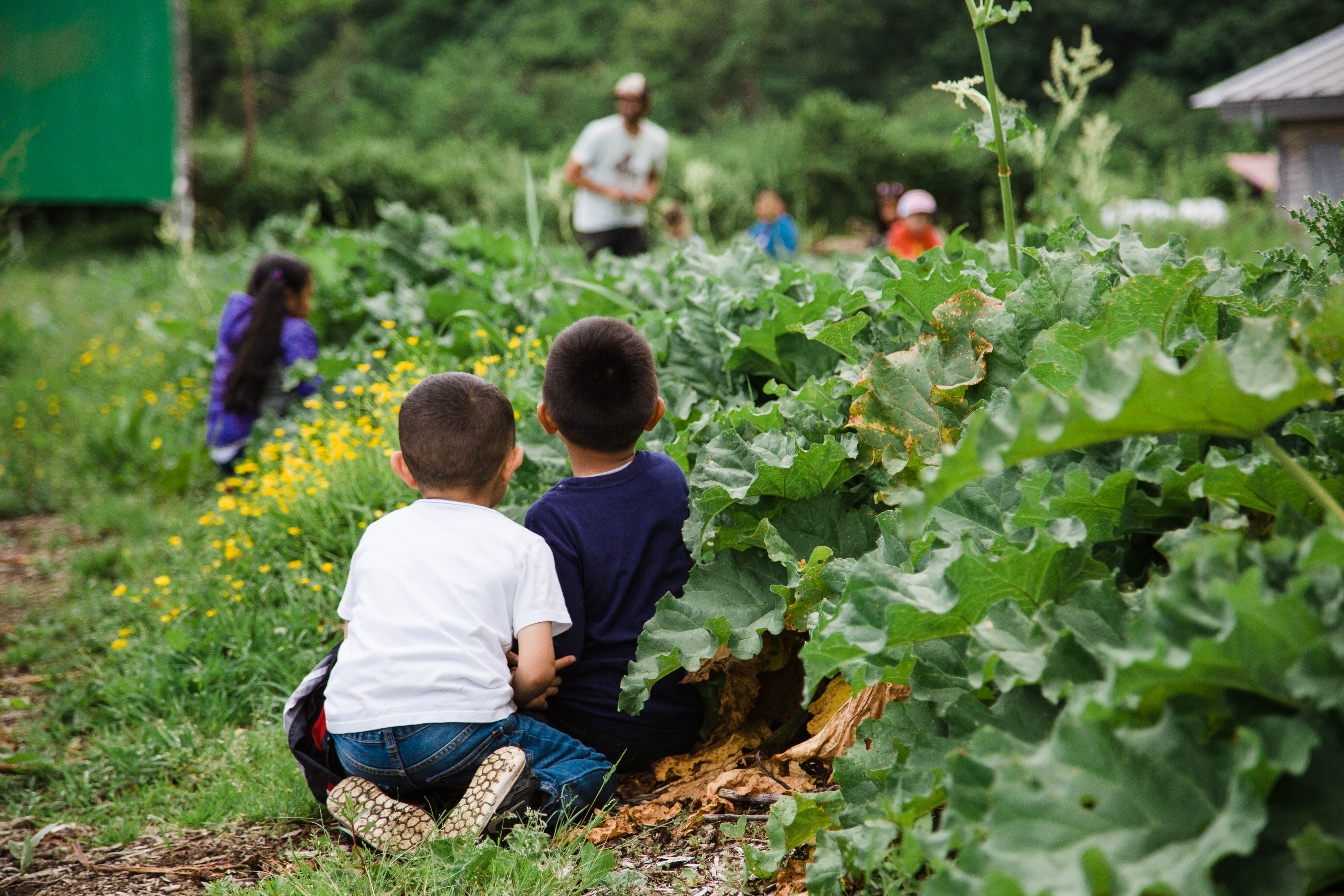
Two students sit together behind large rhubarb leaves, playing a game of hide-and-seek (and finding hidden frogs and insects living in the field) during their spring fieldtrip. Photo Credit: Jess Eskelsen
Oxbow Educators visited the classrooms in the fall and collaborated with the students to construct a “CommuniTree” contract. Together, we used the structures of an apple tree to guide discussion of what sweet “fruits” both students and teachers hope to reap from their experience at school and on the farm, which “beehaviors” will help those fruits mature, and what obstacles to learning might be acting as big “rocks” in the soil, keeping the class’ roots from growing strong. We then began exploring the concept that learning can happen both in the classroom and outdoors through the Inside-Outside sorting activity. Students were given opportunities to express their own understandings of food and nature through prompted drawings, which we used as a baseline for assessing student growth throughout the school year. The Kindergarteners also came out to Oxbow for a Fall Farm Adventure, an introduction to how food grows and the many plants and animals that call a farm home, stoking their curiosity and excitement about the ongoing Farmer visits throughout the year. The fall season also included an introduction to the concept of “habitat,” a recurring and kindergarten-friendly theme that connected student learning about plant and animal needs throughout the rest of the year.
Winter:
For most of us on the west side of the Cascades, winter is cold, dark, and most of all, WET. Farm fields throughout the Snoqualmie River Valley rest quietly under risk of flood while puddles grow into lakes in school parking lots. Rain has shaped the landscape for thousands of years and water continues to connect rural farmland with urban neighborhoods. Dormant plants focus on underground root growth, and many animals must also conserve energy by hibernating or digging deep into warm piles of decomposing fall leaves to survive frosty temperatures.

An Oxbow Farmer Educator helps students find and sample tomatoes growing in a high tunnel during their fall fieldtrip, catching the tail end of the growing season on the Oxbow Kids’ Farm. Photo credit: 2016 Jess Eskelsen
Building on the relationships forged through the fall, winter was a time to begin channeling student’s excitement toward specific learning targets, helping them dig deeper into their wonderments and explore the systems connecting us to one another, and the greater planet we’re all a part of. With now-established routines and a classroom culture helping kids adhere to behavior expectations, students were ready to build on the basics and learn how to ask specific questions, make and share their observations, and consider new concepts. The weather during the winter months kept most of our lessons in the classroom, but certainly didn’t keep the kids from hands-on learning opportunities and ongoing nature connections!
Since things are a bit too muddy at Oxbow in the winter, we brought the farm into the classroom in the form of real live wiggling worms, giving students a chance to gently interact with the creatures as they sorted through the contents of their habitat during the Soil Sorting Activity. Students also identified what components serve as food and shelter for the decomposers to come up with a definition of what “soil is” and then used their observations to design and build a small composting chamber for the classroom. The teachers took this introductory lesson and built on it throughout the winter to address other parts of their curricula and learning targets: helping their students develop fine motor skills by cutting pictures out of seed catalogues and newspaper ads, then sorting the foods into those which worms can eat and those they cannot, and finally gluing their colorful collages onto posters and practicing writing the names of the foods in both English and Spanish. Further exploring habitats and plant and animal needs, we followed student curiosity into the schoolyard to investigate if the schoolyard is a healthy habitat for squirrels and learned how Squirrels and Trees help meet each other’s needs.
The Snoqualmie River flowing past Oxbow joins with the Skykomish River right near Frank Wagner to form the Snohomish River, a perfect natural connection to frame an investigation! As winter transitioned into (a still wet) spring, a Watersheds lesson helped to reinforce the link between farm and school, giving students a chance to work with maps of the actual landscape to trace the route of a raindrop as it would flow down from mountaintops and through interconnected rivers, and illustrate many human and natural features that use and depend on this water.

A kindergarten student carefully draws in her science notebook, documenting a specific apple tree she observed in the orchard. Photo credit: 2017 Jess Eskelsen
Spring:
Early-season native pollinators like blue orchard mason bees are a Farmer Educator’s best friend. Not only do these cute little insects help flowers turn to fruits and seeds, but they do so in a kid-friendly manner, hatching from hardy cocoons into adults friendly enough to hold without fear of a sting! With the warmer weather, students were able to spend more time outdoors exploring nature around the schoolyard and came back out to Oxbow to see how the big pumpkins they harvested back in the fall get their start as tiny seeds in the cozy greenhouse. With spring’s official arrival, the time had come for all that fall fertilizing and deep-winter pondering to transition into a growing, independent entity—be it a seedling or an excited student!
Springtime is a season full of vigorous growth and the kindergarteners were practically bursting to share with us all they’d been learning about through the winter. The students were ready to dynamically explore and understand the many connections between their lives, the farmers, and the plants and animals they saw popping up from the warming soils. Lessons in the springtime harnessed this energy by playing active games during multiple field trips to the farm and further investigating the nature around the schoolyard, all with a focus on connecting students more intimately with their sense of place.
Through an early spring field trip focused on Animals in the Water, students participated in a macroinvertebrate study, closely examining the “little bugs” that rely on cool, toxin-free water in the oxbow lake, and played games embodying the flow of nutrients through the freshwater food web these bugs are an integral part of. Their Spring Farm Adventure field trip and Orchard Stations had a focus on lifecycles and natural processes they could observe firsthand: how the buds on the orchard trees would soon (with a little help from the farmers, sunny and wet weather, and pollinators) become summer’s sweet fruits, and how the growing season for most food crops in this region is really just beginning as their school year comes to an end. As an end-line assessment of the student’s change in environmental understanding, we asked the students to again “draw a picture of nature” and were impressed to see the concepts of life cycles, interdependence of organisms, habitat needs, and where food comes from recalled and illustrated so eagerly by the students.
Our Tree
Behind every future environmental steward there is a spark of wonder which must be fanned to a flame, often with the support of dedicated educators and an array of tried and tested strategies. The Foundation of the tree includes a selection of Best Practices, which are continually growing. These ideas and strategies are intended to prepare students for outdoor science learning and provide teachers with the tools and skills to feel confident teaching in the outdoors.
Of course, none of the curricular branches would be strong without the solid structure of the trunk and roots. Building strong relationships with the teachers, school district, and other nonprofit partners throughout the project was integral to understanding the specific needs of the kindergarten classes and how informal educators can best support their in-class learning. We look forward to continuing to work with the students through this spring and beyond as we help build a school garden on their campus, giving students of every grade more opportunities to discover the magic of growing plants, harvesting food, and caring for worms and native wildlife. Our Earth Connections compendium will continue to be populated with additional resources and we hope to hear from educators like you about how you’ve used the materials, your recommendations for improvement, or ideas for expansion!
We are thrilled to share the fruits of this partnership with fellow educators and hope you find inspiration to continue exploring and learning from nature, both inside the classroom and around the schoolyard, maybe even taking a field trip to a local farm or community garden! You can learn more about Oxbow Farm & Conservation Center at www.oxbow.org.
About the author:
 Shea Scribner is an Environmental Education Specialist and Summer Camp Director at Oxbow Farm & Conservation Center in Carnation, WA.
