
by editor | Jan 19, 2020 | Equity and Inclusion, IslandWood
Brave with Braids
Empowering young female voices
By Jennifer Allen
 uthor Chimamanda Ngozi Adichie’s words have been echoing in my head recently; “We teach girls to shrink themselves, to make themselves smaller, we say to girls, ‘You can have ambition, but not too much.’ ‘You should aim to be successful, but not too successful, otherwise you would threaten the man.’” Up until five years ago, I was that small girl. I strongly believed that I could not learn. I went through school without faith in my abilities in math or science, and history and language felt irrelevant. Fortunately, when I attended college, I met a few professors who provided me with life altering experiences, and my attitude towards learning completely changed. My new love of learning fueled my way through my undergraduate degree in education. After graduation, I spent three years teaching fifth grade science, hoping to inspire the same love of learning. Today, I am working towards my Masters in Science Education, somewhere I never dreamed I would be academically. I am a part of a unique program through the University of Washington called Education for Environment and Community at IslandWood, an outdoor school on Bainbridge Island, WA. I take classes and teach students who come from the Seattle area and stay for nearly a week to learn about science, stewardship, and teamwork.
There is a stark difference between classroom teaching and where I am now. Breaking down the classroom walls and teaching in the natural world means that I get to spend my days exploring the forest, wetlands, and shoreline with students, looking for magical teaching moments and providing lessons in the context of the content. What I didn’t anticipate is how much I would miss building strong relationships with students over the course of a year. I miss watching their growth, coaching them through arguments they would get in with friends, and being a shoulder for them to cry on when things didn’t feel safe at home. During my first few weeks teaching at IslandWood, I contemplated if I was making any lasting impact in such a short time spent with the students. Just when I had decided that I could make a bigger difference elsewhere, I met a girl who changed my mind.
In my group that week were four girls, most of whom were incredibly soft-spoken, and five boys, most of whom were loud and opinionated. Where the boys scribbled down answers to reflection questions and quickly returned to exploring or joking around with each other, the girls took their time, answering thoughtfully and with perfect, petite handwriting. When a question was posed to the group, the boys were quick to raise their hands or shout out answers, while the girls either avoided eye contact or hesitantly put their hands in the air. It was troubling how quick the girls were to step back and let the spotlight shine on the boys of the group, and how happy the boys were to bask in it. This confidence gap became most apparent with Maddie*, a small girl in a bright pink raincoat with her hair pulled back in two neat braids.
The first time her confidence, or lack thereof, was brought to my attention was on our way down to Blakely Harbor, about a mile and a half away from IslandWood’s main campus. Each team member had a role to fill on our way down the hill. Maddie was a “Navigator” along with Nate*, a highly eloquent and confident boy. Maddie had communicated with me early on that she did not like to speak in front of groups of her peers, so when she volunteered to be a Navigator, I was delightfully surprised. Armed with their maps and a compass, they started to lead the way, as I walked a few strides behind them with the rest of the group. Nate’s friend Mateo*, an equally confident and even more outspoken boy, decided he would help the pair in finding their way to the harbor. We reached a split in the trail, the trio paused, and the two boys loudly proclaimed we needed to go to the left. Maddie disagreed quietly as the boys took off. She had an idea of which way to go with evidence to back it up, but did not have the confidence to share it with her male peers.
I was once a lot like Maddie. I lacked confidence in my ideas and in my ability to contribute them to a group. As I read Schoolgirls: Young Women, Self-Esteem, and the Confidence Gap by Peggy Orenstein, I was frequently faced with memories of my past; my development as a young woman was reflected in the stories of many of the 8th grade girls with whom Orenstein spent time over the course of a year. I was reminded of my lack of confidence, my need to be well-liked, and my fear of making mistakes, especially in public. I was also reminded of many students from my three years in the classroom. Daily, it was made clear that there was a discrepancy between the boys and girls when it comes to academic self confidence. Orenstein described this accurately when she states, “For a girl, the passage into adolescence is not just marked by a menarche or a few new curves. It is marked by a loss of confidence in herself and her abilities, especially in math and science.” (1994, p. xx)
Troubled by the evidence of the confidence gap in my personal and professional experience as well as in my research, I reflected on how I got myself to graduate school coming from the days of making myself small and believing that I could not learn. I started to wonder where I gained my current, sometimes-wavering, but much higher sense of confidence. Slowly, I began to realize that my most influential moments were those spent outdoors. I found confidence deep on the rainforest floor, high up in the misty cloud forest, on the tops of frigid mountains, in the eyes of bats, and the flippers of sea turtles. It took until college for me to experience science in a way that was accessible, in a place we can all feel a connection: the natural world.
According to the Women in STEM: A Gender Gap to Innovation survey done in 2009, only 24% of the STEM careers in the United States are filled by women (2011). Women are underrepresented in these fields because we, as teachers and parents, fail to provide girls with an accessible science and math education. Giving girls a meaningful, natural, scientific experience at the prime time for their coming into womanhood will plant a seed that, with the right amount of nurturing, can grow into a gloriorious bloom of self love, determination, and confidence in science.
This started to become clear to me during my week with Maddie and her classmates. After several minutes of reluctance, she eventually spoke up about which way the harbor was. The boys finally listened to her and decided to try it out. When it was clear that they were leading us the correct way, Maddie beamed. I watched her closely throughout the week as she began to participate, get her hands dirty, and shamelessly and aggressively participate in science.
Her new confidence began to leak into other areas. When the boys were loudly playing the piano in the art studio the next day, I saw her staring longingly in their direction. “Can you play?” I asked. She nodded shyly, as if she knew what I was going to say next; “Let’s hear it!” After many shakes of her head and encouragement from me, including a reminder of the navigation event the day before, she agreed to play a song and blew us all away with the beautiful tune. The climax of the entire week came on the last night, when she sang a song all by herself in front of over 100 other students at community campfire. She was extraordinarily nervous and insistent that she wouldn’t end up performing. When she got on stage and started to sing, tears filled my eyes. Here was a young girl that came to IslandWood on Monday, reluctant to talk in front of her eight other group members, putting herself in one of the most vulnerable positions a fifth grader can be in. I watched Maddie steadily feel more comfortable with science as she engaged in hands-on, approachable activities and team building.
At IslandWood and in similar programs, there is a focus not only on the sciences, but on building a safe community. Between countless team building opportunities and honest and explicit discussions on kindness, empathy, and emotional and physical safety we create an environment that allows students to feel comfortable to take risks and make mistakes. This space allows girls to begin to engage scientifically, and Maddie is not the only girl in whom I have seen this growth.
More recently, I had a group of five girls and seven boys. Like Maddie’s group, most of the girls were timid to participate in discussions, and most of the boys had more to say than we had time to hear. On Tuesday morning, we had a discussion to debrief an activity called Each One Teach One, where each student takes turns teaching the other students about a plant found on IslandWood property. The students had a chance to reflect on the discussion questions beforehand by answering them in their field journals. The first question was, “What was it like to be a teacher?” The students were encouraged to call on each other and they did so by whose hand was up. Every student with their hand up had the chance to share. Five of the twelve students responded, with 100% of the responses coming from males. Not a single female raised her hand to contribute.
We focused a lot that week on team building and productive discussions, and it paid off. I watched as the girls gradually opened up more to each other, the group, and me. Our two navigators for our Wednesday Harbor trip were both females who started the week off not at all friends, but had their arms around each other’s shoulders by the time we go to the harbor. When we were exploring the nutrient cycle, it was mostly the girls who dug their hands deep into the compost and fearlessly breathed in the scent of decomposition. On Thursday morning before the students left, we had one last group discussion. I posed the question, “What can you do after IslandWood to continue practicing stewardship?” This time, there were 22 total student responses, 64% of which were from males (who made up 58% of the group) and 36% from females (who made up 42% of the group.) Every student responded verbally, and four students responded in writing. After they had left, I sat down to read the feedback the group had left for me. One of the questions was, “What was one thing I taught you?” Atari*, the most quiet of the girls, the one who needed the most encouragement to share her ideas, wrote, “You taught me that my voice matters.”
I have only been teaching at IslandWood for a short amount of time, but I have learned that I can make a difference in students’ lives in just four short days. I’ve seen many girls, and even some boys, go from keeping their eyes on the ground and standing aside to getting their hands dirty. I’ve seen them go from speaking in near whispers to getting excited about science. Seeing these incredible changes take place never fails to fill my heart. We need to teach boys to share the spotlight and encourage girls to shine. We need to provide an accessible science education for girls if we want to live in a society where all genders share the responsibility of caring for the environment and moving forward through the STEM fields.
References
Adichie, C.N. (2012, November). We should all be feminists [Video file]. Retrieved from
Beede, D. N., Julian, T. A., Langdon, D., McKittrick, G., Khan, B., & Doms, M. E. (2011). Women in STEM: A gender gap to innovation.
Orenstein, P., & American Association of University Women (1994). Schoolgirls: Young women, self-esteem, and the confidence gap.

by editor | Dec 2, 2019 | K-12 Activities
Favorite EE Activity Ideas
from PNW Educators
Practical and proven environmental education activities for all grade levels and subject areas, shared by members of the EE community. What is your favorite?
 Nature Journal
Kristen Clapper Bergsman
My favorite EE resource is a hardback journal with blank pages ready to fill with observations and revelations. Step into a circle of cedars, nestle down in meadow, or sit down on your back porch stairs and nature emerges all around you. Creative nature journaling is a powerful educational tool for young children and adults alike. I use journaling as both an educational activity and as a way to reinvigorate my teaching and writing.
A hardback journal can take the knocks of being thrown into a backpack and carried into the field. You can waterproof your journal simply by slipping it into a gallon-sized Ziploc bag. Toss in a waterproof pen, a pencil, a sharpener and perhaps a few watercolor-pencils and you are ready for five-minutes or five-hours of immersive journaling.
Some people are hesitant about their drawing or writing skills, but by using some simple journaling exercises, you can soothe people’s fears about their own abilities. Even young children quickly connect with journaling exercises like gesture drawings, blind contour sketches and event maps.
I highly recommend several natural journaling books that provide sample activities and ideas on how to use journaling as an education tool, as well as having pages filled with lush examples of field journal pages. Keeping a Nature Journal by Clare Walker Leslie & Charles Roth (Storey Books, 2000) is an excellent resource for teachers who want to use nature journaling with their students. Into the Field: A Guide to Locally Focused Teaching by Leslie, Tallmadge and Wessels is available through the Orion Society�s Nature Literacy Series. Hannah Hinchman�s A Trail Through Leaves (W.W. Norton and Co., 1997) will provide pages of inspiration.
Complete Citations:
Clare Walker Leslie & Charles Roth, Keeping a Nature Journal. Vermont: Storey Books, 2000. Pg. 181. ISBN 1-58017-306-3.
Leslie, Tallmadge and Wessels,� Into the Field: A Guide to Locally Focused Teaching. Massachusetts: The Orion Society, 1999. Pg. 83. ISBN 0-913098-52-3.
Hannah Hinchman, A Trail Through Leaves. W.W. New York: Norton and Co., 1997. Pg. 192. ISBN 0-393-04101-8.
Kristen Clapper Bergsman is an environmental educator and freelance writer. She owns her own curriculum development company, Laughing Crow Curriculum. She and her husband share their Seattle neighborhood with over 9,000 crows.

Changes
Tracy Mosgrove
Grade Level: Kindergarten through High School.
Students take a designated outdoor space and observe the changes in that space over a period of time (several months during a change of seasons works best). Depending upon the age of your students, the size of space and the way in which you record the changes varies.
Kindergarten through primary grades: Measure out one square meter of ground. This can be one space for the whole class, or groups can each have their own square. In simple field journals, students draw and write words or sentences about what they see. Simple language arts and math integration can be used through what they find in their square.
Intermediate through high school: Each group or individual child measures one square (or cubic) meter. Observations can be recorded through the use of a digital camera, field journals, or PowerPoint/Hyper Studio presentations. Math (graphing, data collection), Language Arts (cause/effect, writing descriptions) can easily be integrated.
Intermediate through High School: Each student measures a square meter or takes a larger area (Iíve had students use a mile long hiking trail in a forest). Use science probes, soil testing kits, digital cameras and field journals to research and record data. Talk to builders, foresters, farmers, etc. to find out how the changes in the ground affect their jobs and work schedules. Math (graphing, data collection), Language Arts (cause/effect, writing descriptions, letter writing to industry people) can easily be integrated.
Tracy Mosgrove
Skyway Elementary School
Coeur d’Alene, Idaho
tmosgrove@sd271.k12.id.us
Let Them Eat Cake
Sarah Bidwell
My favorite activity is “Let Them Eat Cake” from Facing the Future: People and the Planet Curriculum Guide. This is a very effective and interactive activity for demonstrating the inequitable distribution of resources around the world. Students are divided into world regional groups (i.e. Asia, Africa, Europe, etc) and given a slice of cake relative to their regions’ share of global resources. The Asia group (about half the class) gets only a sliver of cake, while the one person from North America gets a quarter of the cake! Students really see how consumptive Americans are relative to people around the world. You can download the activity from their website, www.facingthefuture.org.
Sarah Bidwell, Administrative Director Alternatives to Growth Oregon
Fish in the Floodlight
Joanne Day
One of my favorite environmental education resources is the Fisheries and Oceans resource “Fish in the Floodlights.” This package contains nine short plays about salmon for grades 4-7.
The plays are useful for teaching about salmon and there are themes of conservation and also social responsibility.
Drama can be a very creative tool for working with students to both empower them and to widen their understanding of ideas and issues in the world. Critical thinking skills can be developed as the students perform plays adopting different points of view.
Each play also contains suggestions for the use of cooperative learning strategies such as Know, Wonder, Learn, as well as integration with other subjects, such as art and math.
The package is very versatile and allows for plays to be read between students or performed before the entire school.
It can be ordered through the BC Teachers’ Federation Lesson Aids service at www.bctf.ca
Look for it under the title “Salmonids Go to the Ocean.”
 Food Web Game
Joanne Day
Note: If weather and opportunity permits, you may wish to do this webbing activity outdoors (i.e. in the school field). This webbing activity can also be done as a stand alone activity during any outreach event (indoors or out).
1. Review the definition of a food web.
2. Have the students sit in a circle and hand out the species cards randomly. Ask students to put up their hands when their species name is called out. Have a role of string with you to pull throughout the circle, making connections between different species in the food web. At each connection (student), the student is asked to hold tightly to the string. Start with the Sun and pull the string to the plants that require the sun for energy. Then feed the string to the animals that require the plants for food. Continue this process in the order of species below: plankton and bull kelp, barnacles, sea star, crab and shrimp (scavengers, would go after a dead bit of sea star)…now back to another plankton eater (since there are so many animals that eat plankton) – Pacific herring, salmon, cormorant, harbour seal, stellar sea lion, Pacific white sided dolphin, blue shark, killer whale (top predator), and finally the human. By the end of this exercise, the string in the middle of the circle should look like a spider’s web.
While handing out the string revisit the interesting facts of each species and explain again how they fit into this food web. Some examples have been incorporated above. Since the plankton has not been explained extensively to this point, include some information on these free-floating organisms. Q. What are plankton? A. They are “wanderers”; microscopic plants (phytoplankton) and animals (zooplankton) that drift in the ocean currents. Q. Why are plankton important in the ocean food web? A. First of all they provide the base food supply for many of the ocean creatures. Secondly they (along with ocean seaweed) produce over half of the oxygen that we breathe. We always think of the trees in the forests as being important for producing oxygen. They are, however, the ocean plants produce even more than the land plants. Q. Ask the students if this is another good reason to keep the ocean healthy. To reinforce, now or later ask the students to take a big breath and say “Thank you to the plankton and the seaweed!”
3. After the web has been formed get all the students to stand up while holding onto the string. Q. What does the string pattern remind you of? A. Many will say spider web and you can make this connection to the term food web to help them visualize the concept. The students can now see that they are part of a large ocean food web. Revisit with the students some of the factors mentioned earlier on in the presentation that could negatively effect this web (such as oil pollution, overfishing etc). Select one of these disturbances and incorporate it into the activity. An example of this would be oil pollution. Q. After an oil spill what would be the first organisms that would be negatively affected? A. The plankton would die since they would no longer be getting any exposure to the sunlight. Q. If the plankton die what happens to the rest of the food web? A. All the other organisms will be negatively affected. Some of the smaller ones will die and thus will no longer support the larger organisms which in turn will die or have to leave this ocean environment in search of a new food source. Get the students to actively demonstrate this negative impact on the food web. This can be done two ways.
Option 1: Get the plankton to sit down and then a tug the string to the next person in the web directly connected to them. Once the other students feel a tug they also sit down until everybody but the sun is sitting down.
Option 2: Get the plankton to let go of their string. Ask the students what next will get affected (i.e. who has a loose string hanging down, indicating their food source is gone). As the students lose their food source, they too drop their string until everybody is standing up and the entire web is on the floor.
Joanne Day, Information Co-ordinator
Stewardship and Community Involvement Unit
Habitat and Enhancement Branch, Fisheries and Oceans Canada
Government of Canada
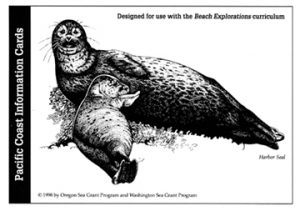 Pacific Coast Information Cards
Margy Ransford
Here is a bit about one of my favourite resources, which I use in the classroom and in public education.
Pacific Coast Information Cards, beautifully illustrated black and white recipe-sized cards with pictures of Pacific Ocean species (one species per card) on one side, and a description of the following “need to know” tidbits of info. on the flip side: Common Name
Latin Name
Range
Habitat
Quick Identification (basic physical description)
Predators (or, as I tell the kids, what eats them)
Feeding Type: (“what they eat”)
Commercial Value” (how humans have historically perceived them)
Status: common, rare,
Comments: special features of interest
These cards can be used in many different activities–I like to give a few to each student to sort when introducing classification and let the students loose to come up with their own criteria, or guide them with preset (for example, phyla) categories. Foodchain sequences are another great way to get the students engaged. First nations’ use of the organisms, and harvesting methods in modern economies, are other great focus possibilities.
The Pacific Coast Information Cards were published in 1998 by Oregon and Washington Sea Grant Programs. The artists were Karl Geist, Philip Croft and Mark Wynja, Cooper Publishing, editing , design and production. Gloria Snively at the University of Victoria, British Columbia, Canada, one of my “marine mentors”, was the author, and commissioned the creation of the cards to accompany her “Beach Explorations” curriculum. I highly recommend this resource.
You will want to possibly laminate them for frequent use!
Margy Ransford, past-President, NAME (Northwest Aquatic and Marine Educators)
 Crumple Your Own Watershed
Erica Ritter
Make your own three-dimensional map, and use it to explore how flowing water defines the areas of land we call “watersheds.” This activity provides opportunities for creativity and for meaningful discussion, a great combination for engaging students.
You can have each student make their own, or have groups collaborate.
Loosely crumple a piece of graph paper, unfold it but don’t smooth it out, and tape it onto a stiff backing so that the remaining wrinkles and creases resemble mountain ridges and valleys.
Use brown, purple, or black ink to identify and mark the ridgelines — “where water would ‘choose’ whether to go on one side or another.” These are the lines that define a watershed: on one side, the water will go one direction, and on the other side, the other. (The Rocky Mountains are the classic example of a defining ridgeline: raindrops that fall to earth on either side of the main ridgeline may end up flowing downhill to oceans thousands of miles apart.)
Use blue ink to trace where you think water will gather into rivers, lakes, streams, etc. These are the water-bodies that the water is shed into. Water connects areas of land — discuss various ways water connects landscapes, local bodies of water that define students’ home watersheds, etc.
Use other colors to add farms, houses, factories, roads, cities, etc. If students are planning out an island or city, this process can be quite elaborate. The grid-lines on the graph paper can be used to designate personal land areas in group projects, or to estimate the relative sizes of farms, cities, etc.
When “all done,” bring the landscapes over to a suitable table, and “make it rain” with the squirt bottle. (Squirt water onto the map until it runs down the creases.) See if student’s drawn-in blue rivers correctly anticipated the flow of water; did any cities drown? If landscapes sag, this may be a good opportunity to discuss how forces of nature (including water) can cause similar effects in real life.
In addition to watching the water, watch the colors it carries with it. Colors from uphill things will smear downhill, and water bodies below populated areas will show the effects. If you let the paper dry, the end result is often quite beautiful, with streaks of color from the ridges and valleys.
While watching the colors run, you can discuss connections to local watershed issues, such as dams, agricultural or urban runoff, water-rights negotiations, etc. One of my favorite all-purpose factoids is the “Fido Hypothesis:” in California, Florida, Idaho, and Virginia, researchers have found that dog “doo” runoff from parks and yards contributes dangerous bacteria to lakes and coastal waters, sometimes to the point where it’s unsafe to swim at local beaches. (Dog doo can be responsible for 10%-30% of the fecal coliform bacteria in coastal waters, including the now-infamous E. Coli.)
You can also discuss other kinds of land features, and what their analogies would be: sponges for wetlands, tiny clay dams, permanent-marker forests or other structures that resist runoff.
Some teachers extend this basic activity to teach students to read contour lines. (To make this work smoothly, it’s helpful to crumple the paper around something so that there’s one mountain peak and all the slopes can be reached from outside by the fixed-height pen. This isn’t as useful for showing watersheds, as it tends to eliminate meandering valleys, but it’s way easier to show contour lines around a single mountain.)
Prop a waterproof pen or pencil at a fixed height (tape it securely across a ruler, or stick it horizontally through a paper cup or piece of cardboard, so that the point stays the same height). Slide the pen around against the crumpled ridges, marking an equal-height line. Mark other lines at other heights the same way; 3 or more heights is appropriate. At the end of the activity, unfold the papers. The now-flat paper approximates a topo-map of the origonal surface. (There will be a few discrepancies, and steep slopes will not show up as dramatically as on a real topographical map. A photocopy or photograph of the intact crumpled paper would be more accurate, but not as beautiful.)
This activity has been documented several times, so you may be able to find it online. The version I use is currently available at http://www.omsi.edu/teachers/psd/
2000/watershed/crumple.pdf. Credit goes to Chris Maun for the version in “The Living River: An educator’s guide to the Nisqually River Basin,” and to Greg Dardis who originally adopted that activity for use at OMSI (the Oregon Museum of Science and Industry).
The “Fido hypothesis” was reported in USA Today (06/06/2002, “Dog waste poses threat to water” by Traci Watson, USA TODAY), and in other sources.
Erica Ritter is a science educator at the Oregon Museum of Science and Industry in Portland, Oregon.

Photo by Stewart Wilson from Cranbrook Guardian
Macroinvertebrate Mayhem
Karen Lippy
One of my favorite activities, Macroinvertebrate Mayhem, comes from (of course) the Project WET Curriculum and Activity Guide. If you liked Project WILD’s Hooks and Ladders, you’ll love this one!
Students get to act out macroinvertebrates while playing a game of tag. Sensitive critters have challenging “hindrances” to cope with. For example, caddisflies have to play in their case….a pillow case. And, stoneflies need to get extra oxygen by doing push-ups every ten steps. The mayflies flap their gills wildly.
Various “Environmental Stressors” race around tagging macroinvertebrates out. Survivors play on. Tagged macroinvertebrates can come back, but if they were a sensitive species, they return as a tolerant species.
This activity clearly demonstrates how water quality affects macroinvertebrates and how diversity and populations are affected by the health of their ecosystem.
Karen Lippy is an award-winning teacher in Shelton, Washington.
 Naturalist’s Journal
Tim Maze
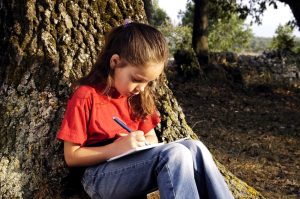
One of my favorite activities is simply teaching students to make a naturalist’s journal. Using examples of Olaus Murie’s journal or the journals of Lewis and Clark is a good way to model and begin. We go outside for a few minutes and record the date, place and some weather data and then do a field sketch or a writing in response to a prompt. The journals can be worked into lots of areas of instruction or can become a phenological study themselves. A good journal makes for a good keepsake of a field trip or school unit or year.
My favorite EE resource is simply the outdoors. Just stepping out for a teachable moment in the school yard can be very inspiring. Recently we experienced a beautiful frosty morning, so I took my students out for a quick peek at the huge frost crystals that had formed. Great lesson, followed by cool student questions. The entire experience took maybe 15 minutes. You don’t have to be much of an expert to find something pretty interesting right in your own backyard (or schoolyard!).
Tim Maze teaches at Tongue River Middle School in Wyoming
 Dancing Up Worms: A Teachable Moment
Laurelei Primeau
It was a damp, sunny day, and my grade three class was called to the front lawn of the school for a school-wide portrait. Classes from kindergarten to grade five trooped out and jostled for places on the lawn. My third graders, however, were distracted. They were peering into the long grass at the gigantic earthworms that were wriggling at their feet. Seeing other students shy away and shriek at the worms, my class sprang into action, the bravest of them picking up the worms and moving them to the edge of the grass, away from the stampede of feet. Eventually, we were chastised for holding up the photo, and my worm wranglers were themselves wrangled into place.
With the photo shoot completed, the students looked around frantically for the worms. The questions came fast and furious – why would the worms come out when they’re going to get stepped on? One child suggested that worms come out when they feel the ground shake. We decided to test it and find out. We spread out on the lawn and stomped up and down, and up popped a worm. Jubilant, the students danced more vigorously, laughing. The office staff was laughing pretty hard, too. Every student danced a worm up out of the ground that morning. We observed them, and let them go, and finally headed back inside.
Laurelei Primeau teaches in the Coquitlam School District in Coquitlam, British Columbia</em?\>

by editor | Sep 27, 2019 | Equity and Inclusion, Outdoor education and Outdoor School, Teaching Science
by Sprinavasa Brown
I often hear White educators ask “What should I do?” expressing an earnest desire to move beyond talking about equity and inclusion to wanting action steps toward meaningful change.
I will offer you my advice as a fellow educator. It is both a command and a powerful tool for individual and organizational change for those willing to shift their mindset to understand it, invest the time to practice it and hold fast to witness its potential.
The work of this moment is all about environmental justice centered in social justice, led by the communities most impacted by the outcomes of our collective action. It’s time to leverage your platform as a White person to make space for the voice of a person of color. It’s time to connect your resources and wealth to leaders from underrepresented communities so they can make decisions that place their community’s needs first.
If you have participated in any diversity trainings, you are likely familiar with the common process of establishing group agreements. Early on, set the foundation for how you engage colleagues, a circumspect reminder that meaningful interpersonal and intrapersonal discourse has protocols in order to be effective. I appreciate these agreements and the principles they represent because they remind us that this work is not easy. If you are doing it right, you will and should be uncomfortable, challenged and ready to work toward a transformational process that ends in visible change.
I want you to recall one such agreement: step up, step back, step aside.
That last part is where I want to focus. It’s a radical call to action: Step aside! There are leaders of color full of potential and solutions who no doubt hold crucial advice and wisdom that organizations are missing. Think about the ways you can step back and step aside to share power. Step back from a decision, step down from a position or simply step aside. If you currently work for or serve on the board of an organization whose primary stakeholders are from communities of color, then this advice is especially for you.
Stepping aside draws to attention arguably the most important and effective way White people can advance racial equity, especially when working in institutions that serve marginalized communities. To leverage your privilege for marginalized communities means removing yourself from your position and making space for Black and Brown leaders to leave the margins and be brought into the fold of power.
You may find yourself with the opportunity to retire or take another job. Before you depart, commit to making strides to position your organization to hire a person of color to fill the vacancy. Be outspoken, agitate and question the status quo. This requires advocating for equitable hiring policies, addressing bias in the interview process and diversifying the pool with applicants with transferable skills. Recruit applicants from a pipeline supported and led by culturally specific organizations with ties to the communities you want to attract, and perhaps invite those community members to serve on interview panels with direct access to hiring managers.
As an organizational leader responsible for decisions related to hiring, partnerships and board recruitment, I have made uncomfortable, hard choices in the name of racial equity, but these choices yield fruitful outcomes for leaders willing to stay the course. I’ve found myself at crossroads where the best course forward wasn’t always clear. This I have come to accept is part of my equity journey. Be encouraged: Effective change can be made through staying engaged in your personal equity journey. Across our region we have much work ahead at the institutional level, and even more courage is required for hard work at the interpersonal level.
In stepping aside you create an opportunity for a member of a marginalized community who may be your colleague, fellow board member or staff member to access power that you have held.
White people alone will not provide all of the solutions to fix institutional systems of oppression and to shift organizational culture from exclusion to inclusion. These solutions must come from those whose voices have not been heard. Your participation is integral to evolving systems and organizations and carrying out change, but your leadership as a White person in the change process is not.
The best investment we can make for marginalized communities is to actively create and hold space for leaders of color at every level from executives to interns. Invest time and energy into continuous self-reflection and selfevaluation. This is not the path for everyone, but I hope you can see that there are a variety of actions that can shift the paradigm of the environmental movement. If you find yourself unsure of what action steps best align with where you or your organization are at on your equity journey, then reach out to organizations led by people of color, consultants, and leaders and hire them for their leadership and expertise. By placing yourself in the passenger seat, with a person of color as the driver, you can identify areas to leverage your privilege to benefit marginalized communities.
Finally, share an act of gratitude. Be cognizant of opportunities to step back and step aside and actively pursue ways to listen, understand and practice empathy with your colleagues, community members, neighbors and friends.
Camp ELSO is an example of the outcomes of this advice. Our achievements are most notable because it is within the context of an organization led 100 percent by people of color from our Board of Directors to our seasonal staff. This in the context of a city and state with a history of racial oppression and in a field that is historically exclusively White.
We began as a community-supported project and are growing into a thriving community-based organization successfully providing a vital service for Black and Brown youths across the Portland metro area. The support we have received has crossed cultures, bridged the racial divide and united partners around our vision. It is built from the financial investments of allies – public agencies, foundations, corporations and individuals. I see this as an act of solidarity with our work and our mission, and more importantly, an act of solidarity and support for our unwavering commitment to racial equity.
Sprinavasa Brown is the co-founder and executive director of Camp ELSO. She also serves on Metro’s Public Engagement Review Committee and the Parks and Nature Equity Advisory Committee.


 Whitney Chandler has a master’s in natural resources with certificates in environmental education and science communication. She writes passionately about nature and the outdoors, human connections and relationships, and nutrition.