
by editor | Jan 22, 2019 | Indigenous Peoples & Traditional Ecological Knowledge
Native Voices: Reclaiming a Culture through the Traditional Canoe
Nathan Piengkham is a member of the Kalispel Tribe and the Executive Director of The River Warrior Society. Members of the fourth-grade crew interviewed him about his involvement in the resurgence of the traditional canoe. This is the interview transcript.

Can you tell us your name, where you are from, and a little bit about yourself?
My full name is Nathan Samsavath (pronounced Sahm-suh-vat) Piengkham (Pronounced Pink’em). I am from the Kalispell Reservation in Washington State. I was born on the coast near Seattle, in Redmond Washington.
I went to Cusick School, which is a tiny school. There were about 20 kids in my class. I played soccer and baseball. I also did martial arts a lot when I was a kid. My dad is not Native American. My mom is half Native American and half European. My dad is from Laos, near Thailand. So I am half Lao. One of the things Laos is known for is kickboxing and my dad taught me that when I was younger. My uncles taught me Kung Fu and Karate when I was younger. My Uncle Dave was a national Judo champion when he was younger.
I grew up in the mountains so my cousins and I were out in the forest a lot when we were younger. It was really fun. I got see frogs, bugs and turtles.
Many tribes throughout the region have not made a canoe in many years and they are starting to build canoes again. Why and can you tell us what is happening now?
Well, that is kind of a long story. I didn’t know anything about canoes. I actually bought a 12-foot long fiberglass canoe from the store. I never got to paddle it because my uncle had finished building that dugout canoe. So I didn’t even know a lot about the stuff that was going on. A lot of the dams were put in so we didn’t really have a use for our canoes anymore, so no one ever built canoes. We were told not to speak our language, so no one really spoke our language either. We only just started to get a lot of that stuff back. So we are starting to learn our language again. If I were to greet you guys I would say Hest Shulook (xest schulux) or Hest Salhalt (Xest Sxlxalt). That means good day. Then I would say Nathan Piengkham or thlue ease quest (ᴌu i skwest), which means “Nathan Piengkham I am called” if you translate it directly. We just started learning our language so it’s hard to get it all back. It is strange growing up without knowing my language. I knew some of my language growing up, but not a lot of it. So it is cool now to see everybody learning the language. We have a school about the size of your school (Palouse Prairie Charter School, about 180 kids) and the kids learn it from a really young age, so they know it better than I do. So what happened is that one of the tribes on the coast gave the tribes in my area giant cedar logs, maybe 3,000 – 4,000 pound logs. Those logs were sitting there for about two years and no one was doing anything with them. They sit that long because they were actually drying out. When the plants are first cut down, they are still wet, so it takes about two years for logs to dry out. After those two years my uncle and my brother, and a few other people started carving a log. And in 2016 all of the tribes decided that we would paddle together. There were two people named Dan Nanamken and BenAlex Dupri who organized some paddles, but they did not get all of the canoes together. Later they both told me that I was the one who has to take over to organize all of the canoes and the canoe journeys. And I said, “Okay!” And that’s how I am involved in all of this.
When you were a kid, what types of canoes did the tribes that you were most exposed to build and use for transportation?
When I was a kid we didn’t have canoes at all. The canoes that they had before I was young, people aren’t sure about. People thought we had sturgeon nose canoes made out of birchbark, and people thought that was all we had. But we did our own research and we found out that we had birchbark canoes, white pine bark canoes, and another canoe called the tamarack bark canoe. I just found out that we used to have these canoes too. And those are the different bark canoes, but we also had dugout canoes, which is the kind that you guys might have seen us bring out to the Snake River. It’s the kind that starts with a giant log and you carve it out. There are also different types of dugout canoes. There are all different shapes and sizes. We used to have all of those types of canoes.
What happened to the canoes that your ancestors made?
When our ancestors made canoes, it was their canoe. So when they died, they buried them with it. That is why no one every sees canoes anymore is because we would sink them out in the lakes or rivers and they would get buried. There is one dugout canoe in the very bottom of Pend Oreille Lake. It could be part of a burial, so that is why we don’t bother it. So we can’t really see what it looks like.
Why did your tribe stop building canoes?
We stopped building canoes for a long time because people didn’t like to be Native American when I was younger. I am Kalispel, but people didn’t like to be Kalispel. They were ashamed of it because we were really poor. We were put on a reservation where farming wasn’t good, so people couldn’t make any money. So no one wanted to be us because we didn’t have any money and we didn’t have a good place to live. So people didn’t like us to speak our language. Our own parents and grandparents didn’t like us to speak our language. They didn’t like us to do things that our people used to do. Many people were focused on drugs and alcohol and getting into trouble because, out in the mountains there’s not a lot of stuff to do. Normally we would be making canoes because canoes and canoeing out on the water or fishing or picking strawberries and huckleberries was what we always did. We would be doing a lot of fun stuff, but we didn’t have all of that anymore, so people just turned to doing things that they didn’t understand very well, like drugs and alcohol, which is sad.
When was the last canoe made by your tribe?
We don’t know actually. That is not in our history. Right now we have two canoes. One dugout canoe and one white pine bark canoe. And those are the only ones that the Kalispell tribe has that anyone knows about. We used to have more, but nobody knows about them. The thing is we didn’t have a lot of written history, so there are people alive right now who might remember that last canoe, but they can’t remember it unless they are out there canoeing with us. If they are stuck at home, they won’t be able to remember. So maybe hopefully when you guys get to go paddle out on this canoe maybe we can bring some older people and they might remember stuff like that.
Did transport become difficult when you stopped building canoes?
Transport did get a little bit harder. Instead of canoeing down to our family members, we would walk. It wasn’t that big of a deal since we have a tiny reservation and people were starting to buy cars for transportation. Like I said, our tribe was really poor, so all the families would all use one car. They would all pack into one car and drive up and down the reservation Our reservation is not very big. The Kalispell tribe is a small tribe, about 500 of us total. About 150 live on the coast, 150 live in Spokane, and about 150 of us live on the reservation. So there are only about 100 of us who know anything about our history and our ancestors. There are not very many of us left. In 1950 there were less than 150 of us left total. There are not many Kalispels alive anymore, at least that’s what we were always told.
What is the importance of the traditional canoe for you and your tribe?
It’s about learning our history and learning what we should be doing. Instead of turning to drugs and alcohol or other boring stuff, or instead of leaving the tribe and going somewhere else, now people can stay home and work with the canoes. Or they can learn our Salish Language of the Kalispell Tribe, or they can learn how to get the natural foods from our mountains. With the canoes we would fish all the time for fish that were in our area. And we would eat plants that were along the edge of the river, like garlic, onions, or chives. There is a lot of good food on the river. We used to eat oysters or mussels. We would trade with other tribes to get salmon or other types of plants, like water potatoes. A lot of the kids go out in October to get water potatoes, and some of us will take out canoes to get them because water potatoes are in shallow water. But the water is cold so you have to be really tough.
Why after so long did you decide to bring the traditional canoe back?
I didn’t decide, but others were Dan Nanamkin was the first one that was trying to bring it back. He started the River Warrior Facebook page and that’s how everyone originally communicated about canoes. Then BenAlex Dupri, he is a videographer and he makes documentaries. When we left Standing Rock, North Dakota and visited with the tribe up there, he stayed there because of the pipeline protest, which became very well-known throughout the world. Ben Alex made it his mission to stay there and make a documentary there, which just came out not too long ago. Our canoes are in that film for sure. Our canoe families went out there and helped a lot to make sure that the people were taken care of. When he left for Standing Rock, I was left as the only one to take care of the canoe families. I see it bringing a lot of our community together. The Bureau of Indian Affairs (BIA) originally for the Kalispell Tribe, the BIA office was on the Nez Perce Reservation. Even though our office was far away from us, it worked really well and we didn’t have any issues. The problem was that when they switched our office to the Spokane agency, suddenly we didn’t get any services anymore and we couldn’t contact the BIA anymore. We don’t know why, but we needed to have a relationship with the Nez Perce Tribe that was far away. Now because of the canoes, we are talking to the Nez Perce Tribe again and visiting people down here in Moscow. The canoes are bringing our communities together. So that is why I chose to stick with the canoe stuff. It is really important for all of our people, our family and our friends.
Was it hard to bring the canoe back, and why or why not?
Yes, it was very difficult to bring the canoes back. Like I mentioned, there were a couple of people trying to help me, but they ended up doing other things and they kind of left me with it. For two years we paddled without any formal support. A lot of people have a school or cultural or language program to help them organize, but at the time I was still in my late 20s and I was really new to organizing and being a leader. I used to be a tutor and I would help people graduate from high school. I would help some of my family members graduate. I also took kids out for activities, like to play basketball, go skateboarding, or go swimming. One time I took a bunch of kids to Yellowstone National Park and we went swimming, but there was a big sign that said “Beware, Vicious Otters May Attack.” And I was like, “What?” There were no vicious otters, but there were leeches, and that was creepy. There were a lot of buffalo wandering around the streets. So it was difficult, but I had a lot of training to learn how to organize people. I went to college for Tribal Administration and Tribal Government. I double majored in Psychology and Philosophy. I took a lot of business, accounting and math classes, but my focus was always psychology and philosophy.
It has been difficult to bring back the canoe. We are still organizing our canoe family. I just started a nonprofit, the River Warrior Society, to help us so that we have an organization to facilitate everything that we’re doing. Some people might think that “Warrior” is aggressive for a name, but “Warrior” could mean a lot of different thing. It’s people who are fighting for a cause, not fighting people. It’s people who are fighting for people’s rights. Your teacher could be an Education Warrior because they are fighting every day to make sure that you get the best education you can get. So as River Warrior, we are fighting to maintain our culture. We are fighting to keep it. And so that we can educate our future generations so everyone can learn about the canoes, not just certain people. If you think about it, it doesn’t matter where your ancestors were from. Wherever they lived in the world, they all lived by a lake or a river or an ocean and they probably had a canoe. So learning this canoe stuff is learning all of our history.
Did the tradition and steps of how to build a canoe fade from your mind as so many years have gone by?
No, the thoughts and processes don’t fade because every time we look at the canoes, we remember what happened. Like my uncle chipped a piece out of the canoe, and every time I see that chip I remember him carving that out too hard and too big. So every time I see it, I remember the techniques and procedures of building the canoe. Every time we go out to paddle, we remember another piece.
Do you build new paddles every time you build a canoe?
We usually try to because the pieces you shave off of the canoe, you can use to make paddles. I have a paddle that is made from the same wood of my canoe. So they are both connected in that way. The cedar log we had was over 800 years old, so that paddle that I have is over 800 years old.
What is the importance of carving paddles?
There is a lot of thought that gets put into making a paddle. Every time you make a carve into it, you remember that. So having your own paddle means that every time you look at it and every time you paddle you remember how to carve. So it is like a teacher. That is one important reason, but also our ancestors did that same thing a long time ago, so at the same time you are learning how to carve a paddle, you are also learning your history. And people make paddles out of different types of wood, and every type of wood you carve differently. If the paddle is super light, you’d have to make it thicker so it doesn’t break. If the wood is super heavy, you can make the paddle really thin because it is really strong so it is not going to break. There is a lot of knowledge about making paddles. What the tribes on the coast would do is that they would make everyone on their team make a paddle, and then they would sell them to raise money to go on a paddle trip. That was how they would raise their money to go on paddles.
To learn more about Nathan and the River Warrior Society, visit https://riverwarriorsociety.org.

by editor | Jan 15, 2019 | Place-based Education

Photo courtesy of Mike Brown.
Not One More Cute Project for the Kids:
Neal Maine’s Educational Vision
by Gregory A. Smith
Lewis & Clark College, Professor Emeritus
PART ONE
 eal Maine, now in his late-70s is an iconic figure for many environmental educators in the state of Oregon. Early in his teaching career in Seaside, he decided to shelve the textbooks in his biology classroom and base his teaching practice on the premise that “If we couldn’t do it, we weren’t doing it.” He then focused on getting his students outside onto the beach and into the estuaries of the northern Oregon coast as well as onto their city streets and into public meetings, believing that the way to stimulate deep engagement on the part of his students required personalizing what they were learning by designing educational experiences characterized by immersion, involvement, and meaningfulness.
Central to Neal’s approach is a belief that functional communities provide the authentic curriculum that should occupy the attention of educators and their students. The job of the teacher is to create experiences that provide young people with the opportunity to access the processes that make a community work. Also central is Neal’s belief that students are among a community’s most valuable intellectual resources. As he observes, “Where else in the community can you get 20 or more people in the same room that can do calculus?” Instead of teachers seeing their task as getting students ready to do something in the future, they ought to be engaging them in work and experience that is valuable to the community right now.
I first met Neal in the mid-1990s on a visit organized by my Lewis & Clark College colleague, science educator Kip Ault. Over the previous few years, Kip had worked with Neal in a variety of capacities and they had become friends. Well aware of my interest in environmental and ecological education, Kip figured I needed to get to know more about what Neal was up to.
The thing I remember most about that first meeting was Neal’s commitment to inducting children into the processes that citizens able to support a democracy need to know. He asserted that just as supportive strategies are put into place to teach kids how to play baseball (t-balls, pitching machines, smaller diamonds, fewer innings), similar supports and experiences ought to be used to teach young people how to be citizens. With regard to baseball, children learn how to play the sport not by reading about it but by getting on a baseball field and pitching, throwing, catching running, and making sure players on the opposing team are called out. The same kind of learning in context should happen in their community. To that end, he had overseen the development of memoranda of agreement with the city and county to tap children’s energy and expertise for community projects.
What I learned from Neal profoundly shaped my thinking about place- and community-based education and the impact that treating children as the citizens they are right now rather than in the future could have on both educational practice but also their civic practice as grownups. Neal claims that the most important thing children can offer to public dialogue is the fact that they aren’t adults; their thinking has not yet been fenced in by convention and conformity, and they have the capacity to offer fresh insights, creative solutions, and energy to the life of their community. Given my concerns about the link between schools and sustainability, I felt as though I had hit the jackpot.

Photo courtesy of Mike Brown.
Other people concerned about similar issues felt the same way after meeting Neal. When Paul Nachtigal, a widely respected expert in rural education from Colorado and the president of the Annenberg Rural Challenge, a national effort in the late 1990s aimed at helping schools and communities get better together, heard of Neal’s work, he quickly enlisted him as a board member of what was then a fledgling organization. I recently stumbled upon the business card Neal gave me when we first met, and it focused on this institutional association. I didn’t know anything about the Rural Challenge at the time, but I subsequently became a board member of the Rural School and Community Trust, the organization it morphed into after the initial funding from the Annenberg Foundation came to an end in the early 2000s. Both the Rural Challenge and then the Trust were advocates for place-based education and provided important support for early adopters of this approach, an approach influenced in important ways by the work Neal had been imagining and then enacting from Cannon Beach, Oregon to Long Beach, Washington.
In the summer of 2013, Neal invited me to spend another day with him at the coast to acquaint me with some of the projects that represented the essence of his work as an educator. As he mentioned at the time, he didn’t know how much longer he’d be around, and he wanted to make sure that some of his ideas outlasted him. He hoped that deepening my own knowledge about things he’d done and helped start would increase the likelihood that this might happen. To that end, I recorded our conversation as we traveled from site to site thinking that it might eventually make its way into an article. A mutual acquaintance of Neal’s and mine, Sylvia Parker (formerly a Rural Challenge steward and now an education professor at the University of Wyoming), helped get the five-hour recording transcribed, and I finally got around to rereading, coding, and analyzing what was shared that day in the spring and summer of 2018. Larry Beutler at Clearing Magazine expressed a willingness to publish what I was able to distill, and I set myself the task of trying to capture some of the central principles that undergirded Neal’s work in the hope that other Pacific Northwest educators might continue experimenting with some of the practices that have inspired me and many others both here and elsewhere for years.
In addition to his work as a biology teacher and football coach at Seaside High School, Neal spent more than a decade supporting teachers interested in adopting his out-of-classroom approaches after being requested to do so by the superintendent of the local school district. His impact on students—often those he described as being too creative to plow through the regular curriculum—had not gone unnoticed. They sought out his classes because “they had heard rumors that you got to do something there” and wanted to be part of the action. What they got to do had really meaning and purpose. While on the surface their work could be seen as little more than a “cute project,” what was actually happening went far deeper. They were being shown that their voices mattered and that their community could be made better if they spoke up and got involved. The following collection of place- and community-based learning experiences are emblematic of the educational vision Neal nurtured in the district.
A Compendium of Educational Experiments
Little Pompey Wetlands. Little Pompey Wetlands is located just a few blocks from the town center of Cannon Beach, a resort community nine miles south of Seaside. Somewhat more than two decades ago the city was interested in developing a nature trail for residents and tourists in the vicinity of the wastewater treatment facility and had hired a consultant to assist in this project. Aware of this effort, Neal approached the city manager about whether students might be able to participate in some aspect of this work as a means of honoring the memorandum of agreement that called on city and county agencies to make use of students whenever possible. The city manager was interested; Neal then found a teacher willing to rework her spring curriculum so that many of its goals could be met through the project. They presented their plan to the board, gained permission to proceed, and then with the students decided to create a sign about the wetlands and its species that could be shared with visitors.
This project required not only gaining knowledge about wetlands ecology in general and the variety of plants and animals found in the area (including birds such as red-winged blackbirds, shovelers, eagles, and fox sparrows, and during the winter, an occasional coyote or Roosevelt elk) but also the tasks of writing the text for the sign, naming the wetlands, overseeing the spending of $2000 allocated for the sign’s production and development, shaping and assessing the work of the artist hired to realize their vision, and selecting a sign maker to produce it. In most conventional classrooms, this process would have stopped with knowledge acquisition and most often a test or perhaps individual or group reports. In this instance, students not only had to collectively determine the most critical information to display; they also needed to act as a citizen committee responsible for the wise use of public dollars and as the employer of adults who had contracted with them to fulfill specific services. A project like this treats students as the citizens they already are and gives them the opportunity to practice decision-making skills generally reserved for adults, a task few people, regardless of age, have been prepared for in school.
Naming the wetlands introduced a whole new realm of adult activity when students and their teacher learned they couldn’t simply give a name to a wetlands but had to go through a complex legal process. Investigating other wetlands in Oregon, they could find none that had been named after a child. An earlier unit had acquainted them with Sacajawea and the Lewis & Clark Corps of Discovery; they decided to honor her infant son Little Pompey by naming the wetlands after him. Their commitment to a name they had chosen themselves propelled them through the legal requirements of the state and introduced them to processes often required to accomplish meaningful work in a community.
Democracies depend on the capacity of citizens to engage in civic life in these ways. Not uncommonly, the knowledge required to do so is limited to people whose parents understand the rules of public participation since these skills and insights are not made available to the general population in any systematic way. By giving school children the chance to acquire such knowledge and skill, educators like Neal Maine are inviting a broader group of people into the decision-making process and cultivating in them the ways of thinking, speaking, and acting needed to accomplish tasks they believe to be important. More than simple participation in marches and demonstrations, as important as these activities might be, “this is what democracy looks like.”
Friends of Haystack Rock. Central to Neal’s educational approach is its emphasis on the value of finding ways to situate learning experiences outside the school in the community or region, and in some instances creating new institutional structures to accomplish this end. Fittingly, the next part of our tour took us to a bluff overlooking the beach beside Haystack Rock, Cannon Beach’s geological claim to fame. Scores of people were clustered in small groups on the sand, looking through viewing scopes, examining displays on tables, listening to presentations. Neal explained that what I was seeing was the work of staff and volunteers at the Friends of Haystack Rock, an organization that has a cooperative agreement with the city to provide interpretive services to locals and tourists interested in learning more about the natural features of the area. Special attention is directed to the lowest tides of the year during the spring and summer when the marine gardens surrounding Haystack Rock are more accessible.
In existence now for more than 30 years, Friends of Haystack Rock grew out of Sea Week, a project Neal had started in the 1980s. During Sea Week, regular classes were suspended and students from throughout the school district would make presentations to the public about projects they had completed related to their home environment with the aim of preserving and protecting it. Sea Week as it was implemented then no longer exists, but the Friends of Haystack Rock essentially provides the same kind of educational experiences but over a more extensive period of time with the support of volunteers, many of whom are young adults. Its volunteers also become the teachers of the community’s children about marine resources, offering programs both in classrooms and then on the beach. Although the school district ended up not supporting this effort over the long-term, its advantages were apparent to city leaders and an ongoing collection of volunteers who have sustained it now for three decades. Given the fickle and short-lived nature of many educational reforms, organizations like the Friends of Haystack Rock offer a way to perpetuate educational experiences aimed at enhancing the public’s knowledge about their region.
Coastal Studies and Technology Center. For ten years, the Coastal Studies and Technology Center, located at Seaside High School, offered another way to strengthen the relationship between the school and community. Under the leadership of science and technology teacher Mike Brown, students were able to get course credit for engaging in research projects requested by either the city or even federal agencies like the Environmental Protection Agency. The Center provided the workspace and intellectual support that allowed students to contact resource people at the police department, the local hospital, or other governmental offices. One group of students, for example, investigated the economic impact of the Seaside youth riots that occurred over three Labor Days in a row in the early 1960s. I accompanied another group of Upward Bound students working through the Center one summer day in the early 2000s as they mapped the location of woody debris in the Neawanna estuary. Using GIS equipment, they tagged and identified the location of the debris, data that were later recorded on maps of the area that would be used to preserve and enhance salmon habitat.
The Center functioned as a non-profit entity within the context of the school. Its success in pursuing grant dollars and its independence from traditional decision-making structures in the district, however, led to the imposition of constraints that eventually resulted in a narrowing of its focus to technology education. Still, for several years it demonstrated the way that an organization that treats young people as researchers and actors rather than passive recipients of knowledge passed down by others can create engaging learning experiences and do so in ways that benefit others.
Earth Odyssey. Neal was also instrumental in encouraging two fourth grade teachers at the elementary school in Gearhart, a small town just north of Seaside, to collaborate on the creation of a curriculum grounded in the history and natural phenomena of the north Oregon coast. Modeled on a summer camp program called Sunship Earth, the teachers ended up naming their year-long educational adventure, Earth Odyssey. The day of my tour, we met over lunch with Jan Weiting, who had taught in this program for three years. The work of Jan and her partner Larry Nelson exemplify ways that Neal’s vision can be incorporated into the classroom over the course of an entire year. Students’ work in the fall, for example, started with a study of entomology. They moved on from there to the archeology of the North Coast and the Indians who have lived in the area for over 10,000 years, Lewis and Clark’s experience of spending the winter at Fort Clatsop a dozen miles north of the school, and then on to the mountain men and the Oregon Trail. Nearly all of the traditional subjects could be taught through these broad topics tied into the district-prescribed curriculum for fourth graders. Over and beyond this curriculum, students planted trees that are now a small forest outside their portable classroom, painted a mural on one of the building’s walls, and dug and planted a pond. After school Jan and Larry would take smaller groups of interested students on additional field trips to investigate things like sea kelp or to lend a hand with conservation projects, learning activities that brought them recognition as conversation educators of the year by the US Department of Agriculture.
An especially significant activity involved the annual publishing of the Coastal Geographic, a collection of student writing based on interviews with local characters like a famous clam digger. As Neal observed, “The interviews of the people were just so personal and written in such a way that only a kid could talk about, the ordinariness of a person as opposed to the world record they just set.” Although only published for three years, the Coastal Geographic served as a model for the Neawanna Journal, a project that was adopted by a high school teacher who worked with students who were potential dropouts. The students interviewed people who had been born on the Neawanna River in the 1900s, took photos, and wrote up their stories. Their efforts won them an award from the library delivered at a public reception. Neal remarked that “The kids had so much ownership, it was just fabulous.” He added, however, “What sense does this make to have to be so bad at school that you get to produce something that the people who are really good [at school] wouldn’t have a chance at?”
Other Neal-inspired learning experiences. During his years as a teacher support staff in the Seaside School District, Neal found many ways to provide similar instructional opportunities to a broad range of students. One year a group of seventh-grade teachers approached Neal about helping them get funding to take students from their health classes to Portland to see the “plastic lady” at the Oregon Museum of Science and Industry and learn more about bodily systems. Neal persuaded them to pursue a less expensive and potentially more productive idea—a health fair the students would put on for senior citizens in which student groups would be responsible for running booths focused on physical systems like digestion or circulation or respiration. Willing to try out this idea, teachers enlisted the support of staff at the hospital to instruct students and provide equipment like respirators and blood pressure machines they could legally use with people who visited their booths. A day was then set aside for the fair, advertising went out to the public, and arrangements were made to hold the event at the senior citizens center. The fair ended up being well attended by community elders interested in helping the kids. When Neal heard one of the older teachers saying “It’s the first time I’ve ever really enjoyed seeing kids fight,” he asked about what she was talking about. She said. “They were fighting over whose turn it was to do the test next.”
Another year, a seventh-grade social studies teacher got in touch with Neal about a project he had in mind that was not much different from the trip to see the “plastic lady.” Neal explored ways that he might do something that required more involvement, and together they proposed to the Seaside City Council that students audit the decades-old city charter, something the mayor didn’t even know existed. Drawing on the six career themes that were then central to the Oregon’s educational reform—industry and engineering, natural resources, human resources, health services, arts and community, and business and management—the teacher had each of his six classes take on one theme and compare what was written in the charter to what the city was currently doing. The students early on realized they’d need support to do credible work, so they designed a resource list of people they then invited to their classes. They went on site visits and synthesized what they were learning into a presentation.
At the end of the term, the mayor called the city council to order in the middle school gymnasium. With 137 people in attendance, it ended up being one of the largest city council meetings in the history of Seaside. As Neal remembered, “The kids started going to the microphone and presenting their audit results. Some of them were pretty harsh.” The school district, in particular, came in for some major criticism for its failure to spend the required one percent of money allocated for building projects on public art. The students noted that not one dime had been spent on art during a recent $7 million remodeling effort, something that shocked them after documenting the art works that had been incorporated in other local city and state building projects.
On earlier visits with Neal I’d learned about similar projects taken on by teachers and students from elementary school to high school that gave children and youth the opportunity to do school work that showed them what it means to be an involved citizen. Fourth graders one year visited a number of the parks in Clatsop County and then made recommendations about new playground equipment during one of the public meetings of the parks commission. Middle school science students did a species survey at an old mill site the city hoped to turn into a public park with federal urban renewal funding. High school pre-calculus students used trigonometry to determine the dimensions of all of the buildings on the tsunami plain so that emergency planners could use new software to determine the impact of smaller and larger tidal waves. Another group of fourth graders surveyed their families and neighbors about whether they changed the batteries in their smoke detectors when daylight savings time comes to an end in the fall. The possibilities for investigations like these are nearly endless; all it takes is the willingness of teachers to be alert to them and for community organizations to value and then make use of the intellectual resource provided by public school students.
Asking/answering questions of the world
Beyond inducting children and youth into the processes by which a community governs and cares for itself, I learned about two other elements of Neal’s educational vision on our tour that are worth discussing. The first of these is tied to his belief that the curriculum should in part arise from questions that children raise about their world. Early on in his career as a science teacher, Neal decided that restricting instruction to textbook experiments people already knew the answer to is a recipe for disengagement and boredom. What is critical instead is acquainting students with the value of raising questions that can be answered through the systematic gathering and analysis of data. For elementary school students, he designed a process to convey this understanding.
Students were asked to predict where a rubber-tipped dart shot from a toy gun taped to and stabilized on a tripod would land on a classroom wall. The first stage was to draw a circle that you knew the dart would hit. Some students chose to include the entire wall, absolutely guaranteeing success; others were more precise. Then they conducted the experiment. The next step was to refine their prediction, something that required discussion and decision making. Eventually they found that the gun fired pretty consistently and would hit a point within a three-inch circle. As Neal observed, “What they found was testing is so valuable, getting data, because it makes your answer so much better. So simple. But for fifth grade, it was perfect. It was fun and it was interesting. They’d never gotten to shoot a dart gun in their classroom before.”
With this understanding in hand, Neal would encourage students to then ask questions of things like their watershed and design experiments or procedures aimed at answering them. For example, one day a student said that when he was out hiking with his family, his grandpa said that moss always grows on the north side of the trees. He wondered whether this was right or not. The teacher and class ran with the question and designed a project that involved taking acetate sheets, cutting them the length of the circumference of a tree, pinning them in place after checking and marking the four cardinal directions, and then recording with different colors the location of lichen, moss, and any other growth on the tree. All of this teacher’s classes ended up doing the experiment in a forest close to the school, so there were hundreds of acetate sheets. Once they had all been collected, the sheets were then laid with those on the north side lined up, allowing the students to determine how much moss or lichen grew on different sides of trees in at least this one forested area. What they discovered ended up being published in the Seaside newspaper.
Other questions led students to design experiments aimed at determining what kind of material was falling from trees in the forest. They strung up 10 feet by 10 feet tarps from trees, put a rock in the middle, and then left the tarps alone for 48 hours. They came back and swept everything that had accumulated into the middle and took what they collected back to the classroom. They then examined what was there through a stereoscopic microscope. Neal still gets excited about what they discovered: “That one was mind boggling because the number of insect larvae was shocking. It was amazing that there’s tons of stuff falling out the trees that you don’t see.” The students also wondered about what it is about the soil in a forest that allows it to produce so much vegetative matter. The teacher invited soil scientists into the classroom who taught the students about the constituents of soil, itself. The scientists were followed by a master gardener who helped the kids gather the appropriate materials and make their own soil that was then placed in raised beds. They planted seeds, and the experiment was under way. “The idea was they’d learn the scientific method as a result of trying to get, pry, answers from the landscape.”
Expanding the boundaries of home
Beyond inducting students into the processes that govern their own community, Neal believed that students’ school experiences should ideally lead to a recognition of their home community’s relationship to other towns and cities in their region. As a former football coach, he had been concerned about the way that most interscholastic contact focuses on “beating the crap out of Astoria and all that kind of business.” He wanted students from different communities to recognize the value of learning from and working with one another, as well. On the day I spent with him, he told me of three projects that sought to achieve this end.
Towards the end of the morning, much of our conversation took place at an elementary school on the outskirts of Seaside on a hill up above the tsunami plain. This location was ideal for the educational experiences described above because of the proximity of the forest but also the proximity of Coho Creek, a salmon-bearing stream partly located on school district property that feeds into fresh water marshes and then the salt water marshes where salmon undergo the transition that allows them to become fish capable of living in the ocean. Neal and teachers at the school quickly saw the learning possibilities of this site, turning it into a watershed education center for students from other schools. After learning the ins and outs of the salmon life cycle, Seaside students became watershed guides for fifth-grade students from Knappa and Astoria, towns to the north. For Neal, this kind of opportunity made it possible for students to have experiences that helped them recognize their kinship with peers in other schools in the same region.
The inspiration for the second project was a 1974 issue of Life Magazine that featured photos aimed at telling a story about what happened in the United States over the course of a single day. Neal figured that something similar could be done for the “Columbia Pacific region” stretching from Seaside and Jewell and Warrenton in Oregon up to Ilwaco and Long Beach in Washington. After getting the Daily Astorian to agree to print and publish it, staff from the paper led a workshop that was attended by 74-75 students from the region. The plan was to send these students out for 24 hours on the day of May 4, 1999 to document photographically what they saw happening in their community. The hope was that they would begin to communicate with one another as citizens of a common region. With their cameras in hand, students found that people gave them acceptance and access as they captured their fellow citizens milking goats, making taffy, cutting trees, docking a fishing boat. Few of the students had ever spent a day in their own community just observing and speaking with people they didn’t know. After this experience, one girl said that “she gave up her old eyes” and had come to realize that she lived in a kind of paradise. The project turned out to be “monumental” according to Neal, being written up in The Oregonian, the state’s largest paper. It was also selected for a Library of Congress journalism program with which the Daily Astorian was involved.
A project with a similar aim was called “Crossing Boundaries.” It involved students from five middle schools throughout the region who were asked to develop a transect across the entire Columbia River based upon the collection of bottom samples. To do this work, students had to learn how to run a boat in a straight line using GPS equipment across a few miles of river. Mastering this skill this took a couple of days. Then, with a boat captain standing behind them, some of the students kept the boat on course while their compatriots dropped scientific gear into the water and gathered data. The report based on their findings, “New Designs: Youth Voices Building Communities,” touched on important land use planning issues for the region and became the foundation for subsequent investigations, like strategies for protecting beach areas inhabited by sanderlings, a kind of small sandpiper. What is striking about these projects is their creativity, the depth of learning they elicited, and the meaning they possessed for both student participants and the people throughout their region.
CLICK HERE FOR PART TWO
 Greg Smith is an emeritus professor who taught for 23 years in the Graduate School of Education and Counseling at Lewis & Clark College. He’s keeping busy in his retirement serving on the board of the Great Lakes Stewardship Initiative in Michigan and the educational advisory committee of the Teton Science Schools in Wyoming; at home, he’s co-chairing a local committee that is seeking to develop curriculum regarding the Portland-Multnomah County Climate Action Plan. He is the author or editor of six books including Place- and Community-Based Education in Schools with David Sobel.
by editor | Jan 15, 2019 | Learning Theory, Place-based Education
Photo courtesy of Mike Brown.
Not One More Cute Project for the Kids:
Neal Maine’s Educational Vision
by Gregory A. Smith
Lewis & Clark College, Professor Emeritus
PART TWO
(see Part One here)
Sustaining Neal’s Place-Based Vision of Education: Lessons Learned
Despite the power and attractiveness of these educational practices, few of them remain in evidence after the close to 20 years since Neal retired and started devoting his time to land conservation and nature photography, one of the reasons he sought me out to document central elements of his work in Seaside and the north coast. He is thus well aware of the difficulty of institutionalizing teaching approaches that run contrary to the direction embraced by most contemporary schools. Part of the reason behind this outcome might be related to the way this dilemma is framed in dualistic terms. Rather than seeing the implementation of Neal’s vision as an either-or proposition, a more productive strategy might be to adopt a both-and perspective and then find ways that more of the kinds of things that Neal encouraged could become part of the mainstream educational agenda, not replacing what is now familiar and widely accepted but balancing this with an approach capable of generating higher levels of student engagement, ownership, and meaning. To that end, here are six lessons I take from what I’ve learned from Neal over the years:
- Give as much priority to student questions as to required standards.
- Value excited learners as much as competent test takers.
- Make as much time for community and outside-of-classroom explorations as the mastery of textbook knowledge.
- Create organizational structures that encourage creativity as much as accountability.
- Encourage teachers to partner with students as co-learners as much as they serve as their instructors.
- Develop teachers as alert to unexpected learning opportunities as they are to curricular requirements.
Give as much priority to student questions as to required standards. Human beings are intellectually primed to investigate questions whose answers are not immediately apparent. Think of the appeal of mystery novels, movies, or television programs, our attraction to riddles, the appeal of crossword puzzles. Although these formats involve no ownership on the part of readers, listeners, or players, they still are capable of eliciting attention and time commitment. Even more powerful are the questions we come up with ourselves. Part of the power of the educational approach Neal encouraged teachers to develop lay in the way he tapped into this human desire. Here’s one more story from the tour as an example of the possible. The students who had been involved in the Pompey Wetlands project at one point got ahold of a tape recorder and oscilloscope and began recording one another’s laughter. They had been studying the sounds and images (on the oscilloscope) of whale songs. They wondered whether their individual laughter would have some of the same recognizable visual features on the oscilloscope as what they had observed with whales. They found that they did and after a time could associate different visual patterns with the laughter of specific students in the classroom. Imagine their fascination at having made this discovery. Such fascination is the stuff of serious learning.
Value excited learners as much as competent test takers. Making time for student questions Is one way to excite learning. Another is to provide the opportunity to do things as well as hear about them or meet people as well as read about them. Part of that doing can be as simple as taking a walk in the woods or planting a garden. Part of it could involve designing an experiment to see whether moss really does only grow on the north side of trees. Part of it could involve participating in a group that sees what’s on the river bottom across a transect of the Columbia River. The possibilities of the doing and the investigating are nearly limitless. Such learning opportunities take advantage of human curiosity and the pleasure our species takes in gaining new skills and competencies. I can imagine some of the stories that children who had learned to keep a boat on straight course across the Columbia must have told their parents when they got home that evening—or what students who participated as photographers in the Day in the Life project shared. Not all learning experiences in school will be as memorable or as exciting as these, but some of them should be and not only on an infrequent basis. Things should be happening in school that fire students’ imaginations and intellects, things that instill in them a desire to learn more. Mastery of information for tests of one sort or another is one the requirements of life in modern societies, and it is a mastery we desire from the experts we turn to when in need of medical, legal, or mechanical services. The demand for such testing is not going to go away. But what ignites deep learning is an emotional connection with different topics, the personalization of learning that Neal sought to spread throughout the Seaside School District, something much more likely to happen by getting kids into the thick of things and engaging them in projects that demand their involvement.
Make as much time for community and outside-of-classroom explorations as the mastery of textbook knowledge. The knowledge found within textbooks is not without value; it is, after all, one of the central tasks of education to transmit culture to the young. At issue is whether this culture is being linked to the lives of children and youth in ways that communicate its significance and meaning. In the past, the authority (and fear) invested in teachers, ministers, and older relatives was enough to ensure the attention of many children to these issues. This is no longer the case in part thanks to the media, to mass culture, and to the weakening of traditional institutions like the family, school, and church. Place-based educators argue that one way to address this issue involves situating learning within the context of students’ own lived experience and the experience of people in their community. When this learning also engages them in the investigation of important local issues and provides them with the opportunity to share their findings with other peers and adults, so much the better. One of the strongest motivators for human participation is the chance to engage in activities that are purposeful and valued by others. Experiences like the health fair described earlier can both encourage involvement and strengthen students’ mastery of the knowledge and skills their teachers are attempting to convey to them. More students, furthermore, seem likely to produce higher quality work when they grasp its social significance and know it will be viewed and examined by community members as well as their teacher.
Create organizational structures that encourage creativity as much as accountability. One of the consequences of the standards and accountability movement since the 1980s has been the tendency on the part of many educators to teach to the test and for their administrators to assess their competence on the basis of students’ scores. School administrators have also become more likely to require teachers to justify the activities they bring into the classroom on the basis of specific curricular aims or benchmarks. Given the degree to which schools, for decades, have failed to adequately prepare non-White and lower income students, accountability structures are clearly needed, but the way they are currently being used has resulted in a narrowing of the curriculum and a reduction in teachers’ ability to respond to learning opportunities presented by either students or community members. Place- and community-based education requires the capacity to improvise and make use of instructional possibilities that present themselves during the school year; these possibilities can’t always be anticipated. Embracing them demands the willingness of teachers to follow interesting leads while at the same time looking for ways that curricular requirements can be addressed by doing so. When schools impose both constraints and reward structures that inhibit this kind of flexibility, fewer teachers become willing to experiment in the way teachers who worked with Neal were able to. School districts can go a long way to encouraging creativity by inviting innovative teachers like Neal to share their expertise with others, either as teachers on special assignment or as members of within-district teams responsible for professional development. Addressing policies that affect daily schedules, the school calendar, and transportation requests can also do much to make learning in the community both possible and accessible.
Encourage teachers to partner with students as co-learners as much as they serve as their instructors. It is not surprising that teachers feel uncomfortable about venturing into unfamiliar intellectual terrain with their students, something that gaining knowledge about what may be a new or minimally examined place and community will necessarily require. The same thing is true of pursuing questions that aren’t going to be answered by the textbook but demand data gathering and analysis. Teaching in this way involves a certain relinquishment of control and the willingness to trust students to be engaged participants in a process of collective learning. This doesn’t mean that a teacher only becomes a “guide on the side” completely following students’ lead and offering assistance only when needed. The teacher instead becomes a “model learner,” the person in the room with more expertise in knowing how to frame questions, seek out information, assess its credibility, locate appropriate experts, create experiments, organize data and analyze findings, and prepare presentations. There will still be a need for mini-lessons about specific content tied into students’ investigations, but the primary task of a teacher with many place-based units will be—like a graduate school advisor—to demonstrate what it means to be an independent learner committed to uncovering the truth inherent in different situations—just as some of the students attempted to discover whether moss always grows on the north side of trees when they began asking questions of the watershed. Moving into a role like this will be disconcerting for many teachers, but the rewards can be worth their initial discomfort as they find themselves no longer teaching the same thing every year but joining their students in a process of intellectual discovery and knowledge creation.
Develop teachers as alert to unexpected learning opportunities as they are to curricular requirements. Enacting the previous five suggestions involves cultivating teachers who feel competent enough about their capacity as educators–drawing upon an analogy from the kitchen–to invent new and healthful dishes from ingredients at hand as they do following recipes. Recipes are certainly useful, but the test of an experienced cook is found in what they can create from scratch. Toward the end of our day together, Neal told a story about a storm-felled Sitka spruce in a park just across the street from a local middle school. Neal and a teacher there recognized the learning potentiality of this fallen giant and were able to forestall city employees for a couple of weeks as students conducted a tree necropsy. Especially valuable was the possibility of seeing at ground level the biological activity that goes on at the crown of a mature tree. In many instances, this learning resource would have been seen as no more than a mess to be cleaned up rather than an opportunity for an in-depth and unique scientific investigation. Novice and even experienced teachers need to be exposed to stories like this one that invite them to consider possibilities they may have never or rarely encountered during the course of their own education. Neal recognized that teaching in this way might be more of an art form than something that cab be easily taught but still offered the following guidance: “Don’t sleep on the way to school. Have your brain engaged. Always be looking for opportunities to make it come to life, especially if it’s community based. That really makes it work!”
Paying It Forward
My day-long journey through a partial history of Neal Maine’s work in Seaside deepened my understanding of his vision of the possible and at the same time his frustration with how difficult it has been to get many of his good ideas to stick. Early in our conversation he spoke of the way our society’s conventional vision of schooling constrains the education he believes needs to happen if young people are to grow into responsible citizens able to bring fresh and potentially more appropriate ideas to the challenges of living in the 21st century. Rather than asking students to be the passive recipients of information passed on to them by others in an effort to prepare them for adulthood and citizenship, educators need to give children the chance to participate now as data gatherers, knowledge producers, and community participants. As Neal put it, “You ought to exploit someone who is uncontaminated with having the same old answer. . . . How much could you exploit them, so to speak, in a positive, productive, humane, and sincere way? The irony of it is that the effort to exploit that capacity becomes the most powerful preparation possible for a later point in your life cycle which is what we should call adulthood.” This, not the creation of “one more cute project for the kids,” was Neal’s aim when he attempted to stimulate educational innovation in districts along the Northern Oregon and Southern Washington coast and influenced the thinking of rural educators across the United States as a board member of the Annenberg Rural Challenge.
He found that institutionalizing changes like the ones he enacted is not easy. A similar lesson was learned through the Rural Challenge, as well. As a board member of the Rural School and Community Trust I had a chance to be in touch with a number of the schools or districts that had received grants from the earlier Rural Challenge. Without the added resources and the network of support provided by that well-funded effort, it was difficult for teachers and administrators to sustain the work they had accomplished during that five-year period.
Regardless of these difficulties, ideas set in motion during that time are continuing to evolve. One of Neal’s Oregon colleagues, Jon Yoder, played a significant role in shaping the Great Lakes Stewardship Initiative in Michigan that has sought to make environmental stewards out of the state’s children and youth for over a decade. Much of the work done there bears the stamp of Neal’s efforts, affecting over 115,000 students since the program began in 2007 (https://greatlakesstewardship.org/). Across the United States, a survey of place- and community-based educators completed in 2016 surfaced over 150 schools that are retooling their curriculum and instruction in ways that advance the aims Neal pursued in the Pacific Northwest (https://awesome-table.com/-KlsuLBGU0pYWpjFH1uh/view). Many other schools were also surfaced through a project sponsored by the Getting Smart website that has created a blog where teachers have been able to post their own stories about place-based education (http://www.gettingsmart.com/categories/series/place-based-education/). Finally, well-established institutions like Eastern Michigan University (https://www.emich.edu/coe/news/2016/2016-05-10-a-new-wave-of-urban-education.php) and the Teton Science Schools in Wyoming (https://education-reimagined.org/pioneers/teton-science-schools/) are creating teacher education and professional development programs aimed at preparing teachers able to embrace and then deliver learning experiences likely to lead to the forms of participation, citizenship, and community change Neal hoped to engender.
Whether schools on their own will be able to support and sustain innovations like these remains an open question, but the persistence of these ideas and the possibilities they are stimulating seem hopeful. Believing as I do that cultures change more through the telling of stories than bureaucratic manipulation, I encourage readers to have conversations about the work of Neal Maine and his educational vision. Going even further, for those of you who are teachers, try some of these possibilities out in your own schools and communities and see what happens. Then share your experiences with others—both the things that work and those that don’t. Learn from one another. As a tribute to Neal and the future, let’s see how long we can keep these ideas alive and how far we might be able to spread them.
Greg Smith is an emeritus professor who taught for 23 years in the Graduate School of Education and Counseling at Lewis & Clark College. He’s keeping busy in his retirement serving on the board of the Great Lakes Stewardship Initiative in Michigan and the educational advisory committee of the Teton Science Schools in Wyoming; at home, he’s co-chairing a local committee that is seeking to develop curriculum regarding the Portland-Multnomah County Climate Action Plan. He is the author or editor of six books including Place- and Community-Based Education in Schools with David Sobel.
by editor | Jan 15, 2019 | IslandWood, Marine/Aquatic Education

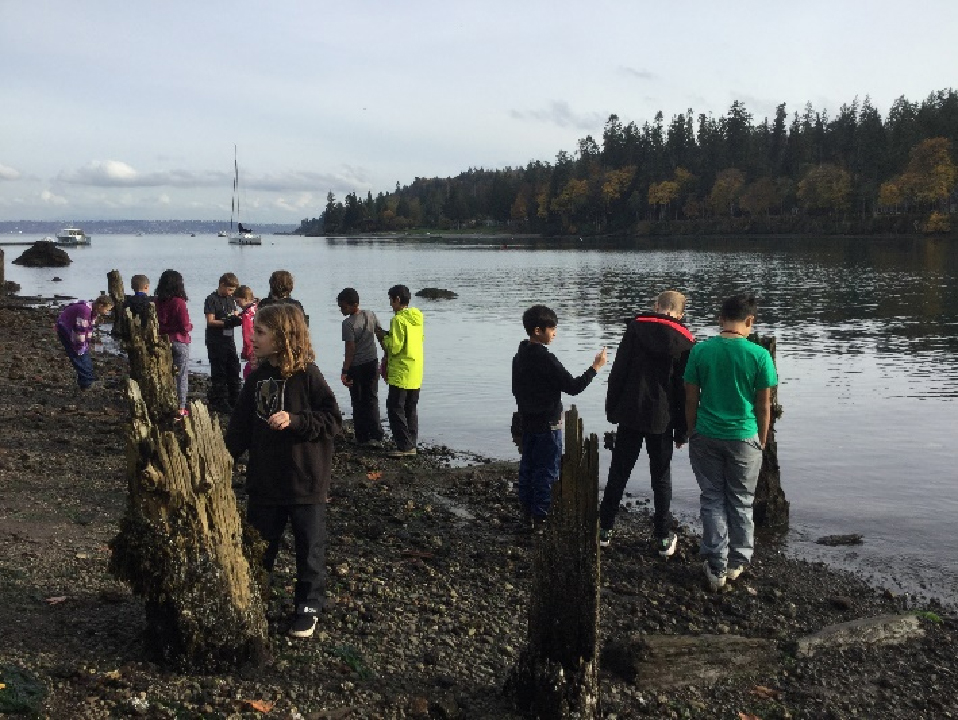
These students are checking out Blakely Harbor on Bainbridge Island, WA with sight, touch, hearing, and smell. Photo credit: Glassy, 2018
Adventure Hike to a Harbor:
Creating a space for all to engage with marine science
By Julia Glassy
I am currently a graduate student of University of Washington over on Bainbridge Island, WA at IslandWood, a non-profit outdoor education center. I am passionate about adventuring outdoors and marine science education. Interacting with the marine ecosystem allows people of all ages to explore a new ecosystem and grow an appreciation for all that ecosystem provides to the plants and animals who live there and for us, as humans.
What exactly is an adventure hike?
To some it may be walking somewhere with style or awe inspiring activities on the way to a location. While for others it may be getting in a car and driving to a location to check it out and explore. Lastly, an adventure hike could be riding a bus to go out and explore an outdoor space. To me, it is all of the above!
What might one do on adventure hike?
This all depends on the mode of transportation to a waterfront or shoreline and the age of the members going. Games you can play include wind storm (everyone needs to find a tree to hold onto or someone else if they are connected to a tree). Also flash flood (where everyone has to be on higher ground then the caller of the flood). Another game is “I-Spy” where you say “I spy with my little eye something that is blank” and you can fill in the blank. Talking as a group work too!
If in a car, then look out the window and take in the nature outside. Play a couple rounds of “I Spy” with all members in the car.
If on a bus, do what Ms. Frizzle does and make the adventure unique and exciting. Ms. Frizzle is a fictional charismatic 4th grade science teacher who takes her students on unique out-of-this-world field trips via her magic school bus.
Public transportation is an eco-friendly option to get to places that are a little farther away where walking is not an option. Also buses bring people together from all backgrounds, ages, cultures, and economic statuses. Taking a bus might not always be the most direct option, but it sure is the most fun as seen by Ms. Frizzle. It is okay to let the inner child out during these adventure hikes and explore in a new way. Aim for getting to the point of being comfortable with saying “We are on another one of Ms. Frizzle’s crazy class trips!” (Cole, 1995, p. 18). Take ownership over the adventure and be like Ms. Frizzle or like her students.
If visiting a shoreline is not feasible
Visiting your local aquarium:
They will have marine organisms that you can check out up close or hands-on. This hands-on experience is important for children of all ages in order to learn and understand similarities and differences among a variety of ecosystems.
Even if you do not have access locally to a marine or fresh water ecosystem that is okay! Books and films are good resources for learning more about an unfamiliar ecosystem. Reference books and documentaries can be purchased online or in store, but many of them can be checked out at your local library.
Getting more out of a visit to the shoreline
Get familiar with shore and ocean creatures and be a part of an investigation with children or adults you take to the harbor as an adventure hike or school field trip. Investigations do not follow the strict procedure of experiments, but instead are informal ways of wondering and discovering something. An investigation can be done in multiple ways, by taking in observations through sight, hearing, touch, or smell, and making guesses, and asking questions. Taking in observations through the different senses allows someone to become familiar with and gain a sense of place. With this new information, you can gain an appreciation for the place or item that was investigated.
Some books to refer to while familiarizing oneself with shore or ocean habitat depending on age are:
Toddlers:
On the Beach (Smith and Howell, 2003)
Young Readers and Explorers:
In One Tidepool: Crabs, Snails, and Salty Tails (Fredericks, 2002)
Magic School Bus On the Ocean Floor (Cole, 1995)
Ocean (MacQuitty, 2000)
Seashore (Parker, 2000)
Shoreline (Taylor, 1993)
All Ages-Reference:
Beachcombers Guide to Seashore Life in the Pacific Northwest (Sept, 1999)
Activities to do at a Harbor, Shoreline, or Beach
Free Exploration:
Free explorations are where someone takes a few minutes or longer of unstructured time to wander or explore a new space or ecosystem. This unstructured time can reduce all aged students’ distraction level and setup for other activities by allowing students to self-direct their investigations and learning. This is important because it allows students, children, and adults to build confidence, independence, and a greater understanding about the world around them.

Students at IslandWood’s School Overnight Program searching for crabs at Blakely Harbor on Bainbridge Island WA. Photo credit: Glassy, 2018
Crab-itat:
Crab-itats are a fun, hands-on way to explore and learn the important components that crabs need to survive and thrive. One way to make a crab-itat is to use natural materials from the beach you are on to make a habitat for the crabs found there (IslandWood Education Wiki, 2018). The logistics of this project are up to the person making the habitat, and the habitat could take many forms, and be made with several different natural items. Young students and adults can try to add abiotic (non-living) and biotic (living) items to their habitat and then think and describe their reasoning behind the items they chose.
This process of thinking and then explaining the habitat they created allows for the connection to the survival needs of crabs. You can then relate this learning to any animal or plant in other ecosystems. Another important take away from this activity is for someone to gain a sense of place and appreciation for the beach environment. With this new appreciation the person will feel more inclined to take small steps or community action to help take care of the ecosystem so others can enjoy it too!
Investigation:
Step 1: Pick three different locations on the shoreline (ex: sand, rocks, and water’s edge).
Step 2: Make a table similar to this one:
|
Different
locations |
# of crabs found |
| Trial 1 |
Trail 2 |
Trial 3 |
Average |
| Sand |
|
|
|
|
| Rocks |
|
|
|
|
| Water’s Edge |
|
|
|
|
(Cunningham, 2017)
Step 3: Count the number of crabs at each location. The number of trials is up to you.
Step 4: Calculate average of each location, if you have more than one trial. The average will give an area that crabs are more likely to be, providing evidence for a potential claim. Through this investigation, you can gain knowledge of the preferred habitat of the crabs in your area, make observations, form claims with evidence, and be like a scientist. Investigations are important because you can make them relatable or personal to you and then gain skills that you can use at school, work, or other aspects of your life. You can also look for and investigate sea stars, sea anemones, or snails depending on your personal interests and the beach location near you.
Finding something new to learn more about:
This is similar to free exploration, but instead each person or pair can find something they are interested in and use different tools to explore and learn about it. This includes using a Lummi Loupe (a domed magnifier), small containers, magnifying glasses, and/or reference books. For example, a group of fifth graders I was teaching were excited to go to Blakely Harbor on Bainbridge Island so I brought some small clear containers and some Lummi Loupes to the harbor. Some students were excited about barnacles so we picked up a rock with living, but closed up barnacles on it and put it in one of the containers with saltwater. While still at the beach we observed the barnacles in the container. Also the students used the Lummi Loupes to look at the barnacles up close. We then returned the rock to where we found it and put the saltwater back in Puget Sound. Using the different tools to learn something about the organisms through the use of the four senses (sight, smell, hear, and touch) and then referring to a guide to find out the name of the plant or animal allows for more comprehensive learning and understanding.
Common Animals and Plants Found At the Shoreline
Crabs: Shield-Backed Kelp Crab, Purple Shore Crab, many types of Hermit Crabs (Sept, 1999)
Sea Star: Leather Star, Pacific Blood Star, Purple Star, and many others (Sept, 1999)
Sea Anemones: Giant Green Anemone, Plumose Sea Anemone (Sept, 1999)
Barnacles: Thatched Barnacle, Acorn Barnacle, Goose Barnacle (Sept 1999)
Limpets: Rough Keyhole Limpet, Ribbed Limpet, and more (Sept, 1999)
Chitons: Gumboot Chiton, Woody Chiton, Cooper’s Chiton, and more (Sept, 1999)
Plants On or Near the Shore: Common Sea Lettuce, Bull Kelp, Iridescent Seaweed (Sept, 1999), and Pickleweed
Guidelines for Exploring At the Beach
- Gently roll a rock over to see what is underneath and then return to original state. The rock should be no bigger than the size of your head.
- Be cautious of picking up animals higher than your knee (that is a long way to fall)
- Have a blast exploring the beach and enjoy discovering and learning about something new
 Julia Glassy is a current graduate student of University of Washington over on Bainbridge Island, WA at IslandWood. In addition to taking classes, she teaches 3rd through 6th graders who come over to IslandWood from their schools in the greater Seattle and Bainbridge Island area for four days as a part of the School Overnight Program.
References:
Cole, J. (1995). The Magic School Bus On the Ocean Floor. Littleton, MA: Sundance.
Cunningham, Jenny. (Ed.). (2017). IslandWood Field Journal. Bainbridge Island, WA: IslandWood.
Ecosystem in a Box. (n.d.). Retrieved December 6, 2018, from https://wiki.islandwood.org/index.php?title=Ecosytem_in_a_Box
Glassy, Julia. (Photograph). (2018). Blakely Harbor, Bainbridge Island. Bainbridge Island, WA: IslandWood.
Fredericks, A. D. (2002). In One Tidepool: Crabs, Snails, and Salty Tails. Nevada City, CA: Dawn Publications.
MacQuitty, M., Dr. (2000). Ocean. New York: Dorling Kindersley.
Parker, S. (2000). Seashore. New York: Dorling Kindersley.
Sept, J. D. (1999). The Beachcombers Guide to Seashore Life in the Pacific Northwest. Madeira Park, BC: Harbour Pub.
Smith, A., & Howell, L. (2003). On the Beach. Tulsa, OK: EDC Publishing.
Taylor, B. (1993). Shoreline. London: Dorling Kindersley.

by editor | Dec 17, 2018 | Indigenous Peoples & Traditional Ecological Knowledge
Native Voices: Reclaiming a Culture through the Traditional Canoe
Gary Dorr is a member of the Nez Perce Tribe and Chairman of The River Warrior Society. Members of the fourth-grade crew interviewed him about his involvement in the resurgence of the traditional canoe. This is the interview transcript.

What is your full name and where are you from?
My English name is Gary Dorr. My real name is Standing Red Bear. I live in Craigmont, Idaho on the Nez Perce Indian Reservation.
Many Tribes throughout the region have not made a canoe in many years and they are starting to build canoes again. Why is this happening now?
The reason why we are building canoes again, or why we are going back to it, is to reclaim part of our culture. It comes at a time when the culture and the environment are under attack from global warming threats, from pollution. So it makes sense for us to reclaim our authority over the water. And the best way to do that is in the traditional way because our treaties are traditional, traditional words for our ancestors. So we are going back to those words in a good way, the way we would have done it back then with a traditional canoe. Whether it is Kootenai, Coeur d’Alene, Shoshone-Bannock, Paiute, Standing Rock, Rose Bud, or all the coastal tribes, including the Nez Perce, we are all reasserting our authority on the water in a traditional way. So that is why it is coming back.
What types of canoes has your tribe built in the past and what were they used for?
In the past we have done dugout canoes and sometimes we used to burn them out instead of carve them out. I like to tell people that they were our grocery cart, our family car, our post office, and our hunting rigs. We would take them on the river and we would go across the river. Sometimes we’d go just right across the river to go to the other side to gather roots. Sometimes we would take them fishing, even at night time using lanterns with fire, and we would spear fish from it. The other thing we would do is to take them out to lay nets in the water. And we would go all the way to the ocean to gather different shells, to get to where the other fisherman are, and to meet with our other relatives on the coast. We would bring messages back, so that is why the canoe was our post office. And our grocery cart because we would go over and get berries or other roots. It was our hunting rig because before we had trucks we would go hunting in the canoes and gather things.
What happened to the canoes your ancestors made?
Well a lot of different theories on that. Some people say that some people burned them and others say that they buried them in the mud because when the missionaries came here they wanted to get rid of all that culture. So to save it we either burned it ourselves or we buried it in the mud and lakes. We do have four canoes that were made by some Nez Perce elders back in 1913, or somewhere around there. They are in our museum, not on display, but in a separate warehouse. So those are the oldest canoes and the models that we are working off of to make our canoes today.
Do you know why your tribe stopped building canoes?
Again, there are a couple of different theories about why we stopped building canoes and that was probably the missionary influence because when they made the Indian Reservations they wanted us to become farmers. And we used to go from Oregon all the way to Montana, and to Washington, all over the place. We would go with the seasons to different camps. We didn’t stay in on place like a farm house to farm. So in order to keep us doing that they took our horses, they burned down our wickiups and our tipis, and took our boats. They made those things bad to use so we would stay in one spot and become farmers.
Why after so long did you decide to bring the traditional canoe back?
Well we have been trying to bring our language back for years and years and years, and there are quite a few people who are taking our language classes. The other part of that is actually using the language. When we go to ceremonies we use the language. When we go root digging some of the women have songs that they sing when they are digging the roots. So this is just another way for us to expand our culture. A new use for our language is to build this canoe. And we wanted our children to experience this again because people have tried it in the past. I guess abut 1990 someone tried, but they didn’t finish the canoe. So we are going further than they have. It is mainly for our children, so that they can regain that skill.
What is the importance of the traditional canoe for you and your tribe?
It is a symbol. It is a symbol of living with the land. There is nothing man made in the dugout canoe. The paddles are from trees. The canoe is from trees. There is no plastic, no glass, none of that. It takes people to build that. So the importance is gaining our culture and passing it on to our children, also because the children helping us build our canoe have never been in a dugout canoe. So they are going to be the first Nez Perce children in over 113 years to sit in a dugout canoe. It is a big part of our culture because we are surrounded by rivers – the Clearwater, The Salmon, The Snake, The Columbia, The Palouse, all these different rivers and yet we don’t have any canoes left. We want our children to have that back. This is basically our gift to our children and that is why it is important to us.
Is it hard to bring back the canoe, and if so, why?
It is a little bit hard because we don’t have all day to do it. We meet once a week for about three hours so it has taken us a long time. Part of having that canoe sitting exposed for so long is that it’s curing. And as it curing, it is drying out, and it is starting to crack. Because we haven’t sealed it up, because we haven’t finished carving it. So I went through and I sealed what was left on the outside and that helped to stop the cracking. We put some butterfly braces in there along the cracks to keep it from separating more. It is hard with everybody’s work schedule. We are dealing with a traditional craft that was built in three or four days and we are only there for a couple of hours a week, so it has taken us almost a year to get this done. And that is because we are taking a traditional craft and we are combining it with today’s modern work environment and work schedule.
Why did you name your canoe New Medicine?
It is named New Medicine because to us we’ve lost this way. Let me explain what medicine is. Medicine can be words. Medicine can be actual roots, plants, or food. Water is medicine. Prayers are medicine. Giving someone a hug is medicine. You have a good effect and a bad effect and medicine is that effect. So when we built this canoe it is a new medicine to us because none of us have built a canoe in 113 years. To us it is new, but it is actually an old medicine that we are bringing forward. It has always been there for thousands of years, but for us, for me, it is new. So that is why we called it New Medicine.
 What is the importance in your tribe to have kids help make canoes or paddles?
It is very important because we are making mistakes on our canoe, but our children are there so next time we are going to teach them a better way of making a canoe. What has happened is we have families now that are coming to the canoe. We have two families that are coming there with their children. My dream is for those people to get a tree in their yard and start building their own family canoe. When they do that, for the children it just becomes natural. Just like every day you brush your teeth, it is a natural thing when you get up in the morning. For children when they want to go camping and go up in the mountains. If they want to come back the easy way, they will find a tree, chop it down and make a canoe. That is how simple the knowledge should be.
How special is it that the kids are helping you?
I think it is really special because children are more pure than we are. When you are born, you are the most pure you are ever going to be. When you are older, you are exposed to things, you have anger, jealousy and all these things that can come the older you get. When you are young, you don’t have all of that. You are just happy. So that brings a good energy to the site where we are building the canoe. They have prayed with the canoe, so I think that is the most important thing. This canoe is a ceremony. Even before we started building it we went into our sweat lodge and prayed for their canoe to come to us. On that day we started the ceremony, and our children are part of that ceremony.
Did the tradition of building a canoe, and the knowledge of how to build it, fade from your mind as the years passed that you didn’t build the traditional canoe?
Yeah it did. For example, when we were here in 1805, when Lewis and Clark first got here. When we sent them down the river, in ten days we built five canoes for them. Ten days. So that’s two days per canoe. That is just as natural as getting up and brushing your teeth. But for us it has taken a year to build. We are getting better at it, but it is something we have to learn. You are not going to learn it until you actually do it. That is why we started to do it, because there is no other way to learn it. You can read it in a book, but until you swing and axe and start carving, until the wood starts to split, you don’t know how to handle that. That is why we are doing it.
What is the importance of carving paddles?
The importance of carving paddles as it was explained to me is that because we worked on these canoes very quickly in three or four days there was a lot of carving going on. So to keep the children from getting hurt while we were swinging axes, we let them carve the paddles. That gave them the hand skills to use a knife, carving tools, whatever we used to carve the canoe to carve the paddle. It kept the children busy while we were doing the heavy work with the log.
What do paddles mean to you in your tribe?
The paddles for us mean the children’s independence. Once we had these small canoes, the children wouldn’t be able to do it unless they had paddles. In order to use the canoe you had to have your own paddles. That makes you independent. And it was the same thing for the people. Sometimes the women had smaller canoes to go across the river. If there canoes were small enough they could use their hands, but if not, they had to have a paddle. So you can have the nicest canoe in the world, but if you don’t have a paddle you aren’t going to be able to go anywhere. So it was about independence.
Historically how long did it take to make a paddle?
Well usually we could make a paddle in maybe a day. For us, the Nimi´ipuu, the Nez Perce, our canoes and our paddles were not fancy. They didn’t look like a piece of art. They were clunky. As long as they worked that was all we cared about. We didn’t put drawings on them. Today we do just because it’s something special for us. But in the past, way back in the day, we built canoes in two days.
What are the steps to making a paddle in your tribe?
First you have to draw it out. The thing with paddles is that normally the children built them because we did a lot of heavy work with the logs. So to keep the children safe while we were working on the canoe the children would be the ones working on the paddles. So we’d trace it out and just let them carve away with knives or sharp points.
With your tribe, traditionally what kinds of shapes and uses did your paddles have?
Normally the first person in the canoe has a pointed paddle that is maybe a little bit skinnier. The reason is that when we pull into shore the first person digs that addle into the dirt, into the shore, and holds the canoe while everyone else gets out. So everyone else should have a rounded paddle. The person in the very back is the one steering the canoe. They might have a little bit longer and thicker paddle because they are pushing and pulling and directing that canoe on a straight line.
Why do you make paddles?
I actually haven’t made a paddle yet. I had someone give me a paddle so I didn’t have to build mine. The reason why we make paddles is when you’re in a canoe, it’s really neat, and you will see this once you are in your canoe, you lay your paddles across the canoe and you can go like a drum beat and sing songs. When you are all going at the same time, that expresses unity. Thump, thump, thump, thump, thump, thump. You can all start on different beats, but if you do it long enough you will find that everybody gets the same beat. It’s a natural thing and we know that. That’s why we do it, to get everybody right in the same mind and get everybody unfied.
Do you build new paddles every time you build a canoe?
I don’t know about every time because this is our first canoe that we have built. We are building a bunch of paddles though. Generally, if you carve your own paddle that goes home with you. We always place the paddle part in the water, but when we lean it up against the wall, we always place that end up and the handle is what touches the floor. And that is just one thing we have learned from our elders. We might have to build paddles again because some of them might break. I think that some people have built their paddle a little bit too thin and when we get on the shore the first paddle on the front of the canoe is always pointed. And the reason for that is when we pull into shore that person digs that paddle into the sand and the dirt and holds the canoe. So that paddle probably will break, because we are down there on the river with e bunch of rocks. So we build them whenever we need them.
 Is there anything else that you want us to know about paddles?
The only other thing I want you to know about paddles is to make sure that you guys practice with them on the land first, so that you are all stroking with them at the same time. Because you’re not all on the right side, you’re not all on the left side. So one person will be on the right side, the next person up on the left side, the next person up on the right side, the next person up on the left side. So when you stand in two lines what happens is that the first person in the front of the canoe, when they raise their paddle, everybody on that side behind them raises their paddle, and that way they stroke at the same time. So the person in the front is the one who controls the speed at which you guys are paddling. If you are on the left side you watch the person in front of you, and that person watches the person in front of them, all the way to the front of the canoe. So the person in the front, as soon as they start stroking, everybody on the left side should be stroking at the same time. Same thing on the right side. You watch the person in front of you, they watch the person in front of them, and so on all the way to the front. So you are not clunking paddles, and you’re all going at the same time. That is something you can practice today. Even though your paddles aren’t done, you can practice getting up in two lines, one on the right side and one on the left side, and watch the person in front of you, all the way to the front. That’s so you have more power and so you’re not clunking paddles or mashing anyone’s fingers.
Is there anything about paddles and your tribe specifically that you want the world to know?
We started making our dugout 13 months ago. We started in a ceremony in a sweat lodge and we prayed for this to come in a good way and for everybody to be safe. Building the canoe is part of our ceremony, so our ceremony has been going for 13 months now. When we put the canoe and paddles into the water, it is also a ceremony because we want the Snake River dams to be breached. We have some goals to get those dams out. So we are taking these canoes as a form of prayer. For the paddlers, every stroke, every time they put their paddle in, they are making a prayer. So we say “every pull a prayer.” We are going to break that down. We are going to protect the water. We are going to restore the salmon. Please help us. So that’s probably the difference between just going out recreational boating and a traditional canoe that we’re doing.
To learn more about Gary and the River Warrior Society, visit https://riverwarriorsociety.org.
