by editor | Dec 17, 2018 | STEM
Utilizing the Tools of Poetry for Science Inquiry
by Jim Martin
CLEARING consultant
 pril is National Poetry Month. Can we celebrate it by using poetry to facilitate teaching science as inquiry? What does the flow of thoughts, images of relationships, grammar and syntax, in poetry have that would make it an effective element to use while engaging in the process of science inquiry? Is it possible? Let’s see.
So, what would it look like, engaging a science inquiry in a natural place with the tools of poetry? Might be interesting; might be a flop, depending on my own interest, familiarity, and confidence in science and in poetry. A natural concern, yes, but I do know that my students would become invested in their work when I decided to spring something unexpected on them. How would I go about this now?
One thing I’ve learned from looking for curricula outside my classroom, even in school parking lots, is that curricula of all kinds are actually there, embedded in the world. If you think about it, school is learning about the world outside the classroom. We just insulate our classrooms from the world, then teach about the world from within them. It takes dedicated work to make our curricula connect with the world it teaches about. The arts and humanities do open the mind to clear thinking and good work. We might consider using them more often to make those connections.
Which gets us back to poetry. We are human, all of us; we use the arts and humanities to communicate. Not just writers, artists, musicians, and actors, but suits running a powerpoint for other suits at a table, or a man with a cardboard sign saying, “stranded, anything helps.” Without that grounding, we might stumble through life; and, on a larger scale, lose sight of our on-going move toward a global civilization. We need the arts and humanities as much as we need science and technology.
Does poetry really relate to scientific inquiry in riparian areas?
How do I tell this need for the arts and humanities to a streambank? We can combine the streambank and the arts and humanities as we teach; the place and the tools. My own experience tells me that doing science with the assistance of the arts and humanities does work, does engage students in their studies, and does empower them as persons. When students draw what they observe on-site or at a lab bench, and condense each drawing to a word or phrase, use these to build an illustrated poem, write a story, or draw an accurate “photo” point then return in another season to re-draw and analyze it, they easily attain new concepts, and develop conceptual memories that remain with them. These memories tie the work to a personalized picture in their mind; the laying down of a conceptual memory. It is those kinetic, verbal, and visual records of what they experience which help build the strong conceptual memories that they will carry into their lives as something understood; just ‘common sense’.
Poetry, coupled with a drawing, can do this. Here’s a simple example of using the arts and humanities to help clarify conceptions in a stream study. Students are studying a section of a side-channel of the stream, comparing it with the main channel. You have them start the project by observing a reach they choose along the stream. As they decide on their particular reach, they get to know it by observing things there that they think might play a role in maintaining the main and side channels as habitat. This helps them begin to develop an incipient concept of a riparian area as an integrated organization of collaborating entities.
As they work, you ask them to express what they have observed with an incipient poem about the things, themselves, and their place in the stream; how they think that these things help maintain the work of the stream, and the life it supports. This poem is a work in progress, so they’ll add elements to it as they encounter them; updating it as they discover and understand more. Once they are engaged, you ask them to draw a birds-eye-view map of their reach, from stream bank to stream bank. When this is done, you ask them to use their observations, work, and poem to date, to build a section at the end of their poem that ties the parts of the map together within a conceptual framework to express the life of this stream.
They, not you, pull the work they’ve done on-site, and express it as a conceptual schematum
When their work is done, you bundle up and return to the classroom to begin to pull meaning from the evidence and thoughts they have engaged. And, to present each group’s findings and products to the class. The final presentation begins with a seminar report from each group on their work, results, interpretations, and recommendations. This presentation will utilize students’ data, insights, map, and poem, in a way that works best for them. They may wish to keep the map projected on a screen for their entire presentation, with verses of their poem interspersed to the place where they will fit best, or make the most sense. Some groups may wish to include an artful representation of their map. Others may wish to complete their presentation with a performance of their poem. Others may do the same, but with their map, data, etc., included in the performance in spots where they work well. Your job will be to comment on what each presentation brings to the goals and outcomes you had planned to achieve. The first time through, this is an interesting experience, sometimes with a challenge or two. A perfect learning experience for any teacher! Take notes, and incipient preparations for the next time you do this.
By this time, your students should have reached a place where they own their work, and know it intimately enough to begin to intuitively make decisions about it on their own. After the presentations are completed, each group hangs or posts their map and poem in the classroom. The class can then discuss the information in their posted maps and poems, and in their data and analysis sheets, to come to some consensus about connections among the elements of the stream, its environment, and its channels.
Then, they discuss and comment upon a question posed at the beginning of this article: “Can we celebrate our work in the field and lab by using poetry to facilitate teaching science as inquiry? What does the flow of thoughts, images of relationships, grammar and syntax, in poetry have that would make it an effective element to use while engaging in the process of science inquiry?” They’ll be ready to provide specific examples to support their thinking about this. As they share their thoughts, observe carefully for evidence that they have assumed ownership of the work, involvement and investment in their shared learnings, and personal empowerment. When you see evidence of this, ask some questions about it. How did they feel? When did they know they were on a profitable trail? What most helped them get to where they are? And, what part did the poem play in their inquiry? Was it effective in helping you think about the work, relationships around the components of the system?
Something for you to do:
If you did try this in some form or another, and it worked somewhat, but needed tweaking or major surgery, write a blog about your experience and post it to clearingmagazine.org. Or, post it as a comment here, just below the end of this blog, and I’ll get back to you.
 This is a regular feature by CLEARING “master teacher” Jim Martin that explores how environmental educators can help classroom teachers get away from the pressure to teach to the standardized tests, and how teachers can gain the confidence to go into the world outside of their classrooms for a substantial piece of their curricula. See the other installments here, or search Categories for “Jim Martin.”
by editor | Dec 17, 2018 | IslandWood, Marine/Aquatic Education, Place-based Education
Adventure Hike to a Harbor:
Creating a space for all to engage with marine science
By Julia Glassy
I am currently a graduate student of University of Washington over on Bainbridge Island, WA at IslandWood, a non-profit outdoor education center. I am passionate about adventuring outdoors and marine science education. Interacting with the marine ecosystem allows people of all ages to explore a new ecosystem and grow an appreciation for all that ecosystem provides to the plants and animals who live there and for us, as humans.
What exactly is an adventure hike?
To some it may be walking somewhere with style or awe inspiring activities on the way to a location. While for others it may be getting in a car and driving to a location to check it out and explore. Lastly, an adventure hike could be riding a bus to go out and explore an outdoor space. To me, it is all of the above!
What might one do on an adventure hike?
This all depends on the mode of transportation to a waterfront or shoreline and the age of the members going. Games you can play include wind storm (everyone needs to find a tree to hold onto or someone else if they are connected to a tree). Also flash flood (where everyone has to be on higher ground then the caller of the flood). Another game is “I-Spy” where you say “I spy with my little eye something that is blank” and you can fill in the blank. Talking as a group work too!
If in a car, then look out the window and take in the nature outside. Play a couple rounds of “I Spy” with all members in the car
If on a bus, do what Ms. Frizzle does and make the adventure unique and exciting. Ms. Frizzle is a fictional charismatic 4th grade science teacher who takes her students on unique out-of-this-world field trips via her magic school bus
Public transportation is an eco-friendly option to get to places that are a little farther away where walking is not an option. Also buses bring people together from all backgrounds, ages, cultures, and economic statuses. Taking a bus might not always be the most direct option, but it sure is the most fun as seen by Ms. Frizzle. It is okay to let the inner child out during these adventure hikes and explore in a new way. Aim for getting to the point of being comfortable with saying “We are on another one of Ms. Frizzle’s crazy class trips!” (Cole, 1995, p. 18). Take ownership over the adventure and be like Ms. Frizzle or like her students.
If visiting a shoreline is not feasible
Visiting your local aquarium:
They will have marine organisms that you can check out up close or hands-on. This hands-on experience is important for children of all ages in order to learn and understand similarities and differences among a variety of ecosystems.
Even if you do not have access locally to a marine or fresh water ecosystem that is okay! Books and films are good resources for learning more about an unfamiliar ecosystem. Reference books and documentaries can be purchased online or in store, but many of them can be checked out at your local library.
 Getting more out of a visit to the shoreline
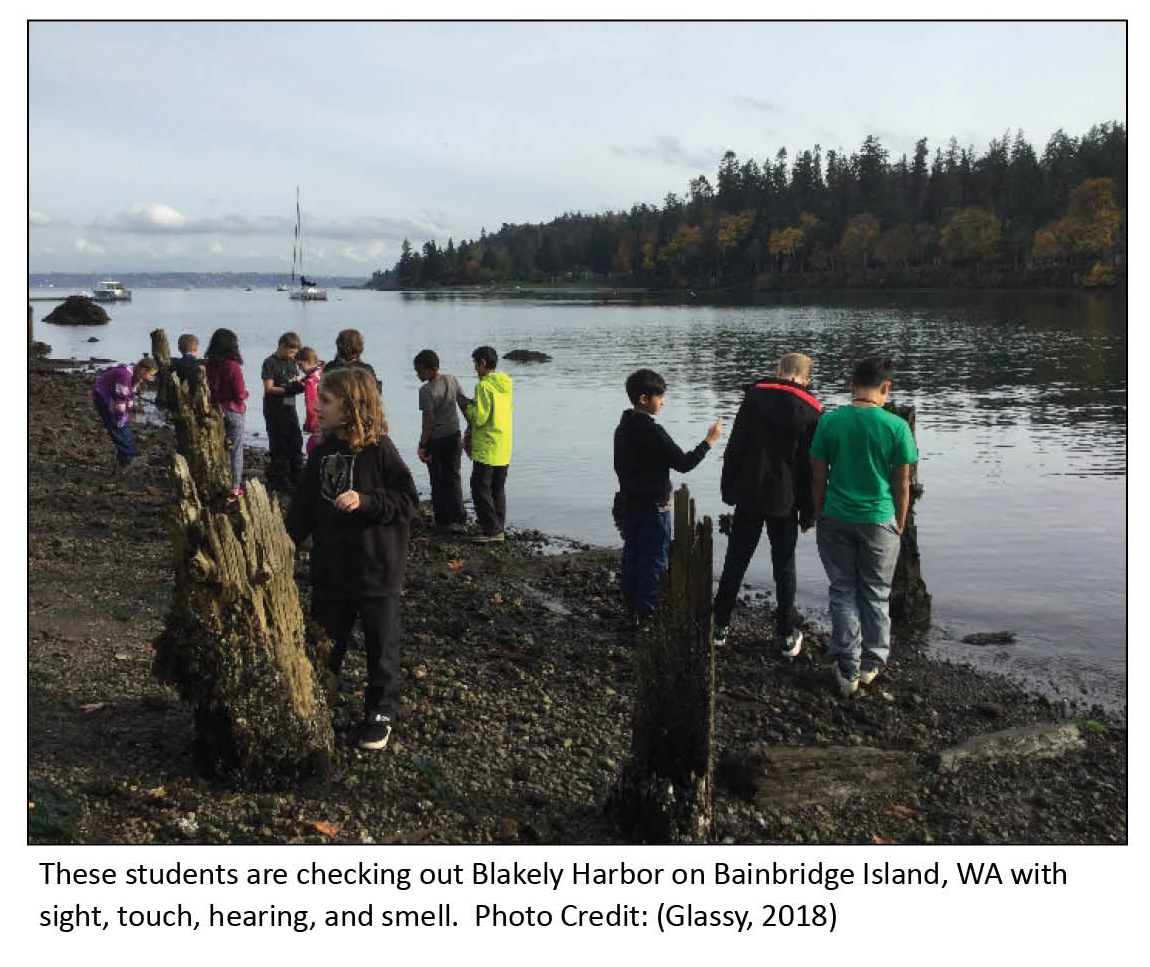
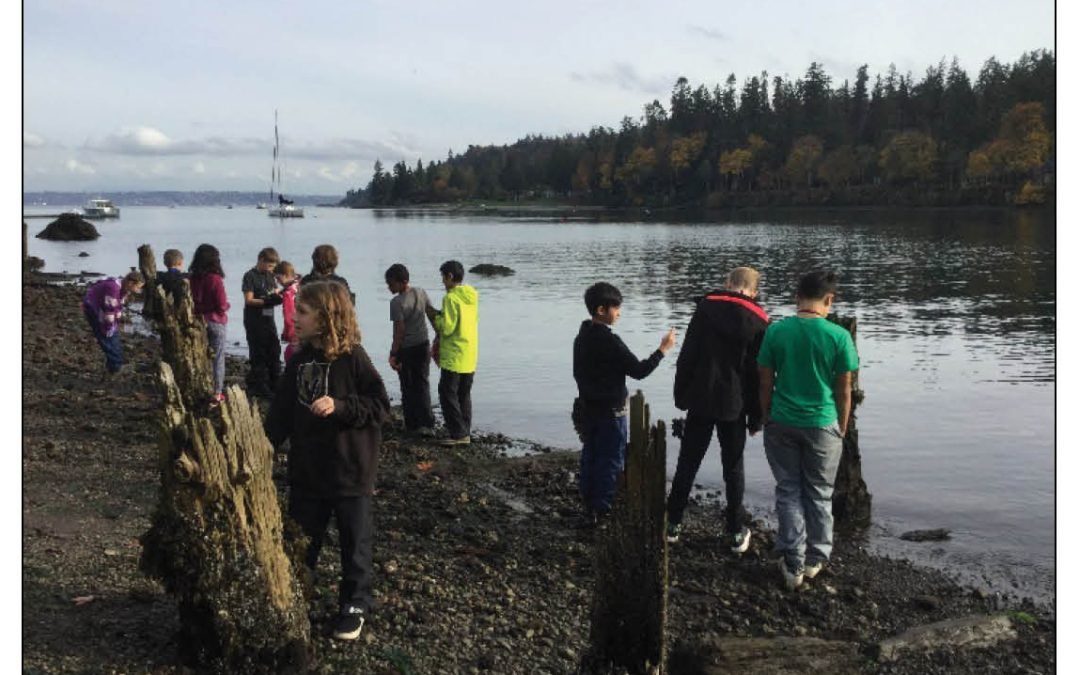
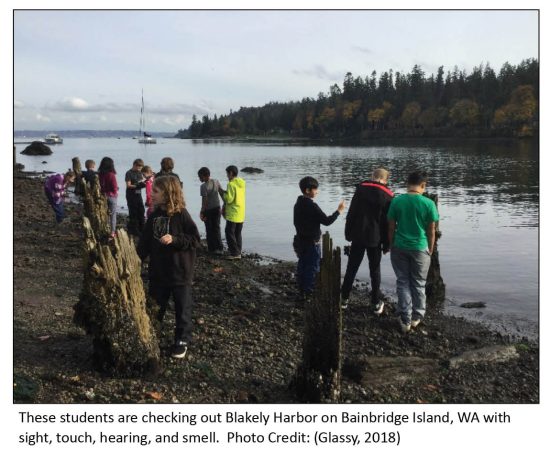
Get familiar with shore and ocean creatures and be a part of an investigation with children or adults you take to the harbor as an adventure hike or school field trip. Investigations do not follow the strict procedure of experiments, but instead are informal ways of wondering and discovering something. An investigation can be done in multiple ways, by taking in observations through sight, hearing, touch, or smell, and making guesses, and asking questions. Taking in observations through the different senses allows someone to become familiar with and gain a sense of place. With this new information, you can gain an appreciation for the place or item that was investigated.
Some books to refer to while familiarizing oneself with shore or ocean habitat depending on age are:
Toddlers:
On the Beach (Smith and Howell, 2003)
Young Readers and Explorers:
In One Tidepool: Crabs, Snails, and Salty Tails (Fredericks, 2002)
Magic School Bus On the Ocean Floor (Cole, 1995)
Ocean (MacQuitty, 2000)
Seashore (Parker, 2000)
Shoreline (Taylor, 1993)
All Ages-Reference:
Beachcombers Guide to Seashore Life in the Pacific Northwest (Sept, 1999)
Activities to do at a Harbor, Shoreline, or Beach
Free Exploration
Free explorations are where someone takes a few minutes or longer of unstructured time to wander or explore a new space or ecosystem. This unstructured time can reduce all aged students’ distraction level and setup for other activities by allowing students to self-direct their investigations and learning. This is important because it allows students, children, and adults to build confidence, independence, and a greater understanding about the world around them.
Crabitat
Crab-itats are a fun, hands-on way to explore and learn the important components that crabs need to survive and thrive. One way to make a crab-itat is to use natural materials from the beach you are on to make a habitat for the crabs found there (IslandWood Education Wiki, 2018). The logistics of this project are up to the person making the habitat, and the habitat could take many forms, and be made with several different natural items. Young students and adults can try to add abiotic (non-living) and biotic (living) items to their habitat and then think and describe their reasoning behind the items they chose.
This process of thinking and then explaining the habitat they created allows for the connection to the survival needs of crabs. You can then relate this learning to any animal or plant in other ecosystems. Another important take away from this activity is for someone to gain a sense of place and appreciation for the beach environment. With this new appreciation the person will feel more inclined to take small steps or community action to help take care of the ecosystem so others can enjoy it too!
Investigation
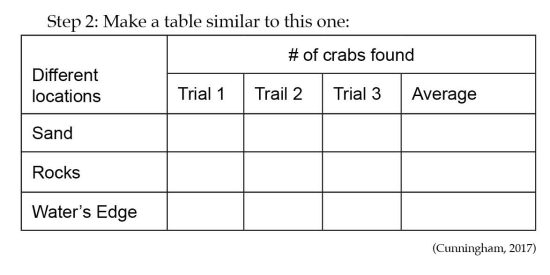
 Step 1: Pick three different locations on the shoreline (ex: sand, rocks, and water’s edge).
Step 2: Make a table similar to this one
(Cunningham, 2017)
Step 3: Count the number of crabs at each location. The number of trials is up to you.
Step 4: Calculate average of each location, if you have more than one trial. The average will give an area that crabs are more likely to be, providing evidence for a potential claim. Through this investigation, you can gain knowledge of the preferred habitat of the crabs in your area, make observations, form claims with evidence, and be like a scientist. Investigations are important because you can make them relatable or personal to you and then gain skills that you can use at school, work, or other aspects of your life. You can also look for and investigate sea stars, sea anemones, or snails depending on your personal interests and the beach location near you.
Finding something new to learn more about
This is similar to free exploration, but instead each person or pair can find something they are interested in and use different tools to explore and learn about it. This includes using a Lummi Loupe (a domed magnifier), small containers, magnifying glasses, and/or reference books. For example, a group of fifth graders I was teaching were excited to go to Blakely Harbor on Bainbridge Island so I brought some small clear containers and some Lummi Loupes to the harbor. Some students were excited about barnacles so we picked up a rock with living, but closed up barnacles on it and put it in one of the containers with saltwater. While still at the beach we observed the barnacles in the container. Also the students used the Lummi Loupes to look at the barnacles up close. We then returned the rock to where we found it and put the saltwater back in Puget Sound. Using the different tools to learn something about the organisms through the use of the four senses (sight, smell, hear, and touch) and then referring to a guide to find out the name of the plant or animal allows for more comprehensive learning and understanding.
Common Animals and Plants Found At the Shoreline
Crabs: Shield-Backed Kelp Crab, Purple Shore Crab, many types of Hermit Crabs (Sept, 1999)
Sea Star: Leather Star, Pacific Blood Star, Purple Star, and many others (Sept, 1999)
Sea Anemones: Giant Green Anemone, Plumose Sea Anemone (Sept, 1999)
Barnacles: Thatched Barnacle, Acorn Barnacle, Goose Barnacle (Sept 1999)
Limpets: Rough Keyhole Limpet, Ribbed Limpet, and more (Sept, 1999)
Chitons: Gumboot Chiton, Woody Chiton, Cooper’s Chiton, and more (Sept, 1999)
Plants On or Near the Shore: Common Sea Lettuce, Bull Kelp, Iridescent Seaweed (Sept, 1999), and Pickleweed
Guidelines for Exploring at the Beach
- Gently roll a rock over to see what is underneath and then return to original state. The rock should be no bigger than the size of your head.
- Be cautious of picking up animals higher than your knee (that is a long way to fall)
- Have a blast exploring the beach and enjoy discovering and learning about something new
 Julia Glassy is a current graduate student of University of Washington over on Bainbridge Island, WA at IslandWood. In addition to taking classes, she teaches 3rd through 6th graders who come over to IslandWood from their schools in the greater Seattle and Bainbridge Island area for four days as a part of the School Overnight Program.
References
Cole, J. (1995). The Magic School Bus On the Ocean Floor. Littleton, MA: Sundance.
Cunningham, Jenny. (Ed.). (2017). IslandWood Field Journal. Bainbridge Island, WA: IslandWood.
Ecosystem in a Box. (n.d.). Retrieved December 6, 2018, from https://wiki.islandwood.org/index.php?title=Ecosytem_in_a_Box
Glassy, Julia. (Photograph). (2018). Blakely Harbor, Bainbridge Island. Bainbridge Island, WA: IslandWood.
Fredericks, A. D. (2002). In One Tidepool: Crabs, Snails, and Salty Tails. Nevada City, CA: Dawn Publications.
MacQuitty, M., Dr. (2000). Ocean. New York: Dorling Kindersley.
Parker, S. (2000). Seashore. New York: Dorling Kindersley.
Sept, J. D. (1999). The Beachcombers Guide to Seashore Life in the Pacific Northwest. Madeira Park, BC: Harbour Pub.
Smith, A., & Howell, L. (2003). On the Beach. Tulsa, OK: EDC Publishing.
Taylor, B. (1993). Shoreline. London: Dorling Kindersley.

by editor | Dec 17, 2018 | Conservation & Sustainability
Four Lessons in Global Education from the Beatles
By Sean Gaillard, June 19, 2017
Editor’s note: Sean Gaillard, principal of Lexington Middle School in Lexington, North Carolina, is a huge proponent of international collaboration for students in his school. In this essay he shares lessons in global education connections from an unlikely source: The Beatles.
The Beatles as Global Education Pioneers
This year marks the 50th anniversary of the Sgt. Pepper Lonely Hearts Club Band album by the Beatles. Over the last few months, the album has been the subject of many celebrations in the media. Special edition re-releases have reached the top of album charts. Retrospective commentaries on the innovative nature of this game-changing album by the most successful musical group in history abound. In the midst of this commemoration, another important footnote in Beatles history has been overlooked. This is also the upcoming 50th anniversary of “All You Need Is Love.”
This song is essentially an early example of a global Skype conversation. In 1967, the BBC produced a television special entitled “Our World,” which was the first live global satellite link-up. It aired in 25 countries simultaneously, and each participating country produced a representative segment—Great Britain was represented by the Beatles. The “Our World” audience watched the Beatles in the studio recording “All You Need Is Love.” John Lennon, the song’s primary lyricist, used it to capture a simple, universal message.
In late June 1967, the 400 million global citizens who tuned into the “Our World” broadcast saw the Beatles bedecked in flowers and beads with a group of friends, including Mick Jagger and Keith Richards of the Rolling Stones, Eric Clapton, and Marianne Faithful singing to the infectious chorus. Signs of “All You Need Is Love” written in several different languages were carried and flashed at the camera by various audience members.
Using technology to reach a global audience with the mindset to intentionally build community, empathy, and connection is a good example of taking action, one of the pillars of global competence. Educators, thought leaders, and organizations use this template on many levels to help students build global competence. Whether intentional or not, the Beatles served as global education pioneers with the example they set in this 1967 broadcast. Educators can glean many lessons from the Beatles and adapt them to support the needs of all students.
Lessons in Global Education from The Beatles
- Demonstrate a Positive Mindset: The message in “All You Need Is Love” is an anthem for the growth mindset expressed in the simplest of terms. Connecting with organizations with similar mindsets, like Teach SDGs, a United Nations-affiliated project to empower educators to teach about the sustainable development goals, provide resources for promoting a positive mindset and developing creative solutions for global challenges.
- Leverage and Integrate Technology: The Beatles understood the magnitude of what was then a new and innovative communication platform. They made sure that their message was simple, clear, and identifiable. Likewise today, there are numerous technology resources that can be leveraged to promote global awareness. Tools like Skype, Google Hangout, and Flipgrid are just a few of the tools breaking new ground in global communication among classrooms all over the world.
- Connect and Collaborate: Collaboration is the unsung element in the success of the Beatles. Global collaboration is more than just a simple “one and done” Skype session with another classroom or a token world map tossed on a bulletin board. Global collaboration is a sustained movement of inspired dialogue, vision building, and strategic planning. Twitter is one avenue for educators to build a network of global collaboration. Following Twitter hashtags like #GlobalEd, #GlobalEdChat, or #TeachSDGs will lead to an endless array of like-minded, inspiring educators who are ready to connect, support, and collaborate on global action projects.
- Take Global Action: The Beatles could have simply recorded “All You Need Is Love” and released it in the traditional manner. By agreeing to participate in a live broadcast for a global audience, they took global action in a daring way. Consider that the band had retired from live performance by that time but chose the “Our World” broadcast as a platform to perform and share a global message for unity, peace, and understanding. Organizations like the Global Oneness Project, Calliope Global, and Asia Society provide resources for educators to assist students in taking on global action projects to solve problems and create empathy.
As a principal, it is important for me to model ways to connect our students to enacting the incredible potential they all possess. Participating in Skype sessions with new international friends is a way to build the vision of preparing our students to be positive, future-ready innovators. Supporting global education projects in the schoolhouse is one way to build and sustain a positive school culture. The inspiring lessons of the Beatles is one of many musical riffs out there for educators to mine for global action.

by editor | Nov 18, 2018 | Outstanding Programs in EE
 NatureBridge Takes the Classroom Outdoors: Inspires Teachers and Students Through Discovery
by Karen West
for NatureBridge
“The future will belong to the nature smart… the more high-tech we become, the more nature we need.”
– Richard Louv, author of “Last Child in the Woods, Saving Our Children from Nature-Deficit Disorder’’
Jeff Glaser stood at the base of Madison Creek Falls in Olympic National Park, taking in the beauty of the water cascading 76 feet. As he hiked back toward the Elwha River, he recalled his nature-filled childhood, packed with camping, hiking and fishing trips throughout the Pacific Northwest.
He couldn’t help comparing the wilderness adventures of his youth to experiences of today’s generation, many of whom are growing up in an over-scheduled, technology bubble. “I love getting my students off their devices and into the natural environment where they can breathe, stretch and grow,’’ says Glaser, who teaches sixth grade math, science and religion at St. Louise School in Bellevue, Wa.
Glaser was one of more than a dozen teachers participating in a four-day professional development summer workshop at NatureBridge, an environmental education nonprofit with a campus in Olympic National Park on the shores of Lake Crescent. With environmental science at its core, the workshop was an example of how NatureBridge provides educators with training, resources and curriculum to help prepare their students to be the next-generation of environmental stewards.
The teachers from Washington, Oregon, California and New Jersey spent the week exploring marine and lowland forest ecosystems in Olympic National Park including the lower Elwha River watershed. NatureBridge educators, Olympic National Park assistant superintendent and rangers, and data driven scientists provided insight into how science, technology, engineering, and math skills inform decision making and management of this one million acre park.
In final projects, teachers in the workshop collaborated with their grade-level peers to submit classroom content for publication on the National Park Service’s K – 12 education site. Inspired by his visit to Rialto Beach, Glaser created a lesson plan focused on marine plastics – Where does the debris come from? What happens to it? And how much is generated?
“Many kids today don’t have these experiences – some don’t know their trees or their national parks,’’ says Glaser, whose parents integrated nature into his life-long learning. “It’s not just kids who are missing out on nature experiences. As teachers, we need to step it up and show our students these things.’’
The educational workshop is just one way NatureBridge collaborates with the national park to inspire teachers and students through critical-thinking skills, hands-on scientific research and inquiry-based learning.

OLYMPUS DIGITAL CAMERA
Letting Kids Get Their Hands Dirty
Founded in 1971 as Yosemite Institute, NatureBridge serves over 30,000 young people from more than 700 schools each year at its six national park campuses: the valleys of Yosemite, the watersheds of Washington’s Olympic National Park, the peaks of the Santa Monica Mountains, the marine sanctuary of the Channel Islands, the coastal hills of the Golden Gate National Recreation Area and the piedmont forest of Washington, D.C.’s Prince William Forest.
No matter what grade level or type of school, many of the teachers who go through a NatureBridge program all leave with the same discovery: Kids get excited about environmental science when they are immersed in a living, outdoor laboratory where they can become scientists in the field – and not worry about making mistakes.
“It’s all about discovery,’’ says NatureBridge educator Josh McLean, during a recent Elwha Exploration Day event. He says it’s more important for kids to think about and create questions than answering them correctly, adding that the most rewarding experiences often come when students are feeling out of their comfort zone.
“The struggles build our ability to persevere and find new knowledge,’’ McLean says, throwing in his favorite quote from poet William Blake who once said, “it’s the crooked paths that are the paths of genius.’’
NatureBridge offers three- to five-day residential programs primarily targeting students in grades 4–12. Olympic National Park is a place where kids and adults aren’t afraid to step in the mud. Students get to hold slimy salamanders, hike in an old growth forest or even touch snow for the first time. They walk across the bottom of what used to be a 60-foot deep lake conducting experiments like real-world scientists, touch springboard notches on tree stumps that were cut down 100 years ago and stand on a 210-foot slab of concrete that once was a dam.
“I can’t think of a better way to teach kids about nature,’’ says Stephen Streufert, vice president of education and Pacific Northwest director at NatureBridge. “By letting kids get their hands and feet dirty in outdoor classrooms, students acquire a deeper understanding of their environment and often begin a lifelong interest in science.’’

NatureBridge Changes Lives
Just ask high school senior Marisa Granados, NatureBridge’s 2018 Student of the Year. Before I had the opportunity to travel to Olympic National Park, I had begun to feel discouraged about the impact I really could make in the world.’’
Inspired by her first school trip to NatureBridge, Granados embarked on a 14-day NatureBridge Summer Backpacking program in 2017 that gave her renewed confidence in her ability to thrive and make a difference: “I was able to gain the confidence to speak up about what I wanted to do with my life. By gaining a stronger relationship with nature and discovering a deeper part of myself, I now see the influence of my actions and the amount of power that I have in creating change.’’
With the support of the U.S. Forest Service, she developed a handbook and curriculum for middle school students to learn and apply environmental stewardship effectively in her home state of New Mexico. She hopes to pursue a career in environmental engineering and outdoor education.
Granados is just one of thousands of students who has worked like a true scientist collecting and analyzing data in the Olympic National Park.
“There’s a mysticism around here that makes everything magical,’’ says Ingraham High School senior Jonathan Mignon on a recent scientific exploration in the Olympic National Park. “This is a place where you get sense of wild, untamed nature that speaks to me. It makes everything more tangible. You’re not only learning it but you’re feeling it.’’
When students hike in the Elwha River watershed, they don’t just hear that obstructions to river passage has changed, they see first-hand that salmon are now able to swim upriver and spawn in cobbled pools miles upriver from where the dams used to be. Students become part of the dam restoration story practicing scientific inquiry and critical thinking to understand complex issues associated with engineered environmental change.
“They think like scientists testing the quality of water, then transform into politicians, activists and concerned citizens engaging in debates about how the river and its salmon are managed,’’ says Streufert.
Students also get first-hand lessons in stewardship. “They learn that, for the Elwha dam removal to be successful, people had to listen, to engage with those they did not always agree with and to ultimately act, with multiple stakeholders and multiple outcomes in mind,’’ says Katie Draude, NatureBridge summer backpacking manager.

Bringing Back the Elwha
The Elwha Valley, where two dams were removed between 2011 and 2014, is a fertile learning environment for educators and students. The Elwha River Restoration Project – to date the largest dam removal in U.S. history – is one of the key areas of study for students visiting NatureBridge’s Olympic National Park campus. The $325 million National Park Service project entailed tearing down the 108-foot Elwha Dam and the nearby, 210-foot Glines Canyon Dam and restoring the river watershed.
Over the last several years, NatureBridge students have literally watched the river be reborn, recording its long and storied history.
The dams, the first of which was built in 1911, served their purpose of fueling regional growth by supplying much-needed electricity for the local timber and fishing industries. Though state laws required that construction of any kind allow for fish passage, both dams were built without it. But in 1992, after years of protest by many local tribes, lobbying and citizen outcry, Congress passed the Elwha River Ecosystem and Fisheries Restoration Act, which authorized dam removals. It took nearly two decades of bureaucratic wrangling before deconstruction began in 2011.
Meanwhile, the damage had already been done. The dams put a 100-year chokehold on migration of salmon just five miles upstream along the 46 mile river, disrupted the flow of sediment and wood downstream, and flooded the historic homelands and cultural sites of the Lower Elwha Klallam Tribe.
In its heyday, the Elwha River was home to one of the largest year-round salmon and steelhead runs of any river on the Olympic Peninsula and supported all five species of Pacific salmon. “People who were riding their horses up the trail just upstream from the river couldn’t cross,’’ Pat Crane, a longtime biologist for the Olympic National Park, told the professional development workshop teachers as they sat on what used to be the bottom of Lake Aldwell. “The horses refused to cross the creek because there were so many pink salmon in the creek.’’
That was in the late 1800s and 1900s, before there was electricity in Port Angeles and when steamboats were the region’s primary means of transportation – and before the dams were built. Back then, Crane estimates an average of 120,000 salmon came back to the river every year to spawn. “But by the time we go around to dam removal, we had between 100 and 200.’’
Today, the river, which flows from its headwaters in the Olympic Mountains to the Strait of Juan de Fuca, is the largest ecosystem restoration project in the National Park Service history – unleashing more than 70 miles of salmon habitat.
In September 2014, the first reported sighting of Chinook in the Elwha River above where the Glines Canyon Dam came down was confirmed, and they have slowly been returning ever since. In fact, as Crane was talking with the teachers during their workshop, he noticed a small stream near the river where dozens of baby salmon were gathering. “The fish are gambling they will be safe here,’’ Crane told the group. “They are safe for now but if the water dries up or a heron comes by, they could die.”
To kickstart the river’s recovery and help manage a century of accumulated sediment, Forest Service crews are planting 400,000 native plants and more than 5,000 pounds of native seed in the reservoir basins. But biologists say it could take a generation or more to heal.
What if We Taught Baseball the Way We Teach Science
Research shows that environmental outdoor education sparks student interest, helps improve academic performance and builds confidence. A Stanford University study measuring the impacts of environmental education for K-12 students showed that environmental education helps students enhance critical thinking skills, develop personal growth and increase civic engagement.
An educator in the Stanford study commented: “In my 20 years of teaching before using the environment-based approach, I heard, ‘Why are we learning this? When are we going to finish?’ And now when we are out in the field and sorting macroinvertebrates, for example, I have to make them stop after four hours for lunch. And then they say, ‘We don’t want to!’”
A recent report from the Kaiser Family Foundation found that the average eight to 18-year-old American now spends more than 53 hours a week using “entertainment media”, up from 44 hours five years ago.
“When you think about the pressures of youth today and the kinds of things they are dealing with their families and teachers, their primary interface is screens,’’ Streufert recently told a group of educators, donors and community leaders.“We know that the average time of kids outside on any given day is about seven minutes – that includes structured play (soccer practice) and unstructured play (playing out in the woods).’’
To illustrate the importance of hands-on learning, NatureBridge educator McLean recalls the writings of UC Berkeley professor Alison Gopnik, who believes “children are designed to be messy and unpredictable, playful and imaginative.” In her book, The Gardner and the Carpenter, Gopnik asks, “imagine if we taught baseball the way we teach science.”
McLean says it would go something like this: “In kindergarten or first grade we might bring a baseball into the classroom. You could look at it but not touch it—it might be dangerous… And if you got to the sixth or seventh grade level, now you can roll the ball across the room or perhaps swing a bat as long as you are well away from everyone else. In high school, with close, coach supervision, maybe you have an interview with a famous baseball player or maybe re-enact a play from some famous game. And it’s not until undergraduate level in college that you play a game of baseball. If we taught baseball that way, we would expect to see the same level of success in Little League that we currently see in our science classrooms – it’s not high.’’
In her book, Gopnik answers her question by saying: “learning to play baseball doesn’t prepare you to be a baseball player—it makes you a baseball player.’’
The same is true in environmental education—if you want kids to learn, to be scientists, to be stewards, you must involve them in the process. Take them into the woods, show them the rivers, let them experience the outdoors. These are the moments that will transform them into scientists. These are the moments that will inspire them to care for the natural world—not one day, but now.
# # #

by editor | Nov 18, 2018 | STEM

Making Science Engaging at Camp
Connecting art and science helps students find STEM classes more engaging and enjoyable
By Elli Korthuis
 is a youth development organization that focuses on helping members, ages 5-19 years, grow as individuals through their mastery of their passions, referred to as their spark. The more traditional 4-H program offers clubs in projects such as sewing, presentations, and livestock. However, 4-H reaches a broader audience through its non-traditional programs including camp and in-school instruction.
We attempt to offer a broad range of classes at our 4-H camps including those in STEM (science, technology, engineering, mathematics). One of the reoccurring themes we see in 4-H camp evaluations is that the science classes are “boring” while the craft classes have remained highly popular. With the growing need for STEM education, we needed to find a way to make these classes more engaging and enjoyable for the youth.
Over 2017, my colleague, Robin Galloway, and I developed a camp class to teach aquatic science, microscope skills, and basic nature terminology. To engage the youth in the STEM themed class, we incorporated art lessons since this was where their interest resided according to past evaluations. It was initially to be taught at the Oregon 4-H Center in Salem for campers in grades 4 – 8 along with their camp counselors. The facility is in a forested region with camp cabins, several buildings for lessons, and a pond.
Drinking the Water
During the class, we started indoors with a discussion of what organisms and materials could be found in the pond. I opened by asking which youth would want to drink the water from the pond. To my surprise, nearly half the class agreed that it would be safe to drink the unfiltered pond water. Several more said they wouldn’t because it was “gross” but didn’t have an explanation for their answer. We talked about the flora and fauna that may leave their traces in the water all the way down to potential microscopic organisms. Terms were explained along the way but there was nearly always at least one youth that could define a scientific term for the class. It was also an opportunity to gauge how in depth their knowledge was of water particles from different sources.
After our discussion, we went as a group to the pond and they could compare their discussion to what they were seeing. We got a bucket of pond water for a water sample and the youth had the chance to identify some of the particulates. Clipboards with water color paper and a pencil were given to each youth and they were asked to draw the macroscopic world they were seeing on the top half of their paper. The drawing time gave us the opportunity to delve into how some of the organisms present could affect us if we drank the water and what other organisms and materials may be present at different sources such as the ocean, a river, or a swimming pool.
The class finished their drawings and we took our supplies and the water sample inside. I put a drop of the water sample on a microscope slide, making sure to include the particulates that had filtered to the bottom of the bucket. We had brought a digital microscope that included a small LCD screen to view the slide. In a larger group setting, this microscope could have been attached to a projector to show a greater audience. With our water sample under the microscope lens, we identified the materials and organisms. One of the highlights was when we found a mosquito larva and were able to use the highest magnification to view the blood platelets flowing through its open circulatory system. It wasn’t an original part of the lesson but an added bonus. Although some youth were disgusted by what they saw, the majority were fascinated and wanted to continue in the discoveries. The class was then asked to draw the microscopic organisms and particulates they had seen on the bottom half of their paper. We wanted to encourage the scientific fascination so after a quick explanation of how to use a microscope, the youth were free to continue searching for other organisms if they wished to during the allotted drawing time. We also discussed how some of the organisms they had seen impact our health and environment.
Although many of the youth were comfortable drawing what they saw, there were a few in each class that didn’t feel confident in their drawing skills. We encouraged them in different ways including saying perfection was not the goal and joking that it could be called abstract instead. The time constraint also helped encourage the youth that weren’t as confident drawing because they understood high quality drawings could not be expected in the given time.
Water color pencils were distributed after the initial drawings were done so the campers could fill in the color. While they were coloring, I poured our water sample into several cups and passed them around with paint brushes. The youth then created the water color painting by brushing the water sample over the water color pencil areas. While painting, they remarked on how the particulates from the pond water changed both the texture and color of their painting. We talked about how the results would be different if they had used another water source and they were overflowing with ideas.
Their views on whether they were willing to drink the pond water were drastically different from when we started the class. Not one camper wanted to drink the water and many were quick to offer their explanations why.
Evaluation
 We ended with a quick evaluation to gauge how their opinions about both art and science had changed after taking the class. Some of the highlights from the evaluation include:
- 71.11% agreed or strongly agreed science is not boring after taking this class.
- 76.09% agreed or strongly agreed they want to learn more about science as a result of this class.
- 63.64% agreed or strongly agreed they would do more art in their free time because of this class.
The evaluation method was also an experiment for our program. We were trying to encourage higher levels of participation since regular paper survey evaluations are turned down by a large percentage of attendees normally. Instead, we had larger flip chart papers with each evaluation question stuck to the wall with columns for strongly agree, agree, disagree, and strongly disagree. Each youth was given a set of numbered stickers to share their opinion. This made the evaluation more engaging while remaining anonymous and encouraged more honest opinions. It was an extremely successful evaluation method that I will continue to use in the future.
After successfully conducting the class with 4th to 8th grade youth, we decided to offer it at a day camp for youth ages 5-8. The concepts were simplified but the class was still a high level science lesson for youth in this age group. They still discussed what the water sample contained, defined terms such as microscopic and macroscopic, learned how to use a microscope, and exceeded our expectations for their ages. These youth were not formally evaluated but from my individual conversations and the group discussions, I observed that the youth were engaged and excited about the entire class.
Since conducting the classes, this concept has been taught at the American Camp Association (ACA) 2017 Oregon Trail Fall Education Event where camp staff and directors from Washington, Oregon, and Idaho all enthusiastically agreed that they would like to incorporate it in their own classes. It will also be taught at the Western Regional Leaders Forum held in San Diego, CA in March 2018.
I am excited to expand this lesson into several 4-H camp STEM classes in the future. I believe that bridging the gap between art and STEM has proven itself to be a sound method for teaching “boring” science concepts to campers

 This is a regular feature by CLEARING “master teacher” Jim Martin that explores how environmental educators can help classroom teachers get away from the pressure to teach to the standardized tests, and how teachers can gain the confidence to go into the world outside of their classrooms for a substantial piece of their curricula. See the other installments here, or search Categories for “Jim Martin.”