by editor | Nov 12, 2018 | Learning Theory
by Jan van Boeckel
MANY PEOPLE DEPLORE the loss of direct contact with nature. Moreover, this absence might be one of the root causes for the ecological crisis we are experiencing today, and for the mood of indifference that many people feel for it. It is hard to care for something that we no longer perceive as being constitutive to what makes us human. To counter this development, an increasing group of educators thinks that education should facilitate a form of learning that enhances children’s sensibility to nature and place, to what Gregory Bateson so aptly described as ‘the pattern which connects’.
One effort in this direction has been the advance of what is called ‘environmental education’. It is one of the challenges for environmental education to get children enthusiastic beyond the limited perspective that the natural sciences offer. On top of that it runs the risk of unintentionally conveying an ethics of ‘guilt’. A one-sided focus on the scope and magnitude of today’s environmental crises can cause feelings of personal inadequacy and even despair. The result can paradoxically be an even further detachment from nature, and a mindset that considers the act of reflection on the relation between humans and nature as a limiting endeavour, rather than something that can enrich one’s life. If an ecological lifestyle is seen only as restriction and austerity, it will only be accepted as a last resort.
Beautiful actions
This is one of the underlying reasons that the Norwegian eco-philosopher Arne Naess called attention to an interesting element in the writings of Immanuel Kant. Kant makes a distinction between what he calls a ‘beautiful act’ and a ‘moral act’. An act is moral if it is in accordance with your ethical duty: you have an obligation to do something. More often than not, this may go against your inclinations, against that what you want to do. For Kant, a beautiful act is an act where we act with our inclinations, so that it is what we want to do. Naess believes that through spiritual or psychological development we can learn to identify with other humans, with animals and plants and even ecosystems. We can learn to see ourselves in these other creatures, and in that way they become part of our being. By identifying with the more-than-human world, we want to protect it; we are not acting against our inclinations.
The desire to act beautifully is something that can be learned at an early age. According to Naess, we might have to relearn the way children appreciate the things around them: “Children are more spontaneous in the sense that reflection and conventional views of things do not yet play such enormous role. If we were able to see a little bit more like children, we would gain very much. That’s a very difficult re-development, to get into this state of children’s inner life.”
Nearly a quarter century ago, Edith Cobb argued in The Ecology of Imagination in Childhood that children have a certain age period at which they are more predisposed to be open for the natural world: “There is a special period, the little-understood, prepuberal, halcyon, middle age of childhood, approximately from five or six to eleven or twelve…when the natural world is experienced in some highly evocative way, producing in the child a sense of some profound continuity, a renewal of relationship with nature as process … [This original childhood experience may be] extended through memory into a lifelong renewal of the early power to learn and to evolve.”
Since Cobb wrote these words, however, the environment for children has become more and more an environment permeated by technology. For many children in Western society, the prevailing childhood experience is that of being engaged in watching TV and playing computer and video games. TV and electronic games present to a child a world of constantly changing pictures. A child is brought into a reality where there is a direct and observable cause-effect relationship between all of his or her actions and the images on the screen. Culture critic Jerry Mander describes the consequences as follows: “When that whirling-spinning-exploding world is turned off, he or she is left in real life, the room, the house, a much slower world. Boring by comparison. If he or she then goes outside into nature – well, nature is really slow. It barely moves at all. It takes an extreme degree of calm to perceive things in nature, and I suspect we may be producing a generation of people too sped-up to attune themselves to slower natural rhythms. Children of the computer generation grow up with their nervous systems attuned to televisions, video games, and computers. Like the techno-centred adult, they are out of touch with the speed of natural life, and are easily annoyed and bored by what they perceive as human slowness and inefficiency.”
So when we try to establish a bond between children and nature, we are stuck with two major problems. One, that conventional environmental education runs the risk of leading to despair and indifference, and two, the fact that many children have lost interest in nature because it is less exciting than the world of electronic illusions. We are badly in need of innovative ways to awaken and nourish the supposed innate sensibility of children to the natural world.
Arts-based environmental education
It is here that exciting developments in the Nordic European countries can be of inspiration. Art is the key here. In the beginning of the 1990’s, a group of art educators in Finland, aware of the worsening ecological crisis in the society around them, began to ask if art could help in the development of a more profound form of environmental education. According to Meri-Helga Mantere, who first coined the term ‘arts-based environmental education’ in 1992, it is a method that “supports fresh perception, the nearby, personal enjoyment and pleasure (and sometimes agony) of perceiving the world from the heart.” It aims at “an openness to sensitivity, new and personal ways to articulate and share one’s environmental experiences, which might be beautiful but also disgusting, peaceful but also threatening.” In short, aesthetic environmental education is grounded on the belief that sensitivity to the environment can be developed by artistic activities. Motivation to act for the good of the environment is based above all on positive and valued experiences which are often of an aesthetic nature. In the view of Mantere, these experiences can be generated by open and immediate contact with nature and the often new and fresh view of such phenomena that art provides. Arts subjects can develop a positive image for a way of life that conserves nature. This requires a great deal of inventiveness, joy and dignity. To Meri-Helga the connections are obvious: “The early experiences of nature in childhood, the ability as an adult to enjoy these experiences, comprehending the value of the richness and diversity of nature, and the need and energy to act on behalf of nature and a better environment are all interdependent.”
One way of defining art is that it can offer a person – both as a ‘producer’ and as a ‘consumer’ of art – unique, often non-cognitive ways of interpreting and signifying experiences in the world. Art can feed and guide our sensibility for reality and life. Art activities have a tendency (or at least potential) to reach, in different degrees of intensity, the sensory, perceptual, emotional, cognitive, symbolic and creative levels of human beings. They can sharpen and refine our perception and make us sensitive for the mystery of the things around us. Through that we may experience the world, nature and people in such a way as if we see them for the first time. In the context of learning about nature, art thus has a potential that conventional approaches lack.
Henri David Thoreau in the mid-nineteenth century, wrote in his Journals that he was continuously struggling to meet nature in its elementary directness, unmediated by conventions, categories, concepts, and scientific knowledge. To really understand something, he believed one continuously had to approach it as if it were completely strange. “If you want to learn of the ferns, you have to forget your botany. You have to get free from what commonly is regarded as knowledge of them.” In its essence, ecological perception is about perceiving the dynamic relationships between distinctions such as the self and the other, and spirit and matter. By orienting one’s personal artistic responses to the sensuous natural environment, one has an opening to embrace our living connection to the world. Through art we can see and approach the outside world afresh.
Art also has a capacity “to stop us in our tracks”. An important function of art is estrangement or de-familiarisation. It helps us to review and renew our understandings of everyday things and events which are so familiar to us that our perception of them has become routine. Furthermore, art can open us up to the presence of ambiguity. In all these meanings, art has the potential to offer new ways of coming to terms with the present human condition, which includes coming to terms with living and surviving in the technosphere.
Dealing with pessimism
Some educators argue that a clear distinction between different age groups of children should be made when engaging in environmental education. The assumption being that teachers can only take up the subject of the ecological crisis with children of a certain age. According to this view, education should begin with stressing the positive aspects of nature, rather than the disempowering news of ecological decline. As a teacher of horticulture and biology with many years of experience, Linda Jolly has had ample opportunity to learn from the pupils themselves what they associate with the word ‘ecology’. To them, she says, ecology means information about environmental problems, e.g. the pollution of air and water, etc.: “There is certainly no lack of awareness of this kind of ‘ecology’ among the pupils and one could easily be tempted to contribute even more to this type of information and awareness in the school context. Yet the multitude of catastrophic news items pouring out over our children today is apt to engender discouragement and pessimism – a fact acknowledged by many educators today. Young people long for real experiences of nature and what they want to feel is that they can do something towards saving nature. So the question must be: What can schools do to enable children to experience positive ecological actions of humanity in nature as a counterweight to all the disaster reports? How can we help the children to experience nature at a deeper level and attain a better understanding of the relationships between all living beings?”
There is a considerable difference between living in an environment without being conscious of it, and, in contrast, having one’s roots in a biological and cultural area and also having an idea of where one comes from, where one is at present, and where one may be going. In a similar vein, according to Meri-Helga Mantere, there is a great difference between seeing the future as only an ominous and vaguely defined threat or void, and seeing it as something one can outline, imagine and influence. She believes that educators have not paid enough attention to the pessimistic idea of the future that is common among many young people, and to the understanding of life that follows from it. Rather than ignoring or suppressing them, she suggests that these fears and feelings of pessimism and hopelessness should be discussed with adults in a spirit of sufficient confidentiality. In that way, previously unexpressed mental images and sources of anxiety would lose at least some of their debilitating power.
One of the main meanings of art through the ages has indeed been its ability to reach the deeper levels of the psyche and to act as a channel and possibility for giving shape to feelings that are often unconscious. This means, says Mantere, that also the ‘dark’ side of the mind can be integrated into the totality of the psyche, and thus be made relative. If an art teacher is willing to give the pupils and students art exercises in which they can break down their possible fears, life-negating visions and hopelessness in a sufficiently secure context, he or she can act therapeutically: “It is a therapeutic practice to receive these pictures with respect for the students’ views and their world of mental images, while at the same time trying to pass on a positive attitude towards life and hope for the future.”
Seeing
Judith Belzer is an environmental artist who strongly believes in the importance of learning new ways to approach the world around us: “If you can learn to immerse yourself in the ordinary things that are very close by, you start to understand what it means to exist in nature. By establishing a relationship with nature based on particulars – the way leaves move in space, say, or attach to a branch – you begin to break our habit of generalising about nature from a distance. This is the first step towards changing our approach to the land and that starts with seeing.” In arts-based environmental education, much emphasis is given to clarifying the ‘seeing process’ and developing skills to express this enhanced vision. Artistic-aesthetic learning, according to Finnish environmental artist Timo Jokela, involves observation, experience and increasing awareness in a holistic way. “Observation is a core issue in interpreting and evaluating the environment. …Our observations are based on the sum of our previous experiences and our expectations of the future.” Jokela argues that many of the phenomena that are brought to our consciousness through art can be understood as the sharpening of schemes of observation and activity: “The romantic artist climbed a mountain and created an aerial perspective model of observation, teaching us to see the beauty of the dim shades of blue in the distance.
The impressionists led us to observe the colour of light determined by weather, and the beauty in the changes of natural phenomena. Art creates new ways of observing, and examining art can act as a model for seeing one’s own everyday surroundings in a new way, enriching one’s knowledge, experience and understanding. Observational schemes can also stiffen and become confining conventions. In this case there is great educational significance in enriching them. Re-examined aesthetic models lead to new models to observe, classify, understand and construct one’s own relationship with the environment.”
Environmental art is art that is defined by a place: the form, material and even the birth process of the work takes the location into account. Jokela remarks: “The surrounding space itself may act as an artistic element. This requires that the birth process begins with a close orientation to the location: sitting, watching, smelling, walking – in other words a holistic exploration of the place.” Usually the process also includes orienting to the history of a place, the stories it tells, and the meanings given to it by its users.
Many works of environmental art can be seen as environmental processes which aim to change environmental attitudes on an individual or community level. Jokela gives the example of European environmental art by artists like Andy Goldsworthy and Richard Long, whose connection to nature is respectful, almost sacral: “It is as if the work refers to nature’s own beauty or significance. The work of art opens one’s eyes to see something ordinary and everyday in a new way. This way of work refines one’s perceptions and makes one more sensitive to the environment. Here the borderlines between art and philosophy are disappearing, environmental art and environmental philosophy merge together.”
Another example is the work of American eco-artist Erica Fielder, who wants to encourage deeply personal relationships with the wild. “Science and technology have given us all the tools and know-how we need to halt environmental destruction today”, she says. “But what’s missing is a feeling of kinship and empathy that motivates us to include the health of our watershed in our everyday decisions.” One way to bring us closer to nature is the Bird Feeder Hat that Fielder created: a wide-brimmed, brushy hat covered with seeds. He or she who wears the hat must sit silent and still in order to feel the movement of birds on the hat. The experience is vivid and sensory, and provides an opportunity to begin experiencing a deeper kinship with a wild creature up close.
Art exercises in nature
Timo Jokela has a clear view on how environmental art can be applied as a method of environmental education. According to Jokela, forms of environmental art are remarkably suitable to fieldwork and research practised in the environment by learners of all ages. Based on didactic planning models that have been developed in art education, exercises are developed in which the pupil’s phase of development and previous knowledge of the subject are taken into consideration. In the process, the art world and the learner’s world are combined into a project in which experiencing, searching for information, and structuring all merge together. All of them aim to increase one’s sensitivity towards the environment. Jokela distinguishes four categories of exercises that can be adapted as methods of arts-based environmental education:
• exercises focusing one’s observations;
• exercises which bring forward the processes happening in nature and help us to perceive them more sensitively: growth and decay, the flow of water, the turning of day and night, the changes of light, the wind, etc.;
• exercises which aim to alter set ways of viewing the environment, and finally:
• exercises which test the scale of the environment and human ‘limits’.
In the exercises, the ‘chaos’ of the environment can be organised according to certain chosen variables. The choice can be based on visual observations such as colour, form, size, or on tactile sensations such as soft or hard. Other choices could be based on cognitive concepts such as living, lifeless, belonging to nature, left behind by a human. An exercise could start by making observations and could continue with methods of comparison, classification and organisation. To Jokela, especially well-suited starting points are archetypal symbols such as a circle, square, triangle, point, line, cross or spiral. When the exercise is more process-focused, it could involve paths of movement and rituals in which the participant or viewer takes part.
Such exercises lead to works that create a moment of change; movement and time create new spaces and environments. One assignment to a group may be that they have to go outside and select a tree. Two members of the group then mention eight adjectives about the tree. After that, two other members write a poem together using those adjectives. Then the pupils come back and read the poem to the whole group. Another exercise might be that the group goes outside and each pupil picks up an object from nature without harming it. This could be a stone, a piece of dry wood, etc. They select the pieces according to how the object is felt to resemble themselves. After finding those objects, they come back and each tells in front of the group why they selected just that object.
When the goal of the exercises is to change the way in which one is common to see the environment, an exercise could be as follows: roughly sketch a line or circle on a map. Walk the distance of the line in nature. Stop every hundred metres and document and gather samples. Afterwards, analyse the differences between the experiences you gain this way and the preconceived impressions you had. Exercises that aim to test the human limits vis-à-vis the scale of the environment often have a communal, cooperative nature. The starting point is a large amount of material and the aim is to bring about a clear change in the environment. Suitable places are places where nature brings the material back into its cycle such as a beaches. An example could be an exercise where the task is to arrange the flotsam on a shore in a mathematical order.
Jan van Boeckel is a Dutch anthropologist, filmmaker and art teacher. Currently he is engaged in a research project on arts-based environmental education at the University of Art and Design in Helsinki, Finland. He can be reached at: polarstarcentre@yahoo.com

by editor | Oct 16, 2018 | Marine/Aquatic Education
Getting to the HeART of Teaching Marine Conservation
by Kerry Hynes

“I don’t understand. This is too hard. Why are we learning this?” These are just a few of the phrases that I hear in my classroom that force me to stop, take a deep breath, and remind myself that, yes, I am going to get through this lesson. As a teacher in 2018, I know that I’m not alone in feeling this way.
Every single day, educators take on the task of fostering students’ learning and increasing achievement in a variety of venues. And guaranteed, as a teacher, every single day you will come across challenges that make that task even more difficult than it already is. Limited resources, varied abilities, language barriers, and disinterest are a few elements that can deter every effort that you have to teach a strong lesson. It can be tiresome, frustrating, and downright exasperating when it seems as if there is no success in sight.
Engagement and Conservation
When I was assigned to teach a conservation and sustainability themed course this year to elementary school students, I was plagued with the thought of how I would be able to make the content accessible for all of my students, especially when they had never been exposed in depth to these topics. From experience, I have noted that many students associate negative attitudes with science, which makes sense due to the abstract nature and complex content of the subject [i]. Effective learners also need projects that advance their feelings of aptitude, permits them to form connections with others, gives them a sense of self-sufficiency, and advances prospects for creativity and self-expression [ii]. In turn, this can allow for greater engagement, thus creating a student who will display enthusiasm, effort, commitment to the task, and concentration. It is vital to guarantee lesson resources that relate to students’ lives and emphasize ways education can be practical.
Specifically, with regards to science, conservation-based programs have shown that participating adolescents are able to develop more moralistic attitudes toward the environment and increase positive lifestyle changes [iii]. I had the virtuous voice inside my head reminding me just how meaningful this sort of course could be in helping my students develop those environmentally sensitive attitudes, a growth that could be beneficial in leading them to understand their important role as stakeholders in conservation efforts. So not only did the content need to be accessible, but students had to become engaged with what they were learning in order for it to be applicable and produce tangible benefits to society. No pressure.
Now the question arose. How was I supposed to take this increasingly important material and transfer it to not only the minds, but hearts, of kids, many of whom were English language learners and students with disabilities? They have as much of a right and obligation to become global and environmental citizens. But how do you do that despite these challenges?
The Case for Art and Science
For me, success came with the incorporation of art. I developed lessons that In order to further develop a sense of success and allow students opportunities to work in ways in which they find their strengths, nontraditional forms of teaching have begun to emerge in the classroom as ways to engage. Multi-modal studies, which include art, allow students to engage with the curriculum in a different way so that they can examine and make meaning through all types of mediums, including graffiti, pictures, music, and gestures [iv]. Art can be a supplementary tool to teaching conservation, in that it allows individuals to become engaged with visual representations that are not as overwhelming in the sense of requiring an extensive amount of background knowledge.
Since emotions also play an integral role in our actions and everyday deeds, the arts present a way for people to form an emotional attachment and help reach new audiences and can play a positive role in changing behaviors that affect the environment [v]. Mediums such as the visual arts, poetry and music offer a vehicle to address the public not only on important issues, but in a way in which it can connect to emotions, beliefs, and attitudes [vi]. Presenting facts alone is less likely to produce a long term outcome that changes behaviors and outlook on issues [vii], whereas the incorporation of arts can lead to the long-term retention of retaining of the content long-term as well as a method to motivate innovation [viii]. Especially with students who don’t speak English as their first language, or need alternative pathways to comprehend information, visuals communicate in a way that words cannot.
 Teaching Marine Conservation
When it came to teaching a unit on the threats surrounding marine life, I decided to try to use art as one of the main mediums for conveying information. Despite living in an urban setting, there are many marine species that live or migrate through the our waters surrounding the city. Threats such as beach litter, loose fishing constraints, oil leaks, and improper disposal have been cited as some of the main causes of marine pollution and litter [ix]. With marine pollution being increasingly associated with decreasing aquatic populations, it is imperative that action and knowledge is increased to save these species.
Being that my school is in an urban setting, many students didn’t realize the variety of animals that were directly being impacted by marine litter and pollution only a few miles away. However,since many visit local beaches during the summer, as many are visitors at local beaches, I wanted them to understand the connection that they each have to the issues of marine litter and pollution. Many tend to bring many items with them such as coolers, food and beverage, and blankets, which are disposed or left at the end of their visit on the sand away from trash receptacles. Any amount of garbage and litter that is left on the public beaches is detrimental to the wildlife when left to be blown away or very, very slowly break down. There are many negative effects of this apathy for the natural world, some of which include disease, suffocation, infection, and ingestion of plastics and other types of litter, as well as entanglement in various packaging and disposed netting [x].
In order to teach about this topic, I formed educational centers that students were able to rotate to throughout the lesson, each with a different set of resources that focused on various subcategories of marine conservation. These centers used various art forms as the main methods of communication. For example, political and nonpolitical cartoons were displayed to illuminate the effects of oil leaks on habitat and seabirds. Paintings depicting the ocean with tons of man made debris floating around taught about the physical litter that winds up in the water, as well as the threats of entanglement, and ingestion. Songs and performance art pieces were also shown to educate my students about the dangers to biodiversity and vast effects that our actions can have on the environment.
After students learned about threats to marine life, their task was to create a work of art that would educate the public on the issues of marine pollution or explain ways in which they could assist in conservation efforts. Since many of my students are able to access information more readily (both in terms of engagement and understanding) through artwork, I decided to have them communicate the knowledge that they acquired to others through some of the same mediums. Their task was to create a work of art that would educate the public on the issues of marine pollution and litter or explain ways in which they could assist in conservation efforts. Since that technique was effective in engaging students, I figured that others who weren’t inclined to go out on their own to research marine conservation could learn through similar, appealing methods. And you know what? It worked.
It seems as though art can bring out the heart in science.
 Kerry Hynes is a STEAM educator in an elementary school and assists in running a Makers Lab which focuses on sustainability and conservation. She is a graduate of Manhattan College and is receiving a Masters degree in biology from Miami University in conjunction with Project Dragonfly and the Wildlife Conservation Society.
References
[i.] Osborne, J., Simon, S., & Collins, S. (2003). Attitudes towards science: A review of the literature and its implications, International Journal of Science Education, 25:9, 1049-1079, DOI: 10.1080/0950069032000032199
[ii] Kostons, D., Van Gog, T., & Paas, F. (2010). Self-assessment and task selection in learner-controlled instruction: differences between effective and ineffective learners. Computers & Education, 54, 932e940. doi:10.1016/ j.compedu.2009.09.025.
[iii] Jacobson, S. K., Mcduff, M. D., & Monroe, M. C. (2007). Promoting Conservation through the Arts: Outreach for Hearts and Minds. Conservation Biology, 21(1), 7-10. doi:10.1111/j.1523-1739.2006.00596.x
[iv] Cable, T., and T. Ernst. (2003). Interpreting rightly in a left-brain world. Legacy 14:27–
29.
[v] Brown, A. G. (2003). Visualization as a common design language: Connecting art and
science. Automation in Construction. 12(6), 703-713.
[vi] Jacobson, S. K. (2009). Communication skills for conservation professionals. Second edition. Island Press, Washington, D.C.,
USA.
[vii] Inoa, R., Weltsek, G., Tabone, C. (2014). A study on the relationship between theater
arts and Student Literacy and Mathematics Achievement. Journal for Learning
Through the Arts. (1).
[viii] Gurnon, D., J. Voss-Andreae, and J. Stanley. (2013). Integrating art and science in undergraduate education. PLoS Biology 11(2).
[ix] Zettler, E.R., Mincer, T.J., Amaral-Zettler, L.A. (2013). Life in the “Plastisphere”: Microbial Communities on Plastic Marine Debris. Environmental Science and Technology, 47 (13): 7137-7146.
[x] Kraus, G., & Diekmann, R. (2017). Impact of Fishing Activities on Marine Life. Handbook on Marine Environment Protection, 79-96. doi:10.1007/978-3-319-60156-4_4

by editor | Aug 13, 2018 | K-12 Classroom Resources, Place-based Education
Enlivening Students
by Gregory A. Smith
Review of Sarah Anderson’s, Bringing School to Life: Place-Based Education across the Curriculum (Lanham, Massachusetts: Rowman & Littlefield, 2017)
 or the past two decades, books and articles written by place- and community-based advocates have been largely focused on defining and justifying an alternative approach to teaching and learning grounded in local knowledge and issues with the aim of inducting children into a sense of community participation and responsibility. This literature was largely exhortatory rather than prescriptive. It did not often provide interested teachers with detailed guidelines about how to move from a broad vision to the challenge of creating and enacting curriculum and instruction not limited by either textbooks or even classrooms. These advocates asked teachers to be courageous and take risks, trusting in their capacity to experiment and learn from their failures and successes. And many teachers across the United States and elsewhere became early adopters of this approach, willing to embrace those challenges and risks. As place- and community-based education enters its third decade, however, something more is needed to make its implementation appealing and understandable to a broader group of educators. Sarah Anderson’s Bringing School to Life: Place-Based Education across the Curriculum (2017) provides exactly the kind of guidance required to accomplish this end.
Anderson is a former student of David Sobel, one of the early advocates of this approach. For the past dozen years she has embraced what she learned while studying with him first as a middle-school teacher and now as the fieldwork coordinator at the Cottonwood School of Civics and Science in Portland, Oregon. Anderson’s work is especially powerful because of her concern about citizenship education and democratic practice. Place-based educators often focus primarily on providing students with immersive experiences in nature without necessarily engaging them in the cultural understandings, conflicts, problem-solving, and negotiation that accompany life in civil society. This is not to diminish the importance of those immersive experiences—which can be central to the development of a strong environmental ethic—but in themselves not enough to give young people the confidence or savvy required to become engaged community actors. Anderson’s work exemplifies how this can happen and how schools and communities can truly “get better together.”1
Her volume provides multiple examples of lessons and units she or the teachers she works with have developed and taught. Chapters describe ways that students can use maps to learn about their place, contribute to its human and environmental health through community science, learn directly about local history, partner with nearby agencies and organizations, explore the way different subject areas can be integrated to deepen knowledge and understanding, and develop a sense of connection with and empathy for one another and people beyond the school. The three chapters about mapping, citizen science, and local history provide detailed descriptions of units interested but uncertain teachers could profit from as they begin to incorporate local possibilities into their own work with students; they will be the focus of the remainder of this review.
Maps offer not only a good way to introduce children to their own place but to think about “What is where, why there, why care?”2 They naturally lead students to observe, collect data, and make inferences. At the Cottonwood School maps are integrated into the learning experiences of children at all grade levels. Early in the school year as a welcoming activity, everyone is invited to create and share personal maps of things special to them in their bedroom, home, neighborhood, or someplace away from home. Kindergarteners through second graders then create maps of their classroom and playground, sometimes using blocks and unix cubes to illustrate a space. Third graders map the school focusing on specific features such as sound. Fourth through sixth graders create maps to scale of neighborhood features such as parks and then compare and contrast in writing the data presented in their maps. Sixth graders map nearby features of their own choosing. They walk through the South Waterfront neighborhood and record the location of things like K9 restrooms (fire hydrants), bike racks, and food carts. They then create a formal illustrated map with compass roses and borders (and sometimes sea serpents in the Willamette River) to represent what they have found. Seventh and eighth graders go further afield and focus on the city and state. Given a map of the city’s boundaries and different districts, they identify major bodies of water, traffic routes, and one personally significant place in each district. This leads into a more extensive exercise in which they choose one data set to map. Possibilities include population, temperature levels during a heat wave, city parks, or the location of Starbucks coffee shops. They are encouraged to think about who has access to which resources by comparing demographic maps that focus on race and ethnicity. Maps offer a way to synthesize disparate but related information as well as integrate a variety of subject matter.
The school’s incorporation of community science offers similar opportunities to link lessons to students’ lives and create learning experiences that allow for observation, analysis, and curricular integration. Community science involves identifying local phenomena or issues worthy of study and action and linking these topics to the Next Generation Science Standards. One year, seventh- and eighth-graders identified the problem of animal waste in the neighborhood as an issue they wanted to explore and investigate. As they ventured beyond the school for a variety of learning activities, they found nearby sidewalks both hazardous and smelly. They decided to do something about it. Their teacher divided the class into teams who performed different tasks: one counted all of the pet waste in a six-block radius, another researched the environmental toxins found in dog poop, a third team investigated Portland laws regarding the regulation of pet waste, and a fourth researched similar laws in other cities. Once students had all of this information in hand, they analyzed what they had found and brainstormed possible solutions. They then wrote letters to public officials recommending that the city provide more public education about this problem and enact bigger fines for people who violated laws already on the books. Their letters resulted in a meeting with officials in city hall, and their ideas were incorporated into a “petiquette” campaign that the city had already begun planning. Extended units like these offers students a chance to systematically explore a topic, do so in ways that allow them to see its relevance to their own lives, and then make a contribution to the broader community. Such experiences match the call by framers of the NGSS to apply scientific concepts and practices to real life circumstances.
One of Anderson’s talents lies in her capacity to find ways to make the study of history local, as well. The third grade curriculum, for example, includes a focus on Native Americans. As part of that study, students visited the Oregon Historical Society, Portland State University’s Department of Archeology, and a traditional Chinook longhouse at Ridgefield, a National Wildlife Refuge in Washington State less than an hour from the city. Returning to the school, they transformed their classroom into a longhouse with a “fire pit” in the middle of the room. They also participated in PSU’s Archeology Roadshow where after having learned about the characteristics of meaningful exhibits at the Oregon Museum of Science Industry, they created a longhouse model and became the only K-12 students to share their work at an event otherwise populated with much older presenters. The opportunity to be involved with people beyond the school at PSU or City Hall demonstrates to children that they are as much citizens as anyone else in their community, lending them both a level of confidence and a sense of responsibility too absent in the education of this country’s future adults.
Learning experiences like these are deeply engaging for students. Furthermore, they demonstrate to community members the capacity of children to make genuine contributions to their common life. Anderson’s book offers a useful and inspiring roadmap for other educators interested in realizing this vision of place-based education themselves.
NOTES:
1 Tagline for the Rural School and Community Trust, an organization that grew out of the Annenberg Rural Challenge, the first national effort in the 1990s aimed at disseminating the possibilities of place-based education.
2 In Brian Baskerville’s 2013 article, “Becoming Geographers: An Interview about Geography with Geographer Dr. Charles Gritzner (http://geography.about.com/od/historyofgeographty/fl/Becoming-Geographers.htm).
____________________________________________________________________________
 Gregory Smith is a professor emeritus of the Graduate School of Education and Counseling at Lewis & Clark College in Portland, Oregon. He has written numerous articles and books about environmental and place- and community-based education. He is a fellow of the National Education Policy Center at UC-Boulder, a member of the education advisory committee of the Teton Science Schools, and a board member of the Cottonwood School of Civics and Science.
by editor | Aug 13, 2018 | Marine/Aquatic Education
The search for sea slugs
Linking non-divers to the excitement of ocean discovery
by Elise Pletcher
Citizen Science and Volunteer Coordinator
The Marine Science and Technology Center
Highline College

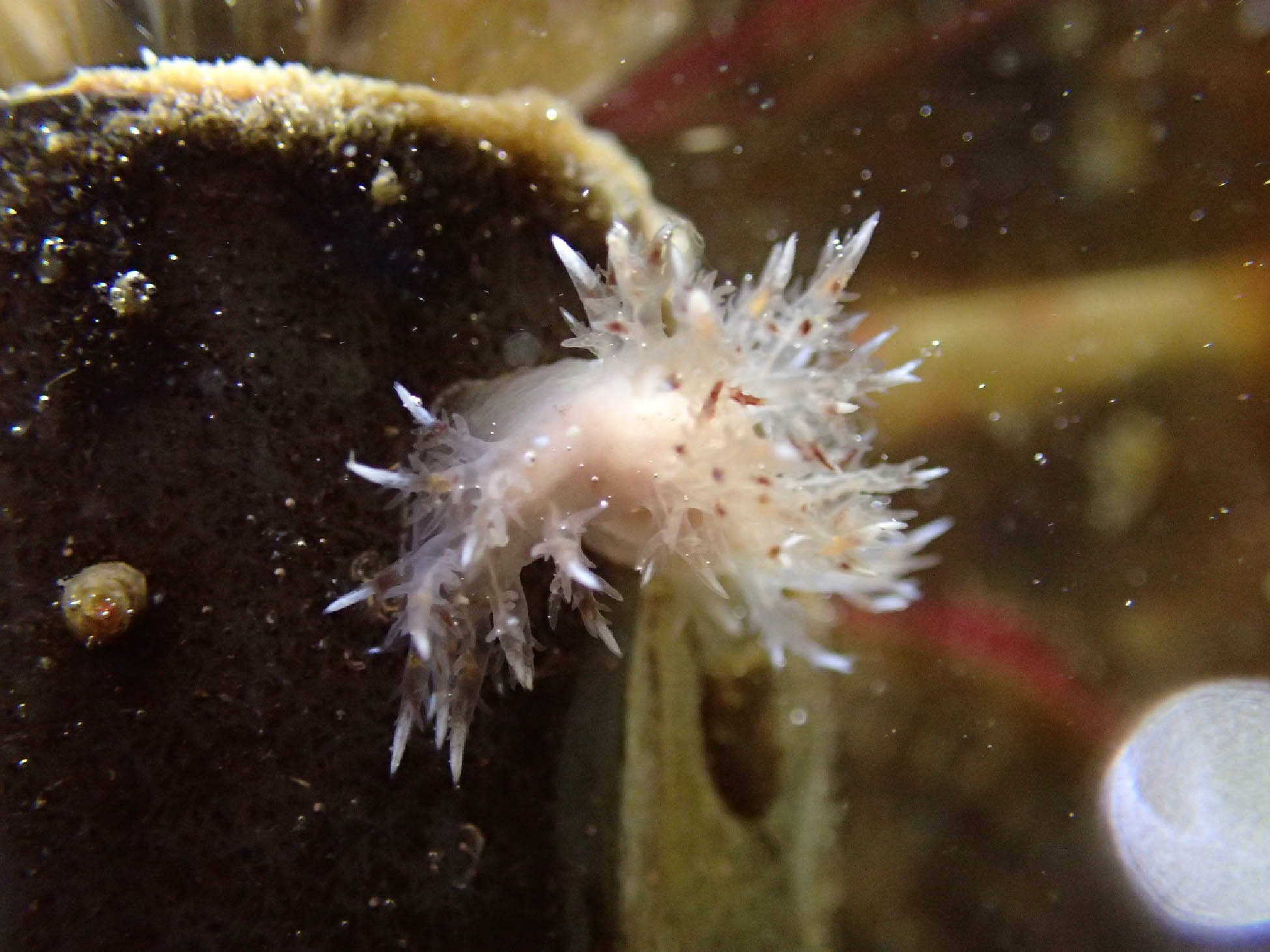
The Dendronotus iris, a species of nudibranch recently found in one of the MaST Aquarium tanks.
 he Nudibranch Team is a citizen science volunteer program at the Marine Science and Technology Center of Highline College. Volunteers work with Aquarium Staff to record populations of nudibranchs (colorful sea slugs). The MaST Center’s 3,000-gallon aquarium is operated on a “flow-through” model where 250 gallons of unfiltered Puget Sound water is pumped every minute through the tanks. This water brings with it several kinds of plankton, which are hard to identify and collect in the open waters of the Puget Sound, but within our tanks can be identified at the species level. Even once they are past their planktonic larval stage, many of the nudibranchs found in our aquarium are less than 1 cm in length!
This system offers the unique opportunity to record abundance of several nudibranch species throughout the year. Citizen scientists on our nudibranch team are trained to identify upwards of twenty nudibranch species, and use flashlights to track them down in our tanks. Why nudibranchs you may ask? They make an excellent species to study because each species is very distinct morphologically. Nudibranchs are the subject of a lot of macrophotography here in the Puget Sound; their bright colors and patterns make them a photogenic group of animals. Many of the animals in our aquarium are collected, but the nudibranchs come in naturally. When we see a nudibranch, it is exciting, because we get to discover them in the tanks! The thrill of not knowing what you are going to see is also a key part of what makes diving so exciting. The Nudibranch Team provides this thrill to non-divers.
The MaST’s Nudibranch Team hosts a diverse crowd with a wide range of abilities. Some are divers who already have a passion for filming nudibranchs, while others are just learning about these sea slugs for the first time. Our team is made up of mother-child duos, music teachers, retirees, and recent college graduates, all with one thing in common: their obsession with these peculiar sea slugs. You don’t need a SCUBA certification to get involved, just an interest in peering into a tank with a flashlight for an hour or two a week. Volunteers start with a 1.5 hour training in which they learn all about nudibranchs and how to identify them, including morphological traits. After the training, they’re given an identification guide, a data collection sheet, and set loose. Of all the MaST’s volunteer programs the Nudibranch Team demands the least amount of training time, it’s what helps make it so efficient.
The program originally started in 2013 when former Education Coordinator Eugene Disney and Manager Rus Higley started noticing certain nudibranchs were in the tanks in greater numbers depending on the time of year. They decided to round up a couple of volunteers to help count nudibranchs. Fast forward five years, and we are starting to see some interesting trends in nudibranch abundance emerge. Certain species are peaking in abundance at certain times of the year.
Of our most common species, each has a distinguished peak in annual abundance. Some tend to have high abundance throughout the year, but dip in the summer. While others peak in the summer months. This is interesting because nudibranchs are indicators of ocean health. If we see a huge spike in populations, something in ecosystem is likely influencing this spike. Since they occur naturally in our aquarium, we can use their abundance as a proxy for nudibranch abundance in the water at Redondo Beach. With the MaST’s four complete years’ of nudibranch population data, we have a strong baseline for tracking population changes. Nudibranch population changes can provide insight into the population health of their food sources: hydroids, sponges, and bryozoans.

We have shared this unique citizen science program at the Western Society of Naturalists Conference in 2017, Salish Sea Ecosystem Conference 2018, and the Northwest Aquatic and Marine Educators Conference this summer! Are you attending the Northwest Aquatic and Marine Educators Conference this summer? Check out our poster Tracking Temporal and Seasonal Changes in Nudibranch Populations from a Small Aquarium presented by the wonderful Vanessa Hunt, an Associate Professor at Central Washington University.
In the next few months, we hope to design a better classification system based on volunteer experience and expertise. This includes updating our identification keys to address species color variation. The ultimate goal for this program is to publish the data, and make it available for public use by others who wish to study invertebrate population trends in the South Puget Sound.
While the MaST is excited to have some quantitative data behind our sea slug populations, the best part of the team is still sharing in the excitement of discovering a new nudibranch –just recently, we found a Dendronotus iris, a beautifully branched nudibranch, mostly white and flecked with orange and purplish-brown. Staff and volunteers flocked to the aquarium to get a closer look at this nudibranch. It has been over a year and a half since the last time this species was spotted in one of our tanks!
The Marine Science and Technology Center is the marine laboratory of Highline College. Committed to increasing ocean literacy through community interaction, personal relations and exploration; the MaST strives to accomplish this through volunteer programs, formal college classes, and k-12 school programs.
###
Author: Elise Pletcher is the Citizen Science and Volunteer Coordinator at the MaST Center in Des Moines WA, where she works alongside volunteers on the Jelly, Nudibranch, Marine Mammal, and Discovery Day volunteer teams.
by editor | Aug 12, 2018 | Learning Theory
Know and Do What We Teach: How many times are we assigned to teach a subject we know little about?
by Jim Martin
CLEARING Special Contributor
 t a riparian ecology training for teachers a few years ago, I met two who epitomize a perennial problem in education in America. One of the teachers was in her third year of teaching, said she had no background in science, was never trained for teaching it, but was assigned to teach all of the 6th grade science in her middle school. The other was a teacher who had been a fisheries biologist for several years, and was now teaching high school science. Two teachers, each of whom is assumed will deliver equally effective, student-empowering curricula in their schools. Who are assumed to be teaching at the same level of experience and expertise. How do we rationalize this? How do we deal with it?
Many teachers who lack confidence in teaching the content they are assigned forces them to simply use and parrot the instructions in teachers’ editions of their assigned curricular materials. If we are simply in the schools to prepare our students for the standards tests they will take, adhering to the status quo may be able to make the attempt; although, to date, this effort has produced no nation-wide positive result. But, if we are in schools to involve and invest our students in authentic and challenging concept-based curriculum, and to deliver our curricula in a way which empowers them as persons, then we all need to comprehend the concepts we teach at a level which makes us comfortable in determining our own ways to deliver our curricula. The only way to do that is to know and do what we teach.
As long as we are able to build a learning environment which involves and invests our students in their learnings and empowers them as persons, their brains will do the work. While there are many reasons posited for the poor performance of US students compared with their global peers, assumptions about student capacity based on demographics ought not to matter, not be a reason for poor performance; the brain is an autonomous learning machine. If we allow it.
Why should I want more than a good set of published curricular materials?
All teachers of empowered students that I’ve observed have a content background strong enough to allow them to design their own curricular deliveries. And their students, regardless of demographics, respond to this in a positive, participating way. I’ve also observed teachers with little or no background in the curricular content and/or grade level they are assigned to teach become exceptional teachers when they receive competent mentoring in their classrooms while they are teaching. Just as with their students, these teachers’ brains became autonomous learning machines when they were allowed to. Our expectations re teachers’ preparation for the content they are assigned to teach is a strong indicator that many of us do not allow that. They are assigned to teach what they are assigned to teach. Beyond that, most receive precious little support in the way of developing professional competence in their assigned content area.
Would we accept a world in which only about half of automobile mechanics have training to repair the motors they work on? Where half of dentists have the training to perform a root canal on their root canal patients? How about only half of surgeons with training for the surgeries they perform? Only half of lawyers with training for the cases they proceed with in the court? Half the baristas with no training for the coffees they produce in the coffee shops where they work? We have, and assume, the right to people who have had effective training for the work they perform. Except for teachers. It’s almost as if there is an assumption that teachers can “just do it.” In fact, I’ve heard this claim. More than once.
So, why are we so complacent about having teachers in classrooms who may be only marginally trained in the content they deliver? Jaime Escalante taught calculus to students at Garfield High School in Los Angeles, where 85 percent of the students were eligible for free or reduced-fee meals, and faculty morale was low (Scientific American, Aug 2011, p. 14: Stand and Deliver). His unpopular, to some, attitude toward his students’ brains’ capacity for learning was displayed in a banner in his classroom which declared, “Calculus does not have to be made easy – It is easy already”. In spite of opposition from the school administration and some faculty to his teaching, more of his students took the AP calculus exam than at all but three other public schools in the nation. Two thirds of his students passed the exam. He possessed a background in calculus which allowed him to develop and execute a very clear demonstration that the brain is an autonomous learning machine when we allow it. And proved it.
In a recent article, Climate confusion among U.S. teachers: Teachers’ knowledge and values can hinder climate education, published in the 12 February 2016 issue of Science magazine, the authors report that fewer than 25% of teachers have the training they need to teach the basics of global warming. This, in spite of the fact that climate change may be the most important challenge that today’s students and their children will face. Why aren’t schools allowed to provide the training their teachers need to become more effective teachers of climate change in their classrooms? A large fraction of the business world does just that. Especially when there is a demonstrated authentic need for it.
What do I need in addition to good curricular materials to better prepare my students for their future?
A suggestion: I submit that we need to work together to develop an effective method to ensure that teachers have access to the training and support they need to teach inquiry-based science in their classrooms. Every day. We don’t think of students as the people who will set our nation’s place among the other nations in the world, but they are. We need more than a small fraction of K-12 students who excel in school. My experience tells me that nearly all students have the capacity to either excel, or do very well in school. Dysfunctional families can certainly hold their children back, and schools have very little influence over what happens at home. But, they ought to have influence over what happens at school. That’s where their power lies.
Schools, can, and do, produce environments in which all of their students can excel, or at the least, do very well. For instance, one school I’ve known for a long time does just that. The Jane Goodall Environmental Middle School (JGEMS), a public charter school in Salem, OR, does that consistently every year. Entering students are selected via a lottery which covers Salem’s demographic spectrum. While the faculty don’t focus on the standards, each year 100% of their students pass the standards exams, 90% or more at the two highest levels. Oddly enough, all of their teachers have strong backgrounds in the content they teach.
In many of these cases, teachers have engaged in summer workshops and institutes which deliver hands-on experience in doing science inquiries they have conceived, designed, and executed in natural environments, and using those experiences to develop in-depth content knowledge of the subject of their inquiries. This is a context in which regional environmental educators and experienced teachers can collaborate to plan and execute workshops and institutes which can provide the training and support to produce classrooms which are facilitated by teachers who are experienced in science inquiry and have deep knowledge of the content they teach. And which deliver students who are involved and invested in their educations; and empowered as persons. A strong content and process background gives teachers the confidence it takes to deliver a student-centered, active-learning based curriculum. Something we all need to learn to do. Well.
How can you help?
 This is a regular feature by CLEARING “master teacher” Jim Martin that explores how environmental educators can help classroom teachers get away from the pressure to teach to the standardized tests, and how teachers can gain the confidence to go into the world outside of their classrooms for a substantial piece of their curricula. See the other installments here, or search Categories for “Jim Martin.”

