by editor | Apr 21, 2015 | Outstanding Programs in EE
Brightwater: An Opportunity for Connection
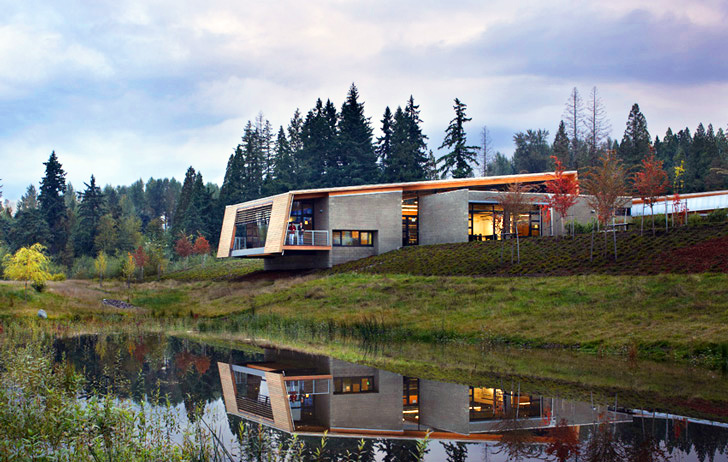
The treatment facility employs state-of-the-art technology for a cleaner effluent and odorless operation.
by Cynthia Thomashow
 he Metro bus opens its doors, releasing 40 fourth-graders who have ridden an hour from South Seattle to the Brightwater Water Treatment Center in Woodinville, Washington. “We’re in the wilderness!” squeals one of the young boys. To his credit, the landscape is very different from his urban schoolyard. But, just 20 years ago Brightwater was an industrial site, housing an old soup factory and a scrap-metal heap. Now it is home to a state-of- the-art water treatment center, flourishing wetlands, a LEED Platinum environmental education center, and 40+ acres of woods and fields crisscrossed by trails and abundant wildlife.
In 2011, IslandWood, an environmental education center on Bainbridge Island, Washington, won the contract to provide educational programming at Brightwater in partnership with Seattle Public Utilities to a mostly urban population. The Center is a laboratory and gathering place filled with interpretive displays that creatively connect water quality, engineered waste treatment processes, and the health of the Puget Sound to everyday life choices. IslandWood educators use this site to deliver field-study approaches that enhance science curriculum in the King County schools. Woven into every lesson is relevance of the field-based learning to the home environment of the urban students.
 Over 4,000 students come through the doors of Brightwater each year to study Freshwater Ecosystems, Land Forms and Humans in the Water Cycle with IslandWood educators. Sparked by the question, “Which pond at Brightwater has more types of water bugs, Storm Pond (an untreated storm water runoff catchment) or Otter Pond (a pond fed by a stream originating in the watershed above the treatment plant)?” Students may spend half the day mucking through wetlands, climbing hilly fields, and dipping their nets into containment ponds to collect macro-invertebrates. Student make observations and predictions about freshwater ecosystems in the field, collect specimens, tabulate data using microscopes in the lab and discuss their results together.
Another key question, “What happens when we ‘borrow’ water from the water cycle in our homes, schools and businesses?” begins the study of how humans participate in the water cycle every time they turn on their tap, run the dishwasher or go to the bathroom. During the Humans and the Water Cycle program, students experience the treatment process first-hand, discuss water issues in an interactive exhibit hall, and participate in a hands-on lab focusing on three different water-related STEM careers.
An ongoing professional development challenge for staff is to connect the field experiences to the actual neighborhoods where students live. The goal of IslandWood’s Brightwater Team is to ‘urbanize’ their signature field-based approach of getting kids outdoors to the urban settings where students live. Once a month, staff delve into the assumptions that define our goals around environmental education, considering equity issues, environmental justice and cultural competency as it relates to educational approaches. Every time a new group of students arrives at Brightwater, a conceptual shift moves the educators closer to relevant and meaningful engagement with the young urban leaders of tomorrow’s world.
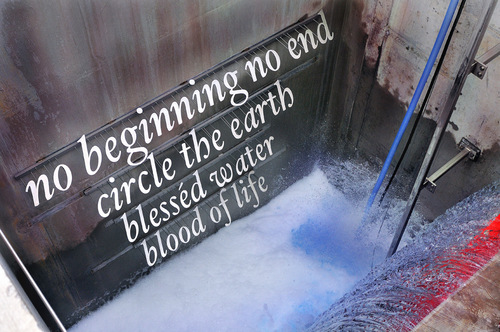
An installation by artist Jane Tsong illustrates the treatment process to visitors through poetry, and “blesses” the water before it is released.
(Photo credit: Juan Hernandez.)

by editor | Apr 21, 2015 | Conservation & Sustainability, Environmental Literacy, Learning Theory
Although this article was written in 1996, and contains references to events and people from that era, much of Weilbacher’s critique remains relevant today. -Ed.
 Every Day is NOT Earth Day
Reflections on the True Meaning of Earth Day
by Mike Weilbacher
 ‘ll admit it up front: I’m a sucker for Earth Day. I’m a child of the first Earth Day in 1970, for its tidal wave of publicity captivated my teenage attention and launched my career. My wife and I met planning Philadelphia’s Earth Day ’90 extravaganza – her parade met my outdoor stage, and the rest was history. Today, my workplace’s largest education program has become Philly’s longest running Earth Day event.
So few things annoy me more than the standard environmental knee-jerk position on Earth Day. You know it well, and have probably recited it like some Zen mantra: every day is Earth Day; make every day Earth Day.
As usual, we got it all wrong.
Because the environmental movement began as a countercultural phenomenon, we simply can’t stand our own successes, and continually sabotage our greatest gains. Like Earth Day.
Just think of what’s happened. Millions of kids across the planet are gearing up for some celebration of the day, perhaps a tree planting, a litter clean-up, a bad assembly featuring some whining folksinger (“Please save the rainforest, boys and girls, and when you’re done, please save every large endangered mammal”), or a recycled art contest, where eminently recyclable objects like cans and egg cartons are irrevocably glued to each other and turned into wholly non-recyclable monstrosities that are trashed after the event is over (and we’re teaching what here?).
OK, bad examples, but what it means is so startlingly simple it has flown way over our still-shaggy heads. Earth Day has arrived; it has planted a taproot in the mainstream of American pop culture, and like it or not, there it will stay, and grow, and blossom…
…Into a new intemational holiday that will one day rival Christmas in its scope. I’m dead serious. Signs of this were first revealed during the extraordinary event that was Earth Day’90. While the first Earth Day was an exclusively American college-oriented teach-in, Earth Day ’90 graduated into a global festival of more than 100 million people in more than 100 countries gathering to, in some cases, perform quite meaningful work: restore rivers, save species, reclaim battered landscapes. Earth Day ’90 was, barring world wars or Michael Jackson concerts, the largest mass event in world history.
Today, the sound of the holiday embedding itself in our cultural psyche can be heard everywhere. In schools: Earth Day has become a part of many school curricula; kids are growing up knowing that Earth Day is April 22nd, and doing something relevant on or near that day. In politics: every April 22nd, President Clinton – with Vice President Green, I mean, Gore, at his side – hosts a press conference to announce another underwhelming eco-initiative. On TV: every April, there’s a round of cheesy Earth Day specials featuring forgettable stars like Bob Saget performing amazing feats like installing toilet dams in their home bathrooms (that really happened a few years back.) On radio: Rush Limbaugh will likely repeat his tired tirade that the day reflects the true deep green plot against society, for April 22nd is also Lenin’s birthday – proof that environmentalism is a Communist plot! (Memo to Rush: April 22nd was chosen because it was the only spring Saturday Senator Gaylord Nelson had free in 1970, and no environmentalist I’ve ever met in 27 years of Earth Days ever knew when Lenin was born.
You’ll hear it in newspaper editorials and worldwide web pages; in store ads and nature center events; in zoos and museums; on T-shirts and coffee mugs.
Love it or hate it, you gotta admit it: Earth Day is here to stay.
And Earth Day will only grow in scope because environmental issues are not going to go away. Quite the contrary. With Pinatubo’s ash finally settling out, with atmospheric carbon dioxide concentrations on the rise, the global warming debate will likely warm up quite dramatically in the next few years. The biodiversity conflict is only starting to gain any intensity at all – here’s one issue guaranteed to explode as soon as a large, charismatic mammal vanishes, like the black rhino or mountain gorilla, both threatened by Africa’s political instability. And we have never properly confronted the population issue – we likely will when the next famine arrives.
On top of this, the nascent Earth Day holiday will receive a huge jolt in the year 2000. New millennium. The thirtieth anniversary. That year’s Earth Day will be a humbling event.
Sure, the “make every day Earth Day” sentiment has its place. Mostly, it serves as a reminder that the values and ethics we hold important must be cultivated daily if they will thrive. And it should remind schools of the danger of pigeonholing the ecology unit into a one-day or one-week project. Certainly, state educational mandates for ecological/environmental understandings must never be met from a one-day event, and too many schools rely on this one day to complete its environmental education requirements.
Speaking of schools, Earth Day brings out the worst in too many teacher, and too many outside educational agencies, from corporations to utilities to non-profit. There are too many lame Earth Day poster contests, where kids are asked to draw a colorful poster with an Earth Day theme. So it’s education as fascist slogan: “Don’t Pollute!” “Love the Earth!” “Reduce! Reuse! Recycle!” Relax already. We still labor under the horribly misguided notion that if we command kids’ knees to jerk in the proper direction, their heads will follow. Wrong, so wrong. Sloganeering is not educational in any sense whatsoever, teaches no information at all, and only confirms our kids’ worst fears about the state of the Earth: The Earth must be dying because the posters say so. Environmental education must be uplifting, never down- grading, and never be reduced to a bumper-sticker answer to a lapel-pin question.
Still, wading through all the flotsam and jetsam floating around Earth Day, there is a nugget of truth, a seed of change that we must hold onto tightly.
We need holidays. Better yet, we need holidays with meaning. Christmas resonates with so many people – even people who are barely Christian the rest of the year – because it speaks to a set of values we all want so desperately to believe, like the triumph of Light over Dark. The Fourth of July is centered on freedom, independence, and the meaning of America. Martin Luther King Day, I hope, will evolve to take on transcendent relevance around issues of equality, nonviolence, change and the need for multicultural connections.
Sadly, Memorial Day, Labor Day and President’s Day have lost so much of their original meaning, and exist only as three-day holidays for overworking people. Our culture may be seeking new holidays with new meanings for a new millennium, and the beauty of Earth Day is that it emerges as the only secular holiday the entire world will celebrate simultaneously. Earth Day will become just that, the “Earth’s day,” a holiday where people pause to consider what it means to be a planetary citizen, and reflect on how well we shared limited resources with so many other species.
My eldest daughter will be a graduate of the Class of 2010. I’ll wager that during her school career, she’ll have a day off from school for Earth Day. Banks will close. Governments shut down. Stores hold Earth Day sales. Greenpeace’s executive director will write an op-ed piece in the New York Times begging us to “put the ‘Earth’ back in Earth Day.”
And I’ll be on some stage somewhere hosting an Earth Day festival, living every minute of it all.
So remember: every day is NOT Earth Day. Once a year is fine. Happy Earth Day.
At the time this was written, Mike Weilbacher was executive director of the Lower Merion Conservancy, sponsor of the Children’s Earth Day Forest, an event featuring an indoor life-size recreation of a Pennsylvania forest hand-crafted by local schoolchildren.
by editor | Apr 16, 2015 | Equity and Inclusion
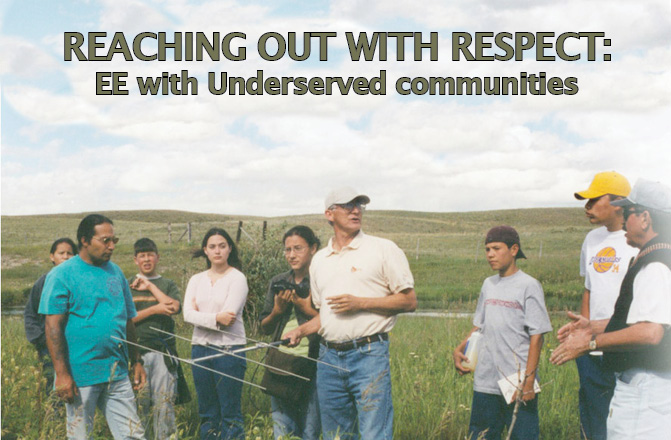
Reaching out with Respect: Environmental Education with Underserved Communities
Thinking about environmental education and underserved communities is an opportunity to challenge our assumptions about nature, culture and science, and, our assumptions about the life experiences of people of different backgrounds and cultures.
.
by Bonnie Sachetello-Sawyer and Shamu Fenyvesi
(from The Best of CLEARING)
Read article here.

by editor | Mar 26, 2015 | Questioning strategies
Is Science Communication? Can students, moving around and talking, do science?

by Jim Martin
CLEARING Associate Editor
You’re trying to answer a question. Student work groups have designed their own investigations to understand the question, develop inquiries to investigate what they have found and thought about, then present their findings to the other work groups in a symposium. There are many processes going on here. Let’s look at a few as they engage them to see what emerges in addition to discovering and testing possible answers to the original question.
Start small. In groups, you help students learn to communicate effectively. How to say, “Here’s what I think, and why;” and to listen and respond when other group members do the same. This is very basic to developing effective work groups. You have them keep notes on these conversations, and use them to elicit concepts, plan work, etc. (Basic, but essential. They need to know why they think what they do, and make what they think and why clear to others. And to learn to be advised or informed by others in their group.)
When your groups are communicating effectively, you observe for outcomes of their collaborative discussions. Do they understand their data, its patterns, its shape in graphs, etc. Are they showing signs of being able to relate data patterns to their question: Is it answered? What is the convincing evidence? What if the evidence doesn’t support their guesses about the answer to question? Or, does their question itself come into question? Are they becoming less mechanical and more purposeful in their work?
Further questions can move the groups along the learning curve by developing their critical thinking capacities: Are their interpretations of data supported by evidence? How confident are they of their data? Can they explain or justify data interpretations they have made, and their validity? What do their interpretations say about possible next steps?
You can continue to build on this conceptual foundation, each step easier because the foundation is becoming broad and more stable. You have them assess the design of their investigation and interpretations of data: How certain are they that they got the right data and used the best techniques of data acquisition? How certain are they that their data do, in fact, tell them what they need to know? Has their knowledge and expertise increased during this process? How much do they really know? Questions like these will tend to focus their thoughts on how they are learning and doing. Metacognition. Students who know how to learn know how to learn. Communication within effective work groups helps generate this capacity.
When they are ready, you have the groups report in a symposium. This is where their communication skills will be called upon to build conceptual understandings. How familiar are they with their evidence and its interpretation? How well do they comprehend other groups’ data and interpretations? How well do they generalize what they’ve learned and developed about collaborative communication within their work groups? Do they move it outward to carry on effective discussion with all of the work groups in the class? When an entire class develops the capacity to engage in substantive conversation about what they are learning, they’ll learn and nail down more than you could ever teach them using the publishers’ prepared materials and recommendations in the Teachers’ Editions.
Learning about science, but not doing science, does not develop the capacities described here. By only collecting and reporting data, students don’t engage the critical thinking capacities of their brain. I’ve observed science classes in which students looked up the boiling point of a liquid, say water, boiled the liquid and noted that it did boil at that temperature. What do they communicate amongst themselves? Is communication actually involved here? Or, are they simply engaging a perfunctory ritual? Might they have learned more if they had heated 3 or 4 liquids, noted their boiling points (or figured out how they’d know the boiling points, then test that), then looked up boiling points and made a guess about what their liquids were?)
Nor do they develop their capacity for conceptual learning when they simply learn about science, and commit science facts to memory. When students do engage in self-directed inquiries, examine the relevance of their collected data, critique it and the process of collecting it, and formulate interpretations they agree upon, they become involved and invested in the work, and empowered as persons. Engaging life. Engaged students are learning students. What our schools need today.
There’s not a lot of information out there on how to engage this part of teaching. There should be. This kind of work supports critical thinking, so it is of value. Critical thinking uses a part of the cortex that is especially well-organized for conceptual learning. That’s the prefrontal cortex, where relevant information from associative memories throughout the brain are brought together in working memory to nail down this new learning, then send it back out to associative memory; not as a fact to memorize for a test then forget, but as something more akin to common sense – something integrated into associative memory that you ‘just know.’
This critical thinking system turns on when you ask a question that is meaningful to you, and seek an answer to it. Science inquiry is a perfect complement and extension of this cortical learning system. In contrast, learning simply to prepare for a test won’t, of itself, entrain critical thinking. Instead, because of its aversive nature, learning content in order to answer test questions is accompanied by some level of anxiety, and entrains the limbic system, which isn’t good at engaging critical thinking. At least in this context, learning facilitated by anxiety about passing a test.
As the Common Core State Standards (CCSS) and Next Generation Science Standards (NGSS) continue to influence teachers’ and students’ experience in school, they present some level of anxiety to many, whether from an unfamiliar expectation for performance, change from structured, curriculum-directed teaching and learning to a more open-ended, active learning model, or from increased paperwork and accounting with no accommodating increase in free time for such work. Anxiety is processed through the limbic system, which impacts how the brain learns; which of its resources are freed for the task. As student and teacher stress levels increase, it becomes increasingly difficult to engage critical thinking. Instead, the limbic system, busy processing anxiety, increasingly limits communication with the prefrontal cortex, where critical thinking does its work. Instead, learning is limited to simple thoughts, which remain connected solely to the need to pass questions on a test, with little or no integration into associative memory, as occurs in critical thinking.
On the other hand, when students and teachers are free to explore new learnings (which the CCSS and NGSS seem to be interested in), to ask questions and seek answers to them, the limbic system supports this work with a heightened sense of pleasure and excitement, and feelings of well-being and inquisitiveness. And by assuring the doors to the prefrontal cortex are open.The different limbic involvements in learning are entrained by the properties of the learning environment. As they were when our brain evolved in the savannah during the Pleistocene. Might we use that history to revisit how we teach? How we organize student-student interactions while they learn? In the classroom and on-site in the natural world? In these cases, the limbic supports the work of the cortex, especially the prefrontal cortex, where working memory resides, and the brain’s conscious executive functions do their work. Work in which goals direct effort, reasoning and abstract thought are supported, and critical thinking takes place. Where we actively construct knowledge and commit it to long-term associative memory; ask questions, design investigations, develop needs-to-know which drive us into the information we seek, desire to complete and communicate our work.
When we are driven only by anxiety about not being able to answer questions on tests, this wonderful part of our brain is lost to us. The limbic system limits its use, and we simply memorize disconnected bits of information long enough to use them on a test, then forget. Are we teaching for fight or flight, or for higher-order critical thinking?
Used knowledgably, communication as practiced in doing science has the capacity to produce a foundation for critical thinking. By the information it generates, the testing of the information, and its processing and communication, it involves and invests students in critical thinking; in using their prefrontal cortex, its executive and working memory functions. The key feature is that the students, not the teacher, are involved in constructing knowledge. The teacher, while responsible for producing an environment where a constructivist approach to learning will probably happen, becomes a facilitator of their work. A difficult transition for many of us to make. I went into it willingly, but once committed, sorely missed lecturing and wowing students with the wondrous things I could show them in the lab. In spite of this, when I would pull out my old lesson plans, it would be immediately clear to me that this constructivist model was much, much more effective and empowering. And I eventually discovered this was because it used those sites and connections in the brain which were organized to engage conceptual learning. Something my pre-service and graduate education in teaching never addressed. It should have. Had it, and we learned as our brain is organized to learn, we just might have learned well.
Communication, when it is substantive, has the capacity to facilitate critical thinking. It does this by requiring us to consider what we are saying and doing, which is a readily useable road to the prefrontal cortex and working memory. Sort of like working in a shared workspace, a place with all the resources and facilities you need to focus on what you are learning, and the executive capacity to follow up on what you have learned.
 This is a regular feature by CLEARING “master teacher” Jim Martin that explores how environmental educators can help classroom teachers get away from the pressure to teach to the standardized tests,and how teachers can gain the confidence to go into the world outside of their classrooms for a substantial piece of their curricula. See the other installments here, or search Categories for “Jim Martin.”

by editor | Mar 25, 2015 | Conservation & Sustainability, Environmental Literacy
Creating the Need to Pay Attention
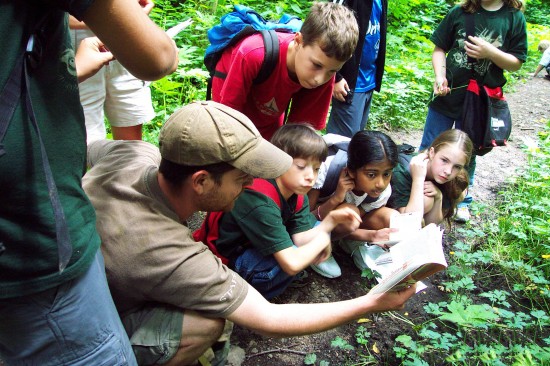
Field trips and adventures in the woods are tremendously important experiences for children, especially those students that don’t often get to spend time in a natural setting. Some of the most important, lasting results of good Environmental Education are the heartfelt connections that young people make with nature. They value the natural world because they have experienced first hand the beauty and magic of living ecological systems. To really feel this in a personal way, the kids have to go outside and experience it.
by Chris Laliberte
 he excitement of exploring outside with friends and classmates can turn a well behaved class into a pretty raucous crowd, and in all the commotion, it’s very easy for students to pay more attention to each other than to the woods around them. And while they might huddle up at each interpretive spot for a brief lesson or activity, what teacher or educator could possibly be there with each student for the whole walk, helping them learn from each moment as they explore the landscape with all their senses? The trick to making the entire outing an intense learning experience is to find ways to ensure that the students are invested in paying close attention the whole time.
“Tree Tag” is the classic example of creating a need to pay attention. Kids love to play tag, and they NEED a base, some place to avoid the tagger. So when base is whatever kind of tree the teacher calls out, the kids suddenly have a very real need to be able to identify trees correctly, so they can get to base. I love to watch what happens when kids disagree about correctly identifying trees, and they have to prove to each other what kind of tree it is. Tree Tag, however, illustrates a deeper point around creating need. A game of tag is a boisterous, wild, hectic thing. But remarkably, within this game is a fantastic heightening of awareness. The danger, the risk of being tagged, or the need to tag someone, is visceral. It creates physical and chemical responses in the body that affect awareness and the learning process. Adrenalated states provide a powerful opportunity for learning. Notice that this suggests an interesting point: in Tree Tag, the key dynamic for learning is the creation of a certain amount of anxiety, or a state of discomfort. This creates a very strong need to pay attention, and then the game focuses the heightened awareness onto something very detailed and specific — in this case, the differences in bark, leaf, branching pattern and color of different trees. By paying careful attention, the student can resolve the anxiety and get to someplace “safe.”
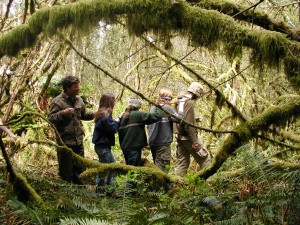 It’s a testament to the power of the adrenalated state that, more often than not, kids will leave base and venture back out into the fray on their own for another dose. Of course, some students will be reluctant to leave base, so the teacher can keep the game active by announcing that base is now a different kind of tree, and it starts again: more adrenaline, more awareness, more attention to details of different kinds of trees, more good learning about nature.
So how can this dynamic be harnessed so that it is present throughout the whole field trip? Here’s one method that has proved enormously powerful at Wilderness Awareness School. It’s called “Bird Language.”
The basic principle behind Bird Language is that birds love to gossip. They are constantly announcing to each other and the world around them just how they are feeling about their lives at that moment. It’s almost like a town crier who likes the job so much that s/he uses any excuse to make another public announcement. “The forest is calm and happy!” “The forest is still calm and happy!” But what birds love to talk about most of all is danger and peril. Anything that might possibly be a threat is immediately announced and pointed out. Jim Corbett, a famous tracker from India, once mentioned how puzzled he was that anyone could ever get eaten by a tiger. The birds and monkeys are so loud and aggressive in announcing the presence of any tiger, and even following along above it in the treetops, screaming out their warnings, that it seemed inconceivable to him that anyone could be taken unaware by a tiger in the jungle. By coming to understand Bird Language, students can learn to recognize all the movement and activity going on in the forest around them. They’ll know when raptors or other predators are moving through, or when animals like deer or raccoons are sneaking away.
Using Bird Language with your students starts with creating the need to pay attention to what the birds are saying. For some younger students, the possibility of seeing fairies or unicorns works wonders at getting them to listen for the announcements of the birds. This is especially good if students are already uncomfortable with being outside in the woods and need a little assurance. Our favorite strategy at Wilderness Awareness School is to set up the day so that students are hiking or exploring in small groups, and might at any time be ambushed by another group sneaking up on them. If you don’t have the ability to set up the ambush dynamic, or if the group is older and more callous to the woods, the classic anxiety here in the Pacific Northwest is the threat of the cougar. Wilderness Awareness School is very careful in using this particular set-up for bird language. We let students know that cougars are sneaky but cowardly hunters, who like to attack unseen and avoid a fight or struggle. To really help students feel the anxiety in a visceral way (like the threat of being tagged), you can describe the nerve endings in the canine teeth of the cougar that help it to feel just where to bite on your neck to cleanly sever the spinal column like scissors through a banana . Now, we are careful to point out that cougars don’t normally attack people. But they sometimes can’t help themselves when a really loud, obviously unaware, small, tasty looking person hurries by without paying any attention to the woods at all. But if you notice a cougar, and make yourself look tough, maybe yell at it, then the cougar won’t bother you. They’re really pretty timid once they’ve been found out.
Regardless of what strategy you use to create a need to pay attention, listening to Bird Language can provide the focus for your students’ heightened awareness, and will allow them to resolve their tension and anxiety appropriately. For if they are listening carefully to Bird Language, no cougar or group of kids will be able to sneak up on them without alarming the birds and giving itself away. Really accurate interpretation is a fine art, and requires a lot of practice sitting outside and investigating bird alarms, but mastery is not required for Bird Language to be a remarkably effective learning tool. Here are the basic details your students will need to know to be able to get started successfully:
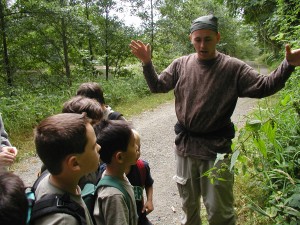 Bird Language: A Quick Summary
Pay closest attention to the small ground-feeding birds: Robins, Sparrows, Juncos, Wrens, Towhees, etc. They are the best sentries.
Learn to distinguish the Five Voices of the Birds. The first four Baseline Voices indicate that the forest is relatively comfortable, and therefore “in baseline.” The last voice, the alarm, indicates a threat, usually a predator, often a human.
1. The Song: Birds singing their characteristic celebration, they are often loud but the feeling is very comfortable.
2. Companion Calling: Birds in pairs or groups call back and forth to each other regularly, either with their voice or with body movements, just to let each other know that they are alright. Usually this is soft, quiet language. It can occasionally sound scolding if one bird gets out of sight from another and fails to respond quickly enough.
3. Juvenile Begging: Young hatchlings can make quite a racket demanding to be fed. This repetitive whining may sound obnoxious, but don’t mistake it for distress.
4. Territorial Aggression: Generally made by males, this is loud, aggressive language that can sound like alarms, but you’ll notice that it doesn’t bother other birds (females, or birds of other species).
5. The Alarm is dramatically different from the four baseline voices. While the baseline voices sound like someone happily whistling, the alarm sounds like someone yelling for help. Different species sound different, but they all sound terribly upset, worried and nervous, and you’ll find yourself feeling that way too, when you open yourself up to really listening receptively to birds.
Watch the body language of alarming birds:
1. Where does it go when it alarms?
Does it fly up higher into the branches, or down low to the ground? Ground-feeding birds are typically brown, so they like to be down low where they are camouflaged and hidden. The only reason they fly UP is if there’s a threat on the ground. They will fly just high enough to avoid the danger, so how high up they fly is a good indicator of how high the danger can reach. If they go down, it’s because they’ll be safer down low in the thick brush, so it’s either a raptor or a threat that can’t get into the bushes (like a human).
2. Does the bird fly up and then look back to where it came from as it alarms?
If so, it was scared out of its place by something close by on the ground. Does it fly up and look forward, or out and around? If so, it was probably startled by a sound or another bird’s alarm and it is looking for the danger. It usually looks towards the source of the alarm (remember, these birds often look sideways).
3. Does it just fly madly away alarming as it goes? If so, it has been “plowed” out of the area, quite likely by a human.
Those are the very basics of Bird Language; however, the most important aspect of all is the “Secret Lesson” that you don’t even talk about. By attending to bird alarms, students soon realize that they themselves are disturbing the “baseline” of the forest. One of the old sayings from Kenya that young kids heard constantly was “Never disturb a singing bird.” Once they notice that they are scaring all the birds away, they begin to work at not alarming birds, and the transformation that this causes is remarkable. Once oblivious, boisterous and unconnected kids turn into quiet, observant, and respectful participants in the ecological community. Listening to birds now becomes a fabulous tool to encourage heightened awareness and a phenomenal source for amazing close encounters with animals that they want to see, like elk, deer, foxes, and raccoons, because now the birds aren’t warning these animals of the approaching students five minutes before they arrive.
In Wilderness Awareness School’s experience, Bird Language works best initially as the focal point for new students who have been “set up” to pay attention by the cultivation of a state of discomfort, and quite literally gives students the awareness they need to be safe, aware and feel comfortable in the woods. Remember, it will take some time to establish this as a routine for your students. They’ll need plenty of reminders early on. The most effective one is simply “Ssshhh! What was that? Did you hear that alarm?” Above all, have fun with it! You’ll be amazed at the transformation Bird Language can work in your students if you just stick with it.
Chris Laliberte is the Program Director for Wilderness Awareness School, a national not-for-profit environmental education organization based in Duvall, WA which is “dedicated to caring for the earth and our children by fostering appreciation and understanding of nature, community and self,” on the web at http://www.WildernessAwareness.org
Resources for Bird Language Study
Audio:
The Language of the Birds and Advanced Bird Language: Reading the Concentric Rings of Nature, beginning and advanced audio series by Jon Young. Available at http://www.WildernessAwareness.org
Backyard Bird Walk and Marshland Bird Walk, and other recordings by Lang Elliott. Available at http://www.naturesound.com
Books:
Kamana One: Exploring Natural Mysteries, by Jon Young, part one of Wilderness Awareness School’s four-level independent study Kamana Naturalist Training Program. Includes bird language, tracking, wilderness living skills, traditional herbalism, and naturalist mentoring. Available at http://www.WildernessAwareness.org
Jungle Lore, by Jim Corbett. A powerful narrative from the Indian jungle which includes Bird Language lore.
Bird Tracks and Sign: A Guide to North American Species, a unique new resource for studying birds by Mark Elbroch , Eleanor Marks, and Diane C. Boreto.
A Guide to Bird Behavior, Vols. I,II, and III, by Donald and Lillian Stokes.
Peterson Field Guides: Western Birds, by Roger Tory Peterson.
Other:
A Birds World, permanent exhibit on Bird Language at the Boston Museum of Science. http://www.mos.org

 Over 4,000 students come through the doors of Brightwater each year to study Freshwater Ecosystems, Land Forms and Humans in the Water Cycle with IslandWood educators. Sparked by the question, “Which pond at Brightwater has more types of water bugs, Storm Pond (an untreated storm water runoff catchment) or Otter Pond (a pond fed by a stream originating in the watershed above the treatment plant)?” Students may spend half the day mucking through wetlands, climbing hilly fields, and dipping their nets into containment ponds to collect macro-invertebrates. Student make observations and predictions about freshwater ecosystems in the field, collect specimens, tabulate data using microscopes in the lab and discuss their results together.


