by editor | May 26, 2015 | Questioning strategies, Teaching Science
Can I become a science inquiry facilitator? . . . If I’ve never been one?
by Jim Martin
What do I need to be competent in, comfortable with, being a facilitator instead of a top-down teacher? I think a first thing is the recognition that people can learn on their own; that they don’t need to hear me say every single thing that I want them to know. To be free to allow that, facilitators have to be comfortable with their understandings of the content they are delivering. And, they need to be comfortable developing effective work groups. Actually, I can think of a bazillion things, but these three are, so I currently believe, essential to making the transition.
If the Common Core State Standards (CCSS) and New Generation Science Standards (NGSS) are going to become more than simply another swing of the pendulum that arcs through the schools with predictive regularity, then teachers need to rally to support and develop those pieces of these initiatives which are directly targeted at the deficiencies in our teaching. Deficiencies which have landed us in a mediocre position in the educational statistics describing achievement on the globe. We’re the only ones who can do it.
Both the CCSS and NGSS initiatives profess to be based on a constructivist, active learning model of teaching and learning. This, to me, is wonderful news. Our brain is admirably organized to learn by actively constructing conceptual schemata, conceptual learnings. It does this best by asking questions of the real world. This means that teachers aren’t , of necessity, people who put learning into other people’s brains; rather, they are people who can organize their teaching environments to draw out the learning potential which resides in their students’ brains. They facilitate those brains to enter a conceptual space, engage and discuss what is there, and find out as much as they can about it. Like the little robotic vacuum cleaners, when, once their switch is turned on, clean up all the dust and litter in the room. All by themselves, with no one directing them. Once you turn on a brain, it doesn’t turn off. Unless it loses its freedom to work.
I’ve observed this dichotomy of teaching practices as long as I have taught, and been a student. Didactic, teacher-centered practices, and constructivist, student-centered practices: Is it a matter of personality, or of comfort with the content and methods being used to teach it? That makes a teacher prefer one or another? I’ve had (and observed) teachers who told me what to learn and how to learn it, then tested me on the results. Twice, in high school, I had teachers who threw out an idea, then sat back as I tried to find out more about it. I remember what I learned by finding out 60 years later. And the excitement of the learning. I carry no specific memories of learnings from the rest, except for things which personally interested me, like diagramming sentences. Which, odd it may seem, I loved to do.
The didactic teacher I had from fifth through eighth grades was the kind who told me what to learn and how to learn it all the way to the last days of eighth grade. Then, she started us on the way to pre-algebra by saying, “You don’t have to learn this. Just see if you can follow the argument.” Then, she wrote on the board the first algebraic expression I’d ever seen, a + 2 = 6. I looked at that for awhile and thought, “Wow! You can use letters to stand for anything! You could learn about anything with that!” A mind, at last free to explore.
For that brief moment, my stern, demanding teacher had become a facilitator. All by herself. That was 1952. Had her stern and demanding exterior reflected a lack of comfort with the content she was teaching and the methods used to deliver it; or, was her exterior reflecting the personality within? I can’t answer that question, but the obvious interest and enthusiasm she brought to the introduction to equations suggest she may not have actually been a stern and demanding person. It seems almost, from hindsight, relief to be free to teach as she thought she ought that I observed those very few days at the end of eighth grade. Today, more teachers have experienced being facilitators, but many have not. What would you need to become one? How can you find out?
At this point, I should leave you to find out; but, I’ll barge ahead with my own ideas, just as any didactic teacher would. Hoping all along that you’ll adopt a constructivist approach to the subject. That said, let’s start with my offering of three things a person who is a facilitator must have encountered and successfully engaged.
The first is probably the most difficult for a teacher to entertain – recognizing that people can learn on their own. When I first experienced this, I was in my first year teaching below college, in a 7th grade self-contained classroom. I didn’t know it at the time, but I had begun employing a constructivist teaching paradigm. It was hard, exciting work, yet I always felt the anxiety-producing peer pressure from colleagues whose view of school was students sitting in rows doing quiet seat work. Luckily, I had a very supportive principal, who encouraged what I was doing. And I applied what I had so far learned from raising my own children, that they do best when they are following up on choices they have made, which I had offered them, and which were within the limits I knew were workable.
So, what did I learn about using constructivist vehicles for delivering 7th grade curricula? About whether and how students can learn on their own? One, that this worked. At least, for me. They had two and a half hours each morning for language arts. During that tiem, they scheduled and worked on open-ended (but contained) writing and reading assignments. We also used speech and drama to engage active learning. (I didn’t know that’s what it is called; I simply knew it worked.) For instance, while working in groups to write and deliver one-act plays to elementary classes, they also learned the current language arts curriculum I had to deliver. Students became involved and invested in their work, and I noticed they also seemed empowered as persons. These were outcomes of the work; I wanted to know how this involvement and investment in their educations came to be. And that started my lengthy, often-interrupted journey into the human brain. A long stretch for me, with my background in intertidal marine invertebrate communities!
How would a constructivist science-inquiry delivery look in an actual classroom in two very different activities? The first is a microscope activity, where students observe for the stages of mitosis in plant cells. The second is a field activity, where students observe the effects of streamside vegetation on the temperature and dissolved oxygen content of the water adjacent to it.
When you employ a constructivist paradigm to organize the delivery of your curriculum, the students’ job is to construct the concepts you hope they’ll acquire by examining the pieces of the concept they are acquiring. Instead of you telling them the concept, they learn its essential parts by engaging them, and then use these parts to tell themselves the concept. A different way to teach; but effective. The first few attempts call for courage and confidence on the part of the teacher. And, in time, the patience to take the time to allow the learning to happen.
How does this play out? In the mitosis activity, you might start by projecting a slide of plant tissue containing cells whose chromosomes have been stained; the usual root cells most of us have observed. You have students pair up to do two things: Locate as many chromosomal configurations as they can and draw them. Or, if you know your students well, ask them to find out if there is any underlying order in the mish-mash of chromosomal configurations they see. This done, they are to organize their drawings in the order they think they occur during the progress of cell division. If you’re truly brave, you might ask them to find and draw other cellular evidence to support your placements. That done, they can present their findings, then go to the books and internet to find what other scientists have found about cell division. They will learn as much, or more, than you would have taught them. And moved further on the road to becoming life-long learners; explorers of the world they live in.
In the streamside activity, you ask each group to take a reach along the stream, then find out the effect of the vegetation on temperature and dissolved oxygen in the water along that reach. Nearly all students can do this. You can provide gentle hints about overhanging vegetation if necessary. The hard part of this work for you is locating a stream which has enough overhanging vegetation for the number of groups in your class. When they’ve collected the data, they find out what they can about temperature and dissolved oxygen, and relate that to what they observed. Next, they prepare presentations about their work, what their data tell them, and what next steps would be if they have discussed them in their groups. (Note that these are things the students and teacher do. To know what they think, we need to go into the brain.)
Eventually, with a constructivist approach to conceptual learnings, coupled with a didactic approach to things like safely lighting a bunsen burner or using a dissolved oxygen probe, I became convinced that this consistently led to solid learning. So, I slowly began to learn about the brain we carry with us, and the ways that it learns. What I found reinforced what I observed; validated it as a teaching paradigm based on real evidence. I had observed evidence over the years that students seeking answers to their own questions involved and invested them in their work; but that was just me, making observations and inferences. As I learned more about how the brain processes input from the world outside the body, I discovered that what I observed was real. Students get better and better at this. Probably quicker than you do. This relates to students as autonomous learners. Autonomous because they are pointing their needs to know, and following up on them.
The other two things a facilitator must engage, comfort with understandings of content, and comfort with developing effective work groups, are our responsibilities. Here is how I approached them. First, I recognized that they are, indeed, our responsibilities. Just as it was my responsibility to take college and graduate courses to fill the gaps in my understandings when I taught in college. Goes with the job. We’re teaching professionals, and that places the onus on us to do what is necessary to become comfortable with the content we teach. The only way to do that is to learn the content. We can take courses in it, work out an internship with someone who does the work, or teach ourselves. It’s an unfortunate fact of American education that we’ll be asked more than once in our careers to teach content we’re either marginally prepared to teach, or know next to nothing about. It will take all of us, working together, to resolve that.
When I finally decided to teach in K-12 schools, I knew nothing about teaching reading. I’d taken literature courses in college, but could only recall that we read, then discussed, then wrote papers. Not much help. I’d noticed in the few teacher education courses I’d taken that the most informative were the special education courses, so I enrolled in a course in corrective reading. It was taught by Colin Dunkeld, and delivered within a constructivist paradigm. (This was in the early 1970s!) I became comfortable enough to make my own decisions about teaching language arts. The corrective reading course was very hard and time-consuming work, but had a great payoff – confidence in content and comfort in delivery. That, and my life-long love of words helped me build a useful / effective / profitable / worthwhile7th grade language arts curriculum.
When you decided to do the mitosis and streamside vegetation activities, you marshallled together your understandings about those topics. You’d observed slides of dividing onion root-tip cells in a genetics course you took in college, and felt familiar enough with the process and observations that you would probably only have to review and practice to come up to speed in the mitosis activity. You’d also taken two botany courses because you’ve always loved plants, so felt you could understand the vegetation part of the overhanging vegetation activity. Temperature and dissolved oxygen in streams is new to you, so you decide to ask around about finding help. You contact the school district science specialist who recommends a field trip program which focuses on the riparian (streams and their banks) which includes water temperature and dissolved oxygen in its offerings. As a real bonus, the program includes measuring the effect of streamside vegetation on temperature and dissolved oxygen near the stream bank, and a field trip for you and your students. Offerings like the one described are fairly common! You do have to ask.
If your circumstances are different for your preparation to teach these two activities, how would you approach them? Leave your thoughts as a comment for others who will, you can be sure, be interested. Or, leave a question for me to answer!
Aside from knowing and teaching the learner inside each student who enters your door, your becoming comfortable with content and its delivery is something you cannot bypass. Its effect on your students is profound. Think of yourself as being assigned to perform as a heart surgeon, even though you’d never done it. Would you be satisfied knowing that, while you did have experience in knee surgery, you had none in heart surgery? Like surgeons, we directly affect the quality of our students’ lives, and must be certain we are delivering the best education possible. We can’t do that if we’re uncertain about our content understandings and delivery methodologies. Knowing is our responsibility.
If you know the learner who lives within your students, and are comfortable with the content you teach, then you’re ready to become comfortable developing and using what I call Effective Work Groups. These are small groups of students who know how to work together to accomplish tasks, and who can coalesce into larger groups to carry out projects. Humans are social beings, and can learn to work together effectively. Let’s look at the two examples of constructivist approaches to learning as they would appear from within an effective work group, or team. First, make the groups, then have each group discuss the work and decide how to organize it. After each session, they will discuss how it went, decide on any modifications, and then continue. When the work is completed, and it’s time to move on to more curriculum, they in their groups, then as a class, nail down what they know about effective work groups. (Be sure to call them that, and that they know this is a goal. Toward the end of the year, have them develop a description of effective work groups.)
Now, here is what one group has decided to do. Mitosis: Identify chromosomes; find different examples of chromosomes; each person will use a microscope because they all need to develop this skill; sort chromosomes out; declare the steps in mitosis; research what other scientists have found out about chromosomes; develop and critique their report; report to the class; assess their work. Communication is important here; one of the keys to becoming effective. You have them assess the role of communication in the effectiveness of their work after they have found and identified chromosomes, sorted them into a process, and have prepared their report to the class. They decide they’ll each observe their own slide, and will show others what they find and what they think it means. They assign tasks when they present. Streamside vegetation: They divide into temperature and dissolved oxygen teams; each team learns how to do the observation, then teaches the other group; then they divide the reach. After they arrive on site, they decide to assign a group of Mappers to map the vegetation. The group works on communication when they discuss data’s meaning, and divide jobs when they look up other scientists’ work on web and in books. You ask them to assess their roles in their group, and the outcome of their working together.
Active learning within a constructivist paradigm is effective, even at the college level. Many teachers engage it, but far from enough. It takes confidence in your students’ capacity for autonomous learning, and confidence in your capacity to do and facilitate this kind of work. And patience; lots of it. If you don’t believe students of almost any age can engage this paradigm, find a class of young students which uses it and observe them at work. When they are born, children possess wonderful potential. The environments they develop in determine, to a large extent, whether they will generate the capacity to achieve their potential. If their environment believes they cannot, more than likely they won’t. If their environment recognizes the learner within, they more than likely will. And feel this is normal.
 This is a regular feature by CLEARING “master teacher” Jim Martin that explores how environmental educators can help classroom teachers get away from the pressure to teach to the standardized tests,and how teachers can gain the confidence to go into the world outside of their classrooms for a substantial piece of their curricula. See the other installments here, or search Categories for “Jim Martin.”

by editor | May 26, 2015 | STEM
Girls in Engineering and Marine Science (GEMS)
by Marie Kowalski
Reprinted from Oregon Coast STEM Hub blog

A team with their light trap
On April 16th, twenty-seven young women arrived at Hatfield Marine Science Center, excited for two sunny days of science and engineering. The Oregon Coast STEM Hub hosted this highly engaging program called GEMS (Girls in Engineering and Marine Science) to connect 7th and 8th grade girls on the Oregon coast with female researchers and engineers working in marine-related fields. The program offered an opportunity for girls to learn about new careers, collaborate, complete engineering challenges, make new connections, and gain confidence in science and engineering.

Completing the ROV challenge at the test site
The first engineering challenge began quickly after a brief welcome and introduction. The girls were charged with building the tallest, strongest structure possible using only a few simple materials. Each team got right to work, collaborating to create a unique design, testing their structures’ strength with pennies, and then redesigning their towers. After this creative warm-up, Sarah Henkel, a professor at Oregon State University, spoke with the group about her research on wave energy development and its effects on benthic communities. Sarah described how complex and exciting research can be, as well as the number of people it takes to operate scientific equipment like ROVs (remotely operated vehicles). The girls were then able to work in teams, designing their own ROVs and testing them by completing an underwater task. The variety of designs was amazing, and everyone got a chance to drive their ROV.
In the afternoon, the GEMS girls had a chance to meet women working with marine organisms of all sizes. Scarlett Arbuckle shared her knowledge of plankton and a method of catching plankton in a light trap. The girls designed and built their own light traps, which they later deployed in the Yaquina Estuary and left overnight. They had to wait in suspense until the next morning to see what types of plankton they had trapped.

Using a launcher to “Pin the tag on the whale”
Shifting to animals on a larger scale, Shea Steingass and Barb Lagerquist from the Marine Mammal Institute joined the group to discuss tracking harbor seals and whales. The girls got to see the tags used to track these animals, and many seemed surprised at the size of the tags. They even got to use an antenna to track a tagged “seal” hidden on the Hatfield Marine Science Center campus and practice tagging a “whale” with a straw rocket launcher! Later that afternoon, Christine Clapp from the Oregon Department of Fish and Wildlife walked the girls through a dissection of adult Steelhead. Every single girl was engaged in the dissection, pulling out the gills, swim bladder, eyeballs, heart, and many other organs. Some even had a huge pile of bright orange eggs on their table!
At the end of the first day, the group took a survey of the shore crabs present near HMSC in the estuary, marking and releasing crabs after taking measurements. Even after a full day of scientific fun, girls enthusiastically participated in the Sleep with the Sharks sleepover program at the Oregon Coast Aquarium. The girls were able to meet female aquarium staff who worked in several different capacities at the aquarium and learn about their career paths.
 After sleeping in the tunnels with sharks and other fish swimming overhead all night, the girls recovered their light traps and investigated the success of their trap designs under the microscope. They saw many copepods, a larval fish, and several other types of plankton. Friday morning also had an opportunity for the girls to explore the HMSC visitor center and take a behind the scenes tour of the facility with female HMSC husbandry staff.
OSU Fisheries and Wildlife PhD student Chante Davis lead a DNA extraction activity with the group. She also shared a demonstration showing the importance of using genetics to manage fishing practices using goldfish crackers and skittles, yum! The final GEMS guest was Marine Resource Management Master’s student Jessica Porquez. She discussed her research with wind energy devices and their potential impacts on sea birds, which also provided a context for the final design challenge: creating efficient wind turbine blades. The girls worked in teams to create, test, and redesign their turbine blades.

Extracting DNA from strawberries
This two day program was exciting, collaborative, intellectual, challenging, and inspiring. Many girls asked if the program would be happening again next year, even before it was over.
When asked what was their favorite part of GEMS, some of the girls replied that they especially liked:
“All these strong science women who have done so well in their career and how they told us, thank you :)”
“I enjoyed learning about all of the different marine life and being able to learn about how people got to where they are now.”
“I enjoyed the part when we learned the sleepover attendants’ way to their job over at the aquarium. It really inspired me to learn how to pursue the husbandry industry.”
“Everything! But if I had to choose it would be the light trap, the crab survey, the wind turbine experiment and the fun sleepover!!!!!”
————-
Marie Kowalski is a master’s student at Oregon State University in Marine Resource Management with a focus on marine education. She is currently developing a relevant middle school curriculum about microplastics for her thesis. Marie also gets to be involved with some of the education-related programs at Hatfield, including the Oregon Coast STEM Hub and events like GEMS!
by editor | May 25, 2015 | Environmental Literacy
Bringing Home the Data:
The Jane Goodall Environmental Middle School
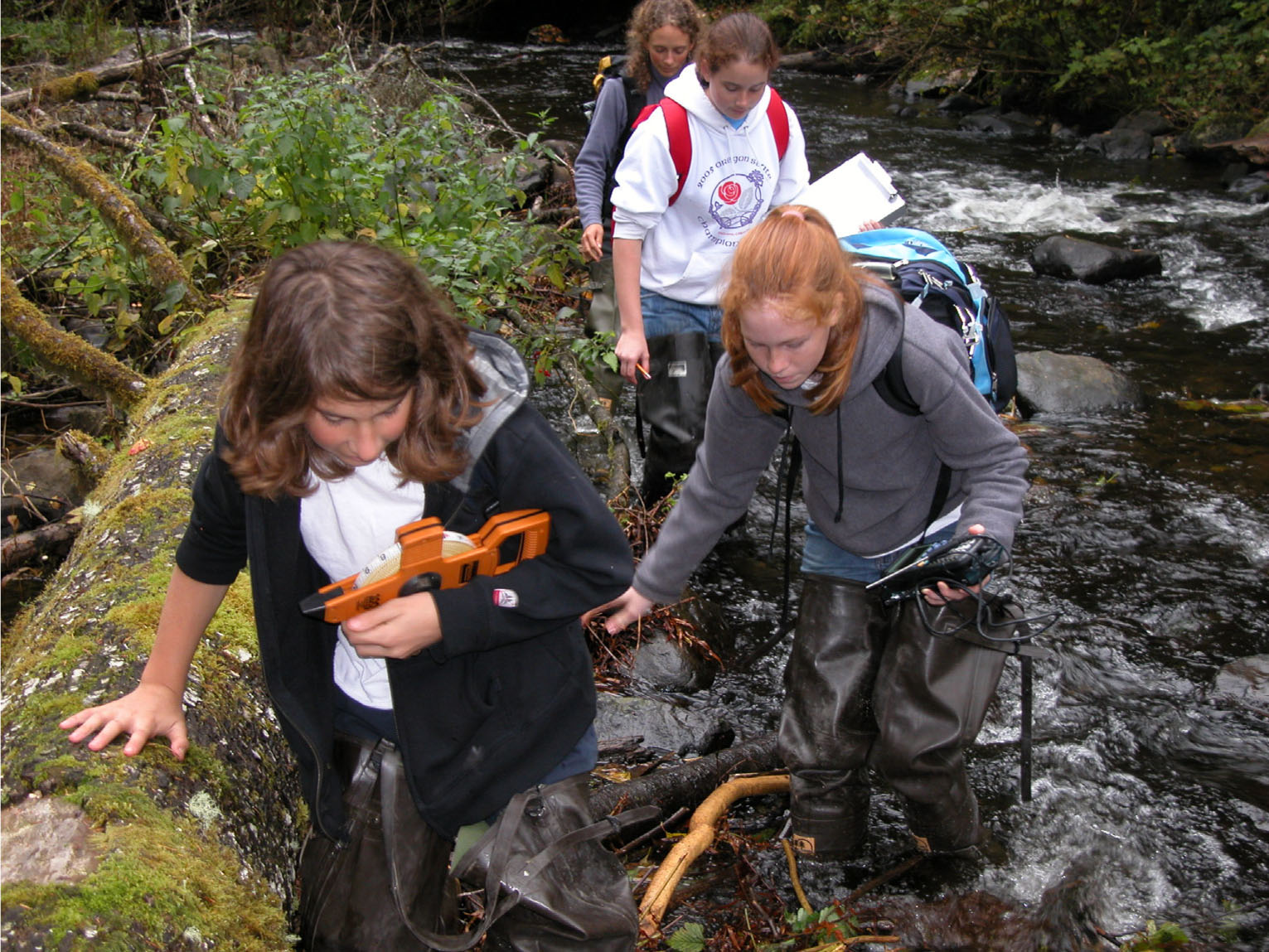
Students hike upstream to collect water quality samples as part of their research at the Jane Goodall Environmental Middle School. Photo by Mike Weddle.
by Mike Weddle
The Jane Goodall Environmental Middle School (JGEMS) is a public charter school located within Waldo Middle School in Salem, Oregon. The ten-year old school has an enrollment of 90 students in grades six to eight. JGEMS students have classes in all subject areas that are part of a regular middle school curriculum, but the overriding focus for all curriculum areas is the environment.
Introduction
Teachers are always looking for engaging and meaningful projects for their students. At the same time, government or non-government conservation organizations are seemingly always shorthanded when it comes to conducting all the research projects they would like to do. At the Jane Goodall Environmental Middle School (JGEMS) in Salem, Oregon we have been able to use student scientists to conduct these research projects, providing both the assistance needed by the organizations and the engaging and meaningful projects that students need. We have found that projects done in collaboration with non- school organizations provide an incentive and a relevance to research work that may be missing from research done in school. Additionally, collaborating with outside organizations can provide expertise, equipment and even funds that may not normally be available to the classroom teacher. (more…)
by editor | Apr 21, 2015 | Equity and Inclusion
How Environmental Education Can Address Issues of Environmental Justice in Urban Settings
by Anjelique Hjarding, Alicia King and Belinda Chin
HIGHLIGHTS
• Environmental injustice occurs when the most vulnerable, poor, minority or underserved populations carry the greatest burden of environmental risk by living in “undesirable” areas.
• Environmental education can provide an opportunity to connect people to nature even in urban areas, and help empower people to mitigate environmental issues.
• Addressing the challenges of environmental justice through the support of environmental education programs can help engage people in actions to improve their environment.
• As citizens engage in environmental education and action bringing positive changes in their communities, they become more empowered to take future actions to further improve their environment.
Introduction
According to the US Environmental Protection Agency (EPA) environmental justice is defined as, “the fair treatment and meaningful involvement of all people regardless of race, color, national origin, or income with respect to the development, implementation, and enforcement of environmental laws, regulations, and policies.”Environmental injustice occurs when the most vulnerable populations carry the greatest burden of environmental risk. Environmental justice seeks to create environmental equity and address issues of environmental racism and inequalities that are the result of human settlement and industrial development. Scholars have explored the topic of environmental justice on both applied and theoretical levels. From examining the geographic distribution of toxins (Lewis & Bennett, 2013) to equitable allocation of green space (Boone et al., 2009) to the debate over how to define environmental racism, there tends to be a pattern of environmental injustice suggesting that minorities and poor people are those that live in areas considered “undesirable.”
Many of the urban communities we work with are touched daily by environmental injustices. Landfills, interstates and train lines are most often located in close proximity to low-income minority neighborhoods. These areas often have reduced access to natural amenities and green space is often distributed by socio-economic lines (Agyeman & Evans, 2003). As educators, how can we work to bring environmental justice education to the forefront?
Environmental justice issues have a history of being excluded from environmental education study (Haluza-Delay, 2012). This can occur because educators lack an understanding of environmental justice or the politics of the education system dissuades teaching on controversial topics related to race and injustice. Environmental education can provide an opportunity to connect people to nature and can help empower them to actively address environmental issues. In fact, the North American Association for Environmental Education suggests that diversity and justice should be a top priority in environmental education, and that more progress should be done in this area.
Students in the urban environment can often experience a disconnect between themselves and the natural world and may not notice their direct impacts on the environment. Lessons focused on issues such as the carbon footprint allow students to visualize their impact on the environment and will help make the issue relevant.
Seattle: Race and social justice initiative
In 2002, the City of Seattle launched its Race and Social Justice initiative, and Seattle Department of Parks and Recreation (Parks) began an Environmental Stewardship Initiative. The Race and Social Justice is Seattle’s effort to focus on the roots of problems – to change the underlying system that creates and preserves inequities – rather than attempt to treat the symptoms (Seattle, 2008). Seattle City Hall acknowledged the need to expose institutionalized racism and expunge discriminatory municipal policies, procedures and practices overall; and Parks wanted to equitably serve more people, more often in the public green spaces where people live, work and play.
In 2014, residents of a historically diverse, working class Seattle neighborhood applied for a grant from the Department of Neighborhoods to pay for an environmental assessment and design for a bike trail in a public green space imbedded within a residential area. The Parks Board of Commissioners approved the project early in the year. No one had proposed a recreational use in a public green space before. In fact, there were no policies to refer to regarding uses of public green spaces. By summer, advocates and opponents of the mountain bike trail were vying for time to speak to city council members about their points of view.
The story, as reported by the local newspaper, The Seattle Times, presented points of view that, intentionally or not, perpetuated historic social constructs (Shellenberger & Nordhaus, 2007). These included: conflicts between whites and people of color concerning uses of parklands, “people are not a part of nature,” and people of color not having access to nature unless they are working in it. Those interviewed for the article were all white residents of the area. A photograph with the story showed a white male leading a work group in the green space consisting only of youth of color (Photo 1). However, there were no direct quotes given by youth of color in the article. Imagine the empowering potential of environmental education if used in this situation as a tool to facilitate discussion for better understanding and clarity of the issues among the various stakeholders.
Both opponents and advocates of the project used environmental justice to make their arguments to City Council. Opponents claimed the mountain bike trail would “exclude all but the able-bodied,” with a neighbor quoted as saying (Seattle Times, July 28, 2014): “We’re talking about young, white male energy. This is public land. This is a social justice issue.” Advocates for the bike trail said, “…[it] would give youths who aren’t able to get out of the city an opportunity to
experience the joy of riding their bikes in the woods. And in the process… the kids
Photo 1. Volunteer work party at site of proposed bike trail.
would gain an appreciation of nature and a sense of ownership for the greenspace.”
The green space was an urban mix of invasive plant species and native flora. Neighborhood volunteers, including many youth groups, spent hours restoring the forest and installing public trails. The area attracted wildlife as well as illegal dumping, homeless encampments, and drug use. At the end, City Council voted to award the grant in favor of the bike trail, with a caveat that Parks develop policies for use of green spaces (Seattle Times, August 13, 2014).
A lot of progress has been made regarding Seattle’s institutional commitment in 2002 to expose and scrub itself of discriminatory practices, policies and procedures. That said, there is still a lot of work to be done to reach equity and social justice.
Washington,DC: Urban Bird Treaty
Urban Bird Treaty program in Washington, DC engaged with several organizations that focus on the Anacostia River. One such organization, Anacostia Watershed Society, works to engage teachers and students in public policy and advocacy actions through targeted programs.
The Anacostia has a long history as a working port and industrial river, leaving a legacy of toxic pollution that impacts the health of aquatic life and humans that fish, swim, or otherwise recreate on the river. Stormwater runoff collects trash, bacteria, and toxins, and flows into storm drains, and straight into the Anacostia River and its tributaries. With a watershed that is 70 percent developed, the Anacostia is impacted by a huge amount of impervious surface. The Anacostia River is so severely impacted by trash that in 2007 it was declared “impaired by trash” under the provisions of the Clean Water Act. Additionally, the developed areas near this river serve a primarily low-income minority population.
There are many efforts to pick up trash manually or catch it with trash traps, but ultimately trash use needs to be reduced from the source. Reducing this impact one of the biggest challenges. The Anacostia Watershed Society has several programs available for teachers and students to help engage citizens in actions that will not only teach them about the watershed environment, but also how to take actions to improve the environment and to become part of the solution.
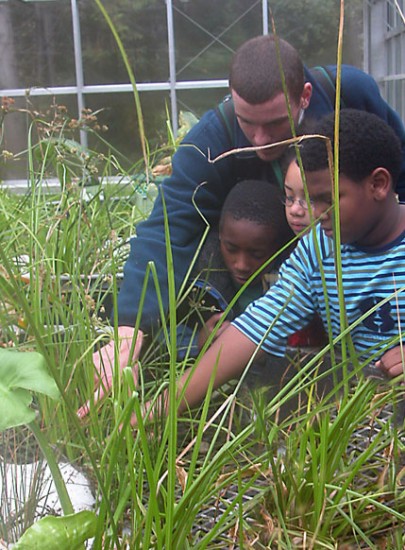
As part of the Urban Bird Treaty program, Anacostia Watershed Society was awarded grant monies to work on several projected related to engaging diverse and minority audiences in areas that are demographically considered underserved minority neighborhoods. Sixteen teachers were mentored and equipped for the Rice Rangers program (wetland plant growing in elementary school classrooms), including 11 grow light systems set up in schools. About 300 Washington, DC students participated in a lesson on wetlands and planted native wetland seeds in classrooms, engaged in field studies on the Anacostia River by pontoon boat and participated in wetland planting events. Elementary school students grew 2200 wetland seeds in classrooms and planted the grasses in restoration plots at Kenilworth Aquatic Gardens. Kenilworth is a National Park in the inner city of Washington, DC surrounded by areas where communities are mostly underserved.
While there are not yet any statistics to show that engaging citizens in this area resulted in actions independent of the organized efforts presented to students and citizens, environmental justice actions are being shared with citizens and continued efforts are being monitored.
References
Agyeman, J., & Evans, T. (2003). Toward just sustainability in urban communities: Building equity rights with sustainable solutions. The annals of the American Academy of Political and Social Science, 590(1), 35–53.
Boone, C.G., Buckley, G.L., Grove, J.M., & Sister, C. (2009). Parks and people: An environmental justice inquiry in Baltimore, Maryland. Annals of the American Association of Geographers, 4, 767–787.
Haluza-Delay, R. (2012). Educating for environmental justice. In Wals, A.E.J., Stevenson R.B., Brody, M., & Dillon J. (Ed.), International handbook of research on environmental education (pp. 394–403). Routledge.
Lewis, T., & Bennett, S. (2013). The juxtaposition and spatial disconnect of environmental justice declarations and actual risk: A new method and its application to New York State. Applied geography, 39, 57–66.
Seattle Forestry Commission. (2014). Revised letter to Seattle Parks Commission – Mountain bike trail at Cheasty Greenspace. April 1, 2014.
Seattle Office for Civil Rights. (2008). Race and social justice initiative: Looking back, moving forward. City of Seattle.
Seattle Times. (2014). Council clears way for bike-trail work. Seattle Times, August 13.
Shellenberger, M. & Nordhaus, T. (2007). The Death of environmentalism: Global climate politics in a post-environmental world. Break through: From the death of environmentalism to the politics of possibility. New York: Houghton Mifflin Company.
Thompson, L. (2014). Residents split on parkland bike trails. Seattle Times, July 28.
Tucker, T. An Environmental justice (EJ) teaching resource: Inventory and analysis of current practices in College EJ Education. Seattle University.
Article reprinted from Urban Environmental Education, an e-book published by the North American Association for Environmental Education (NAAEE). Downloadable at http://www.naaee.net/publications.

by editor | Apr 21, 2015 | Language Arts
The Hunger Games and the Nature of Rebellion
By Natalie Gillis
In my nature explorations, I’ve always been fascinated not just with identifying the species I encounter, but with digging deeper and learning their backstories. There are many stories behind the plants and animals that fill our landscapes. Sometimes they’re hidden in history, myths and cultural narratives. Sometimes they’re hidden in our very words.
 ith Catching Fire, the second film installment of The Hunger Games trilogy, fans of Suzanne Collins’ post-apocalyptic dystopian world will be celebrating. Many educators will too, since the film’s release will revive the series for students, and thus its relevance in language arts programming.
From a literary perspective, The Hunger Games is an action-packed hero’s quest told through the eyes of a strong-but-flawed heroine fighting to survive in a dystopian future. It’s a great entry point into explorations of the monomyth, and it can be easily compared to other classic quests like The Hobbit, Harry Potter, Star Wars, The Lion King and many comic-book superheroes.
But The Hunger Games is also about a society that is completely broken—as unhealthy as societies can get. Even though it only glosses over most of the issues it touches on, it is a great springboard to deeper examination of all sorts of environmental and social justice problems. Panem is post-climate change North America. There are parallels with the Occupy movement (Panem’s 99% live with ongoing environmental strife, food insecurity and resource depletion while the remaining 1% live in the Capitol, where the nation’s wealth and power are concentrated). And just why is Panem still coal-powered, anyway? Enter conversations about technological innovation and sustainability.
The Dystopian Nature Disconnect
The Hunger Games can do more than just raise sexy contemporary issues, though. The symbolic role of nature in the story is a portal to a deeper examination of the characterization of nature across the genre. After reading The Hunger Games and thinking more broadly about dystopian fiction, I concluded that many, if not most, fictional dystopias are set in highly urban environments or ravaged wastelands. Even those that are set in relatively healthy landscapes isolate their characters from contact with the natural world, as in Ray Bradbury’s Fahrenheit 451, where the countryside is the domain of the exiles. The Hunger Games is no different: the land has been wasted, resources have been depleted, citizens are prohibited from wandering freely in the forest and gates surround the districts to separate humans from their natural environment. Wild landscapes and the animals that inhabit them are perceived as dangerous—a continuation of the civilization versus wilderness binary that is a fundamental aspect of colonial and postcolonial culture.
The Nature of Rebellion
Why is this such a common element in dystopian fiction? I think it’s because the primal connection humans have with the land is fundamentally incompatible with dystopian power structures. Beyond providing sustenance, nature has a healing and revitalizing power and is intrinsically linked to human freedom and happiness (Children & Nature Network and IUCN Commission on Education and Communication, 2012). Seen through the lens of the dualistic nature/culture paradigm, a dystopian superpower cannot effectively control its subjects if the people have healthy relationships with the land, which is by definition wild and uncontrollable. Excluding nature’s light and beauty excludes hope, which enables control. Separating people from the place in which they live is necessary in dystopian worlds, because a return to nature would lead to rebellion and independence. Seen in this light, the staging of the final battle in Star Wars: Return of the Jedi (in which the Rebel Alliance finally succeeds in overthrowing the Galactic Empire) on the lush forest moon of Endor was highly symbolic. In The Hunger Games, the return to nature and freedom is played out through the heroine, Katniss Everdeen.
Katniss’ deep connection to the land is fundamental to her survival throughout her life. As a young girl, the sight of a single dandelion inspired her to hunt and forage to keep her family from starving and to provide healing medicines. Because these acts are illegal in Panem—all resources belong to the state, and wandering in the woods is forbidden—Katniss’ relationship with the land defines her as a rebel before the story even begins. Aside from the resources the woods provide, Katniss also finds existential freedom and relief there. This bond with the natural world and the vitality it gives her is in stark contrast to the dreary hopelessness of the other residents of her community, who remain caged within the district fences, and to the shallow, overconsumptive urbanity of the Capitol residents, who do not realize they are imprisoned by their luxury.
Once she enters the Hunger Games arena, it is Katniss’ skill as a forager, hunter and herbalist that keep her alive. She knows how to read the land as efficiently as readers of books can decode symbols on a page. But beyond these skills, I think it’s Katniss’ lifelong immersion in nature that gives her the self-assurance and freedom of mind needed to defy the Capitol and ultimately spark a rebellion against its repressive regime.
Dystopias: Utopias for Educators
Katniss’ ecological literacy gives educators an opportunity to forge curricular connections with environmental stewardship and traditional ways of knowing. Questions on the links between nature, rebellion and freedom in the dystopian genre could lead to a comparative study of other dystopian novels. And it’s easy to draw parallels between the expulsion of nature in dystopian societies and our own society’s impoverished nature experiences. What is the existential and symbolic importance of natural spaces to healthy societies? With so many students already in love with The Hunger Games series, the release of the second film offers a cornucopia of discussion topics on nature and society.
Reference
Children & Nature Network and IUCN Commission on Education and Communication (2012). Children & nature worldwide: An exploration of children’s experiences of the outdoors and nature with associated risks and benefits.
Natalie Gillis is a Grade 6–7 French Immersion teacher in Peterborough, Ontario, Canada. She likes books and backpacking, and thinks more people should ride bikes.


 After sleeping in the tunnels with sharks and other fish swimming overhead all night, the girls recovered their light traps and investigated the success of their trap designs under the microscope. They saw many copepods, a larval fish, and several other types of plankton. Friday morning also had an opportunity for the girls to explore the HMSC visitor center and take a behind the scenes tour of the facility with female HMSC husbandry staff.

